Explaining New Phenomena in Terms of
Previous Phenomena
DRAFT January 2004
Rens Bod*
This draft paper is intended to seek discussion and suggestions for improvement. Please send any comments to [email protected]
Abstract
It has become increasingly clear that natural phenomena cannot be formally deduced from laws but that almost every phenomenon has its own particular way of being linked to higher-level generalizations, usually via approximations, normalizations and corrections. This paper deals with the following problem: if every phenomenon has its own way of being explained, how can we -- or how can a theory -- explain any new phenomenon? I will argue that while particular explanations only apply to the specific phenomena they describe, parts of such explanations can be productively reused in explaining new phenomena. This leads to a view on theory, which I call maximalism, according to which we are entitled to use all previously explained phenomena in understanding new phenomena. On the maximalist view, a theory is not a system of axioms or a set of models, but a dynamically updated corpus of explanations. New phenomena are explained by combining fragments of explanations of previous phenomena. I will give an instantiation of this view, based on a corpus of phenomena from classical and fluid mechanics, and show that the maximalist approach is not only used in scientific practice but that we cannot do without it in explaining real-world systems. This paper also aims to integrate three, previously disparate views: particularism, exemplarism and maximalism.
1. Introduction
1.1 Particularism
By particularism I mean the view that phenomena cannot be explained by an axiomatic
system of laws or by a class of theoretical models, but that each phenomenon has its own particular way of being explained and linked to higher-level generalizations, usually via intermediate models, approximations, corrections, normalizations and the like. The
particularist view has received a wave of support in recent philosophy of science by authors like Nancy Cartwright, Ronald Giere, Marcel Boumans, Margaret Morrison and others. These authors reject both the syntactic, covering-law view of Hempel and Oppenheim (1948) and the semantic, set-theoretical view of Suppes (1967) and van Fraassen (1980). Instead they claim that the world is highly dappled (Cartwright 1999), that intermediate models are needed to link theory to phenomena (Boumans 1999;
Morrison 1999; Teller 2001), and that such models form an open-ended family (Hacking 1983; Dupré 2002). The particularist view implies that there are no rigorous solutions of real-life problems (Cartwright 1983) and that natural phenomena cannot be formally derived from laws (Giere 1988).1
The evidence in favor of the particularist view is overwhelming. In quantum mechanics, arguably the most successful physical theory, phenomena like radioactive decay, the Lamb shift or Zeeman splitting cannot be deduced from Schrödinger's equation but are the result of various approximations, "some fairly sloppy" as Richard Feynman remarks in his Lectures (Feynman et al. 1965: section 16-13). For example, the exponential decay phenomenon, for which there is a wealth of experimental support, has only approximate solutions, for instance by taking a markov approximation over a perturbation expansion of Pauli's rate equation (see Cartwright 1983). And the same counts for other phenomena in QM that are not limited to an isolated hydrogen atom which does not exist in practice. Quantum mechanics textbooks don't spend much space in stating its fundamental principles, the bulk is about trying to link the principles to phenomena.
The situation in fluid mechanics is not much different: derivations are replete with approximations and dimensionless quantities, and empirical coefficients turn up almost everywhere. Without approximations and corrections, there are no links from phenomena such as the vena contracta, the Coanda effect and the Hele Shaw flow to the higher-level principles of conservation of energy and conservation of momentum (cf. Faber 1997; Tritton 2002).
Even in classical mechanics there are virtually no rigorous derivations of natural phenomena. The moon's orbit or an asteroid's velocity can only be approximated by perturbation calculus. Rigorous solutions are not even available for a relatively simple system as the pendulum (see Giere 1988 and Morrison 1999 for an extensive discussion).
These examples indicate that laws by themselves do not cover phenomena. Lots of knowledge goes into the linkings between laws and phenomena. Laws are abstract, and the more abstract they are the more knowledge needs to be added to link them to real phenomena. Theories don't tell us what additional knowledge is needed and this must be collected outside a theory (cf. Boumans 1999; Cartwright 1999). A very substantial part of scientific modeling is concerned with figuring out what kind of knowledge should be added where, so as to enforce a derivation and "save" the phenomenon. Rather than being an organized system, this knowledge appears to be a motley collection of idealizations, boundary conditions, approximations, ad hoc corrections and normalizations. And this not only counts for "messy" phenomena where many external influences play a role. Even very stable phenomena, from the vena contracta to exponential decay, can only be derived via ad hoc adjustments and approximations rather than by deduction. What students learn and experts possess is not just a set of laws but a set of derivations that describe how to get from laws to phenomena via idealizations, approximations, corrections and the like.
The particularist stance is often contrasted to universalism, the view that all phenomena can be covered by a few universal laws (also called fundamentalism -- see Hoefer 2003; Sklar 2003). Yet, it is possible to accept that the current state of science is particularist while "the ultimate set of mathematical laws that a fundamentalist believes in is meant to be unified, consistent, coherent and of clear applicability to any real situation" (Hoefer 2003: 13). However, it must be admitted that our current best theories are still very far away from such an ultimate set of laws. From a purely empiricist point of view, the universalist stance should be rejected.
But if every phenomenon has its own way of being explained, how can we -- or how can a theory -- explain any new phenomenon? The way out of this apparent contradiction is, I believe, to take the particularist derivations themselves as the theory. Once I realized this, I also saw the merits of particularist derivations: they contain both higher-level laws and all knowledge about linking these laws to particular cases (I thus explicitly allow derivations to contain not only deductive steps but also non-deductive steps). Of course, particularist derivations themselves only apply to the phenomena they describe. But parts of these derivations may be reapplied to derive new phenomena. One of my goals is to show how derivations of new phenomena can be constructed by combining partial derivations of known phenomena. The underlying idea is that once you have learned how to fit equations to a number of phenomena you can productively apply previous derivation steps to a range of other phenomena. Before I go into the details of this idea, I want to discuss two related concepts: exemplarism and maximalism.
1.2 Exemplarism
The claim that novel phenomena can be modeled on previously explained phenomena is not new. It is usually attributed to Thomas Kuhn with regard to his notion of exemplar in the Postscript of the second edition of Structure (Kuhn 1970).2 Following Kuhn,
exemplars are "problem solutions that students encounter from the start of their scientific education", and "All physicists [...] begin by learning the same exemplars" (Kuhn 1970: 187). Kuhn urges that "Scientists solve puzzles by modeling them on previous puzzle-solutions, often with minimal recourse to symbolic generalizations" (Kuhn 1970: 189-190). According to Frederick Suppe, implicit in Kuhn's work is an account of theory as "symbolic generalizations empirically interpreted by exemplars and modeling of other applications on the exemplars" (Suppe 1977: 149). I will refer to Kuhn's view by the term exemplarism which I define as the view that phenomena are explained not by laws
but by exemplars, i.e. by explanations of previous phenomena.
Thomas Nickles relates the exemplarist view to case-based and model-based reasoning: "Since exemplars play such a prominent role in Kuhn's account of problem solving, it is natural to reinterpret his work as a theory of case-based and/or model-based reasoning in normal science" (Nickles 2003: 161). Case-based reasoning (CBR) is an artificial intelligence technique which provides an alternative to rule-based problem solving. Instead of solving each new problem from scratch, CBR tries to match the new problem to one or more problems-plus-solutions already available in a database of previous cases (see Kolodner 1998). Model-based reasoning (MBR) is related to CBR,
and has been extensively motivated by Ronald Giere (Giere 1988, 1999a/b). According to Giere (1999b), "Scientists have at their disposal an inventory of various known phenomena and the sorts of models that fit these phenomena. When faced with a new phenomenon, scientists may look for known phenomena that are in various ways similar to, which is to say, analogous with, the new phenomenon. Once found, the sort of models that successfully accounted for the known phenomena can be adapted to the new phenomenon." Giere supports his claim by referring to work in cognitive science that indicates that scientific reasoning is pattern-based or model-based rather than rule-based or law-based (e.g. Larkin et al. 1980).
Both CBR and MBR can be put under the general umbrella of exemplarism. However, neither Nickles nor Giere, let alone Kuhn, offer a formal mechanism that generalizes from previous explanations to explain new phenomena. In this paper I propose such a mechanism that provides new explanations by productively combining parts of previous explanations. The idea that parts of derivations may be reapplied to new sitations has also been proposed by Kitcher (1989: 432): "Science advances our understanding of nature by showing us how to derive descriptions of many phenomena, using the same patterns of derivation again and again". However, different from Kitcher I will give a precise mechanism that instantiates this idea. I claim that my mechanism captures the notions of analogy and similarity that are so prominent in CBR and MBR, and that it also provides a formalization of Kuhn's notion of exemplar-based reasoning. But while Kuhn focuses on the use of exemplars in scientific practice, leaving it as an open question whether phenomena can just as well be explained by laws only, I take this view one step further and claim that exemplars are indispensable in explaining real-world phenomena.
What then is the difference between the use of exemplars and the use of laws? Although this will become fully clear only in the following sections, I may already hint on it here. If we only consider highly idealized phenomena for which we have exact, deductive solutions, there is no formal difference, except that exemplars allow for reusing previous solutions rather than having to explain each new phenomenon from scratch (see section 2). But in the case of real-world phenomena, exemplars often contain additional knowledge such as corrections, normalizations and approximations that do not follow from fundamental laws -- remember that exemplars describe each step in linking laws to phenomena. Exemplars thus "ground" the laws in concrete situations. By reusing derivation steps from exemplars, we not only (re)use laws but also the additional knowledge about corrections and approximations etc. Exemplarism integrates the productivity of laws and the specificity of concrete explanations. While particularism urges that there are only concrete explanations of specific phenomena, exemplarism takes advantage of these explanations by reusing (parts of) them to explain new phenomena.
1.3 Maximalism
all models in physics have become unmanageable for one person's memory. But given that we can also consult the literature rather than relying on memory only, is there in
principle a limit on the number of previous explanations that may be consulted to explain
of a new phenomenon? The answer is no: there is no reason to neglect any previous successful explanation in constructing an explanation for a newly presented phenomenon. That is, we have in principle access to the entire body of knowledge. This view is covered by the concept of maximalism.
According to the maximalist view, we are entitled to employ all of our antecedent knowledge in understanding new phenomena.3 Rather than trying to synthesize our
knowledge by a succinct set of laws, models or exemplars, the maximalist view urges that all knowledge of previous phenomena be used. Thus any previous (fragment of) explanation may be employed as an exemplar to explain new phenomena. A theory, on the maximalist view, then, is not a system of axioms or a set of models, but a dynamically updated corpus of explanations of phenomena. New phenomena are explained out of fragments of previously explained phenomena. Ideally, such a corpus should be structured into partially overlapping subcorpora, reflecting the various interconnected subfields.
At first glance, maximalism may seem like an overkill: do we really need all previously explained phenomena for explaining new phenomena? Couldn't a smaller subset do as well? In textbooks, it is common to select the most useful phenomena as exemplars that can next be straightforwardly adapted and extended to new phenomena. However, science does not work like a textbook where new phenomena are seamlessly built upon previously described phenomena. In practice, a scientist may consider very different previously explained phenomena to see if some fragment is of use when confronted with a new phenomenon. Sure enough, a scientist may first try to model a new phenomenon on the basis of most similar previous phenomena, as Giere (1999a/b) argues. But a scientist cannot know beforehand where to find some useful technique or approximation. For example, the "independent particle approximation" in quantum mechanics has its precursor in classical celestial mechanics (cf. Feynman et al. 1965). And in quantum chemistry, fragments from divergent, contrasting models in statistical mechanics, quantum mechanics and even classical molecular structure are combined to explain complex molecules (Hendry 1998). The situation in other areas is basically the same: since we do not know beforehand which previous explanations may be useful for explaining new phenomena, we are entitled to take all previous explanations as possible exemplars.
To make my notion of explanation explicit, two parameters need to be instantiated:
(1) a prior corpus of explanations of known phenomena,
(2) a formal mechanism that specifies how parts of explanations from known phenomena can be combined into explanations of new phenomena.
I will refer to these two parameters as "the maximalist framework", and I will refer to any instantiation of these two parameters as "a maximalist model of explanation". The maximalist framework thus allows for a wide range of different models of explanations. It hypothesizes that scientific explanation can be modeled as a matching process between a new phenomenon and a corpus of previously explained phenomena, but it leaves open how the explanations in the corpus are represented and how fragments from these explanations may be combined.
The parameters above do not demand that a prior corpus contain all known phenomena; it only implicitly demands that all parts of explanations in the corpus can be reused. The reason that I left out the quantifier all in the definition, is that otherwise we could not instantiate any maximalist model, since we do not (yet) have an actual corpus containing all known phenomena. But even if in the next sections we use only very small corpora to illustrate our models of explanation, the goal is to have a corpus that is as large as possible. Why then not call it an "exemplarist" model of explanation rather than "maximalist"? I prefer "maximalist" since even with a small corpus there are no constraints on the fragments of the explanations that may be used in explaining new phenomena. All fragments count.
Note that a maximalist model according to the definition above is inherently exemplarist but not necessarily particularist: the maximalist framework also allows for models that use a corpus of highly idealized, exactly solvable phenomena. In section 2, I will start out with such a corpus and argue that the advantage of using a maximalist model is that we do not have to explain new phenomena from scratch if we have already explained similar phenomena before. Since idealized phenomena do not exist in the real world, I will not stay with my decision very long. But idealized phenomena do form the typical examples of introductory textbooks, thereby constituting the exemplars all physicists posses. In section 3, I will show how our initial maximalist model can be extended to real-world phenomena and systems that are not rigorously derivable from laws. It is here that maximalism shows its greatest benefit: real-world phenomena can only be explained in terms of explanations of previous phenomena.
2. A maximalist model for idealized, exactly solvable phenomena
To pave the way to real-world phenomena, it is convenient to first illustrate the maximalist framework for idealized examples. Looking afresh into a number of introductory physics textbooks (e.g. Eisberg and Lerner 1982; Giancoli 1984; Alonso and Finn 1996; Halliday et al. 2002), it struck me how often solutions of example problems are used as exemplars for solving new problems. For example, in the textbook
Physics, Alonso and Finn derive the Earth's mass from the Earth-Moon system and use
the resulting derivation as an exemplar for deriving various other phenomena (Alonso and Finn 1996: 247). We first give their derivation of the Earth's mass:
Suppose that a satellite of mass m describes, with a period P, a circular orbit of radius r around a planet of mass M. The force of attraction between the planet and the satellite is F = GMm/r2. This force must be equal to m times the centripetal acceleration v2/r = 4π2r/P2 of the satellite. Thus,
Canceling the common factor m and solving for M gives M = 4π2r3/GP2.
Figure 1. Derivation of the Earth's mass according to Alonso and Finn (1996)
By substituting the data for the Moon, r = 3.84 ⋅ 108 m and P = 2.36 ⋅ 106 s, Alonso and
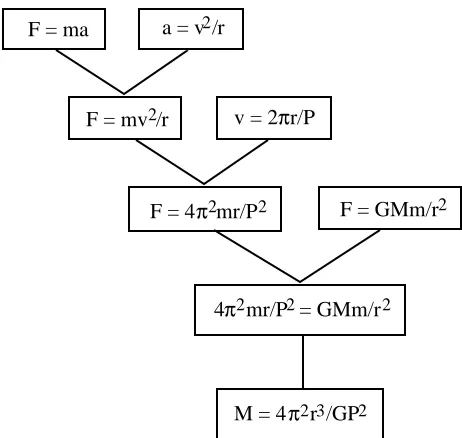
Finn compute the mass of the Earth: M = 5.98 ⋅ 1024 kg. Note that Alonso and Finn abstract from many features of the actual Earth-Moon system, such as the gravitational forces of the Sun and other planets, the magnetic fields, the solar wind, etc. Moreover, Alonso and Finn do not correct for these abstractions afterwards (which would be very well possible and which is usually accomplished in the more advanced textbooks). That's why the represented system is called an idealized system, or better, an idealized model of the system. Albeit idealized, the derivation in figure 1 can be used as an exemplar to derive various other (idealized) phenomena, such as the altitude of a geostationary satellite, the velocity of a satellite at a certain distance from a planet, Kepler's third law, etc. To show this, it is convenient to first represent the derivation in figure 1 in a step-by-step way by a derivation tree, given in figure 2.
F = ma
F = GMm/r2 a = v2/r
F = mv2/r v = 2πr/P
F = 4π2mr/P2
4π2mr/P2 = GMm/r2
[image:7.595.182.413.365.584.2]M = 4π2r3/GP2
Figure 2. Derivation tree for the derivation in figure 1
step which solves the previous equation for M, I will leave the derivational actions implicit for the moment. The reader is referred to Baader and Nipkow (1999) for an overview on term rewriting and equational reasoning.
Note that a derivation tree captures the notion of covering-law explanation or deductive-nomological (D-N) explanation of Hempel and Oppenheim (1948). In the D-N account, a phenomenon is explained by deducing it from theoretical laws. Thus derivation trees of the kind above may be viewed as representing a D-N explanation.
But a derivation tree represents more than just a D-N explanation: there is also an implicit theoretical model in the tree in figure 2. A theoretical model is a representation of a phenomenon for which the laws of the theory are true (cf. Suppes 1961, 1967). By equating the centripetal force of circular motion 4π2mr/P2 with the gravitational force
GMm/r2 the model that is implied in figure 2 is a two particle model where one particle
describes a circular orbit around the other one due to gravitational interaction and for which the mass of the first particle is negligible compared to the other. Theoretical models have been claimed to be the primary representational entities in science (Suppe 1977; van Fraassen 1980; Giere 1988). Suppes (1961) shows how the field of classical particle mechanics can be described in terms of a set-theoretical notion of model. However, while such models can indeed represent idealized systems, it has been widely argued that they fail to represent reality. Applying a theoretical model to a real system is a matter of intricate approximation and de-idealization for which no formal principles exist (cf. Cartwright 1999; Morrison 1999). In section 3 we will show how derivation trees can be extended to include not only theoretical models buts also phenomenological models and how these two models can be integrated within the same tree representation. For the current section, it suffices to keep in mind that derivation trees are not just representations of the D-N account but that they also refer to an underlying model.4
Turning back to the derivation tree in figure 2, we can extract the following fragment or subtree by leaving out the last derivation step in the derivation tree in figure 2 (i.e. the solution for the mass M). This subtree is given in figure 3, and reflects a theoretical model of a general planet-satellite or sun-planet system (or any other orbiting system where the mass of one particle is negligent compared to the other).
F = ma
F = GMm/r2 a = v2/r
F = mv2/r v = 2πr/P
F = 4π2mr/P2
[image:9.595.183.416.69.239.2]4π2mr/P2 = GMm/r2
Figure 3. A subtree from figure 2
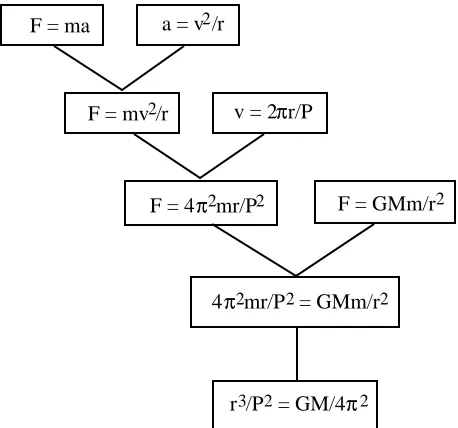
This subtree can be applied to various other situations. For example, in deriving Kepler's third law (which states that r3/P2 is constant for all planets orbiting around the sun) the
subtree in figure 3 needs only to be extended with a derivation step that solves the last equation for r3/P2, as represented in figure 4.
F = ma
F = GMm/r2 a = v2/r
F = mv2/r v = 2πr/P
F = 4π2mr/P2
4π2mr/P2 = GMm/r2
r3/P2 = GM/4π2
Figure 4. Derivation tree for Kepler's third law from the subtree in figure 3
Thus we can productively reuse parts from previous derivations to derive new phenomena. Instead of starting each time from scratch, we learn from previous derivations and partially reuse them for new problems. This is exactly what the maximalist framework entails: a theory is viewed as a prior corpus of derivations (our body of physical knowledge, if you wish) by which new phenomena are predicted and explained. In a similar way we can derive the distance of a geostationary satellite, namely by solving the subtree in figure 3 for r.
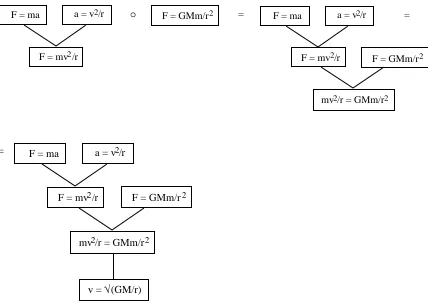
[image:9.595.184.413.357.571.2]from figure 2 that are first combined by term substitution (represented by the operation "°"5) and then solved for v in figure 5:
F = ma a = v2/r
F = mv2/r
F = GMm/r2 F = ma a = v2/r
F = mv2/r F = GMm/r2
o =
mv2/r = GMm/r2
=
F = ma a = v2/r
F = mv2/r F = GMm/r2
mv2/r = GMm/r2
[image:10.595.89.517.129.435.2]v = √(GM/r) =
Figure 5. Constructing a derivation tree for a satellite's velocity by combining two subtrees from figure 2
Figure 5 shows that we can create entirely new derivations out of given derivations, i.e. out of exemplars. The result can be used as an exemplar itself.
We have thus instantiated a first, extremely simple "maximalist model of explanation". This maximalist model uses a corpus of only one explanation i.e. the derivation tree in figure 2 (which instantiates the first parameter of our maximalist framework), and it uses a mechanism which combines subtrees into new derivation trees by means of term substitution (which is the second parameter of our maximalist framework). Note that substrees can be of any size: from single equations to any combination of laws upto entire derivation trees. This reflects the continuum between laws and derivations in the maximalist framework. Despite the extreme simplicity of our
maximalist model, we have seen that it can provide explanations for a range of other idealized phenomena.
In the next section I will extend this maximalist model to real systems and phenomena, showing that maximalism is not only possible but also necessary. As an intermediate step, I could have dealt with idealized phenomena that are not exactly solvable. A typical example is the three body problem in Newtonian dynamics. Even if we make the problem unrealistically simple (e.g. by assuming that the bodies are perfect spheres that lie in the same plane), the motion of three bodies due to their gravitational interaction can only be approximated by techniques such as perturbation calculus. However, in perturbation calculus every derivation step still follows numerically from higher-level laws. The actual challenge lies in real-world phenomena and systems for which there are derivation steps that are not dictated by any higher-level law.
3. A maximalist model for real systems and phenomena
Derivations of real systems are strikingly absent in physics textbooks. But they are abundant in engineering practice and engineering textbooks. As an example I will discuss how a general engineering textbook treats a real system from fluid mechanics: the velocity of a jet through a small orifice, known as Torricelli's theorem, and to which I will also refer as an orifice system. I have chosen this system because it is very simple and yet it has no rigorous solution from higher-level laws but involves ad hoc coefficients. I will show how a "derivation" of the orifice system allows us to develop a new maximalist model that can derive a range of other real-world systems, such as weirs and water breaks. I urge that engineering practice not only employs exemplars in designing systems, but that it can even not do without exemplars.
The orifice system is usually derived from Bernoulli's equation, which is in turn derived from the Principle of Conservation of Energy.6 According to the Principle of
Conservation of Energy the total energy of a system of particles remains constant. The total energy is the sum of kinetic energy (Ek), internal potential energy (Ep,int) and external potential energy (Ep,ext):
Σ
E = Ek + Ep,int + Ep,ext = constantApplied to an incompressible fluid, the principle comes down to saying that the total energy per unit volume of a fluid in motion remains constant, which is expressed by Bernoulli's equation:
ρgz + ρv2/2 + p = constant
The term ρgz is the external potential energy per unit volume due to gravity, where ρ is the fluid's density and z the height of the unit (note the resemblance with mgh in classical mechanics). The term ρv2/2 is the kinetic energy per unit volume (which resembles
mv2/2 in classical mechanics). And p is the potential energy per unit volume associated with pressure. Bernoulli's equation is also written as
ρgz1 + ρv12/2 + p1 = ρgz2 + ρv22/2 + p2
which says that the total energy of a fluid in motion is the same at any two unit volumes along its path.
Here is how the engineering textbook Advanced Design and Technology derives Torricelli's theorem from Bernoulli's equation (Norman et al. 1990: 497):
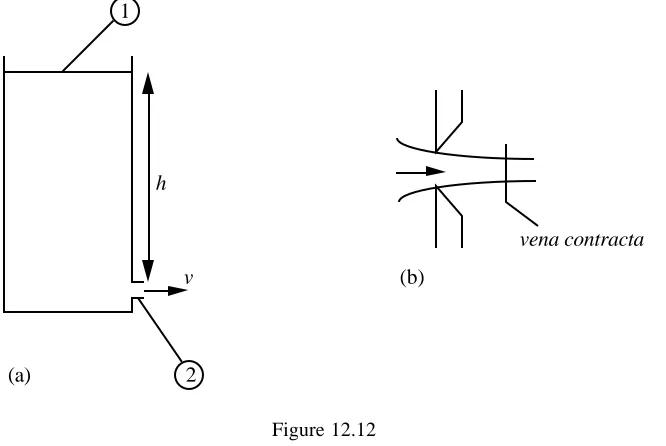
We can use Bernoulli's equation to estimate the velocity of a jet emerging from a small circular hole or orifice in a tank, Fig. 12.12a. Suppose the subscripts 1 and 2 refer to a point in the surface of the liquid in the tank, and a section of the jet just outside the orifice. If the orifice is small we can assume that the velocity of the jet is v at all points in this section.
h
v 1
2
vena contracta
(a)
[image:12.595.135.468.261.484.2](b)
Figure 12.12
The pressure is atmospheric at points 1 and 2 and therefore p1 = p2. In addition the velocity v1 is negligible, provided the liquid in the tank has a large surface area. Let the difference in level between 1 and 2 be h as shown, so that z1− z2 = h. With these values, Bernoulli's equation becomes:
h = v2/2g from which v = √(2gh)
This result is known as Torricelli's theorem. If the area of the orifice is A the theoretical discharge is:
Q(theoretical) = vA = A√(2gh)
The actual discharge will be less than this. In practice the liquid in the tank converges on the orifice as shown in Fig. 12.12b. The flow does not become parallel until it is a short distance away from the orifice. The section at which this occurs has the Latin name vena contracta (vena = vein) and the diameter of the jet there is less than that of the orifice. The actual discharge can be written:
where Cd is the coefficient of discharge. Its value depends on the profile of the orifice. For a sharp-edged orifice, as shown in Fig. 12.12b, it is about 0.62.
Figure 6. Derivation of Torricelli's theorem in Norman et al. (1990)
Thus the theoretically derived discharge of the system differs substantially from the actual discharge and is corrected by a coefficient of discharge, Cd. This is mainly due to an additional phenomenon which occurs in any orifice system: the vena contracta. Although this phenomenon is known for centuries, no rigorous derivation exists for it and it is taken care of by a correction factor. Note that the correction factor is not an adjustment of a few percent, but of almost 40%. The value of the factor varies however with the profile of the orifice and can range from 0.5 (the co-called Borda mouthpiece) to 0.97 (a rounded orifice).
Introductory engineering textbooks tell us that coefficients of discharge are experimentally derived corrections that need to be established for each orifice separately (see Norman et al. 1990; Douglas and Matthews 1996). While this is true for real-world three-dimensional orifices, there are analytical solutions for idealized two-dimensional orifice models by using free-streamline theory (see Batchelor 1967: 497). Sadri and Floryan (2002) have recently shown that the vena contracta can also be simulated by a numerical solution of the general Navier-Stokes equations which is, however, again based on a two-dimensional model. For three-dimensional orifice models there are no analytical or numerical solutions (Munson 2002; Graebel 2002). The coefficients of discharge are then derived by physical modeling, i.e. by experiment. This explains perhaps why physics textbooks usually neglect the vena contracta. And some physics textbooks don't deal with Torricelli's theorem at all. To the best of my knowledge, all engineering textbooks that cover Torricelli's theorem also deal with the coefficient of discharge. (Of course, one may claim that the vena contracta can still be informally understood by higher-level conservation principles, but it is a fact that there exists no deduction from such principles).
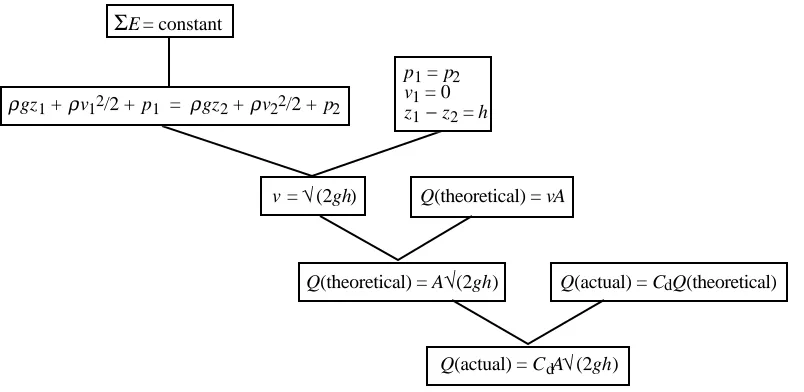
Although no analytical or numerical derivations exist for real-world orifice systems, engineering textbooks still link such systems via experimentally derived corrections to the theoretical law of Bernoulli, as if there were some deductive scheme. Why do they do that? One reason for enforcing such a link is that theory does explain some important features of orifice systems: the derivation in figure 6, albeit not fully rigorous, explains why the discharge of the system is proportional to the square-root of the height h of the tank, and it also generalizes over different heights h and orifice areas A. Another reason for enforcing a link to higher-level laws is that the resulting derivation can be used as an exemplar for solving new problems and systems. To formally show this, I will first turn the derivation in figure 6 into its corresponding derivation tree. But how can we create such a derivation tree if the coefficient of discharge is not derived from any higher-level equation? The orifice system indicates that there can be phenomenological models that are not derived from the theoretical model of the system. Yet, when we write the coefficient of discharge as the empirical generalization Q(actual) = CdQ(theoretical), which is in fact
conservation of energy, from which Bernoulli's equation is derived in Norman et al. 1990).
ΣE = constant
ρgz1 + ρv12/2 + p1 = ρgz2 + ρv22/2 + p2
p1 = p2
v1 = 0
z1− z2 = h
v = √(2gh) Q(theoretical) = vA
Q(theoretical) = A√(2gh) Q(actual) = CdQ(theoretical)
[image:14.595.101.503.115.311.2]Q(actual) = CdA√(2gh)
Figure 7. Derivation tree for the derivation in figure 6
The tree in figure 7 closely follows the derivation given in figure 6, where the initial conditions for p1, p2, v1, z1 and z2 are represented by a separate label in the tree. The coefficient of discharge in figure 7 is introduced in the tree by the equation Q(actual) =
CdQ(theoretical). Although this equation does not follow from any higher-level law or
principle, we can use it as if it were a law. Of course it is not a law in the universalist sense; it is a correction, a rule of thumb, but it can be used again and again for a range of other systems. Thus the equation Q(actual) = CdQ(theoretical) has effectively the same
status in the derivation tree as e.g.
Σ
E = constant: it is not derived from other principles.Different from physics textbooks, engineering textbooks freely combine theoretical with empirical knowledge: some steps in the derivation are deductive and are part of the theoretical model of the system, and other steps are non-deductive and are part of the phenomenological or physical model. The derivation tree in figure 7 effectively combines these two models where the coefficient of discharge glues the two together within the same tree representation.
semantic account of explanation: the final result Q(actual) = CdA
√
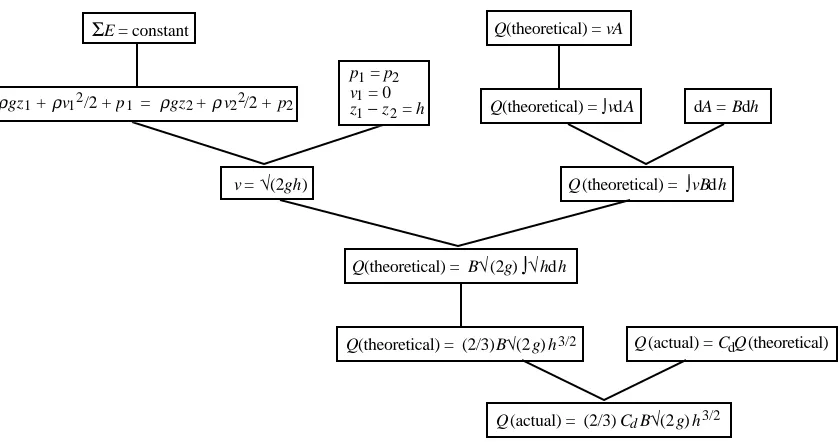
(2gh) is not true according to a theoretical model (except if Cd were equal to 1, which never occurs).What does this all mean for maximalism? By using the derivation tree in figure 7 as our corpus and by using the same substitution mechanism for combining subtrees as in section 2 (together with a mathematical procedure that can solve a formula for a certain variable), we obtain a maximalist model that can explain a range of new real-world systems. For example, the following three subtrees in figure 8 can be extracted from the derivation tree in figure 7 and can be reused in deriving the rate of flow of a rectangular
weir of width B and height h (see e.g. Norman et al. 1990: 498):
ΣE = constant
ρgz1 + ρv12/2 + p
1 = ρgz2 + ρv22/2 + p2
p1 = p2
v1 = 0 z1− z2 = h
v = √(2gh)
[image:15.595.82.516.227.325.2]Q(theoretical) = vA Q(actual) = CdQ(theoretical)
Figure 8. Three subtrees from figure 7 that can be reused to derive a weir
By adding the equivalence dA = Bdh, which follows from the definition of a rectangular weir, and the mathematical equivalence vA = ∫vdA, we can create the derivation tree in
figure 9 for the discharge of a weir.
ΣE = constant
ρgz1 + ρv12/2 + p1 = ρgz2 + ρv22/2 + p2
p1 = p2
v1 = 0
z1− z2 = h
v = √(2gh)
Q(theoretical) = vA
Q(actual) = CdQ(theoretical)
Q(theoretical) = ∫vdA dA = Bdh
Q(theoretical) = ∫vBdh
Q(theoretical) = B√(2g) ∫√hdh
Q(theoretical) = (2/3)B√(2 g)h3/2
Q(actual) = (2/3)CdB√(2 g)h3/2
Figure 9. Derivation tree for a weir constructed by combining the subtrees from figure 8
[image:15.595.93.513.442.663.2]figure 5 in section 2, where we also constructed a new derivation tree by combining subtrees from a previous derivation tree (i.e. a satellite's velocity from a derivation of the Earth's mass). But there is one very important difference: while the phenomenon represented in figure 5 can just as well be derived from laws rather than from previous subtrees, this is not the case for the phenomenon represented in figure 9. For deriving the weir system, we need to make recourse to knowledge from a previously explained phenomenon, otherwise we do not have access to the rule Q(actual) = CdQ(theoretical)
-- except if we invent this empirical rule every time from scratch. But since scientists do not rediscover the same empirical rule(s) for each system anew, this knowledge is taken from exemplars, i.e. from successful explanations of previous systems.
This brings me to the following claim: real-world phenomena cannot be explained
by laws but need to be explained by parts of explanations of previous real-world phenomena. This claim is consonant with the case-based or analogy-based view on
explanation: you explain one or more cases and use it for explaining other, similar cases (cf. Sterrett 2002; Ankeny 2003). The rationale of reusing the derivation step Q(actual) =
CdQ(theoretical) is: since it works well in one system it is likely to work well in another,
similar system.
The final formula in figure 9 is widely used in hydraulic engineering, where the coefficient Cd is usually established experimentally. However, the coefficient Cd is not just a "fudge" factor. For example, for the class of rectangular weirs there exists an empirical generalization that can compute Cd from two other quantities. This generalization was first formulated by Henry Bazin, the assistant of the celebrated hydaulician Henry Darcy (Darcy and Bazin 1865), and is commonly referred to as Bazin formula (also called "Bazin weir formula", to distinguish it from "Bazin open channel formula" -- see Douglas and Matthews 1996: 119):
Cd = (0.607 + 0.00451/H) ⋅ (1 + 0.55(H/(P + H)2))
In this formula H = head over sill in metres, and P = height of sill above floor in metres of the weir. Bazin formula is an empirical regularity derived from a number of concrete weir systems, and as such it can be used in derivation trees for new weir systems. Although the regularity is known for more than 150 years, there exists no derivation from higher-level laws. Yet this does not prevent us from using and reusing the regularity in designing real world systems that have to work accurately and reliably. Hydraulics is replete with formulas like Bazin's, each describing particular regularities within a certain flow system. There are, for example, Francis formula, Rehbock formula, Kutter formula, Manning formula, Chezy formula, Darcy formula, Colebrook-White formula, Keulegan formula, to name a few (see Chanson 2002 for an overview). Many of these formulas are known for more than a century but none of them has been deduced from higher-level laws. They are entirely based on previous systems (exemplars), and form the lubricant that make our new systems work.
that links such systems to higher-level generalizations. Next, it can be productively reused for linking new systems. Finding initial links between laws and systems can be very hard (and I have not tried to give a theory of discovery), but once you have found some links, you can reuse them to predict and explain new systems by our maximalist model.
4. Conclusion
I have given a maximalist framework of explanation that uses a corpus of explanations of prior phenomena together with a mechanism that combines sub-explanations of prior phenomena into explanations of newly presented phenomena. I have also given a first instantiation of this framework which uses derivation trees as explanations and a simple term substitution mechanism for combining subtrees into new trees. I have argued that derivation trees generalize over both the syntactic, covering-law view and the semantic, set-theoretical view of explanation, and that they can even go beyond that by combining theoretical and phenomenological models. I have shown that derivation trees can capture various kinds of theory-external knowledge provided that this knowledge is represented by mathematical equations. I have argued that a maximalist model is indispensable for explaining real-world phenomena and systems. Although each real-world system may have its own particular explanation, new systems can be explained by productively combining parts of previously explained systems.
I do not want to claim that my instantiation of the maximalist framework is definitive or representative for scientific explanation (though I do conjecture that scientists reason with fragments of previous explanations). It is important to explore other instantiations of the maximalist framework by using different notions of explanation and different combination operations. Among the various future projects, I want to extend the current maximalist model to include diagrammatic reasoning (cf. Glasgow et al. 1995; Greaves 2002). And I want to extend the second parameter with a probability function that computes the most probable explanation of a phenomenon. Since explanation is inherently redundant (see e.g. Cartwright 1983: 78-82), our mechanism should compute an "optimal" match between a newly presented phenomenon and as many previously derived phenomena. Such an optimal match can be captured in a Bayesian framework which maximizes the conditional probability of an explanation given a phenomenon.
What happens if a phenomenon cannot be explained by any combination of subexplanations -- even if we had a corpus of all previously explained phenomena? This situation clearly goes beyond the scope of maximalism. It is an enormous challenge for a scientist to find an explanation for a novel phenomenon that does not seem to correspond to any known theory or previous explanation. I have not attempted to develop a theory of discovery in this paper, but I believe that my maximalist approach may aid scientists to come up with unconventional explanations as it considers any combination of subtrees from previous phenomena (cf. "computer-aided discovery" -- Bay et al. 2002).
structures (cf. Bod 1998, 2002; Collins and Duffy 2002; Bod et al. 2003). Although it would be beyond the scope of this paper to go into the details of the DOP model, it is noteworthy that the maximalist model of explanation presented in this paper has much in common with the DOP model for language: both construct new trees by combining subtrees from previous trees. It will be part of future research to explore if a general model of cognition can be distilled from them.
References
Alonso, Marcelo and Edward Finn (1996), Physics, Addison-Wesley.
Ankeny, Rachel (2003), "Cases as explanations: modeling in the biomedical and human sciences", Volume of abstracts, 12th International Congress of Logic, Methodology and Philosophy of Science.
Baader, Franz and Tobias Nipkow (1998), Term Rewriting and All That, Cambridge University Press Batchelor, G. (1967), An Introduction to Fluid Mechanics, Cambridge University Press.
Bay, Stephen, Daniel Shapiro and Pat Langley (2002), "Revising engineering models: combining computational discovery with knowledge", Proceedings of the Thirteenth European Conference on Machine Learning, Helsinki, Finland.
Bod, Rens (1998), Beyond Grammar: An Experience-Based Theory of Language, CSLI Publications, Cambridge University Press.
Bod, Rens (2002), "A unified model of structural organization in language and music", Journal of Artificial Intelligence Research, 17, 289-308.
Bod, Rens, Jennifer Hay and Stefanie Jannedy (eds.) (2003a), Probabilistic Linguistics, The MIT Press.
Bod, Rens, Remko Scha and Khalil Sima'an (eds.) (2003b), Data-Oriented Parsing, The University of Chicago Press.
Boumans, Marcel (1999), "Built-in justification", in M. Morgan and M. Morrison (eds.), Models as Mediators, Cambridge University Press, 66-96.
Cartwright, Nancy (1983), How the Laws of Physics Lie, Oxford University Press. Cartwright, Nancy (1999), The Dappled World, Cambridge University Press.
Chanson, Hubert (2002), The Hydraulics of Open Channel Flow, Butterworth-Heinemann.
Collins, Michael and Nigel Duffy (2002), "New ranking algorithms for parsing and tagging", Proceedings 40th Annual Meeting of the Association of Computational Linguistics (ACL'2002), Philadelphia, PA.
Darcy, Henry and Henry Bazin (1865), Recherches Hydrauliques, Imprimerie Nationale, Paris. Douglas, J. and R. Matthews (1996), Fluid Mechanics, Vol. 1, 3rd edition, Longman.
Dupré, John (2002), "The Lure of the Simplistic", Philosophy of Science, 69, S284-S293.
Eisberg, Robert and Lawrence Lerner (1982), Physics: Foundations and Applications, McGraw-Hill. Faber, T. E. (1997), Fluid Dynamics for Physicists, Cambridge University Press.
Feynman, Richard, Robert Leighton and Matthew Sands (1965), The Feynman Lectures on Physics, Vol. III, Addison-Wesley.
Foley, Richard (1983), "Epistemic Conservatism", Philosophical Studies, 43, 165-182. Giancoli, Douglas (1984), General Physics, Prentice-Hall.
Giere, Ronald (1988), Explaining Science: A Cognitive Approach, University of Chicago Press. Giere, Ronald (1999a), Science without Laws, University of Chicago Press.
Giere, Ronald (1999b), "Using models to represent reality", in L. Magnani, N. Nersessian and P. Thagard (eds.), Model-Based Reasoning in Scientific Discovery, Kluwer Academic Publishers, 41-57.
Glasgow, Janice, Hari Narayanan and B. Chandrasekaran (1995), Diagrammatic Reasoning: Cognitive and Computational Perspectives, The MIT Press.
Goldman, Alvin (1979), "Varieties of cognitive appraisal", Nous, 13, 23-38. Graebel, W. (2001), Engineering Fluid Mechanics, Taylor & Francis.
Halliday, David, Robert Resnick and Jearl Walker (2002), Fundamentals of Physics, John Wiley & Sons.
Hartmann, Stephan (1999), "Models and stories in hadron physics", in M. Morgan and M. Morrison (eds.), Models as Mediators, Cambridge University Press, 326-346.
Hempel, Carl and Paul Oppenheim (1948), "Studies in the Logic of Explanation", Philosophy of Science, 15, 135-175.
Hendry, Robin (1998), "Models and approximations in quantum chemistry", in N. Shanks (ed.), Idealization in Contemporary Physics: Poznan Studies in the Philosophy of the Sciences and Humanities 63, Rodopi, 123-142.
Hoefer, Carl (2003), "For Fundamentalism", to appear in S. Hartmann and L. Bovens (eds.), Nancy Cartwright's Philosophy of Science, Cambridge University Press.
Kitcher, Philip (1989), "Explanatory unification and the causal structure of the world", in Kitcher, Philip, and Salmon, Wesley (eds.), Scientific Explanation, University of Minnesota Press, 410-505.
Kolodner, Janet (1993), Case-Based Reasoning, Morgan Kaufmann.
Kuhn, Thomas (1970), The Structure of Scientific Revolutions, 2nd edition, University of Chicago Press.
Larkin, J., J. McDermott, D. Simon and H. Simon (1980), "Expert and novice performance in solving physics problems", Science, 208, 1335-42.
Lehrer, Keith (1974), Knowledge, Clarendon Press, Oxford.
Manning, Chris and Hinrich Schütze (1999), Foundations of Statistical Natural Language Processing, The MIT Press.
Morgan, Mary and Margaret Morrison (eds.) (1999), Models as Mediators, Cambridge University Press.
Morrison, Margaret (1999), "Models as autonomous agents", in M. Morgan and M. Morrison (eds.), Models as Mediators, Cambridge University Press, 38-65.
Munson, Bruce (2002). Fundamentals of Fluid Mechanics, Wiley.
Nickles, Thomas (2003), "Normal science: from logic to case-based and model-based reasoning", in Thomas Nickles (ed.), Thomas Kuhn, Cambridge University Press, 142-177.
Norman, Eddie, Joyce Riley and Mike Whittaker (1990), Advanced Design and Technology, Longman.
Sadri, R. and Floryan, J. M. (2002), "Entry flow in a channel", Computers and Fluids, 31, 133-157. Sklar, Lawrence (2003), "Dappled Theories in a Uniform World", Philosophy of Science, 70,
424-441.
Sterrett, Susan (2002), "Physical models and fundamental laws: using one piece of the world to tell about another", Mind and Society, 2002-2.
Suppe, Frederick (ed.) (1977), The Structure of Scientific Theories, 2nd edition, University of Illinois Press.
Suppes, Patrick (1961), "A comparison of the meaning and use of models in the mathematical and empirical sciences", in H. Freudenthal (ed.), The Concept and Role of the Model in Mathematics and Natural and Social Sciences, Reidel, 163-177.
Suppes, Patrick (1967), "What is a scientific theory?", in S. Morgenbesser (ed.), Philosophy of Science Today, New York: Basic Books, 55-67.
Teller, Paul (2001), "Twilight of the perfect model model", Erkenntnis, 55, 393-415. Tritton, D. J. (2002), Physical Fluid Dynamics, Oxford University Press.