ErnestoEstrada
1,2
andMatthew Sheerin
1
1
DepartmentofMathematis&Statistis,UniversityofStrathlyde,26RihmondStreet,
GlasgowG11XQ,U.K.;
2
CentreforMathematialResearh(CIMAT),Guanajuato,
Mexio.
Correspondingauthor: ErnestoEstrada
Telf. +44(0)1415483657
Fax. +44(0)1415483345
A random retangular graph (RRG) is a generalization of the random
ge-ometrigraph (RGG) in whih thenodes are embedded into aretangle with
sidelengths
a
andb
= 1
/a
, insteadof onaunit square[0
,
1]
2
.
TwonodesarethenonnetedifandonlyiftheyareseparatedataEulideandistanesmaller
than orequalto a ertain thresholdradius
r
. Whena
= 1
the RRG is iden-tial to theRGG.Here weapply the onsensusdynamis model to the RRG.Our main result is a lower bound for the time of onsensus, i.e., the time at
whih the network reahes a global onsensusstate. To prove this result we
need rst to nd an upperbound for the algebraionnetivity of the RRG,
i.e.,theseondsmallesteigenvalueoftheombinatorialLaplaianofthegraph.
Thisboundisbasedonatightlowerboundfoundforthegraphdiameter. Our
resultsprovethat asthe retangle in whih the nodes areembedded beomes
moreelongated,the RRG beomes a'large-world',i.e., thediameter growsto
innity, and a poorly-onneted graph, i.e., the algebrai onnetivity deays
to zero. The main onsequeneof these ndings isthe proof that thetime of
onsensusin RRGsgrowsto innity asthe retanglebeome moreelongated.
Inlosing,onsensusdynamisinRRGsstronglydependonthegeometri
har-ateristis ofthe embedding spae, and reahing the onsensusstate beomes
morediultastheretangleismoreelongated.
Keywords
•
Consensusdynamis•
Randomgeometrigraphs•
Graphdiameter•
AlgebraionnetivityManyreal-worldnetworkedsystemsareembeddedinto geometrialspaes.
Thesespatialnetworks,astheyareknown,mayrepresentmanydierentkinds
ofsenarios[1℄. For instane, in urban streetnetworksthe nodesdesribe the
intersetionofstreets,whihare representedbytheedges ofthegraph. These
streetsandtheirintersetionsareembeddedinthetwo-dimensionalspae
repre-sentingthesurfaeoupiedbytheorrespondingity. Similarsituationsour
withinfrastruturalandtransportationsystemsrangingfromwatersupply
net-works and railroads to the internet and wireless sensor networks (WSNs). In
WSNs[2℄, thenodesrepresent thesensorswhih aredeployed onagiven
geo-graphialregionandtheirommuniationdenestheonnetivityofthenodes.
Thisis analogous to manyother ommuniationsystemsranging from mobile
phonesto radio signals. On adierentsale weanmentionthe vasularand
ellularnetworks of nodesembedded into ellsand biologialtissues [3℄;
pro-tein residue networks [3℄; the networks of hannels in fratured roks [4℄; the
networks representing the orridors and galleries in animal nests [5, 6℄; and
landsapenetworks [7℄, among others. Formodeling these spatial networks it
isneessarytohaveatheoretialmodelthatapturesboththetopologial
fea-turestypial of omplexnetworks and the spatial embedding of these spei
kindsof systems. The mostommonly usedmodel forspatial networks is the
so-alled random geometri graph (RGG) [8, 9, 10, 11℄. In RGGs eah node
israndomlyassigned geometrioordinatesand thentwonodesareonneted
ifthe(Eulidean)distane betweenthem issmaller thanorequaltoaertain
threshold
r
.The RGG model has been widelyused in the studyof wireless sensor
net-works (WSNs) and peer-to-peer networks [12, 13, 14℄, where the problem of
onsensushasreeivedgreatattentionduetothefatthatitallowsthe
ahiev-ing of tasks with a minimum overhead of ommuniation [15, 16, 17, 18, 19℄.
Intheonsensusprotools,astheyareknownintehnologialappliations,the
problemonsists ofmakingthesalarstatesof asetof agentsonvergeto the
samevalueunderloalommuniationonstraints[20,21℄. Thus,sinethe
om-muniationrequiresonlyloalinformationthereisnoongestionduetonetwork
tra. RGGsarealsousedtomodelpopulationswhiharegeographially
on-strainedinaertainregion,likeaity. Thissenarioisimportant,forinstane,
forthe analysis of epidemi spreadingin suh populations[22,17, 23, 24℄. In
this sense Rileyet al. [25℄ haveremarked that RGGs provide a nie way of
esaping the lak of loal orrelation and lustering that are impliit
proper-tiesofthe ongurationgraphsoften usedtoexplore epidemidynamis. Ina
similar fashion, RGGs anbe used to model strutured populations in whih
opinions,insteadofviruses,arepropagated. InthisasetheRGGsalsoaptures
verywellthegeographionstraintsofthepopulationand,inomparisonwith
othermodels[26℄,theyaremorerealistifor anumber ofreasons: (i)RGG is
isotropi (onaverage)while regularlattieisnot;(ii) the average degreefor an
RGGanbesettoanarbitrarypositivenumber,insteadofasmallxednumber
IntheformulationoftheRGGmodelitisassumedthat thenodesare
uni-formlyandindependentlydistributedonaunitsquare(orahigherdimensional
hyperube in thegeneralase) [8, 9℄. This unit square representstheareaon
whih the agentsare interating to reah aonsensusstate, and itould be a
workplae,aity,oraforest,justtomentionsomeexamples. Suhasquare-like
areaistypialofmanyreal-worldsenarios.Forinstane,theityofSan
Fran-iso(USA)isknownasthe"seven-by-seven-milesquare",duetothefatthat
themainlandpartoftheityisasquareofnearly11kmby11km. However,if
weonsiderotherities, likeManhattan,thepiturelooksverydierent.
Man-hattanis13.4miles(21.6km)longand2.3miles(3.7km)wide,whihresembles
aretangularshapeinsteadofasquareone. Basedonthisneessityof
onsid-eringtheinuene of theretangular shapeonthe topologial anddynamial
properties of the random networks deployed on these areas we have reently
introdued therandomretangular graph(RRG) model [27℄. Inthis ase, the
nodesareuniformlyandindependentlydistributedonaunit retangleofgiven
sidelengths. When both sidesare of thesamelength we reovertheRGG in
suhawaythattheRRGmodelgeneralizestheRGGone.
Here, we are interested in investigating analytially and omputationally
howtheelongationoftheretangleintheRRGaetstheonsensusdynamis
takingplaeonthenodesandedgesof thenetworksonstrutedonthem. We
startbyintroduingtheoneptoftherandomretangulargraph(RRG),and
ontinuewith thedesriptionof theonsensusmodelto beonsidered. Then,
westatethemain resultofthisworkwhihprovesthatforaRRGwithaxed
numberofnodesandagivenonnetionradius,thetimeforreahingonsensus
growsto innity whentheretangle isveryelongated. Wenally support our
analytiresultswithomputationalsimulationsforRRGs.
2. Preliminaries
Here we present somedenitions, notations, and properties whih will be
usedinthis work(see[3℄). Forthebasidenitions aboutnetworksthereader
is direted to the literature (see for instane [3℄). The notation used here is
standard. Forinstane,
ki
designatethedegreeofthenodei
. ThematrixK
=
diag
(
ki
)
designatethe degreematrixofthegraphand thematrixL
=
K
−
A
isthegraphLaplaian,where
A
standsfortheadjaenymatrixof thegraph. IthasentriesL
uv
=
ki
ifu
=
v
−
1
if(
u, v
)
∈
E
0
otherwise∀
u, v
∈
V.
TheeigenvaluesoftheLaplaianmatrixaredenotedhereby:
0 =
µ1
≤
µ2
≤
· · · ≤
µn
. If the network is onneted the multipliity of the zero eigenvaluethematrixoforthonormalizedeigenvetors
ψj
~
ofL
,i.e.,U
=
h
~
ψ1
· · ·
ψn
~
i
.Theeigenvetor
ψ2
~
assoiated withthe algebraionnetivityis known asthe Fiedlervetor[28℄. LetΛ
bethediagonalmatrixofeigenvaluesoftheLaplaian matrix. Then,L
=
U ΛU
T
.
2.1. Random Retangular Graphs
The RGG is dened by distributing uniformlyand independently
n
points in the unitd
-dimensional ube[0
,
1]
d
[8℄. Then, two points are onnetedby
anedgeiftheirEulideandistaneis atmost
r
,whihis agivenxednumber known as theonnetion radius. That is, wereate adisk of radiusr
entred ateahnode,andeverynodeinside thatdiskisonnetedtotheentralnode.Thisdiskplaystheroleoftheareaofinueneofagivennode,suhasthearea
ofoverageofamobileorwirelesssensor.
In [27℄ wehaveonsidered aunit hyperretangleasthe Cartesianprodut
[
a1, b1
]
×
[
a2, b2
]
× · · · ×
[
ad, bd
]
whereai, bi
∈
R
, ai
≤
bi
,and1
≤
i
≤
d
insteadof the unit square of the RGG. Hereafter we will restrit ourselves to the
2-dimensionalase,whihorrespondstoaretangleofunitarea. Now,theRRG
hasbeendened by distributing uniformly and independently
n
pointsin the unitretangle[
a, b
]
andthenonnetingtwopointsbyanedgeiftheirEulidean distaneisatmostr
. Therestoftheonstrutionproessremainsthesameas fortheRGG.This impliesthatRRG
→
RGG
as(
a/b
)
→
1
and onsequently theRRGisageneralizationoftheRGG.InFig. 1weillustratetwoRRGswithdierentvaluesoftheretangleside
length
a
andthesamenumberofnodesandedges. Intherstasewhena
= 1
the graph orresponds to the lassial random geometri graph in whih the0
0.2
0.4
0.6
0.8
1
0
0.1
0.2
0.3
0.4
0.5
0.6
0.7
0.8
0.9
1
0
0.5
1
1.5
2
0
0.2
0.4
Figure1: IllustrationofaRRGreatedwith250nodesembeddedintoaunitsquare,
a
= 1
,(top)andaunitretanglewith
a
= 2
(bottom). InbothasesthenodesareonnetediftheyareataEulideandistanesmallerthanorequalto
r
= 0
.
15
.A fewimportantstruturalparametersofRRGshavebeendetermined
an-alytially in a previous work by the urrent authors (see [27℄). They inlude
theaveragedegree,theprobabilitythat thegraphsareonneted,theirdegree
distributions,averagepathlengthandlusteringoeient.
2.2. Consensusdynamis on graphs
Letusonsiderthatthestateofthenodesofthegraphattime
t
arestored in thevetor~u
(
t
)
. Then, thevariation ofthestate ofthenodei
with timeis ontrolledbytheequation[21,20℄:~
˙
ui
(
t
) =
X
(i,j)
∈E
(
uj
~
(
t
)
−
ui
~
(
t
))
, i
= 1
,
2
, . . . , n,
(1)whih,forthekindofgraphsweanalyzeinthis workanbewrittenas
~
˙
ui
(
t
) =
−
n
X
j=1
aij
(
ui
~
(
t
)
−
uj
~
(
t
))
, i
= 1
,
2
, . . . , n.
(2)Itisobviousnowthatweanwrite1byusingtheLaplaianmatrixofthegraph:
~
˙
u
(
t
) =
−L
~u
(
t
)
,
(3)~u
(0) =
~z.
(4)Intheequation(3)theLaplaianmatrixisatingoverthevetor
~u
(
t
)
whih isupdatedin time. Thatis,~up
(
t
)
is asalarwhih representsthe'opinion'of thenodep
atthetimet
. Thesolutionofthis equationis:~u
(
t
) =
e
−tL
~z.
(5)
where
0 =
µ1
< µ2
≤ · · · ≤
µn
aretheeigenvaluesandψj,p
~
thep
thentryoftheorresponding
j
th eigenvetoroftheLaplaianmatrix. Then, thesolutionoftheonsensusequationonthegraphisgivenby
~
u
(
t
) =
e
−tµ
1
ψ1
~
·
~z
ψ1
~
+
e
−tµ
2
ψ2
~
·
~z
ψ2
~
+
· · ·
+
e
−tµ
n
~
ψn
·
~z
ψn,
~
(6)where
~x
·
~y
representstheinnerprodutoftheorrespondingvetors. When thetimetendstoinnityeverynodetendstothestateditatedbytheaverageofthevaluesoftheinitialondition. Thisstateisusuallyknownastheonsensus
set [21℄anditanbeformallydened astheset
A ⊆
R
n
whihisthesubspae
span
{
1
}
,
i.e.,A
=
{
~u
∈
R
n
|
ui
~
=
uj,
~
∀
i, j
∈
V
}
.
(7)The following is a well-known result in the theory of onsensus dynamis on
networks.
Lemma1. ([21℄p. 46) Let
G
be aonnetedgraph. Then, the onsensus dy-namisonvergestotheagreementsetwitharateofonvergenethatisditatedby
µ2
.Proof. As
t
→ ∞
~u
(
t
)
→
ψ1
~
·
~z
ψ1
~
=
~
1
~z
n
~
1
(8)and hene
~ut
→ A
. Asµ2
is the smallestpositiveeigenvalueof the graph Laplaian,itditatestheslowestmodeof onvergenein theequation6.For thesake of simulationsit is sometimes useful to onsider the
~ui
(
k
+ 1) =
~ui
(
k
) +
ǫ
n
X
j=1
aij
(
~uj
(
k
)
−
~ui
(
k
))
,
(9)where
0
< ǫ < k
−
1
max
isthetimestepforthesimulation. Theequation9anbewrittenin matrixform asfollows:
~u
(
k
+ 1) = (
I
−
ǫL
)
~u
(
k
)
,
(10)where
I
istheidentitymatrix. Thematrix(
I
−
ǫL
)
isusuallyknownasthe Perronmatrix[20℄.3. Algebraionnetivity and diameterof RRGs
Aswehaveseenin theprevioussetiontheso-alledalgebraionnetivity
µ2
[28,29℄ditatestheslowestmodeofonvergeneintheonsensusdynamis.Thatis,therateatwhihagivengroupofnodesonnetedinanetworkreahes
theglobalonsensusismainlydeterminedbytheseondsmallesteigenvalueof
theLaplaianmatrix. Consequently,weobtaintherstresulthere,whihisan
upperboundforthealgebraionnetivityof aRRG.
Theorem2. Let
GR
(
n, a, r
)
beaonnetedRRGwithn
nodesembeddedin a retangle of sides with lengthsa
andb
=
a
−1
,and onnetion radius
r
. Then, the algebrai onnetivity, i.e., the seond smallest eigenvalueof the Laplaianmatrix,isboundedas
µ2
(
GR
)
≤
8 (
n
−
1) (
ar
)
2
a
4
+ 1
log
2
2
n.
(11)InordertoproveTheorem2weneedthefollowingresult.
Lemma 3. Let
GR
(
n, a, r
)
be a onneted RRG withn
nodes embedded in a retangleofsideswithlengthsa
andb
=
a
−
1
,andtwonodesareonnetedifand
onlyif their at aEulidean distane smaller or equal than
r
. LetD
=
D
(
GR
)
bethe diameterof the orresponding RRG.Then,D
(
GR
)
≥
√
a
4
+ 1
ar
.
(12)Proof. Thenodes ofthe RRG are uniformlyand independently distributed in
theunit retangle. Then, letusassumethatthe
n
pointsareequallyspaedin theareaoftheretangleseparatedbyaEulideandistaneofr
. Inthisasethe largestnumberofpointsareonnetedalongthemaindiagonaloftheretangle.Ifthelengthofthemaindiagonalis
c
therearec
r
onnetednodesin thisline.Thus,themaximumshortestpathdistanein theRRGis
c
r
withc
=
√
r
,thenthediameterofGR
willbelargerthanc
r
,whihprovestheresult.Now,weonsiderthefollowingboundobtainedbyAlonandMilman[30℄for
thealgebraionnetivityofanysimplegraph.
Theorem4. ([30 ℄). The seondsmallesteigenvalueofthe Laplaianmatrixof
anygraphisboundedas
µ2
(
G
)
≤
8
kmax
D
2
log
2
2
n.
(13)Then,bysubstituting12into13wehave
µ2
(
G
)
≤
8
dD
kmax
2
log
2
2
n
≤
8
kmax
(
ar
)
2
a
4
+ 1
log
2
2
n
≤
8 (
n
−
1) (
ar
)
2
a
4
+ 1
log
2
2
n,
(14)wherethelastinequalityusesthefatthatforanysimplegraph
kmax
≤
n
−
1
, whihnally provestheTheorem2.Remark 5. Theresultsinthissetionprovethattheelongationoftheretangle
in the RRG makes the graphs drastially less onneted for a given radius.
However,asanbe seenin theinequalities(11) and(12)the redutionof the
algebraionnetivitywith the retangleelongationanbeompensatedwith
theinreaseof theonnetionradius,whihalsodereases thediameterof the
graph. Forinstane, ifweareonsideringthedeploymentofwirelesssensorsin
veryelongatedregionitisustomarytousesensorswhihhaveoverageradius
signiantlylargerthanthosetypiallyusedforoveringmoresquaredregions.
Otherwise,there isahighriskthatthewhole network isdisonneted.
4. Consensustime
Hereweareinterestedinanalyzingtheinueneofthealgebraionnetivity
onthetimeof onsensus
tc
,i.e., thetimeforwhih|
ui
~
−
uj
~
| ≤
δ
,whereδ
is a giventhreshold. Then,westateourmainresultofthiswork.Theorem 6. Let
GR
(
n, a, r
)
be a onneted RRG withn
nodes embedded in a retangle of sides with lengthsa
andb
=
a
−
1
, and two nodes are onneted
if andonly if they are ata Eulidean distane smaller than or equal to
r
. Leth
tc
i
be the timeofonsensusaveragedfor all the nodesinthe graph. Letµ2
bethe algebrai onnetivityof the RRGand
ψ2
~
the orresponding Fiedler vetor. Thenh
tc
i ≥
1
nµ2
n
X
p=1
ln
~
ψ2,p
ψ2
~
·
~z
δ
Proof. First,wewritetheeq. 6foragivennode
p
as~up
(
t
) =
n
X
q=1
~zq
n
X
j=1
~
ψj,p
ψj,q
~
e
−tµ
j
,
(15)
whih represents the evolution of the state of the orresponding node as
timeevolves. Now,letusonsiderthat thetimetendstothetimeofonsensus
t
→
tc
, wheretc
is thetimeat whihu
(
t
)
→
~
ψ
T
1
~z
~
ψ1
. Letus designatethistimeby
t
−
c
~up
t
−
c
=
1
n
n
X
q=1
~zq
+
n
X
j=2
~
ψj,pe
−t
−
c
(p)µ
j
n
X
q=1
~
ψj,q~zq
!
,
(16) heret
−
c
(
p
)
means the time at whih the nodep
is lose to reahing theonsensusstate. Let
h
~u0
i
=
1
n
P
n
q=1
~zq
andletuswrite16asfollows~up
t
−
c
− h
~z
i
=
n
X
j=2
~
ψj,pe
−t
−
c
(p)µ
j
n
X
q=1
~
ψj,q~zq
!
.
(17)Letusseletanode
p
suhthatψ2,p
~
hasthesamesignasψ2
~
·
~z
.Sine
µ2
orrespondingtoj
= 2
isthesmallesteigenvalueinthesumonthe righthandoftheexpression,thistermstendsto0slowerthanthetermsfortheothervaluesof
j
. Thismeansthat,ifwehooseasmallenoughvalueofδ
, the valuesoftc
and thust
−
c
will be verylarge. Thus, weanensurethat theleftsideofthe equationissmall enoughthat
n
P
j=3
~
ψj,pe
−
t
−
c
(p)µ
j
(
ψj
~
·
~z
)
<
0
. Thisimpliesthat
~up
t
−
c
− h
~z
i
< ~
ψ2,pe
−t
−
c
(p)µ
2
~
ψ2
·
~z
.
(18)Now,beause
|
~up
(
t
−
c
)
− h
~z
i| ≥
δ
wehaveδ
≤
~up
t
−
c
− h
~z
i
<
ψ2,pe
~
−t
−
c
(p)µ
2
ψ2
~
·
~z
.
(19)Then,thetimeatwhihtheonsensusisreahed
tc
(
p
)
isbounded bytc
(
p
)
≥
t
−
c
(
p
)
≥
1
µ
2
ln
~
ψ2,p
ψ2
~
·
~z
δ
.
(20)h
tc
i ≥
µ2n
1
n
X
p=1
ln
~
ψ2,p
ψ2
~
·
~z
δ
,
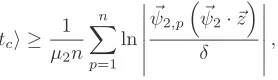
(21)whihprovestheresult.
Ifweareusingadisrete-timeapproahliketheonegivenin 10then
h
tc
i ≥
ǫµ2n
1
n
X
p=1
ln
~
ψ2,p
ψ2
~
·
~z
δ
.
(22)TheimportaneoftheTheorem6isthatwhen
µ2
→
0
thetimeofonsensus grows to innity. Previously, we have already proved in Theorem 2 that theelongationofarandomgeometrigraphwithagivennumberofnodesandaxed
onnetionradiusmeansthat thealgebraionnetivitygoesasymptotiallyto
zero. The immediate onsequene of this result is that the onsensus time
growstoinnityin RRGwhen
a
→ ∞
due totheinverserelationbetweenthe onsensustimeandthealgebraionnetivity.5. Simulations
Inthissetionwearryoutsimulationswiththemain goalofinvestigating
howtheelongationof aretangleinuenestheonsensustime. However,due
to its importane for the urrent paper as well as in general for the further
studyof RRGwerstinvestigatetheinuene ofthe retanglesidelengthon
the diameter of the graphsand on their algebraionnetivity. Here we will
onsiderRRGsonstrutedbyplaing
n
= 500
nodesinaunitretangleofside lengthsa
andb
=
a
−
1
. Theonnetionradiuswill bexedto
r
= 0
.
15
andwe systematiallyvary the sidelengthfroma
= 1
toa
= 12
. Foreah valueofa
we take100 random realizations of the RRGand report the averagevalue oftheorresponding property. InFig. 2(a)weillustrate the plotof the average
valuesofthediameter
h
D
i
versusthevaluesofa
(bluesquares). Asanbeseen the diameter inreases linearly with the elongationof the retangle. In fat,h
D
i ≈
7
.
927
a
−
0
.
237
. Thisresultagreeswithouranalytialones(seeTheorem 3)whihindiatesthatasa
→ ∞
thediameteroftheRRGalsogrowstoinnity. Thelowerbound (12)isalso plottedin Fig. 2(a)(redirles)where itanbeseen that it follows idential trend as the observed value of the diameter for
RRG. Indeed,theobserved diameter linearlyorrelateswiththe oneobtained
byeq. 12withaorrelationoeientof0.999.
Thediameter ismainly usedhereto ndanupperbound forthealgebrai
onnetivity
µ2
ofthegraph,i.e.,theseondsmallesteigenvalueoftheLaplaian matrix. Wehavealulatedtheaveragevaluesofthealgebraionnetivityfor [image:11.595.239.378.135.175.2] [image:11.595.233.389.240.280.2]lengthof theretangle:
µ2
≈
0
.
7487
a
−
1.968
−
0
.
00661
withPearsonorrelation
oeientequalto 0.9999. This onrmsour analytialresultthat as
a
→ ∞
the algebrai onnetivity deays to zero. We also inlude in this gure theplot orresponding to the values of the upper bound found for the algebrai
onnetivity (red irles). As an be seen, although the observed values are
signiantly smaller than the ones provided by the upper bound, they both
deayfollowingsimilarpower-lawswiththehangeoftheretanglesidelength.
Theobserved valuesof thealgebraionnetivity donothange linearlywith
thoseprovided by theupperbound. Instead, theyare relatedby apower-law
relation of the type:
h
µ2
i ≈
4476ˆ
µ
0.61
2
−
84
.
65
, whereµ2
ˆ
is the upper boundobtainedbytheeq. (11).
Themainonlusionofthispartoftheworkisthat whentheretangle
be-omesmoreelongated,theRRGbeomesalargerworld(thediameterinreases)
and alsoit displaysless onnetivity (derease of
µ2
), whih makesthe graph morevulnerable to be split into isolated omponents by removing just a fewnodes/edges. Theonsequenesofthis resultfor theanalysisof theonsensus
dynamisareanalyzedbelow.
0
2
4
6
8
10
12
0
10
20
30
40
50
60
70
80
90
100
Rectangle side length, a
Network diameter
0
2
4
6
8
10
12
10
−3
10
−2
10
−1
10
0
10
1
10
2
10
3
10
4
Rectangle side length, a
Algebraic connectivity
Figure2: Changeof thediameter(a)and thealgebrai onnetivity(b)of RRGswiththe
variationinthesidelength oftheretangle,
a.
Allthegraphshaven
= 500
nodesand theonnetionradiusis
r
= 0
.
15
.ThesquaresorrespondtotheaveragevaluesobservedfortheRRGafter100randomrealizations,andtheirlesrepresentstheboundsobtainedbyeq.12
andeq. 11,respetively.Notiethesemilogplotonthey-axisfortheplot(b).
Wenowstudy theinuene of theretangle elongationovertheonsensus
dynamisonRRGs. Wetakearewiththeelongationproesssothatthegraphs
donot beome disonneted. First weompare the disrete-timeevolutionof
shorterthanthat fortheelongatedRRG(seefurther). Beause theseplotsare
the results of only one random realization we perform a systemativariation
of the retangle side length and report the average of the time of onsensus
after 100 random realizations for eah valueof
a
with astopping riterion ofδ
= 10
−
4
. Theresultsareillustratedin Fig. 5(), where weplotthevaluesof
theaveragetimeforonsensusversustheretanglesidelengths(bluesquares).
As an be seen the time for onsensus inreases with the elongation of the
retangle. The best t for this orrelation is a 4th order polynomial:
h
tc
i ≈
0
.
1885
a
4
−
1
.
651
a
3
+ 19
.
59
a
2
−
37
.
06
a
2
+ 30
.
59
;thethasaPearsonorrelation
oeientof0.9997. Usingthismodelweanobtainamorepreiseestimation
ofthe averagetime for onsensusofthe random realizationillustratedin Fig.
5(a) and(b). Foravalueof
δ
= 10
−
4
theonsensusisreahedfor
a
= 1
at a timeof11.66,whilefora
= 10
at atimeof1853. Wewill gobaktothis kind ofanalysislateroninthispaper.Theestimatedtimesforonsensusobtainedfromtheequation(21)arealso
plottedinFig. 5()(redirles),whereitanbeseenthattheyfollowthesame
trendastheobservedvalues. Indeed,theplotoftheobservedvaluesversusthose
expetedfromtheeq. (21)(seeFig. 5(d))indiatesaperfetlinearorrelation
0
100
200
300
400
500
0
0.1
0.2
0.3
0.4
0.5
0.6
0.7
0.8
0.9
1
time
state
0
1000
2000
3000
4000
5000
0
0.1
0.2
0.3
0.4
0.5
0.6
0.7
0.8
0.9
1
time
state
0
2
4
6
8
10
12
0
500
1000
1500
2000
2500
3000
3500
4000
Rectangle side length
Time for consensus
0
500
1000
1500
2000
2500
3000
0
500
1000
1500
2000
2500
3000
3500
Observed time for consensus
Estimated time for consensus
Figure3:IllustrationoftheonsensusdynamisforaRRGwith
a
= 1
(a)andfora
= 5
(b).Thesimulationswerearriedoutusingadisretetimeonsensusmodel(see10)witharandom
alloationof initialstatesforthe nodes. Bothnetworkshave500nodesandthe onnetion
radiusis
r
= 0
.
15
.
Notiethatthesaleforthetimeaxishashangedbyafatorof10fromoneplottotheother. ()Dependeneofthetimeforonsensuswiththelengthofthesideof
theretangle. Herethesquaresrepresenttheaveragevaluesofthe100simulationsand the
irlesarethevaluesobtainedbytheequation21. Thesolidlinesrepresentthebesttwhih
wereobtainedusing4th orderpolynomials. (d)Linear plotof the observedand estimated
(usingequation21)forthetimeofonsensusoftheRRGswith500nodesand
r
= 0
.
15
.
Finally, we plot in Fig. 4 the dependene of the time of onsensus with
respet to both theonnetion radius andthe retangle side length. Theline
that divides the region of relatively fast onsensus (deep blue region in the
ontourplot) fromthatofrelativelyslowoneisgivenby
a
=
κ
·
r
−
1
.
5
,whereκ
= 28
fortheanalytialandκ
= 26
fortheobservedresults. Thus,aonditionforfastonsensusinRRGwith
n
= 500
anbesimplyapproximatedbya
+ 1
.
5
[image:14.595.135.477.125.459.2]haveonthestudyofonsensusinreal-worldsituations. Aswehaveseenin the
IntrodutionaitylikeManhattanhasdimensionswhih resemblearetangle
morethanasquare. Thatis,Manhattanis21.6kmlongand3.7kmwide. This
anbe represented as a unit retangle of dimensions
a
≈
2
.
42
andb
≈
0
.
41
. Usingourttedmodel,andonsideringthatweembed500nodes,e.g.,wirelesssensorsto monitortheity,weobtaintheexpetedtime foronsensusonthis
RRG,whihis38.3. Thistimeis3.3timeslongerthantheoneexpetedifthe
network is onsideredto beembedded into aunit square, i.e.,
a
= 1
. That is, wewould beunderestimatingthetimefor onsensusof thesensors byafatorofthree. Also, aordingto (23)weanestimatethat afastonsensusanbe
reahedin thisnetwork onlyif
r >
0
.
157
.Connection radius
Rectangle side length
0.1
0.2
0.3
0.4
0.5
0.6
2
4
6
8
10
12
14
50
100
150
200
250
300
350
400
Connection radius
Rectangle side length
0.1
0.2
0.3
0.4
0.5
0.6
2
4
6
8
10
12
14
50
100
150
200
250
300
350
400
450
500
550
Figure4: Contourplotshowingthedependeneofthetimeofonsensuswiththeonnetion
radius and the retangle side length in RRGs with 500 nodes. a) Analytial results. b)
Observedresultsfromthesimulations. Thediagonalwhitelineorrespondstotheequations
a
=
κ
·
r
−
1
.
5
,whereκ
= 28
fortheanalytialandκ
= 26
fortheobservedresults.6. Conlusions
Inthisworkwehavefoundsomeinterestingstruturalanddynamial
prop-ertiesofgraphsembeddedintoretangularareas. Thereentlydenedrandom
retangulargraphs(RRGs)aountforthespatialdistributionofnodesallowing
thevariationoftheshapeoftheunit retangleommonlyused inrandom
geo-metrigraphs(RGGs). Inpartiular, wehavefound anexellentlowerbound
for the diameter of RRGs. The diameter is an important parameter per se
as well as for its inlusion in many inequalities for other network strutural
parameters. For instane, we have used this bound to nd an upper bound
forthealgebraionnetivityof RRGs. Thealgebrai onnetivity,theseond
smallesteigenvalueofthegraphLaplaian,isoneofthemostimportant
param-etersrelatingnetworkstrutureanddynamialproessestakingplaeonthem,
e.g., onsensus/diusion dynamis, synhronization. Finally, we have studied
polynomially with theside lengthof the retangle. The simulationresults
al-lowed us to onrm these results and to nd empirial relations between the
topologialanddynamialparameterswiththeretanglesidelength.
The results obtained in this work have important pratial onsequenes
formodeling real-worldsenarios. First,modeling areal-worldsenariowhih
is not geometrially similar to a square using the `lassial' RGG, produes
a signiant error in estimating important strutural and dynamial network
parameters. Moreimportantly,theRRGprovidesamodelingsenarioinwhih
we an simulate the inuene of the shape of a geographial region on the
topologialanddynamialpropertiesofthegraphsembeddedonthem.
TherearemanynewresearhavenuesthatthestudyofRRGsopenfor the
study ofspatially embedded graphs. One ofthem is the analysisof other
dy-namialproesses,suh assynhronization,and epidemi spreadingonRRGs.
AnotherareaofdevelopmentistheextensionofRRGstohigherdimensions,
spe-iallytothree-dimensional(3D)ones. 3D-RRGswillallowtheeetivemodeling
of many real-worldsenariosin whih thenodes are embedded into elongated
ubiregionsofthe3Dspae. Finally,athirdareaofinterestingdevelopmentis
theonsiderationofotherproximitygraphs,suhasGabrielgraphsandrandom
neighborhoodgraphs,embeddedintoretangularregionsinsteadofunitsquared
ones. Wehopethese developmentswill ontributeto bebetterunderstanding
ofnetworksembeddedintogeometrialspaes.
[1℄ MarBarthélemy. Spatialnetworks. Physis Reports, 499(1):1101,2011.
doi: doi:10.1016/j.physrep.2010.11.002.
[2℄ I.F.AkyildizandM.C.Vuran. WirelessSensorNetworks.AdvanedTexts
in Communiations and Networking. Wiley, 2010. ISBN 9780470515198.
URL http://books.google.o.uk/books?id=7YBHYJsSmS8C.
[3℄ E. Estrada. The Struture of Complex Networks: Theory and
Ap-pliations. OUP Oxford, 2011. ISBN 9780191613425. URL
http://books.google.o.uk/books?id=6iK4vp8oewYC.
[4℄ Elizabeth Santiago, Jorge X. Velaso-Hernández, and Manuel
Romero-Saledo. A methodology for the haraterization of ow ondutivity
through the identiation of ommunities in samples of fratured
roks. Expert Systems with Appliations, 41(3):811 820, 2014. ISSN
0957-4174. doi: http://dx.doi.org/10.1016/j.eswa.2013.08.011. URL
http://www.sienediret.om/siene/artile/pii/S0957417413006234.
MethodsandAppliationsofArtiialandComputationalIntelligene.
[5℄ Andrea Perna, Sergi Valverde, Jaques Gautrais, Christian Jost,
Ri-ard Solé, Pasale Kuntz, and Guy Theraulaz. Topologial eieny
in three-dimensional gallery networks of termite nests. Physia A:
Statistial Mehanis and its Appliations, 387(24):6235 6244, 2008.
ISSN0378-4371.doi: http://dx.doi.org/10.1016/j.physa.2008.07.019.URL
and G. Theraulaz. Eieny androbustness in ant networks of galleries.
The European Physial Journal B - CondensedMatter andComplex
Sys-tems, 42(1):123129, 2004. ISSN 1434-6028. doi:
10.1140/epjb/e2004-00364-9. URLhttp://dx.doi.org/10.1140/epjb/e2004-00364-9.
[7℄ DeanUrbanandTimothyKeitt.Landsapeonnetivity: agraph-theoreti
perspetive. Eology,82(5):12051218,2001. doi: 10.1890/0012-9658.
[8℄ MathewPenrose. Random geometri graphs,volume5. OxfordUniversity
PressOxford,2003. ISBN 01985062609780198506263.
[9℄ Jesper Dall and Mihael Christensen. Random geometri graphs. Phys.
Rev. E, 66:016121, Jul 2002. doi: 10.1103/PhysRevE.66.016121. URL
http://link.aps.org/doi/10.1103/PhysRevE.66.016121.
[10℄ B. Bollobás. Random Graphs. Aademi Press, London, 1985. URL
http://www.amazon.om/Random-Graphs-Bela-Bollobas/dp/0121117561.
[11℄ E. N. Gilbert. Random graphs. Ann. Math. Statist., 30
(4):11411144, 12 1959. doi: 10.1214/aoms/1177706098. URL
http://dx.doi.org/10.1214/aoms/1177706098.
[12℄ Piyush Gupta and P.R. Kumar. Critial power for
asymp-toti onnetivity in wireless networks. In WilliamM. MEneaney,
G.George Yin, and Qing Zhang, editors, Stohasti Analysis,
Con-trol, Optimization and Appliations, Systems & Control: F
oun-dations & Appliations, pages 547566. Birkhüuser Boston, 1999.
ISBN 978-1-4612-7281-6. doi: 10.1007/978-1-4612-1784-8_33. URL
http://dx.doi.org/10.1007/978-1-4612-1784-8_33.
[13℄ Deborah Estrin,RameshGovindan,JohnHeidemann,andSatishKumar.
Nextenturyhallenges: Salableoordinationinsensornetworks.In
Pro-eedingsofthe5thAnnualACM/IEEEInternationalConfereneonMobile
ComputingandNetworking,MobiCom'99,pages263270,NewYork,NY,
USA,1999.ACM.ISBN1-58113-142-9.doi: 10.1145/313451.313556.URL
http://doi.am.org/10.1145/313451.313556.
[14℄ G. J. Pottie and W. J. Kaiser. Wireless integrated
net-work sensors. Commun. ACM, 43(5):5158, May 2000.
ISSN 0001-0782. doi: 10.1145/332833.332838. URL
http://doi.am.org/10.1145/332833.332838.
[15℄ H.KenniheandV.Ravelomananana.Randomgeometrigraphsasmodel
of wireless sensor networks. In Computer and Automation Engineering
(ICCAE), 2010 The 2nd International Conferene on, volume 4, pages
in sensor networks based on broadast gossip algorithms. Sensors
Journal, IEEE, 11(3):808817, Marh 2011. ISSN 1530-437X. doi:
10.1109/JSEN.2010.2064295.
[17℄ Albert Díaz-Guilera, Jesús Gómez-Gardeñes, Yamir Moreno,
and Maziar Nekovee. Synhronization in random geometri
graphs. International Journal of Bifuration and Chaos, 19
(02):687693, 2009. doi: 10.1142/S0218127409023044. URL
http://www.worldsientifi.om/doi/abs/10.1142/S0218127409023044.
[18℄ Andrea Baronhelli and Albert Díaz-Guilera. Consensus in
net-works of mobile ommuniating agents. Phys. Rev. E, 85:
016113, Jan 2012. doi: 10.1103/PhysRevE.85.016113. URL
http://link.aps.org/doi/10.1103/PhysRevE.85.016113.
[19℄ S.S.PereiraandA.Pages-Zamora.Consensusinorrelatedrandomwireless
sensor networks. Signal Proessing, IEEE Transations on, 59(12):6279
6284,De2011. ISSN1053-587X. doi: 10.1109/TSP.2011.2166552.
[20℄ R. Olfati-Saber, J.A. Fax,and R.M. Murray. Consensusand ooperation
innetworkedmulti-agentsystems.ProeedingsoftheIEEE,95(1):215233,
Jan2007. ISSN 0018-9219.doi: 10.1109/JPROC.2006.887293.
[21℄ M. Mesbahi and M. Egerstedt. Graph Theoreti Methods in
Multiagent Networks. Prineton Series in Applied Mathematis.
Prineton University Press, 2010. ISBN 9781400835355. URL
http://books.google.o.uk/books?id=GlrqRwumdDC.
[22℄ Valerie Isham, Joanna Kazmarska, and Maziar Nekovee. Spread
of information and infetion on nite random networks. Phys. Rev.
E, 83:046128, Apr 2011. doi: 10.1103/PhysRevE.83.046128. URL
http://link.aps.org/doi/10.1103/PhysRevE.83.046128.
[23℄ Zoltán Torozkai and Hasan Gulu. Proximity networks and epidemis.
PhysiaA:StatistialMehanisanditsAppliations,378(1):6875,2007.
ISSN0378-4371.doi: http://dx.doi.org/10.1016/j.physa.2006.11.088.URL
http://www.sienediret.om/siene/artile/pii/S0378437106012672.
Soial network analysis: Measuring tools, struturesand dynamis Soial
NetworkAnalysisandComplexity.
[24℄ MaziarNekovee. Wormepidemisin wirelessadhonetworks. New
Jour-nal of Physis, 9(6):189, 2007. doi: 10.1088/1367-2630/9/6/189. URL
http://staks.iop.org/1367-2630/9/i=6/a=189.
[25℄ Steven Riley, Ken Eames, Valerie Isham, Denis
Molli-son, and Pieter Trapman. Five hallenges for spatial
epi-demi models. Epidemis, (0), 2014. ISSN 1755-4365.
doi: http://dx.doi.org/10.1016/j.epidem.2014.07.001. URL
Opinion dynamisandinueningonrandomgeometrigraphs. Sienti
reports,4,2014. doi: 10.1038/srep05568.
[27℄ ErnestoEstradaandMatthewSheerin. Randomretangulargraphs.arXiv
preprint arXiv:1502.02577,2015.
[28℄ MiroslavFiedler. Algebrai onnetivityof graphs. Czehoslovak
Mathe-matial Journal,23(2):298305,1973.
[29℄ NairMariaMaiadeAbreu. Oldandnewresultsonalgebraionnetivity
of graphs. Linear Algebra and its Appliations, 423(1):53 73, 2007.
ISSN 0024-3795. doi: http://dx.doi.org/10.1016/j.laa.2006.08.017. URL
http://www.sienediret.om/siene/artile/pii/S0024379506003971.
Speial Issue devoted to papers presented at the Aveiro Workshop on
GraphSpetraAveiroWorkshoponGraphSpetra.
[30℄ N Alon and V.D Milman.
λ
1
, isoperimetri inequalities for graphs, and superonentrators. Journal ofCombinato-rial Theory, Series B, 38(1):73 88, 1985. ISSN 0095-8956.
doi: http://dx.doi.org/10.1016/0095-8956(85)90092-9. URL