City, University of London Institutional Repository
Citation
:
Bunning, K. (1996). Development of an 'individualised sensory environment' for adults with learning disabilities and an evaluation of its effects on their interactivebehaviours. (Unpublished Doctoral thesis, City University London)
This is the accepted version of the paper.
This version of the publication may differ from the final published
version.
Permanent repository link:
http://openaccess.city.ac.uk/id/eprint/7938/Link to published version
:
Copyright and reuse:
City Research Online aims to make research
outputs of City, University of London available to a wider audience.
Copyright and Moral Rights remain with the author(s) and/or copyright
holders. URLs from City Research Online may be freely distributed and
linked to.
DEVELOPMENT OF AN
'INDIVIDUALISED SENSORY ENVIRONMENT'
FOR ADULTS WITH LEARNING DISABILITIES
AND AN EVALUATION OF ITS EFFECTS
ON THEIR INTERACTIVE BEHAVIOURS
Volume!
Author: Karen Bunning
Ph.D.
City University
Clinical Communication Studies
June 1996
TABLE OF CONTENTS
List of Tables and Figures p.8
Acknowledgements p.18
Declaration p•19
Abstract of Thesis p.20
Abbreviations p•21
The corresponding Appendix for each Chapter is detailed in the right hand column. The
Appendices are to be found in consecutive order in Volume 11 of the thesis.
VOLUME I Page VOLUME 11 Page
No. Appendices No.
Chapter 1: Introduction to Thesis 17
1.1 Introduction to the Chapter 17
1.2 The Setting 17
1.2.1 Closure of Local Institution and 18 Development of Community Services
1.3 Rationale 21
1.3.1 Level of Engagement 21
1.3.2 Definition of Learning Disability 22 1.3.3 Prevalence of Communication Difficulties 23 1.3.4 Speech and Language Therapy Assessment 24
1.3.5 Intervention Strategies 26
1.3.6 Summary of Problem Situation 28
1.4 Aims of Research 28
1.5 Structure of Thesis 29
Chapter 2: Review of Literature and Theoretical 32 Framework
2.1 Introduction 32
2.2 Intervention Practice and Service Philosophy 33
2.2.1 Concept of Intervention 33
2.2.2 Current Practice with the Learning Disabled 35
2.2.3 The Communication Environment 37
2.2.4 Level of Specification 41
2.2.5 Methodology for Planning Intervention 45
2.2.6 Measuring Outcomes 46
2.2.7 Summary of Intervention Issues 47
VOLUME I
Chapter 2 (continued)
Page No. 49 49 50 52 53 54 56 57 57 60 63 66 66 67 67 69 69 71 72 74 75 77 80 81 82 83 87 88 90 97 104 104 106 107 VOLUME II Appendices Appendix A: Page No. 101 2.3 2.3.1 2.3.2 2.3.3 2.3.4 2.3.5 2.3.6 2.4 2.4.1 2.4.2 2.4.3 2.4.4 2.4.5 2.5 2.5. 1 2.5.2 2.5.3 2.5.4 2.5.5 2.5.6 2.5.7 2.5.8 2.5.9 2.6 2.7 2.7.1 2.7.2 2.7.3 2.7.4 2.7.5 2.8 2.8.1 2.8.2 2.9
The Role of Sensory Reinforcement
Contingent and Non-Contingent Stimulation Sensory Leisure Environments
Background to Sensory Reinforcement Vibratory Reinforcement
Effects of Object Reactivity Implications for Intervention
Sensory Integration Theory Definition
Theoretical Framework Summary of Principles Candidacy
Relevance to Intervention
Sensory Integration Therapy Operational Definition The Form of Stimulation The Vestibular System
Outcomes of Vestibular Stimulation The Tactile System
Tactile Defensiveness
Outcomes of Tactile Stimulation
The Model of Sensory Integration Therapy Implications for Intervention
Implications for a Therapy Model
Theoretical Framework for the
'Individualised Sensory Environment' (I.S.E.) The Framework of Relationships
The Model of Purposeful Adaptation The Model of the Learning Disabled
Population
The Model of the Sample Population The Model of I. S.E. Intervention
Scope of the Study Research Objectives Research Hypotheses
Summary of Chapter
Theoretical Phase
VOLUME I Page VOLUME II Page
No. Appendices No.
Chapter 3: Definition of Population 109 Appendix B: 112
Definition Phase
3.1 Introduction to Definition Phase 109
3.2 Ethics 110
3.3 Definition of the Sample Population 111 (Objectives 2.1, 2.2 and 2.3)
3.3.1 Development of a Referral Form 112
3.3.2 Data Analysis 115
3.3.3 Interpretation of Results: Objective 2.1 117 3.3.4 Interpretation of Results: Objective 2.2 120 3.3.5 Interpretation of Results: Objective 2.3 123
3.3.6 Summary and Conclusions 124
3.4 Multi-Axial Comparison Between the 125 Sample and Remainder (Objective 2.4)
3.4.1 Development of a Case History Form 126 3.4.2 Interpretation of Results (Objective 2.4) 128 3.4.3 Summary of Multi-Axial Case History 148
Survey
3.5 Summary of Chapter 149
Chapter 4: Construction of Instrumentation and 150 Appendix C: 177
Pilot Studies Construction
Phase
4.1 Introduction to Construction Phase 150
4.2 Development of I. S .E. Decision-Making 150 Schedule
4.2.1 Concept 150
4.2.2 Construction of Schedule 151
4.2.3 Administration of Schedule 173
4.2.4 Reliability of Schedule 174
4.3 Engagement Background Questionnaire 176
4.3.1 Introduction 176
4.3.2 Concept 177
4.3.3 Construction of Engagement Background 177 Questionnaire
4.3.4 Administration of Questionnaire 179 4.3.5 Scoring System of Questionnaire 180
4.3.6 Reliability of Questionnaire 181
4.3.7 Discussion of Difficulties 185
VOLUME I
Chapter 4 (continued)
Page No. 186 187 187 188 189 193 193 194 195 197 199 199 200 202 205 205 206 207 209 209 211 211 211 214 216 218 218 218 220 221 223 225 226 227 227 VOLUME It Appendices Appendix D: Page No. 223 4.4 Development of a Systematic Observation
Procedure 4.4.1 Concept
4.4.2 Construction of Assessment Procedure 4.4.3 Administration of Assessment Procedure 4.4.4 Reliability of Assessment Procedure
4.5 Pilot Studies 4.5.1 Research Design
4.5.2 Research Design Issues from Pilot Study 1 4.5.3 Research Design Issues from Pilot Study 2 4.5.4 Compliance with Recommended Frequency
in Pilot Study 2
4.5.5 Characteristics of Sample 4.5.6 Data Collection Schedule 4.5.7 Recording Medium 4.5.8 Results from Pilot Study 1 4.5.9 Discussion of Results 4.5.10 Assessment by Observation 4.5.11 Assessment by Questionnaire
4.5.12 Conclusion and Implications for Main Study
Chapter 5: The Experimental Design and
Methodology Experimental
5.1 Experimental Design
5.2 Definition of Variables 5.2.1 Independent Variable
5.2.2 Distinctive Features of Interventions 5.2.3 Dependent Variable
5.2.4 Classificatory Variables
5.3 Assessment Methodology 5.3.1 Systematic Observation 5.3.2 Focus of Observation 5.3.3 Recording System 5.3.4 Observation Schedule 5.3.5 Observational Settings 5.3.6 Role of the Observer
5.3.7 Selection and Training of Observers 5.3.8 Recording Medium
5.3.9 Scoring Method
Phase
VOLUME I
Chapter 5 (continued)
Page No. 228 228 229 229 230 230 230 230 234 244 251 254 261 268 268 270 272 274 276 277 277 VOLUME II Appendices Appendix E: Page No. 227
5.4 Method of Experimental Analysis
5.4.1 Statistical Analysis of Experimental Groups 5.4.2 Analysis of Single Case Studies
5.5 Summary of Chapter
Chapter 6: Summary of Results
6.1 Introduction to Results Chapter
6.2 Summary of Group Data 6.2.1 Hypothesis One
6.2.2 Hypotheses Two, Three and Four 6.2.3 Hypothesis Five
6.2.4 Hypothesis Six 6.2.5 Hypothesis Seven 6.2.6 Hypothesis Eight
6.3 Summary of Individual Cases
6.3.1 Summary of Experimental Group 1: Therapy Group 1.1
6.3.2 Summary of Experimental Group 1: Therapy Group 1.2
6.3.3 Summary of Experimental Group 2: Therapy Group 2.1
6.3.4 Summary of Experimental Group 2: Therapy Group 2.2
6.3.5 Summary of Experimental Group 2: Therapy Group 2.3
6.3.6 Summary of Differences Between Experimental Groups
6.4 Summary of Chapter
Summary of Results for Single Cases
VOLUME II Page
No.
Chapter 7: Discussion of Results 4
7.1 Introduction to Chapter 4
7.2 Structure of Discussion 4
7.2.1 Hypothesis One: Effects of Interventions Over Time 5
7.2.2 Hypothesis Two: High Levels of Non-Purposeful Engagement 10 7.2.3 Hypothesis Three: Decrease in Non-Purposeful Engagement 19
VOLUME 11 Page
No.
Chapter 7 (continued)
7.2.4 Hypothesis Four: Increase in Purposeful Engagements 27 7.2.5 Hypothesis Five: Changes in Engagement Levels from Baseline 34 7.2.6 Hypothesis Six: Contrasting Effects of the Two Interventions 39
(I. S.E. & A.P.)
7.2.7 Hypothesis Seven: Maintenance of Effects After One Month 48 7.2.8 Hypothesis Eight: Maintenance of Effects After Four Months 53
7.2.9 Summary of Discussion 58
7.3 Review of Research Aims and Objectives 60
7.3.1 The Theoretical Phase 61
7.3.2 The Definition Phase 63
7.3.3 The Construction Phase 67
7.3.4 The Experimental Phase 71
7.3.5 Summary of Aims and Objectives 74
7.4 Summary of Chapter 74
Chapter 8: Critique of Research and Implications for Future Work 76
8.1 Introduction to Chapter 76
8.2 Critique of Research 76
8.2.1 Selection of Participants 76
8.2.2 Experimental Design 79
8.2.3 Methodology 82
8.2.4 Intervention 87
8.3 Implications for Future Work 88
8.3.1 Service Philosophy and Practice 88
8.3.2 Speech and Language Therapy Practice 94
8.4 Conclusion of Thesis 98
Appendices A, B, C, D and E 101
Bibliography 277
LIST OF TABLES AND FIGURES
Tables and figures are listed in chronological order. The exception is when the data from a table is illustrated in a subsequent figure. Then the numbering is identical to establish the connection. Volume I Figure 2.5.8.1 Figure 2.5.8.2 Figure 2.7.1.1 Figure 2.7.2.1 Figure 2.7.3.1 Figure 2.7.4.1 Figure 2.7.5.1 Table 3.3.1.1 Table 3.3.3.1 Table 3.3.3.2 Table 3.4.2.1 Table 4.2.2.1 Table 4.2.2.2 Figure 4.2.2.3 Figure 4.2.2.4 Figure 4.2.2.5 Figure 4.2.2.6 Figure 4.2.2.7 Table 4.2.2.8 Figure 4.2.2.9 Figure 4.2.2.10 Table 4.2.2.11 Table 4.2.2.12 Table 4.2.2.13 Table 4.2.2.14 Figure 4.2.2.15 Table 4.2.2.16 Table 4.2.2.17 Table 4.2.2.18
Title of Table or Figure Page
No. Synchronic Model of Sensory Integration Therapy 77 Effectiveness (Tickle, 1988).
Diachronic Model of Sensory Integration Therapy 79 Effectiveness (Tickle, 1988).
The Framework of Relationships in the I.S.E. Model 83 The Purposeful Adaptation Process in the I.S.E. Model 87 The Learning Disabled Population on the I.S.E. Model 89
The Sample Population in the I.S.E. Model 91
The Intervention in the I.S.E. Model 97
Additional Information Regarding Speech and Language 115 Therapy Service
Referral Form Response Groupings 118
Referral Form Response Exclusions 118
Other Problem Behaviours 147
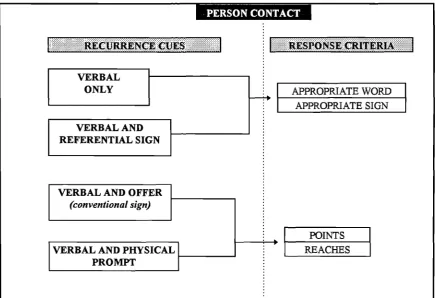
Rationale for the Organisation of a Core Lexicon 155 Organisation of Core Lexicon for I.S.E. Schedule 156 Hierarchy of Presentation Cues for Person Contact 157 Hierarchy of Recurrence Cues for Person Contact 157 Hierarchy of Presentation Cues for Object Contact 158 Hierarchy of Presentation Cues for Person Contact (Vestibular 158 Stimuli)
Hierarchy of Recurrence Cues for Person Contact (Vestibular 159 Stimuli)
Response Repertoire for Person Contact 161
Response Criteria in Person Contact 162
Response Criteria in Object Contact 162
Response Repertoire for Object Contact 163
Orientation Items for Person Engagement 164
Orientation Items for Object Engagement 165
Checklist for I.S.E. Decision-Making Schedule 166 Continuum of Sensory Registration and Responsivity (Fisher et 170 al, 1991)
Principles of Environmental Modification Applied to Sensory 171 Responsivity Levels
Order of Presentation of Person Items 172
Order of Presentation of Object Items 172
Table 4.2.4.1 Table 4.2.4.2 Table 4.2.4.3 Table 4.2.4.4 Table 4.3.5.1 Table 4.3.6.1 Table 4.3.6.2 Table 4.3.6.3 Figure 4.3.6.3 Table 4.3.6.4 Figure 4.3.6.4 Figure 4.4.2.1 Table 4.4.4.1 Table 4.4.4.2 Table 4.4.4.3 Table 4.4.4.4 Figure 4.5.1.1 Figure 4.5.2.1 Table 4.5.4.1 Table 4.5.4.2 Table 4.5.8.1 Figure 4.5.8.1 Table 4.5.8.2 Figure 4.5.8.2 Table 4.5.8.3 Figure 4.5.8.3 Table 4.5.8.4 Figure 4.5.8.4
Title of Table or Figure Page
No.
Inter-Rater Reliability - Person Engagement where 174 Presentation Cues have been Used
Inter-Rater Reliability - Person Engagement where Recurrence 175 Cues have been Used
Inter-Rater Reliability - Person Engagement where 175 Presentation Cues have been Used
Orientation Agreements Recorded for One Participant (group 176 1.1)
Scoring System for Questionnaire 180
Examples of Reliability Calculation for Questionnaire Items 181
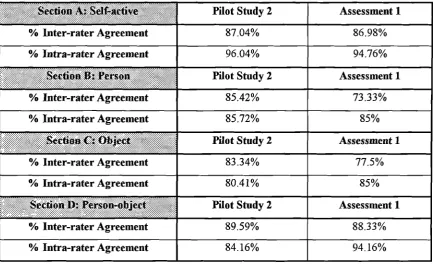
Table of Agreements by Category/Section 182
Percentage Agreements by Questionnaire Item (Section A) 183 Graph to Show Percentage Agreements by Questionnaire Item 183 (Section A) for Combined Data, i.e. Pilot Study 2 and
Assessment 1
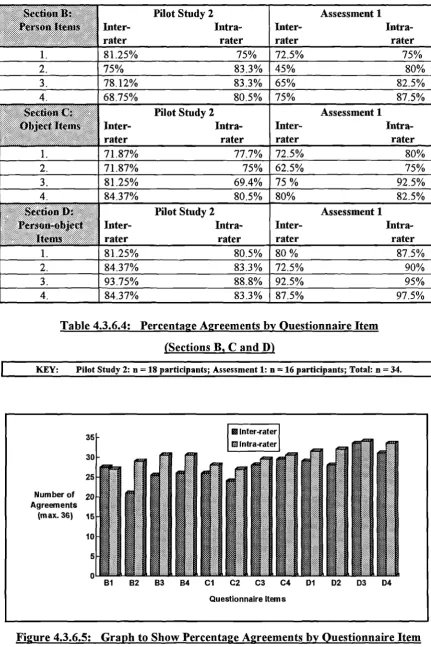
Percentage Agreements by Questionnaire Item (Sections B, C 184 &D)
Graph to Show Percentage Agreements by Questionnaire Item 184 (Sections B, C & D) for Combined Data, i.e. Pilot Study 2 and
Assessment 1
Sample Checksheet 188
Percentage Agreements Between Observers by Category of 191 Engagement
Percentage Agreements Between Observers by Moments 191 Observed
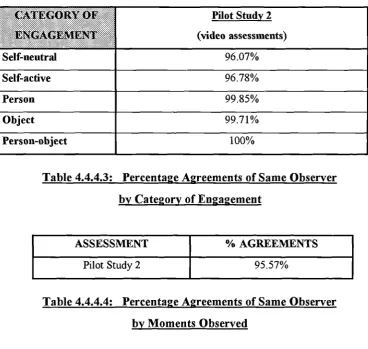
Percentage Agreements of Same Observer by Category of 192 Engagement
Percentage Agreements of Same Observer by Moments 192 Observed
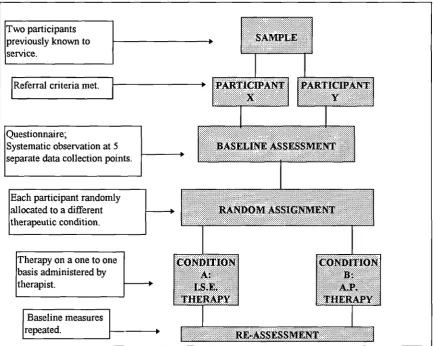
Research Design of Pilot Study 1 193
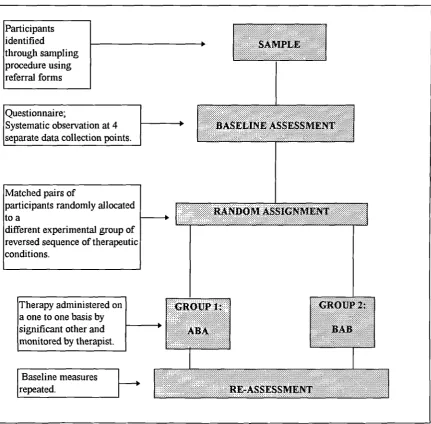
Research Design of Pilot Study 2 195
Table to Show Rate of Compliance Regarding the Running of 197 Sessions in Pilot Study 2 (By Individual Participant)
Table to Show Rate of Compliance with Recommended 198 Frequency for Running of Therapy Sessions (By Experimental
Group)
Engagement Background Questionnaire/Participant X 202 Engagement Background Questionnaire/Participant X 202 Observation by Momentary Time Sampling/Participant X 203 Observation by Momentary Time Sampling/Participant X 203 Engagement Background Questionnaire/Participant Y 204 Engagement Background Questionnaire/Participant Y 204 Observation by Momentary Time Sampling/Participant Y 204 Observation by Momentary Time Sampling/Participant Y 205
Title of Table or Figure Page
No.
Figure 5.1.1.1 Model of Experimental Strategy 210
Figure 5.3.4.1 Schedule of Assessments for Main Study 222
The tables and figures of the statistical results are numbered similarly to acknowledge the connection between them. The letter (a) is added to every second table that relates to the same mean group data.
Table 6.2.1.1 ANOVA Summary for Group 1 231
Table 6.2.1.1a Simple Main Effects for Group 1 231
Figure 6.2.1.1 Graph to Show Changes in Engagement Levels Over The Four 232 Assessment Points for Group 1
Table 6.2.1.2 ANOVA Summary for Group 2 232
Table 6.2.1.2a Simple Main Effects for Group 2 233
Figure 6.2.1.2 Graph to Show Changes in Engagement Levels Over The Four 233 Assessment Points for Group 2
Table 6.2.2.1 ANOVA Summary for Group 1/Assessment (1) to (2) 234 Table 6.2.2.1a Simple Main Effects for Group 1/Assessment (1) to (2) 235 Figure 6.2.2.1 Graph to Show Changes in Engagement Levels From Baseline 235
to After the First Intervention (I.S.E.) for Group 1
Table 6.2.2.2 ANOVA Summary for Group 2/Assessment (1) to (2) 236 Table 6.2.2.2a Simple Main Effects for Group 2/Assessment (1) to (2) 236 Figure 6.2.2.2 Graph to Show Changes in Engagement Levels From Baseline 237
to After the First Intervention (A.P.) for Group 2
Table 6.2.2.3 ANOVA Summary for Group 1/Assessment (2) to (3) 237 Table 6.2.2.3a Simple Main Effects for Group 1/Assessment (2) to (3) 238 Figure 6.2.2.3 Graph to Show Changes in Engagement Levels From Baseline 238
to After Second Intervention (A.P.) for Group 1
Table 6.2.2.4 ANOVA Summary for Group 2/Assessment (2) to (3) 239 Table 6.2.2.4a Simple Main Effects for Group 2/Assessment (2) to (3) 239 Figure 6.2.2.4 Graph to Show Changes in Engagement Levels From Baseline 240
to After Second Intervention (I.S.E.) for Group 2
Table 6.2.2.5 ANOVA Summary for Group 1/Assessment (3) to (4) 240 Table 6.2.2.5a Simple Main Effects for Group 1/Assessment (3) to (4) 241 Figure 6.2.2.5 Graph to Show Changes in Engagement Levels From Baseline 241
to After Third Intervention (I.S.E.) for Group 1
Table 6.2.2.6 ANOVA Summary for Group 2/Assessment (3) to (4) 242 Table 6.2.2.6a Simple Main Effects for Group 2/Assessment (3) to (4) 242 Figure 6.2.2.6 Graph to Show Changes in Engagement Levels From Baseline 243
to After Third Intervention (A.P.) for Group 2
Table 6.2.3.1 ANOVA Summary for Group 1/Assessment (1) to (4) 244 Table 6.2.3.1a Simple Main Effects for Group 1/Assessment (1) to (4) 245 Figure 6.2.3.1 Graph to Show Changes in Engagement Levels From Baseline 245
to After Third Intervention (I.S.E.) for Group 1
Table 6.2.3.2 Table 6.2.3.2a Figure 6.2.3.2 Table 6.2.3.3 Table 6.2.3.3a Figure 6.2.3.3 Table 6.2.3.4 Table 6.2.3.4a Figure 6.2.3.4 Table 6.2.4.1 Table 6.2.4.1a Figure 6.2.4.1 Table 6.2.4.2 Figure 6.2.4.2 Table 6.2.5.1 Table 6.2.5.1a Figure 6.2.5.1 Table 6.2.5.3 Table 6.2.5.3a Figure 6.2.5.3 Table 6.2.5.4 Table 6.2.5.4a Figure 6.2.5.4 Table 6.2.6.1 Table 6.2.6.1a Figure 6.2.6.1 Table 6.2.5.2 Table 6.2.5.2a Figure 6.2.5.2
Title of Table or Figure Page
No. ANOVA Summary for Group 2/Assessment (1) to (3) 246 Simple Main Effects for Group 2/Assessment (1) to (3) 246 Graph to Show Changes in Engagement Levels From Baseline 247 to After Second Intervention (I.S.E.) for Group 2
ANOVA Summary for Group 1/Assessment (1) to (3) 247 Simple Main Effects for Group 1/Assessment (1) to (3) 248 Graph to Show Changes in Engagement Levels From Baseline 248 to After Second Intervention (A.P.) for Group 1
ANOVA Summary for Group 2/Assessment (1) to (4) 249 Simple Main Effects for Group 2/Assessment (1) to (4) 249 Graph to Show Changes in Engagement Levels From Baseline 250 to After Third Intervention (A.P.) for Group 2
ANOVA Summary for First I.S.E. Intervention Using the 251 Combined Data from Both Groups
Simple Main Effects for First I.S.E. Intervention Using the 252 Combined Data from Both Groups
Graph to Show the Combined Effects of the First I.S.E. 252 Intervention for Both Groups
ANOVA Summary for First A.P. Intervention Using the 253 Combined Data from Both Groups
Graph to Show the Combined Effects of the First AP. 253 Intervention for Both Groups
ANOVA Summary for Group 1/Assessment (4) to (5) 254 Simple Main Effects for Group 1/Assessment (4) to (5) 255 Graph to Show Changes in Engagement Levels From After the 255 Final Intervention (I.S.E.) to After One Month Follow-up for
Group 1
ANOVA Summary for Group 2/Assessment (4) to (5) 256 Simple Main Effects for Group 2/Assessment (4) to (5) 256 Graph to Show Changes in Engagement Levels From After the 257 Final Intervention (A.P.) to After One Month Follow-up for
Group 2
ANOVA Summary for Group 1/Assessment (1) to (5) 257 Simple Main Effects for Group 1/Assessment (1) to (5) 258 Graph to Compare the Engagement Levels of Baseline and 258 One Month After the Withdrawal of Intervention for Group 1
ANOVA Summary for Group 2/Assessment (1) to (5) 259 Simple Main Effects for Group 2/Assessment (1) to (5) 259 Graph to Compare the Engagement Levels of Baseline and 260 One Month After the Withdrawal of Intervention for Group 2
ANOVA Summary for Group 1/Assessment (5) to (6) 261 Simple Main Effects for Group 1/Assessment (5) to (6) 262 Graph to Show Changes in Engagement Levels From One 262 Month to Four Months after the Withdrawal of
Intervention-up for GroIntervention-up 1
Table 6.2.6.2 Table 6.2.6.2a Figure 6.2.6.2 Table 6.2.6.3 Table 6.2.6.3a Figure 6.2.6.3 Table 6.2.6.4 Table 6.2.6.4a Figure 6.2.6.4 Table 6.3.1.1 Table 6.3.1.2 Table 6.3.2.1 Table 6.3.2.2 Table 6.3.3.1 Table 6.3.3.2 Table 6.3.4.1 Table 6.3.4.2 Table 6.3.5.1 Table 6.3.5.2 Table 6.3.6.1 Volume II Figure 7.2.1.1 Figure 7.2.1.2 Figure 7.2.1.3 268 269 270 271 272 273 274 275 276 276 277 Page No. 263 263 264
Title of Table or Figure
ANOVA Summary for Group 2/Assessment (5) to (6) Simple Main Effects for Group 2/Assessment (5) to (6) Graph to Show Changes in Engagement Levels From One Month to Four Months after the Withdrawal of Intervention-up for GroIntervention-up 2
ANOVA Summary for Group 1/Assessment (1) to (6) Simple Main Effects for Group 1/Assessment (1) to (6) Graph to Show Changes in Engagement Levels Baseline to Four Months after the Withdrawal of Intervention-up for Group 1
ANOVA Summary for Group 2/Assessment (1) to (6) Simple Main Effects for Group 2/Assessment (1) to (6) Graph to Show Changes in Engagement Levels Baseline to Four Months after the Withdrawal of Intervention-up for Group 2
Summary of Characteristics of Groups 1.1
Summary of Types of Changes in Engagement Levels for Participants in Group 1.1
Summary of Characteristics of Groups 1.2
Summary of Types of Changes in Engagement Levels for Participants in Group 1.2
Summary of Characteristics of Groups 2.1
Summary of Types of Changes in Engagement Levels for Participants in Group 2.1
Summary of Characteristics of Groups 2.2
Summary of Types of Changes in Engagement Levels for Participants in Group 2.2
Summary of Characteristics of Groups 2.3
Summary of Types of Changes in Engagement Levels for Participants in Group 2.3
Summary Comparison of Characteristics in Groups 1 and 2
The Direct Route of Therapeutic Effect The Indirect Route of Therapeutic Effect
ACKNOWLEDGEMENTS
I would like to thank several people for their support and encouragement during the course of this study. Firstly, my academic supervisor, Professor John Weinman for his unswerving and gentle guidance during the course of my studies. My gratitude to Dr. Tim Pring for his generous help in the statistical analysis of the results. I am particularly indebted to my manager, Shirley Davis, at the inception of and during the main body of the research, for giving me the time, financial support and professional encouragement to proceed. A big thank you to my colleagues Dr. James Law and Professor Sally Byng for their support, both practical and psychological!
Many ideas were conceived in the early days by fruitfiil discussions with the Senior Instructor of the special needs unit, Zenia Melnyk-Wainwright, and the social services team of Day Centre officers in Lewisham. I would also like to thank Matt Laws, my then 'downstairs neighbour' for his willingness to listen and for his useful feedback. My love and thanks must also go to my partner, Joe, who shared the "ups and downs" of the writing-up phase and was always there when I needed him!
Thanks too must be given to all the Day Centre instructors who worked so willingly with me during the course of the project, without whom this intervention study would not have been possible. Finally, my warm appreciation to all the clients who worked so closely with me and who taught me so much about communication.
DECLARATION
I grant powers of discretion to the University Librarian to allow this thesis to be copied in
whole or in part without further reference to the author. This permission covers only single
copies made for study purposes, subject to normal conditions of acknowledgement.
ABSTRACT
This thesis is about the development and evaluation of an intervention incorporating structured sensory stimulation. It was designed for use with adults with learning disabilities who were not yet intentional communicators.
The intervention was termed an 'Individualised Sensory Environment' (I.S.E.). The main objective was to reduce the levels of non-purposeful engagement and to increase the levels of purposeful interaction. Appropriate opportunities for adaptive responding were organised by the provision of sensory stimulation that was identified as personally motivating to the individual. The reinforcing sensory experience was contingent on the participant's responses. The focal sensory domains of the intervention were the tactile and vestibular systems for input, and the proprioceptive for participant response feedback.
An alternating treatments design was used to evaluate the effects of the intervention (I.S.E.) on engagement levels of participants. An attention placebo condition was also used.
The participants attended a social service's Day Centre and formed therapy groups whose membership ranged from two to four, based on their location within the service's structure. Groupings were then randomly assigned to two experimental groups, the order of interventions for one being the reverse of the other.
Data was collected by systematic observation of participant's engagements in the natural environment: at baseline, after each phase of therapy and at two follow-up points. Analysis of variance was the main method of statistical interpretation. The results showed that high levels of non-purposeful behaviour were emitted at baseline when compared with the construct purposeful interaction. When the intervention (I.S.E.) was introduced, a significant decline in the level of non-purposeful behaviour was observed, which maintained its new lower level up to one month after the termination of therapy. The placebo condition also effected a similar change initially. However, a significant increase in purposeful interactions was only observed after a phase of the 'Individualised Sensory Environment'.
Some limitations of the study are discussed and recommendations for future work are indicated.
ABBREVIATIONS
Notation Full Term Definition
I. S. E.
A.P.
S.R.V.
M. T. S.
S.P.
R.P.
Individualised Sensory Environment
Attention-Placebo or Action-Performance
Social Role Valorisation_
Momentary Time Sampling
Sample Population
Remainder of the Population
Intervention A: I. S.E.
Intervention B: A.P.
Philosophy developed by
Wolfensberger (1972) and others to guide the planning and delivery of services to adults with learning disabilities. Originally termed 'normalisation', it was renamed 'social role valorisation' to avoid the connotations of normalising. It is about valuing achievements and the 'ordinary' lifestyle.
Systematic approach to observation used to measure behaviour.
Selected participants for the project characterised by limited
communication skills and high levels of non-purposeful behaviour.
Those amongst the focal learning disabled population who did not meet the referral criteria for the study, i.e. characterised by intentional communication and purposeful behaviour.
CWPTER . . ...
ODIUCTION TO THESIS
1.1 Introduction to the Chapter
This chapter provides an introduction to the focus of the research project. It aims to set the
scene regarding the current philosophy of care and service provision for adults with learning
disabilities. This will serve as a backdrop for the consideration of the particular challenges
experienced by Speech and Language Therapists in their working with learning disabled
adults who are not yet intentional communicators.
In order to establish the need for an approach to assessment and intervention which is
appropriate to the characteristics and skill sets of the target population, particular attention
will be paid to the following areas, as reported in the literature: levels of purposeful activity
or engagement; definition of characteristics perceived to be present; and the incidence of
communication difficulties. Following this, there will be a brief overview of the current
assessment tools used with adults with learning disabilities, together with an introduction to
the main issues regarding relevant intervention strategies.
1.2 The Setting
It is only since the 1970s that consideration has been given to the education and enrichment
of the lives of people with learning disabilities. Two main areas of activity appear to have
been the focus of those employed to develop and deliver specialist services to people with
learning disabilities. Firstly, the education of severely learning disabled children made a
philosophical and practical shift from 'care' to 'stimulation'. This was stressed in the 1970
Education Act in England. Secondly, the closure of long stay institutions for people with
learning disabilities and mental health problems was hi . hlighted for consideration by Health
and Local Authorities. It was primarily the responsibility of the Health Authorities and they
started to formulate proposals for the planned closures of these large institutions and the
provision of supported housing in the community.
In response to this second area of activity, the planning for institutional closure, the Guy's
District Management Team established the "Development Group" on 1st May 1980. Their
remit was to ascertain the number of people with a learning disability resident in or
originating from the Guy's Health District who required services; to evaluate identified
services already in existence; and to plan future services within the community setting.
1.2.1 Closure of Local Institution and Development of Community Services
The impending closure of one of England's largest institutions for people with learning
disabilities located in the South East Thames Region, Darenth Park Hospital, heralded a
revision of both residential and day services for the population. This meant an increase in
community facilities with the accent on an ordinary life in the community. The philosophy of
'Normalisation' first formulated by Bank-Mikkelsen (1969), with later interpretations by
Nirje (1969); and Wolfensberger (1972) was used in the planning of the new services.
O'Brien (1981) in the Values into Action Publication adapted by Alan Tyne: "The
Principle of Normalisation" summarised the philosophy thus:
"Using valued means to as much as possible enhance and support behaviours, appearance,
and experiences, as well as perceptions by other people in the community which are
culturally normative". 6,.1)
Tensions arose due to the misinterpretation of certain concepts within the philosophy. The
concept of 'what is normal' and meeting the specific needs of people with learning
disabilities frequently clashed. For instance, the principle of age appropriateness (O'Brien,
1981) has frequently been misinterpreted by support staff to mean that practice should match
the chronological age of the individual. Therefore, it was expected that 'normal' adult
communication acts should be established with an individual regardless of the available skill
set. The service and its components achieved a 'normal' image but at the expense of meeting
individual needs. This led to the renaming and modification of 'normalisation' as 'Social
Role Valorisation' (S.R.V.). This was in order that value could be given to the many
different social roles performed by an individual (Wolfensberger, 1983). A relatively recent
definition of S.R.V. was put forward by Wolfensberger (1992): "the enablement,
establishment, enhancement, maintenance, and/or defence of valued social roles for people
- particularly for those at value risk--by using, as much as possible, culturally valued
means." (p. 32).
However, certain principles defined in the original works on 'normalisation' have been
maintained in service philosophies. O'Brien defined five basic principles (In: Tyne, 1981),
which he termed the 'five accomplishments'. They were and still
are
used as a frame ofreference by which to deliver and evaluate services for this population. The accomplishments
are viewed as targeted achievements for the learning disabled and are summarised as:
• Community Presence
defined as the experience of using the same facilities and sharing the same physical space
as non handicapped people;
• Relationships
defined as having a broad range of contacts and relationships with others participating;
• Respect and Dignity
defined as the right of individuals to a role of value, status, respect and dignity that is
comparable with that of others;
• Choice
defined as the opportunity to make choices on all relevant issues;
• Competence
defined as the right to help to develop and grow; learn new skills thereby minimising any
permanent disabilities.
Therefore, some of the tensions that existed under the former 'normalisation' due to
misinterpretation in practice persist, despite the reformulation of the philosophy as 'social
role valorisation'.
In January 1981, the Development Group for 'Services for Mentally Handicapped People'
made its report to the Guy's District Management Team. Issued for consultation in the
planning of new services, it considered in its documentation the whole service planning of
those people with the most severe learning disabilities or "special needs".
Four proposals were made. Firstly, it was felt that this group of people should not be
excluded from the mainstream of services where building adaptations or additional staff
support could help to maintain them in the community. Secondly, it was stated that when
people have very special needs the first response should be to make available to them extra
resources and support in the place they would normally be. Thirdly, that when people are in
danger of being excluded due to behavioural problems, some very individual solutions
should be sought. Fourthly, that because of the extreme deficits experienced by people with
very severe mental handicaps, the daily programmes should be 'highly intensive, extremely
active and with a positive/habitational emphasis' (p. 82).
Prior to these proposals, the local Speech and Language Therapy service had been delivered
on a restricted, sessional basis to meet the communication needs of those attending social
service's Day Centres in the district. The planned dispersal of institutional residents,
concurrent with the establishment of community based services, led directly to the
development of 'Community Mental Handicap Teams'. These were multi-disciplinary
structures that aimed to facilitate collaborative working effort amongst the professionals, i.e.
Psychologist, Occupational Therapist, Physiotherapist, Community Nurse, Psychiatrist and
Speech and Language Therapist.
Speech and Language Therapy as a profession started to play a major role in service
provision to learning disabled adults, after 1980, when the first community mental handicap
teams were set up to assist in the community resettlement programmes for institutionalised
adults around the country according to the published government recommendations. They
were specifically employed to assess the communication skills of residents in long stay
institutions such as Darenth Park Hospital, and to work with teams of support workers for
the relocation of people to their borough of origin and for their ongoing maintenance in the
community, in this case Lewisham and North Southwark. Speech and Language Therapy
with people already resident in these London Boroughs, was also extended, to meet
individual support needs and to preserve their continued presence in the community.
It therefore followed that developments should take place amongst the professions who
were required to provide assessments; staff training and advise on therapeutic programmes
in relation to this population.
1.3 Rationale
There were some amongst the learning disabled population who were reported to require a
higher degree of support. They exhibited increased levels of dependence on their significant
others regarding personal, cognitive, communicative and social needs. In short, there
appeared to be a proportion of the learning disabled population who experienced extreme
difficulties in all areas of independent living. The literature has reported on the engagement
levels and the presenting characteristics of this group of people with learning disabilities.
These will be reviewed in turn.
1.3.1 Level of Engagement
Low levels of purposeful activity provided in facilities for people with severe and profound
learning disabilities seems to be a persistent problem. Grant and Moores (1976) studied
severely learning disabled adults in two hospitals, finding a range of between 48% and 55%
of their day was spent in purposeful activity. This sample did however exclude those
participants described as 'totally non ambulant' or 'deaf' or 'blind'. Their inclusion would
very likely have caused a reduction in this level based on the premise that the more severe
the disabilities are for the individual, the harder it is to engage in purposeful activity and for
others to facilitate it. A later study by Felce, Kushlick and Mansell (1980) found that, from a
cross section of severely learning disabled children resident in two hospital villas, the
average purposeful activity per day was 31%, and from a similar cross section of adults in
three hospital villas, 39% of the day. The average in similar cross sections of this population
based in small community homes was found to be significantly higher. This may be due to
the greater provision of residential care in an institutional setting to more severely learning
disabled people with additional sensory and motor impairments, or else to the relative
freedom from routine and increase in choice and opportunity that is found in smaller,
community placements.
Jones, Fayell, Lattimore and Risley (1984) looked more specifically at the independent and
active use of leisure materials amongst residents with profound learning disabilities plus
multiple handicaps. This was reported at less than 13% of the available time.
The researcher was concerned with the number of people with a learning disability who were
not yet intentional communicators, and who seemed to experience diminished interactions
with people and objects in the environment. The majority of these people attended special
needs units under local authority social service day centres. The questions were: who were
these people and how were they to be identified; how were their skills of pre-intentional
communication to be measured; and what form should remediation take. Each of these
questions is crucial to the current study.
1.3.2 Definition of Learning Disability
There have been many attempts to define this population, the most commonly used system
being based on psychometric assessment of intelligence that distinguishes between the
'profound' and other degrees of learning disability (Grossman, 1983). Other classification
systems have employed functional terminology in relation to the person's skills or lack of
them (Presland, 1982; Sontag, Burke and York, 1973; Browning, Bailey and Clark 1981).
In 1985 the National Development Team (N.D.T.) set up by the British Government to
guide and advise local organisations on the development of services defined the features
deemed to be characteristic of those with the highest level of dependency (Group IV):
severely handicapped, doubly incontinent with multiple physical handicaps, severe epilepsy,
extreme hyper kinetic behaviour and aggressive to self and others. It is nnlikely that such an
imprecise collection of features is completely descriptive of any one person and therefore
can only be said to approximate the population of people with profound learning disability.
Additionally, it is worth considering that functional definitions which describe the current
skills of individuals may actually reflect lack of opportunity rather than potential.
Historically, people with learning disabilities have either been defined by the services being
provided, i.e. attendance of a special care unit denotes a high level of dependency; or else by
exclusion from a service, e.g. prior to 1975, profound learning disability was defined in
Scotland in terms of exclusion from educational services - "ineducable" (Browning, Bailey
and Clark, 1981).
Because of the difficulties in standardising a definition of 'profound learning disability',
prevalence figures are hard to establish. Prevalence studies completed have revealed
differences according to the following: where people live - in the community or an institution
(Dupont, 1981); age range - (Fryers, 1984).
Although, it is likely that the communication status of individuals is associated with the
degree of learning disability, this study is not concerned with the categorisation of degrees of
learning disability as reported in the literature, but more with their communication skills and
engagement levels.
1.3.3 Prevalence of Communication Difficulties
It is widely acknowledged that people with learning disabilities experience communication
problems although the exact size of the problem has not been documented. A survey of
clients in day centres and long stay hospitals completed by Blackwell, Hulbert, Bell, Elston,
Morgan, Robertshaw and Thomas (1989), concluded that 33% had some verbal
communication difficulty, with 25% of cases demonstrating marked problems, and 29%
were non verbal, making a total of 62% of the population experiencing identifiable
communication problems. It was not made clear what percentage of non verbal people were
also severely physically disabled, thus perhaps accounting for a lack of verbal
communication. Nevertheless, it is possible to see the extent of difficulties in the
communication skill sets of the study population.
Another survey by Law and Lester (1991) in a social education centre found slightly higher
levels of need: 81% were considered to require support for their communication skills; 9.5%
being non-verbal and 5.9% experiencing low comprehension and/or low expression. The
variations between these two studies may be explained by differences in the focal
populations; the criterion used for their identification and data collection methods.
This study is concerned with the close examination of the communication skills and
engagement levels of people who demonstrate severely restricted verbal use, in order that
an appropriate assessment procedure and intervention may be developed for use by Speech
and Language Therapists and significant others.
1.3.4 Speech and Language Therapy Assessment
Traditionally, Speech and Language Therapists have been associated with child speech and
language development, and the acquired problems of adulthood. Some large institutions for
the learning disabled may have received a Speech and Language Therapy service in the
1960-70s, but the assessments and therapy techniques were "borrowed" mainly from the
paediatric and some from the adult fields. Informally, adapted versions of the 'Derbyshire
Language Scheme' (Knowles and Masidlover, 1982); developmentally based assessments
such as The Reynell Developmental Language Scales' (1978); were used, together with a
battery of informal assessment procedures including subsections of global criterion
referenced checklists: 'Behaviour Assessment Battery' (B.A.B.; Kiernan and Jones, 1982);
Bereweeke Checklist' (Felce, Mansell, Jenkins and de Kock, 1984); 'Next Step on the
Ladder' (Simon, 1981). Apart from the obvious problems of the standardisation restrictions
arising from "borrowed" formal assessments, few of them included a detailed examination of
early communication skills.
Other checklists comprise criteria which either relate specifically to communication skills at
the pre-verbal level: 'The Pre-Verbal Communication Schedule' (P.V.C.S; Kiernan and
Reid, 1986); or else include a focused section at this level: 'Personal Communication Plan'
(P.C.P; Hitchings and Spence, 1992). The P.V.C.S. aims to provide detailed diagnostic
information about pre-communicative, informal and formal communicative and receptive
skills. It is in the form of a checklist comprising 195 items and the information gathered is
largely descriptive. The assessor has the main responsibility for defining the context for the
collection of assessment data. The P.C.P. seeks to profile communication skills according to
O'Brien's five accomplishments attributed to the 'ordinary life'. Again, the assessment takes
the form of a checklist with an unspecified procedure for data collection, its main aim being
to provide a format for long term assessment and programme planning
Van der Gaag (1989) recommended the utilisation of the client's main carers in a joint
assessment of communication skills. The 'Communication Assessment and Speech Profile'
(C.A.S.P.: van der Gaag, 1988) was devised specifically with the population of adults with
learning disabilities in mind and was based upon the premise that the carer and professional
should be equal partners in the assessment process. C.A.S.P. covers both verbal
comprehension (from single word to sentence level, looking at naming vocabulary and
attributes), and expressive skills (from single word to communicative functions). However,
even its baseline presupposes a verbal communication skill set, of the individual being
assessed.
An assessment procedure that focused on early communication behaviours for use with the
severely learning disabled was developed by Coupe, Barton, Barber, Collins, Levy and
Murphy (1985). They established a theoretical framework for their 'Affective
Communication Assessment'. The procedure aimed at providing a structure for the
observation of differential responses by focal clients to sensory opportunities provided by the
assessor. The application of its principles in the teaching and monitoring of communication
development was later considered, (Coupe and Goldbart, 1988). Coupe et al made their
suggestions based on observations of the behavioural repertoires of a paediatric population.
All these published assessment procedures raise a number of issues variously regarding: the
reliability of information which is based on informal observation with a rating scale; time
required to complete a checklist; the organisation needed in terms of stimuli required in
sub-tests; the limitations of use when presented with a client with complex needs including
additional sensory-motor impairments; a lack of clear direction in terms of target
identification and an intervention procedure.
It was therefore the primary intention of the researcher, to assess in as objective manner as
possible, the communication and interaction levels of learning disabled adults who present a
diverse range of additional sensory and motor impairments. Secondly, the researcher was
concerned with the development of an intervention to effect change in the daily interactions
of the focal population.
1.3.5 Intervention Strategies
As with assessment packages, so there has also been significantly less material published on
the application of Speech and Language Therapy techniques to learning disabled adults,
compared with other presenting difficulties, i.e. developmental speech and language
disorders, acquired neurologically-based communication problems, etc. Review of strategies
reportedly used by Speech and Language Therapists with this population can be roughly
subdivided into direct (client centred), and indirect (through significant other to client and
via environmental adjustment) intervention strategies. However, it must be pointed out, that
very often an approach encompasses both direct and indirect techniques to a greater or
lesser extent. That is, the direct technique may be applied through the indirect coaching of
the significant other.
1. Direct Techniques:
Little, if any investigative effort has been reported in the literature regarding those people
with a more 'severe' learning disability. Van Dijk (1965a, 1965b) has described a number of
hierarchical procedures for use with deaf-blind clients; Sternberg, Battle and Hill (1980)
suggested some adaptations for use with many other types of profound disability; Sternberg,
Pegnatore and Hill (1983) developed interactive communication behaviours through use of
movements, signals, gestures objects, pictures, signs and speech, according to the
functioning status of the individual. This latter study used the procedural stages to be found
in a pre-language training approach: resonance; co-action; and deferred imitation, which
respectively define: physical contact between client and therapist in simultaneous
communication act; demonstration of model of communication behaviour; and removal of
model prior to client's reproduction of behaviour. This applied hierarchy to meet individual
needs was reported to be effective in the majority of cases, as communication behaviours
generalised to other situations.
The most frequently quoted direct technique for use with the broader learning disabled
population is 'Makaton' . It is a language programme that utilises a core vocabulary of
functional hand signs and/or symbols, developed by Walker and her associates (1976, 1978)
originally designed to meet the communication needs of learning disabled adults with a
hearing loss. Signs are based on natural gesture and taught in a developmental sequence.
Several advantages to its use have been pointed out, amongst which are: iconic, visual
representation; facilitated auditory processing; and ease of response production (Karlan,
Fristoe and Lloyd, 1984).
Makaton has been used with a wide range of this population: early language training with
Down's children has been examined using both sign and symbol (Le Prevost, 1983); signing
with the visually impaired (Mountain, 1984); and the deaf-blind (Clark, 1988). Walker
reported in her initial research findings that intervention by Makaton showed an increase in
expressive language, sociability, eye contact, attention levels and vocalisation (1978). She
also commented that adults with learning disabilities could learn to sign with ease. Grove
and Walker (1990) went on to examine the use of signs and symbols, the latter based on a
rebus system, to develop interpersonal communication skills amongst people with learning
disabilities. Makaton signing is considered relevant to the development of an intervention
strategy in the current study. This will be explored in greater depth later on in the thesis.
2. Indirect Techniques:
Other therapy strategies have concentrated on intervention through the client's significant
others termed an indirect approach. A speech teaching scheme was developed for use by
Adult Training Centre staff by McCartney and Byers Brown (1980) to improve intelligibility
of communication acts. More recently, Jones (1990) produced `Intecorn% a programme
planning package that focuses in part, on the training of the carers to promote
communication development in the clients. It has been criticised for its over emphasis on the
communication environment and its concurrent neglect of the communication impairment
(van der Gaag and Dormandy, 1993). Furthermore, no measured outcomes have been
reported on either strategy. It is the opinion of the researcher that a combined approach that
encompasses both professional input and carer involvement, as recommended by Van der
Gaag (1989), is likely to be the most effective.
This research project is concerned with the assessment of and intervention with people who
present as largely non verbal. The selected publications or strategies mentioned here, have
been briefly surveyed in an appraisal of the current situation facing the Speech and Language
Therapist working with adults with learning disabilities. A more detailed examination of
interventions will be presented in the next Chapter which reviews the literature.
1.3.6 Summary of Problem Situation
This first chapter has introduced the reader to the current situation that exists within the field
of Speech and Language Therapy and people with severe learning disabilities who are not
yet intentional communicators. It has recounted the more recent developments in service
provision, particularly since the 1980s. It has then moved on to overview the challenging
issues which face the Speech and Language Therapist regarding: poor engagement levels
amongst learning disabled clients; high incidence of communication difficulties; the restricted
availability published assessment packages; and defined intervention strategies that have not
necessarily been developed for use with those with profound learning disabilities. These
issues will receive further attention in the following chapter: Chapter 2: Review of
Literature and Theoretical Framework.
The aims of the current study are now recounted and an outline of the structure of the thesis
is provided.
1.4 Aims of Research
The initial aim of the project was to develop a theoretical framework for a suitable
intervention for learning disabled adults who are not yet intentional communicators, based
on a synthesis of four key areas reported in the literature. These areas are: (i) intervention
practice with adults with learning disabilities interfacing with current service philosophy; (ii)
sensation as an artefact in therapy programmes in the forms of contingent and
non-contingent reinforcement in relation to the learning process; (iii) Sensory Integration Theory;
and (iv) Sensory Integration Therapy (Ayres, 1972; 1979). This is termed the theoretical
phase of the project.
The second aim was to define the target population (people with learning disabilities who are
not yet intentional communicators), in terms of presenting features, to make a comparison
with the remainder of the population (people with learning disabilities who are intentional
communicators), and to ascertain the type of Speech and Language Therapy interventions
currently being implemented. This is termed the definition phase of the project.
The third aim of the study was to develop appropriate instrumentation for the purposes of
assessment and individualised intervention planning, and to pilot the procedures in a
feasibility study. This is termed the construction phase of the project.
The final aim was to implement the intervention with a sample population in order to
evaluate its effects. This is termed the experimental phase of the project.
1.5 Structure of Thesis
The thesis is contained in two volumes. Volume I consists of Chapters 1 to 6. Volume II
consists of Chapters 7 to 8 and the Appendices. The relevant Appendices are identified in
the text of Volume I for appropriate access by the reader.
Volume I
Chapter 2 focuses on the theoretical phase of the project. It provides a critical review of
current Speech and Language Therapy intervention practice with learning disabled adults
and examines the interface with current service philosophy. It then proceeds to explore the
role of sensation in therapy programmes, focusing on both contingent and non-contingent
reinforcement in relation to the learning process. The theoretical writings on Sensory
Integration Therapy are then critically reviewed, together with its reported applications
(Ayres, 1972; 1979). The final part of this chapter provides a synthesis of the literature
review in a theoretical framework for the intervention termed 'Individualised Sensory
Environment' (I.S.E.). A clinical rationale is formulated to provide the foundations of the
intervention. The scope of the study and the research objectives are summarised based on
the previously stated aims in Chapter 1. The research hypotheses are provided at the end of
the chapter.
Chapter 3 focuses on the definition phase of the project. It provides an account of the
process conducted to deal with the ethical issues of the study. Then it is subdivided into
three areas where the methodology and resulting data are discussed. Firstly, the selection
process of the participants from one social services Day Centre is recounted for the main
study. Next, a second survey of a similarly defined population in three Day centres in a
neighbouring borough is also provided for comparison, with additional information
regarding current Speech and Language Therapy interventions. Thirdly, there is a more
detailed survey of the study population which provides a multi-axial comparison between
the sample population and the remainder. The chapter provides a summary discussion of the
characteristics which provides both a definition of the sample population, and outlines the
implications for the empirical phase of the project.
Chapter 4 focuses on the construction phase of the project. It recounts the development of the instntmentation required for the purposes of assessment and intervention planning. It
describes the two main pilot studies and reviews the data collection methodology and
recording medium. There is a discussion of the difficulties that arose at each stage and a
summary of the implications for the main study.
Chapter 5 and the remainder of the thesis focus on the experimental phase of the project. This chapter describes the methodology for the main experimental study. It outlines the
experimental design used to evaluate the effects of the intervention supported by definitions
of the variables including the attention-placebo condition. Justification for the chosen
method of statistical analysis is provided.
Chapter 6 provides a summary of the results in two parts. The first part presents the mean group data in relation to the main experimental hypotheses. The second part presents a
summary of the data arising from the single case studies.
Volume II
Chapter 7 provides a discussion of the research findings in relation to the eight main hypotheses and the literature review. The outcomes of the study are considered in the
context of a critical appraisal of the key theoretical positions cited in the review of the
literature. The originally stated aims and objectives are discussed in the light of the
achievements of the current study.
Chapter 8 concludes the thesis. It provides a critique of the present study and outlines the
directions for future work. The first part discusses the complexities of the current research
project with an appraisal of its limitations and the strategies that were invoked to deal with
issues. Future research ideas are also highlighted. The second part attends to the potentially
controversial relationship of the I.S.E. intervention of the current study to current service
philosophy and practice. Finally, consideration is given to the direction of future work,
policy development and the practical implications for the work of the Speech and Language
Therapist.
2.1 Introduction
The review of the literature covers four key areas: intervention practice with adults with
learning disabilities interfacing with current service philosophy; contingent and
non-contingent sensory reinforcement in relation to the learning process; Sensory Integration
Theory; and Sensory Integration Therapy (Ayres, 1972; 1979; Fisher, Murray and
Bundy, 1991). The fifth and final section of this Chapter represents a synthesis of the
previous four areas. It provides a theoretical framework for the intervention termed the
'Individualised Sensory Environment' (I.S.E.) incorporating the nature of intentional
communication development, and its relevance to severely learning disabled adults.
1. Intervention Practice and Service Philosophy:
In order to establish an intervention and to later assess its contributions to the work of
the Speech and Language Therapist, the first part examines Intervention Practice with
adults with learning disabilities. Particular attention is paid to the interpretations of
service philosophy which influence current practice, and which, may later require detailed
review for the complex needs of some in the learning disabled population.
2. The Role of Sensory Reinforcement:
Once the nature of intervention practice and service philosophy is established, the review
moves onto to examine the role of sensory reinforcement and stimulus reactivity in the
learning process. This is considered to be a crucial part of the developing intervention.
The various uses of contingent and non-contingent sensory stimulation are appraised,
particularly the role of reinforcement in the learning process where sensory stimulation is
a significant component of the intervention.
3. Sensory Integration Theory:
Having reviewed the reinforcing role of sensory stimulation in the learning process, and
for the establishment of a clinical rationale for a sensory based intervention, this review
proceeds to examine a theory based intervention that employs sensory stimulation as a
(Ayres, 1972; 79), which is based on a theoretical framework. As the most frequently
published example of this kind of intervention, Sensory Integration Theory is critically
reviewed here, with particular attention to its defined relationships amongst the central
nervous system (C.N. S.), the environment and behaviour.
4. Sensory Integration Therapy:
Following this, the applied research on Sensory Integration Therapy is inspected with a
particular focus on the clarity of its operational definition and reported practice.
5. Theoretical Framework for an Intervention:
The clinical rationale represents a synthesis of the four areas of the literature review
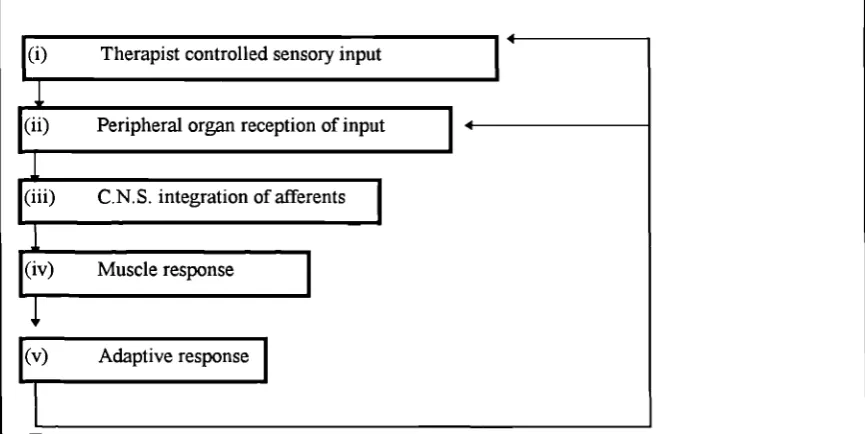
previously presented. It is explained by the provision of a five part model which examines
the relationships amongst the environment, the organisation of incoming sensory data
and adaptive behaviour. It serves as the theoretical framework or foundation from which
the operational definition will grow. The need for a developmental frame of reference
when working with learning disabled adults is established within the model for its
relevance to the overall goal of therapy.
Finally, a summary of the research objectives is provided, in relation to the scope of the
study which is supported by the research hypotheses.
2.2 Intervention Practice and Service Philosophy
It is intended that a critical appraisal of current intervention practice and service
philosophy with the learning disabled population, will hi . hlight the need for development
work regarding those people with severely restricted communication skills.
2.2.1 Concept of Intervention
Intervention, treatment or therapy, are all terms used interchangeably. Each is concerned
with the introduction of a new variable to an existing situation with the aim of bringing
about change in that situation. It is, very often, the main reason why a person attends a
clinical Speech and Language Therapy service: to affect change in communication skill
Interventions are usually devised as a result of an interpretation of assessment findings,
where the skill set of the individual is profiled, based on his/her responses to a standard
set of directives encased within an assessment package. The assessment would normally
present a hierarchy of test items of increasing complexity in order to find the point at
which the individual's skill set starts to break down. In short, a baseline reference is
identified for the individual against which to compute any changes which might have
been brought about by an episode of intervention.
The therapist needs to consider the client's potential to learn new behaviours, as in the
case of the child with a developmental language problem, or to achieve more frequent
use of their already existing response repertoire. Then, decisions are required regarding
the structuring of the therapy procedure. Gerard and Carson (1990) outlined a systematic
approach to decision-making in child language assessment: 'What objects, events, people
and interaction patterns should be altered and haw will they be altered' (p. 73). They
were principally concerned with the ordering of clinical decisions based on an integration
of assessment data relating to child performance and environmental factors.
The therapist formulates a series of hypotheses based on assessment findings and this
represents the first stage in the planning process. Materials and activities are selected,
facilitation strategies are invoked, in order that the appropriate setting or opportunity is
created for the testing out of the hypotheses. A central question for the therapist making
decisions for a client's intervention must be: what type and degree of information is
provided by the assessment battery and how can it be integrated into a programme of
intervention? Or, how does the assessment data relate to an intervention plan? It is
perhaps at this point, that the therapist has the major responsibility for identifying the
clinical decisions and then for taking them.
As well as the assessment data regarding communication skill set level, a number of
extraneous variables inform the therapist's clinical decisions, such as: age of person;
cognitive finictioning level; presence of additional sensory or motor impairments; medical
condition; service context or setting for the realisation of therapy targets; and the role of
significant others. The therapist would usually plan the client's intervention based on an
Although intervention may be considered to be central to the work of the Speech and
Language Therapist, there are few programmes that have been operationally defined,
with a clear specification regarding: (1) candidacy; (ii) first level clinical decisions for
entry to the programme to identify appropriate facilitation or presentation strategies,
activities and equipment, and client response repertoire to be expected in the course of
therapy; (iii) structure of intervention session; (iv) a uniform recording method for
logging client's performance that is appropriate to the specific intervention; (v) a
systematic procedure for the adjustment of programmes currently running.
2.2.2 Current Practice with the Learning Disabled
Using ethnographic methods, van der Gaag and Davies (1994) examined the working
practice of four Speech and Language Therapists specialising in the field of learning
disabilities. They refer to the 'complex integration of knowledge and skills' (p. 215),
which appear to be used in every day clinical practice. Furthermore, data regarding
knowledge used in case management and therapeutic skills included only a very few
recognised techniques, amongst which were Makaton techniques and the Derbyshire
Language Scheme (D.L.S.). Broad recognition was given to many different domains of
knowledge and skill, such as the use of demonstration and modelling techniques;
strategies for managing challenging behaviour; social skills training; use of the
community setting to achieve objectives; and maintenance of the client's interest and
motivation. However, this information was not necessarily accompanied by standard
operational definitions, therefore their interpretation across the Speech and Language
Therapists reporting the use of such techniques, may not have been consistent.
More traditional language programmes that were reported to be in use with learning
disabled adults have originally been developed for use with children, e.g. D.L.S. and
Makaton. Whilst acknowledging the advantages that these structured approaches offer in
terms of specified stimuli, controlled teaching and reinforcement procedures, their
restricted views of the interactional process cannot be ignored. This will be expanded on
in the following section which addresses the advantages of a more indirect approach to
the communication environment.
It would seem that current Speech and Language Therapy practice with learning disabled