City, University of London Institutional Repository
Citation
:
Wimmer, M. C. and Howe, M. L. (2010). Are children's memory illusions created differently from those of adults? Evidence from levels-of-processing and divided attention paradigms. Journal of Experimental Child Psychology, 107(1), pp. 31-49. doi:10.1016/j.jecp.2010.03.003
This is the accepted version of the paper.
This version of the publication may differ from the final published
version.
Permanent repository link:
http://openaccess.city.ac.uk/4206/Link to published version
:
http://dx.doi.org/10.1016/j.jecp.2010.03.003Copyright and reuse:
City Research Online aims to make research
outputs of City, University of London available to a wider audience.
Copyright and Moral Rights remain with the author(s) and/or copyright
holders. URLs from City Research Online may be freely distributed and
linked to.
City Research Online: http://openaccess.city.ac.uk/ [email protected]
RUNNING HEAD: Different generation of children’s and adults’ false memories
Are Children’s Memory Illusions Created Differently than Adults’?
Evidence from Levels-of-Processing and Divided Attention Paradigms
Marina C. Wimmer and Mark L. Howe
Lancaster University
Send correspondence to: Dr. Marina C. Wimmer
Centre for Research in Human Development
Lancaster University, Lancaster, UK LA1 4YF
email: [email protected]
Authors’ Note
We thank Lauren Knott for comments on a previous draft of this manuscript. Marina C.
Wimmer and Mark L. Howe, Centre for Research in Human Development, Lancaster
University, UK. This research was supported by a grant from the Economic and Social
Research Council, UK (RES-062-23-0452) to Mark L. Howe. Correspondence
concerning this research should be sent to Marina C. Wimmer or Mark L. Howe, Centre
for Research in Human Development Lancaster University, Lancaster, LA1 4YF, United
Kingdom, e-mail: [email protected], [email protected].
Abstract
In two experiments we investigated the robustness and automaticity of adults’ and
children’s generation of false memories by using a levels-of-processing paradigm
(Experiment 1) and a divided-attention paradigm (Experiment 2). The first experiment
revealed that when information was encoded at a shallow level, true recognition rates
decreased for all ages. For false recognition, when information was encoded on a
shallow level we found a different pattern for young children compared to older children
and adults. Seven-year-olds’ false recognition rates were related to the overall amount
correctly remembered information whereas no such association was found for the other
age groups. In the second experiment divided attention decreased true recognition for all
ages. In contrast, children’s (7- and 11-year-olds) false recognition rates were again
dependent on the overall amount correctly remembered whereas adults’ false recognition
was left unaffected. Overall, children’s false recognition rates changed when
levels-of-processing or divided-attention was manipulated in comparison to adults. Together these
results suggest that there may be both quantitative and qualitative changes in false
memory rates with age.
Keywords: False memories; Memory development; Automaticity; Levels-of-processing;
Are Children’s Memory Illusions Created Differently than Adults’?
Evidence from Levels-of-Processing and Divided Attention Paradigms
A vast amount of research over the past fifteen years has used the
Deese/Roediger-McDermott (DRM) paradigm (Deese, 1959; Roediger & McDermott,
1995) in order to investigate memory errors in adults. Here, participants study word lists
containing items (e.g., bed, rest snore, awake, dream) that are all associated with a
non-presented item, the “critical lure” (e.g., sleep). When asked to remember the non-presented
items, some participants also falsely remember the critical lure among the correct list
items. This robust false memory effect has also been observed in children. Interestingly,
as children’s overall memory capacity increases over the primary school period, so too
does their false memory rate (e.g., Brainerd, Forrest, Karibian, & Reyna, 2006; Carneiro,
Albuquerque, Fernandez, & Esteves, 2007; Dewhurst & Robinson, 2004; Howe, 2006;
2008). This finding from the DRM paradigm is striking because it suggests that here
children’s net memory accuracy decreases over childhood (Brainerd, Reyna, & Ceci,
2008).
In order to explain this counterintuitive increase in false memories with age, two
theories have emerged. Fuzzy-Trace Theory (FTT; Brainerd & Reyna, 2005) suggests
that presented information is encoded by two different memory traces, a verbatim trace
that encodes surface features of items (e.g., the color of a word, specific font of a word)
and a gist trace that encodes the overall meaning of an item or a list of items (i.e., the
overall theme). It is this gist trace that is thought to be responsible for false memories in
the DRM paradigm, particularly when verbatim traces, ones that fade more rapidly than
of to-be-remembered information improves with age. As this ability increases with age,
so too does children’s susceptibility to the DRM illusion (Brainerd & Reyna, 2005).
Alternatively, Associative-Activation Theory (AAT; Howe, Wimmer, Gagnon, &
Plumpton, 2009a) suggests that true and false memories are both a product of automatic
associative activation processes. In particular, this theory derives from the idea of
spreading activation, also discussed in Activation-Monitoring Theory (Roediger, Watson,
McDermott, & Gallo, 2001) for adults’ false memory. The basic idea is that in an
associative network, the processing of one word activates a corresponding node in our
mental lexicon and this activation spreads to surrounding concept nodes (Collins &
Loftus, 1975; Kimball, Smith, & Kahana, 2007; Landauer & Dumais, 1997). False
memories occur because the critical lure is activated many times due to its association
with the presented list items in the associative network. Children’s false memories
increase with age because of changes in children’s knowledge base which result in
increases in the automaticity with which children access and activate associations in their
knowledge base, including associations that mediate false remembering (e.g., Howe,
Wimmer, & Blease, 2009b).
In sum, both FTT a dual-process theory and AAT a single-process theory, provide
an explanation of why the quantity of false memories increases with age. However,
irrespective of the theoretical basis of the source of the occurrence of false memories, the
question that remains to be answered is, when false memories occur, are these false
memories qualitatively different for children and adults?
This question is of fundamental importance for the legal arena, where children are
eyewitnesses. Due to extensive research, it has been shown that although overall children
remember fewer facts than adults, children are capable of providing accurate accounts of
past experiences. However, what is still unclear is under which conditions false
memories occur in children. For example, do false memories arise only out of
consciously experienced events or also out of incidentally experienced events? The aim
of the current research is to investigate these possibilities.
For adults, the general consensus is that false memories occur automatically,
outside of conscious awareness (e.g., Dodd & MacLeod, 2004; Kimball & Bjork, 2002;
Seamon, Luo, Shulman, Toner, & Caglar, 2002) but can reach conscious awareness in
some circumstances (e.g., McDermott, 1997). For example, false memories occur even
when information has been encoded incidentally (Dodd & MacLeod, 2004), or even after
adults are forewarned about the false memory phenomenon (Gallo, Roberts, & Seamon,
1997; Gallo, Roediger, & McDermott, 2001; McDermott & Roediger, 1998). Similarly,
when adults are instructed to “forget” a just studied word list then only true recall but not
false recall is reduced (Kimball & Bjork, 2002; Seamon, et al., 2002; but see Marche,
Brainerd, Lane, & Loehr, 2005 for a different finding using a different method). Thus, at
least for adults, false memories appear to occur relatively automatically, both at the
generation or encoding stage (i.e., evidence from incidental memory studies and
forewarning procedures) and at the output or retrieval phase (i.e., evidence from directed
forgetting studies).
What evidence do we have concerning the automaticity of children’s false
memories at the generation (encoding) and output (retrieval) phases? To date there is
relation to false memories at the generation stage (Wimmer & Howe, 2009) and only a
single study on automaticity at the output stage (Howe, 2005). In particular, using a
modified DRM paradigm it has been shown that there is a developmental increase of
automaticity in activating associative relations in one’s knowledge base. However,
associative activation is already fairly automatic in 5-year-olds when it is mapped onto a
child’s knowledge base (Wimmer & Howe, 2009). This finding gives some indication
that children’s formation of associations that can lead to false memories may be relatively
automatic. Alternatively, at the output stage the story is different. Here, in contrast to
adults, children’s false memories, like their true memories, all but disappeared when
given a directed forgetting instruction (Howe, 2005). That is, children, but not adults,
were able to inhibit false memories during the output phase. If information can only be
intentionally inhibited if it is active in consciousness, then these results suggest that there
are qualitative differences in children’s and adults’ false memories at the retrieval phase.
That is, children’s false memories can be consciously inhibited at output whereas adults’
false memories are automatically output outside of conscious awareness. These
developmental differences at the output stage raise the question as to whether similar
qualitative differences in automaticity exist between children and adults during the
generation or encoding stage. Because directed-forgetting paradigms assess conscious
and explicit inhibitory processes after information has been encoded, the question is
whether the generation or initial activation of false information occurs automatically in
children as it does in adults. Although children generate fewer false memories than
adults, the question is when they do generate false memories, are they generated in the
To date, the automaticity and robustness of false memory effects in adults has
been shown in studies that have used a levels-of-processing or divided-attention
paradigm. The assumption is that if false memories are generated automatically and
unconsciously, then conditions that affect conscious associative activation or gist
extraction, such as different levels of processing and attentional mode, should have very
little effect on false memory generation. If false memories are generated via elaborative
and conscious processes, then levels of processing and divided attention should affect the
generation of false memories as it does for true memories. The aim of the current
research is to investigate whether children’s false memories are generated using similar
automatic processes as those found in adults. To our knowledge there is no published
research on children’s false memories using a levels-of-processing or a divided-attention
paradigm. Therefore, we investigate both children’s and adults’ automaticity of false
memory generation under different levels-of-processing (Experiment 1) and
divided-attention manipulations (Experiment 2).
Levels-of-Processing
Studies of the effects of levels-of-processing on adults’ true and false memories
have shown that these effects vary systematically depending on whether the studied
information was processed in a shallow or deep manner. For shallow processing,
participants focus on surface or verbatim features of presented information (e.g., number
of vowels in a word) whereas for deep processing participants focus on the gist or
meaning of a word (e.g., rating the pleasantness of a word). Deep processing increases
Research with adults using levels-of-processing has produced mixed results
concerning the effects on true and false memories (Read, 1996; Rhodes & Anastasi,
2000; Thapar & McDermott, 2001; Toglia, Neuschatz, & Goodwin, 1999; Tussing &
Greene, 1997). Three studies have demonstrated that when information is encoded using
deep processing, significant increases occur in both true and false memory rates relative
to when that same information is processed in a shallow fashion. Moreover, these effects
were obtained regardless of whether recall or recognition measures were used (Rhodes &
Anastasi, 2000; Thapar & McDermott, 2001; Toglia et al., 1999). In contrast, two other
studies found few effects of levels-of-processing on true and false memories (Read, 1996;
Tussing & Greene, 1997). Specifically, Tussing and Greene (1997) found no effect of
levels-of-processing on true and false recognition. However, it has been noted that it was
not clear in this study whether levels-of-processing did not affect true and false
recognition or was simply not manipulated properly (see Thapar & McDermott, 2001;
Toglia et al., 1999). As well, Read (1996) found that deep processing increased true
recall but had no effect on false recall, whereas shallow processing decreased false recall.
However, this study has been criticized because only a single DRM list was used (i.e., the
sleep list) (see Thapar & McDermott, 2001; Toglia et al., 1999).
Together, these studies fail to provide a clear picture of the effects
of,levels-of-processing on true and false memories. These inconsistent findings arising out of
between-participants manipulations may be a result of individual differences in false
memory formation. That is, some individuals are more prone to false memories than
others (see Gallo, 2006 for an overview of individual differences in false memories).
participants by using a within-participant design. Once these differences are reduced,
like what the research above also suggests, false memories should still occur under
shallow processing indicating that at least adults’ false memories are generated
automatically.
Divided Attention
Research using divided-attention paradigms has also produced inconsistent results
concerning true and false memories. In a typical divided-attention paradigm, participants
receive instructions to memorize presented information while performing a secondary
task (e.g., generating random numbers). Overall, dividing attention decreases true
memory in comparison to full attention. For false memories, dividing attention has
different effects on false recall than on false recognition. In particular, it has been shown
that the introduction of a secondary task at encoding increasesfalse recall (Dewhurst,
Barry, & Holmes, 2005; Pérez-Mata, Read, & Diges, 2002; Peters, Jelicic, Gorski,
Sijstermans, Giesbrecht, Merckelbach, 2008) but decreases false recognition (Dewhurst,
et al., 2005; Dewhurst, Barry, Swannell, Holmes, & Bathurst, 2007). Similarly, when
introducing an additional memory load at encoding rather than using a divided attention
paradigm, false recognition is reduced (but only in a between-participants condition not
in a within-participant design) (Seamon, et al., 1998). It has also been shown that divided
attention at encoding impairs true recognition but not false recognition (Seamon et al.,
2003).
Overall, the research on divided attention yields inconsistent results and a direct
comparison between studies is difficult because the secondary tasks that have been used
depending on whether a within- or between-participants design has been used and
whether recall, recognition, or both have been investigated. One explanation for the
contrasting findings of an increase of false recall in comparison to a decrease of false
recognition when dividing attention at encoding is that participants adopt a criterion shift
in recall (Dewhurst et al., 2005, 2007). That is, at recall participants realize that their
performance is poorer in a divided-attention paradigm and therefore compensate by
adopting a lower threshold for considering an item as presented and thus recall is more
prone to the false memory illusion.
In sum, despite the mixed results of divided-attention on true and false memories,
similar to the studies that have used a levels-of-processing paradigm, false memories still
occur when items are studied under conditions that divide attention. This finding
indicates that adults’ false memory production is fairly robust and is not eliminated under
conditions that divide attention, another indication that adults’ false memories arise out of
automatic processing. In what follows, we examine whether children’s false memories
are generated in a similar, automatic fashion.
Experiments 1 and 2
To our knowledge, no published study has directly investigated whether
children’s and adults’ false memories are generated in a qualitatively different manner,
particularly whether they differ in terms of their associative activation processes (i.e.,
conscious versus automatic). The aim of the current research is to investigate this by
using a levels-of-processing paradigm (Experiments 1) and a divided-attention paradigm
(Experiments 2). Across both experiments 7- and 11-year-old children and adults take
in the quantity of false memories generated (e.g., Howe, Wimmer, & Blease, 2009).
Including this age range will allow us to directly compare changes in quantity to changes
in quality of false memory formation. If children’s false memories are generated less
automatically than adults’ and are constructed using conscious associative activation
processes, then, like true memories, they should be considerably reduced under shallow
processing conditions (Experiments 1) and under divided attention conditions
(Experiments 2). In both experiments we used a recognition paradigm because as already
noted, it is not clear whether encoding manipulations interfere with associative activation
processes or cause a criterion shift in adult participants when measured using a recall
paradigm. Furthermore, both levels-of-processing and divided-attention were
manipulated within participant. This within-manipulation was necessary because, as
noted above, it controls for individual differences in false memory formation, where
some people are more prone to false memories than others(Gallo, 2006), something that
may explain the inconsistent results of previous studies of levels-of-processing and
divided attention.
Experiment 1 requires a specific response to each item during study whereas
Experiment 2 requires dividing attention between a secondary task and the DRM task at
study. If shallow processing and divided attention interfere with memory processes, then
true recognition should be reduced compared to standard/deep levels-of-processing and
full attention. If false memories arise out of conscious processes, then shallow
processing and divided attention should also reduce false recognition compared to
standard/deep processing levels and full attention. If false memories arise from
reduced under shallow processing levels and divided attention compared to standard/deep
processing levels and full attention respectively
Experiment 1
In the first experiment, we implemented a classical levels-of-processing design,
one that is similar to those previously with adults (e.g., Thapar & McDermott, 2001).
However, instead of using pleasantness ratings as a deep processing manipulation,
something that may pose problems for younger children, we presented DRM lists in a
story format, one that bears similarities to that used in earlier research on children’s false
memories (Dewhurst, Pursglove, & Lewis, 2007). Presenting DRM lists in a story format
has been already successfully implemented with 5-year-old children in Dewhurst and
colleagues’ study, thus, our 7-year-olds should have no problems with this type of
manipulation. We created our own sentences conveying a story (see Appendix). This
was necessary because each sentence was presented separately and the last word of each
sentence was the to-be-remembered item.
We created a comparable shallow processing condition in which participants
simply counted the number of words in each sentence of the story. Concerning the
automaticity of false memories, there are two possible outcomes: If false memories are
automatic, then levels-of-processing should have little effect on false memory rates
whereas if false memories arise out of conscious processes, then shallow processing
should decrease, and deep processing should increase, false memory rates. Moreover, if
children’s false memories are generated in a similar way as adults’ then we expect no age
differences in the pattern of shallow versus deep versus standard processing.
Method
Participants
A total of 63 children and adults (60% female) participated in this experiment, 20
7-year-olds (M = 7.7, SD = 3 months), 20 11-year-olds (M = 11.7, SD = 5 months), and
23 adults (M = 20 years, SD = 1 year). The children were predominantly White, from a
working class background, and were tested following parental consent and their own
assent on the day of testing. The adults were undergraduate students and received
financial reimbursement for their participation.
Design
Each participant received six 13-item DRM lists. The lists were presented in
three different levels-of-processing study formats: (1) standard: 2 standard DRM lists, (2)
deep: 2 sentence DRM lists, and (3) shallow: 2 sentence counting-the-number-of-words
DRM lists. After that children received an age appropriate 3½-minute distractor task
followed by a recognition task.
Materials and Procedure
The six 13-item DRM lists¹ (sleep, cold, bread, doctor, lion, and shirt) were all
presented orally and visually at a 2 second rate on a Mac computer. This dual
presentation mode was implemented because in the shallow processing condition it was
necessary to visualize the sentences in order to count the number of letters. Thus, for
reasons of comparison, the standard and deep processing conditions had to follow the
same modality of presentation. Moreover, presenting information in both formats
simultaneously allows for controlling for potential differences in reading capacity
each item/sentence simultaneously, they were not required to read them themselves.
Participants across all conditions were instructed to remember as many items as possible.
After each list, a neutral filler picture appeared for 2 seconds in order to mark the end of
one list and the beginning of the next list. There were 3 list pairs (shirt/lion, sleep/doctor,
and bread/cold). The list pairs used for each condition and the presentation order were
counterbalanced across participants.
All participants received two standard DRM, two deep-meaning DRM, and two
shallow-meaning DRM lists. In the standard levels-of-processing condition participants
received a standard DRM paradigm. In the deep meaning processing condition
participants received a sentence DRM paradigm, and were presented with sentences
where the last item of each sentence was displayed in bold and underlined. Participants
were instructed that this last item was the to-be-remembered item. All sentences within a
list conveyed a story. In the shallowmeaning processing condition, participants received
a sentence DRM paradigm that followed the same procedure as the sentence paradigm
except that participants were also asked to count the number of words in each sentence.
Participants received two practise sentences that were not associated with the sentences
that followed in order to familiarize them with the procedure. Next, participants received
a 3½-minute age-appropriate distractor task (visual search game for children and
mathematical calculations for adults), followed by a recognition task. The recognition
task consisted of 48 items: 24 correct list items (4 per list), 12 related non-presented items
Results
Chance Performance
First, we examined whether participants’ recognition performance was above
chance². We conducted a one-sample t-test with 0.5 as the test statistic comparing
children’s and adults’ performance against chance on all 4 item types (correct, related
non-presented, unrelated non-presented, and critical lures). Seven-year-olds performed
above chance on all item types (at least p < .05 and higher) except during shallow
processing for both correct items and critical lures. Thus, 7-year-olds had no problems
with the task demands of processing and remembering information when it was presented
in the form of single items or sentences conveying a story, but encountered problems
when information was processed incidentally under shallow processing. In contrast,
11-year-olds and adults performed above chance on all item types (at least p < .01 and
higher). In sum, shallow processing only affected 7-year-olds’ chance performance for
both correct items and critical lures.
True and False Recognition
Next, we analyzed age and levels-of-processing effects for true and false
recognition. Proportion of “yes” responses to studied items, critical lures, related items,
and unrelated items were analyzed separately in a series of 3(levels-of-processing:
standard vs. deep vs. shallow) x 3(age: 7-year-olds vs. 11-year-olds vs. adults) analyses
of variance (ANOVAs) where the first factor was within-participant and the second factor
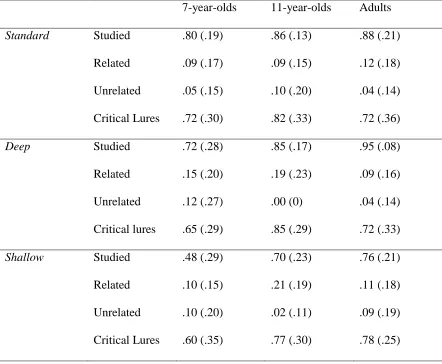
was between-participants. Mean recognition scores are shown in Table 1.
For studied items there was a main effect for levels-of-processing, F(2, 120) =
items were correctly recognized following shallow processing (M = .65) than either the
standard (M = .84) or deep processing conditions (M = .84), and the latter two conditions
did not differ. There was also a main effect for age, F(2, 60) = 9.57, p < .001, ηp² = .24,
where Bonferroni post-hoc tests showed that 7-year-olds (M = .66, p = .017) correctly
recognized fewer items than both 11-year-olds (M = .80) and adults (M = .86, p < .001)
and the latter two age groups did not differ. Further, there was a marginally significant
Age x Levels-of-processing interaction, F(4, 120) = 2.35, p = .058, ηp² = .07. This
interaction occurred because 7-year-olds (p < .001) recognized less following shallow
processing (M = .48) than deep (M = .72) or standard processing (M = .80), and the latter
two conditions did not differ. For 11-year-olds (p = .021) their correct recognition was
lower following shallow (M = .70) than standard processing (M = .86) or deep processing
(M = .84), and the latter two conditions did not differ. In contrast, adults (p = .006)
remembered less following shallow (M = .76) than deep processing (M = .95) both of
which did not differ from standard processing (M = .88). Thus across all ages, shallow
processing reduced correct recognition whereas the effect of deep processing was less
clear.
For false recognition of critical lures, there was no effect for levels-of-processing
but there was a main effect for age, F(2, 60) = 3.37, p = .041, ηp² = .10. Post-hoc
Bonferroni adjacent age groups’ comparisons (p = .036) indicated that 7-year-olds (M =
.66) had fewer false memories than 11-year-olds (M = .82) who in turn did not differ
from adults (M = .74). However, the difference between 7-year-olds’ and adults’ false
Finally, for related and unrelated non-presented items there were no main effects
or interactions. Together, these results show levels of processing affected only true
recollection. That is, although false memory rates increased with age,
levels-of-processing had no effect on false recognition whereas it did have an effect on true
recognition.
Overall Accuracy and False Alarms
Because children are known to have a yea-saying bias, in order to obtain an
overall index of accuracy and an estimate of false alarm rates, we used the two-high
threshold correction³ (Snodgrass & Corwin, 1988). For true recognition we calculated H
– FA(U), where H is the proportion of correct responses to studied items and FA(U) is
the proportion of false alarms to unrelated distractors. For false recognition to critical
lures we calculated FA(CL) – FA(U), where FA(CL) is the proportion of false alarms to
the critical lures.
Using the corrected scores for true recognition we calculated a
3(levels-of-processing: standard vs. deep vs. shallow) x 3(age: 7-year-olds vs. 11-year-olds vs.
adults) ANOVA. The results were similar to the uncorrected scores and revealed a main
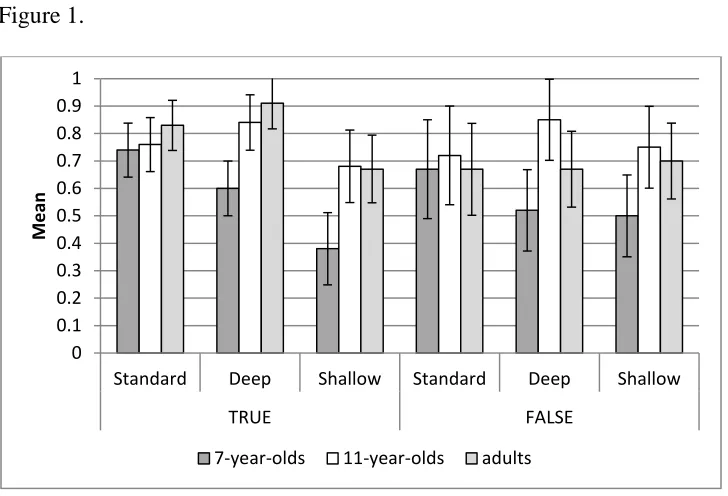
effect for levels-of-processing (Figure 1), F(2, 120) = 18.68, p < .001, ηp² = .24. Post-hoc
Bonferroni comparisons (p < .001) showed that fewer items were correctly identified
following shallow processing (M = .58) than deep (M = .78) or standard processing (M =
.78), and the latter two conditions did not differ. There was also a main effect for age,
F(2, 60) = 10.30, p < .001, ηp² = .26. Post-hoc Bonferroni age groups’ comparisons
indicated that there was a reliable difference between 7-year-olds (M = .57) and both
did not differ. Furthermore, there was a Levels-of-processing x Age interaction, F(4,
120) = 2.97, p = .022, ηp² = .09. This interaction occurred because the youngest age
group had a unique order of correct recognition as a function of levels-of-processing in
comparison to the older participants. For 7-year-olds, more items were recognized
following standard processing (M = .75) than deep (M = .59, p = .041) or shallow
processing (M = .38, p = .008). For 11-year-olds, marginally significantly (p = .059)
more items were recognized following deep processing (M = .84) than shallow
processing (M = .68) but there was no difference in comparison to standard processing
(M = .76). For adults we found the same pattern: deep processing (M = .91) increased
correct recognition in comparison to shallow processing (M = .67, p = .002) and neither
differed from standard processing (M = .83). Together these findings from the corrected
scores suggest that deep processing enhances true recognition and shallow processing
decreases true recognition for adults and 11-year-olds but not necessarily in comparison
to standard processing conditions. In contrast, for 7-year-olds shallow processing
decreases true recognition but only in comparison to standard processing. The effect of
deep processing in 7-year-olds was less clear.
For false recognition (Figure 1), using the corrected scores, we did not find an
effect for levels-of-processing but did find one for age, F(2, 60) = 5.16 p = .009, ηp² =
.15. Bonferroni adjacent age groups’ comparisons (p = .006) revealed that 7-year-olds
(M = .57) had fewer false alarms to critical lures than 11-year-olds (M = .77) who did not
differ from adults (M = .68). As for the uncorrected scores, the difference between
memories increased between 7 and 11 years of age, levels-of-processing had no effect on
false memories regardless of age.
In sum, levels-of-processing affected true recognition where shallow processing
decreased and deep processing increased true memories. In contrast, although false
memories increased with age, levels-of-processing had no effect on false memory rates
regardless of age. Thus, levels-of-processing affects true but not false recognition and
this latter effect is age invariant.
Correlational Analysis
In order to examine individual differences and the relation of true and false
memories under different levels-of processing conditions, we conducted a correlational
analysis for each age group separately. Interestingly, for 7-year-olds there was a strong
association between true and false recognition under shallow processing (r = .57, p <
.001). No further associations emerged, and none of the older two age groups’ true and
false recognition performance revealed any positive correlations. If anything, for adults
there was a negative relation in the deep processing condition between true and false
recognition (r = -.53, p = .009). These findings suggest that when information is encoded
at a shallow level, 7-year-olds’ true and false recognition performance are positively
correlated, whereas for older children and adults they are unrelated.
Discussion
When we examined the effects of levels-of-processing for true and false
recognition separately, we found that encoding information at a deep level (sentence
DRM) increased true recognition for the older age groups whereas encoding information
case for all ages. Thus, both shallow and deep processing affected true recognition rates
for both children and adults. In contrast, the levels-of-processing manipulation had no
effect on false memory rates regardless of age. The lack of a levels-of-processing effect
on false recognition contrasts with previous research with adults (Rhodes & Anastasi,
2000; Thapar & McDermott, 2001; Toglia et al., 1999) that found that
levels-of-processing either decreased or increased false recognition depending on whether
information had been encoded in a shallow or a deep fashion, respectively. However,
these contrasting findings may be due to individual differences in the susceptibility to
false memories, something a between-participants design cannot control for. Our results
are in line with Seamon et al. (1998) who found that memory load had no effect or
decreased false recognition depending on whether a within- or between-participants
design was used, respectively. The advantage of a within-participant design is that it
controls for variability in false memory rates that occur especially in children and is more
comparable to an everyday life scenario where some information may be encoded more
deeply (e.g., an event that is particularly unusual or interesting such as taking a plane for
going on holidays) and some information may be encoded on a shallow level (e.g., events
that have been encountered many times such as a trip to the supermarket). Furthermore,
our results are consistent with the findings from Dewhurst and colleagues (Dewhurst et
al., 2007). They examined true and false recognition rates in 5-, 8-, and 11-year-olds’ in
a standard DRM paradigm compared to a story condition. Specifically, they found that
5-year-olds’ true and false recognition rates were increased when information was
presented in a story compared to the standard list format whereas no difference occurred
Thus, despite differences in story contents and presentation mode between Dewhurst and
colleagues’ and the current study, both found similar false memory rates when
information was presented in a story (deep processing) compared to standard DRM lists
(standard processing) for both 7- and 11-year-olds.
Despite our finding that there are no differences in levels-of-processing effects on
children’s and adults’ false memories, shallow processing affected young children’s and
adults’ memories differently as became apparent in the correlational analysis.
Specifically, when 7-year-olds processed information in a shallow fashion, then the
amount of false memories was dependent on the overall amount remembered and vice
versa. In contrast, for 11-year-olds false memories occurred under different levels of
processing, independent of how much information was correctly or incorrectly
remembered. Moreover, for adults false memories occurred either independently of true
memories or were even negatively related under deep processing. These correlational
findings may indicate that there are qualitative differences between 7-year-olds’ false
memories and those of older children compared to adults. That is, young children’s false
memories may arise out of less automatic processes than adults’ because when they
encode information incidentally their false recognition is contingent on true recognition.
In contrast for adults, there appears to be no relation between how much is correctly or
incorrectly remembered. If anything, true and false recognition were negatively related
under deep processing conditions in adults. We will investigate this potential qualitative
Experiment 2
In Experiment 2 we divided attention during encoding. A comparison of the
different findings from research on divided attention and their mixed results may be
difficult because of the different types of secondary tasks that have been used across
studies (Gallo, 2006). However, the studies by Dewhurst and colleagues (Dewhurst et
al., 2005; Dewhurst et al., 2007; Knott & Dewhurst, 2007) have shown that at encoding,
any secondary task that is resource demanding, whether it inhibits associative processes
(e.g., generating random numbers during list encoding) or increases the memory load
(e.g., remembering several digits during list encoding), prevents the generation of
associative processes which in turn may reduce false recognition. Because the tasks used
in a divided attention paradigm in adult research are too demanding for children, we
implemented a secondary task that is age appropriate and requires inhibitory processes.
Inhibitory processes play a significant role in children’s memory (Bjorklund &
Harnishfeger, 1995; Harnishfeger & Bjorklund, 1994). Inhibition helps children to
ignore irrelevant information and reduces sensitivity to interference (Dempster, 1992). A
lack of inhibition for irrelevant information may cause relevant information to be
encoded less efficiently which may in turn weaken memory traces for relevant events
(Harnishfeger & Bjorklund, 1994). Further, younger children have more problems than
older children and adults when trying to inhibit irrelevant information as an intrusion into
the to-be-remembered information (Bjorklund & Harnishfeger, 1995). Thus, children’s
inhibitory strength is directly linked to the magnitude of irrelevant intrusions in memory
tasks. Therefore, using an inhibitory task will directly interfere with memory processes.
Hong, & Diamond, 1994) that is derived from the most classical test for measuring
inhibitory processes in adults, the Stroop task (Stroop, 1935). Previous research that has
implemented the Day/Night-Stroop task with children has found significant increases in
inhibitory abilities from 3½ to 7 years and to 11 years of age (Gerstadt, et al., 1994;
Simpson & Riggs, 2005). Therefore, this task is an ideal measure for inhibitory
processes within the child age range studied here. In order to keep a direct comparison
with adults and to control for secondary-task consistency, this task is also administered
with adults. Apart from classical studies investigating increases in inhibitory abilities, the
Day/Night-Sroop task has also been used in several studies in order to predict memory
errors following from suggestibility (e.g., Alexander, Goodman, Schaaf, Edelstein, Quas,
Shaver, 2002; Roberts & Powell, 2005; Schaaf, Alexander, & Goodman, 2008). The
basic idea is that children who are better at inhibiting a prepotent response may be less
susceptible to suggestibility. Based on previous research, dividing attention with an
inhibitory task should reduce true recognition, as shown in Dewhurst and colleagues’
research where participants, for example, generated random numbers during list
encoding. For false recognition there are two possibilities: if false memories are derived
from conscious elaboration processes, then divided attention should also reduce false
recognition. If false memories are derived from automatic associative processes, then
false recognition should be little affected. Moreover, if children’s false memories are
generated in a similar way as adults’ false memories then we expect no age differences in
Method
Participants
A total of 60 children and adults (55% female) participated in this experiment, 20
7-year-olds (M = 7.9, SD = 4 months), 20 11-year-olds (M = 11.8, SD = 5 months), and
20 adults (M = 20 years, SD = 1 years). The children were predominantly White, from a
working class background, and were tested following parental consent and their own
assent on the day of testing. The adults were undergraduate students and received
financial reimbursement for their participation.
Design
Overall, each participant received six 13-item standard DRM lists. Three of them
were presented in a divided attention paradigm at study. Here, participants additionally
performed the Day-Night Stroop task. After that each participant received a 3½-minute
distractor task followed by the recognition task.
Materials and Procedure
The six 13-item DRM lists (music, fruit, man, soft, needle, and foot) were all
presented orally at a 2 second rate on a Mac computer and selected according to the same
criteria as in Experiment 1 (see footnote 1). Participants were instructed to remember as
many list items as possible. In addition, for 3 out of the 6 lists participants performed the
Day-Night Stroop task (Gerstadt, et al., 1994; Simpson & Riggs, 2005). Participants
were instructed to press a dark blue button on the keyboard in response to a day scenario
(yellow sun with white background) and a yellow button in response to a night scenario
(white stars and moon with dark blue background). This requires inhibiting a prepotent
with the procedure. Which 3 lists were presented in the divided-attention paradigm was
counterbalanced between participants. Further, the order of divided-attention was
counterbalanced (i.e., either the first 3 lists were presented under divided attention or the
last 3 lists). After that all participants received a 3½-minute distractor task, followed by
the 48-item recognition task, as in Experiment 1.
Results
Day-Night Stroop Task
First, we were interested in how participants performed on the secondary task in
the divided-attention condition. Overall the proportion of correct responses was high and
increased with age, F(2, 57) = 8.06, p = .001, ηp² = .22. Post-hoc Bonferroni comparisons
indicated that 7-year-olds (M = .85) had fewer correct responses than 11-year-olds (M =
.98, p = .004) and adults (M = .98, p = .002) and the latter two groups did not differ.
Similarly, reaction time decreased with age, F(2, 57) = 11.0, p < .001, ηp² = .28; where
both adults (M = 1.69, p < .001) and 11-year-olds (M = 1.95, p = .013) responded faster
than 7-year-olds (M = 2.42). Both findings suggest an increase in inhibitory abilities
between 7 and 11 years of age as well as adulthood.
Chance Performance
As in Experiment 1, we examined whether children and adults performed above
chance on all 4 item types across the different conditions. Seven-year-olds performed
above chance on all item types (at least p < .05 and higher) except for correct items under
divided attention and critical lures under full attention. Eleven-year-olds performed
above chance on all item types (at least p < .01 and higher) except for critical lures under
critical lures under both full and divided attention. Thus, dividing attention affected
children’s and adults’ performance differently.
True and False Recognition
As in the previous experiment, we investigated whether dividing attention at study
affected true and false recognition in comparison to full attention and whether this effect
was the same at all ages. Proportion of “yes” responses to studied items, critical lures,
related items, and unrelated items were analyzed separately in a series of 2(attention: full
vs. divided) x 3(age: 7-year-olds vs. 11-year-olds vs. adults) ANOVAs where the first
factor was within-participant and the latter factor between-subjects. Mean recognition
scores are displayed in Table 2.
For studied items there was a main effect for attention, F(1, 57) = 12.25, p = .001,
ηp² = .18, where more studied items were correctly recognized under full attention (M =
.75) than under divided attention (M = .64). There was also a main effect for age, F(2,
57) = 10.12, p < .001, ηp² = .26. Post-hoc Bonferroni comparisons (p < .001) indicated
that 7-year-olds (M = .57) correctly recognized fewer items than both 11-year-olds (M =
.76) and adults (M = .75) and the latter two groups did not differ. Thus, divided attention
at encoding decreased true memory rates across all ages.
For critical lures there was a main effect for age, F(2, 57) = 4.92, p = .011, ηp² =
.15. Post-hoc Bonferroni adjacent age groups’ comparisons (p = .008) indicated that
7-year-olds (M = .40) had lower levels of false recognition than 11-year-olds (M = .66) who
did not differ from adults (M = .54). The difference between 7-year-olds and adults did
There were no other main effects or interactions. Thus, whereas divided attention
reduces accuracy (true recognition), there were no effects on false memories.
At first glance this pattern of results suggests that divided attention affects true
but not false recall across all ages. However, when looking closer at the means in Table
2,the magnitude of the differences between the full and divided attention is comparable
for the and 11-year olds for the correct items and critical lures (mean differences,
7-year-olds = .12 and .14, respectively; 11-7-year-olds = .12 and .15, respectively). However,
the pattern is different for adults (mean difference = .10 and -.02, respectively). Thus,
despite differences in mean performance, statistically no interaction occurred and the
pattern appears to be the same for children as for adults. The fact that there was no
interaction, suggests that there was a large variation in individual performance. In order
to investigate this further, we conducted a correlational analysis below.
Overall Accuracy and False Alarms
As in Experiment 1, we controlled for response bias and used the two-high
threshold correction (Snodgrass & Corwin, 1988). As for raw scores, using the corrected
scores for true recognition, a 2(attention: full vs. divided) x 3(age group: 7-year-olds vs.
11-year-olds vs. Adults) ANOVA revealed a main effect for attention; F(1, 57) = 5.3, p =
.025, ηp² = .09, where more studied items were correctly recognized under full attention
(M = .56) than under divided attention (M = .46). There was also a main effect for age
group; F(2, 57) = 4.25, p = .019, ηp² = .13. Post-hoc Bonferroni comparisons indicated
that there was a reliable difference between 7-year-olds (M = .40, p = .016) and adults (M
= .63) whereas the 11-year-olds’ level of recognition (M = .50) was in between and did
Using the corrected scores for false recognition, a 2(attention: full vs. divided) x
3(age group: 7-year-olds vs. 11-year-olds vs. adults) ANOVA did not reveal any main
effects.
Thus, like the raw scores, for true recognition the level of attention affects
performance and increases with age whereas for false recognition the level of attention
had no effect. In contrast to the raw score analysis, with the corrected scores, the age
increase in false memory formation disappeared.
Correlational analysis
In order to control for individual differences in the susceptibility to false
memories, we conducted a correlational analysis comparing correct and false recognition
performance under full versus divided attention for each age group separately.
Interestingly, there was a strong association between true and false recognition under
divided attention for both 7-year-olds (r = .70, p < .001) and 11-year-olds (r = .57, p <
.008). There was no association between true and false recognition under full attention
(7-year-olds: r = .24,n.s.; 11-year-olds: r = .34, n.s.). In contrast, for adults true and false
recognition were unrelated irrespective of attentional mode (full attention: r = .14;
divided attention: r = .08, n.s.). Thus, a different pattern emerges for children and adults
under divided attention.
Discussion
The reduction of true recognition under divided attention is consistent with
previous research that included adult participants (Dewhurst et al. 2005; 2007; Knott &
Dewhurst, 2007). However, these studies also found a similar decrease in false
of divided attention for false recognition. This latter finding is more consistent with
Seamon et al.’s (2003) study that did not find any effect of divided attention on false
recognition in adults. It is possible that the secondary task used may account for the
differences in findings across studies. However, previously used secondary tasks would
not have been appropriate for the current purpose. As noted earlier, it was important to
use a secondary task that is taxing for both children and adults. The Day/Night Stroop
task has been administered with children in previous studies (e.g., Gerstadt et al., 1994;
Simpson & Riggs, 2005) but not with adults. It is possible that this task was less
demanding for adults than it was for children. However, this seems unlikely given the
finding that under divided attention true recognition decreased across all ages. This
finding suggests that the Day/Night Stroop task was effective in dividing attention for
both children and adults4. Moreover, the implementation of the Day/Night Stroop task
allowed for objective measures of participants’ performances on the secondary task in
comparison to previous studies that have used (e.g.) random number generation as a
measure of divided attention. The disadvantage with (e.g.) a random number generation
is that participants perform this task internally. Thus, there is no objective measure
whether all participants follow the instructions properly, something that requires control
in children.
Overall, although findings vary across studies that have implemented a
divided-attention paradigm, altogether it seems that the secondary task has to be a labor intensive
continuous central executive task if it affects false memories (i.e., reduces them) as found
attention has an effect on false memories, then this may provide further indication that
false memories are fairly robust and generated from automatic associative processes.
However, the important finding concerns false recognition compared to true
recognition as a function of attention in children compared to adults. What the findings
of our correlational analysis revealed is that for both child participant groups, true and
false recognition were strongly associated when attention was divided. In contrast, for
adults, true and false memory formation was unrelated. Specifically, when children
encoded information under divided attention then the occurrence of false memories was
dependent on the amount of true memories and vice versa. What this finding suggests is
that there may be qualitative differences in children’s and adults’ false memories. That
is, when the attentional level is low then children’s false memories seem to be contingent
on the overall amount remembered whereas no such relation exists in adults.
Finally, two of the current findings require closer attention. First, we found very
low levels of false recognition for adults under full attention. We do not have a plausible
explanation other than variations in populations and individual differences in
susceptibility to false memories (also see Unsworth & Brewer, 2010). Second, we found
higher levels of false alarms to unrelated non-presented items for 11-year-olds than for
7-year-olds. Here the threshold corrected analysis provides more insight. That is, despite
11-year-olds’ high levels of false alarms to unrelated non-presented items, their overall
true recognition rates are higher than those of 7-year-olds, although this is not statistically
significant. Thus, although 11-year-olds made more errors, in relation they also
General Discussion
The current experiments were designed to assess the robustness of adults’ and
children’s false memories and to establish whether there are differences in the
automaticity with which false memories arise during the generation stage itself. Across
both experiments it has been demonstrated that manipulating levels-of-processing or
dividing attention significantly affects both children’s and adults’ true memories.
Conversely, false memory rates were left unaffected by any experimental manipulation of
levels-of-processing or divided attention. Most importantly, this latter effect was age
invariant.
At first glance these findings suggest that false memories are fairly robust and are
generated automatically inasmuch as they are not affected by levels-of-processing or by
dividing attention. However, the lack of and age x divided attention interaction in
Experiment 2 and the findings of our correlational analysis across both experiments give
some grounds for caution. In particular, in Experiment 1 we found that only under
shallow processing and only for the youngest age group, false memory formation was
significantly dependent on the amount of true recognition and vice versa. Further, in
Experiment 2 we found a similar pattern for divided attention for both child participant
groups. Here, only under divided attention and only for 7- and 11-year-olds, false
recognition rates were dependent on true recognition and vice versa. In contrast for
adults, there appeared to be no association between true and false recognition across both
experiments. More importantly, we found this pattern despite an overall increase in the
quantity of false recognition with age, which was due to an increase between the ages of
false memory levels were relatively low and comparable to those of 11-year-olds but
statistically did not differ significantly from those of 7-year-olds. This finding reflects
the fact that the susceptibility to false memories varies with variations in populations and
converges on inconsistent findings from studies with adults on the effects of
levels-of-processing and divided attention as noted in the introduction. Overall we found that
when information is encoded incidentally (either through shallow processing or divided
attention) then children’s false memory rates appear to differ from adults’ because their
occurrence depends on the level of true memories (and vice versa) whereas for adults this
was not the case.
Two additional findings support the reliability of the current results. First, across
both experiments, levels-of-processing and divided attention affected true memory rates
across all ages. Thus, the manipulations implemented were effective for both children
and adults. Second, across both experiments, false memory rates increased with age,
except for the corrected scores in Experiment 2. Specifically, in both experiments false
memories increased between 7 and 11 years of age but not into adulthood. Additionally,
the relation between true and false recognition under shallow processing and divided
attention differed for 7-year-olds compared to both 11-year-olds and adults (Experiment
1) and for both child participant groups compared to adults (Experiment 2). This finding
may indicate that potential differences in quality of false memories occur independently
from quantitative changes.
Most of our findings can be explained by both developmental false memory
theories. Both Fuzzy-Trace-Theory (Brainerd, et al., 2008) and
found across both experiments. Both theories agree that children need to have a
semantic/associative lexicon or the necessary knowledge base in order to elicit false
memories. It is established that children can form associative links between concepts at a
relatively young age, but these links are strengthened and refined with increases in both
knowledge and experience (Bjorklund, 2005). Thus, increases in the quantity of false
memories with age have something to do with the fact that children simply gain more
experience and knowledge of concepts and their relations in the world5.
However, as previous research has shown, this increase in knowledge base alone
cannot explain false memory increases with age (Anastasi & Rhodes, 2008; Carneiro,
Albuquerque, Fernandez, & Esteves, 2007; Metzger, Warren, Shelton, Price, Reed, &
Williams, 2008). That is, false memory formation increases with age even when it is
mapped onto the knowledge base of very young children. Where the two false memory
theories diverge is in the suggested processes that activate our semantic lexicon:
associative-activation (AAT) versus gist extraction (FTT). As noted above, quantitative
increases can be well explained by both theories. Qualitative differences between
children’s and adults’ false memories, specifically differences in automaticity, are
predicted by AAT whereas FTT does not make any specific claims with regard to
automaticity.
Altogether, our findings fit into recent research that found increases in the
automaticity of the generation of word associates that may lead to false memories
between the ages of 5, 7, and 11(Wimmer & Howe, 2009). This finding may indicate
qualitative differences between younger and older primary school aged children in the
differences in automatic processing after false memories have been generated.
Specifically, research on directed forgetting shows that adults’ true memory rates are
significantly reduced under directed forgetting instructions whereas false memory rates
are not (Kimball & Bjork, 2002; Seamon et al., 2002). In contrast, both children’s true
and false memory rates are reduced given a directed forgetting instruction (Howe, 2005;
Howe, Toth, & Cicchetti, in press). Thus, according to these studies there appears to be
qualitative, as well as quantitative, developmental differences in false memories after
information has been generated or encoded such that false items may enter children’s
conscious awareness whereas they can remain outside of conscious awareness for adults.
The question whether children’s and adults’ false memories differ qualitatively
may be of fundamental importance for forensic settings. In particular, the finding that
children’s false memories may be less automatic than those of adults but may be derived
from more effortful conscious processing, may allow for using different memorial
strategies (e.g., directed forgetting, Howe, 2005) in order to control for the occurrence of
false memories in an interview situation and may in turn increase the reliability of
children’s forensic reports.
A further important issue is whether results arising from the DRM paradigm can
have implications for the legal arena. That is, because the DRM paradigm is limited to
study-list procedures there is some discussion whether the DRM paradigm is a valid tool
for investigating false memories in the real world (e.g., Pezdek & Lam, 2007). Evidence
suggests that findings from the DRM paradigms can also translate into real world settings
(e.g., Platt, Lacey, Iobst, & Finkelmann, 1998) but more research is warranted that
technique is that it allows examining the core cognitive processes underlying false
memories that can occur in everyday-life. This may also explain the wealth of empirical
research that has implemented the DRM paradigm over the last decade (see Brainerd et
al., 2008 for an overview). For the current purpose, the implementation of the DRM
paradigm proved useful because it allowed us to investigate whether there would be
qualitative differences in children’s and adults’ false memories that can be attributed to
cognitive factors per se.
In sum the current research reveals two main findings. Levels-of-processing and
divided-attention manipulations both affect true recognition across all ages. Individually,
the occurrence of false memories depends on the overall amount of information
remembered when information is processed on a shallow level (7-year-olds) and under
divided attention (7- and 11-year-olds) and vice versa whereas for adults false memories
occur irrespective of the amount of information correctly remembered. This may suggest
a qualitative difference in children’s and adults’ false memory formation. Recent
research has shown that children’s formation of associative concepts increases in
automaticity with age but is already fairly automatic by the age of 5 (Wimmer & Howe,
2009). What the current research adds is that children’s false memories may also differ
in the quality to those generated by adults. Further research will be required to establish
References
Alexander, K. W., Goodman, G. S., Schaaf, J. M., Edelstein, R. S., Quas, J. A., & Shaver,
P. R. (2002). The role of attachment and cognitive inhibition in children’s
memory and suggestibility for a stressful event. Journal of Experimental Child
Psychology, 83, 262-290.
Anastasi, J. S., & Rhodes, M. G. (2008). Examining differences in levels of false
memories in children and adults using child-normed lists. Developmental
Psychology, 44, 889-894.
Bjorklund, D. F. (2005). Children’s thinking: Developmental and individual differences
(4th edition). Belmont, CA: Wadsworth/Thompson.
Bjorklund, D. F., & Harnishfeger, K. (1995). The evolution of inhibition mechanisms and
their role in human cognition and behavior. In F. N. Dempster & C. J. Brainerd
(Eds.), Interference and inhibition in cognition (pp. 141-173). San Diego:
Academic Press.
Brainerd, C. J., Forrest, T. J., Karibian, D., & Reyna, V. F. (2006). Development of the
false-memory illusion. Developmental Psychology, 42, 962-979.
Brainerd, C. J., & Reyna, V. F. (2005). The science of false memory. New York: Oxford
University Press.
Brainerd, C. J., Reyna, V. F., & Ceci, S. J. (2008). Developmental reversals in false
memory: A review of data and theory. Psychological Bulletin, 134, 343-382.
Carneiro, P., Albuquerque, P., Fernandez, A., & Esteves, F. (2007). Analyzing false
memories in children with associative lists specific for their age. Child
Collins, A. M., & Loftus, E. F. (1975). A spreading-activation theory of semantic
processing. Psychological Review, 82, 407-428.
Deese, J. (1959). On the prediction of occurrence of certain verbal intrusions in free
recall. Journal of Experimental Psychology, 58, 17-22.
Dempster, F. N. (1992). The rise and fall of the inhibitory mechanism: Toward a unified
theory of cognitive development and ageing. Developmental Review, 12, 45-75.
Dewhurst, S. A., Barry, C., & Holmes, S. (2005). Exploring the false recognition of
category exemplars: Effects of divided attention and explicit generation.
European Journal of Cognitive Psychology, 17, 803-819.
Dewhurst, S. A., Barry, C., Swannell, E. R., Holmes, S. J., & Bathurst, L. (2007). The
effect of divided attention on false memory depends on how memory is tested.
Memory & Cognition, 35, 660-667.
Dewhurst, S. A., Bould, E., Knott, L. M., & Thorley, C. (2009). The roles of encoding
and retrieval processes in associative and categorical memory illusions. Journal of
Memory and Language, 60, 154-164.
Dewhurst, S. A., Pursglove, R. C., & Lewis, C. (2007). Story contexts increase
susceptibility to the DRM illusion in 5-year-olds. Developmental Science, 10,
374-378.
Dewhurst, S. A., & Robinson, C. A. (2004). False memories in children: Evidence for a
shift from phonological to semantic associations. Psychological Science, 15,
782-786.
Dodd, M. D., & McLeod, C. M. (2004). False recognition without intentional learning.
Gallo, D. A. (2006). Associative illusions of memory: False memory research in DRM
and related tasks. New York: Psychology Press.
Gallo, D. A., Roberts, M. J., & Seamon, J. G. (1997). Remembering words not presented
in lists: Can we avoid creating false memories? Psychonomic Bulletin & Review,
4, 271-276.
Gallo, D. A., Roediger, H. L., III, & McDermott, K. B. (2001). Associative false
recognition occurs without strategic criterion shifts. Psychonomic Bulletin &
Review, 8, 579-586.
Gerstadt, C. L., Hong, Y. J., & Diamond, A. (1994). The relationship between cognition
and action: Performance of 3 ½-7 years old on a Stroop-like day-night test.
Cognition, 53, 129-153.
Ghetti, S. (2008). Rejection of false events in childhood. A metamemory account.
Current Directions in Psychological Science, 17, 16-20.
Harnishfeger, K., & Bjorklund, D. F. (1994). A developmental perspective on individual
differences in inhibition. Special issue: Developmental perspectives on individual
differences in learning and memory, 6, 331-335.
Howe, M. L. (2005). Children (but not adults) can inhibit false memories. Psychological
Science, 16, 927-931.
Howe, M. L. (2006). Developmentally invariant dissociations in children’s true and false
memories: Not all relatedness is created equal. Child Development, 77,
1112-1123.
Howe, M. L. (2008). Visual distinctiveness and the development of children’s false
Howe, M. L., Toth, S. L., & Cicchetti, D. (in press). Can maltreated children inhibit true
and false memories for emotional information? Child Development.
Howe, M. L., Wimmer, M. C., & Blease, K. (2009b). The role of associative strength in
children’s false memory illusions. Memory, 17, 8-16.
Howe, M. L., Wimmer, M. C., Gagnon, N., & Plumpton, S. (2009a). An associative
activation theory of children’s and adults’ memory illusions. Journal of Memory
and Language, 60, 229-251.
Kimball, D. R., & Bjork, R. A. (2002). Influences of intentional and unintentional
forgetting on false memories. Journal of Experimental Psychology: General, 131,
116–130.
Kimball, D. R., Smith, T. A., & Kahana, M. J. (2007). The fSAM model of false recall.
Psychological Review, 114, 954-993.
Knott, L. M., & Dewhurst, S. A. (2007). The effects of divided attention at study and test
on false recognition: A comparison of DRM and categorized lists. Memory &
Cognition, 35, 1954-1965.
Landauer, T. K., & Dumais, S. T. (1997). A solution to Plato’s problem: The latent
semantic analysis theory of acquisition, induction, and the representation of
knowledge. Psychological Review, 104, 211-240.
Marche, T. A., Brainerd, C. J., Lane, D. G., & Leohr, J. D. (2005). Item-level directed
forgetting diminished false-memory. Memory, 13, 749-758.
McDermott, K. B. (1997). Priming on perceptual implicit memory tests can be achieved