City, University of London Institutional Repository
Citation: Hunt, S. and Sands, D. (2006). On flow-sensitive security types. ACM
SIGPLAN-SIGACT, 41, pp. 79-90. ISSN 0362-1340
This is the unspecified version of the paper.
This version of the publication may differ from the final published
version.
Permanent repository link: http://openaccess.city.ac.uk/194/
Link to published version:
Copyright and reuse: City Research Online aims to make research
outputs of City, University of London available to a wider audience.
Copyright and Moral Rights remain with the author(s) and/or copyright
holders. URLs from City Research Online may be freely distributed and
linked to.
On Flow-Sensitive Security Types
Sebastian Hunt
Department of Computing School of Informatics, City UniversityLondon EC1V OHB, UK [email protected]
David Sands
Department of Computer Science and Engineering, Chalmers University of Technology
G¨oteborg, Sweden [email protected]
Abstract
This article investigates formal properties of a family of seman-tically sound flow-sensitive type systems for tracking information flow in simple While programs. The family is indexed by the choice of flow lattice.
By choosing the flow lattice to be the powerset of program vari-ables, we obtain a system which, in a very strong sense, subsumes all other systems in the family (in particular, for each program, it provides a principal typing from which all others may be inferred). This distinguished system is shown to be equivalent to, though more simply described than, Amtoft and Banerjee’s Hoare-style in-dependence logic (SAS’04).
In general, some lattices are more expressive than others. De-spite this, we show that no type system in the family can give better results for a given choice of lattice than the type system for that lattice itself.
Finally, for any program typeable in one of these systems, we show how to construct an equivalent program which is typeable in a simple flow-insensitive system. We argue that this general approach could be useful in a proof-carrying-code setting.
Categories and Subject Descriptors D.3 [PROGRAMMING LAN-GUAGES]; F.3.1 [LOGICS AND MEANINGS OF PROGRAMS]: Specifying and Verifying and Reasoning about Programs; F.3.2 [LOGICS AND MEANINGS OF PROGRAMS]: Semantics of Pro-gramming Languages—Program analysis
General Terms Languages, Security, Theory
Keywords flow-sensitivity, information flow, non-interference, static analysis, type systems
1.
Introduction
This article investigates formal properties of a family of flow-sensitive type systems for tracking information flow.
The analysis of information flow in programs has received con-siderable attention in recent years due to its connection to the prob-lem of secure information flow [SM03]. The classic end-to-end confidentiality policy says that if certain data in a system is consid-ered secret from the perspective of a certain observer of the system, then during computation there should be no information flow from
Permission to make digital or hard copies of all or part of this work for personal or classroom use is granted without fee provided that copies are not made or distributed for profit or commercial advantage and that copies bear this notice and the full citation on the first page. To copy otherwise, to republish, to post on servers or to redistribute to lists, requires prior specific permission and/or a fee.
POPL’06 January 11–13, 2006, Charleston, South Carolina, USA. This version includes corrections of some small errors in the published version.
Copyright c2006 ACM 1-59593-027-2/06/0001. . . $5.00.
that data to that observer. Denning and Denning [DD77] pioneered the use of program analysis to statically determine if the informa-tion flow properties of a program satisfy a certain confidentiality policy.
Most of the more recent work in this area (see [SM03] for an overview) has been based upon the use of security type systems to formulate the analysis of secure information flow, and to aid in a rigorous proof of its correctness.
We will focus, like many works in the area, on systems in which secrets are stored in variables. Security levels are associated with variables, and this describes the intended secrecy of the contents. The simplest instance of the problem involves two security levels: high (h) which denotes secrets, and low (l) which denotes public data. A partial ordering,l ⊑ h, denotes that the only permitted information flow is fromltoh. The security problem is to verify that there is no dependency between the initial value of the high variables (the secret to which the program has access), and the final value of the low variables (the outputs which are visible to the public).
With respect to the treatment of variables, one feature of almost all recent type based systems is that they are flow-insensitive. This means that the order of execution is not taken into account in the analysis. One simple intuition for the notion of flow-insensitivity [NRH99] is that an analysis is flow-insensitive if the results for analysingC1 ;C2are the same as that forC2;C1. In this respect
the analysis of [VSI96] (which can be viewed as a reformulation of Denning and Denning’s original analysis) is flow-insensitive. In particular flow-insensitivity of this style of type system means that if a program is to be typed as “secure” then every subprogram must also be typed as “secure”. So for example the trivial program l:= h; l:= 0wherehcontains a secret, and the final value of lis low (publicly observable) is considered insecure because the subprograml:=his insecure.
More generally, flow-insensitivity uses a single abstraction (in this case a single security level) to represent each variable in the program. Flow-sensitivity, on the other hand, increases accuracy by providing a different abstraction at each program point.
Although there are a number of empirical/experimental analy-ses of the relationship between flow-sensitive and flow-insensitive program analyses (see e.g. [CH95]), there has been very little dis-cussion of this dimension in connection to information flow analy-sis.
In this article we investigate flow-sensitive typings for a sim-ple While language. We present a family of semantically sound se-curity type systems (parameterised by the choice of flow lattice) which allow the type of a variable to “float”, assigning different security types at different points in the program (Section 2).
•Although we can freely choose an arbitrarily complex flow lat-tice, there is a single “universal” latlat-tice, and hence a single type system, from which all other typings in all other instances can be deduced. In fact, all possible typings in all possible lat-tices can be obtained from one principal typing in the universal lattice. From the principal typing, we can construct both the strongest (smallest) output typing for a given input typing, and the weakest (largest) input typing for a given output typing. The universal lattice is the powerset of program variables.
•For the universal lattice, we show that the type system is equiv-alent to Amtoft and Banerjee’s Hoare-like logic for program de-pendence [AB04], which is expressed in terms of input-variable output-variable independence pairs. Because our formulation is based on dependence rather than independence, it is arguably simpler and admits a more straightforward correctness proof, without the need to resort to a non-standard trace semantics.
•In general, some lattices are more expressive than others. For example, in contrast to the two-point lattice l ⊑ h, a single derivation in the type system for the universal lattice can iden-tify fine-grained inter-variable dependencies of the form “xmay depend on the initial value ofybut not onz”. Despite this vari-ation in expressiveness, we establish in Section 6 an “internal completeness” result which shows that no type system in the family can give better results for a given choice of lattice than the type system for that lattice itself.
•Finally in Section 7 we show that for any program typeable in an instance of the flow-sensitive system, we are able to con-struct an equivalent program which is typeable in a simple flow-insensitive system. The translation is given by a security-type-directed translation, introducing extra variables. This general approach could be useful in a proof-carrying-code setting where the code consumer can have a simple type system, but the code producer is free to work in a more permissive system and use the translation to provide more easily checked code.
1.1 Related Work
A number of authors have presented flow-sensitive information flow analyses e.g. [CHH02]. Those close in style to a type system formulation include Banˆatre et al [BBL94], who present a system very similar to that of [AB04], except that all indirect flows are handled in a pre-pass. Andrews and Reitman describe a similar logic [AR80] but did not consider semantic soundness.
In the treatment of information flow analysis of low level code (e.g., [GS05, HS05]), flow-sensitivity arises as an essential compo-nent to handle single threaded structures such as stacks and regis-ters, since obviously stacks and registers cannot be assigned a fixed type throughout program execution.
The transformation we present in Section 7 is related to sin-gle static assignment(SSA)[CFR+89], although the perspective is quite different. We discuss this further in Section 7.6
2.
A Family of Type Systems
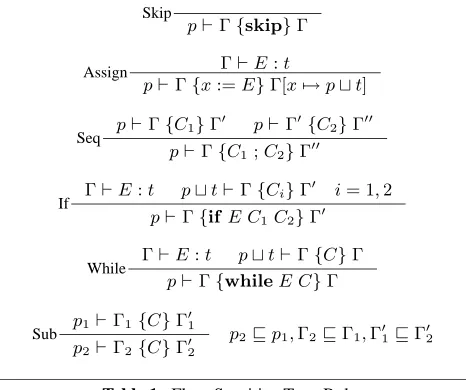
We work with a simple While language with the usual seman-tics. Program variables are drawn from a finite setVar. A flow-insensitive type system, such as that in [VSI96], has the following form: each variable is assigned a fixed security level. When assign-ing an expression to a variablex:=E, all variables inEmust have an equal or lower security level. When assignments take place in loops or conditional branches, to avoid indirect information flows the level ofxmust be at least as high as the level of any variable in the branching expression.
To allow types to be flow-sensitive, we must allow the type of a variable to “float”. For example, taking the two-point flow lattice, when assigning an expression to a variablex:=y+x, ifxhas type
Skip
p⊢Γ{skip}Γ
Assign Γ⊢E:t
p⊢Γ{x:=E}Γ[x7→p⊔t]
Seq p⊢Γ{C1}Γ
′
p⊢Γ′
{C2}Γ′′
p⊢Γ{C1;C2}Γ′′
If Γ⊢E:t p⊔t⊢Γ{Ci}Γ
′
i= 1,2
p⊢Γ{if E C1C2}Γ′
While Γ⊢E:t p⊔t⊢Γ{C}Γ
p⊢Γ{whileE C}Γ
Sub p1⊢Γ1{C}Γ
′
1
p2⊢Γ2{C}Γ′2
p2⊑p1,Γ2⊑Γ1,Γ′1⊑Γ
′
[image:3.612.320.553.76.271.2]2
Table 1. Flow-Sensitive Type Rules
lbefore the assignment andyhas typeh, then after the assignment xmust be considered to have typeh.
The flow-sensitive system we define is a family of inference systems, one for each choice of flow latticeL(whereLmay be any finite lattice). For a commandC, judgements have the form
p⊢LΓ{C}Γ ′
wherep∈ L, andΓ,Γ′
are type environments of typeVar → L. The inference rules are shown in Table 1. The idea is that ifΓ de-scribes the security levels of variables which hold before execution ofC, then Γ′
will describe the security levels of those variables after execution ofC. The typep represents the usual “program counter” level and serves to eliminate indirect information flows; the derivation rules ensure that only variables which end up (inΓ′
) with types greater than or equal topmay be changed byC. We write ⊢L Γ{C} Γ′to mean⊥L ⊢L Γ{C}Γ′. We drop theL
subscript from judgements where the identity of the lattice is clear from the context or is not relevant to the discussion.
In some of the derivation rules we writeΓ⊢E:tto mean that expressionEhas typetassuming type environmentΓ. Throughout this paper the type of an expression is defined simply by taking the lub of the types of its free variables:
Γ⊢E:tifft= G x∈fv(E)
Γ(x).
This is consistent with the typings used in many systems, though more sophisticated typing rules for expressions would be possible in principle.
3.
Semantic Soundness
The type systems satisfy a straightforward non-interference condi-tion: only changes to inputs with types⊑tshould be visible to out-puts with typet. More precisely, given a derivation ⊢Γ{C}Γ′
, the final value of a variablexwith final type t = Γ′
(x), should depend at most on the initial values of those variablesywith initial typesΓ(y)⊑t. Following [HS91, SS01, HR98] we formalise this using equivalence relations.
We note that this is a partial correctness condition: it allows C to terminate onσ but diverge onρ, even whenσ R ρ. This reflects the fact that the type systems take no account of the ways in which the values of variables may affect a program’s termination behaviour. GivenΓ : Var→ Landt∈ L, we write=Γ,tfor the
equivalence relation on stores which relates stores which are equal on all variables having type⊑tin environmentΓ, thus:σ=Γ,tρ
iff∀x.Γ(x)⊑t⇒σ(x) =ρ(x).
The formal statement of correctness for a derivationp⊢Γ{C}
Γ′
has two parts, one asserting a simple safety property relating top(as described in Section 2) and the other asserting the non-interference property.
Definition 3.2. The semantic security relationp |=L Γ {C} Γ′
holds iff both the following conditions are satisfied:
1. For allσ, σ′
, x, ifhC, σi ⇓ σ′
andΓ′
(x) 6⊒p, thenσ′
(x) =
σ(x).
2. For allt∈ L,C: (=Γ,t)⇒(=Γ′,t).
As with⊢L, we suppress theLsubscript where possible. We
write |=L Γ {C} Γ′ to mean⊥L |=L Γ {C} Γ′ (note that
condition 1 is vacuous forp=⊥).
Theorem 3.3 (Semantic Soundness). p ⊢L Γ{C}Γ′ ⇒ p|=L
Γ{C}Γ′
.
The proof for condition 2 of the semantic security relation depends on condition 1, but not vice versa. Proof of condition 1 is by an easy argument thatΓ′
(x) 6⊒ pimplies thatC contains no assignments tox. Proof of condition 2 is by induction on the derivation.
The reverse implication, semantic completeness, does not hold, as shown by the following:
Example 3.4. Consider the programC def= if (h == 0) (l :=
h) (l := 0). This is semantically equivalent to l := 0so it is clear that |= Γ {C} Γ holds for arbitrary Γ. However, for
Γ(h) = h,Γ(l) = l, with l ⊏ h, 6 ⊢ Γ {C} Γ, because
Γ⊢(h== 0) :hand the assignments tolforceΓ′
(l)⊒h.
4.
The Algorithmic Type System
In this section we introduce a variant of the typing rules in which the weakening rule (Sub) is removed and folded into the If and While rules. The result is a system which calculates the smallest
Γ′
such thatp⊢LΓ{C}Γ ′
. The Skip, Assign and Seq rules are unchanged. The replacement If and While rules are shown in Ta-ble 2. The rules are deterministic: given an input type environment exactly one derivation is possible for any givenC. (Well, almost. The While rule allows the chainΓ′
0,Γ
′
1,· · ·,Γ
′
nto be extended
ar-bitrarily by appending unnecessary repetitions of the limit. We may assume thatnis chosen minimally.)
Theorem 4.1 (Algorithmic Correctness). For allLand for allC:
1. For allp,Γ, there exists a uniqueΓ′
such thatp⊢a
LΓ{C}Γ ′
and furthermore, the corresponding functionAC
L(p,Γ)7→ Γ ′
is monotone.
2. Ifp⊢LΓ{C}Γ′thenACL(p,Γ)⊑Γ ′
. 3. Ifp⊢a
LΓ{C}Γ ′
thenp⊢LΓ{C}Γ′.
Corollary 4.2. AC
L(p,Γ)is the leastΓ ′
such thatp⊢LΓ{C}Γ′.
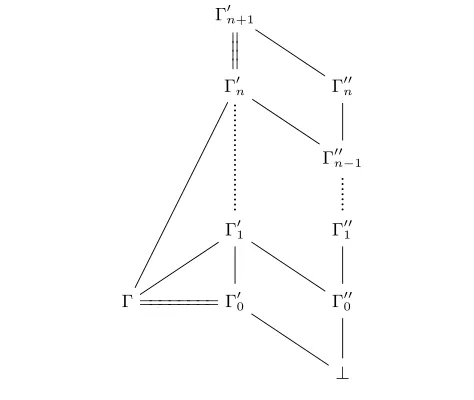
Proof of Algorithmic Correctness. Proof of part 1 of the theorem is by induction on the structure of the command. The interest-ing case iswhile E C. By induction hypothesis,AC
L is
well-defined and monotone. It follows that the sequencesΓ,Γ′
1,Γ
′
2, . . .
and⊥,Γ′′
0,Γ
′′
1, . . .may be constructed asΓ, F(Γ), F2(Γ), . . .and
Γ′n+1
Γ′
n
w w w w
Γ′′
n
Γ′′n−1
Γ′1
... ... ... ... ... ... ... .
Γ′′1
... ... .
Γ ======== Γ′0 Γ
′′
0
[image:4.612.316.553.71.271.2]⊥
Figure 1. Construction of a Minimal While Typing
⊥, G(⊥), G2(⊥), . . ., withFandGbeing monotone functions de-rived fromAC
L; thus these sequences form the ascending chains
shown in Figure 1. The chains have finite height because the lat-tices are finite, thusnis guaranteed to exist such thatΓ′
n+1 = Γ
′
n
and it is then immediate thatΓ′
m = Γ
′
nfor allm > n. Put more
succinctly, the While rule specifiesΓ′
nas an iterative construction
of the least fixed point of a monotone function on a finite lattice. The proofs of parts 2 and 3 of the theorem are then by straight-forward inductions on thep⊢LΓ{C}Γ
′
derivation and the struc-ture ofC, respectively.
In Section 7 we adapt this version of the type system to define a program transformation which allows the use of conventional fixed-type systems in place of the flow-sensitive ones.
5.
A Limiting Case: Dependency Analysis
Given the correctness condition, it is clear that the type systems de-fined above are calculating dependency relationships between pro-gram variables. Intuitively, we might expect to gain the most pre-cise dependency information by choosing the flow latticeP(Var), which allows us to consider arbitrary sets of variables (including the singleton sets) as distinct types. In Section 6 we explore in de-tail this question of precision, with some slightly surprising results. Section 6 also formally establishes the special status of the type system forP(Var); anticipating this, we introduce some terminol-ogy:
Definition 5.1. The universal lattice is the flow latticeP(Var)of sets of program variables. The universal system is the correspond-ing type system.
In this section we show that the universal system is equivalent to (is, in fact, the De Morgan dual of) Amtoft and Banerjee’s Hoare-style independence logic [AB04].
For notational clarity when comparing the universal system with other choices ofL, we let∆,∆′
range over type environments just in the universal system (thus∆,∆′
If Γ⊢E:t p⊔t⊢
aΓ{C
i}Γ′i i= 1,2
p⊢aΓ{ifE C
1C2}Γ′
Γ′
= Γ′
1⊔Γ
′
2
While Γ
′
i⊢E:ti p⊔ti⊢aΓ′i{C}Γ
′′
i 0≤i≤n
p⊢aΓ{whileE C}Γ′
n
Γ′
0= Γ, Γ′i+1= Γ′′i ⊔Γ, Γ
′
n+1= Γ′n
Table 2. Flow-Sensitive Type Rules: Algorithmic Version
5.1 Comparison with Amtoft-Banerjee Hoare Logic
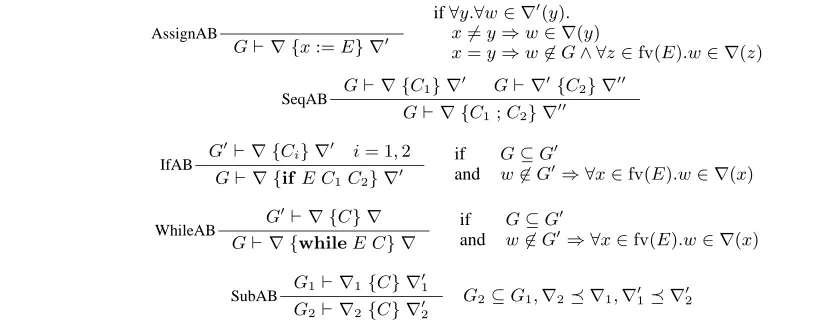
In [AB04], Amtoft and Banerjee define a Hoare-style logic for deducing independence relationships between variables in While programs. Judgements in the logic have the form
G⊢T {C}T′ whereG ∈ P(Var) and T, T′
∈ P(Var×Var). The idea is roughly as follows. Suppose thatCis preceded by some previous computation on the store. We will refer to the value of a variable before this preceding computation as its original value. Then a pair[x#y]inT′ represents an assertion that the value ofxafter Cis independent of the original value ofy, assuming that all the independence pairs inT are valid for the preceding computation. For ease of comparison, rather than sets of independence pairs T, we present the logic in terms of mappings∇,∇′
: Var → P(Var)(this depends simply on the set isomorphismP(A×B)∼=
A → P(B)). Thus Amtoft-Banerjee (AB) judgements in our presentation have the form
G⊢ ∇ {C} ∇′
The AB derivation rules are shown in Table 3. The orderingis pointwise reverse subset inclusion, thus:
∇1 ∇2iff∀x∈Var.∇1(x)⊇ ∇2(x)
Note that the ordering used onGis just⊆, not.
The relationship between the AB logic and the universal sys-tem is straightforward: for each∆there is a corresponding∇such that∇(x)is the complement of∆(x). Where the universal sys-tem derives sets of dependencies, the AB logic simply derives the complementary set of independencies. (An AB context setG, on the other hand, corresponds directly to the same setpin aP(Var) -derivation.) We use the following notation:
∆ def= ∇, where∇(x) = Var−∆(x)
∇ def
= ∆, where∆(x) = Var− ∇(x)
Clearly this is an order isomorphism:∆ = ∆and∆1 ⊑ ∆2iff
∆1∆2, etc.
Theorem 5.2. The AB logic and the universal system are De
Morgan duals. That is, G ⊢ ∆ {C} ∆′
is derivable in the universal system iffG⊢ ∆{C}∆′is derivable in the AB logic.
The proof amounts, essentially, to showing that each AB rule is the dual of the universal system counterpart. This is not quite literally true, since the way some AB rules are formulated builds in the potential for implicit weakening, which must be made explicit using Sub in the correspondingP(Var)-derivation. For example, consider the second side condition on the rule IfAB. If we re-state this in its contrapositive form
(∃x∈fv(E).w6∈ ∇(x))⇒w∈G′
it is easily seen that the two side-conditions together amount to
G′⊇G ∪ [
x∈fv(E)
∇(x) (1)
Note that any subderivation concluding at a premise to IfAB with G′ strictly greater than required by (1), can have an instance of SubAB added at the end to makeG′
= G∪S
x∈fv(E)∇(x).
With this caveat, the side condition for IfAB is equivalent to the If premise in the universal system. Similar observations apply to the side conditions for AssignAB and WhileAB.
6.
Internal Completeness
In this section we explore a fundamental relationship between dif-ferent members of our family of flow-sensitive type systems. For simplicity of presentation, we consider only “top-level” typing judgements, ie, those of the form ⊢ Γ {C} Γ′
(see Section 6.3 for further remarks on this point). We start by formalising a key notion: the sense in which one typing can be viewed as subsuming another (possibly in a different lattice). GivenΓ,Γ′
: Var → L, we refer to a pairΓ{·}Γ′
as anL-typing. If ⊢Γ{C}Γ′
we say that typingΓ{·}Γ′
is derivable forC.
Definition 6.1. AnL1-typingΓ1 {·} Γ′1 is said to subsume an
L2-typingΓ2{·}Γ′2iff, for all commandsC
|=L1Γ1{C}Γ
′
1⇒ |=L2 Γ2{C}Γ
′
2
Note that this is a semantic notion of subsumption: one typing subsumes another precisely when the non-interference property specified by the former is stronger satisfied by fewer programs -than that specified by the latter. As we shall see (Theorem 6.3), the type systems actually faithfully reflect this semantic relationship.
As defined, subsumption appears difficult to verify, since it quantifies over all possible programs. In fact, it suffices to compare the order relationships between the two pairs of type environments:
Theorem 6.2. L1-typingΓ1 {·} Γ′1 subsumesL2-typingΓ2 {·}
Γ′
2 iff, for allx, y∈Var:
Γ1(x)⊑Γ
′
1(y)⇒Γ2(x)⊑Γ
′
2(y)
Proof. For the only if direction we show the contrapositive. As-sumeΓ1(x) ⊑ Γ′1(y)andΓ2(x) 6⊑ Γ′2(y). We must find some
commandCsuch that |=L1Γ1{C}Γ
′
1but6|=L2 Γ2{C}Γ
′
2. Let
{z1, . . . , zn}= Var− {y}and letCbe the program
y:=x;z1:= 0;· · ·;zn:= 0
(the use of 0here is arbitrary, any constant will do). It is then easy to verify thatC : (=Γ1,t) ⇒ (=Γ′
1,t) holds for alltbut
C: (=Γ2,s)⇒(=Γ′2,s)fails fors= Γ
′
2(y).
For the if direction, assume
(A1) Γ1(x)⊑Γ′1(y)⇒Γ2(x)⊑Γ′2(y)
(A2) |=L1Γ1{C}Γ
′
1
We have to show, for alls ∈ L2, C : (=Γ2,s) ⇒ (=Γ′
2,s).
Supposeσ =Γ2,s ρ and hC, σi ⇓ σ
′
and hC, ρi ⇓ ρ′
and
Γ′
2(y) ⊑ s. We must show σ
′
(y) = ρ′(y). Now, for any x,
Γ2(x) ⊑ Γ′2(y) ⇒ Γ2(x) ⊑ s ⇒ σ(x) = ρ(x). Hence, by
(A1),Γ1(x) ⊑ Γ′1(y) ⇒ σ(x) = ρ(x), thusσ =Γ1,t ρ, where
t= Γ′
1(y). Hence, by (A2),σ
′
=Γ′1,tρ
′
AssignAB
G⊢ ∇ {x:=E} ∇′
if∀y.∀w∈ ∇′
(y). x6=y⇒w∈ ∇(y)
x=y⇒w6∈G∧ ∀z∈fv(E).w∈ ∇(z)
SeqAB G⊢ ∇ {C1} ∇
′
G⊢ ∇′
{C2} ∇′′
G⊢ ∇ {C1;C2} ∇′′
IfAB G
′
⊢ ∇ {Ci} ∇
′
i= 1,2
G⊢ ∇ {if E C1C2} ∇′
if G⊆G′
and w6∈G′
⇒ ∀x∈fv(E).w∈ ∇(x)
WhileAB G
′
⊢ ∇ {C} ∇ G⊢ ∇ {whileE C} ∇
if G⊆G′
and w6∈G′
⇒ ∀x∈fv(E).w∈ ∇(x)
SubAB G1⊢ ∇1{C} ∇
′
1
G2⊢ ∇2{C} ∇′2
[image:6.612.74.487.76.243.2]G2⊆G1,∇2 ∇1,∇′1 ∇′2
Table 3. Amtoft-Banerjee Hoare Logic
This result shows that the semantic content of a judgement ⊢
Γ{C}Γ′
is uniquely determined by the set of pairs{(x, y)|Γ(x)⊑
Γ′
(y)}: the smaller this set, the stronger the non-interference prop-erty. In fact, these pairs are precisely the dependencies allowed by the typing: ifΓ(x) ⊑Γ′
(y)then the final value ofyafter execut-ingCmay depend on the initial value ofx. Alternatively, we may consider the contrapositive form of Theorem 6.2, which says that
Γ1{·}Γ′1subsumesΓ2{·}Γ′2 iff
Γ2(x)6⊑Γ′2(y)⇒Γ1(x)6⊑Γ′1(y)
This allows us to understand a typing in terms of independence relations (as used by Amtoft and Banerjee). The larger the set
{(x, y)|Γ(x)6⊑Γ′
(y)}, the stronger the non-interference property: ifΓ(x)6⊑Γ′
(y)then the final value ofyafter executingCmust be independent of the initial value ofx.
Now suppose we have anL1-typing which subsumes anL2
-typing, and suppose we find that the L2-typing is not derivable
forC in theL2-type system. Will it ever be possible to verify
the soundness of theL2-typing forCindirectly, by deriving the
subsumingL1-typing in theL1-system instead? We might expect
this to happen in the case thatL1has more points, and is therefore
able to make more refined dependency distinctions, thanL2.
Con-sider the examples shown in Figure 2, whereLis the four point lattice depicted. It can readily be verified that theP(Var)-typing subsumes theL-typing and both judgements are derivable. How-ever, theLjudgement simply assignsythe most conservative typ-ing inL, whereas theP(Var)judgement captures the fact that the final value ofymay depend on bothxandz, but not on the initial value ofy. Could it be, that as part of a derivation for some larger program, this fine-grained derivation foryenables us to derive a
P(Var)-typing subsuming anL-typing which cannot be derived in the simplerL-system? Surprisingly, the answer is No, as confirmed by the following theorem.
Theorem 6.3 (Internal Completeness). IfL1-typingΓ1 {·} Γ′1
subsumes L2-typing Γ2 {·} Γ′2 and ⊢L1 Γ1 {C} Γ
′
1, then
⊢L2Γ2{C}Γ
′
2.
Before we can prove the theorem, we need to develop some further machinery. As an additional benefit of this development, we find that, for each commandC, there is a principal typing from which all others can be obtained.
6.1 Monotone Renaming of Types
This section establishes a key technical result used in the proof of the Internal Completeness theorem. Roughly speaking, the result says that we can take any derivation and, by consistently renaming the security types, obtain a new one. The notion of renaming is very general and allows us to translate a derivation for one choice of lattice into a derivation for a different lattice; we require only that the renaming function be monotone. GivenΓ : Var→ L1and
a renaming functionf :L1 → L2, we writef∗(Γ) : Var→ L2
for the pointwise extension offtoΓ, thusf∗
(Γ)(x)def=f(Γ(x)).
Lemma 6.4 (Monotone Renaming). Letf :L1 → L2be
mono-tone. Thenp⊢L1 Γ{C}Γ
′
⇒f(p)⊢L2f
∗
(Γ){C}f∗
(Γ′
).
Proof. By induction on the height of theL1-derivation. We present
the Assign and While cases by way of illustration.
Case: Assign. We have anL1- derivation of the form:
Γ⊢L1 E:t
p⊢L1 Γ{x:=E}Γ
′
whereΓ′
= Γ[x7→p⊔t]. We can construct anL2- derivation:
f∗
(Γ)⊢L2E:t
′
f(p)⊢L2f
∗
(Γ){x:=E}f∗(Γ)[x7→f(p)⊔t′]
It suffices to show thatf∗(Γ)[x7→f(p)⊔t′]⊑f∗(Γ′
)(since we can then use Sub). By the definitions,f∗(Γ)[x7→f(p)⊔t′](y) =
f∗(Γ′
)(y)for ally6=xand it remains to showf(p)⊔t′⊑f(p⊔t). Now by monotonicity offwe have
t′def= G y∈fv(E)
f(Γ(y))⊑f
0
@ G
y∈fv(E)
Γ(y)
1
A=f(t) (2)
Finally, using this and monotonicity offagain, we havef(p)⊔t′⊑ f(p)⊔f(t)⊑f(p⊔t).
Case: While. We have anL1- derivation of the form:
Γ⊢L1 E:t p⊔t⊢L1Γ{C}Γ
p⊢L1Γ{whileE C}Γ
By induction hypothesis we havef(p⊔t)⊢L2f
∗
(Γ){C}f∗(Γ). As in the Assign case, we havef∗(Γ)⊢L2 E:t
′
H
L N M
⊢P(Var) [x:{x}, y:{y}, z:{z}] if x(y:=z) (y:= 0) [x:{x}, y:{x, z}, z:{z}]
⊢L [x:m, y:l, z:n] if x(y:=z) (y:= 0) [x:m, y:h, z:n]
Figure 2. Example Derivations
f(p⊔t), allowing us to construct:
f∗
(Γ)⊢L2E:t
′ Sub
f(p⊔t)⊢L2 f
∗
(Γ){C}f∗
(Γ)
f(p)⊔t′⊢L2 f
∗
(Γ){C}f∗(Γ)
f(p)⊢L2f
∗
(Γ){whileE C}f∗(Γ)
6.2 Canonical Derivations
Given the Monotone Renaming lemma, we might hope to prove the Internal Completeness theorem by a construction for a suitable monotone renaming function to translate theL1-derivation into an
L2-derivation for the subsumed typing. However, since an
appro-priate construction is not immediately obvious1, we go via an in-direct route. We begin our detour by showing how to produce any given derivation ⊢LΓ{C}Γ′from a particular form of derivation
in the universal system. To do this we construct, for each choice of
Γ, an abstract interpretation [CC77] which is given by a pair of monotone renaming maps:
Definition 6.5. GivenΓ : Var → L, we define the mapsαΓ :
P(Var)→ LandγΓ:L → P(Var)by:
αΓ(X)
def
= G
x∈X
Γ(x) (3)
γΓ(t)
def
= {x|Γ(x)⊑t} (4)
These maps enjoy a special status. Recall [DP90] that a Galois Connection (GC) betweenL1andL2is a pair of mapshα, γiwith
α : L1 → L2,γ : L2 → L1 and such that α(s) ⊑ t ⇐⇒
s⊑γ(t). Key properties of a GC are thatα, γare both monotone, α◦γ ⊑id,γ◦α⊒id,αpreserves joins andγpreserves meets. Furthermore, the two component maps uniquely determine each other, thus:
α(s) = l{t|s⊑γ(t)} (5)
γ(t) = G{s|α(s)⊑t} (6)
Lemma 6.6. For anyΓ : Var→ L, the pairhαΓ, γΓiis a Galois
Connection betweenP(Var)andL.
Our first use of these renaming functions is, given anL-typing
Γ {·} Γ′
, to construct a typing in the universal system which subsumes it. A central rˆole is played by the particularP(Var)type environment which maps eachxto the singleton{x}. We denote this environment by∆0. Thus, for allx∈Var,∆0(x)
def
={x}.
Lemma 6.7. ∆0{·}γΓ∗(Γ
′
)subsumesΓ{·}Γ′
.
Proof. Assume∆0(x) ⊆γΓ(Γ′(y)). We must show thatΓ(x) ⊑
Γ′
(y). Since∆0(x) ={x}, the assumption is justx∈γΓ(Γ′(y)),
henceΓ(x)⊑Γ′
(y)by definition ofγΓ.
It turns out that the two related typings stand or fall together: for anyC, the one is derivable if and only if the other is.
1Though we can read it off easily enough once we have the proof. It is:
f(s) =F
{Γ2(x)|Γ1(x)⊑s}.
Lemma 6.8 (Canonical Derivations).
⊢LΓ{C}Γ′⇐⇒ ⊢∆0{C}γΓ∗(Γ
′
)
Proof. The proof makes essential use of the Monotone Renam-ing lemma. For the⇒direction, Monotone Renaming gives ⊢ γ∗
Γ(Γ) {C} γ
∗
Γ(Γ
′
). It then suffices to show that∆0 ⊆ γΓ∗(Γ),
since appending a single use of Sub then gives the required deriva-tion. To show∆0 ⊆γ∗Γ(Γ)we must showx∈γΓ(Γ(x))for allx,
and this is justΓ(x)⊑Γ(x).
For the⇐direction, Monotone Renaming gives ⊢α∗
Γ(∆0){C}
α∗
Γ(γ
∗
Γ(Γ
′
)). Now, by (5),αΓ({x})) = d{t | x ∈ γΓ(t)} = d
{t|Γ(x)⊑t}= Γ(x), thusα∗
Γ(∆0) = Γ. By standard
prop-erties of a GC,α∗
Γ(γ
∗
Γ(Γ
′
)) ⊑ Γ′
. Thus the required derivation follows by appending a single use of Sub.
Now we can prove the theorem stated at the start of Section 6.
Proof of Internal Completeness. Assume L1-typing Γ1 {·} Γ′1
subsumes L2-typing Γ2 {·} Γ′2 and ⊢L1 Γ1 {C} Γ
′
1. We
must show ⊢L2 Γ2 {C}Γ
′
2which, by the Canonical Derivations
lemma, is equivalent to
⊢∆0{C}γ
∗
Γ2(Γ
′
2) (7)
Furthermore, again by the Canonical Derivations lemma, the exis-tence of our assumed derivation is equivalent to
⊢∆0{C}γ
∗
Γ1(Γ
′
1) (8)
It thus suffices to show
γ∗Γ1(Γ
′
1)⊑γ
∗
Γ2(Γ
′
2) (9)
and append a single use of Sub to derive (7) from (8). To show (9) we must showΓ1(y)⊑Γ′1(x)⇒Γ2(y)⊑Γ′2(x), and this is just
the assumed type subsumption, so we are done.
As we noted above, the use of Galois Connections above is a form of abstract interpretation, and is reminiscent of the study of complete abstract interpretations [CC79, GRS00]. We have not explored these connections deeply, but a key difference would appear to be in our use of a different GC for each choice ofΓ, rather than a single GC relating allL-derivations to counterpart derivations in the universal system.
6.3 Principal Typings
As an additional corollary of the Canonical Derivations lemma, we find that, for each commandC, there is a typing derivable forC from which all others can be inferred, namely
⊢∆0{C}∆C
where∆Cis the smallest∆′
such that ⊢ ∆0{C}∆′(recall that,
by Corollary 4.2, this exists and is given byAC
P(Var)(∅,∆0)). The
Canonical Derivations lemma shows that derivability of any given
⊢L Γ {C} Γ′ is equivalent to∀x.∆C(x) ⊆ γΓ∗(Γ′(x)), which
unpacks to:
y∈∆C(x)⇒Γ(y)⊑Γ′
In fact, we can show that∆0 {·}∆C is a principal typing forC,
in the sense defined by Wells [Wel02]. Transposed to our setting2, Wells makes the following definitions:
•A pre-order on typings:Γ1 {·} Γ′1 ≤ Γ2 {·} Γ′2 iff∀C. ⊢
Γ1{C}Γ′1⇒ ⊢Γ2{C}Γ′2.
•Principal typings: typing Γ1 {·} Γ′1 is principal for C iff
⊢Γ1{C}Γ1′, and ⊢Γ2{C}Γ′2⇒Γ1{·}Γ′1≤Γ2{·}Γ′2. Theorem 6.9 (Principal Typing). ∆0{·}∆Cis principal forC.
Before proving the theorem we state an easy lemma about sub-sumption:
Lemma 6.10. IfΓ1 {·} Γ′1subsumesΓ2 {·} Γ′2andΓ
′
⊑Γ′
1,
thenΓ1{·}Γ′subsumesΓ2{·}Γ′2.
Proof of Principal Typing. By definition of∆C, ⊢ ∆0 {C}∆C.
Suppose ⊢ Γ {C} Γ′
. We must show, for allC′
, ⊢ ∆0 {C′}
∆C ⇒ ⊢Γ{C′}Γ′
. So suppose ⊢ ∆0 {C′}∆C. By Internal
Completeness, it suffices to show that ∆0 {·} ∆C subsumes
Γ{·}Γ′
. By Lemma 6.7,∆0{·}γ∗Γ(Γ
′
)subsumesΓ{·}Γ′
so, by Lemma 6.10, it suffices to show∆C ⊑γΓ∗(Γ
′
). By the Canonical Derivations lemma (using ⊢ Γ{C}Γ′
), ⊢ ∆0 {C}γΓ∗(Γ
′
), so by definition of∆C,∆C⊑γΓ∗(Γ
′
).
As noted earlier, we have restricted attention to typing judge-mentsp⊢ Γ{C}Γ′
withp=⊥. While this is appropriate when we wish to consider whole programs, it does not allow us to apply our principal typings result compositionally. We believe the results above extend straightforwardly to the general case, the key step be-ing to adjoin a “program counter variable” toVar, so the universal lattice becomesP(Var +{pc}).
6.3.1 Polymorphism
The principal typing result above suggests that we should be able to view typings in the universal system as polymorphic, in some sense. In fact, this can be done quite directly: we may take an isomorphic view ofP(Var)which shows typings in the universal system to be polymorphic in the standard sense of types involving type variables. Assume given a set of type variablesTVar∼= Var, ranged over byβ. Assume also some particular 1-1 mapping be-tween the two sets: we writeβxfor the type variable associated to
program variablex. In this view,∆0is a type environment which
assigns a unique polymorphic variableβxto eachx. The
applica-tion ofαΓto ∆0 in the proof (⇐) of the Canonical Derivations
lemma amounts to an instantiation of the type variables to produce
Γ. In general,αΓinterprets a setT of type variables as the lub of
the interpretations of its elements. Thus, in this view, types in the
P(TVar)lattice can be thought of as formal lubs, which can be interpreted as elements in any latticeLby fixing an interpretation Ifor eachβ.
As above, let∆Cbe the smallest∆′
such that ⊢∆0 {C}∆′.
It can be shown that fixing Γand calculatingα∗
Γ(∆C) gives us
AC
L(⊥,Γ), ie the smallestΓ ′
such that ⊢ Γ {C} Γ′
. More interestingly, ∆C may also be used in the reverse direction, to calculate the greatestΓsuch that ⊢ Γ {C} Γ′
for a givenΓ′
. The idea is to construct an interpretationI : TVar → Lwhich “unifies”∆CandΓ′
, in the sense that
αI(∆C(x))⊑Γ′(x) (11) for allx, whereαI(T) def= F
β∈TI(β). The greatestIsatisfying
this equation for allxis given by
I(β)def=l{Γ′(x)|β∈∆C(x)} (12) 2For this purpose, we view our family as a single type system consisting of
the disjoint union of all its members.
The hope is that takingΓ(x) def= I(βx) should then give us the greatestΓ such that ⊢ Γ {C} Γ′
. This is borne out by the following:
Proposition 6.11. GivenΓ′
: Var→ L, letIbe defined as in (12). ThenΓ(x)def=I(βx)is the greatestΓsuch that ⊢Γ{C}Γ′
.
Proof. By the Canonical Derivations lemma, it suffices to show that theΓdefined is the greatest such that
⊢∆0{C}γ
∗
Γ(Γ
′
) (13)
Firstly, we show that (13) holds by showing that γΓ(Γ′(x)) ⊇
∆C(x)for allx. Supposeβy ∈ ∆C(x), then we must show that Γ(y) =I(βy)⊑Γ′
(x). This holds becauseβy∈∆C(x)implies Γ′
(x)belongs to the set over which the meet is taken in (12). It remains to show that γ∗Γ′′(Γ
′
) ⊒ ∆C ⇒ Γ′′
⊑ Γ. We show the contrapositive, so supposeΓ′′
6⊑ Γ. Thus, by (12), for somez,βx ∈∆C(z)andΓ′′(x)6⊑Γ′(z), thusβx ∈∆C(z)but
βx6∈γΓ′′(Γ′(z)).
7.
Transformation to Fixed-Types
We have seen that floating types enable more programs to be typed than a standard fixed-type approach. In this section we show that if a program is typeable in the floating type system, then there is an equivalent program which is typeable in a traditional fixed-type system. We show this by construction: we extend the type system so that it also generates such a program. Take as an example the following valid judgement for the flow latticel⊑h, and the type environmentΓ = [l:l, h:h]:
l⊢Γ{l:=h;l:= 0;h:= 0;l:=h}Γ
A traditional security type system would not be able to handle this example because the level oflbecomes temporarily high, and then the level ofhbecomes low. To systematically transform the program to make it typeable by a fixed-type system, we represent each variable by a family of variables, one for each element of the flow lattice. The idea is that at any point in the computation we will be working with one particular member of the family. Whenever we need to raise the type of a variable fromsto tin the original program we represent this in the transformed program by performing an assignment to move information fromxstoxt,
and by henceforth working withxt.
Using this idea, the above program can be represented by the following:
lh:=hh;ll:= 0;hl:= 0;ll:=hl
wherehh andhl, for example, are distinct variables. The initial inputslandhare here represented byllandhhrespectively. In a flow-insensitive security type system the program is deemed secure becausell(andhl) only ever contain “low” information.
7.1 Fixed Variables
To discuss fixed types more precisely it is convenient to introduce a new class of such type-indexed variables into the language:
Definition 7.1. For any given lattice of typesL, define the set of fixed variables,FVar, to be the set of type-indexed variables
FVardef={xt|x∈Var, t∈ L.}
To distinguish the fixed variables from the “ordinary” variables we will henceforth refer to the variables inVaras floating variables.
We will now extend the language with fixed-type variables. Their dynamic semantics is just as for floating variables. We are going to present a transformation by adapting the algorithmic ver-sion of the type system, but first we must extend it to cover fixed-type variables: we extend the rule for expressions and add a rule for fixed-type assignment. We do not extend the type environments to cover fixed variables since their type is given by their index.
Letfv(E) denote the free floating variables (as before), and defineffv(E)to denote the free fixed variables of expressionE (and similarly for commands). Then the typing of expressions in the extended language is given by
Γ⊢E:tifft= G x∈fv(E)
Γ(x) ⊔ G
xt∈ffv(E)
t
The fixed type rule is simply:
Fixed-Assign Γ⊢E:s s⊑t, p⊑t
p⊢aΓ{x
t:=E}Γ
It is straightforward to extend the soundness arguments to encom-pass fixed variables.
Note that if we restrict our attention to programs with no free floating variables (fv(C) = ∅), then type environments are re-dundant. We will use metavariable D to range over commands with no free floating variables. We will writep ⊢ D to denote p ⊢a Γ {D} Γ for arbitrary Γ. It should be straightforward to see that derivations of this form correspond exactly to deriva-tions in e.g. Volpano, Smith and Irvine’s system [VSI96], and other Denning-style analyses, although we will not prove this formally.
7.2 Translation
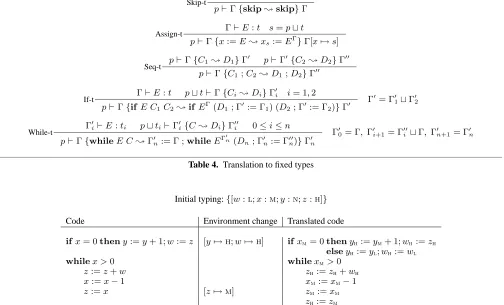
Now we present the translation as an extension of the type system (algorithmic version) to judgements of the form
p⊢LΓ{C;D}Γ′
(we do not decorate⊢for this system since the form of the judge-ments readily distinguish them from the previously defined sys-tems). First we need some basic constructions and notations.
Definition 7.2.
1. For any type environmentsΓandΓ′
, letΓ := Γ′
denote the set
{xs:=xt|Γ(x) =s,Γ
′
(x) =t, s6=t}
2. LetSbe a set of variable to variable assignment statements. We say thatSis independent if for any distinct pairw :=xand y:=zinS, the variablesw,x,yandzare all distinct. For in-dependentS, all sequentialisations are semantically equivalent and we letSrepresent the command obtained by some canoni-cal (but unspecified) sequentialisation.
Lemma 7.3. Γ := Γ′
is an independent set of assignments
Thus we will writeΓ := Γ′
to denote the command obtained by some canonical sequentialisation of the assignments.
Definition 7.4. For any type environmentΓ, let EΓ denote the expression obtained by replacing each floating variablexinEwith the fixed variablexswheres= Γ(x).
With these definitions we are ready to introduce the translation. The rules are presented in Table 4.
The basic idea of the translationp⊢L Γ{C;D}Γ′is that for any program point inD corresponding to a point inC, for each variablex, only one member of the family{xt}t∈L will be
“in play”. The type variables in play at any given program point are given by the type environment at that program point. So for example ifΓ(x) = sthenxswill be thex-variable in play at the
beginning of the execution ofD.
Example 7.5. Since a type derivation is structural in the syntax,
for any derivation we can associate a type environment with each program point. Consider the example derivation shown in Figure 3: in the central column we write the environment update (rather than the whole environment) yielding the environment after that program point in the corresponding sub-derivation, and on the right-hand side we write the translated program. The example uses the four point lattice introduced previously (Figure 2).
It remains to establish two properties of the translated terms:
• Correctness: they should be semantically equivalent to the orig-inal terms, and
• Static Soundness: they should still be typeable.
7.3 Correctness
Correctness means that the input-output behaviour of the program and its translation should be the same. We refer to this as semantic equivalence. Since the original programs operate on floating vari-ables, and the translation operates on fixed varivari-ables, we must con-struct a suitable relation between them.
Definition 7.6. Letσrange over floating variable stores and letρ range over fixed variable stores. Then for each type environmentΓ
we define the compatibility relation as
σ∼Γρ⇐⇒ ∀x∈Var.σ(x) =ρ(xΓ(x))
Theorem 7.7 (Translation Correctness).
Ifp⊢Γ{C;D}Γ′then for allσandρsuch thatσ∼Γρ,
• hC, σi ⇓σ′
⇒ ∃ρ′
.hD, ρi ⇓ρ′
andσ′
∼Γ′ρ′
• hD, ρi ⇓ρ′
⇒ ∃σ′
.hC, σi ⇓σ′
andσ′
∼Γ′ ρ′
Proof. See Appendix A.1.
7.4 Static Soundness
The fact that the translated programs are equivalent to the originals ensures that they have the same security properties, since nonin-terference is an extensional property. Here we show, more signif-icantly, that the translated program is also typeable – and since it only contains fixed variables this means that it is typeable in a con-ventional fixed type system.
Lemma 7.8 (Expression Soundness). IfΓ⊢E:tthen⊢EΓ:t
Follows directly from the definitions.
Theorem 7.9 (Static Soundness). Ifp ⊢ Γ {C;D} Γ′ then
p⊢D
Proof. See Appendix A.2.
7.5 Complexity
The transformation increases program size by adding assignments of the formΓ′
:= Γ. These assignments arise whenever, in the flow-sensitive system, a variable changes its level. Since the only way that a variable can change its level is through an assignment, the size ofΓ′
:= Γis bounded by the number (a) of assignment statements in the original program. The number of such assign-ments that are added to the program is proportional to the number (b) of conditional and while statements. This gives us a bound of
O(ab), i.e., quadratic in the program size. This upper bound is tight, as shown by the following program, where we use the two-point lattice, and initiallyhis the only variable assigned typeh:
ify1then ify2then
· · ·
ifynthen
Skip-t
p⊢Γ{skip;skip}Γ
Assign-t Γ⊢E:t s=p⊔t
p⊢Γ{x:=E;xs:=EΓ}Γ[x7→s]
Seq-t p⊢Γ{C1;D1}Γ
′
p⊢Γ′
{C2;D2}Γ′′
p⊢Γ{C1;C2;D1;D2}Γ′′
If-t Γ⊢E:t p⊔t⊢Γ{Ci;Di}Γ
′
i i= 1,2
p⊢Γ{ifE C1C2;ifEΓ(D1; Γ′:= Γ1) (D2; Γ′:= Γ2)}Γ′
Γ′
= Γ′
1⊔Γ
′
2
While-t Γ
′
i⊢E:ti p⊔ti⊢Γ
′
i{C;Di}Γ
′′
i 0≤i≤n
p⊢ Γ{whileE C;Γ′n:= Γ ;whileEΓ
′ n(D
n; Γ′n:= Γ
′′
n)}Γ′
n Γ′
0= Γ, Γ
′
i+1= Γ
′′
i ⊔Γ, Γ
′
n+1= Γ
′
[image:10.612.82.547.78.235.2]n
Table 4. Translation to fixed types
Initial typing:{[w:l;x:m;y:n;z:h]}
Code Environment change Translated code
ifx= 0theny:=y+ 1;w:=z [y7→h;w7→h] ifxm= 0thenyh:=ym+ 1;wh:=zh
elseyh:=yl;wh:=wl
whilex >0 whilexm>0
z:=z+w zh:=zh+wh
x:=x−1 xm:=xm−1
z:=x [z7→m] zm:=xm
zh:=zm
Figure 3. Example translation derivation
where the one-armed conditional is just shorthand for a conditional withskipin the else branch. The above program is typeable, where in the final environment,x1. . . xnhave typeh. WritingXh:=Xl for the sequence of assignmentsx1h :=x1l;· · ·;xnh :=xnl, the transformed program is:
ify1lthen
ify2lthen · · ·
ifynlthen
ifhhthenx1h:= 0;· · ·;xnh:= 0
elseXh:=XL
elseXh:=XL
· · ·
elseXh:=XL
It seems likely that there is a more precise bound based on the depth of nesting of loops and conditions, and that such blow ups are unlikely in practice.
7.6 Relation to Single Static Assignment
Our transformation introduces additional variables, and this addi-tion is performed in such a way that a flow-insensitive analysis on the transformed program achieves the same effect as a flow-sensitive analysis on the original. Viewed in this way, our trans-formation has a similar effect to transtrans-formation to single static as-signment form (SSA) (see e.g. [App98]). Single static asas-signment is used in the compilation chain to improve and simplify dataflow analyses. It works by the introduction of additional variables in such a way that every variable is assigned-to exactly once. Since there is only one assignment per variable, it follows by
construc-tion that there is no need for a flow-sensitive analysis on a program in SSA form, since there is only one program point that can influ-ence the type of a variable.
Our transformation is however rather different from SSA. The transformation we have described uses a flow-sensitive analysis in order to construct the transformed program, whereas SSA’s purpose is to avoid the need to perform more complex analyses in the first place. Thus our transformation approach is perhaps not interesting when viewed from a classic compiler-construction perspective.
However, applications such as security are not directly rele-vant to optimisation and compilation. In a mobile-code setting, a code consumer may demand that the code can be verified to sat-isfy some information-flow policy. Furthermore, in order to have a small trusted computing base, a small and simple type system is preferable. Transformations of the kind presented here are interest-ing in this settinterest-ing because they allow the code producer the benefits of constructing well-typed code in a more expressive system, with-out requiring the code consumer to verify code with respect to this more complex system3.
8.
Conclusions
We have presented and investigated the formal properties of a fam-ily of semantically sound flow-sensitive type systems for tracking
3The result of the SSA transformation is not an executable program, since
it contains the so-calledφ-nodes at all join-points, so SSA would be
[image:10.612.54.558.80.385.2]information flow in simple While programs. The family is indexed by the choice of flow lattice.
The key results we have shown are that:
•For a given program, all derivations in all members of the family can be inferred from the derivation of a principal typing in the universal system (ie, the type system for the flow lattice
P(Var)).
•The universal system is equivalent to Amtoft and Banerjee’s Hoare-style independence logic.
•Each member of the family is “complete” with respect to the whole family, in that no member can be used to validate more
L-typings than theL-system itself.
•Given a flow-sensitive type derivation for a program, we can systematically transform it to produce a semantically equivalent program which is typeable in a simple flow-insensitive system.
Possible avenues for future work include extending the flow-sensitive systems and program transformation to richer program-ming languages and deriving more precise complexity results for the program transformation.
Acknowledgments
Many thanks to David Clark for participation in discussions on this work, and for suggesting the worst-case complexity example. Discussions with Sruthi Bandhakavi and Daniel Hedin on alterna-tive formulations of Amtoft and Banerjee’s system were particu-larly useful. Thanks to Josef Sveningsson for drawing our atten-tion to the connecatten-tion to SSA, and to Niklas Broberg for system support. We also benefited from comments and suggestions from Dennis Walter and the anonymous referees.
References
[AB04] Torben Amtoft and Anindya Banerjee. Information flow
analysis in logical form. In SAS 2004 (11th Static Analysis
Symposium), Verona, Italy, August 2004, volume 3148 of LNCS, pages 100–115. Springer-Verlag, 2004.
[ADvRF01] Wolfram Amme, Niall Dalton, Jeffery von Ronne, and
Michael Franz. SafeTSA: A type safe and referentially secure mobile-code representation based on static single assignment form. In SIGPLAN ’01 Conference on
Program-ming Language Design and Implementation, pages 137–147,
2001.
[App98] Andrew W. Appel. Modern Compiler Implementation in
Java. Cambridge University Press, Cambridge, 1998.
[AR80] G. R. Andrews and R. P. Reitman. An axiomatic approach to
information flow in programs. ACM TOPLAS, 2(1):56–75, January 1980.
[BBL94] J.-P. Banˆatre, C. Bryce, and D. Le M´etayer. Compile-time
detection of information flow in sequential programs. In
Proc. European Symp. on Research in Computer Security,
volume 875 of LNCS, pages 55–73. Springer-Verlag, 1994.
[CC77] P. Cousot and R. Cousot. Abstract interpretation: A unified
lattice model for static analysis of programs by construction or approximation of fixpoints. In Proc. ACM Symp. on
Principles of Programming Languages, pages 238–252,
January 1977.
[CC79] P. Cousot and R. Cousot. Systematic design of program
analysis frameworks. In Conference Record of the Sixth
Annual ACM SIGPLAN-SIGACT Symposium on Principles of Programming Languages, pages 269–282, San Antonio,
Texas, 1979. ACM Press, New York, NY.
[CFR+89] Ron Cytron, Jeanne Ferrante, Barry K. Rosen, Mark K.
Wegman, and F. Kenneth Zadeck. An efficient method of computing static single assignment form. In 16th Annual
ACM Symposium on Principles of Programming Languages,
pages 25–35, 1989.
[CH95] Paul R. Carini and Michael Hind. Flow-sensitive
interproce-dural constant propagation. In PLDI ’95: Proceedings of the
ACM SIGPLAN 1995 conference on Programming language design and implementation, pages 23–31. ACM Press, 1995.
[CHH02] D. Clark, C. Hankin, and S. Hunt. Information flow for
Algol-like languages. Journal of Computer Languages, 28(1):3–28, April 2002.
[DD77] D. E. Denning and P. J. Denning. Certification of programs
for secure information flow. Comm. of the ACM, 20(7):504– 513, July 1977.
[DP90] B. Davey and H. Priestley. Introduction to Lattices and
Order. Cambridge University Press, 1990.
[GRS00] Roberto Giacobazzi, Francesco Ranzato, and Francesca
Scozzari. Making abstract interpretations complete. J. ACM, 47(2):361–416, 2000.
[GS05] S. Genaim and F. Spoto. Information Flow Analysis for
Java Bytecode. In R. Cousot, editor, Proc. of the Sixth
International Conference on Verification, Model Checking and Abstract Interpretation (VMCAI’05), volume 3385 of Lecture Notes in Computer Science, pages 346–362, Paris,
France, January 2005. Springer-Verlag.
[HR98] N. Heintze and J. G. Riecke. The SLam calculus:
programming with secrecy and integrity. In Proc. ACM
Symp. on Principles of Programming Languages, pages
365–377, January 1998.
[HS91] S. Hunt and D. Sands. Binding Time Analysis: A New
PERspective. In Proceedings of the ACM Symposium
on Partial Evaluation and Semantics-Based Program Manipulation (PEPM’91), pages 154–164, September 1991.
ACM SIGPLAN Notices 26(9).
[HS05] D. Hedin and D. Sands. Timing aware information
flow security for a JavaCard-like bytecode. In First
Workshop on Bytecode Semantics, Verification, Analysis and Transformation (BYTECODE ’05), 2005. To Appear,
ENTCS.
[NRH99] F. Nielson, H. Riis Nielson, and C. Hankin. Principles of
Program Analysis. Springer-Verlag, 1999.
[SM03] A. Sabelfeld and A. C. Myers. Language-based
information-flow security. IEEE J. Selected Areas in Communications, 21(1):5–19, January 2003.
[SS01] A. Sabelfeld and D. Sands. A per model of secure
information flow in sequential programs. Higher Order and
Symbolic Computation, 14(1):59–91, March 2001. Earlier
version in ESOP’99.
[VSI96] D. Volpano, G. Smith, and C. Irvine. A sound type system for
secure flow analysis. J. Computer Security, 4(3):167–187, 1996.
[Wel02] J. B. Wells. The essence of principal typings. In Proc.
International Colloquium on Automata, Languages and Programming, volume 2380 of LNCS, pages 913–925.
A.
Proofs from Section 7
A.1 Translation Correctness
In proving the theorem we will make use of the following simple lemmas:
Lemma A.1. Ifσ∼Γρthen
1.hΓ′
:= Γ, ρi ⇓ρ′
whereσ∼Γρ′
2.[[E]]σ= [[EΓ]]ρ
Proof. 1. From definition 7.2, the effect ofΓ′
:= Γon stateρcan be written as
ρ′=ρ[xΓ′(x)7→ρ(xΓ(x))|x∈Var]
(note that we have ignored the conditionΓ(x) 6= Γ′
(x)in the definition ofΓ′
:= Γsince these are just identity updates). So we have for allx∈Var
σ(x) =ρ(xΓ(x))
=ρ[xΓ′(x)7→ρ(xΓ(x))|x∈Var](xΓ′(x))
=ρ′(xΓ′(x))
and henceσ∼Γ′ρ
′
as required. 2. Straightforward from the definitions.
Proof of Translation Correctness. We argue by induction on the derivation in a standard big-step semantics. For collections of in-dependent assignments of the formΓ′
:= Γwe somewhat improp-erly treat them as if they are evaluated in a single atomic step. We illustrate the first part of the theorem, although most steps are in fact reversible, so the proof in the other direction is essentially the same. We focus on the more interesting cases.
Suppose thatp⊢ Γ{C;D}Γ′,σ∼Γρand thathC, σi ⇓
σ′
. We prove thathD, ρi ⇓ρ′
whereσ′
∼Γ′ ρ′by induction on the derivation ofhC, σi ⇓ σ′
and cases according to the last rule applied:
Case: Assign. We have a derivation of the form
Γ⊢E:t s=p⊔t
p⊢Γ{x:=E;xs:=EΓ}Γ[x7→s]
Suppose that[[E]]σ=V, and hence that
hx:=E, σi ⇓σ[x7→V].
By Lemma A.1,[[EΓ]]σ=V and hence
hxσ:=EΓ, σi ⇓σ[x7→V].
Case: While. There are two cases according to the value of the conditional. We just show the harder case where the last step of the derivation has the form:
[[E]]σ=true hC, σi ⇓σ′
hwhileE C, σ′
i ⇓σ′′
hwhileE C, σi ⇓σ′′ We have a translation derivation of the form
Γ′
i⊢E:ti p⊔ti⊢Γ′i{C;Di}Γ′′i 0≤i≤n
p⊢Γ{whileE C;Γ′:= Γ ;whileEΓ ′
(D; Γ′
:= Γ′′
)}Γ′
where Γ′
0 = Γ, Γ
′
i+1 = Γ
′′
i ⊔ Γ, Γ
′
n+1 = Γ
′
n and Γ
′
= Γ′
n,Γ
′′
= Γ′′
n, D =Dn. Henceforth letWDdenote the subterm
whileEΓ′ (D; Γ′
:= Γ′′
). Assume thatσ∼Γρ. We are required
to show that
hΓ′
:= Γ ;WD, ρi ⇓ρ
′′
whereσ∼Γ′ρ
′′
We assemble the following facts in order to construct a derivation for this claim. From Lemma A.1(1) we get
hΓ′
:= Γ, ρi ⇓ρ1whereσ∼Γ′ ρ1 (14)
and from Lemma A.1(2)
hEΓ′, ρ1i ⇓true. (15)
From the induction hypothesis for the subderivation forCwe have
hD, ρ1i ⇓ρ2whereσ
′
∼Γ′′ρ2, (16)
and from Lemma A.1(1),
hΓ′:= Γ′′, ρ2i ⇓ρ3whereσ
′
∼Γ′ρ3 (17)
Finally from the premises of the typing judgement, we also have the weaker judgement:
p⊢ Γ′
{whileE C;Γ′:= Γ ;WD}Γ
′
Now we apply the induction hypothesis for the second evaluation premise, with respect to this judgement, to obtain
hWD, ρ3i ⇓ρ′′whereσ′′∼Γ′ρ
′′
(18)
Finally from these facts we construct the required derivation, which is given in Figure 4.
A.2 Static Soundness
The proof is by induction on the structure of the translation deriva-tion, making use of the following simple weakening lemmas:
Lemma A.2.
• Ifp⊢Dandp′⊑pthenp′⊢D
• Ifp⊢aΓ{C}Γ′
then for allx,Γ(x)6= Γ′
(x)⇒p⊑Γ′
(x)
Proof. The first item is a straightforward induction on the deriva-tion, and we omit the details.
The second item is also by induction on the derivation. We present the three key cases.
Case: Assign. The conclusion of the rule is:
p⊢aΓ{x:=E}Γ[x7→p⊔t]
The initial and final type environment only differ (potentially) inx and we see immediately thatp⊑Γ′
(x) =p⊔t.
Case: If. The rule provides a derivation of the form
p⊔t⊢a Γ{C
i}Γ
′
i i= 1,2 Γ
′
= Γ′
1⊔Γ
′
2
p⊢aΓ{ifE C
1C2}Γ′
The induction hypothesis gives, fori= 1,2,
∀x.Γ(x)6= Γ′
i(x)⇒p⊑Γ′
i(x)
So suppose that for some particularxwe haveΓ(x)6= Γ′
(x). Since
Γ′
= Γ′
1⊔Γ′2we must haveΓ(x)= Γ6 ′i(x)for eitheri= 1ori= 2
(or both). It follows from the induction hypothesis thatp⊑Γ′
i(x)
for thisi, and hence thatp⊑Γ′
1(x)⊔Γ′2(x)as required. Case: While. The rule provides a derivation of the form
Γ′
i⊢E:ti p⊔ti⊢aΓ′i{C}Γ
′′
i 0≤i≤n
p⊢aΓ{whileE C}Γ′
n
whereΓ′
0 = Γ, Γ
′
i+1 = Γ
′′
i ⊔Γ, Γ
′
n+1 = Γ
′
n. The induction
hypothesis gives, for0 ≤ i≤ n,Γ′′
i(x) 6= Γ
′
i(x) ⇒ p⊔ti ⊑ Γ′′
i(x).
AssumeΓ′
n(x)6= Γ(x). Now suppose thatΓ
′′
i(x) = Γ
′
i(x)for
alliwith0≤i≤n: we show that this contradicts the assumption (ie we show that it entailsΓ′
n(x) = Γ(x)) by induction onn. The base case is immediate sinceΓ′
(14)
hΓ′
:= Γ, ρi ⇓ρ1
(15)
hEΓ′, ρ1i ⇓true
(16)
hD, ρ1i ⇓ρ2
(17)
hΓ′
:= Γ′′
, ρ2i ⇓ρ3
hD; Γ′
:= Γ′′
, ρ1i ⇓ρ3
(18)
hWD, ρ3i ⇓ρ′′
hWD, ρ1i ⇓ρ′′
hΓ′
:= Γ ;whileEΓ′ (D; Γ′
:= Γ′′
[image:13.612.75.551.76.146.2]), ρi ⇓ρ′′
Figure 4. Concluding derivation, While case, Theorem 7.7
By construction,Γ′
k+1(x) = Γ
′′
k(x)⊔Γ(x)so, by supposition, Γ′
k+1(x) = Γ
′
k(x) ⊔Γ(x). But by IHΓ′
k(x) = Γ(x), hence
Γ′
k+1(x) = Γ(x).
We have shown thatΓ′
n(x) 6= Γ(x) implies the existence of someisuch thatΓ′′
i(x) 6= Γ
′
i(x)so, by the induction hypothesis, p⊔ti⊑Γ′′i(x), hencep⊑Γ
′′
i(x). But, as illustrated in Figure 1, Γ′′
i ⊑Γ
′
nholds for alli, so we are done.
Proof of Static Soundness. We give a couple of illustrative cases.
Case: Assign-t. The derivation is of the form
Γ⊢E:t s=p⊔t
p⊢Γ{x:=E;xs:=EΓ}Γ[x7→s]
From Lemma 7.8 we have that ⊢EΓ:t, and thusp⊢xs :=
EΓfollows directly from the Assign-fixed axiom.
Case: While-t. Assume the last rule in the inference has the form:
Γ′
i⊢E:ti p⊔ti⊢Γ′i{C;Di}Γ′′i 0≤i≤n
p⊢Γ{whileE C;Γ′:= Γ ;whileEΓ′(D; Γ′:= Γ′′)}Γ′ whereΓ′
0= Γ, Γ
′
i+1= Γ
′′
i ⊔Γ, Γ
′
n+1= Γ
′
nandΓ
′
= Γ′
n,Γ
′′
= Γ′′
n, D=Dn.
Since the translation system is a conservative extension of the type system, we have a derivationp⊢a Γ{whileE C}Γ′
, and hence by Lemma A.2 that
∀x.Γ(x)6= Γ′(x)⇒p⊑Γ′(x). this, together with the fact thatΓ⊑Γ′
means that every assignment inΓ′
:= Γis typeable, and hence that
p⊢Γ′
:= Γ (19)
Similarly with the subderivationp⊔tn ⊢ Γ
′
{C;D} Γ′′we get, using Lemma A.2 that
∀x.Γ′
(x)6= Γ′′
(x)⇒p⊔tn⊑Γ
′′
(x).
and in the same manner as above we can conclude that
p⊔tn⊢Γ
′
:= Γ′′
. (20)
Furthermore, Lemma 7.8 gives
⊢EΓ′ :tn, (21)
and the inductive hypothesis gives us
p⊔tn⊢D. (22)
Putting this together we obtain the concluding derivation
(19)
p⊢Γ′:= Γ
(21)
⊢EΓ′:tn
(22)
p⊔tn⊢D
(20)
p⊔tn⊢Γ′:= Γ′′
p⊔tn⊢D; Γ
′
:= Γ′′
p⊢whileEΓ′ (D; Γ′
:= Γ′′
)
p⊢Γ′
:= Γ ;whileEΓ′
(D; Γ′
:= Γ′′