
N A N O E X P R E S S
New Hybrid Properties of TiO
2Nanoparticles Surface Modified
With Catecholate Type Ligands
Ivana A. Jankovic´•Zoran V. Sˇaponjic´•
Enis S. Dzˇunuzovic´•Jovan M. Nedeljkovic´
Received: 26 March 2009 / Accepted: 24 September 2009 / Published online: 13 October 2009 Óto the authors 2009
Abstract Surface modification of nanocrystalline TiO2
particles (45 A˚ ) with bidentate benzene derivatives (cate-chol, pyrogallol, and gallic acid) was found to alter optical properties of nanoparticles. The formation of the inner-sphere charge–transfer complexes results in a red shift of the semiconductor absorption compared to unmodified nanocrystallites. The binding structures were investigated by using FTIR spectroscopy. The investigated ligands have the optimal geometry for chelating surface Ti atoms, resulting in ring coordination complexes (catecholate type of binuclear bidentate binding–bridging) thus restoring in six-coordinated octahedral geometry of surface Ti atoms. From the Benesi–Hildebrand plot, the stability constants at pH 2 of the order 103M-1have been determined.
Keywords TiO2nanoparticlesSurface modification
CatecholPyrogallolGallic acid
Introduction
The mechanism of semiconductor-assisted photocatalytic processes is based on the principle that colloidal semi-conductor nanoparticles behave as miniature photoelect-rochemical cells [1–3]. The overall photoexcitation process of semiconductor nanoparticles by ultra bandgap energies
involve the photogeneration of electron–hole pairs within particle, followed by the competition between recombina-tion, interfacial charge transfer to adsorbed compounds, and migration into midgap surface states [4].
Nanocrystalline TiO2has attracted widespread attention
as a photocatalyst in various practical applications [5–7] as well as the part of photoelectrochemical systems, such as Gra¨tzel cells [3]. Although nanoparticulate TiO2 is very
effective from an energetic point of view, it is a relatively inefficient photocatalyst. Due to its large bandgap (Eg=3.2 eV), TiO2absorbs less than 5% of the available
solar light photons. The main energy loss is due to the process of radiative or nonradiative recombination of charges generated upon photoexcitation of TiO2, which is
manifested as the relatively low efficiency of long-lived charge separation. Hence, the successful photochemical energy conversion and subsequent chemical reactions require both the extended separation of photogenerated charges and the response in the visible spectral region.
To achieve larger separation distances, preventing the hole–electron recombination before desired redox reaction occurs, reconstructed surface of TiO2nanoparticle surface
was employed for establishing a strong coupling with electron-accepting and/or electron-donating species [8,9]. Consequently, the lifetime of charge separation and pho-tocatalytic activity of TiO2 nanoparticles are increased.
The origin of the unique photocatalytic activities of TiO2
nanoparticles comparing to the bulk is found in larger surface area and the existence of surface sites with dis-torted coordination. Owing to large curvature of TiO2
particles in the nanosize regime, the surface reconstructs in such manner that distorts the crystalline environment of surface Ti atoms forming coordinatively unsaturated Ti atoms. The changes in the pre-edge structure of Ti K-edge spectrum (XANES) of TiO2 nanoparticles (d\20 nm)
I. A. Jankovic´ (&)Z. V. Sˇaponjic´J. M. Nedeljkovic´ Laboratory for Radiation Chemistry and Physics, Vincˇa Institute of Nuclear Sciences, P.O. Box 522, 11001 Belgrade, Serbia e-mail: [email protected]
E. S. Dzˇunuzovic´
Faculty of Technology and Metallurgy, Department of Physical Chemistry and Electrochemistry, University of Belgrade, Karnegijeva 4, 11120 Belgrade, Serbia
revealed the existence of square–pyramidal coordination of surface Ti atoms (pentacoordinate) [10]. The results obtained from measurements of XAFS spectra of TiO2
nanoparticles proved the existence of shorter Ti–O bond lengths (1.71 A˚ ) as compared to bulk anatase TiO2
(1.96 A˚ ) [11]. The bond length distortion is also related to large curvature of nanometer size particles. These surface Ti atoms are very reactive and act as traps for photogen-erated charges [12]. It was reported, on a whole class of electron-donating enediol ligands [9,13], benzene deriva-tives [14], or mercapto-carboxylic acids [15] that binding to coordinatively unsaturated Ti atoms simultaneously adjusts their coordination to octahedral geometry at the surface of nanocrystallites and changes the electronic properties of TiO2. In such hybrid structures localized
orbitals of surface-attached ligands, are electronically coupled with the delocalized electron levels from the conduction band of a TiO2 semiconductor [16]. As a
consequence, absorption of light by the charge–transfer (CT) complex yields to the excitation of electrons from the chelating ligand directly into the conduction band of TiO2 nanocrystallites. This results in a red shift of the
semiconductor absorption compared to that of unmodified nanocrystallites and enables efficient harvesting of solar photons. Additionally, this type of electronic coupling yields to instantaneous separation of photogenerated charges into two phases, the holes localize on the donating organic modifier, and the electrons delocalize in the conduction band of TiO2. Moreover, the enediol
ligands were found to act as conductive leads, allowing wiring of oligonucleotides and proteins resulting in enhanced charge separation and ensuing chemical trans-formations [17,18].
In last two decades the surface modification of com-mercial TiO2 (Degussa P25, d=30 nm) with benzene
derivatives (mainly catechol and salicylic acid) was studied [19–34]. Just few articles [9, 13–15, 35] investigated CT complex formation between enediol ligands and colloidal TiO2nanoparticles (d=45 A˚ ), where binding of modifiers
is stabilized by ligand-induced surface reconstruction of the nanoparticles.
Herein, we report surface modification of TiO2
nano-particles with enediol ligands (catechol, pyrogallol, and gallic acid) that are able to adjust the coordination geom-etry of the surface Ti atoms inducing shift of the absorption onset toward the visible region of the spectrum, compared to unmodified nanocrystallites. Since these novel CT semiconducting materials exhibit optical properties that are distinct from their constituents, not absorbing in the visible region, Benesi–Hildebrand analysis for molecular com-plexes was employed to determine the stability constants from the absorption spectra. The stoichiometry of formed complexes was obtained using Job’s method of continuous
variation. The binding structures were investigated by using FTIR spectroscopy.
Experimental Section
All the chemicals were of the highest purity available and were used without further purification (Aldrich, Fluka). Milli-Q deionized water (resistivity 18.2 MXcm-1) was used as solvent. The colloidal TiO2dispersions were
pre-pared by the dropwise addition of titanium(IV) chloride to cooled water. The pH of the solution was between 0 and 1, depending on the TiCl4concentration. Slow growth of the
particles was achieved by using dialysis at 4°C against water until the pH=3.5 was reached [36]. The concen-tration of TiO2(0.2 M) was determined from the
concen-tration of the peroxide complex obtained after dissolving the colloid in concentrated H2SO4[37]. The mean particle
diameter of titania used in this study was 45 A˚ .
Surface modification of TiO2resulting in the formation
of a CT complex was achieved by the addition of surface-active ligands up to concentrations required to cover all surface sites ([Tisurf]=[TiO2]12.5/D[38], where Tisurfis
the molar concentration of surface Ti sites, [TiO2] is the
molar concentration of TiO2in molecular units, and Dis
the diameter of the particle in angstroms). As the conse-quence of enhanced particle–particle interaction, upon surface modification that eliminates the surface charge, precipitation, and/or ‘‘gelling’’ of the solution may occur. In order to avoid these problems pH of the solution was adjusted to 2 with HCl. For the determination of CT complex binding constants the absorption spectra were recorded at room temperature in cells with 1 cm optical path length using Thermo Scientific Evolution 600 UV/Vis spectrophotometer. The experiments determining the composition of complexes by Job’s method [39] were conducted by using 7.2 mM TiO2 and 2 mM modifier
solutions. Nine mixtures of TiO2 and modifier were
pre-pared—volumes of TiO2 solution used varied from 1 to
9 mL and those of modifiers’ solutions from 9 to 1 mL; and total volume was always 10 mL.
Infrared spectra were taken in attenuated total reflection (ATR) mode using a Nicolet 380 FTIR spectrometer equipped with a Smart OrbitTMATR attachment containing a single-reflection diamond crystal. The angle of incidence was 45°. In order to avoid the precipitation of modified TiO2and the excess of unbound modifier, in the
prepara-tion of samples for FTIR measurements the quantity of ligands added was 50% of all Tisurfsites ([TiO2]=0.2 M,
cLIGAND=25 mM). The dispersions containing surface
modified TiO2 nanoparticles were dried under argon at
measuring FTIR spectra, powders were triturated in the agate mortar. Typically, 64 scans were performed for each spectrum with 4 cm-1 resolution. The spectrum of the dried TiO2 aqueous slurry (not containing modifier) was
used as the background.
Results and Discussion
Optical Properties of Surface Modified Nanocrystalline TiO2
When TiO2particles are in the nanocrystalline regime, a
large fraction of the atoms that constitute the nanoparticle is located at the surface with significantly altered electro-chemical properties. As the size of nanocrystalline TiO2
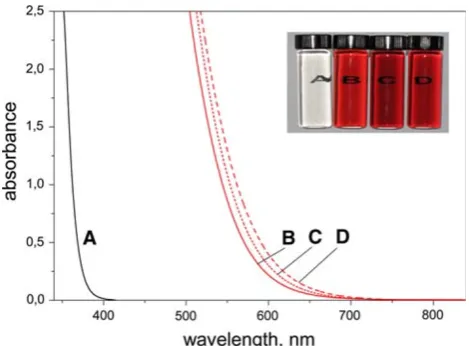
becomes smaller than 20 nm the surface Ti atoms adjust their coordination environment from hexacoordinated (octahe-dral) to pentacoordinated (square pyramidal), which is fol-lowed by the compression of the Ti–O bond to accommodate for the curvature of the nanoparticle [10]. These underco-ordinated defect sites are the source of novel enhanced and selective reactivity of nanoparticles toward bidentate ligand binding. All of the investigated ligands listed in Table1were found to undergo binding at the surface (see inset in Fig.1), inducing new hybrid properties of the surface-modified nanoparticle colloids. These hybrid properties arise from the ligand-to-metal CT interaction coupled with electronic properties of the core of semiconductor nanoparticles.
Consequently, the onset of absorption of these CT nano-crystallites is red shifted compared to unmodified TiO2
(Fig.1). The shift in the absorption edge in the modified semiconductor nanoparticles is attributed to the excitation of localized electrons from the surface modifier into the con-duction band continuum states of the semiconductor particle [13]. Similar position of the absorption threshold for surface-modified nanoparticles with catechol, pyrogallol, and gallic acid (bandgaps are presented in Table1) is probably the consequence of very similar dipole moments of various surface bound Ti–ligand complexes formed [9].
Apart from the shift in the absorption edge, the optical properties of surface modified semiconductor nanoparti-cles, having a continuous rise of absorption toward higher energies, paralleled the absorption properties characteristic of the band structure in bare semiconductor nanoparticles. A similar red shift, but in localized CT complex resulting in a pronounced absorption maximum, was previously observed for Ti4? and catechol [40], salicylic [41], or ascorbic acid [42].
It should be noted that all investigated enediol ligands are by themselves extremely susceptible to oxidation. Apparently, because of the bidentate binding to nanopar-ticles, enediol ligands gain stability and are not easily
oxidized. Enediol-modified TiO2 colloids preserved their
optical properties even after exposure to daylight for 2–3 months.
Due to the existence of undercoordinated surface defect sites and their lower efficiency of covalent bonding with solvent molecules in comparison with covalent bonding between atoms within the TiO2lattice, the surface species
posses energy level in the midgap region [43]. Apart from red shift of the absorption onset of surface modified TiO2
[image:3.595.305.544.82.279.2]nanoparticles, CT interaction between the molecule of modifier and surface Ti atoms also induces fine-tuning of Table 1 Ligands used for modification of TiO2 nanoparticles,
Benesi–Hildebrand binding constants, and bandgaps upon binding
Ligand Structural formula Kb(M-1)a Bandgap (eV)
Catechol 2490±120 1.96
Pyrogallol 3130±120 1.89
Gallic acid 1700±100 1.92
a The absorption wavelengths at which the stability constants were
determined are 400 nm (catechol), 475 nm (gallic acid), and 425 nm (pyrogallol)
Fig. 1 Absorption spectra of surface modified 45 A˚ TiO2
nanopar-ticles (0.09 M, pH 2) with different ligands (2.5 mM): (A) bare TiO2;
[image:3.595.308.543.491.664.2]the electrochemical potential of semiconductor nanocrys-tals indicating changes in oxidizing abilities.
Upon surface modification, the effective bandgap of catechol-, gallic acid-, and pyrogallol-modified TiO2
nanoparticles at pH=2 were determined to be: 1.96, 1.92, and 1.89 eV, respectively. These results indicate similar electrochemical potentials of semiconducting nanocrystals modified with chosen class of enediol ligands indicating similar binding structures and effective electronic coupling. TiO2 nanoparticles modified with this type of bidentate
benzene derivatives can be used for development of Type II dye-sensitized nanoporous titania solar cells where the dyes bind to the particle surface through enediol groups [44]. Also, blends of surface modified TiO2 nanoparticles
and organic semiconductors cast from co-solutions can be used for synthesis of hybrid solar cells combining the unique properties of inorganic semiconductor and film-forming properties of polymers [45].
Determination of Stability (Binding) Constants
Since these novel CT semiconducting materials exhibit optical properties that are distinct from their constituents, not absorbing in the visible region, Benesi–Hildebrand analysis for molecular complexes [46,47] can be employed to determine the stability constant of CT complex. Benesi– Hildebrand analysis can be used for small particles since the same relationship is obtained between the stability constant and ligand concentration from Langmuir isotherm used for bulk compounds [9]. For a colloidal solution of 45 A˚ TiO2 one can consider the formation of an
inner-sphere CT complex
TisurfþLCTcomplex ð1Þ with the stability constantKbexpressed as
Kb ¼
CTcomplex
eq Tisurf
½ eq½ Leq ð2Þ
Since the absorption in the visible region originates solely from the complex formed it is obvious that [CTcomplex]=A/el and the Eq. 2can be rearranged to the
following linearized form 1
A¼ 1 KbAmax
1 L
½ þ
1 Amax
ð3Þ
where [L] is the concentration of ligand, A and Amax the
absorbances of a CT complex for a given concentration of ligand L, and saturation concentration corresponding to the full coverage of TiO2surface, respectively.
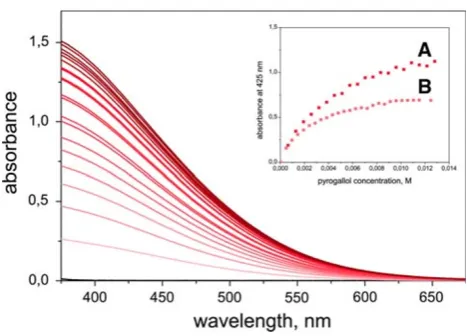
Stability constantsKbwere determined from the
absor-bances of a series of solutions (Fig.2) containing a fixed
concentration of TiO2nanoparticles (cTiO2 =3.5 mM, i.e., 0.97 mM Tisurf according to equation in ‘‘Experimental’’
section) and increasing concentrations of ligands (c li-gand=0.06–1.23 mM). In order to avoid great errors inKb
determination, the wavelength of complex absorption is chosen for each ligand to correspond to the requested absorption range (0.1\A\0.9) [47]. By plotting 1/Avs. 1/[L] the straight lines were obtained and from the ratio of the intercept and the slope, Kbwere determined and
pre-sented in Table1. From the molecular structures of ligands used it can be concluded that two types of binding to Tisurf
may appear—catecholate type (OH, OH) or carboxylate (COOH) in the case of gallic acid solely. However, it is quite obvious that by comparing the measured values ofKb
one cannot differentiate between these two types of binding since these values are similar, of the order 103M-1. In the literature, to determine the CT complex stability constants for catechol and/or gallic acid the adsorption approach after filtration method [14, 20, 21,28] or FTIR measurements [29,30] have been used and two to three times larger Kb
values were reported. We believe that lowerKbvalues we
reported are more precisely determined since they are obtained from the absorbance measurements directly.
It must be pointed out that very interesting phenomenon was observed when TiO2solutions of the same molecular
concentration (3.5 mM) freshly prepared and 4-years-old were used for modification (Inset of Fig.2). A425 versus
pyrogallol concentration curve for freshly prepared TiO2
shows much higher saturation value of A425 than was
observed in the case of 4-years-old TiO2colloidal solution
(A4254-years aged =0.65 A425fleshly prepared). It is known that
crys-tallinity increases with aging of TiO2 nanoparticles
inducing the decrease in concentration of coordinatively Fig. 2 Absorption spectra of 3.5 mM TiO2nanoparticles before and
after surface modification with pyrogallol (0–1.23 mM in 0.06 mM steps). Inset: Absorption at 425 nm of TiO2–pyrogallol CT complex
versus pyrogallol concentration (data recorded 20 h after surface modification). Solutions of TiO2nanoparticles used for modification
[image:4.595.308.542.54.222.2]unsaturated surface defect sites. In order to eliminate the possibility that decrease in number of Tisurfsites is simply
the consequence of agglomeration or Oswald ripening we performed the measurements of the particle size diameter using dynamic light scattering (DLS). In both cases (freshly prepared and 4-years-old TiO2 solutions) the
effective diameter was found to be the same.
Additionally, the stoichiometric ratio between Tisurf
atoms and modifiers in the CT complexes was checked by Job’s method of continuous variation [39] assuming that only one type of complex is present in solution. The results obtained for catechol and gallic acid are presented in Fig.3. Job’s plots for both complexes reached a maximum value at a mole fraction of [Tisurf]/[Tisurf]?[L]=0.7,
confirming that molar ratio between Tisurf atoms and
ligands in the complex is 2:1. The same Tisurf/ligand molar
ratio was obtained for pyrogallol.
Binding Structure of Ligands at Nanoparticle Surface The way ligands bind to TiO2surface was investigated by
using ATR–FTIR spectroscopy. Since the infrared spec-trum of dried TiO2has only the characteristic broadband in
3700–2000 cm-1 region [9], we were able to measure spectra of modified colloids in 1750–1000 cm-1 region where the characteristic bands of modifiers exist. Spectra of adsorbed ligands were obtained by subtracting the spec-trum of bare TiO2 nanoparticles from the spectrum of
surface modified TiO2nanoparticles.
The ATR–FTIR spectra of catechol, free and adsorbed on TiO2nanoparticles were presented in Fig. 4. The main
bands and their assignments [29,30, 34] in free catechol (curve A) are as follows: stretching vibrations of the aro-matic ring m(C–C)/m(C=C) at 1618, 1594, 1512, and 1468 cm-1, stretching vibrations of the phenolic group m(C–OH) at 1279, 1254 and 1239 cm-1, bending vibrations of the phenolic group d(C–OH) at 1365, 1184, 1163, and 1149 cm-1 and bendingd(C–H) at 1039 and 1093 cm-1. Upon adsorption of catechol onto TiO2(curve B) the
dif-ference between FTIR spectra of free and adsorbed modi-fier appears, indicating surface complexation with catechol bound to the oxide surface in bidentate form [29, 30]. Bending d(C–OH) vibrations in the region below 1200 cm-1 loose their hyperfine structure, while the pro-nounced band at 1365 cm-1nearly disappears and a very weak and broad feature centered at 1354 cm-1 appears. Three bands of stretching vibrationsm(C–OH) merge to one prominent band at 1249 cm-1. The binding of catechol to TiO2 via two adjacent phenolic groups even affects the
stretching of the aromatic ring (bands above 1400 cm-1). Catecholate type of binding inherent to catechol mole-cule adsorption to metal-oxide surfaces, with two adjacent phenolic OH groups taking part in complexation, was reported to result in the formation of both bidentate mononuclear chelating and/or bidentate binuclear bridging complexes. There are two opinions dealing with catecho-late binding: some authors [9, 48, 49] claim that five-membered ring coordination complexes predominate, while the others [16, 20, 21, 29, 30] find bridging com-plexes energetically more favorable. Since according to Job’s curve the molar ratio between Tisurf atoms and
Fig. 3 Job’s curve of equimolar solutions for ligand–Tisurfcomplex
(Acatechol,at 400 nm;Agallic acidat 475 nm); [Tisurf]?[L]=2 mM
Fig. 4 FTIR spectra of catechol: free (A) and adsorbed on TiO2
[image:5.595.53.287.452.689.2] [image:5.595.306.542.479.686.2]catechol in the complex is 2:1 (Fig.3), the CT complex formed is most likely bidentate binuclear (bridging) com-plex (Scheme1).
The ATR–FTIR spectra of pyrogallol, free and adsorbed on TiO2nanoparticles were presented in Fig. 5. The main
bands and their assignments [50] in free pyrogallol (curve A) are as follows: stretching vibrations of the aromatic ring m(C–C)/m(C=C) at 1619, 1518, 1479, 1402, and 1383 cm-1, stretching vibrations of the phenolic group m(C–OH) at 1518, 1402, 1315, 1285, 1242, and 999 cm-1, bending vibrations of the phenolic groupd(C–OH) at 1479, 1383, 1350, 1189, and 1156 cm-1and bending d(C–H) at 1150 and 1064 cm-1. The adsorption of pyrogallol onto TiO2
nanoparticles (curve B) leads to obvious changes in FTIR spectra: complete disappearance of the bands at 1518, 1402, 1383, 1350, and 1285 cm-1, shift of the band at 999 to 1032 cm-1, and the intensity attenuation of the bands at 1315, 1189, and 1156 cm-1. The results obtained are quite expected since these bands are assigned to stretching and bending vibrations of phenolic OH groups that participate in the formation of CT complex with Ti surface atoms. The binding of pyrogallol to TiO2, like in the case of catechol,
also shifts the bands assigned to stretching of the aromatic
ring in the region above 1400 cm-1. Bands at 1315, 1242, 1189, and 1157 cm-1, being changed in intensity, are probably the vibrations of the unbound, third phenolic OH group of pyrogallol, since just two adjacent phenolic groups participate in binding (Scheme 1).
The ATR–FTIR spectra of gallic acid, free and adsorbed on TiO2nanoparticles were presented in Fig. 6. The main
bands and their assignments [30, 50] in free protonated gallic acid (curve A) are as follows: stretching vibrations of the aromatic ringm(C–C)/m(C=C) at 1612, 1539, 1469, and 1437 cm-1, stretching vibrations of the phenolic group m(C–OH) at 1372, 1305, 1240, and 1020 cm-1, bending vibrations of the phenolic group d(C–OH) at 1336, 1240, and 1100 cm-1, stretching and/or bending vibrations of CO or OH in COOH at 1199, 1100, and 1046 cm-1and pro-nounced stretching vibration of the carbonyl groupm(C=O) at 1698 cm-1. The adsorption of gallic acid onto TiO2
nanoparticles (curve B) leads to complete disappearance of the bands at 1372 and 1305 cm-1, while the band at 1020 cm-1 disappears with the formation of broad inten-sive band at 1070 cm-1. The band at 1240 cm-1, although slightly shifted, is preserved with decreased intensity. These bands, assigned to stretching and bending vibrations of phenolic OH groups (m(C–OH) and d(C–OH)), are probably those participating in the formation of CT com-plex with Ti surface atoms. Since upon binding the third phenolic group remains unbound, bands at 1336 and 1240 cm-1 remain in spectrum, although slightly shifted and with decreased intensity. The pronounced bands assigned to the vibrations of the carboxylic group (1199 and 1698 cm-1) remain in the spectrum suggesting that this group is not involved in complexation. The binding of Scheme 1 Coordination mode
of Tisurf–catechol complex
Fig. 5 FTIR spectra of pyrogallol: free (A) and adsorbed on TiO2
nanoparticles (B)
Fig. 6 FTIR spectra of gallic acid: free (A) and adsorbed on TiO2
[image:6.595.53.295.367.689.2] [image:6.595.310.542.483.688.2]gallic acid to TiO2, like in the case of catechol and
pyro-gallol, also shifts the bands assigned to stretching of the aromatic ring in the region above 1400 cm-1.
According to the molecular structure of gallic acid two types of binding to Tisurf may appear—catecholate (OH,
OH) or carboxylate (COOH) type. Literature data are quite controversial whether or not benzoic acid, having only COOH functional group, adsorbs on TiO2surface. Tunesi
and Anderson [19, 22] claim that no adsorption was observed, while the others [14,16, 31,33,51] confirmed the formation of bidentate chelate or bridging complexes, pointing out weak adsorption [14,31]. According to FTIR results obtained we may conclude that in the case of gallic acid binding through carboxylate group does not exist. Possible reason for that is as follows: in the carboxylate type of binding formation of chelated four-membered ring is proposed [32] being energetically less favorable than the ring formed through catecholate group (Scheme1).
Hence, in all three ligands investigated (catechol, pyrogallol, and gallic acid) catecholate type of binding is obvious, since carboxylate type of binding takes no part in the binding of gallic acid to TiO2nanoparticles.
Conclusions
All investigated ligands (catechol, pyrogallol, and gallic acid) form inner-sphere CT complexes with TiO2
nano-particles (d=45 A˚ ). Binding of the modifier molecules to undercoordinated surface Ti atoms (defect sites) results in a significant change in the onset of absorption and the effective bandgap. From the Benesi–Hildebrand plot, the stability constants at pH 2 of the order 103M-1have been determined. For chosen enediol modifiers binding was found to be through bidentate binuclear (bridging) com-plexes leading to restoration of six-coordinated octahedral geometry of surface Ti atoms. Stabilized charge separation, being important feature of these systems opens-up possi-bility for using modifier molecules as conductive leads that allow electronic linking of the nanoparticle into molecular circuits providing further extension of photoinduced elec-tron transfer.
Acknowledgment Financial support for this study was granted by the Ministry of Science and Technological Development of the Republic of Serbia (Project 142066).
References
1. A. Hagfeldt, M. Gra¨tzel, Chem. Rev.95, 49 (1995). doi:10.1021/ cr00033a003
2. M. Gra¨tzel, Nature414, 338 (2001). doi:10.1038/35104607
3. B. O’Regan, M. Gra¨tzel, Nature353, 737 (1991). doi:10.1038/ 353737a0
4. A.J. Nozik, Annu. Rev. Phys. Chem.29, 189 (1978). doi:10.1146/ annurev.pc.29.100178.001201
5. X. Fu, W.A. Zeltner, M.A. Anderson, Appl. Catal. B Environ.6, 209 (1995). doi:10.1016/0926-3373(95)00017-8
6. D. Bahnemann, Sol. Energy 77, 445 (2004). doi:10.1016/ j.solener.2004.03.031
7. Y. Kikuchi, K. Sanada, T. Iyoda, K. Hashimoto, A. Fujishima, J. Photochem. Photobiol. Chem. 106, 51 (1997). doi:10.1016/ S1010-6030(97)00038-5
8. Z.V. Sˇaponjic´, N.M. Dimitrijevic´, D.M. Tiede, J.A. Goshe, X. Zuo, L.X. Chen, A.S. Barnard, P. Zapol, L. Curtiss, T. Rajh, Adv. Mater.17, 965 (2005). doi:10.1002/adma.200401041 9. T. Rajh, L.X. Chen, K. Lukas, T. Liu, M.C. Thurnauer, D.M.
Tiede, J. Phys. Chem. B 106, 10543 (2002). doi:10.1021/ jp021235v
10. L.X. Chen, T. Rajh, W. Ja¨ger, J. Nedeljkovic, M.C. Thurnauer, J. Synchrotron. Radiat. 6, 445 (1999). doi:10.1107/S090904 959801591X
11. F. Farges Jr., G.E. Brown, J.J. Rehr, Geochim. Cosmochim. Acta. 60, 3023 (1996). doi:10.1016/0016-7037(96)00144-5
12. N.M. Dimitrijevic´, Z.V. Sˇaponjic´, D.M. Bartels, M.C. Thurnauer, D.M. Tiede, T. Rajh, J. Phys. Chem. B 107, 7368 (2003). doi:10.1021/jp034064i
13. T. Rajh, J.M. Nedeljkovic´, L.X. Chen, O. Poluektov, M.C. Thurnauer, J. Phys. Chem. B 103, 3515 (1999). doi:10.1021/ jp9901904
14. J. Moser, S. Punchihewa, P.P. Infelta, M. Gra¨tzel, Langmuir7, 3012 (1991). doi:10.1021/la00060a018
15. T. Rajh, D.M. Tiede, M.C. Thurnauer, J. Non-Cryst. Solid 205-207, 815 (1996)
16. P. Persson, R. Bergstro¨m, S. Lunell, J. Phys. Chem. B104, 10348 (2000). doi:10.1021/jp002550p
17. T. Rajh, Z. Sˇaponjic´, J. Liu, N.M. Dimitrijevic´, N.F. Scherer, M. Vega-Arroyo, P. Zapol, L.A. Curtiss, M.C. Thurnauer, Nano Lett.4, 1017 (2004). doi:10.1021/nl049684p
18. N.M. Dimitrijevic´, Z.V. Sˇaponjic´, B.M. Rabatic´, T. Rajh, J. Am. Chem. Soc.127, 1344 (2005). doi:10.1021/ja0458118
19. S. Tunesi, M. Anderson, J. Phys. Chem. 95, 3399 (1991). doi:10.1021/j100161a078
20. S.T. Martin, J.M. Kesselman, D.S. Park, N.S. Lewis, M.R. Hoffman, Environ. Sci. Technol.30, 2535 (1996). doi:10.1021/ es950872e
21. P. Rodriguez, M.A. Blesa, A.E. Regazzoni, J. Colloid Interface Sci.177, 122 (1996). doi:10.1006/jcis.1996.0012
22. A.E. Regazzoni, P. Mandelbaum, M. Matsuyoshi, S. Schiller, S.A. Bilmes, M.A. Blesa, Langmuir14, 868 (1998). doi:10.1021/ la970665n
23. Y. Liu, J.I. Dadap, D. Zimdars, K.B. Eisenthal, J. Phys. Chem. B 103, 2480 (1999). doi:10.1021/jp984288e
24. D. Robert, S. Parra, C. Pulgarin, A. Krzton, J.V. Weber, Appl. Surf. Sci.167, 51 (2000). doi:10.1016/S0169-4332(00)00496-7 25. A.D. Roddick-Lanzilotta, A.J. McQuillan, J. Colloid Interface
Sci.227, 48 (2000). doi:10.1006/jcis.2000.6864
26. A.D. Weisz, A.E. Regazzoni, M.A. Blesa, Solid State Ion143, 125 (2001). doi:10.1016/S0167-2738(01)00840-2
27. A.D. Weisz, L. Garcia Rodenas, P.J. Morando, A.E. Regazzoni, M.A. Blesa, Catal. Today 76, 103 (2002). doi:10.1016/S0920-5861(02)00210-9
28. D.V. Heyd, B. Au, J. Photochem. Photobiol. A Chem.174, 62 (2005). doi:10.1016/j.jphotochem.2005.03.009
30. P.Z. Araujo, P.J. Morando, M.A. Blesa, Langmuir 21, 3470 (2005). doi:10.1021/la0476985
31. A.M. Johnson, S. Trakhtenberg, A.S. Cannon, J.C. Warner, J. Phys. Chem. A111, 8139 (2007). doi:10.1021/jp071398p 32. S. Tunesi, M.A. Anderson, Langmuir8, 487 (1992). doi:10.1021/
la00038a030
33. K.D. Dobson, A.J. McQuillan, Spectrochim. Acta [A]56, 557 (2000). doi:10.1016/S1386-1425(99)00154-7
34. P.A. Connor, K.D. Dobson, A.J. McQuillan, Langmuir11, 4193 (1995). doi:10.1021/la00011a003
35. N.M. Dimitrijevic´, O.G. Poluektov, Z.V. Sˇaponjic´, T. Rajh, J. Phys. Chem. B110, 25392 (2006). doi:10.1021/jp064469d 36. T. Rajh, A.E. Ostafin, O.I. Micic, D.M. Tiede, M.C. Thurnauer,
J. Phys. Chem.100, 4538 (1996). doi:10.1021/jp952002p 37. G.M. Eisenberg, Ind. Eng. Chem. Anal. 15, 327 (1943).
doi:10.1021/i560117a011
38. L.X. Chen, T. Rajh, Z. Wang, M.C. Thurnauer, J. Phys. Chem. B 101, 10688 (1997). doi:10.1021/jp971930g
39. W.C. Vosburgh, G.R. Copper, J. Am. Chem. Soc.63, 437 (1941). doi:10.1021/ja01847a025
40. B.A. Borgias, S.R. Cooper, Y.B. Koh, K.N. Raymond, Inorg. Chem.23, 1009 (1984). doi:10.1021/ic00176a005
41. A.E. Hultquist, Anal. Chem. 36, 149 (1964). doi:10.1021/ ac60207a048
42. E.D. Hines, F. Boltz, Anal. Chem.24, 947 (1952). doi:10.1021/ ac60066a007
43. N. Serpone, E. Pelizzetti, Photocatalysis. Fundamentals and application(Wiley Interscience, New York, 1989)
44. E.L. Tae, S.H. Lee, J.K. Lee, S.S. Yoo, E.J. Kang, K.B. Yoon, J. Phys. Chem. B109, 22513 (2005). doi:10.1021/jp0537411 45. S. Gu¨nes, N. Marjanovic´, J.M. Nedeljkovic´, N.S. Sariciftci,
Nanotechnology19, 424009 (2008). doi:10.1088/0957-4484/19/ 42/424009
46. H.A. Benesi, J.H. Hildebrand, J. Am. Chem. Soc. 71, 2703 (1949). doi:10.1021/ja01176a030
47. W.B. Person, J. Am. Chem. Soc. 87, 167 (1965). doi:10.1021/ ja01080a006
48. M. Vega-Arroyo, P.R. Le Breton, T. Rajh, P. Zapol, L.A. Curtiss, Chem. Phys. Lett. 406, 306 (2005). doi:10.1016/j.cplett.2005. 03.029
49. P.C. Redfern, P. Zapol, L.A. Curtiss, T. Rajh, M.C. Thurnauer, J. Phys. Chem. B107, 11419 (2003). doi:10.1021/jp0303669 50. I. Mohammed-Ziegler, F. Billes, J. Mol. Struct. (Theochem.)618,
259 (2002). doi:10.1016/S0166-1280(02)00547-X
![Fig. 3 Job’s curve of equimolar solutions for ligand–Tisurf complex(Acatechol, at 400 nm; Agallic acid at 475 nm); [Tisurf] ? [L] = 2 mM](https://thumb-us.123doks.com/thumbv2/123dok_us/8845706.932840/5.595.53.287.452.689/equimolar-solutions-ligand-tisurf-complex-acatechol-agallic-tisurf.webp)

