City, University of London Institutional Repository
Citation
:
Ul Asad, H. and Jones, K. (2015). Verifying inevitability of phase-locking in a
charge pump phase lock loop using sum of squares programming. In: Proceedings of the
25th edition on Great Lakes Symposium on VLSI. (pp. 295-300). New York, USA: ACM.
ISBN 9781450334747
This is the accepted version of the paper.
This version of the publication may differ from the final published
version.
Permanent repository link:
http://openaccess.city.ac.uk/12325/
Link to published version
:
http://dx.doi.org/10.1145/2742060.2742072
Copyright and reuse:
City Research Online aims to make research
outputs of City, University of London available to a wider audience.
Copyright and Moral Rights remain with the author(s) and/or copyright
holders. URLs from City Research Online may be freely distributed and
linked to.
Verifying Inevitability of Phase-locking in a Charge Pump
Phase Lock Loop using Sum of Squares Programming
Hafiz ul Asad
School of Mathematics,Computer Science and Engineering City University London
EC1 0HB London,UK
[email protected]
Kevin D. Jones
Plymouth University PL4 8AA Plymouth,UK
[email protected]
ABSTRACT
Phase-locking in a charge pump (CP) phase lock loop (PLL) is said to be inevitable if all possible states of the CP PLL eventually converge to the equilibrium where the input and output phases are in lock. We verify this property for a CP PLL using a mixed deductive and bounded verification methodology. This involves a positivity check of polynomial inequalities (which is an NP-Hard problem) so we use the sound but incomplete Sum of Squares (SOS) relaxation al-gorithm to provide a numerical solution.
1.
INTRODUCTION
Formal methods are in their infancy in Analog and Mixed Signal (AMS) circuits verification. Start up problems have been very common in PLL circuits, i.e., for certain initial states of voltages, the circuits do not converge to the de-sired behaviour. In addition, while in phase-locking state and disturbed by an external input, it is important to know whether the PLL circuit retains its locking state. Verifying both these properties are closely related to the verification of inevitability property.
Hybrid systems are well known modelling paradigm for a CP PLL [16], [2], [6]. Techniques for the verification of hybrid systems can be classified as, reach-set methods, abstraction based methods, and certificate based methods. Reachability has been used to prove the above stated property. Hundreds of discrete transitions are required by the hybrid model of the CP PLL before it reaches the locking state. This results in large number of continuous set computations followed by the guard conditions describing the switching laws, mak-ing the reachability computation prohibitively expensive. In this paper, we use a mixture of certificate based deductive and bounded (reach-set) verification methodology. We ver-ify the inevitability of the phase-locking in a CP PLL by adopting a two-pronged verification approach. Due to com-plexity of the property, we essentially divide the inevitability property in to the conjunction of two sub-properties. These
Permission to make digital or hard copies of all or part of this work for personal or classroom use is granted without fee provided that copies are not made or distributed for profit or commercial advantage and that copies bear this notice and the full cita-tion on the first page. Copyrights for components of this work owned by others than ACM must be honored. Abstracting with credit is permitted. To copy otherwise, or re-publish, to post on servers or to redistribute to lists, requires prior specific permission and/or a fee. Request permissions from [email protected]
DAC’15, June 07 - 11, 2015, Pittsburgh, PA, USA. Copyright is held by the owner/author(s). Publication rights licensed to ACM.
ACM 978-1-4503-3520-1/15/06 ...$15.00. http://dx.doi.org/10.1145/2744769.2744926.
two properties determine the truth value of the inevitability property in two disjoint subsets of the state space. The first property specifies, that in a compact set, all system trajec-tories eventually converge to the equilibrium locking state. The second property is specified, such that the set where the first property holds, is reachable from the second subset of the state space. The first property is verified by computing an attractive region (AR) utilizing the deductive Lyapunov stability theory for hybrid systems [5]. We construct multiple Lyapunov certificates for different modes of the CP PLL hy-brid system. The maximized level curves of these Lyapunov certificates characterize the level sets whose union is the AR. We verify the second property utilizing bounded advection of level sets ([15]), and deductive Escape certificate method, showing the reachability of this AR from the states outside it. The deductive and bounded verification approaches in-volve checking positivity of polynomial inequalities, which is an NP-hard problem. We use the sound but incomplete SOS relaxation for the positivity verification of polynomial inequalities.
1.1
Related Work
A survey of the formal verification of AMS circuits can be found in [17]. In [6], the author verified the ‘time to locking’ property for a digitally extensive PLL. [16] verified ‘global convergence’ property for an all digital PLL. They di-vided the state space into linear and non-linear regions, and applied linear Lyapunov stability theory (Using Quadratic Lyapunov Certificate) for linear and reachability analysis for non-linear regions respectively. Time-outs of the reachability tool has been reported by the author due to the large number of discrete transitions needed by the PLL hybrid automata. To avoid discrete jumps, [2] presented a continuization tech-nique and verified the ‘time to locking’ property of a CP PLL.
This paper is organized as follows: In Sec.II, we introduce the preliminaries of this paper. Sec.III illustrates verification of the inevitability of phase-locking in CP PLL. Experimen-tal results are shown in Sec.IV. Sec.V concludes the paper.
2.
PRELIMINARIES
2.1
Hybrid Systems Model
We use the hybrid system formalism described in [4]. We consider a hybrid system described by the tuple (𝒞,ℱ,𝒟,𝒢). Here,{𝒞 = ∪𝑖∈𝐼𝐶𝐶𝑖} ⊂ ℝ𝑛, and {𝒟 =∪𝑖∈𝐼𝐷𝐷𝑖} ⊂ ℝ𝑛
are the flow set and jump set for 𝑖 ∈ ℕ, respectively. 𝐼𝐶
and𝐼𝐷 are finite disjoint index sets and it is possible that
𝐶𝑖∩𝐷𝑖 ∕= ∅. The flow and jump maps are, respectively,
ℱ =∪𝑖∈𝐼𝐶𝐹𝑖, and 𝒢 = ∪𝑖∈𝐼𝐶𝐺𝑖, where each 𝐹𝑖 :ℝ
𝑛×
ℝ𝑚 →ℝ𝑚+𝑛, and, 𝐺
𝑖 = ℝ𝑛 → ℝ𝑛. These two mappings
characterize the continuous and discrete evolution of the sys-tem, whereas𝐶𝑖and 𝐷𝑖 describe subsets ofℝ𝑛 where such
evolution may occur. We represent a hybrid system ℋas
ℋ=
{
˙
𝑥=𝐹𝑖(𝑥, 𝑢)∈ ℱ 𝑥∈ 𝒞, 𝑢∈ 𝒰
𝑥+=𝐺
𝑖(𝑥)∈ 𝒢 𝑥∈ 𝒟 (1)
Here 𝑢 ∈ 𝒰 ⊂ ℝ𝑚 is a vector of uncertain parameters.
The state of the hybrid system consists of alternate flows in jumps through𝒞and𝒟according to𝐹𝑖and𝐺𝑖, respectively.
This hybrid phenomena can be described by a notion of time called hybrid time.
Definition 1(Hybrid Time Domain).
A set𝒯 ⊂ℝ≥0×ℕis a hybrid time domain if
𝒯 =
𝑗∪−1
𝑗=0
([𝑡𝑗, 𝑡𝑗+1], 𝑗)
where 0 =𝑡0≤𝑡1≤𝑡2≤, ..., with the last interval possibly of the form [𝑡𝑗, 𝑡𝑗+1]× {𝑗}, [𝑡𝑗, 𝑡𝑗+1)× {𝑗}, or [𝑡𝑗,∞)× {𝑗}.
Definition 2(Hybrid Arc).
A mapping𝑥:𝒯 →ℝ𝑛is a hybrid arc if𝒯 is a hybrid time
domain and for each𝑗∈ℕ, the function𝑡→𝑥(𝑡, 𝑗) is locally absolutely continuous on the interval𝐼𝑗={𝑡: (𝑡, 𝑗)∈ 𝒯 }.
Assumption 1.
The flow maps𝐹𝑖(𝑥, 𝑢) and the jump maps𝐺𝑖(𝑥) are
poly-nomials.
Definition 3(Equilibrium point).
A point𝑥(𝑡, 𝑗)∈ 𝒞 ∪ 𝒟is called an equilibrium, if∃𝑡, ∃𝑗, 𝐹𝑗(𝑥(𝑡, 𝑗), 𝑢) = 0.
Definition 4(Inevitability of Equilibrium).
The equilibrium point𝑥𝑒 is said to be inevitable, if
∀𝑥(0, 𝑗)∈ 𝒞 ∪ 𝒟and bounded t,𝑥(𝑡, 𝑗)→𝑥𝑒.
2.2
CP PLL Model
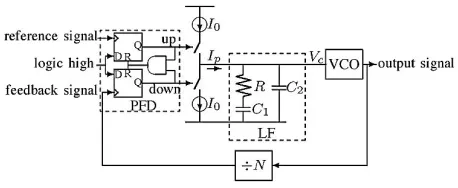
[image:3.595.319.548.55.149.2]A CP PLL circuit consists of a reference signal, a phase frequency detector (PFD), a charge pump (CP), a loop filter (LF), and a voltage controlled oscillator (VCO). In this pa-per we consider a single path higher order (Third and fourth) CP PLL shown in Fig. 11. We use a behavioural model of the PLL, where we consider a linear model for VCO, a lin-ear model for the third order LF, and a non-linlin-ear model for 1Third order shown here,fourth order has an additional resistor-capacitor in its LF
Figure 1: Charge Pump (CP) Phase Lock Loop (PLL)
the PFD. We denote by𝜙𝑟𝑒𝑓, and𝜙𝑉 𝐶𝑂, the phases of the
reference and VCO output feedback signals respectively. We model the CP PLL as a hybrid system such that the non-linearities of the PFD is modelled as a piecewise continuous signal. Ignoring the cycle slip phenomena, the PFD output in the form of the charge pump current𝐼𝑝, is given by the
following piecewise linear inclusion:
𝐼𝑝=
⎧ ⎨ ⎩
∈[𝐼𝑈
𝑝𝐼𝑃𝑈] UP=1, Down=0, 0≤𝜙𝑉 𝐶𝑂<2𝜋≤𝜙𝑟𝑒𝑓
∈[𝐼𝐷
𝑝𝐼𝑃𝐷] UP=0, Down=1, 0≤𝜙𝑟𝑒𝑓 <2𝜋≤𝜙𝑉 𝐶𝑂
∈[0𝑅 0𝑅] UP=0, Down=0, 0≤𝜙
𝑉 𝐶𝑂, 𝜙𝑟𝑒𝑓 <2𝜋
(2) We denote the three modes as mode1 (UP=0, Down=0), mode2 (UP=1, Down=0) and mode3 (UP=0, Down=1). The transition from one mode to another is based on the reference and feedback signals hitting the 2𝜋threshold. Due to the cyclic behaviour of the PLL and to keep the anal-ysis modulo 2𝜋, we need to ensure the phases remain in the range 0 ≤ 𝜙𝑉 𝐶𝑂, 𝜙𝑉 𝐶𝑂 < 2𝜋 (Similarly 𝜙𝑟𝑒𝑓) after
resetting the PFD. This is achieved by resetting the two phases such that (𝜙𝑟𝑒𝑓 := 0, 𝜙𝑉 𝐶𝑂 := 𝜙𝑉 𝐶𝑂−2𝜋), and
(𝜙𝑟𝑒𝑓 :=𝜙𝑟𝑒𝑓 −2𝜋, 𝜙𝑉 𝐶𝑂 := 0), while taking transitions
from mode1 to mode2 and mode1 to mode3, respectively. Identity resets are used for transitions from mode2 to mode1 and mode3 to mode1.
Our model consists of the state variables, 𝜙𝑉 𝐶𝑂, 𝜙𝑟𝑒𝑓,
voltage𝑣1across the capacitor𝐶1, and the voltage𝑣2across the capacitor 𝐶2 (Fourth order has an additional voltage variable across the third capacitor). Let 𝑓𝑉 𝐶𝑂, and 𝑓𝑟𝑒𝑓,
represent the frequencies of the VCO output and the refer-ence signal respectively. If 𝐾𝑝 is the gain of the LF, then
𝑓𝑉 𝐶𝑂 = 𝐾𝑝𝑣2/2𝜋+𝑓𝑂, where 𝑓𝑂 is the free running
fre-quency of the VCO. Therefore, ˙𝜙𝑉 𝐶𝑂= 2𝜋𝑓𝑉 𝐶𝑂/𝑁, 𝜙˙𝑟𝑒𝑓 =
2𝜋𝑓𝑟𝑒𝑓. By Kirchhoff’s current law and using the three modes
of the PFD, we get the following hybrid system of the third order CP PLL
ℋ= ⎧ ⎨ ⎩ ˙ ⎛ ⎜ ⎜ ⎜ ⎝ 𝑣1 𝑣2 𝜙𝑟𝑒𝑓
𝜙𝑉 𝐶𝑂
⎞ ⎟ ⎟ ⎟ ⎠=𝐴
⎛ ⎜ ⎜ ⎜ ⎝ 𝑣1 𝑣2 𝜙𝑟𝑒𝑓
𝜙𝑉 𝐶𝑂
⎞ ⎟ ⎟ ⎟
⎠+𝐵𝐼𝑝+𝑐 𝑥∈ 𝒞,
𝑥+=𝐺
𝑖(𝑥) 𝑥∈ 𝒟
(3)
where,𝐴=
⎛ ⎜ ⎜ ⎝
−1/𝑅𝐶1 1/𝑅𝐶1 0 0
1/𝑅𝐶2 −1/𝑅𝐶2 0 0
0 0 0 0
0 𝐾𝑝/𝑁 0 0
⎞ ⎟ ⎟ ⎠, 𝐵= ⎛ ⎜ ⎜ ⎝ 0 𝐼𝑝/𝐶2
0 0
⎞ ⎟ ⎟ ⎠,𝑐=
⎛ ⎜ ⎜ ⎝ 0 0 2𝜋𝑓𝑟𝑒𝑓
2𝜋𝑓𝑜/𝑁
⎞ ⎟ ⎟
From the three modes and their invariants, we can easily find the sets𝒞, 𝒟, and the jump maps𝐺𝑖(𝑥). Here, we use
the difference 𝜙𝑟𝑒𝑓 −𝜙𝑉 𝐶𝑂 as a state variable instead of
𝜙𝑟𝑒𝑓, and𝜙𝑉 𝐶𝑂.
Remark 1.
This change of state variables transforms all jump maps𝐺𝑖
in to identity maps (𝐺𝑖(𝑥) =𝑥), as the same constant 2𝜋
is subtracted from𝜙𝑉 𝐶𝑂 and 𝜙𝑟𝑒𝑓, leaving their difference
𝜙𝑟𝑒𝑓−𝜙𝑉 𝐶𝑂before and after the jumps unchanged.
2.3
Attractive Invariants in Hybrid Systems
using Lyapunov Certificates
Contrary to safety properties where existence of an invari-ant set is sufficient for proving/dis-proving the property, for inevitability property, we use the concept of ”attractive in-variants”. Attractive invariants are compact semi-algebraic sets where if the CP PLL hybrid system starts, will always remain there and will eventually converge to the equilibrium state. Stability and attractivity concepts for an equilibrium state of the continuous dynamical systems are discussed in [5], and have been extended to hybrid systems in [4]. The equilibrium point, 𝑥𝑒 = 0, is called asymptotically stable
(AS) if it is both stable and attractive. There are several versions of the stability theorems for hybrid systems based on the global Lyapunov function, and multiple Lyapunov certificates [12]. We use the following theorem of AS and define the attractive invariant,
Theorem 1.
Let,ℐ0 ⊆𝐼𝐶 be the set of indices that contain the
equilib-rium. For a hybrid system ℋhaving an equilibrium point 𝑥𝑒= 0, if there exist Lyapunov certificates𝑉𝑖such that,
1. 𝑉𝑖(𝑥)>0, ∀𝑖∈𝐼𝐶, ∀𝑥∈ 𝒞 ∖𝑥𝑒,
2. 𝑉𝑖(0) = 0, ∀𝑖∈ ℐ0, 3. ∂𝑉𝑖
∂𝑥(𝑥)𝐹𝑖(𝑥, 𝑢)<0, ∀𝑖∈𝐼𝐶, ∀𝑥∈ 𝒞 ∖𝑥𝑒, 𝐹𝑖∈ ℱ,
𝑢∈ 𝒰,
4. 𝑉𝑗(𝐺𝑖(𝑥))−𝑉𝑗′(𝑥)<0, ∀𝑗∀𝑗′∈𝐼𝐶, 𝑗∕=𝑗′,
∀𝑖∈𝐼𝐷, ∀𝑥∈ 𝒟 ∖𝑥𝑒, 𝐺𝑖∈ 𝒢,
then𝑥𝑒 is asymptotically stable. Furthermore, the set
𝒜ℐ =∪𝑖(𝑉𝑖 ≤ 𝑐𝑚𝑎𝑥)⊂ 𝒞 ∪ 𝒟 is an ”attractive invariant”
set.
Proof. Similarly to [12].
We also use another important characteristic of the trajec-tories in a semi algebraic set and term it as the Escape prop-erty. This property ensures that trajectories in a compact set can not converge to an invariant set (Equilibrium,Limit Cycle) and will eventually leave that set.
Proposition 1.
For a compact set𝒳 ⊂𝐶𝑖,if there is a differentiable Escape
certificate,𝐸:ℝ𝑛→ℝ, and𝜖 >0,such that
∂𝐸
∂𝑥(𝑥)𝐹𝑖(𝑥, 𝑢)≤ −𝜀, ∀𝑥∈ 𝒳, 𝑢∈ 𝒰 (4) then∀𝑥(𝑡, 𝑖)∈ 𝒳, 𝑥(𝑡+𝑇 , 𝑖)∈ 𝒳/ , 𝑇 > 𝑡.
Proof. Assume that there exists 𝑥0 ∈ 𝒳 such that 𝑥(𝑡, 𝑖)
starting at𝑥0 remain in𝒳 as𝑡→ ∞. From equation. 4, 𝐸(𝑥) = ∫0∞∂𝐸
∂𝑥(𝑥)𝐹𝑖(𝑥) ≤ −𝜀. As𝑡 → ∞, 𝐸(𝑥) → −∞.
This contradicts the assumption as𝐸(𝑥) should be bounded if𝑥(𝑡, 𝑗) has to be in the bounded set𝒳. Therefore,𝑥(𝑡, 𝑗) has to eventually escape𝒳 in finite time.
2.4
SOS Programming
Our hybrid deductive and bounded verification approach involves checking the positivity of polynomials in semi-algebraic sets. To solve this NP-Hard problem, a sound relaxation method based on SOS programming has been discussed in [10], [12]. A sufficient condition for a multivariate polyno-mial p(𝑥) to be non-negative everywhere, is that it can be decomposed as a sum of squares of polynomials. A poly-nomialp(𝑥) is a sum of squares, if there exist polynomials
p1(𝑥), ...,pm(𝑥) such that p(𝑥) = ∑𝑚𝑖=1p𝑖2(𝑥). We denote
the set of polynomials in 𝑛 variables with real coefficients by𝒫𝑛. A subset of this set is the set of SOS polynomials in
𝑛 variables denoted by 𝒮𝑛. For a polynomial 𝑞 :ℝ𝑛 →ℝ,
differentiable scalar function, we define the 0-sub-level-set of 𝑞 as𝒵(𝑞) ={𝑥∈ℝ𝑛∣𝑞(𝑥)≤0}. We present an important
lemma to be used for polynomial level sets operations such as intersection, union, and set inclusion [15].
Lemma 1.
For polynomials𝑝1, 𝑝2∈ 𝒫𝑛, if there exist SOS polynomials
𝑠0, 𝑠1 ∈ 𝒮𝑛such that
𝑠0−𝑠1𝑝1 +𝑝2 = 0∀𝑥∈ℝ𝑛 (5) Then𝒵(𝑝1)⊂ 𝒵(𝑝2)
Proof. See for example [15] and the references there in.
2.5
Bounded Advection of Level Sets
Let we define a flow map 𝜓 : ℝ𝑛×ℝ
≥0 → ℝ𝑛 for the hybrid systemℋ. A time𝑡advection operator𝐴𝑡 is a map
𝐴𝑡:𝑄(ℝ𝑛,ℝ) →𝑄(ℝ𝑛,ℝ), such that𝑈 =𝐴𝑡𝑉 for𝑈, 𝑉 ∈
𝑄(ℝ𝑛,ℝ), and𝑈(𝑥) =𝑉(𝜓
−𝑡(𝑥)) for all𝑥∈ 𝒞 ∪𝒟. This
ad-vection operator has an important property of linearity. For polynomial functions𝑈1, 𝑈2∈𝑄(ℝ𝑛,ℝ), if𝑈2 =𝐴
𝑡𝑈1,then
𝒵(𝑈2) = 𝐴𝑡(𝒵(𝑈1)). For a detailed discussion on the
ad-vection operator see [15].
3.
VERIFICATION METHODOLOGY
To verify inevitability of the CP PLL equilibrium, we in-troduce two compact sets𝒮1, and𝒮2, such that𝒮1∩ 𝒮2 =
∅, and𝒮1∪𝒮2 =𝒞 ∪𝒟. We define two properties whose ver-ification implies verver-ification of the inevitability of the equi-librium.
Property 1.
∀𝑥(0, 𝑗)∈ 𝒮1, 𝑥(𝑡, 𝑗)→𝑥𝑒 for𝑡→ ∞.
Property 2.
∀𝑥(0, 𝑗)∈ 𝒮2 = (𝒞 ∪ 𝒟)∖ 𝒮1, 𝑥(𝑡, 𝑗)∈ 𝒮1 for𝑡→𝑏∈ℝ>0. If we denote the inevitability property by𝜑, Property.1 by 𝜑1 and Property.2 by 𝜑2 , then𝜑=𝜑1∧𝜑2. A hybrid arc 𝑥satisfies𝜑iff it satisfies𝜑1 in𝒮1 and𝜑2 in𝒮2 i.e.,∀𝑥∈
𝒞 ∪ 𝒟, 𝑥∣=𝜑 ⇐⇒ (𝑥∣=𝜑1∀𝑥∈ 𝒮1) ∧(𝑥∣=𝜑2∀𝑥∈ 𝒮2).
Theorem 2.
If there are feasible Lyapunov certificates (fulfilling Th. 1),
{𝑉1, 𝑉2, 𝑉3}, then, 𝑥 ∣= 𝜑1, ∀𝑥(0, 𝑗) ∈ 𝒮1 = {(𝑉1 ≤ 𝛾1𝑚𝑎𝑥)∪(𝑉2 ≤ 𝛾2𝑚𝑎𝑥)∪(𝑉3 ≤ 𝛾3𝑚𝑎𝑥)}, and 𝒜ℐ = 𝒮1
is the attractive invariant set.
Proof. Follows directly from Th. 1, since the level sets
de-fined by the level curves of the Lyapunov certificates repre-sent attractive invariant sets with the negative Lie-derivative along the system trajectories. Therefore, eventually all sys-tem trajectories starting in these level sets converge to the equilibrium point.
Following Th. 2, we encode the verification of𝜑1 as two SOS programs. The truth value of𝜑1 depends on the exis-tence of the attractive invariant set𝒮1. The set𝒮1 is com-puted from the maximized level sets defined by the three candidate Lyapunov certificates𝑉1, 𝑉2, 𝑉3. We compute these certificates using a sound mathematical technique called the S-procedure [3]. The first SOS program is given below:
(a) 𝑉𝑖(𝑥)−∑𝑛𝑘=1𝐶𝑖𝑠1(𝑖𝑘)(𝑥)𝑔𝑖𝑘(𝑥)∈ 𝒮𝑛, ∀𝑥∕= 0,
𝑖∈ {1,2,3},∀𝑘∈ {1, .., 𝑛𝐶𝑖},𝑠(1𝑖𝑘)∈ 𝒮𝑛,
(b)
⎧
⎩−∂𝑉∂𝑥𝑖(𝑥)𝐹𝑖(𝑥, 𝑢)−
∑𝑛𝐶𝑖
𝑘=1𝑠(2𝑖𝑘)(𝑥)𝑔𝑖𝑘(𝑥)−
∑𝑚
𝑗=1𝑠𝑗3(𝑥)𝑎𝑗(𝑢)
⎫ ⎭∈ 𝒮𝑛,
∀𝑖∈ {1,2,3},∀𝑘∈ {1, .., 𝑛𝐶𝑖}, ∀𝑗∈ {1, .., 𝑚}, (𝑠(𝑖𝑘)
2 , 𝑠𝑗3)∈ 𝒮𝑛,
(c)
⎧
⎩𝑉𝑗(𝑥)−𝑉𝑗′(𝐺𝑖(𝑥))−𝑠(4𝑖0)(𝑥)ℎ𝑖0(𝑥)−
∑𝑚𝐷𝑖
𝑘=1 𝑠(5𝑖𝑘)(𝑥)ℎ𝑖𝑘(𝑥)
⎫
⎭∈ 𝒮𝑛, ∀𝑗∀𝑗′∈ {1,2,3},
𝑗∕=𝑗′, ∀𝑖∈ {1,2,3,4},∀𝑘∈ {1, .., 𝑛
𝐷𝑖}, 𝑠(4𝑖0)≥0, 𝑠(5𝑖𝑘)∈ 𝒮𝑛
Here𝑉𝑖(𝑥), 𝑉𝑗(𝑥), 𝑉𝑗′(𝑥), 𝑠(1𝑖𝑘), 𝑠2(𝑖𝑘), 𝑠(3𝑗), 𝑠4(𝑖0), 𝑠(5𝑖𝑘), are
polynomials of degree𝑑.
SOS constraints (a) and (b) enforce positive definiteness on the Lyapunov certificates, and negative semi-definiteness on their Lie-derivatives respectively. Furthermore, these con-straints have to be satisfied in their respective domains𝐶𝑖‘𝑠,
where, 𝐶𝑖 ={𝑥 ∈ ℝ𝑛 :𝑔𝑖𝑘 ≥ 0, for𝑘 ∈ {1, .., 𝑛𝐶𝑖}, 𝑖∈
{1,2,3}}. Constraint (b) also ensures parameters u to belong to the set,{𝑎(𝑢)≥0, for𝑗∈ {1, .., 𝑚}}. Constraint in (c) ensures that Lyapunov certificates𝑉𝑗(𝑥) decrease along the
discrete jumps in the sets,𝐷𝑖={𝑥∈ℝ𝑛 :ℎ𝑖𝑘 ≥0, ℎ𝑖0 = 0, for𝑘 ∈ {1, .., 𝑛𝐷𝑖}, 𝑖 ∈ {1,2,3,4}}, through the map-pings𝐺𝑖(𝑥)‘𝑠. SOS polynomials𝑠(1𝑖𝑘), 𝑠(2𝑖𝑘), 𝑠(3𝑗), 𝑠(4𝑖0), 𝑠(5𝑖𝑘) are used to enforce domain constraints through the S-procedure. A feasible solution of the above SOS program results in Lya-punov certificates𝑉𝑖. If this SOS program is infeasible, then
either the program is repeated for an increased degree𝑑of the polynomials, or we conclude that the truth value of the property𝜑1 can not be established.
The second SOS program for maximizing the level curves for every𝑉𝑖≤𝛾𝑖∈ℝ>0,is,
maximize 𝛾𝑖
subject to 𝑠5 +
𝑛𝐶𝑖
∑
𝑘=1 𝑠6𝑖𝑘(−𝑔
𝑖𝑘)−(𝑉𝑖−𝛾𝑖) +𝜖= 0,
(𝑠5, 𝑠6𝑖𝑘) ∈ 𝒮
𝑛, 𝑖∈ {1,2,3}, 𝑘∈ {1, ..., 𝑛𝐶𝑖}. This algorithm maximizes the level curves of the Lyapunov certificates𝑉𝑖 such that𝒵(𝑉𝑖−𝛾𝑖)⊂ 𝒵(−𝑔𝑖𝑘),
for𝑘 ∈ {1, .., 𝑛𝐶𝑖} (Lemma. 1). The set 𝒮1 =
∪3
𝑖=1(𝑉𝑖 ≤
(𝛾𝑖)𝑚𝑎𝑥). The non-emptiness of the set𝒮1 shows that𝑥∣=
𝜑1, ∀𝑥∈ 𝒮1.
To verify property 𝜑2, we extend the advection of level sets [15] to hybrid systems, and show that for all 𝑥(0, 𝑗) ∈ 𝒮2, 𝑥(𝑡, 𝑗)→ 𝒮1 for some bounded𝑡. This is given in Alg. 1 where Line-5 is the set advection implemented as a SOS program. Let the sets, 𝒮2 = 𝒵(𝑃𝐼𝑛𝑖𝑡𝑖𝑎𝑙), and 𝒮2𝑛𝑒𝑥𝑡 =
𝒵(𝑃𝑛𝑒𝑥𝑡), where, (𝑃𝐼𝑛𝑖𝑡𝑖𝑎𝑙, 𝑃𝑛𝑒𝑥𝑡) :ℝ𝑛 →ℝare polynomial
functions. The SOS algorithm for bounded advection of level sets is given below,
minimize𝜂 s.t. 𝑃𝑛𝑒𝑥𝑡(0)<0,
∇𝑃𝑛𝑒𝑥𝑡.(𝑣1, 𝑣2, 𝜙𝑟𝑒𝑓−𝜙𝑉 𝐶𝑂)𝑇 >0,
𝑠1𝑖−𝑠2𝑖𝑃𝐼𝑛𝑖𝑡𝑖𝑎𝑙+𝐴−ℎ𝑃𝑛𝑒𝑥𝑡+𝜂 + 𝑚∑𝐶𝑖
𝑘=1
𝑠3𝑖𝑘𝑔𝑖𝑘= 0,
𝑠4𝑖+𝑠5𝑖(𝑃𝐼𝑛𝑖𝑡𝑖𝑎𝑙−𝜇)−𝐴−ℎ𝑃𝑛𝑒𝑥𝑡+𝜂 + 𝑚∑𝐶𝑖
𝑘=1
𝑠6𝑖𝑘𝑔𝑖𝑘= 0,
𝑠7𝑖−𝑠8𝑖(𝑃𝐼𝑛𝑖𝑡𝑖𝑎𝑙−𝜇) + 𝑚∑𝐶𝑖
𝑘=1
𝑠9𝑖𝑘𝑔𝑖𝑘 +∇2𝑃𝑛𝑒𝑥𝑡ℎ
2
2 −𝜂= 0,
𝑠10𝑖−𝑠11𝑖(𝑃𝐼𝑛𝑖𝑡𝑖𝑎𝑙−𝜇) + 𝑚∑𝐶𝑖
𝑘=1
𝑠12𝑖𝑘𝑔𝑖𝑘∇2𝑃𝑛𝑒𝑥𝑡ℎ
2
2 −𝜂= 0, (𝑠1𝑖, 𝑠2𝑖, 𝑠3𝑖𝑘, 𝑠4𝑖, 𝑠5𝑖, 𝑠6𝑖𝑘, 𝑠7𝑖, 𝑠8𝑖, 𝑠9𝑖𝑘, 𝑠10𝑖, 𝑠11𝑖,
𝑠12𝑖𝑘) ∈ 𝒮𝑛.
(6) Here𝑃𝑛𝑒𝑥𝑡is of degree𝑑𝑟, 𝜇 >0, 𝜂 >0, ℎ >0,
𝑢∈[𝐿 𝑈], and𝑠1𝑖, 𝑠2𝑖, 𝑠3𝑖𝑘, 𝑠4𝑖, 𝑠5𝑖, 𝑠6𝑖𝑘, 𝑠7𝑖𝑘, 𝑠8𝑖, 𝑠9𝑖𝑘,
𝑠10𝑖, 𝑠11𝑖, 𝑠12𝑖𝑘, are polynomials of degree𝑑.
The first two constraints of this SOS program ensure the advected level sets are closed and connected (See [15] and the references there in). The next two constraints search for a polynomial𝑃𝑛𝑒𝑥𝑡, such that when the set𝒵(𝑃𝑛𝑒𝑥𝑡) is
back-ward advected by the first order Taylor advection map𝐴−ℎ,
we obtain a set such that,
𝒵(𝑃𝐼𝑛𝑖𝑡𝑖𝑎𝑙)⊂ 𝒵(𝐴−ℎ𝑃𝑛𝑒𝑥𝑡+𝜂)⊂𝜓−ℎ(𝒵(𝑃𝑛𝑒𝑥𝑡))⊂
𝒵(𝐴−ℎ𝑃𝑛𝑒𝑥𝑡−𝜂)⊂ 𝒵(𝑃𝐼𝑛𝑖𝑡𝑖𝑎𝑙−𝜇).
Here 𝜇 is used as a precision parameter determining, how closely we want the set 𝒵(𝑃𝐼𝑛𝑖𝑡𝑖𝑎𝑙) to be approximated by
the set𝒵(𝐴−ℎ𝑃𝑛𝑒𝑥𝑡+∥𝜂∥). The last two constraints enforce
the truncation error of the first order Taylor approxima-tion such that,∥∇2𝑃
𝑛𝑒𝑥𝑡ℎ22∥≤𝜂, in the set𝒵(𝑃𝐼𝑛𝑖𝑡𝑖𝑎𝑙−𝜇).
Note that we solve the above optimization SOS program by using bisection on 𝜂. To be conservative, and use an over-approximation to the set𝜓ℎ(𝒵(𝑃𝐼𝑛𝑖𝑡𝑖𝑎𝑙)), the set
Algorithm 1Verification of Property𝜑2
INPUT: : Hybrid System Model of CP PLL, Sets𝒮1, 𝒮2
OUTPUT: : 𝜑2 Verified in Bounded Time/No-answer 1: 𝒮2𝑛𝑒𝑥𝑡← ∅
2: 𝒮2𝑎𝑑𝑣𝑒𝑐𝑡← ∅
3: 𝒮2𝑎𝑑𝑣𝑒𝑐𝑡← 𝒮2
4: for𝑗←1to𝑗←𝑚do
5: 𝒮2𝑛𝑒𝑥𝑡←𝐴𝑑𝑣𝑒𝑐𝑡(𝒮2𝑎𝑑𝑣𝑒𝑐𝑡)
6: if 𝒮2𝑛𝑒𝑥𝑡∕⊂ 𝒮1then
7: 𝒮2𝑎𝑑𝑣𝑒𝑐𝑡← 𝒮2𝑛𝑒𝑥𝑡
8: else
9: 𝑥∣=𝜑2, ∀𝑥∈ 𝒮2
10: break
11: end if
12: end for
13: Try a large value of𝑚 14: if 𝒮2𝑛𝑒𝑥𝑡∕⊂ 𝒮1then
15: For𝒮2𝑛𝑒𝑥𝑡∖(𝒮2′𝑛𝑒𝑥𝑡=𝒮1∩ 𝒮2𝑛𝑒𝑥𝑡) find the Escape
Certificate E. 16: if E existsthen
17: 𝑥∣=𝜑2, ∀𝑥∈ 𝒮2
18: break
19: else
20: No Answer about𝜑2 21: end if
22: end if Remark 2.
As for the transformed CP PLL hybrid system (Remark.1) we have identity jump maps, there is therefore no need of constraints on the level sets due to discrete jumps.
After each iteration of the advection of level sets, if the set inclusion𝒮2𝑛𝑒𝑥𝑡⊂ 𝒮1 is true, then property𝜑2 is
veri-fied. Alternatively, the algorithm keeps on advecting the set
𝒮2𝑛𝑒𝑥𝑡for a user defined bounded number of iterations (Line
7-13). If the property𝜑2 is still not verified (This can happen when the advection of the level sets is unsymmetrical and a subset of the set𝒮2 is not immersed in𝒮1), we compute the Escape certificate E for the set,𝒮2𝑛𝑒𝑥𝑡∖𝒮2′𝑛𝑒𝑥𝑡, showing
that trajectories in this set will eventually leave and reach
𝒮1 (Line 14-18, as they can not reach𝒮2𝑛𝑒𝑥𝑡−1). This either results in the verification of the property𝜑2 (respectively 𝜑) in the set𝒮2 or we conclude inconclusiveness about the truth value of𝜑2 (respectively 𝜑). Line 15 is implemented by the following SOS program,
−∂𝐸∂𝑥𝑖(𝑥)𝐹𝑖(𝑥, 𝑢)−𝑠1(𝑥)𝑔2(𝑥) +𝑠2(𝑥)𝑔2′(𝑥) +𝜀∈ 𝒮𝑛
(𝑠1, 𝑠2)∈ 𝒮𝑛
where,𝒮2𝑛𝑒𝑥𝑡:=𝑔2(𝑥)≥0, and𝒮2′𝑛𝑒𝑥𝑡:=𝑔2′(𝑥)≥0.
4.
EXPERIMENTAL EVALUATION
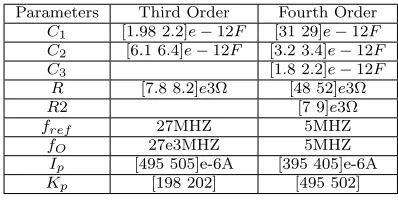
We used YALMIP [7] solvers within MATLAB for the verification of the inevitability property (respectively sub-properties) on a 2.6 GHZ Intel Core i5 machine with 4 GB of memory. The CP PLL parameters are listed in Table. 1, with all phases normalized by 2𝜋. We computed degree-6 multiple Lyapunov certificates for the third order, and degree-4 multi-ple Lyapunov certificates for the fourth order CP PLL. Their attractive invariant sets as projected onto different planes are shown in Fig. 2, and Fig. 3. Results of their bounded
Parameters Third Order Fourth Order
𝐶1 [1.98 2.2]𝑒−12𝐹 [31 29]𝑒−12𝐹 𝐶2 [6.1 6.4]𝑒−12𝐹 [3.2 3.4]𝑒−12𝐹
𝐶3 [1.8 2.2]𝑒−12𝐹
𝑅 [7.8 8.2]𝑒3Ω [48 52]𝑒3Ω
𝑅2 [7 9]𝑒3Ω
𝑓𝑟𝑒𝑓 27MHZ 5MHZ
𝑓𝑂 27e3MHZ 5MHZ
𝐼𝑝 [495 505]e-6A [395 405]e-6A
[image:6.595.336.535.52.152.2]𝐾𝑝 [198 202] [495 502]
Table 1: PLL Parameters used in the Experimentation
−8 −6 −4 −2
2 4 6 8
−8
−6
−4
−2
2
4
6
8
v1 v2
−10 −5
5
10
−2
−1
1
2
v2 Phi_ref − Phi_VCO
Figure 2: 3-Order𝒜ℐProjected onto (𝑣1, 𝑣2), and (𝑣2,(𝜙𝑟𝑒𝑓−𝜙𝑉 𝐶𝑂)
advection are shown in Fig. 4 and Fig. 5 respectively. Note that due to space constraint, we have shown projections on only two planes for each benchmark. The outer set plotted in solid is the initial set inside which we aim to prove the inevitability of the phase-locking in the CP PLL. The ad-vected level curves are shown in dotted. We used the time step h=1e-3 seconds, and𝜇= 1𝑒−4 in the computation of advected sets. It can be observed, for the third order level sets eventually symmetrically immersed in the central at-tractive set after bounded iterations. For the fourth order CP PLL, the advection of level sets is unsymmetrical as the progress in one direction is more abrupt than another. We have therefore the level sets immersed in the attractive in-variant from one direction, but advection is inconclusive for a subset in the other direction shown by the pink shaded area in Fig. 5. For the inconclusive subset, we searched a degree-4 Escape certificate for two modes (In one mode2 bounded advection proved convergence to attractive invari-ant set) showing convergence of the trajectories to the at-tractive invariant. Computation time of different steps of our verification methodology are given in Table. 2.
[image:6.595.328.544.195.297.2]Verification Step 3-Order Time(Sec) 4-Order Time(Sec) Attractive Invariant 1381.7(Degree 6) 10021(Degree 4)
Max.Level Curves 15.5 12 Advection 106.8487 (14 iterations) 140.678 (7 Iterations) Checking Set Inclusion 13 10.2
[image:7.595.55.292.52.103.2]Escape Certificate 18 (2 Certificates)
Table 2: Computation Time of the Inevitability Verification
−8−7−6−5−4−3−2−1 1 2 3 4 5 6 7 8
−1.0 −0.5 0.5 1.0
v2 Phi_ref −Phi_VCO
−8 −6 −4 −2 2 4 6 8
−8 −6 −4 −2 2 4 6 8
[image:7.595.343.533.54.139.2]v2 v3
Figure 3: 4-Order𝒜ℐProjected onto (𝑣2, 𝑣3), and (𝑣2,(𝜙𝑟𝑒𝑓−𝜙𝑉 𝐶𝑂)
5.
CONCLUSION
We have presented a scalable verification methodology benefiting from both deductive and bounded verification ap-proaches. We tailored these approaches to verify the complex inevitability property for a practical AMS CP PLL circuit of higher order. As the problem is known to be NP-hard, we used the sufficient SOS relaxation algorithm for the verifica-tion of these properties. Experimental results show the effec-tiveness of our methodology avoiding expensive discretiza-tion and reach set computadiscretiza-tions.
6.
REFERENCES
[1] T. A.Henzinger, P.-H. Ho, and H. Wong-Toi. Algorithmic analysis of nonlinear hybrid systems.
IEEE Transactions on Automatic Control,
43(4):540–554, Apr 1998.
[2] M. Althoff, A. Rajhans, B. H. Krogh, S. Yaldiz, X. Li, and L. Pileggi. Formal verification of phase-locked loops using reachability analysis and continuization. In
Proceedings of the International Conference on
Computer-Aided Design ICCAD, pages 659–666, 2011.
[3] S. P. Boyd, L. El Ghaoui, E. Feron, and
V. Balakrishnan.Linear matrix inequalities in system
and control theory, volume 15. SIAM, 1994.
[4] R. Goebel, R. G. Sanfelice, and A. R. Teel.Hybrid dynamical systems: modeling, stability, and
robustness. Princeton University Press, 2012.
[5] H. K.Khalil.Nonlinear Systems. Prentice Hall, third edition, 2002.
[6] H. Lin, P. Li, and C. J. Myers. Verification of digitally-intensive analog circuits via kernel ridge regression and hybrid reachability analysis. In
Proceedings of the 50th Annual Design Automation
Conference, page 66. ACM, 2013.
[7] J. Lofberg. Yalmip: A toolbox for modeling and optimization in matlab. InComputer Aided Control Systems Design, 2004 IEEE International Symposium on, pages 284–289. IEEE, 2004.
[8] J. Lygeros, K. H. Johansson, S. N. Simi´c, J. Zhang, and S. S. Sastry. Dynamical properties of hybrid automata.IEEE TRANSACTIONS ON
AUTOMATIC CONTROL, 48(1):2–17, January 2003.
−8 −7 −6 −5 −4 −3 −2 −1 1 2 3 4 5 6 7 8
−8 −6 −4 −2 2 4 6 8
v1 v2
−10 −8 −6 −4 −2 2 4 6 8 10
−2 −1 1 2
[image:7.595.77.274.135.220.2]v2 Phi_ref − Phi_VCO
Figure 4: 3-Order Advection Projected onto (𝑣1, 𝑣2), and (𝑣2,(𝜙𝑟𝑒𝑓−𝜙𝑉 𝐶𝑂))
−8 −7 −6 −5 −4 −3 −2 −1 1 2 3 4 5 6 7 8
−1.0 −0.8 −0.6 −0.4 −0.2 0.2 0.4 0.6 0.8 1.0
v2 Phi_ref − Phi_VCO
−8 −7 −6 −5 −4 −3 −2 −1 1 2 3 4 5 6 7 8
−8 −6 −4 −2 2 4 6 8
v2 v3
Figure 5: 4-Order Advection Projected onto (𝑣2, 𝑣3), and (𝑣2,(𝜙𝑟𝑒𝑓−𝜙𝑉 𝐶𝑂))
[9] A. Papachristodoulou and S. Prajna. On the construction of lyapunov functions using the sum of squares decomposition. In41st IEEE Conference on
Decision and Control, volume 3, pages 348–3487, 2002.
[10] P. A. Parrilo.Structured semidefinite programs and semialgebraic geometry methods in robustness and
optimization. PhD thesis, Citeseer, 2000.
[11] S. Prajna and A. Jadbabaie. Safety verification of hybrid systems using barrier certificates. InHybrid
Systems: Computation and Control, pages 477–492.
Springer, 2004.
[12] S. Prajna and A. Papachristodoulou. Analysis of switched and hybrid systems-beyond piecewise quadratic methods. InAmerican Control Conference,
2003. Proceedings of the 2003, volume 4, pages
2779–2784. IEEE, 2003.
[13] T. Sturm and A. Tiwari. Verification and synthesis using real quantifier elimination. InProceedings of the 36th international symposium on Symbolic and
algebraic computation, pages 329–336. ACM, 2011.
[14] A. Taly and A. Tiwari. Deductive verification of continuous dynamical systems. InLIPIcs-Leibniz
International Proceedings in Informatics, volume 4.
Schloss Dagstuhl-Leibniz-Zentrum f¨ur Informatik, 2009.
[15] T. Wang, S. Lall, and M. West. Polynomial level-set method for polynomial system reachable set estimation. 2013.
[16] J. Wei, Y. Peng, G. Yu, and M. Greenstreet. Verifying global convergence for a digital phase-locked loop. In
Formal Methods in Computer-Aided Design
(FMCAD), 2013, pages 113–120. IEEE, 2013.
[17] M. H. Zaki, S. Tahar, and G. Bois. Formal verification of analog and mixed signal designs: A survey.
[image:7.595.341.536.179.264.2]