City, University of London Institutional Repository
Citation
:
Secker, J. & Morrison, C.M. (2015). UK Copyright Literacy Review. Paper presented at the 11th Northumbria Conference on Performance Measurement in Libraries and Information Services, 20-22 Jul 2015, Edinburgh, Scotland.This is the accepted version of the paper.
This version of the publication may differ from the final published
version.
Permanent repository link:
http://openaccess.city.ac.uk/17539/Link to published version
:
Copyright and reuse:
City Research Online aims to make research
outputs of City, University of London available to a wider audience.
Copyright and Moral Rights remain with the author(s) and/or copyright
holders. URLs from City Research Online may be freely distributed and
linked to.
UK Copyright Literacy Review
Chris Morrison, University of Kent and Jane Secker, LSE.
1Presented at the 11th Northumbria Conference on Performance Measurement in Libraries and
Information Services, Edinburgh 20-22 July 20152. This version submitted to conference organisers
30 September 2015.
Introduction and Purpose
The purpose of this research was to survey the levels of copyright literacy amongst UK librarians and information professionals in all sectors including the cultural heritage sector (e.g. museums, galleries and archives). The UK survey was part of a wider international copyright literacy project which originated in the Bulgarian Ministry of Education and Science [Todorova et al, 2014]. The reason for carrying out the research was to highlight any gaps in knowledge and training requirements in the relevant UK sectors as well as gather data to compare with copyright literacy levels in other countries that were participating in the survey. It is believed that this is the biggest survey of its kind to have been carried out in the UK.
The researchers hoped that the survey would support a better understanding of copyright as part of the wider development of digital literacies within UK libraries and cultural institutions. There was a significant reform of the copyright regime in the UK during 2014 which was intended to provide educational and cultural institutions with greater freedoms. Therefore consideration of copyright in the context of information and digital literacy was of particular interest because the impact of the changes to the law on information professionals was not yet understood. Knowledge of copyright exceptions related to libraries and education, could also potentially empower librarians and their users to better exploit copyright protected materials. The study also sought to consider how the impact of copyright support and literacy programmes within institutions could be measured, particularly in light of the need to take full advantage of the new legal landscape.
Context
The originating international research project [Todorova et al 2014] was entitled ‘Copyright Policy of Libraries and Other Cultural Institutions’. However the term ‘copyright literacy’ was used by
Todorova et al to place the research in the wider context of information literacy. The research attempted to do more than just examine policies and strategic documents, but to gain an insight into actual activities taking place within institutions and the perceived confidence levels of staff members, many of whom may be responsible for advising and educating students, colleagues and other service users. Terminology can often be a contested area with terms such as information literacy, meta
literacy, digital literacy and digital capabilities being a source of debate. However the researchers took the view that regardless of what name it was given, copyright was an essential component of enabling people to navigate the digital information age. Indeed Helen Beetham, leader of the Jisc Digital Capabilities framework project said that “awareness of copyright and the intellectual property of other people is central to…the digital capabilities framework. Understanding one's own copyright and IPR
1 [email protected] [email protected]
2
also comes into 'creation, innovation and scholarship' [and] I don't think it's too far-fetched to argue that in an academic setting, copyright has implications for academic identity.” (Beetham, 2015)
In the UK, copyright was identified as important for libraries in an electronic context as far back as the 1993 Follett Review of Libraries [Joint Funding Council’s Library Review Group, 1993]. In 1999 the Copyright Licensing Agency (CLA) first launched a scanning licence for higher education that changed the relationship that many librarians in educational institutions had with copyright from a purely advisory role to more of a compliance function. This view was supported by Oppenheim and Woodward (2004) who discovered that many librarians in the higher education sector found that their copyright-related responsibilities did not always sit well with other aspects of their roles. And more recently, following the Hargreaves Review of Intellectual Property (Hargreaves, 2011) the UK enacted a range of copyright reforms in 2014 that were intended to provide libraries, educational establishments and cultural institutions with greater freedoms. However, anecdotal evidence
suggested that these changes had left many in the sector unsure of how to handle copyright concerns, especially given the wider application of the ‘fair dealing’ principle. It was therefore of interest to the researchers as to how copyright support was being provided and whether the benefits were or could be measured.
Methods Adopted
This research originated from a project funded by the Bulgarian Ministry of Education and Science, led by Assoc. Prof. Dr Tania Todorova (State University of Library Studies and Information
Technologies, (SULSIT), Sofia, Bulgaria). The original project surveyed information professionals in Bulgaria, Croatia and Turkey (July – October 2013) and in France (January-March 2014). The UK survey was part of a second data collection phase, extending the survey to a greater number of countries. In the period of June - October 2014, the same survey was conducted in Finland, Hungary, Italy, Lithuania, Mexico, Norway, Portugal, Romania and USA.
The survey was made available online using the open source survey tool: LimeSurvey
(https://www.limesurvey.org/en/) and consisted of four sections. It included closed, half-open (through applying 5-degree scale of Likert) and open questions.
The survey aimed to establish the knowledge and awareness of the respondents on issues related to copyright, related intellectual property rights (IPRs) such as database rights and licensing activities. It also explored the attitude of the respondents towards the development and application of copyright policies in library and cultural institutions and attempted to get data on whether these policies were in existence.
The survey also examined attitudes towards the education and continuing professional development of information professionals about issues of intellectual property, for example in programmes on library and information science, archival science and cultural heritage sciences. Finally the survey gathered demographic information and information about the educational and professional experience of the respondents.
Practical Limitations
The survey was made available for one month due to the requirements of the source project to complete data collection by the end of 2014. Achieving a range of responses from across the various types of institutions was also constrained by those groups who were aware and incentivised to respond to the survey. It was widely promoted on relevant email discussion lists in the library and related sectors and via social media, specifically Twitter. There was a strong response from the library sector, particularly academic librarians amongst whom the research team is well known. The response from museums and other library sectors was less strong, however, the number of responses (over 600) received compared favourably to the data collection in other countries.
Findings
[image:4.595.70.525.358.666.2]In total 613 people responded to the survey but only 417 completed all the answers. Fig. 1 shows the number of questions answered compared with those not answered as respondents worked through the questions. There was a high drop-off in responses for the first three questions relating to general knowledge and awareness, but these soon evened out as the survey went on. This was encouraging because the researchers expected there to be a higher level of attrition during the middle section of the survey where the questions became more specific about different aspects of copyright, IPR and licensing awareness.
Fig. 1. Questions answered vs not completed
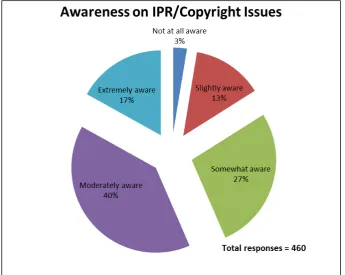
Turkey) surveyed shows a significant difference. Levels of perceived awareness outside the UK were significantly lower with only 33% describing themselves as either moderately or extremely aware of copyright and IPR issues (see Fig. 3).
[image:5.595.126.468.443.732.2]Fig. 2. Awareness of copyright issues
Fig. 4 shows the levels of perceived awareness in the UK by type of institution. There is a clear difference between the higher education sector, where extreme or moderate perceived awareness was at 58%, as opposed to the schools (41%) or public library (48%) sectors.
Fig. 4. Awareness of copyright and IPR issues by sector
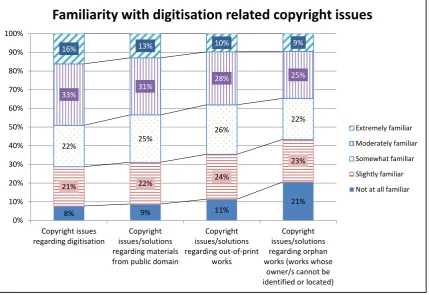
Fig. 5 shows the levels of familiarity with digitisation related copyright issues across all respondents. Whilst ‘copyright issues regarding digitisation’ was the area with the highest levels of reported awareness (49% extremely or moderately aware), other areas where librarians were required to make risk-based decisions, such as out of print content and orphan works, showed a much lower level of reported awareness (out of print issues - 38% extremely or moderately aware; orphan works issues 34% extremely or moderately aware). This may be partly to do with the terminology of the questions and different understandings of what is meant by digitisation. However there appeared to be a trend towards greater anxiety amongst information professionals when having to make risk based
Fig. 5. Familiarity with digitisation related copyright issues
Fig. 6. Copyright policy at institutional level
Fig. 6 shows responses on questions of institutional copyright policy and resourcing of copyright support within institutions. It should be noted that the extent to which multiple submissions had been sent from the same institution wasn’t clear, so the data may not be an accurate reflection of
institutional approaches. However there was a clear disparity between the number of respondents who thought that institutional copyright policies were important (76%) compared with the number of respondents whose institutions actually had one (63%). There was also a correlation with the
8% 9% 11% 21%
21% 22% 24%
23%
22% 25%
26% 22%
33% 31%
28% 25%
16% 13% 10% 9%
0% 10% 20% 30% 40% 50% 60% 70% 80% 90% 100% Copyright issues
regarding digitisation issues/solutionsCopyright
regarding materials from public domain
Copyright issues/solutions regarding out-of-print works Copyright issues/solutions regarding orphan works (works whose
owner/s cannot be identified or located)
Familiarity with digitisation related copyright issues
proportion of respondents who reported having a copyright policy (63%) and those who reported having a decided person in charge of copyright issues (64%). However in the case of copyright policies a much larger proportion didn’t know whether there was a policy (24%) compared with the number who didn’t know whether there was a person responsible for copyright issues (16%).
The survey also asked for qualitative data on views of Library and Information Science (LIS) education programmes and continuing professional development (CPD) via a free text field. Table 1 shows the top 14 areas where respondents felt they wanted more knowledge or support.
Topic / Issue LIS
Education LIS CPD
Overview of UK copyright legislation 68 48
Recent updates to the law 6 67
Copyright exceptions / relation to licences 43 23
Practical application of copyright law 34 30
Digital copyright / copyright and the
internet 33 20
Creative Commons / copyleft 31 15
Fair dealing 27 16
Specific Licensing schemes e.g. CLA, ERA 27 15
As per previous answer 0 41
Exceptions for libraries 24 15
Open access and institutional repositories 23 15
International copyright law 20 14
Licensing of digital resources 20 13
[image:8.595.127.461.194.447.2]How to protect IP 16 17
Table 1. Copyright topics for LIS education and CPD programmes
Although the respondents raised a wide range of different areas that they wanted to have covered, there were some key points raised in the free text comments field about the nature of the development they wanted. There was clear reference to the perception of copyright as a ‘dry’ subject with one respondent saying “whatever it is it needs to be clear and as jargon free as possible to stop people glazing over”.
Another aspect which respondents raised was that copyright education should focus on the positives rather than seeing copyright as a barrier. One respondent said copyright education should “reflect the fact that most LIS practitioners have significant exemptions and freedoms as regards copyright. Much existing copyright education is effectively written from a commercial rightsholder perspective and tends to be unduly dogmatic as a result”.
Other respondents highlighted the anxiety that many feel over questions of copyright with one saying “I think copyright can seem daunting if you are not familiar with it, and by encouraging an awareness at an early stage, this would reduce any anxieties to follow”. Another respondent reinforced this point by stating “I find that people are often scared of copyright”.
wrote “I don’t remember copyright issues being addressed at all in my Postgraduate course and I think this was unfortunate.”
Respondents also expressed a desire to keep up to date with the changing world of copyright with one writing “…I still need to know what I am allowed to do and for whom, especially as digitisation has changed the field completely. We need updates on how legislation has changed and what a difference this makes to our work”.
And the final key area of interest was the role of librarians and information professionals as teachers and their responsibility for encouraging legal compliance within their institutions. One respondent suggested copyright education should be “encouraging more general awareness of copyright issues so librarians/info specialists can educate academics about complying with copyright law. Also practical awareness for students’ creative work and using [copyright] material in their own work”.
Discussion
The findings provide valuable insight into perceived levels of copyright awareness within UK educational and cultural institutions. Of particular relevance to the question of how this could be measured are the models that institutions employ to provide copyright support. The data suggests that the majority of UK institutions within the main sectors that responded (particularly higher education) do have a dedicated copyright specialist. However as Oppenheim and Woodward (2004) identified, many of these specialists feel uncomfortable with this responsibility, as it is often just one of many other responsibilities.
The survey data seems to suggest that those in charge of cultural and educational institutions do perceive value in having this kind of support. However the disparity between those who felt having a copyright policy was important and those who actually had one also suggests this is an area where institutions could do more. The challenge for managers is to determine the most effective way of providing copyright support. At one extreme responsibility for copyright might be dealt with solely by specialists who would act as a central point for copyright-related risk-based decisions, whereas an alternative model could see copyright devolved entirely to individual staff. Although it seems likely that the most appropriate solution lies somewhere between these two approaches it also seems unlikely that there is a one-size-fits-all solution.
Regardless of which approach an institution might take, it seems most likely that the best way of providing an effective response to the risks and opportunities that using and creating copyright content presents is to ensure that the institutional response is embedded into the culture and values of the organisation. The survey data gives us some insight into this, but due to the closed nature of the survey questions we are not provided with a holistic sense of whether or how this process takes place at an institutional level. Crucially, it doesn’t appear to provide the data or framework that managers of library, information and cultural heritage institutions and services would need to either justify
investment in their copyright support provision, or to determine whether they are getting a good return on investment.
Conclusions
would be useful to undertake further research to see what type of training provides the greatest impact to the individual and to the wider institution.
Similarly the data available at the time of the study shows that levels of copyright literacy in UK institutions are higher than in other European countries. However it will be interesting to compare this data in more depth and to bring the other countries that are (or might be) also taking part in the international study. For example, might responses in other English-speaking countries such as Canada and the US be similar to those in the UK?
Another aspect of copyright awareness that this study didn’t address was the difference in capabilities between the target group and those in other professions such as teachers, learning technologists or lawyers. A comparison might bring greater clarity to the value that information and cultural heritage professionals bring to helping others make the best choices when working with copyright content.
As mentioned in the discussion above, this survey does not provide a great deal of insight as to how copyright issues are lived and breathed within an organisation. It seems likely that case studies based on qualitative data gathered via interview or focus group are more likely to yield this type of
information. For example nearly two thirds of respondents reported their institution as having a person responsible for copyright, but to understand whether this is an effective approach to take one would first need to develop a picture of what a ‘copyright officer’ is. It seems likely that the people who take the role of primary copyright support professional are a diverse group, working in different parts of the organisation and employed at different grades depending on the institution.
Although there is much that is unclear, what is clear is the appetite for more training and support for those people who need to support others. From the comments it is also clear that people want to receive this training and support in a range of different formats and in a way that is engaging and interactive rather than being presented in a ‘dry’ and passive way. UK library, information and cultural heritage institutions may regard themselves as relatively aware of copyright issues when compared to other countries, but the message to the UK sector’s leaders and leading institutions is clear. There is still much work to do to support those whose job it is to provide legal and ethical access to copyright works for teaching, research and cultural activities.
References
Beetham, Helen (2015) Email communication to Jane Secker on Digital Capabilities and copyright. 26th June 2015.
Hargreaves, I. (2011) Digital Opportunity – A Review of Intellectual Property and Growth. UK Intellectual Property Office. Available at: http://www.gov.uk/government/publications/digital-opportunity-review-of-intellectual-property-and-growth [accessed 18 September 2015].
Joint Funding Council’s Library Review Group, (1993) The Follett Review. Available at:
http://www.ukoln.ac.uk/services/papers/follett/report/ [accessed 28 Sept 2015]
Oppenheim, C. & Woodward, I. (2004) A survey of copyright advice and guidance in UK higher education libraries. Library and Information Research, 28, (89). Retrieved March 13, 2015 from http://www.lirgjournal.org.uk/lir/ojs/index.php/lir/article/view/167/214
European Conference of Information Literacy. Dubrovnik, Croatia, October 2014. Available at: