City, University of London Institutional Repository
Citation:
Fink, L., Lichtenstein, Y. & Wyss, S. (2013). Ex post adaptations and hybrid
contracts in software development services. Applied Economics, 45(32), pp. 4533-4544. doi:
10.1080/00036846.2013.791021
This is the accepted version of the paper.
This version of the publication may differ from the final published
version.
Permanent repository link:
http://openaccess.city.ac.uk/18016/
Link to published version:
http://dx.doi.org/10.1080/00036846.2013.791021
Copyright and reuse: City Research Online aims to make research
outputs of City, University of London available to a wider audience.
Copyright and Moral Rights remain with the author(s) and/or copyright
holders. URLs from City Research Online may be freely distributed and
linked to.
On: 24 June 2013, At: 10:25 Publisher: Routledge
Informa Ltd Registered in England and Wales Registered Number: 1072954 Registered office: Mortimer House, 37-41 Mortimer Street, London W1T 3JH, UK
Applied Economics
Publication details, including instructions for authors and subscription information:
http://www.tandfonline.com/loi/raec20
Ex post adaptations and hybrid contracts in software
development services
Lior Finka, Yossi Lichtensteinb & Simon Wyssc
a
Department of Industrial Engineering and Management, Ben-Gurion University of the Negev, Beer-Sheva, Israel
b
Norwich Business School, University of East Anglia, London, UK
c
Smurfit Graduate Business School, University College Dublin, Dublin, Ireland
To cite this article: Lior Fink, Yossi Lichtenstein & Simon Wyss (2013): Ex post adaptations and hybrid contracts in software
development services, Applied Economics, 45:32, 4497-4508
To link to this article: http://dx.doi.org/10.1080/00036846.2013.791021
PLEASE SCROLL DOWN FOR ARTICLE
Full terms and conditions of use: http://www.tandfonline.com/page/terms-and-conditions
This article may be used for research, teaching, and private study purposes. Any substantial or systematic reproduction, redistribution, reselling, loan, sub-licensing, systematic supply, or distribution in any form to anyone is expressly forbidden.
Ex post
adaptations and hybrid
contracts in software development
services
Lior Fink
a,*, Yossi Lichtenstein
band Simon Wyss
ca
Department of Industrial Engineering and Management, Ben-Gurion University of the Negev, Beer-Sheva, Israel
b
Norwich Business School, University of East Anglia, London, UK
c
Smurfit Graduate Business School, University College Dublin, Dublin, Ireland
We follow the recent literature onex postadaptations in procurement and argue that highly volatile specifications result in multiple variations offixed price (FP) and time and materials (T&M) contracts. Specifically, placing a cap on specifi ca-tion change in FP contracts prevents specification volatility, similar to the way that placing a cap on the price in T&M contracts prevents price escalation. We argue that these hybrid mechanisms are particularly important in software devel-opment contracting, a new critical business capability involving frequent and costlyex postadaptations to specification change. The level of completeness in these contractual archetypes is hypothesized to be determined by contracting costs and benefits, where costs are related to project uncertainty and benefits are related to the likelihood of vendor opportunism. We test this hypothesis with a unique data set of 270 software development contracts entered into by a leading international bank. The analysis confirms the existence of multiple hybrid con-tracts that mitigate both price escalation and specification volatility. It also shows that contracting costs and benefits explain more variance in contract choice when these hybrids are included, uncovering the detailed mechanisms used to curb opportunism when the vendor is less familiar to the client.
Keywords: incomplete contracting;ex postadaptations; hybrid contracts; soft-ware development
JEL Classification: D23; L14; L24; L86
I. Introduction
It is accepted that more complete contracts mitigateex post
opportunism, but at the cost of additionalex ante contract-ing cost (Williamson, 1985). Empirical studies generally show that the balance between contracting costs and ben-efits is accommodated within thefixed price (FP) and time and materials (T&M) dichotomy (Bajari and Tadelis, 2001; Corts and Singh, 2004). However, Kalnins and
Mayer (2004) argue that in addition to FP and T&M, hybrid contracts are used to balance incentives for cost efficiency and quality. Specifically, T&M contracts with a price cap are used when uncertainty is at an intermediate level andex postmeasurement costs are moderate. Such hybrid contracts are efficient because of the weaker incen-tives for the supplier to under-provide quality and because the relationship between the buyer and supplier has not yet developed.
*Corresponding author. E-mail:fi[email protected]
Applied Economics, 2013
Vol. 45, No. 32, 4497–4508, http://dx.doi.org/10.1080/00036846.2013.791021
© 2013 Taylor & Francis 4497
The current study builds on this argument and reports an additional type of contract that caps specification change to achieve a balance between contracting costs and benefits in a context where specification changes are common and their cost is significant. The context is devel-opment services for custom software (Banerjee and Duflo, 2000; Ethiraj et al., 2005), where standard FP contracts provide a mechanism for specification change. We show that capped FP contracts that allow no specification changes are used when uncertainty is very low and the relationship between the buyer and supplier has yet to be established.
The article thus builds on recent empirical studies of adaptation costs (e.g. Bajariet al., 2009; Guccio et al., 2012) and their influence on contract choice (Bajari and Tadelis, 2001). We reason that clients protect themselves from supplier opportunism related to adaptation costs when specification changes are common. Specifically, we report that the standard FP contract for software devel-opment services includes an implicit contract to renegoti-ate for specification change at a reasonable mark up over the supplier’s costs (Corts, 2012). We argue that this implicit contract is removed when the likelihood of oppor-tunism is high.
The current study is also closely related to the analysis by Crocker and Reynolds (1993) of a contract typology for jet engine procurement. We present the two FP and two T&M contract types as a typology that balances contract-ing costs and benefits. We also report a mixed contract type that includes system components with highly com-plete specifications that are priced on an FP basis and system components with less stringent specifications that are priced on a T&M basis. Although the typology of Crocker and Reynolds (1993) is concerned with the pri-cing of a fully specified product, and therefore that typol-ogy either allows or disallowsex post pricechanges, our analysis includes contract types that either allow or dis-allow both price andspecificationchanges.
Thefirst goal of this article was to describe the observed typology of software development contracts in our research site, a leading international bank. Software devel-opment is of special interest because it is common to leave the specification of system functionality incomplete, in particular when contracting on a T&M basis (Banerjee and Duflo, 2000; Gopalet al., 2003; Ethirajet al., 2005). In addition, uncertainty is exceptionally high in software development projects. Recent industry research reports that 24% of projects are considered failures and 44% are considered challenged in terms of time, cost or function-ality (Standish Group, 2009). This work extends recent analysis of non-standard contracts in this context that include performance-based and profit-sharing contracts (Deyet al., 2010). Interestingly, our evidence goes beyond earlier data reported in the literature, showing that
software development contracts are either FP or T&M, at least for Indian vendors (Banerjee and Duflo, 2000).
However, the main goal of this article was to provide a theoretical rationale for the observed contract typology. We rely on the malleability of software and the fact that about two-thirds of projects either fail or are significantly challenged to assert thatex postadaptations are central to software development. We then argue that the capping of specification change in FP contracts is required under certain circumstances, similar to the practice of capping the price of T&M contracts (Kalnins and Mayer, 2004). Finally, we offer contractual completeness as the main analytical perspective (Grossman and Hart, 1986; Crocker and Reynolds, 1993). We thus posit that the costs and benefits of contracting depend on both project uncertainty and the likelihood ofex postopportunism on the part of the vendor. This hypothesis is then tested on a portfolio of 270 software development contracts for a leading international bank.
The rest of this article is organized as follows. We present a brief overview of software development out-sourcing in Section II. We present the main theoretical considerations, including the description of the observed typology and the formulation of a model-based hypoth-esis, in Section III. In Section IV, we describe the research site and data set. We present the empirical analysis in Section V and discuss thefindings and their implications in Section VI.
II. Software Development Outsourcing
Software development outsourcing involves the develop-ment of custom-made software by external vendors. The National Academy of Engineering (2008) estimated that 2003 global spending on application development was 184 billion US dollars. In outsourcing, software develop-ment activities are managed by the vendor and performed outside the client’s premises. This definition differentiates software development outsourcing from other forms of software-related outsourcing; contracting for consulting services is typical of projects managed by the client, and contracting for licencing of off-the-shelf software packages usually does not involve significant software development.
The Standish Group annually publishes the CHAOS report that provides an integrative assessment of success rates in software development projects. The 2009 report showed that 32% of software development projects are considered successful, 44% are considered challenged in terms of time, cost or scope and 24% are considered failed before completion (Standish Group, 2009). Project failure rates do not decrease as the software engineering
discipline matures, and the 2009 report showed the highest rate of failure in the last decade.
These failure rates reflect the high level of uncertainty in software development, where frequent changes in busi-ness and technological environments require frequent changes in system specification. Therefore, a major chal-lenge in software development outsourcing is bridging the gap between the frequent need to modify the functionality and design of the system under development and the binding nature of the contract governing the relationship between the parties (Siaet al., 2008).
The contracts governing software development have generally been classified as either FP or T&M (Whang, 1992; Banerjee and Duflo, 2000; Gopal et al., 2003; Lichtenstein, 2004). With FP contracts, the price for com-pleting the project is predetermined. Conversely, T&M contracts do not specify a price, but rather reimburse the vendor for its costs plus a predetermined profit. The com-mon practice in the industry is to have very detailed system specifications only for FP contracts and to keep specifi ca-tions loosely defined for T&M contracts (Deyet al., 2010). The detailed specifications are needed in FP contracts to allow agreement on the content of work and the price, whereas the loose specifications in T&M contracts serve the purpose of leaving functionality issues to be resolved during the development process. While the themes of the literature on software development contracting are quite diverse, including risk sharing, project profitability, the role of trust and company reputation and capabilities, it is universally recognized that contract choice is the key man-agerial decision.
III. Theoretical Considerations
Procurement contracting
Economic theory models procurement as a problem ofex ante asymmetric information, uncertainty that persists beyond the contracting date and results in hold-up, and unobservable effort that results in moral hazard (Williamson, 1975; Laffont and Tirole, 1993; Bolton and Dewatripont, 2005). Theory predicts that menus of con-tracts are offered by buyers to reduce private information and potential hold-up and to create incentives to exert effort.
However, most relevant to the current study is research that focuses onex postuncertainty and adaptations. Bajari and Tadelis (2001) observe that most contracts are variants of simple FP and T&M contracts, since the buyer and seller have little ex ante private information but they share uncertainty about many important ex post design changes. They argue that an FP contract is used because it does not require the measurement of production costs
that a cost-sharing contract requires. Similarly, T&M con-tracts are used because they reduce the need to verify quality; even partial incentives to reduce costs require expensive quality verification mechanisms.
The persistence of uncertainty beyond the contracting date is also argued to result in the use of hybrid contracts, which combine the features of FP and T&M contracts to balance incentives for cost efficiency and quality (Kalnins and Mayer, 2004). Capping the price of T&M contracts maintains their renegotiation benefits. As long as the price cap is not exceeded, the supplier is guaranteed a profit and changes are incorporated without renegotiation. This type of hybrid contract also maintains some of the incentives of FP contracts, because the supplier has an incentive to contain costs when it approaches the price cap. Therefore, capped T&M contracts are likely to be used at intermediate levels of ex ante cost uncertainty. Similarly, at intermediate levels ofex postmeasurement costs, capped T&M contracts are more attractive than FP contracts because of the weaker incentive for the supplier to reduce quality. Finally, capped T&M contracts may be used when the relationship between the parties has not yet developed and the benefits of repeated interaction have yet to be realized.
Finally, a major influence on the present study is the empirical investigation of contractual completeness in the US Air Force engine procurement by Crocker and Reynolds (1993). They reason that had contracting been costless, it would have been possible to write sufficiently complete contracts to circumscribe all ex post opportu-nism. However, the costs of identifying contingencies, devising responses and reaching agreements are consider-able. Thus, the partiesbalancethe costs ofex post oppor-tunism against the costs of crafting more complete contracts ex ante. The result is a contract typology, which represents a continuum of balance points ofprice
completeness and includes price adjustments, price ceil-ings and successive negotiations on price targets. Specifically, the costs of a more complete contract are related to environmental uncertainty, because uncertainty leads to more contingencies and responses. The benefits to the client of completeness are related to the likelihood of opportunistic behaviour on the part of the seller.
The observed contract typology
The current article stems from a careful analysis of a contract portfolio of one of the largest banks in the world, which contracts out system development through about 100 vendors. Custom systems are tailored to specific client needs, which, at least in banking, are highly volatile and require frequentex postadaptations. In this context, specification volatility is a major concern in addition to cost uncertainty and quality measurement difficulty (Kalnins and Mayer, 2004). While price escalation is a
Ex post
adaptations and hybrid contracts in software development services
4499
major hazard in T&M contracts, specification volatility is a major hazard in FP contracts. Therefore, placing a cap on specification change in FP contracts can serve as a mechanism of reducing renegotiation costs, in addition to the mechanism created by placing a price cap on T&M contracts. When specification volatility is very low, placing a cap on specification change can curb renegotiation oppor-tunities and limitex postadaptations in FP contracts. When specification volatility is somewhat higher,ex post adapta-tions may be allowed by using the standard FP contract that includes a change mechanism. Finally, T&M contracts are likely to be used when specification volatility is high and frequentex postadaptations are expected.
Our analysis of this contract portfolio shows that about one-third of the contracts are neither FP nor T&M but significant variations of these archetypes. In addition to the introduction of mixed contracts, FP contracts are divided into those that allow changes and those that dis-allow them, and T&M contracts are divided into those that include a binding price cap and those that do not. Two of the archetypes are widely used in the industry, FP without a cap on specification change and T&M without a cap on price, so we label them just as FP and T&M to get the following typology:
● Firm FP (specification changes are not allowed)
● FP (with an explicit procedure for specification
changes)
● Mixed (both FP and T&M components)
● Not-to-exceed T&M (a price cap that may not be
exceeded is agreedex ante)
● T&M (without a price cap)
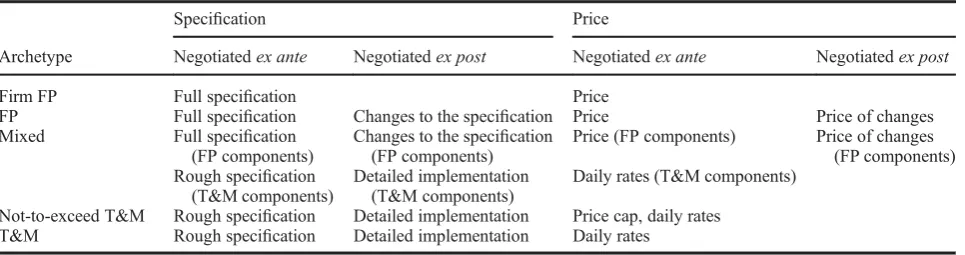
Table 1 presents the issues negotiatedex anteandex post
for each of thefive archetypes. In contrast to many pro-curement contracts (e.g. engine propro-curement), where the specification is given and the level of completeness is related only to production price, the level of completeness in software development is related to both specification and price. The following paragraphs describe each of the
archetypes in the new typology and explain their relative completeness.
Firm FP.Infirm FP contracts, price and specifications are fully predetermined ex ante, and contracts do not include a mechanism to accommodate change in the specifications. Managers at the bank explain that the exclusion of a change mechanism is infrequent because it requires the highest level of design completeness. The contracting consequences of disallowing change are important, becauseex postnegotiation is costly and cre-ates a contractual hazard (Bajari and Tadelis, 2001; Bolton and Dewatripont, 2005). The costs and risks of renegotiation are of special importance because of the difficulty to verify the quality and maintainability of the system. Under this archetype, a high level of trust in the vendor is not warranted (Mayeret al., 1995), and bidding becomes highly competitive (Iacovou and Nakatsu, 2008).
FP.Although price and specifications are fully prede-terminedex ante, the FP contract includes a clause with an explicit change management procedure that allows chan-ging both specifications and price. Managers in the indus-try explain that it is standard practice to include a change provision in FP contracts, as is indeed reflected in the research literature (Saunders et al., 1997; Sia et al., 2008; Chen and Bharadwaj, 2009). Such clauses can be viewed as safeguards (Williamson, 1985), specifically as contingency planning used to protect a vulnerable party (Argyres et al., 2007). Furthermore, these clauses expli-citly open the possibility of an augmented FP contract that allows the vendor to perform modifications on a T&M basis (Corts, 2012).
Mixed. The mixed archetype covers contracts that include both FP and T&M work packages. Mixed soft-ware development contracts have been reported by Dey
[image:6.609.66.549.583.710.2]et al.(2010). Banerjee and Duflo (2000) explain that in these contracts the work involved in writing the full func-tional specification and technological design tends to be performed on a T&M basis and the rest of the work, including programming and testing, tends to be done on
Table 1. Contractual archetypes of software development outsourcing
Specification Price
Archetype Negotiatedex ante Negotiatedex post Negotiatedex ante Negotiatedex post
Firm FP Full specification Price
FP Full specification Changes to the specification Price Price of changes Mixed Full specification
(FP components)
Changes to the specification (FP components)
Price (FP components) Price of changes (FP components) Rough specification
(T&M components)
Detailed implementation (T&M components)
Daily rates (T&M components) Not-to-exceed T&M Rough specification Detailed implementation Price cap, daily rates
T&M Rough specification Detailed implementation Daily rates
an FP basis. An interesting consequence of the mixed archetype is that it leads to simple risk sharing, as T&M cost risk is borne by the client, while FP cost risk is on the vendor (Bajari and Tadelis, 2001).
Not-to-exceed T&M.In the not-to-exceed T&M con-tract, the client reimburses the vendor for its expenses up to a price cap that is agreed ex ante. This archetype is identical to the hybrid contract described by Kalnins and Mayer (2004). The price cap indicates that the client has specified the main features of the software and has esti-mated its development costs, as in FP contracts, but will control costs and pay, as in T&M contracts, up to the cap. The not-to-exceed T&M archetype is considered less complete than the mixed archetype, because the former mostly relies on a T&M mechanism, with loose system specifications, whereas the latter typically includes a sub-stantial FP part, with detailed system specifications.
T&M. This archetype represents the standard T&M contract, in which the specification for the system is not fully detailed and the price for project completion is not constrained. The primary benefit of this archetype, relative to an FP contract, is the reduced negotiation cost (Bajari and Tadelis, 2001) that comes at the expense of introdu-cing a moral hazard problem (Corts and Singh, 2004). As requirements change, the vendor is more likely to accept changes requested by the client without the need for rene-gotiation (Kalnins and Mayer, 2004). In contrast to the not-to-exceed T&M archetype, the standard T&M arche-type poses a significant risk of cost escalation. Thus, familiar, trustworthy vendors are more likely to be granted such contracts.
Contract type selection
It is assumed that the typology described above is applied efficiently, that is the parties balance the costs of selecting a more complete contractual archetype with the benefits that completeness provides (Crocker and Reynolds, 1993). Costs are related to uncertainty, because high uncertainty requires the identification of more contingen-cies and responses. Benefits are related to the likelihood of opportunism by the vendor; when such likelihood is small, there is no need for complete contracts.
In our context, the costs are those of writing a detailed specification of the system and estimating the costs of its development. These costs are related to project uncer-tainty (w), because higher uncertainty requires more nego-tiation about system features and their implementation, as well as more contingency clauses; thus, contracts for uncertain projects are more costly to craft.
The benefits of a complete contract are the ability to prevent ex post opportunism of the vendor andex post
renegotiation costs. Opportunism in our context includes reducing effort on the part of the vendor and developing lower-quality software, inflating T&M costs (Deyet al.,
2010) and increasing costs when changes are requested by either client or vendor. The likelihood of opportunism (L) is influenced by both client and vendor characteristics; in particular, we assume that some vendors engage in oppor-tunistic behaviour and others do not.
We use a panel data set of contracts, estimating the relationship between contractual completeness and project and vendor characteristics:
Yij¼f wij;Lij
þεij (1)
where Yij is the completeness measure of the archetype
chosen for contractiof vendorj,wijrepresents
expecta-tions of project uncertainty and Lijis the expected
like-lihood of opportunism by vendor j before contract i is signed. The relationship (Equation 1) is modelled as a linear relationship as follows:
Yij¼aþbwijþcLijþεij (2)
This model suggests that project uncertainty and likeli-hood of opportunism are linearly related to contractual completeness (Crocker and Reynolds, 1993). Specifically, the incomplete contracting perspective and the reasoning presented above lead to the hypothesis that project uncertainty is negatively related to contractual completeness and that the likelihood of opportunism is
positivelyrelated to contractual completeness. We expect to find more complete contracts used for projects with lower uncertainty (lower cost of drafting complete con-tracts) and higher likelihood of opportunism (higher ben-efit of drafting complete contracts).
IV. Data
The research setting for this study is thefinancial services industry, which is considered to be the largest user of IT in the industrial sectors (Zhuet al., 2004) and which tends to have the highest IT investment risk (Dewanet al., 2007). We analyse the contract portfolio of a leading international bank, headquartered in Europe. It provides retail and com-mercial banking, wealth management and investment bank-ing in dozens of countries and has tens of thousands of employees. The bank’s IT department employs about 3000 permanent employees and 2000 contractors. The bank con-tracts out system development through about 100 local and international vendors. Its methods of managing software development contracts are typical of other large companies. The bank aims at using its standard software development contracts wherever possible. The standard contract is simi-lar to contract forms described in the literature (e.g. Pearson, 1984; Kutten, 1988). This contract is about 10
Ex post
adaptations and hybrid contracts in software development services
4501
pages in length, excluding appendices for scope and sche-dule. The bank’s contracting guidelines permit changes to the standard contract within defined limits.
Consistent with previous research, the unit of analysis in this study is the contract (e.g. Gulati, 1995; Gopalet al., 2003; Ethirajet al., 2005). We collected detailed quanti-tative data from the bank’s contract repository. Each record in the repository represented a single contract and included the contract number, start and end dates, contract price, vendor name and an electronic scan of the contract. We were given access to 270 software development con-tracts signed between January 2000 and April 2003. Table 2 presents data on the contractual archetypes.
Project uncertainty is evaluated by three items gleaned from contract text. Contract price (as a proxy for size) has been identified as a factor contributing to software devel-opment uncertainty (Barki et al., 1993). The relation between project size and uncertainty has been acknowl-edged by much of the literature on software development. Large projects are more likely to fail because of the diffi -culty to coordinate multiple tasks and many developers (Wallaceet al., 2004).Priceis the binding price infirm FP and FP contracts, the price cap in not-to-exceed T&M contracts, the cost estimation in T&M contracts or the sum of FP and T&M prices in mixed contracts. In addi-tion, contractDurationis used as a proxy for business and technology volatility; longer projects require more con-tingency planning and thus more costly contracts, similar to the associations between contract time-horizon, volati-lity and contracting cost in engine procurement (Crocker and Reynolds, 1993). The final measure of uncertainty uses the number ofIntermediate Deliverables, as defined in the contract text. Intermediate deliverables tied to
payments, also known as milestones (Sommerville, 2000), reflect uncertainty because when many such deli-verables are defined, the development course is defined in minute detail andex anteuncertainty is low. It should be noted that our conversations with managers at the bank showed that contract details, including the timely provi-sion of deliverables, their acceptance and the transfer of payments, are typically followed strictly during contract execution, in accordance with the highly controlled man-agement style of the bank.
The likelihood of opportunism is measured in terms of business familiarity (Gulati, 1995; Ryall and Sampson, 2009) using two measures (Gefenet al., 2008). Thefirst measure is Previous Contracts, defined as the accumu-lated price of previous contracts signed with the same vendor after January 2000 and up to the specific contract. The logic underlying this measure is that vendors who have a long history of work for the bank are unlikely to be opportunistic, at least because the bank continues to be a major client for IT services. Therefore, high values in this measure represent high business familiarity and thus low likelihood of opportunism. The second measure is the vendorLocality, which may be either international (desig-nated by 1) or local (2). The logic underlying this measure is that local vendors are less likely to behave opportunis-tically with this large local client.
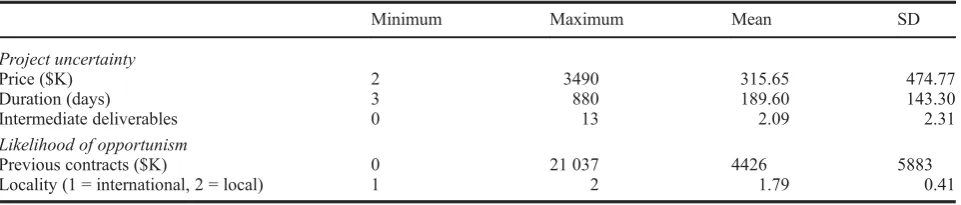
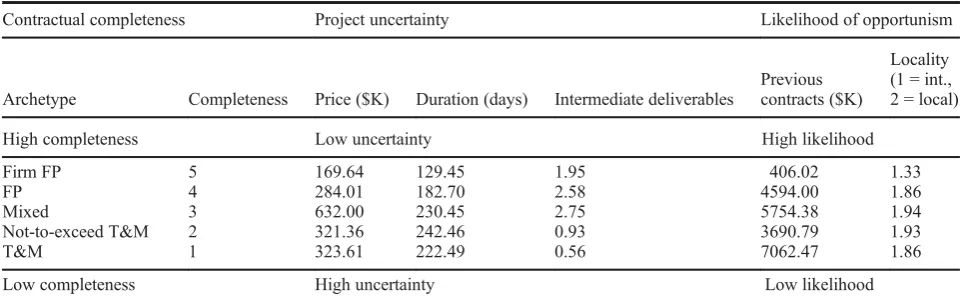
All the measures described above are objective and involve no subjective judgment. Descriptive statistics are given in Table 3, the correlation matrix is given in Table 4 and cross-tabulation of the measures with contractual completeness is given in Table 5.
[image:8.609.65.545.78.153.2]The cross-tabulation in Table 5 suggests that project uncertainty is negatively associated with contractual
Table 2. Archetype data (N= 270)
Archetype Number of contracts Percentage Average price ($K) Average duration (days) Example Firm FP 42 16% 169.64 129.45 Electronic archive
FP 139 51% 284.01 182.70 SWIFT
Mixed 32 12% 632.00 230.45 Credit process Not-to-exceed T&M 14 5% 321.36 242.46 Global accounting
[image:8.609.66.547.611.713.2]T&M 43 16% 323.61 222.49 ATM
Table 3. Descriptive statistics
Minimum Maximum Mean SD
Project uncertainty
Price ($K) 2 3490 315.65 474.77
Duration (days) 3 880 189.60 143.30
Intermediate deliverables 0 13 2.09 2.31
Likelihood of opportunism
Previous contracts ($K) 0 21 037 4426 5883 Locality (1 = international, 2 = local) 1 2 1.79 0.41
completeness. Specifically, larger (higher priced) and longer projects are characterized by higher uncertainty and thus use less complete contract types (i.e. mixed or T&M contracts). Similarly, higher uncertainty, as reflected by a lower number of intermediate deliverables, is asso-ciated with T&M contracts.
The effect of likelihood of opportunism on contractual completeness is not as clear when observing the full range of archetypes. With the exception offirm FP contracts, locality is similar on average for all archetypes and the effect of previous contracts with the bank is not obvious. These effects are analysed more carefully in the next section.
However, Table 5 is much clearer with respect to the differences between the two FP archetypes and between the two T&M archetypes. On average, vendors with
firm FP contracts have about 10 times less experience with the bank than vendors with standard FP contracts. Similarly, vendors with not-to-exceed T&M contracts have about half the experience with the bank of vendors with open, standard T&M contracts. Therefore, the like-lihood of opportunism is restricted by using capped contracts in both FP and T&M regimes. Our data set thus shows that capped variations of FP and T&M contracts are used as insurance against unfamiliar ven-dors, a mechanism predicted but not confirmed by Kalnins and Mayer (2004).
V. Empirical Analysis
[image:9.609.66.550.75.164.2]We test the hypothesis that contractual completeness is negatively affected by project uncertainty and positively affected by the likelihood of opportunism using OLS and ordered probit models, which include controls for vendor and contract characteristics. The estimates of Equation 2 using OLS regressions are presented in Table 6. Column 1 includes thefive measures of project uncertainty and like-lihood of opportunism, and columns 2 and 3 add variables intended to control for potential effects of vendor and contract characteristics on contractual completeness. Specifically, column 2 adds the variables of vendor size and vendor experience, where the former represents the total number of vendor employees and the latter represents the number of years since the vendor was founded. These two vendor characteristics control for the possibility that less complete contracts are used for larger and more experienced vendors. Column 3 adds the variables of contract length and attached documents, where the former represents the number of contract pages and the latter represents the number of attached documents, such as system specifications and design, referred to in the actual contract text. These two contract characteristics control for the possibility that contract choice is affected by the volume or detail of the actual contract and attached documents.
Table 4. Correlation matrix
1 2 3 4 5 6
1. Price (log) 1
2. Duration (log) 0.533*** 1
3. Intermediate deliverables 0.217*** 0.136* 1
4. Previous contracts (log) 0.098 0.054 −0.066 1
5. Locality 0.376*** 0.267*** 0.060 0.386*** 1
6. Contractual completeness −0.325*** −0.231*** 0.257*** −0.204*** −0.262*** 1
Note: *p< 0.05; ***p< 0.001; two-tailedp-values are reported.
Table 5. Cross-tabulation of contractual completeness with project uncertainty and likelihood of opportunism
Contractual completeness Project uncertainty Likelihood of opportunism
Archetype Completeness Price ($K) Duration (days) Intermediate deliverables
Previous contracts ($K)
Locality (1 = int., 2 = local) High completeness Low uncertainty High likelihood
Firm FP 5 169.64 129.45 1.95 406.02 1.33 FP 4 284.01 182.70 2.58 4594.00 1.86 Mixed 3 632.00 230.45 2.75 5754.38 1.94 Not-to-exceed T&M 2 321.36 242.46 0.93 3690.79 1.93 T&M 1 323.61 222.49 0.56 7062.47 1.86 Low completeness High uncertainty Low likelihood
Ex post
adaptations and hybrid contracts in software development services
4503
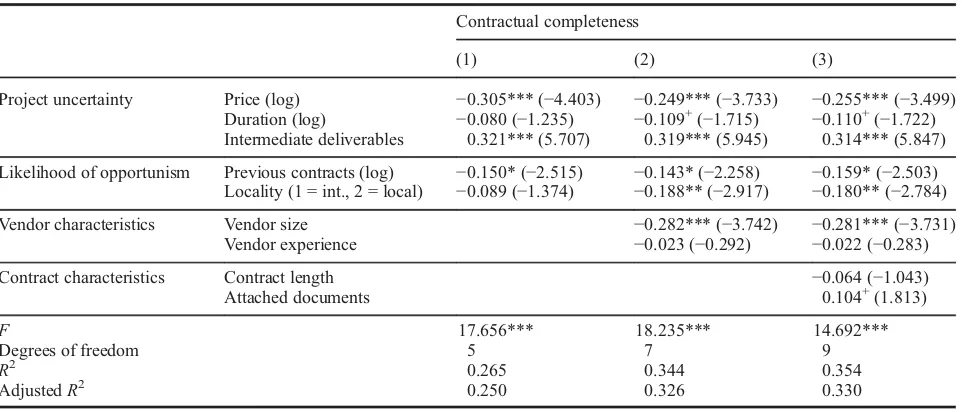
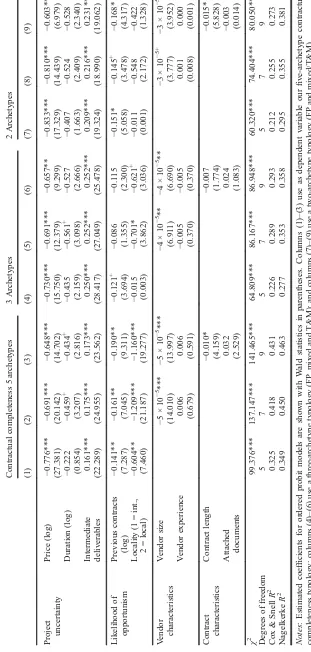
[image:9.609.64.547.207.355.2]The signs of the coefficients estimated in Table 6 are consistent with our hypothesis. Specifically, the coeffi -cients of price and duration are negative (higher price and longer duration, thus higher uncertainty, resulting in lower completeness), while the coefficient of intermediate deliverables is positive (more intermediate deliverables, lower uncertainty and higher completeness). As expected, the coefficients of previous contracts and locality are negative (higher business familiarity, lower likelihood of opportunism and lower completeness). Only three of the coefficients for the baseline model in column 1, those for price, intermediate deliverables and previous contracts, are statistically significant (at the 0.05 level). However, the inclusion of vendor and contract characteristics as additional explanatory variables in columns 2 and 3 results in statistically significant coefficients for allfive measures of project uncertainty and likelihood of opportunism (the coefficient of duration is significant at the 0.10 level). The hypothesized effects thus become stronger after control-ling for the effects of vendor and contract characteristics. A concern with the OLS regressions is that they treat contractual completeness as a continuous variable. This con-cern is addressed by using ordered probit models, as summar-ized in Table 7. We estimate nine ordered probit specifications: three using our five-archetype contractual completeness typology, three using a three-archetype typol-ogy (FP, mixed and T&M) and three using a two-archetype typology (FP and mixed/T&M). The two-archetype typology is created by combining the mixed archetype with the T&M archetypes because in all three archetypes, the overall price is not determinedex ante, whereas in the two FP archetypes, the price is fixed ex ante. The three specifications for each
typology are similar to those in Table 6: columns 1, 4 and 7 include thefive measures of project uncertainty and likeli-hood of opportunism, columns 2, 5 and 8 add the two vendor characteristics and columns 3, 6 and 9 add the two contract characteristics.
The ordered probit results presented in columns 1–3 of Table 7 are generally consistent with the OLS results, with the exception that the coefficient of locality is statistically significant in the baseline ordered probit model (column 1). Similar to the OLS results, allfive measures of project uncer-tainty and likelihood of opportunism become statistically sig-nificant once vendor and contract characteristics are included as additional explanatory variables (columns 2 and 3). The ordered probit models for the three-archetype typology (col-umns 4–6) and the two-archetype typology (columns 7–9) are less predictive of contract choice than ourfive-archetype typol-ogy. Beyond lowerχ2andR2values, the coefficients of pre-vious contracts and locality are weaker and generally not statistically significant for the narrower typologies. Thisfi nd-ing suggests that the likelihood of opportunism explains more variance in our broader contractual completeness typology than in narrower contract typologies. Interestingly, across all OLS and ordered probit models estimated, the coefficients of vendor size are negative and statistically significant, implying that more complete contracts are used with smaller vendors.
Endogeneity analysis
[image:10.609.66.547.74.280.2]The results of our analysis may be biased because of simulta-neity and endogenous matching (Ackerberg and Botticini, 2002; Corts and Singh, 2004). In our context, simultaneity means that decisions relating to system specification, vendor selection and contract choice may be taken simultaneously.
Table 6. OLS results
Contractual completeness
(1) (2) (3)
Project uncertainty Price (log) −0.305*** (−4.403) −0.249*** (−3.733) −0.255*** (−3.499) Duration (log) −0.080 (−1.235) −0.109+(−1.715) −0.110+(−1.722)
Intermediate deliverables 0.321*** (5.707) 0.319*** (5.945) 0.314*** (5.847) Likelihood of opportunism Previous contracts (log) −0.150* (−2.515) −0.143* (−2.258) −0.159* (−2.503)
Locality (1 = int., 2 = local) −0.089 (−1.374) −0.188** (−2.917) −0.180** (−2.784) Vendor characteristics Vendor size −0.282*** (−3.742) −0.281*** (−3.731)
Vendor experience −0.023 (−0.292) −0.022 (−0.283) Contract characteristics Contract length −0.064 (−1.043) Attached documents 0.104+(1.813)
F 17.656*** 18.235*** 14.692***
Degrees of freedom 5 7 9
R2 0.265 0.344 0.354
AdjustedR2 0.250 0.326 0.330
Notes: Estimated standardized coefficients for OLS models are shown withtvalues in parentheses. Columns (1)–(3) use as dependent
variable ourfive-archetype contractual completeness typology.
+p< 0.10; *p< 0.05; **p< 0.01; ***p< 0.001; two-tailedp-values are reported.
T able 7. Order ed pr obit results Contractual completeness 5 archetypes 3 Archetypes 2 Archetypes (1) (2) (3) (4) (5) (6) (7) (8) (9) Project Price (log) − 0.776*** − 0.691*** − 0.648** * − 0.730*** − 0.691*** − 0.657** − 0.833** * − 0.810*** − 0.603** uncertainty (27.381) (20.142) (14.702) (15.750) (12.379) (9.299) (17.329) (14.439) (6.979) Duration (log) − 0.222 − 0.459 + − 0.434 + − 0.435 − 0.561 + − 0.527 − 0.407 − 0.524 − 0.528 (0.854) (3.207) (2.816) (2.159) (3.098) (2.666) (1.663) (2.409) (2.340) Intermediate 0.161*** 0.175*** 0.173** * 0.250*** 0.252*** 0.252*** 0.209** * 0.216*** 0.231*** deliverables (22.289) (24.955) (23.562) (28.417) (27.049) (25.478) (19.324) (18.990) (19.062) Likelihood of Previous contracts − 0.141** − 0.161** − 0.190** − 0.121 + − 0.086 − 0.1 15 − 0.151* − 0.145 + − 0.168* opportunism (log) (7.287) (7.045) (9.31 1) (3.694) (1.355) (2.300) (5.058) (3.478) (4.317) Locality (1 = int., − 0.604** − 1.209*** − 1.160** * − 0.015 − 0.701* − 0.621 + − 0.01 1 − 0.548 − 0.422 2 = local) (7.460) (21.187) (19.277) (0.003) (3.862) (3.036) (0.001) (2.172) (1.328) V endor V endor size − 5×1 0 − 5 *** − 5× 1 0 − 5 *** − 4× 1 0 − 5 ** − 4×1 0 − 5 ** − 3×1 0 − 5+ − 3× 1 0 − 5 * characteristics (14.010) (13.997) (6.91 1) (6.690) (3.777) (3.952) V endor experience 0.006 0.006 − 0.005 − 0.005 0.001 0.000 (0.679) (0.591) (0.370) (0.370) (0.008) (0.001) Contract Contract length − 0.010* − 0.007 − 0.015* characteristics (4.159) (1.774) (5.828) Attached 0.032 0.024 − 0.003 documents (2.529) (1.083) (0.014) χ 2 99.376*** 137.147*** 141.465*** 64.809*** 86.167* ** 86.948*** 60.320* ** 74.404*** 80.050*** Degrees of freedom 5 7 9 5 7 9 5 7 9 Cox & Snell R 2 0.325 0.418 0.431 0.226 0.289 0.293 0.212 0.255 0.273 Nagelkerke R 2 0.349 0.450 0.463 0.277 0.353 0.358 0.295 0.355 0.381 Notes : Estimated coef fi cients for ordered probit models are shown with W ald statistics in parentheses. Columns (1) – (3) use as dependent variable our fi ve-archetype contractual completeness typology; columns (4) – (6) use a three-archetype typology (FP , mixed and T&M); and columns (7) – (9) use a two-archetype typology (FP and mixed/T&M). + p < 0.10; * p < 0.05; ** p < 0.01; *** p < 0.001; two-tailed p -values are reported.
Ex post
adaptations and hybrid contracts in software development services
4505
[image:11.609.152.463.71.723.2]According to industry experts we interviewed, a client may have preliminary contract preferences for a specific project. However, thefinal choice of contract is made only after the requirements are defined, the vendor is selected and specifi -cation and price are negotiated. Endogenous matching (Ackerberg and Botticini, 2002) may occur because of unob-served characteristics of the project that create associations among specific projects, vendors and contracts. Among the variables hypothesized in this study to affect contractual completeness, price is the most susceptible to the problems of simultaneity and endogenous matching. After the contract type has been determined, the contracting parties are not likely to make adjustments to system specification or vendor selection. The variable most susceptible to adjustments at this stage is price, because adjustments to duration or intermediate deliverables require changes in project planning, and the vendor is not likely to be replaced at this stage. Moreover, price is the variable most likely to be matched with contrac-tual completeness as a consequence of unobserved technolo-gical characteristics. For example, a new and expensive technology may create an incentive for the client to use a T&M contract for a high-priced project.
To address these problems, we use a perceived measure of System Interconnectedness, which relates to the con-nectedness of the new system with other internal systems of the bank, as an instrumental variable. During data collection, each contract in the portfolio was reviewed and ranked on a 5-point scale by one of the authors (who had extensive experience with software development pro-jects in both client and vendor firms). The degree of interconnectedness was determined by mapping informa-tion in the contracts to clear-cut criteria, as detailed in Table 8. We assume that interconnectedness is exogenous because the technical specifications of the connections with other bank systems are a standard part of the bank’s IT infrastructure, which is relatively stable. The intercon-nectedness of the system under development is central to its specification, and it rarely changes during negotiation or development. It is, therefore, unlikely that interconnect-edness is affected by contract choice. We further assume that interconnectedness is informative because it corre-lates with price– a higher degree of interconnectedness requires more development effort. According to inter-views with industry experts, the careful connection of a new system to existing systems consumes significant development resources because of the need to analyse all
possible interactions between systems, to specify the required inputs and outputs, to program these specifi ca-tions and to test them in both synthetic and operational environments. All this work is reflected in the price of a new system in large organizations.
[image:12.609.65.543.76.144.2]Consequently, interconnectedness is used as an instru-mental variable in testing the endogeneity of price with a two-stage least squares (2SLS) analysis. The results of this analysis, presented in Table 9, validate our earlierfindings by showing only small differences in the magnitude of coefficients for the baseline model. In particular, the pre-dicted price using the instrumental variable maintains the highly significant effect on contractual completeness. We use the Wu–Hausman specification test for endogeneity to examine the significance of the predicted values of price when included as an additional explanatory variable in the full regression. This test shows that the predicted price has no significant effect in this case (t = −1.24,p = 0.216), indicating that the null hypothesis that price should be treated as an exogenous variable cannot be rejected. Therefore, endogeneity does not appear to be a serious concern in interpreting our results. Although our instru-mentation approach is limited, it goes beyond most of the
Table 9. 2SLS results
Contractual completeness 2SLS model Project uncertainty Price (log) ‒0.464** (‒2.604)
Duration (log) ‒0.050 (‒0.453) Intermediate
deliverables
0.385*** (6.416)
Likelihood of opportunism
Previous contracts (log)
‒0.139* (‒2.281) Locality
(1 = int., 2 = local)
‒0.014 (‒0.190)
F 15.914***
Degrees of freedom 5
R2 0.255
AdjustedR2 0.239
Notes: The 2SLS model uses the instrumental variable of system
interconnectedness to test the endogeneity of price. Estimated standardized coefficients are shown withtvalues in parentheses. *p< 0.05; **p< 0.01; ***p< 0.001; two-tailedp-values are reported.
Table 8. Definition of the system interconnectedness instrumental variable
Interconnectedness 1 2 3 4 5
Interfaces/modules Single Single Single Multiple Multiple Interface definitions None None Well-defined Well-defined Ill-defined Relation to other systems Standalone Standalone Connected Connected Connected Specification Simple Elaborated Simple Elaborated Elaborated
[image:12.609.314.544.473.664.2]extant literature, which typically does not address these problems (Corts and Singh, 2004).
VI. Discussion
The main goal of this article was to provide a theore-tical rationale for the combinations of FP and T&M mechanisms that create the observed contract typology. Our analysis of a large portfolio of software develop-ment contracts of a leading international bank indeed shows that archetypes are chosen by balancing the costs and benefits of crafting more complete contracts (Crocker and Reynolds, 1993). High specification vola-tility projects, for which complete contracts would be costly to draft, are likely to be based on the less complete archetypes. Similarly, these incomplete con-tracts are likely to be granted to familiar vendors for whom the likelihood of behaving opportunistically is low. The differences among archetypes in uncertainty and likelihood of opportunism are significant along the full typology and not only between the standard FP and T&M archetypes.
An additional goal of the article was to bring to light a nuanced typology of contracts for software development. Indeed, one-third of the contracts we reviewed differ sig-nificantly from the FP and T&M types on which the litera-ture focuses (Banerjee and Duflo, 2000; Gopalet al., 2003; Ethiraj et al., 2005). Specifically, firm FP contracts cap specification volatility by allowing no change during the development period and thus prevent costly renegotiation (Bolton and Dewatripont, 2005). Firm FP contracts are, on average, about half the price of standard FP contracts and are more frequently awarded to unfamiliar vendors. Not-to-exceed T&M contracts define a price cap on the T&M mechanism; these contracts are similar to T&M contracts in all dimensions but one–vendors’previous experience with the client, which is, on average, half of the experience of T&M vendors. Thesefindings confirm the expectation that capped variations of FP and T&M contracts are used as insurance against unfamiliar vendors. Finally, mixed con-tracts, which may be seen as the simplest form of hybrid contracts, are shown here to be a major technique of soft-ware development contracting. Although only one-eighth of the contracts are mixed, they constitute one quarter of the bank’s portfolio, by price.
The limitations of the article lie in the reliance on a single organization, particularly since the large size and long experience of the bank are likely to influence its contracting practices. Although learning from such a client is laudable, our results should be generalized to other organizations with caution. Similarly, we had to rely on the contracts themselves to measure project uncertainty and likelihood of opportunism. While these measures are objective and not subject to bias, our analysis is limited by
the fact that we had no access to the project managers and their considerations for selecting contact types.
The main implication of the current study for research is the need to identify additional mechanisms that addressex postadaptations and, more generally, other combinations or hybrids of FP and T&M mechanisms that are used in practice. The recent procurement literature describes a range of contract typologies: the single-archetype typol-ogy of unit price auctions for highway improvements (Bajariet al., 2006), the prevalent two-archetype typology of FP and T&M typical of construction projects (Bajari and Tadelis, 2001; Bajariet al., 2009), the three-archetype typology for IT services (Kalnins and Mayer, 2004) and the five-archetype typology for jet engine procurement (Crocker and Reynolds, 1993). The present study extends this line of research by describing a novelfive-archetype typology for custom software development. Are there other hybrids and elaborate typologies used in practice?
Practical implications are mostly relevant to the soft-ware development industry. They include the need for managers to consider the full gamut of FP and T&M mechanisms to make more resources available while redu-cing risks in software development. Specifically, using
firm FP contracts should allow clients to start working with unfamiliar vendors on short and stable projects that are not prone to renegotiation. Similarly, not-to-exceed T&M contracts should allow the client to work with ven-dors that are usually not trusted with standard T&M pro-jects. The importance of software vendors in modern businesses creates new challenges in the management of technology (Applegateet al., 2009). The current article shows that specification volatility andex postadaptations are central to these challenges and that an elaborate con-tract typology is required to balance project uncertainty and vendor-related hazards.
Finally, the merits of different contractual mechan-isms have recently become an issue for public debate, as the US government has encouraged agencies to use competitive bidding and FP contracts for Recovery Act 2009 projects to the maximum extent possible. However, the literature suggests that for projects in which specifications and cost are difficult to estimate, T&M contracts may be more appropriate. This article will hopefully inform this debate by extending the literature onex postadaptations, presenting additional contractual mechanisms and analysing their various levels of contractual completeness.
References
Ackerberg, D. A. and Botticini, M. (2002) Endogenous matching and the empirical determinants of contract form,Journal of
Political Economy,110, 564–91.
Ex post
adaptations and hybrid contracts in software development services
4507
Applegate, L. M., Austin, R. D. and Soule, D. L. (2009)
Corporate Information Strategy and Management: Text
and Cases, 8th edn, McGraw-Hill, New York.
Argyres, N. S., Bercovitz, J. and Mayer, K. J. (2007) Complementarity and evolution of contractual provisions: an empirical study of IT services contracts,Organization
Science,18, 3–19.
Bajari, P., Houghton, S. and Tadelis, S. (2006) Bidding for incomplete contracts: an empirical analysis, NBER Working Paper No. 12051, NBER, Cambridge, MA. Bajari, P., McMillan, R. and Tadelis, S. (2009) Auctions versus
negotiations in procurement: an empirical analysis,Journal
of Law, Economics, and Organization,25, 372–99.
Bajari, P. and Tadelis, S. (2001) Incentives versus transaction costs: a theory of procurement contracts,RAND Journal of
Economics,32, 387–407.
Banerjee, A. V. and Duflo, E. (2000) Reputation effects and the limits of contracting: a study of the Indian software
indus-try,Quarterly Journal of Economics,115, 989–1017.
Barki, H., Rivard, S. and Talbot, J. (1993) Toward an assessment of software development risk, Journal of Management
Information Systems,10, 203–25.
Bolton, P. and Dewatripont, M. (2005)Contract Theory, MIT Press, Cambridge, MA.
Chen, Y. and Bharadwaj, A. (2009) An empirical analysis of contract structures in IT outsourcing,Information Systems
Research,20, 484–506.
Corts, K. S. (2012) The interaction of implicit and explicit con-tracts in construction and procurement contracting,Journal
of Law, Economics, and Organization,28, 550–68.
Corts, K. S. and Singh, J. (2004) The effect of repeated interac-tion on contract choice: evidence from offshore drilling,
Journal of Law, Economics, and Organization,20, 230–60.
Crocker, K. J. and Reynolds, K. J. (1993) The efficiency of incomplete contracts: an empirical analysis of air force engine procurement,RAND Journal of Economics,24, 126–46. Dewan, S., Shi, C. and Gurbaxani, V. (2007) The risk-return
relationship of information technology investment: fi rm-level empirical analysis,Management Science,53, 1829–42. Dey, D., Fan, M. and Zhang, C. (2010) Design and analysis of contracts for software outsourcing, Information Systems
Research,21, 93–114.
Ethiraj, S. K., Kale, P., Krishnan, M. S.,et al.(2005) Where do capabilities come from and how do they matter? A study in the software services industry, Strategic Management
Journal,26, 25–45.
Gefen, D., Wyss, S. and Lichtenstein, Y. (2008) Business famil-iarity as risk mitigation in software development outsour-cing contracts,MIS Quarterly,32, 531–51.
Gopal, A., Sivaramakrishnan, K., Krishnan, M. S,et al.(2003) Contracts in offshore software development: an empirical analysis,Management Science,49, 1671–83.
Grossman, S. J. and Hart, O. D. (1986) The costs and benefits of ownership: a theory of vertical and lateral integration,
Journal of Political Economy,94, 691–719.
Standish Group (2009)CHAOS Summary 2009, The Standish Group, Boston, MA.
Guccio, C., Pignataro, G. and Rizzo, I. (2012) Determinants of adaptation costs in procurement: an empirical estimation on Italian public works contracts, Applied Economics, 44, 1891–909.
Gulati, R. (1995) Does familiarity breed trust? The implications of repeated ties for contractual choice in alliances,Academy
of Management Journal,38, 85–112.
Iacovou, C. L. and Nakatsu, R. (2008) A risk profile of offshore-outsourced development projects,Communications of the
ACM,51, 89–94.
Kalnins, A. and Mayer, K. J. (2004) Relationships and hybrid contracts: an analysis of contract choice in information technology, Journal of Law, Economics, and
Organization,20, 207–29.
Kutten, L. J. (1988)Computer Software: Protection/Liability/
Law/Forms, West Group Publishing, St. Paul, MN.
Laffont, J. J. and Tirole, J. (1993) A Theory of Incentives in
Procurement and Regulation, MIT Press, Cambridge,
MA.
Lichtenstein, Y. (2004) Puzzles in software development con-tracting,Communications of the ACM,47, 61–5.
Mayer, R. C., Davis, J. H. and Schoorman, F. D. (1995) An integrative model of organizational trust, Academy of
Management Review,20, 709–34.
National Academy of Engineering (2008) The Offshoring of
Engineering: Facts, Unknowns, and Potential
Implications, The National Academies Press, Washington,
DC.
Pearson, H. E. (1984) Computer Contracts: An International
Guide to Agreements and Software Protection, Chapman
& Hall, London.
Ryall, M. D. and Sampson, R. C. (2009) Formal contracts in the presence of relational enforcement mechanisms: evidence from technology development projects, Management
Science,55, 906–25.
Saunders, C., Gebelt, M. and Hu, Q. (1997) Achieving success in information systems outsourcing,California Management
Review,39, 63–79.
Sia, S. K., Koh, C. and Tan, C. X. (2008) Strategic maneuvers for outsourcingflexibility: an empirical assessment,Decision
Sciences,39, 407–43.
Sommerville, I. (2000)Software Engineering, Addison Wesley, Reading, MA.
Wallace, L., Keil, M. and Rai, A. (2004) Understanding software project risk: a cluster analysis,Information & Management,
42, 115–25.
Whang, S. (1992) Contracting for software development,
Management Science,38, 307–24.
Williamson, O. E. (1975)Markets and Hierarchies: Analysis and
Antitrust Implications, Free Press, New York.
Williamson, O. E. (1985) The Economic Institutions of
Capitalism, Free Press, New York.
Zhu, K., Kraemer, K. L. and Dedrick, J. (2004) Information technology payoff in e-business environments: an interna-tional perspective on value creation of e-business in the
financial services industry, Journal of Management
Information Systems,21, 17–54.