City, University of London Institutional Repository
Citation
:
Markova, M.S., Wilson, S. and Stumpf, S. (2012). Tangible user interfaces for
learning. International Journal of Technology Enhanced Learning, 4(3-4), pp. 139-155.
This is the accepted version of the paper.
This version of the publication may differ from the final published
version.
Permanent repository link:
http://openaccess.city.ac.uk/4353/
Link to published version
:
Copyright and reuse:
City Research Online aims to make research
outputs of City, University of London available to a wider audience.
Copyright and Moral Rights remain with the author(s) and/or copyright
holders. URLs from City Research Online may be freely distributed and
linked to.
Copyright © 200x Inderscience Enterprises Ltd.
Tangible User Interfaces for Learning
Milena Markova*, Stephanie Wilson and
Simone Stumpf
City University London
Northampton Square, London EC1V 0HB, UK E-mail: [email protected]
E-mail: [email protected] E-mail: [email protected] *Corresponding author
Abstract: Tangible user interfaces (TUIs), systems characterised by the embodiment of interaction in physical objects, have attracted general interest but have not yet been widely adopted for learning. Employing these kinds of novel technologies could yield substantial benefits to learners. This paper provides a review of state-of-the-art TUIs for learning, scoped by a revised definition of TUIs that serves to delineate and differentiate these from other kinds of interfaces. We propose a classification framework that attends to important aspects of TUIs for use in learning and review tangible systems within this classification to expose research and design gaps. Our work provides guidance for researchers and learning technologists to help identify potential research directions for TUIs for learning.
Keywords: Tangible User Interfaces, learning, classification framework
Reference to this paper should be made as follows: Markova, M., Wilson, S. and Stumpf, S. (xxxx) ‘Tangible User Interfaces for Learning’, Int. J. Technology Enhanced Learning, Vol. x, No. x, pp. xx-xx.
Biographical notes: Milena Markova has been a PhD student in the Centre for HCI Design at City University London since 2011. She gained a Master in Cognitive Systems and Interactive Media from Pompeu Fabra University in Barcelona, Spain in 2010. She holds a Bachelor in Communications from Angelo State University in San Angelo, Texas, USA, completed in 2004. Her research interests include learning with tangible user interfaces and new interactive technologies.
Stephanie Wilson is a Reader in the Centre for HCI Design and an Assistant Dean in the School of Informatics at City University London. Stephanie's research includes modelling and interaction design for healthcare environments, technology enhanced learning, and creative and inclusive interaction design. She has led and participated in several research projects at the intersection of human-computer interaction and technology enhanced learning. Stephanie is primary supervisor for PhD candidate Milena Markova.
collaboration to develop and investigate technologies that support end-users to directly influence software behaviour. Dr Stumpf also has professional experience as a User Experience Architect. She is Milena Markova’s second supervisor.
1 Introduction
Advances in technology, such as multi-touch and tablet devices, offer intriguing possibilities for teaching and learning. They represent an opportunity to move educational technologies away from traditional software and devices to technologies that are more naturally embedded in the learning context (Schöning, 2010). Tangible user interfaces (TUIs) are a new kind of technology that emphasises the physicality of interaction through the coupling of physical and digital representations. While these are growing in popularity in research environments (Horn et al., 2009; Antle, Wise, and Nielsen, 2011; Shaer et al., 2011; Horn, Crouser, and Bers, 2011; Hornecker, 2005a and 2005b; Fleck et al., 2009; Africano et al., 2004; Xie and Antle, 2007; Scarlatos, 2002), there is scant research into employing TUIs in educational environments (Wang, Young, and Jang, 2010; Horn and Jacob, 2007; Zufferey, Jermann, Do-lenh and Dillenbourg, 2009).
The aim of this paper is to review TUIs for learning. To scope this review, we first propose a definition of TUIs in light of previous work to sharply delineate the space of these kinds of interfaces. We then provide a classification framework for TUIs in the context of learning, and offer a more detailed review of eight TUIs according to this classification. We discuss the implications of this classification for further work.
Our work provides benefits to two main audiences. First, it will help guide researchers who are interested in TUIs to explore new challenges in the area of teaching and learning. Second, it will allow learning technologists to identify the TUIs that might be best suited to particular types of learning. This review is very timely, given the current pace of technological change, as it provides an overview of current TUIs and helps to identify gaps in the design and use of TUIs for learning.
2 Tangible user interfaces
2.1 What is a tangible user interface?
Introducing a tangible aspect into user interfaces is a relatively new concept. “Tangibles” are concerned with mediating between physical and digital worlds (Ishii and Ullmer, 1997) by providing an extension of the digital world that is made touchable and manipulable in the physical world. Different terms are used to describe these physical “bits” of tangible user interfaces – objects, containers, artefacts, props, phicons, tangibles, tokens, etc (Ishii and Ulmer 1997; Shaer et al., 2004). In this paper, we will refer to them as tangible objects.
There have been some attempts at differentiating TUIs from other kinds of interfaces. Most definitions of TUIs have focused on the user’s manipulation of physical objects which is then reflected in a change of state in the digital world (Fishkin, 2004). Furthermore, a TUI requires that this change of state in the digital world is fed back to the physical world, either through the same or a different object (Gentile et al, 2011).
properties closely “coupled” to their digital representation (Ullmer and Ishii, 2000). This notion of coupling is similar to Fishkin’s (2004) concept of metaphor in a TUI, which captures how closely, and in what way, the tangible object mirrors the digital object. This use of metaphor means that a TUI should be inherently more usable because it can leverage intuitive knowledge about how to interact with it (Hurtienne and Israel, 2007).
However, these attempts at a definition still fall short of clarifying whether a system is a TUI or whether it is really a different kind of interface that has some tangible aspects. There is some evidence in support of this assertion that a clear definition is lacking; recent research into tangible user interfaces (e.g. Wang, Young and Jang, 2010; Antle, Wise, and Nielsen, 2011; Antle et al., 2011; Horn, Crouser, and Bers, 2011; Shaer et al., 2011) uses the terms “tangibles”, “tangible systems” and “tangible user interfaces” in a variety of ways. For example, should Ely the Explorer in (Africano et al., 2004) be called a tangible system or a tangible user interface? We therefore start by proposing a more specific definition of TUIs in order to guide our review of TUIs for learning.
2.2 Tangible user interfaces: definition
To scope our review, we present a working definition for tangible user interfaces that distinguishes them from other kinds of user interfaces. Our working definition provides four criteria that a system has to meet to be a TUI:
Criterion I – Tangible objects. Tangible user interfaces consist of one or more
tangible objects that are used either as input devices or as both input and output devices. This means that the TUI either consists of tangible objects that are used as input devices and output is provided via separate displays such as tabletop surfaces, or the TUI is the object that is used for both input and output, for example, the Learning Cube (Terrenghi et al., 2005).
Criterion II - Embodiment. Tangible user interfaces are systems in which input and
output are closely temporally and spatially related, i.e. the tangible object is both the input and the output device, or the output takes place around the input device/object. This proximal embodiment means that the output from the TUI needs to take place within the immediate space of sensory feedback (visual, auditory, haptic) of the user – the output could be directly proximate to the object, or it could be projected on a screen next to it.
Criterion III – Metaphor. Tangible user interfaces are systems where digital and
physical spaces are closely integrated, and where there is a straightforward mapping or analogy between the digital world and physical space in terms of a) object and/or b) action. This means that the physical form of a tangible object, and/or the action performed with it, are analogous to its representation in the digital world. This is based on Fishkin’s (2004) notion of metaphor presented by the TUI. In addition, when a tangible object is used to represent an object of the digital world, if the tangible object is removed from the physical environment, its digital representation is removed from the digital world.
Criterion IV - Continuity. Tangible user interfaces are interactive and they support
continuous interaction. This means that the user does not cease to interact with the TUI following just one input. Rather, the user continues to interact with the TUI after the system has responded and invited the user to interact further with its objects. The continuity criterion does not mean, however, that a TUI requires uninterrupted input from the user – it means that the TUI promotes interaction with its objects that goes beyond one initial input.
2.3 Examples of what is and is not a TUI
Not all systems with tangible objects are tangible user interfaces although they might enhance a certain quality or property by adding a tangible aspect to the user’s experience. We explore three examples of systems and their uses to see whether they are TUIs according to our working definition.
The Wiimote in a tennis game
The Wiimote (the controller for Nintendo’s Wii console) could be considered just a different kind of pointing device, similar to a mouse. However, the Wiimote, used in conjunction with a tennis game, falls within our definition of a TUI.
The Wiimote, when used in a tennis game, becomes the tennis racket. The user hits a virtual tennis ball in the digital space by moving the Wiimote in a manner analogous to the racket in the physical space. When the Wiimote is removed from the physical environment, the tennis racket is removed from the digital world, or if the Wiimote is placed on the ground, the tennis racket appears stationary on the ground in the digital world as (thus meeting the metaphor criterion). The Wiimote is used as an input device, but also functions as an output device through haptic feedback (fulfilling the tangible object criterion). The Wiimote in the tennis game is interactive and the user continues playing the game after first hitting the tennis ball (satisfying the continuity criterion). Finally, the Wiimote is proximally embodied, because the user can see the output on the screen in front of him/her (fulfilling the embodiment criterion). Overall, the Wiimote used in a tennis game meets all four criteria and therefore is a TUI.
Programmable Bricks
We now present a system which, according to our definition, is not a TUI but which clearly provides a tangible aspect to the user experience.
Programmable Bricks (Resnick, 1996) is a system that allows the user to put together bricks each of which is programmed to carry out some action (Figure 1, left). Although the user interacts with tangible objects (the bricks), they are not used for input (failing the tangible object criterion); instead the user inputs the program that the bricks should perform by entering it via a standard computer and the output takes place “nearby” the input (thus passing the embodiment criterion). The user cannot change the state of the system by physically interacting with the bricks (and therefore cannot continue interacting with it through its objects) – the bricks have been pre-programmed (violating the continuity criterion). Moreover, there is no tight mapping between physical and digital world (failing the metaphor criterion).
The Reactable
The Reactable (Figure 1, right) is an electronic musical instrument that provides tangible objects, called pucks, which interact with each other according to their form, position and proximity. Users place these pucks on a translucent tabletop display and by manipulating them—rotating and sliding to connect different pucks —the performers create music (Jordà, 2010).
The Reactable consists of tangible objects that are tightly coupled with their digital representation – the user has to use and rotate the pucks on the tabletop surface to achieve the desired musical effect. If a puck is removed from the tabletop surface, its digital representation is also removed from the digital world, and its feedback ceases (passing the metaphor criterion). The pucks of the Reactable (the tangible objects) are used as input devices (fulfilling the tangible object criterion). The Reactable is interactive and it invites the user to continue using it in order to play music (satisfying the continuity criterion). The tangible objects of the Reactable are proximally embodied as the output takes place near the input – output is presented in visual form on the tabletop surface and all around the user in the form of audio feedback (fulfilling the embodiment criterion). All four criteria for a TUI are fulfilled; therefore the Reactable is a TUI.
3 Classifications of TUIs
The definition given in section 2.2 scopes the space of TUIs by defining what we consider is, or is not, a TUI. We now turn our attention to providing some structure to this space, by briefly reviewing notable classifications and taxonomies of TUIs and noting their adequacy from the perspective of an interest in TUIs for learning.
In an early attempt to classify TUIs, Ullmer and Ishii (2000) focused on the different relationships between objects. They distinguished and exemplified four main types of TUIs: spatial, relational, constructive and mixed systems. In spatial TUIs, the spatial relationships between the tangible objects are directly expressed by the system. Relational TUIs transfer the logical relationship between tangible objects into the digital world. Constructive TUIs comprise of systems in which the user slots together a collection of tangible objects in the same manner as he or she would construct LEGO™ blocks (Ullmer and Ishii, 2000). Mixed systems, the fourth category of TUIs identified by Ullmer and Ishii, is a combination of the aforementioned types.
was one of the earliest published classifications of TUIs, it is not surprising that other types of TUIs were not described at that time.
Koleva, Benford, Ng and Rodden (2003) presented a framework for classification of TUIs, based on degrees of coherence and link properties between physical and digital objects. They described six degrees of freedom in their coherence category in a weak-strong continuum depending on whether the analogy between objects is weak or weak-strong (i.e. strong coherence exists when objects appear to be the same in both physical and digital worlds). The link properties in the classification were transformation, sensing of interaction, configurability of transformation, lifetime of link, autonomy, cardinality of link and link source. This classification, however, was not specifically intended for TUIs for learning, and it focused mainly on the technical properties of TUIs. There was no attempt to examine whether the nature of the link between the physical and the digital objects, or the degree of coherence between them, might be important to learning.
A different type of classification was put forward by Fishkin (2004) who offered a two-level taxonomy of TUIs based on the concepts of “embodiment” and “metaphor”. In Fishkin’s taxonomy, “embodiment” refers to the relationship between input and output device and it serves to categorise four different types of relationship – full, nearby, environmental, and distant. Full embodiment applies when the user provides input and receives output from the same tangible object. When the objects of a TUI are nearby embodied the output takes place near the tangible object. Environmental, “non-graspable” embodiment is when the output is provided around the user and this includes audio output. Lastly, distant embodiment is when the output is observed ‘over there’, which could be another screen or room (Fishkin, 2004). “Metaphor” refers to whether and how the digital world mirrors the physical world (and vice versa) through the shape and motion of an object; this is similar to the idea of coherence in Koleva, Benford, Ng and Rodden’s classification. Fishkin identifies four types of metaphor: noun, verb, noun and verb, and full. A full metaphor is present in a TUI when the user does not need to make an analogy between the physical and the digital world because “the virtual system is the physical system”, while in a noun and/or verb metaphor both the state (shape) and the motion (user’s action) of the tangible objects in the digital world are analogous to their physical representation, but the user still needs to make the analogy (Fishkin, 2004).
A shortcoming of Fishkin’s taxonomy for our purposes is that it provides only a spectrum of TUIs—something is more or less tangible. Fishkin’s use of the concepts of embodiment and metaphor is too broad to identify the difference between TUIs and other types of user interfaces. As with the other classifications of TUIs mentioned here, Fishkin’s taxonomy also lacks attributes that could be useful for investigating TUIs for learning. However, these classifications do contain several useful components that we draw upon in proposing a classification of TUIs for learning.
4 TUIs for learning
4.1 Learning Theories
We set out to understand the role and future potential of TUIs for learning. There are numerous theories of learning, but two are particularly applicable when considering technologies such as tangibles: cognitivism and constructivism.
learning as a process in which knowledge is acquired through the construction of information, building on previous knowledge of the world (Piaget, 1999). Piaget's theory sees children as individuals capable of rational thinking and approaching scientific reasoning. “Constructivism, in a nutshell, states that children are the builders of their own cognitive tools, as well as of their external realities. In other words, knowledge and the world are both construed and interpreted through action, and mediated through symbol use” (Ackermann, 2004). The schools of Froebel and Montessori followed the principles of constructivism by encouraging children to do more practical work and directly use materials that exist in the real world, and learn by following an autonomous development of their inner nature (Zuckerman, 2010).
Seymour Papert's constructionism theory was based upon some of Jean Piaget's constructivist ideas, but it expresses a clearer belief that children learn through making things (Papert and Harel, 1991). The constructionism theory led to Papert’s invention of the Logo Programming Language in 1967, which was the inspiration for the creation of LEGO/Logo (Resnick and Ocko, 1991). LEGO/Logo, which links LEGO structures with Logo programming (e.g. a child may build a car by using LEGO bricks and write a program in Logo that controls the car), was the first example of how TUIs fall within the context of constructivism, as it combined the ideas of Froebel, Montessori and Papert in a TUI for learning basic programming skills.
From a cognitivist learning perspective, TUIs can support the storing of new knowledge related to the physical world, either through expressive or explorative activity (Marshall et al., 2003; Malley and Stanton Fraser, 2004). Expressive activity is where the TUI supports the acquisition of behaviour, whereas exploratory activity encompasses a learner gaining new knowledge, via TUIs, of physical or computational theories.
Constructivism is especially relevant in relation to TUIs because of the emphasis in both the theory and the system on the physical interaction which allows the learner to construct knowledge of the world through experiencing it (Lefrançois, 2000) - or in other words, to learn by doing (manipulating things in the physical world). This view is also supported by Goschler (2004) who argues that parts of learners’ conceptual systems are shaped by the direct experience of their bodies.
4.2 A classification of TUIs for learning
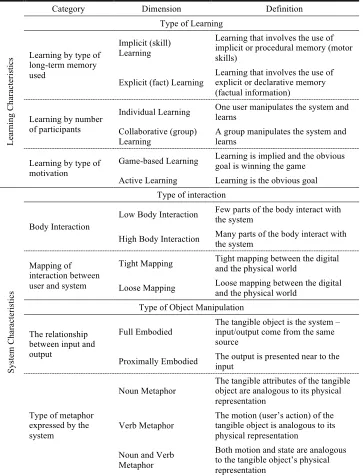
Drawing on existing classifications of TUIs and learning theories, we have developed a classification scheme for tangible user interfaces. This extends existing taxonomies to include concepts that are of special relevance to learning. The classification (Table 1) uses seven categories to focus on key aspects of TUIs that may have an impact on learning. These seven categories are organised into three broader groups: the type of learning that the TUI supports, the type of interaction between the learner and the digital world and the type of object manipulation.
4.2.1 Type of learning
TUIs could be used to support different types of learning. This first group of categories distinguishes three main aspects of learning: the type of long-term memory that is targeted in the learning, the number of participants in the learning environment and the motivation of the learning context. These were chosen specifically because they may have implications for learning, drawing on cognitivist ideology.
Learning by type of long-term memory used
memory is usually concerned with the storage of factual information and involves conscious recall; it is also called declarative memory. In contrast, implicit (or procedural) memory is associated with learning of motor skills and does not require conscious recall of information; it is also called non-declarative memory. Therefore, implicit (skill) learning applies to TUIs that are used to learn a skill, whereas explicit (fact) learning applies to TUIs that are used to learn factual information.
Table 1 Classification of TUIs for learning
Category Dimension Definition
Le ar ni ng C ha ra ct er is ti cs
Type of Learning
Learning by type of long-term memory used
Implicit (skill) Learning
Learning that involves the use of implicit or procedural memory (motor skills)
Explicit (fact) Learning
Learning that involves the use of explicit or declarative memory (factual information)
Learning by number of participants
Individual Learning One user manipulates the system and learns
Collaborative (group)
Learning A group manipulates the system and learns
Learning by type of motivation
Game-based Learning Learning is implied and the obvious goal is winning the game
Active Learning Learning is the obvious goal
Sy st em C ha ra ct er is ti cs
Type of interaction
Body Interaction
Low Body Interaction Few parts of the body interact with the system
High Body Interaction Many parts of the body interact with the system
Mapping of interaction between user and system
Tight Mapping Tight mapping between the digital and the physical world
Loose Mapping Loose mapping between the digital and the physical world
Type of Object Manipulation
The relationship between input and output
Full Embodied The tangible object is the system – input/output come from the same source
Proximally Embodied The output is presented near to the input
Type of metaphor expressed by the system
Noun Metaphor The tangible attributes of the tangible object are analogous to its physical representation
Verb Metaphor The motion (user’s action) of the tangible object is analogous to its physical representation
Noun and Verb Metaphor
Learning by number of participants
Recent TUI research has focused extensively on collaborative learning (e.g. Antle, 2011; Antle et al., 2011; Fleck, 2009; Falcão and Price, 2009; Price, Sheridan, and Falcão, 2010). Our classification distinguishes the number of participants who are involved in the learning task. We distinguish individual learning, where one person manipulates the tangible system, from collaborative learning, where a group of people learn together by manipulating the system. This category stems from the constructivist (and its successor constructionist) idea of learning by doing or constructing one’s knowledge of the world.
Learning by type of motivation
Some learning contexts make it obvious that the learner is engaging in a learning task, whereas other contexts achieve learning through “edutainment” (Prensky, 2001). It has been argued that digital game-based learning is a strong motivating factor for learners and there has been intense interest in this approach (Prensky, 2001). Following this, the classification distinguishes game-based and active learning. The game-based learning dimension represents the situation where the learning is presented in the form of a game or an entertainment activity (e.g. playing music): the motivating factor and obvious goal is winning the game or achieving a goal (i.e. playing in a certain way or composing a melody), and learning is implied as the game is being played. We term the opposite end of the dimension “active learning” and this represents the situation where the user knows that their goal is learning per se or retaining information (e.g. learning the periodic table).
4.2.2 Type of interaction
The means by which a learner interacts with a TUI is relevant and we distinguish two different facets of this: how the user’s body is used to interact with the system and the interaction exchanges or mappings between the user and the system.
Body interaction
This category refers to the amount of the user’s body involved in interacting with the TUI; the importance of body experience to learning has been pointed out by Goschler (2004). Some TUIs require that many parts of the user’s body interact with the system, while others require less body interaction, perhaps limited to just the hand. We distinguish high body interaction – in which the user is using their whole body or the interaction requires extensive motor coordination – and low body interaction. This category is included because of its particular relevance to the learning of motor skills in implicit learning TUIs, although this does not mean that only implicit learning TUIs support a high level of body interaction (as demonstrated in the comparison of different TUIs in section 4.3).
Mapping of interaction between user and system
these interactions may not be directly mapped to the digital world. This category is included because different mappings of interaction may be appropriate for different types of learning e.g. implicit learning may benefit from a TUI with tight mapping, as in the case of the T-Stick (Malloch and Wanderley, 2007) and the Jam-O-World (Blaine and Forlines, 2002).
4.2.3 Type of object manipulation
Finally, the concepts of embodiment and metaphor, as captured in previous classifications and definitions of TUIs, offer further useful categories for differentiating TUIs even though those previous classifications were not intended for TUIs for learning.
The relationship between input and output
Following Fishkin’s notion of embodiment (Fishkin, 2004), we distinguish two dimensions that are concerned with the manner in which the user manipulates objects in a TUI:
1. The tangible object itself is the whole system and it is therefore fully embodied: the output object is the same as the input object.
2. The system is proximally embodied i.e. the system consists of one or more tangible objects which are used as input devices, but not as output devices – the output is presented near the objects.
This category is important because of the technical specifications of tangible systems that have already been used for learning (which express different forms of embodiment), and therefore suggest that embodiment may have an impact on learning - Terrenghi et al., 2005; Gallardo et al, 2008; Ryokai, Marti, and Ishii, 2004 etc.
The type of metaphor expressed by the system
Furthermore, we also make use of Fishkin’s notion of metaphor (Fishkin, 2004) in classifying TUIs. We distinguish between systems that employ a noun metaphor, a verb metaphor, and a noun and verb metaphor. In a noun metaphor, the shape (or appearance) of the tangible object in the physical world is analogous to its digital representation. When a verb metaphor is used, the motion (or user’s action) of the tangible object in the digital world is analogous to its physical representation. Similarly, in a noun and verb metaphor, the shape and the motion of the tangible object are analogous to its physical representation. This category is included because of the importance of metaphor in learning situations, as demonstrated by Glynn and Takahashi (1998).
4.3 Applying the classification of TUIs for learning purposes
We have chosen eight tangible user interfaces to illustrate the application of the classification. These TUIs have been selected because they have been used previously for learning. While there are many other systems with tangible aspects (e.g. Billinghurst and Jounghyun, 2004; Bonanni et al., 2008; Cheok et al., 2002; Do-lenh, Kaplan, and Dillenbourg, 2009; Frei et al., 2000; Morelli, et al., 2011; Nagel et al., 2010; Stanton et al., 2001, etc), we omitted systems which are either not TUIs according to our definition or have not been used for learning purposes. The eight selected TUIs are:
digital grid; the goal of the game is to teaching programming skills as the user completes the puzzle (Horn and Jacob, 2007).
2. TurTan – a tangible tabletop programming interface. A turtle moves around the physical world (tabletop) and responds to tangible objects placed on the surface (Figure 2). Programmed shapes are displayed, as a result of the turtle’s movement, which are based on the Logo Programming Language. Each tangible object is equivalent to a Logo command line (Gallardo et al, 2008; Gallardo, Julia, and Jorda, 2008).
3. Learning Cube – a tangible cube that has six displays. The top side of the cube displays a question and four possible answers are displayed on the four vertical sides of the cube. The user has to rotate the cube to find the correct answer and shake the cube to select it. The cube uses test-based quizzes, where images and text could be used to support learning (Terrenghi et al., 2005).
4. TagTiles – a racing learning game for energy use and sustainability. A maximum of two players race objects to a final destination by using different energy sources in a tabletop sensor board environment. TagTiles targets “learning and understanding of the use of energy sources and their environmental impact and consequences for sustainability” (Zhang, Shrubsole, and Janse, 2010).
5. Towards Utopia – a tabletop system to build a community in the Coquitlam River Basin (Canada) by assigning “various land uses and activities to specific locations on a topographic map displayed on an interactive tabletop” (Antle, Wise, and Nielsen, 2011). Towards Utopia encourages the learning of concepts related to land use planning and sustainable environment.
6. I/O Brush – a tangible brush enhanced with sensors to “pick up” colours and patterns from its surroundings, which afterwards is used to draw them on a digital graphics tablet (Ryokai, Marti, and Ishii, 2004). This TUI was designed for kindergarten children to produce artwork and explore colour – they were taught how to use it in their classroom, and then they were encouraged to play and produce drawings of their own.
7. T-Stick – a tangible musical instrument. Each T-Stick can represent a family of instruments, which generally changes the way it is manipulated or “played”. It is made of plumbing pipe, which is cut in half and filled with sensors and circuitry (Malloch and Wanderley, 2007). Touching and tilting the T-Stick in certain directions creates the desired input to play it as a musical instrument.
8. Jam-O-World – a tabletop installation which runs the software of a musical game called Jam-O-Whirl. The players rotate a circular disk to guide a ball through a circular maze, accompanied by musical effects (Blaine and Forlines, 2002).
Considering the second group of categories, type of interaction, the T-Stick is classified as high body interaction, as the learner has to use his/her whole body to tilt the TUI in a certain way, and at the same time manipulate its sensors to achieve the desired effect, while the rest of the TUIs only require users to use their hands or arms to interact. This is related to the T-Stick belonging to the individual dimension in learning characteristics: it is easier to support collaborative learning when a TUI is proximally embodied, as more users are able to interact with it and observe its output (as in the case of tabletops). The T-Stick and Jam-O-World have tight mapping between the user and the system: they require the user to continuously monitor the system and immediate input is required from the user to continue interacting with the TUI. The mapping is loose for all the other TUIs: the user is not required to produce immediate input and continuously monitor the system.
Finally, we consider the type of object manipulation in these TUIs. In terms of metaphor, TurTan is the only one of these TUIs where only the motion of the tangible object in the digital world is analogous to its physical representation, and therefore it exhibits a verb metaphor. Tern, Jam-O-World, the I/O Brush and the T-Stick are classified as having a noun and verb metaphor because both the shape and the motion of their tangible objects are analogous to their digital representations. The Learning Cube, TagTiles and Towards Utopia express a noun metaphor because the shape of the tangible objects in the physical world is analogous to their digital representation, but the action performed with them is not analogous. It is interesting that the TUIs in the noun and verb metaphor dimension are also classified as TUIs for implicit learning. The question is whether this is achieved by accident or if there is a reason why TUIs that express a noun and verb metaphor are best applied in implicit learning situations? Is active learning best achieved with a TUI that expresses a noun metaphor or a verb metaphor or both? Is explicit learning always related to TUIs with low body interaction, as Table 1 shows? Similarly, as Table 1 suggests, is collaborative learning better achieved with a proximally embodied TUI?
Implicit ü ü
Explicit ü ü ü ü ü ü
Individual ü ü ü ü
Collaborative ü ü ü ü
Game-based ü ü ü
Active ü ü ü ü ü
Interaction
Low Body ü ü ü ü ü ü ü
High Body ü
Tight Mapping ü ü
Loose Mapping ü ü ü ü ü ü
Object Manipulation
Fully Embodied ü ü
Proximally Embodied ü ü ü ü ü ü
Noun Metaphor ü ü ü
Verb Metaphor ü
[image:14.595.120.483.94.372.2]5 Discussion and future work
In this paper, we have proposed a working definition of TUIs. Our definition provides a common terminology for discussing important aspects of these systems while also limiting the scope of systems that can truly be considered to be TUIs. Although some previous work has added a tangible aspect to a learner’s experience (Africano et al., 2004), we argue that a number of these systems do not meet the criteria for a TUI. Our definition therefore clearly delineates and differentiates the space of TUIs from other types of interfaces that learning technologists and researchers could consider in educational contexts.
Working within the scope of the definition, we further proposed a seven-dimensional classification scheme for TUIs. We selected eight representative TUIs to demonstrate the application of the classification; these were chosen because they have previously been used in learning contexts. The majority of systems we reviewed are based on tabletop technology, currently the most prevalent technology for TUIs. With the continuing progress of technology, we anticipate the emergence of a greater diversity of TUIs and these can be accommodated within the classification scheme in the future. In addition, there are many TUIs that exist today that are employed in art installations, performance, data visualisations, etc. These were excluded from our review because they have not been used for learning, however, we expect that some of these TUIs could also be useful in future educational contexts.
Our classification of TUIs for learning shows there are gaps which offer research opportunities for investigating the potential role of TUIs in certain types of learning. While numerous studies have focused on TUIs for collaboration (Africano et al., 2004; Fleck et al., 2009; Hornecker, 2005a and 2005b; Scarlatos, 2002; Xie and Antle, 2007), there are currently few TUIs which address implicit learning (Ryokai, Marti, and Ishii, 2004; Malloch and Wanderley, 2007). Further research is needed to investigate whether this is simply a reflection of the aim and design of current TUIs or whether TUIs are fundamentally less successful in supporting implicit learning. Likewise, there is an interesting opportunity to look at the connection between implicit learning and TUIs that express a noun and verb metaphor.
The TUIs reviewed in this paper also appear to combine specific types of learning with particular user interactions. In general, explicit learning of facts tended to be mostly achieved using TUIs that involved low body interaction, whereas implicit learning was combined with high body interaction. Similarly, if we look at the TUIs in Table 2 that are involved with active learning, we notice that most of them also have loose mapping between the digital and the physical world. This implies that the user in these systems is not required to continuously observe the system, and possibly this is based on the assumption that tight mapping is not important for this type of learning. Perhaps continuous observation of the system is not relevant to active and explicit learning with TUIs. This points to promising areas of future research which evaluate the effects of users’ interaction with TUIs on specific types of learning. It would also be interesting to create novel learning technologies by explicitly combining dimensions in our classification framework in the design of new TUIs. For example, we could attempt to design TUIs which couple individual with implicit learning involving high body interaction and tight mapping between the digital and the physical world. Another possible novel combination of TUI dimensions could be collaborative learning through a proximally embodied TUI. Our classification therefore also allows the creative generation of TUI technology.
feasibly transferred from a research to a real-world classroom setting? There is a clear requirement for learning research to focus on the long-term effects of learning with TUIs in the classroom. Since there is some evidence that children enjoy using TUIs and that TUIs promote collaboration (Africano et al., 2004; Fleck et al., 2009; Hornecker, 2005a and 2005b; Scarlatos, 2002; Xie and Antle, 2007), TUIs could prove useful for early stage learning.
6 Conclusion
In this paper, we have reviewed previous definitions of TUIs and provided a new classification framework that allows the analysis of TUIs for learning. We reviewed eight existing TUIs with respect to the classification we proposed. Our work found that: • A clearer definition of TUIs distinguishes them from other types of interfaces,
provides a clear terminology for discussing their characteristics and helps to scope systems under consideration for learning contexts
• Our classification framework successfully differentiates existing TUIs and categorises them according to type of learning, type of interaction and type of object manipulation
• There are gaps in the types of learning that current TUIs address. Currently, there are few TUIs which focus on implicit learning.
• The TUIs that were reviewed appear to combine specific types of learning with particular user interactions. Research is needed to establish the impact of these user interactions on learning.
Our definition and classification of TUIs can help researchers and learning specialists to further investigate TUIs for learning and is a first step in paving the way for the use of TUIs by learners in classrooms.
References
Ackermann, E. 2004. ‘Constructing knowledge and transforming the world’, in M. Tokoro and L.Steels (Eds.) A learning zone of one's own: Sharing representations and flow in collaborative learning environments. IOS Press, Washington, DC, pp. 15-37.
Africano, D. et al., 2004. Designing tangible interfaces for children’s collaboration. In Extended abstracts of the 2004 conference on Human factors and computing systems - CHI ’04. New York, New York, USA: ACM Press, p. 853.
Antle, A.N., Wise, A.F. and Nielsen, K., 2011. Towards Utopia: Designing Tangibles for Learning. In Proceedings of IDC’11. pp. 11-20.
Blaine, T. and Forlines, C., 2002. JAM-O-WORLD: Evolution of the Jam-O-Drum Multi-player Musical Controller into the Jam-O-Whirl Gaming Interface. In Proceedings of NIME ’02. pp. 1-6.
Bonanni, L. et al., 2008. Handsaw: Tangible Exploration of Volumetric Data by Direct Cut-Plane Projection. In Proceedings of CHI ’08. pp. 251-254.
Cheok, A.D. et al., 2002. Touch-Space: Mixed Reality Game Space Based on Ubiquitous, Tangible, and Social Computing. Personal and Ubiquitous Computing, 6, pp.430-442.
conference on Computer supported collaborative learning - CSCL’09. Morristown, NJ, USA: Association for Computational Linguistics, pp. 325-334.
Fishkin, K.P., 2004. A taxonomy for and analysis of tangible interfaces. Personal and Ubiquitous Computing, 8(5), pp.347-358.
Frei, P., Su, V., Mikhak, B., and Ishii, H., 2000. Curlybot. In Proceedings of the SIGCHI conference on Human factors in computing systems - CHI ’0. New York, New York, USA: ACM Press, pp. 129-136.
Gallardo, D., Julia, C.F. and Jorda, S., 2008. TurTan: A tangible programming language for creative exploration. In 2008 3rd IEEE International Workshop on Horizontal Interactive Human Computer Systems. Ieee, pp. 89-92.
Gentile, A. et al., 2011. Novel Human-to-Human Interactions from the Evolution of HCI. In 2011 International Conference on Complex, Intelligent, and Software Intensive Systems. Ieee, pp. 600-605.
Glynn, S. M., and Takahashi, T. (1998). Learning from analogy-enhanced science text. Journal of Research in Science Teaching, 35(10), 1129-1149.
Goschler, J., 2004. Embodiment and Body Metaphors. Metaphorik.de, (1999), pp.33-52.
Horn, M. and Jacob, R.J.K., 2007. Tangible Programming in the Classroom with Tern. In Proceedings of CHI ’07. pp. 1965-1970.
Hornecker, E., 2005a. A Design Theme for Tangible Interaction: Embodied Facilitation. In Proceedings of the ninth conference on European Conference on Computer Supported Cooperative Work ECSCW’05. New York, New York, USA, pp. 23 - 43.
Hornecker, E., 2005b. Tangible Interaction Design, Space, and Place. Children.
Hung, D., 2001. Theories of Learning and Computer-Mediated Instructional Technologies. Educational Media International, 38(4), pp.281-287.
Hurtienne, J. and Israel, J.H., 2007. Image Schemas and Their Metaphorical Extensions – Intuitive Patterns for Tangible Interaction. In Proceedings of TEI ’07. pp. 15-17.
Ishii, H. and Ullmer, B., 1997. Tangible bits. In Proceedings of the SIGCHI conference on Human factors in computing systems - CHI ’97. New York, New York, USA: ACM Press, pp. 234-241.
Koleva, B., Benford, S., Ng, K.H. and Rodden, T., 2003. A Framework for Tangible User Interfaces. In Proceedings of PI03 workshop at Mobile HCI ‘03. pp. 46-50.
Jordà, S., 2010. The Reactable: Tangible and Tabletop Music Performance. In Proceedings of CHI ’10. pp. 2989-2994.
Lefrançois, G.R., 2000. Theories of human learning: what the old man said 4th ed., Australia; United Kingdom: Wadsworth.
Malley, C.O. and Stanton Fraser, D., 2004. Literature Review in Learning with Tangible Technologies, Bristol.
Malloch, J. and Wanderley, M.M., 2007. The T-Stick: From Musical Interface to Musical Instrument. In Proceedings of NIME ’07. pp. 66-69.
Marshall, P., Price, S. and Rogers, Y., 2003. Conceptualising tangibles to support learning. In Proceedings of IDC’03. pp. 101 - 109.
Morelli, T. et al., 2011. Pet-N-Punch: Upper Body Tactile / Audio Exergame to Engage Children with Visual Impairments into Physical Activity. In Proceedings of Graphics Interface ’11. pp. 223-230.
Nagel, T. et al., 2010. Venice Unfolding: A Tangible User Interface for Exploring Faceted Data in a Geographical Context. In Proceedings of NordiCHI ’10. pp. 743-746.
Papert, B.S. & Harel, I., 1991. Situating Constructionism. In Constructionism. Albex Publishing Corporation.
Prensky, M., 2001. The Digital Game-Based Learning Revolution. In Digital Game-Based Learning. McGraw-Hill, pp. 1-19.
Price, S., Sheridan, J.G. and Falcão, T.P., 2010. Action and Representation in Tangible Systems: Implications for Design of Learning Interactions. Children, pp.145-152.
Resnick, M. & Ocko, S., 1991. LEGO/Logo: Learning Through and About Design. In Constructionism. Albex Publishing Corporation.
Ryokai, K., Marti, S. and Ishii, H., 2004. I/O Brush: Drawing with Everyday Objects as Ink. In Proceedings of CHI ’04. pp. 1-8.
Scarlatos, L., 2002. An application of tangible interfaces in collaborative learning environments. In ACM SIGGRAPH 2002 conference abstracts and applications on - SIGGRAPH ’02. New York, New York, USA: ACM Press, p. 125.
Schöning, J., 2010. Touching the Future: The Rise of Multi-touch Interfaces A. Butz et al., eds. Per Ada Magazine, 5531.
Shaer, O. et al., 2004. The TAC paradigm: specifying tangible user interfaces. Personal and Ubiquitous Computing, 8(5), pp.359-369.
Shaer, O. et al., 2011. Enhancing Genomic Learning through Tabletop Interaction. Proceedings of CHI 2011, pp.2817-2826.
Stanton, D. et al., 2001. Classroom collaboration in the design of tangible interfaces for storytelling. Proceedings of the SIGCHI conference on Human factors in computing systems - CHI ’01, (3), pp.482-489.
Terrenghi, L. et al., 2005. A cube to learn: a tangible user interface for the design of a learning appliance. Personal and Ubiquitous Computing, 10(2-3), pp.153-158.
Ullmer, B. and Ishii, H., 2000. Emerging frameworks for tangible user interfaces. IBM Systems Journal, 39(3), pp.915-931.
Wang, Y.H., Young, S.S.C. and Jang, J.-S.R., 2010. Using Tangible Learning Companions in English Education. In 2010 10th IEEE International Conference on Advanced Learning Technologies. Ieee, pp. 671-675.
Xie, L. and Antle, A., 2007. Exploring Children’s Engagement, Enjoyment and Collaboration on Tangible User Interfaces. International Journal.
Zhang, Z., Shrubsole, P. and Janse, M., 2010. Learning environmental factors through playful interaction. In Proceedings of IDC ’10. New York, New York, USA: ACM Press, p. 166. Zuckerman, O., 2010. Designing digital objects for learning: lessons from Froebel and Montessori.
International Journal of Arts and Technology, 3(1), pp.124-135.