OF
0022-538X/92/127549-06$02.00/0
Copyright © 1992, AmericanSociety for Microbiology
Vol.66, No. 12
Processing and Localization of Dengue Virus Type 2
Polyprotein
Precursor
NS3-NS4A-NS4B-NS5
LUWENZHANG, P. MARUTHIMOHAN,tAND R. PADMANABHAN*
DepartmentofBiochemistry and Molecular Biology, University of Kansas MedicalCenter Kansas
City,
Kansas 66103Received 2 April 1992/Accepted 28 August 1992
Processing of dengue virus type 2 polyprotein precursor NS3-NS4A-NS4B-NS5 could be mediated by the
catalytically
active NS3 protease domain and NS2B intrans at the dibasic sites NS3-NS4A and NS4B-NS5.Subcellular localization of the unprocessed precursor NS3-NS4A-NS4B-NS5 showed that it was confined to a distinct subcellular organelle in the
cytoplasm,
which wasdistinct from the distribution of the mature NS5.Dengue virus type 2 (DEN-2), a member of the family
Flaviviridae, contains a single-stranded RNA genome of
10,723 nucleotides (New Guinea C strain), having a type 1
capatthe5' end,but lacking a poly(A) tract at the 3' end (for
reviews, see references 1, 4, 23, 27, and 28). The genomic
RNA is of positive-strand polarity, having a single open
reading frame that encodes a polyprotein of 3,391 amino
acids, which is processed into three structural and at least
seven nonstructural proteins so far identified. The gene order is
5'-C-prM-E-NS1-NS2A-NS2B-NS3-NS4A-NS4B-NS5-3',where C, prM, and E are the structural proteins and
NS1 through NS5 represent the nonstructural proteins. The
processing of the polyprotein precursor occurs
cotransla-tionallyas well as posttranslationally and is performed by
eitherthe host signalasein association with the membranes
of the endoplasmic reticulum or the viral protease(s)
(re-viewed in reference 4). For the construction of expression
plasmidstostudy the processing of the DEN-2 polyprotein
precursors, arecombinant vaccinia virus expression vector
(pTM1)was used (18). This vector contains a T7 promoter
(PT7)
and an encephalomyocarditis virus (EMCV)5'-un-translatedregionupstreamof the target gene,which allows
cap-independent translation of the transcripts; with this
system,the target gene has beenreportedtobeexpressedat high levels of RNA as well as protein because of more
efficient utilization of the transcripts by cap-independent
translation(7, 19). Figure1shows thepolyproteinprecursor of DEN-2 and the location of the coding sequences of the nonstructural proteins used inthis study. Theseexpression
plasmids were constructedby standard recombinant DNA
techniques(17)asfollows. Thedetailsof theconstruction of
theintermediate plasmidspLZ-3PCR, 3, 5,
pLZ-123, and pLZ-2B-3-4A-4B-5 and the plasmid pLZ-12345
encoding all the nonstructural proteins of DEN-2 will be
described elsewhere(unpublished data).
pLZ-345. ThepLZ-3PCRplasmidwasdigestedwith NsiI
(nucleotide 4696) and EcoRI in the
pTM1
vector and thenligated with two other DNA fragments; one of these was
obtained from theplasmid pLZ-3 by digestingwith NsiI and PvuII(nucleotides4696to5447),and the otherwasfrom the cDNA clone
pPM-A1O
(14) by digesting with PvuII and EcoRI (nucleotides 5447 to 8761). This cloning procedure* Correspondingauthor.
tPresentaddress:Departmentof
Biochemistry,
Osmania Univer-sity,Hyderabad-500007,(A.P.),India.resulted in the plasmid pLZ-310 containing the coding
se-quenceNS3-NS4A-NS4B-truncatedNS5. pLZ-310 was then
digested with StuI to release a 900-bp fragment between
nucleotide 7872 and a site in the vector. Thisfragmentwas
replaced by theStuIfragment(2.7kb) from pLZ-5, and the
plasmid pLZ-345 was obtained containing the region from
NS3 to NS5 (nucleotides 4522to10543).
pLZ-2B. A polymerase chain reaction (PCR) was per-formed with twooligonucleotides, 5'-AGCTGGCCACTAA
ATGAGGCT-3'(nucleotides4132to4152) and5'-ttaCCGTT
GTlClTCTCACTTCCCACAG-3'
(complementarytonucle-otides 4498to4521),onthepLZ-123template, and the PCR
fragmentwasclonedinto thepTM1vector atthe NcoI siteto
obtain the pLZ-2Bplasmid containing the complete NS2B
coding sequence and ending with the termination codon
TAA(tta in theoligonucleotide).
pLZ-2B3(pro) and pLZ-3(pro). The plasmid pLZ-2B345 was digested withXhoI (nucleotide 5426) andXbaI (inthe
pTMl vector) and clonedinto thepTMlvectordigestedwith
XbaIandXhoItoobtain theplasmidpLZ-2B3(pro) encoding
the complete NS2B and the N-terminal
region
of NS3(-50%).pLZ-3(pro)wasconstructedbya
procedure
similarto the procedure followed for
pLZ-2B3(pro),
butusing
pLZ-3instead of thepLZ-2B345 plasmid.
pLZ-3(50%oC)45.
pLZ-345wasdigestedwithXhoI(nucle-otide 5426) andXbaI
(in
the pTM1vector),
and thelarge
fragment containingthe C-terminalNS3(50%)45 sequences
was ligated with the small XbaI-XhoI fragment obtained
from the pTM1 vector; this step gave rise to the
plasmid
pLZ-3(50%C)45.
The Nterminusof the clone contained 13amino acid residues from the
multiple
cloning
sites of thepTM-1vector.
pLZ-3*45. Twooligonucleotides, 5'-GCTGGAGTATTGT
GGGAT-3'
(nucleotides
4522 to4539)
and 5'-TTATGCATTAGAACAGCGCCGCGTGTGACAGCCCACATTGTATT-3' (complementarytonucleotides 4660to
4703),
wereusedfor PCR; the longer one contained the desired mutation
converting histidine into alanine in theactive-site
catalytic
triad (asshownbyan
underline);
anadditional mutation(as
shown by an
overline)
was found to be present in threeindependent clones,whichresultedin the His--Asn
change;
thismutationmayhaveresulted from the G- T
change
atthe3'-terminal nucleotideof the
oligonucleotide
primer
used forPCR. TheresultingmutantPCR
fragment
(nucleotides
4522to4703)was clonedinto the
pTM1
vector at the NcoI site.Theresulting
plasmid,
pLZ-3*PCR,
wasdigested
withNsiI(nucleotide
4696)
andXbaI andligated
with theNsiI-XbaI7549
on November 9, 2019 by guest
http://jvi.asm.org/
STRUCTURAL NONSTRUCTURAL(NS) PROTEINS NS2A NS2B NS4A NS4B
C prM E NS 1 \ / NS3 \ / NS5 3'UTR
5' 1 - X|3'
ExpronClones*
pLZ-345
pLZ-3*45
pLZ-3(50%C)45
pLZ-2B __
pLZ-3(pro)
[image:2.612.58.296.66.188.2]pLZ-2B3(pro)
FIG. 1. Plasmids encoding DEN-2 nonstructural proteins and theirprecursorsused for theinfection-transfection protocol.Inthe topofthefigure, along horizontal bar indicates theopen reading frameencoding theDEN-2 precursorpolyprotein, and thevertical lines within the bar denote the boundaries of individual mature
proteinswhichresultfrom theprocessingofthe precursorprotein. The gene order of the precursorprotein consistsof the structural region encodingtheC,prM,and Eproteins and the nonstructural region whichencodesNS1,NS2A,NS2B,NS3, NS4A,NS4B, and NS5proteins(seereference 4forareview). Single linesextending from the bar toward the 5' and 3' ends denote the untranslated region(UTR)oftheDEN-2 RNA. The sizesarenotdrawntoscale. The pLZ series of plasmids indicate the locations of the coding sequencesof the variousnonstructuralproteinsand their precursors used in thisstudy. The experimental details of the plasmid
con-structs aregiveninthetext. *,mutationofHis--Alain theactive site of the proteasedomainof the NS3protein, whichisindicatedby ablack box.
fragment from pLZ-345. The resulting plasmid, pLZ-3*45,
contained thecompleteNS3toNS5codingsequencewitha mutation which changed histidine into alanine at the con-servedactive sitecatalytictriad of the NS3 proteasedomain.
AllPCR-derivedcloneswereverifiedbysequence analysis.
To examine the processing, we first infected monkey
kidney (CV-1) cells with the recombinant vaccinia virus vTF7-3 to provide T7 RNA polymerase (9, 18); this was followed by transfection of an expression plasmid by a protocol based on liposome-mediated DNA uptake. This transient expression system is referred to as an infection-transfection protocol(18). Theexpression plasmid pLZ-345
gaveriseto a180-kDa proteinin the transfected CV-1 cells which could react with either the anti-NS3 or anti-NS5
antibodies, whereas no cleavage of the precursor
NS3-NS4A-NS4B-NS5 (hereafter referred to as NS345) was observed (data notshown), althoughthe N-terminal region
of NS3 contains aproteasedomain (10).Yellow fevervirus
(YF) precursor
NS345356
containing one-third of the NS5 protein (3) and the dengue virus type 4 (DEN-4) precursorNS345 (2) also didnotundergo processingwhen expressed
alone. The failure of the polyprotein precursor NS345 to
undergo processing suggested that the catalytically active
NS3 alonewasnotsufficientfor cleavages at the NS3-NS4A and NS4B-NS5 sites and that one or more nonstructural
proteinswerealso required. NS2B was a good candidate for
that role because oftherecentreportsthat NS2B is required for NS3 protease activity (2, 3, 6, 8, 22). To test whether NS2B could mediate processing of NS345 in trans, we cotransfected anexpression clone encoding NS2B with the
plasmid encodingNS345. When the labeled cell lysates from
the transfected cells were analyzed by immunoprecipitation, itwas found that the NS345 polyprotein precursor under-wentprocessing as indicated by the release of NS3 and NS5
(Fig.2AandB, lanes2), which would require cleavages at
boththe NS3-NS4Aand NS4B-NS5 sites. These data
indi-catethat NS2Bplaysanimportantrole in theprocessingof
NS345 atboth the NS3-NS4Aand NS4B-NS5 sites.
How-ever, the YF polyprotein substrate
NS345356
containingone-third of the NS5
protein
wasprocessed by
NS2Bsup-pliedintransonlyattheNS4B-NS5
site,
andnodetectablecleavage of the NS3-NS4A sitewas observed
(3).
Incon-trast,the DEN-2 NS345 substrate used inourstudycontains the entire NS5 sequence and could
undergo
cleavages
at both the NS3-NS4A and NS4B-NS5 sites(Fig.
2A andB).
From these results, an intact NS5 sequence seems to be
importantforcleavageatthe NS3-NS4A site
by
NS2B. Wefound thatthecleavageattheNS3-NS4A site is
exquisitely
sensitive toconformation of the
polyprotein
precursor;themost efficient cleavage, similar to the pattern in
DEN-2-infected
cells,
was observed when the precursorNS12345containing the entire nonstructural
region
was used as thesubstrate (29). Thus, it appears that conformation of a precursorproteinmayplayanimportant rolein the
process-ing events mediated by a viral protease. To
investigate
whether the NS3 protease domain was
important
for theprocessing of NS345, we made a deletion mutant,
pLZ-3(50%C)45,which encodesa
region starting
fromtheC-ter-minal halfof NS3 andendingwith theentire NS5 sequence
(Fig. 1). Transient
expression
fromthisplasmid
gaverisetothe
unprocessed
NS3(50%
Cterminal)45
precursor(Fig. 2C,
lane2). Cotransfectionof the
plasmids encoding
NS2B aloneor the NS3 protease domain alone
[NS3(pro)]
could not mediate theprocessing
of theNS3(50%
Cterminal)45
pre-cursor(Fig.
2C, lanes 3 and4,
respectively).
Butwhen theplasmids encodingNS2B and
NS3(pro)
were cotransfectedwith the precursorplasmid
pLZ-3(50%C)45,
theNS4B-NS5site of the precursorwas
cleaved,
asshownby
the releaseofNS5 (Fig. 2C,lane5). Cotransfectionof the plasmid
encod-ingthelinked
NS2B-NS3(pro)
sequencealso gave asimilarresult (Fig. 2C, lane 6). However, cleavage of the NS3-NS4Asitewas notdetectable in theseexperiments
(data
notshown). Two possible
explanations
could be invoked fromthis result: the conformation assumed
by
precursor Ahaving
alarge deletionin theNS3sequence
might preclude
cleavage
atthe NS3-NS4A
site,
orthe cislinkage
of the NS3 protease domain to NS4A is required for this cleavage, which isabrogatedin precursor A. To addressthis
question,
wemadea mutant
plasmid, pLZ-3*45,
in which theconservedprote-asetriadresidueHis-51waschangedtoAlaby site-directed
point mutagenesis by
PCR(31).
An additional mutation(His-47- Asn), theoriginof whichwastracedtotheprimer
oligonucleotide
used forPCR,wasalso foundtobe presentin three
independent
clonesbysequence analysis.Cotrans-fection ofthisplasmidwithpLZ-2Bshowedthat,unlike the
processingof thewild-typeprecursor(Fig. 2AandB, lanes
2),
NS2Baloneintranswasineffectivein theprocessing ofthismutantprecursorNS3*45 and required coexpressionof
wild-type
NS3(pro) (Fig.
2A and B, lanes 3 and 4). Theseexperiments clearly
indicated that the cis linkage of thecatalyticallyactive protease domainofNS3tothe NS4A site
isnotrequired for thecleavageatthe NS3-NS4Asite, asit
could be cleaved intransbyNS2B andNS3(pro).
Theunprocessed precursorsaswell asthe intermediates
formed in theprocessingofNS345orNS3*45areidentifiable
by
using
anti-NS3 andanti-NS5antibodies. Forexample,theintermediate NS3-NS4A was detected by using anti-NS3
antibodies in the processing of the NS345 and NS3*45
precursors
(Fig.
2A,lanes 2 and4). Theidentityof this band as toNS3-NS4Awasconfirmedby usingadditional expres-sionconstructs(29).
Formation ofanNS3-NS4Aon November 9, 2019 by guest
http://jvi.asm.org/
NOTES 7551
A~~~~~~~
I" .A& ;~ C ; _:^S-->N
¢;-'9
-NS K
46
-_ .-N;s prtl
_ 4 ' r
B .-;r v
-'o ,N' -\"b \
-li--_ N>' }
1-- -1
-Z -.Nie().
orA\
..._ N:''
69 a
4 6 4
[image:3.612.95.274.74.511.2]1 2 3 4 5 6 7
FIG. 2. Processing of the NS345 precursor protein requires NS2B and a catalytically active protease domain. Monolayers of CV-1 cellsin25-cm2flaskswereinfected withrecombinant vaccinia virusexpressing T7 RNA polymerase (vTF7-3), except one indi-catedasDEN-2-infected, and then transfectedwiththeexpression plasmid. Three hoursposttransfection,thecellsweremetabolically labeledwith[35S]methionine for4 to5h, and thecelllysateswere
immunoprecipitated with the polyclonal antibodies raised against the intact NS3 and NS5 proteins (29) and analyzed by sodium dodecylsulfate-polyacrylamide gel electrophoresisand autoradiog-raphy. (A) Rabbit polyclonal anti-NS3 antibody was used for immunoprecipitations. Thenumbersonthe leftmargin denotethe sizes of the protein standards in kilodaltons. Lanes: 1, negative control(infectiononly; noDNAtransfection); 2,plasmidspLZ-2B andpLZ-345weretransfected; 3, plasmids pLZ-2BandpLZ-3*45
weretransfected; 4, plasmids pLZ-2B,pLZ-3(pro), andpLZ-3*45
weretransfected; 5,DEN-2virus-infected CV-1celllysates. (B)The sampleswere thesame asinpanel A except thatthe immunopre-cipitateswere derived fromusingrabbitpolyclonalanti-NS5 anti-body. (C)Theimmunoprecipitates werederived fromusingrabbit polyclonal anti-NS5antibody.Lanes:M,14C-labeled protein molec-ularmass standards (kilodaltons); 1, negative control; 2, plasmid pLZ-3(50%C)45 (referredto as A)wastransfected; 3, plasmidsA
ate reactive with anti-NS3 antibodies is one evidence that
the cleavageofNS4A-NS4B had taken place in the
process-ingofNS345. Since specific antibodies against these dengue viral antigens, NS4A and NS4B, are not presently available, we could not confirm independently the cleavage of the NS4A-NS4B site by immunoprecipitation. However, the efficiency of cleavageattheNS3-NS4Asite of the precursor NS345 or NS3*45 can be estimated from the ratio of the mature NS3 (or the NS3*) to the unprocessed precursor NS345 (or NS3*45) and the amount of the intermediate NS3-NS4A formed (Fig. 2A, lanes 2 and 4); this efficiency wasbetterwith thewild-type NS345 substrate, in which the
catalytically activeNS3 proteasedomain was linked in cis to
NS4A andwhenonly NS2B was supplied in trans (Fig. 2A, lane 2), than with the processing of the mutant NS3*45
substrate,inwhichboth theactive NS3(pro)andNS2B were
suppliedin trans. Thisobservationmaybe explained by the
possibility that the NS3-NS4A site can be cleaved in both cis andtrans configurations during the processing of the wild-type substrate NS345; once a small fraction of the mature NS3 is released by cis cleavage, the rest of NS3 can be released from the precursor NS345 by both cis and trans
cleavages attheNS3-NS4A site. However, the cleavage of
theNS3-NS4A site in the NS3*45 precursor by NS2B and
NS3(pro) can occur only in the trans configuration. This
difference in theefficiency of cleavageattheNS3-NS4A site was notobserved for the cleavage at the NS4B-NS5 site of
the twosubstrates, asthe intermediate NS4B-NS5 was not
formedat a level detectablewith anti-NS5 antibodies (Fig.
2B, lanes 2 and 4). Although the NS4B-NS5 site can be cleaved in trans mediated by NS2B andNS3(pro),wecannot
ruleout thepossibility that in the naturalprocessing of the
DEN-2polyprotein, aciscleavage is involved if the
catalyt-icallyactiveNS3(pro) domain in conjunctionwith NS2B is
brought in close proximity to the NS4B-NS5 site (see the
model inFig.4). Experimentsare in progressto clarify this aspect.
Itisnotyetunderstood whatrole NS2B plays in conjunc-tion with NS3 in the processing of the precursor protein.
NS3 by itself may not have the right conformation for
protease activity, and it is possible that the interaction of NS2B with NS3 confers protease activity for NS3. In this
regard, the proteolytic processing done by the NS2B and
NS3proteinsresembles the two-componentprotein
require-mentfor thecleavage ofamino-terminal targetingsequences in the mitochondrial matrix of Neurosporacrassa
(13):
the57-kDa matrixprocessing peptidase havingthecatalyticsite and the 52-kDaprocessing enhancingprotein. Matrix
proc-essing peptidase alonewas shownto havealowprocessing
activity, whereas processing enhancing protein alone was
devoid of any activity, but it
significantly
enhanced theprocessing activity of matrix processing peptide. It is
un-knownatpresentwhether NS3 alone has any basal protease
activity in the absence of NS2B. It is possible that the
system used in this studymay not be sensitive
enough
to detect the low proteaseactivity,
if any, of NS3. Studiesusing model substrates
containing
the dibasiccleavage
siteswith sensitivedetection methods may address this
question.
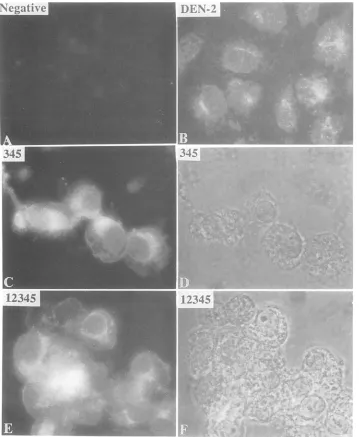
We then examined the subcellular localization of the
andpLZ-2Bweretransfected; 4,plasmidsAandpLZ-3(pro)were
transfected; 5, plasmids A, pLZ-2B, and the pLZ-3(pro) were
transfected; 6, plasmidsAandpLZ-2B3(pro) weretransfected; 7,
DEN-2-infected celllysates. VOL.66, 1992
on November 9, 2019 by guest
http://jvi.asm.org/
FIG. 3. Subcellular localization of theunprocessedprecursorNS345. CV-1 cellswereused for theinfection-transfection protocol.The cellswereinfected with the vTF7-3 virus (1PFUpercell)atroomtemperature for30 min. Subsequently, the vTF7-3-infected cellswere
transfected with theindicatedplasmid for3h. Cellswerethenincubated with DulbeccomodifiedEaglemediumcontaining5% fetal bovine
serumforabout 12h.Cellswerefixed for30 minwithparaformaldehyde (3.7%)inphosphate-bufferedsaline(PBS)(pH 7.4)andthen treated
withTritonX-100(0.1%)in PBS for 10 min.Cellswerethen washedwith PBS for30min andprepared for indirect immunofluorescence with anti-NS5 antibodiesaspreviously described (30).(A)vTF7-3-infectedcellsasthenegative control.(B)CV-1 cellswereinfected with DEN-2 virusat1PFUpercellfor1 hatroomtemperature. Then the cellswereincubated with Dulbecco modifiedEaglemediumcontaining10% fetal bovine serumfor 48 h before being fixed for immunofluorescence. (C)vTF7-3-infected cells were transfected with pLZ-345. (D) Phase-contrast pictureofcellsinpanelC.(E)SameaspanelC,excepttransfectedwithpLZ-12345.(F)Phase-contrastpictureof cells inpanel E.
polyprotein precursor NS345 by indirect
immunofluores-cencewith rabbitpolyclonalantibodies against purified NS3 and NS5. We found that the unprocessed precursor was associated withsomesubcellular organelle in the cytoplasm
ofthemajorityof cells transfected with theplasmid pLZ-345
(Fig. 3C), whereas the vTF7-3-infected cells alone were
negativein
immunoreactivity
withanti-NS5 antibodies (Fig.3A). However, in the cells transfected with the plasmid
pLZ-12345 in which the precursorwasprocessedefficiently
(29), the released NS5 was localized predominantly in the perinuclear region, although some diffuse cytoplasmic dis-tributionwasalsoseen(Fig. 3E and F). It is interesting that flavivirus replication siteswerealso localized in the perinu-clear region by usingantibodies to adouble-stranded RNA and autoradiographic and immunofluorescence techniques (16, 20, 27). NS5 has been implicated in the replicationofthe flavivirus genome (12). In the DEN-2-infected CV-1 cells (Fig. 3B), NS5was seen tobedistributed in theperinuclear
on November 9, 2019 by guest
http://jvi.asm.org/
NOTES 7553 region, although some cytoplasmic and nuclear staining was
also seen (Fig. 3B). Thus, our results suggest that the processing of the polyprotein precursor occurs at an intra-cellular site distinct from the site of localization of the processed NS5. In fact, in Sindbis virus, a member of the alphaviruses, it was shown that the precursor of the struc-tural proteins and the cleavage products were destined to
different compartments (reviewed in reference 15). For
example, the mature capsid protein cleaved off from the amino terminus of the precursor assembled in the cytoplasm, whereas the C-terminal portion of this precursor is trans-ported to the rough endoplasmic reticulum for further
proc-essing.
The precursor NS2B345 polyprotein could not be detected in the YF-infected cells (5), probably due to a rapid cleavage of the NS2B-NS3 site by the NS3 protease. This cleavage eventwould give rise to theprecursor NS345 as a transient intermediate, the processing of which must await the trans function of NS2B at the NS3-NS4A and NS4B-NS5 sites. The transient existence of this precursor has been noted in YF-infected cells by pulse-chase experiments (5) and in DEN-2-infected cells (data not shown). Two points drawn from the present experimental evidence suggest that the precursor NS345 may assume a special conformation prior to its processing into mature products. First, the NS4A-NS4B site could not be cleaved in the DEN-2 precursor NS345 (this study), in NS4A-NS4B (21), in the DEN-4 precursor NS345, or in the YF precursor
NS345356
contain-ing the truncated NS5 (2, 3); but this site could be cleaved inNS34AI4B(84%)
and NS4A4B5 (2, 8). Second, the NS345precursor has several consensus cleavage sites, although actual cleavage occurs only at the NS3-NS4A and NS4B-NS5 sites.
The nonstructural proteins NS4A and NS4B consist of hydrophobicmembrane-spanning domains, and the N-termi-nal amino acid sequence data for Kunjin virus (KUN) and YF suggest that the cleavage of the NS4A-NS4B site may occur in the lumen of the rough endoplasmic reticulum. NS4Bhas been identified in KUN- and YF-infected cells (5,
24), whereas NS4A has been identified only in KUN-in-fected cells (25). On the basis of our present knowledge
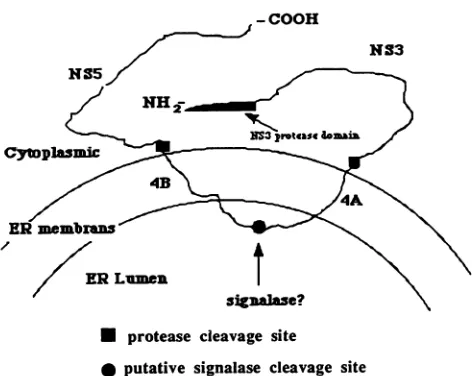
regarding DEN-2 polyprotein processing, we propose a
model for the conformation of the NS345 precursor (Fig. 4). In this model, the NS4A-NS4B region subsequent to inser-tion into the endoplasmic reticulum membrane might confer
a cytoplasmic anchor for the precursor NS345 and thus
accountfor its localization seen in Fig. 3C. In the absence of NS2B, the localization of NS345 may be confined to this
cytoplasmic organelle.
However, the polyprotein precursor NS12345 undergoes
processingmediated by NS2B linked in cis, and the released
NS5 was localized to the perinuclear region (Fig. 3B).
Assembly of the replication complexes at the perinuclear
region wouldrequire the localization of the genomic RNA at
this site toserveasatemplate for negative-strand synthesis
(for reviews, seereferences1, 26, and27).Itis not clear how
the timing of the translation of the positive-strand RNA
genomeinto mature proteins and of its replication to progeny RNAmolecules iscontrolled. It ispossible that the transla-tion of the genomic RNA must precede its replication in order to produce the nonstructural proteins required for replication. NS3 has been implicated to play a dual role as the proteaseaswell the RNA helicase based on the presence of conserved domains in the region C terminal to the protease domain (11). NS5 protein has been implicated to functionasan RNApolymerasebased on the presence of the
-COOH
* protease cleavage site
[image:5.612.320.556.71.259.2]* putative signalase cleavage site
FIG. 4. Proposed model for the conformation of theunprocessed NS345 precursor. The precursor is localized in the endoplasmic reticulum (ER) membrane because of the hydrophobic sequences present in NS4A and NS4B. The NS3 proteasedomain isindicated by an arrow.
highly conserved G-D-D motif found in RNA-dependent RNApolymerases of several positive-strand RNA viruses. It is possible that the transient formation of the precursor NS345 andsubsequent processing to give rise to mature NS3 and NS5 might serve as a control point during the switch from thetranslation mode of the viral RNA template into its replication mode.
We thankBernardMoss for his gift of the vaccinia virus vector plasmid (pTM1) and the vTF7-3 virus used in this study, Charles Rice and James Strauss for their gifts of antibodies againstNS5and NS3 proteins, respectively, and Robert Putnak for the DEN-2 hyperimmune ascitic fluid and the monoclonal antibody againstNS1 (3E9). We thank T. Trirawatanapong for help with the DEN-2 infections of CV-1 cells and M. Ramachandra and M. Kapoor for critical reading of the manuscript.
This work was partly supported by a contract from the U.S.Army Medical Research and Development Command (DAMD17-85-C-5273) to R.P.
REFERENCES
1. Brinton, M. A. 1986.Replication of flaviviruses, p. 327-365. In S.Schlesingerand M. J. Schlesinger (ed.), The Togaviridae and Flaviviridae. Plenum Press, New York.
2. Cahour, A., B.Falgout, and C.-J. Lai. 1992. Cleavage of the dengue virus polyprotein at the NS3/NS4A and NS4B/NS5 junction is mediated by viral protease NS2B-NS3, whereas NS4AINS4Bmay beprocessed by a cellular protease. J. Virol. 66:1535-1542.
3. Chambers, T. J., A. Grakoui, and C. M. Rice. 1991.Processing of theyellowfever virusnonstructuralpolyprotein: a catalyti-cally active NS3 protease domain andNS2B are required for cleavages atdibasic sites. J. Virol.65:6042-6050.
4. Chambers, T. J., C. S. Hahn, R. Galler,and C. M. Rice. 1990. Flavivirus genome organization expression, and replication. Annu. Rev. Microbiol.44:649-688.
5. Chambers, T. J., D. W. McCourt, and C. M. Rice. 1990. Production of yellow fever virus proteins in infected cells: identification of discrete polyprotein species and analysis of cleavage kinetics usingregion-specificpolyclonal antisera. Vi-rology 177:159-174.
6. Chambers, T. J., R. C.Weir, A. Grakoui, D.W.McCourt,J. F. Bazan, R. J. Fletterick, and C. M. Rice.1990. Evidencethatthe N-terminaldomainofnonstructural protein NS3 from yellowfe-66, 1992
on November 9, 2019 by guest
http://jvi.asm.org/
vervirus is a serine proteaseresponsibleforsite-specific cleav-age in the viral polyprotein. Proc. Natl. Acad. Sci. USA 87:8898-8902.
7. Elroy-Stein, O., T. R. Fuerst, and B. Moss.1989. Cap-indepen-denttranslation of mRNA conferredbyencephalomyocarditis virus 5' sequence improves the performance of the vaccinia virus/bacteriophage T7hybrid expression system. Proc. Natl. Acad.Sci. USA86:6126-6130.
8. Falgout, B., M. Pethel, Y. Zhang, and C.-J. Lai. 1991. Both nonstructural proteins NS2B and NS3 are required for the proteolyticprocessing ofdengue virus nonstructural proteins.J. Virol. 65:2467-2475.
9. Fuerst, T. R., E. G. Niles, W. Studier, and B. Moss. 1986. Eukaryotictransient-expression systembasedonrecombinant vaccinia virus thatsynthesizesbacteriophageT7 RNA polymer-ase.Proc.Natl. Acad. Sci. USA83:8122-8126.
10. Gorbalenya, A. E., A. P.Donchenko,E. V.Koonin,and V. M. Blinov.1989. N-terminal domains ofputative helicases of flavi-andpestivirusesmaybe serine proteases. NucleicAcids Res. 17:3889-3897.
11. Gorbalenya,A.E., E. V.Koonin,A. P.Donchenko,and V. M. Blinov. 1989. Two related superfamilies of putative helicase involvedinreplication,recombination, repairandexpressionof DNAandRNAgenomes. Nucleic AcidsRes. 17:4713-4729. 12. Grun,J. B., and M. A. Brinton. 1987.DissociationofNS5from
cell fractions containing West Nile virus-specific polymerase activity.J. Virol. 61:3641-3644.
13. Hawlitschek,G., H. Schneider, B. Schmidt, M. Tropschug, F.-U. Hartl, and W. Neupert. 1988. Mitochondrial protein import: identificationofprocessing peptidase and ofPEP, a processing enhancing protein. Cell 53:795-806.
14. Irie, K., P. M.Mohan, Y.Sasaguri,R.Putnak, and R. Padman-abhan.1989. Sequence analysis of cloneddengue virus type 2 genome(New Guinea-Cstrain). Gene75:197-211.
15. Krausslich, H.-G., and E. Wimmer. 1988. Viral proteinases. Annu. Rev.Biochem. 57:701-754.
16. Lubiniecki, A. S., and C. J. Henry. 1974. Autoradiographic localization ofRNAsynthesis directed by arboviruses in the cytoplasmof infected BHK-21cells.Proc.Soc. Exp. Biol.Med. 145:1165-1169.
17. Maniatis, T., E. F. Fritsch, and J.Sambrook. 1982. Molecular cloning:alaboratorymanual.ColdSpringHarborLaboratory, ColdSpring Harbor,N.Y.
18. Moss,B.,0.Elroy-Stein, T.Mizukami,W. A.Alexander,and T. R.Fuerst. 1990. New mammalianexpressionvectors.Nature (London)348:91-92.
19. Nakano,R., L.-J. Zhao,and R.Padmanabhan. 1991. Overpro-duction ofadenovirus DNApolymeraseandpreterminalprotein in HeLa cells. Gene105:173-178.
20. Ng,M.L., J.S.Pederson,B. H.Toh,andE. G.Westway. 1983. Immunofluorescent sites in Vero cells infected with the
flavivi-rusKunjin.Arch. Virol.78:177-190.
21. Preugschat, F.,andJ.H.Strauss. 1991.Processingof nonstruc-turalproteinsNS4A andNS4Bofdengue2virus in vitro and in vivo.Virology185:689-697.
22. Preugschat, F., C. W. Yao, and J. H. Strauss. 1990. In vitro processingofdenguevirus type 2 nonstructuralproteinsNS2A, NS2B, and NS3. J. Virol. 64:4364-4374.
23. Rice, C. M., E. G. Strauss, andJ.H. Strauss. 1986.Structure of theflavivirus genome, p.279-326. In S.Schlesinger and M. J. Schlesinger (ed.), The Togaviridae and Flaviviridae. Plenum Press,New York.
24. Speight, G., G. Coia, M. D. Parker, and E. G. Westaway. 1988. Genemapping andpositive identification of the nonstructural proteinsNS2A, NS2B,NS3, NS4B, and NS5 of theflavivirus Kunjinandtheircleavagesites. J.Gen. Virol. 69:23-34. 25. Speight, G.,and E.G. Westaway. 1989.Positive identificationof
NS4A, the last of the hypothetical nonstructural proteins of flaviviruses.Virology170:299-301.
26. Westaway, E. G. 1980.Replicationofflaviviruses,p.531-581.In R. W. Schlesinger (ed.), The togaviruses: biology, structure, andreplication.AcademicPress, Inc., New York.
27. Westaway, E. G. 1987. Flavivirus replication strategy. Adv. Virus Res. 33:45-90.
28. Westaway, E. G., M. A. Brinton, S. Y. Gaidamovich, M. C. Horzinek, A. Igarashi, L. Kaariainen, D. K. Lvov, J. S. Porter-field, P. K. Russell, and D. W. Trent. 1985. Flaviviridae. Intervirology 24:183-192.
29. Zhang, L., and R.Padmanabhan. Unpublished data.
30. Zhao, L.-J., and R. Padmanabhan. 1988. Nuclear transport of adenovirus DNApolymerase is facilitated by interaction with preterminal protein. Cell55:1005-1015.
31. Zhao, L.-J.,Q.-X. Zhang, and R. Padmanabhan. 1992. Polymer-asechain reaction-basedpoint mutagenesisprotocol.Methods Enzymol.217:218-227.