Vol.57,No.2 JOURNALOFVIROLOGY, Feb. 1986, p.656-669
0022-538X/86/020656-14$02.00/0
Copyright © 1986, American
Society
forMicrobiologyDNA
Sequence of the Lymphotropic Variant of Minute Virus of
Mice, MVM(i), and
Comparison with the DNA Sequence of the
Fibrotropic Prototype Strain
CAROLINE R. ASTELL,1* EDITH M. GARDINER,2 AND PETERTATTERSALL23
Department ofBiochemistry, Faculty of Medicine, University of British Columbia, Vancouver, British Columbia V6T
WS, Canada,' andDepartments of Laboratory Medicine3 and Human Genetics,2 Yale University, New Haven, Connecticut 06510
Received 9 August 1985/Accepted 9 October 1985
Thesequenceof molecular clones of thegenomeofMVM(i),alymphotropic variant of minute virus of mice, wasdetermined and compared withthat ofMVM(p), thefibrotropicprototypestrain. At the nucleotide level thereare163 basechanges: 129 transitions and 34 transversions. Most nucleotide changesaresilent, with only 27amino acids changes predicted, of which 22areconservative. Notable differences between the MVM(i) and MVM(p)genomeswhichmayaccountfor the cell specificities of these virusesoccurwithinthe3' nontranslated
regions. Thedifferences discussed include the absence ofa65-base-pair directrepeatinMVM(i), thepresence
of only two polyadenylation sites in MVM(i) compared with four in MVM(p), and sequences that bear a resemblance to enhancer sequences. Also included in thispaper is an important correctionto theMVM(p)
sequence (C. R. Astell, M. Thomson, M. Merchlinsky, and D. C. Ward, Nucleic Acids Res. 11:999-1018,
1983).
Autonomous parvoviruses are small, icosahedral animal virusesthat contain a linear, single-stranded DNA genome
(57). Replication of these viruses requires a host factor expressed during the S phaseof the cell cycle (43, 50, 53,58). Inaddition, these viruses have arequirement forahost-cell differentiated state (32, 33, 54). For several parvoviruses, individual strains of the same serotype can show both different pathological spectrain vivo (25, 27) and different host-cell specificitiesinvitro (11, 19, 29, 54). While studies of thestrain-specific tissue tropisms exhibited by viruses of
several other groups have indicated that this specificity is oftendictated by the presence or absence ofareceptor on
the hostcell (20,24,35,36,51,60,61), thisisnotthecasefor
atleast twoserologically identicalvariantsof minutevirusof mice, MVM(p), the prototype strain, and MVM(i), an
im-munosuppressive variant (52).
MVM(i)wasfirst isolated fromamurine T-celllymphoma (8)andshowntoinhibitseveralT-cell-mediatedfunctionsin
vitro (17). This immunosuppressive property of MVM(i) is not associated with the prototype virus MVM(p), which
grows productively in cells of fibroblast origin. In vitro studies on the interaction of both strains of MVM with differentiated cells revealedthatwhile these viruses show a
tropism for cells of lymphoid [MVM(i)] or fibroblast [MVM(p)] origin, both viruses bind toreceptors on produc-tive and restrictive cell types. Furthermore, competition
experiments
showed that both viruses recognize the same receptor. Because the genomesofMVM(i)andMVM(p) are converted to viral replicative forms (RFs) in either the productive or restrictive cell type, it is presumed thatpenetrationanduncoatingof the virusesoccurregardless of
the final outcome of the virus-host cell interaction (52). Development of a plaque assay for both MVM(p) and
MVM(i) in 324K cells, a strain of simian virus
40-transformedhumankidneycellswhich ispermissivefor both
* Corresponding author.
MVM strains, allowed a study of the interactions ofboth strainswith host cells oflymphocyte or fibroblast origin (55). These results showed that the host range of each virus variantis specified by a viral genetic determinant which is stably inherited. In addition, the susceptible host-cell phe-notype is dominant in T lymphocyte x fibroblast fusion hybrids, implying that different cell types express different
developmentally regulatedvirushelper functions which can only be exploited by the virus variant which carries the
appropriatestrain-specificdeterminant (55).
The construction and characterization of an infectious clone of the prototype strain of MVM has been reported
previously (30).As afirststep intheprocess ofmappingthe
lymphotropic and fibrotropicdeterminants of these viruses
by constructing recombinant genomes, we decided to mo-lecularly clone the MVM(i) genome and determine its
com-plete sequence. This paper describes the construction of
molecular clonesofMVM(i) whichwere usedto determine thesequences of the 3' and 5' ends of the viral genome. The sequence of most of the coding region was determined by directcloningofrestrictionfragmentsfromMVM(i)RFinto
M13 vectors. In
addition,
we determined two importantcorrections in our earlier sequence for MVM(p) (4). A
preliminaryreportofsomeofthese data has beenpresented previously (M. Blundell, M. Thomson, E. Gardiner, S.
Cotmore, J. Bratton, P. Tattersall, and C. R. Astell, Can. Fed. Biol. Soc. 27:128, 1984).
While thismanuscriptwasinpreparation,asimilarreport onthesequence ofMVM(i)hasappeared (48),andwehave included in ourdiscussion acomparisonof these results with thosepresentedhere.
MATERIALS ANDMETHODS
Material. Enzymes were purchased from Bethesda Research Laboratories, Inc. (Gaithersburg, Md.) and New
England BioLabs, Inc. (Beverly, Mass.). Linkers were purchasedfrom New England BioLabs.
[a-32P]dATP
(2,000656
on November 10, 2019 by guest
http://jvi.asm.org/
to 3,000 Ci/mmol) was purchased from Amersham Corp.
(Arlington Heights, Ill.). Genetically engineered DNA polymerase (Klenow fragment) was agift from C. Joyce.
Virus stocks and cell lines. The cloned stock of the proto-type strain ofMVM(p) was grown in A9 cells (53, 55) and used as the source of DNA for the sequence studies and the
construction of molecular clones of this genome (4, 30). Derivation of the clonal isolate of the immunosuppressive strain, MVM(i), has been described previously (52) and is thesame virus as that used in the studies of Sahli et al. (48).
Stocksof MVM(i) are routinely grown in S49.1 TB2 cells, a
T-cell-lymphomaline, asdescribed previously (55). The viral DNA from which viral termini were cloned was prepared
from MVM(i) particlesgrown in 324K cells, a simian virus
40-transformednewborn human kidney cell line.
Plasmids of MVM(p) genome. Molecular clones of
MVM(p),pMM984 (30)andpABO (7), have been described
previously.
Molecular cloning of MVM(i) genome. The 5' end of the MVM(i) genome was cloned in a manner similar to that of the MVM(p) genome (30). Single-stranded DNA purified
from MVM(i) particleswas extended with DNA polymerase
(Klenow fragment) plus all four deoxyribonucleotide
tri-phosphates. BamHI linkers were ligated to the right-hand end, and theEcoRI-BamHI (EcoRI-B) fragment (map units 70 to100) wasclonedbetween the EcoRI and BamHI sites of pAT153. This clone was designated pEG222. The left-hand
end of theviral genome was cloned in a similar way, taking advantageofthefactthat1% ofthepackaged viral strands of
MVM(p) areof the plusorientation (9). TheEcoRI-BamHI (EcoRI-C) fragment(mapunits 1 to 21) was cloned between the EcoRI and BamHI sites of pAT153. This clone was
designated pEG618.
Cloning of MVM(i) RF restriction fragments in M13 vec-tors. MVM(i) RF DNA was grown in S49.1 TB2 cells, and RFDNAwas isolated as described previously (55).
Restric-tion fragments from partial and complete digests with
HaeIII, AluI, and Sau3A were cloned intoappropriate sites
of M13 mp8 and mp9 by using the M13 shotgun cloning
approach (31). To obtain clones in specific regions of the genome, we hybridized clones containing the appropriate complementary region from MVM(p) DNA (4). One small
region couldnotbe read on anyofour clones (- map unit 92) and was sequenced on a longer clone with a synthetic
oligonucleotide primer, 5'-TAAGACTAATAAAGA-3'. It
should be notedthatusingthe M13 vectors we had difficulty
obtaining large clones ofthe MVM(i) genome (particularly
the right
half).
We have no explanation for this other than thatfromthesequence it is clear there are many EcoPI sites in the DNA, and our host cell at the time, JM103, carries aP1 lysogen which encodes the restriction and modification
system (62).
Determination ofnucleotidesequence.Sequence of the M13 clones was determined by the dideoxy terminator method
(49). Sequences were aligned with that of MVM(p) on a computer,using theDNASEQNCEprogram of A. Delaney
(14). This approachgavevirtually allthesequences between map units 8 and 94 withtheexceptionof- map unit 92. The
synthetic 15-merdescribedabove was used to sequence this region from map units 91 to 94. The sequence in both strands wasobtained for at least 80% of the genome.
Sequenceof3' and 5' ends of thegenome. Because clones of the 3' and 5'palindromeswerenotexpected (and indeed were never obtained) with single-stranded vectors, we
se-quencedtheendsofthegenomeby usingplasmid clones and the chemical sequencing method (28). The sequence of the
left-hand end (map units 0 to 10) was derived from clone
pEG618. The palindromic sequence was resolved com-pletely by running several different percent acrylamide gels (20, 12, and 8%) at 40 W per gel to ensure complete
denaturationofthe hairpin. The region between map units 87 and 100 including the 5' palindrome was sequenced by the
chemical method with plasmid pEG222 DNA. The full-length 5' palindrome was propagated in Escherichia coli JC8111 (7).
RESULTS
Correction of MVM(p) sequence. From a comparison of the sequence of MVM(i) presented here with that of MVM(p) (4), we are now aware of two errors in the sequence of MVM(p). First, the region about the EcoRI site at map unit 70 was incorrect owing to an error at the computer level in joining the sequence of the EcoRI A fragment to the EcoRI Bfragment from clone pABO. (NB: This clone contains both the A and B fragments with the A fragment inverted relative to B [7].) We have now confirmed this region on pMM984,
thefull-length infectious clone (30),andthe correct sequence
is given in Fig. 1. Incomparingthesequenceof MVM(i) with that of MVM(p), we were initially surprised to find that the
sequences at - map unit 94wereidentical (except for a few
single base changes). However, in agreement with McMas-ter et al. (29), we observed amobility difference ofabout 60 base pairs (bp) in theXbaI-MspIfragment (map units -86 to 99) of MVM(p) and MVM(i). We resequencedthis region of
the MVM(p) genome and discovered that there is a 65-bp direct repeat in this region(nucleotides4720 to 4784 and 4785 to 4849; Fig. 1). This region in the MVM(p) genome was
originally sequencedby thechemical method (28) with clone pABO (4). BecauseSau3AI fragmentswere used to read this region, the 65-bp Sau3AI fragment contained within the direct repeat was missed. Sequencing leftward from the
Sau96I site at nucleotide 4872 to get the overlap of the Sau3AI site should have detected the missing fragment.
Unfortunately,at the time whenthese sequenceexperiments
were done, commercial preparations ofSau96I were often not sufficiently pure togivesequences which could be read for the usual 150 to 200 nucleotides. Indeed, although this
experiment was done, the overlap extended only -25 to 30
nucleotides, alength which was considered adequate at the time. Clearly it was not, since a 65-bp repeat was missed. We
subsequently sequenced this region with current prepara-tions ofSau96I and read 198 nucleotides leftward from the Sau96I site, through both copies of the direct repeat. The possiblesignificance of thisdirect repeat isdiscussedbelow.
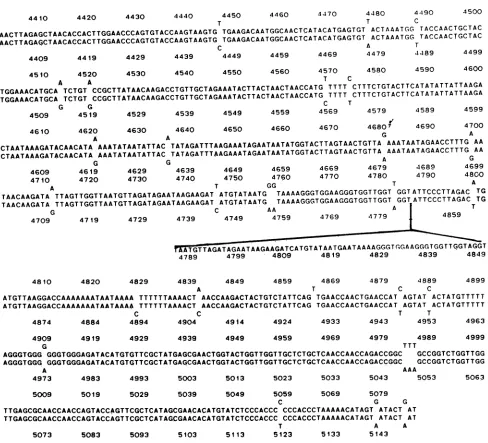
Nucleotide sequence ofMVM(i)genome. The sequence of MVM(i) is given in Fig. 1 (top line). This sequence is presented incomparisonwiththat of the corrected sequence of MVM(p), using the DNASEQNCEprogram (14).
Nucle-otide differences between the two sequences are displaced above [MVM(i)] and below
[MVM(p)]
the respective lines. The 65-bp repeat (nucleotides 4785 to 4849) in MVM(p) is further displaced to facilitate maintaining the homologylineupbetween the twogenomesbeyond this point. It should be noted here that the clone pEG222 is 21 nucleotides
shorter than MVM(p)viral-strandDNA at the right-hand end of the genome owing to the DNA polymerase I (Klenow
fragment) extension of viral DNA which stopped short of
replicating the entirehairpin. The last 22 nucleotides of the MVM(i) right-end sequence shown here are inferred from the sequence of the clone between nucleotides 4880 and 4902.
It is clear from thesequencethat with theexceptionof the
on November 10, 2019 by guest
http://jvi.asm.org/
658 ASTELL ET AL.
10 20 30 40 50 60 70 80 90 100
T T
ATTTTTAGAACTGACCAACCATGTTCACGTAAGTGACGTGATGACGCGCGCT CGCGCGC GCCTTCGGACGTCACACGTCACTTACGTTTCACATGGTT
ATTTTTAGAACTGACCAACCATGTTCACGTAAGTGACGTGATGACGCGCGCT CGCGCGC GCCTTCGGACGTCACACGTCACTTACGTTTCACATGGTT
G
10 20 30 40 50 60 69 79 89 99
110 120 130 140 150 160 170 180 190 200
A G AG
GGTCAGTTCTAAAAATGATAAGCGGTTCAG GAGTTTA ACCAAGGCGCGAAAAGGAAGTGGGCGTGGTTTAAAGTATATAAGCAA T CTGAAGTCAGT
GGTCAGTTCTAAAAATGATAAGCGGTTCAG GAGTTTA ACCAAGGCGCGAAAAGGAAGTGGGCGTGGTTTAAAGTATATAAGCAA T CTGAAGTCAGT
G A C A
109 119 129 139 149 159 169 179 189 199
210 220 230 240 250 260 270 280 290 300
C G A
TACTTATC TTTCTTTCATTCTGTGAGTCGAGACGC CAGAAAGAGAGTAACCAACTAACCATGGCTGGAAATGCTTACTCTGATGAAGTTTTGGGA CA
TACTTATC TTTCTTTCATTCTGTGAGTCGAGACGC CAGAAAGAGAGTAACCAACTAACCATGGCTGGAAATGCTTACTCTGATGAAGTTTTGGGA CA
T A G
209 219 229 239 249 259 269 279 289 299
310 320 330 340 350 360 370 380 390 400
C GG A A
ACCAACTGGTTAAAGGAAAAAAGTAACCAGGAAGTGTTCTCATTTGTTTTTAAAA TGA ATGTTCAACT AATGGAAAAGATATCGGATGGAATA TT
ACCAACTGGTTAAAGGAAAAAAGTAACCAGGAAGTGTTCTCATTTGTTTTTAAAA TGA ATGTTCAACT AATGGAAAAGATATCGGATGGAATA TT
A AA G G
309 319 329 339 349 359 369 379 389 399
410 420 430 440 450 460 470 480 490 500
G C T T
ACAAAAA GAGCTGCAGGAGGACGAGCTGAAATCTTTACAACGAGGAGCGGAAACTAC TGGGACCAAAGCGAGGACATGGAATGGGAA C ACAGTGGA
ACAAAAA GAGCTGCAGGAGGACGAGCTGAAATCTTTACAACGAGGAGCGGAAACTAC TGGGACCAAAGCGAGGACATGGAATGGGAA C ACAGTGGA
A T A C
409 419 429 439 449 459 469 479 489 499
510 520 530 540 550 560 570 580 590 600
A C A G G A GC C C
TGAAATGACCAAAAAGCAAGTATTCATTT TGA TCTTT GTTAAAAAATGTTT TTTGAAGTGCTTA CACAAA AATATA TCCTG TGATGTTA T
TGAAATGACCAAAAAGCAAGTATTCATTT TGA TCTTT GTTAAAAAATGTTT TTTGAAGTGCTTA CACAAA AATATA TCCTG TGATGTTA T
T T G A A G TT G A
509 519 529 539 549 559 569 579 589 599
610 620 630 640 650 660 670 680 690 700
G G C A
TGGTTTGTGCA CATGAATGGGG AAAGACCAAGGCTGGCACTGCCATGTACTAATTGGAGG AAGGACTTTAGTCAAGCTCAAGG AAATGGTGGAGAA
TGGTTTGTGCA CATGAATGGGG AAAGACCAAGGCTGGCACTGCCATGTACTAATTGGAGG AAGGACTTTAGTCAAGCTCAAGG AAATGGTGGAGAA
A A A G
609 619 629 639 649 659 669 679 689 699
710 720 730 740 750 760 770 780 790 800
G G G
GGCA CTAAATGTTTACTGGAGCAGATGGTTGGTAACAGCCTGTAATGTGCA CTAACACCAGCTGAAAGAATTAAACTAAGAGAAATAGCAGAAGACA
GGCA CTAAATGTTTACTGGAGCAGATGGTTGGTAACAGCCTGTAATGTGCA CTAACACCAGCTGAAAGAATTAAACTAAGAGAAATAGCAGAAGACA
A A A
709 719 729 739 749 759 769 779 789 799
81O 820 830 840 850 860 870 380 890 900
T C A G T A T C C
TGAGTGGGTTACT TACT ACTTATAA CATAAGCAAACCAAAAA GACTATAC AA TGTGTTCTTTTTGGAAA ATGATTGCTTACTA TTTTTAAC
TGAGTGGGTTACT TACT ACTTATAA CATAAGCAAACCAAAAA GACTATAC AA TGTGTTCTTTTTGGAAA ATGATTGCTTACTA TTTTTAAC
C T G A C G C T T
809 819 829 839 849 859 869 879 889 899
910 920 930 940 950 960 970 980 990 1000
C G G
ACCGCGGAATACTTAAGA
GCACGATAAAAAGAAAATAAGCAC AGTCC CCAAG GACGGAGGCTATTTTCT AGCAGTGACTCTGGOTGGAAAACTAACTTTTTAAAAGA GGCGA CGCCATC
AAAAAGAAAATAAGCAC AGTCC CCAAG GACGGAGGCTATTTTCT AGCAGTGACTCTGGCTGGAAAACTAACTTTTTAAAAGA GGCGA OGOCATO
T A A T A G
909 919 929 939 949 959 969 979 989 999
1010 1020 1030 1040 1050 1060 1070 1080 1090 1100
TAGTGAGCAAA
TATACACTGATGACATGCGGCCAGAAACGGTTGAAACCACAGTAACCACTGCGCAGGAAACTAAGCGCGGCAGAATTCAAACTAAAAA
TAGTGAGCAAA
TATACACTGATGACATGCGGCCAGAAACGGTTGAAACCACAGTAACCACTGCGCAGGAAACTAAGCGCGGCAGAATTCAAACTAAAAA
C
1009 1019 1029 1039 1049 1059 1069 1079 1089 1099
J. VIROL.
on November 10, 2019 by guest
http://jvi.asm.org/
1110 1120 1130 1140 1150 1160 1170 1180 1190 1200
G C A A
AGA GTTTCTATTAAAAC ACACTTAAAGAGCT GTGCATAAAAGAGTAACCTCACCAGA GACTGGATGATGATGCAGCCAGACAGTTACATTGAAATG
AGA GTTTCTATTAAAAC ACACTTAAAGAGCT GTGCATAAAAGAGTAACCTCACCAGA GACTGGATGATGATGCAGCCAGACAGTTACATTGAAATG
A T G G
1109 1119 1129 1139 1149 1159 1169 1179 1189 1199
1210 1220 1230 1240 1250 1260 1270 1280 1290 1300
G A G
ATGGCTCAACCAGGTGGAGAAAACCTGCTGAAAAATACGCTAGAGATTTGTAC CTAACTCTAGCCAGAAC AAAACAGCATTTGACTT ATTTTAGAAA
ATGGCTCAACCAGGTGGAGAAAACCTGCTGAAAAATACGCTAGAGATTTGTAC CTAACTCTAGCCAGAAC AAAACAGCATTTGACTT ATTTTAGAAA
A C A
1209 1219 1229 1239 1249 1259 1269 1279 1289 1299
1360 1370 1380 1390 1400
1310 1320 1330 1340 1350 AG
A AGCTGAAACCAGCAAACTAACCAACTTTTCACTGCCTGACACAAGAACCTGCA ATTTTTGCTTTTCATGGCTGGAACTATGTTAAAGTTTGCCATGC
A AGCTGAAACCAGCAAACTAACCAACTTTTCACTGCCTGACACAAGAACCTGCA ATTTTTGCTTTTCATGGCTGGAACTATGTTAAAGTTTGCCATGC GA
1309 1319 1329 1339 1349 1359 1369 1379 1389 1399
1410 1420 1430 1440 1450 1460 1470 1480 1490 1500
C C T
TATTTGCTGTGTT TAAACAGACAAGGAGGCAAAAGAAATACTGTTTTATTTCA GGACCAGCCAG ACAGGCAAATCTATTATTGCACAAGCCATAGCA
TATTTGCTGTGTT TAAACAGACAAGGAGGCAAAAGAAATACTGTTTTATTTCA GGACCAGCCAG ACAGGCAAATCTATTATTGCACAAGCCATAGCA
T T C
1409 1419 1429 1439 1449 1459 1469 1479 1489 1499
1510 1520 1530 1540 1550 1560 1570 1580 1590 1600
G T T G
CA GCAGTTGG AATGTTGGTTGCTATAATGCAGC AATGT AACTTTCCATTTAATGACTGTACCAACAAGAACTTGATTTGGGTAGAAGAAGCTGGTA
CA GCAGTTGG AATGTTGGTTGCTATAATGCAGC AATGT AACTTTCCATTTAATGACTGTACCAACAAGAACTTGATTTGGGTAGAAGAAGCTGGTA
A C C A
1509 1519 1529 1539 1549 1559 1569 1579 1589 1599
1610 1620 1630 1640 1650 1660 1670 1680 1690 1700
A
ACTTTGGACAGCAAGTAAACCAGTTTAAAGCCATTTGCTCTGGTCAAACTATTCGCATTGATCAAAAAGGAAAAGGCAGCAAACA ATTGAACCAACACC ACTTTGGACAGCAAGTAAACCAGTTTAAAGCCATTTGCTCTGGTCAAACTATTCGCATTGATCAAAAAGGAAAAGGCAGCAAACA ATTGAACCAACACC
G
1609 1619 1629 1639 1649 1659 1669 1679 1689 1699
1710 1720 1730 1740 1750 1760 1770 1780 1790 1800
G T C
AGTCATCATGACCACAAATGAGAACATTACAGTGGTCAGAATAGGCTGCGAAGA AGACCAGAACACACTCAACCAAT AGAGACAGAATGCT AACATT
AGTCATCATGACCACAAATGAGAACATTACAGTGGTCAGAATAGGCTGCGAAGA AGACCAGAACACACTCAACCAAT AGAGACAGAATGCT AACATT
A C T
1709 1719 1729 1739 1749 1759 1769 1779 1789 1799
1810 1820 1830 1840 1850 1860 1870 1880 1890 1900
A G
CATCTAACACATAC TTGCCTGGTGACTTTGGTTTGGTTGACAA AATGAATGGCCCATGATTTGTGCTTGGTTGGTAAAGAATGGTTACCAATCTACCA
CATCTAACACATAC TTGCCTGGTGACTTTGGTTTGGTTGACAA AATGAATGGCCCATGATTTGTGCTTGGTTGGTAAAGAATGGTTACCAAICTACCA
C A
1809 1819 1829 1839 1849 1859 1869 1879 1889 1899
1910 i920 1930 1940 1950 1960 1970 1980 1990 2000
C G C
TGGCAAGCTACTG GCTAAATGGGGCAAAGTTCCTGATTGGTCAGAAAACTGGGCGGAGCCAAAGGTGCC ACTCCTATAAATT ACTAGGTTCGGCACG
TGGCAAGCTACTG GCTAAATGGGGCAAAGTTCCTGATTGGTCAGAAAACTGGGCGGAGCCAAAGGTGCC ACTCCTATAAATT ACTAGGTTCGGCACG
T A T
1909 1919 1929 1939 1949 1959 1969 1979 1989 1999
2010 2020 2030 2040 2050 2060 2070 2080 2090 2100
A
CTCACCATTCACGACACCGAAAAGTACGCCTCTCAGCCAGAACTATGCA TAACTCCACTTGCATCGGATCTCGAGGACCTGGCTTTAGAGCCTTGGAGC CTCACCATTCACGACACCGAAAAGTACGCCTCTCAGCCAGAACTATGCA TAACTCCACTTGCATCGGATCTCGAGGACCTGGCTTTAGAGCCTTGGAGC
C
2009 2019 2029 2039 2049 2059 2069 2079 2089 2099
2110 2120 2130 2140 2150 2160 2170 2180 2190 2200
ACACCAAATACTCCTGTTGCGGGCACTGCAGAAACC2AGAACACTGGGGAAGCTGGTTCCAAAGCCTGCCAAGATGGTCAACTGAGCCCAACTTGGTCAG ACACCAAATACTCCTGTTGCGGGCACTGCAGAAACCCAGAACACTGGGGAAGCTGGTTCCAAAGCCTGCCAAGATGGTCAACTGAGCCCAACTTGGTCAG
2109 2119 2129 2139 2149 2159 2169 2179 2189 2199
on November 10, 2019 by guest
http://jvi.asm.org/
660 ASTELL ET AL.
2210 2220 2230 2240 2250 2260 2270 2280 2290 2300
G
AGATCGAGGAGGATTTGAGAGCGTGCTTCGGTGCGGAACCGTTGAAGA AGACTTCAGCGAGCCGCTGAACTTGGACTAAGGTACGATGGCGCCTCCAGC
AGATCGAGGAGGATTTGAGAGCGTGCTTCGGTGCGGAACCGTTGAAGA AGACTTCAGCGAGCCGCTGAACTTGGACTAAGGTACGATGGCGCCTCCAGC
A
2209 2219 2229 2239 2249 2259 2269 2279 2289 2299
2310 2320 2330 2340 2350 2360 2370 2380 2390 2400
TAAAAGAGCTAAAAGAGGTAAGGGTTTAAGGGATGGTTGGTTGGTGGGGTATTAATGTTTAATTACCTGTTTTACAGGCCTGAAATCACTTGGTTTTAGG TAAAAGAGCTAAAAGAGGTAAGGGTTTAAGGGATGGTTGGTTGGTGGGGTATTAATGTTTAATTACCTGTTTTACAGGCCTGAAATCACTTGGTTTTAGG
2309 2319 2329 2339 2349 2359 2369 2379 2389 2399
2410 2420 2430 2440 2450 2460 2470 2480 2490 2500
T
TTGGGTGCCTCCTGGCTA AAGTACCTGGGACCAGGGAACAGCCTTGACCAAGGAGAACCAACCAATCCATCTGACGCCGCTGCCAAAGAGCACGACGAG
TTGGGTGCCTCCTGGCTA AAGTACCTGGGACCAGGGAACAGCCTTGACCAAGGAGAACCAACCAATCCATCTGACGCCGCTGCCAAAGAGCACGACGAG
C
2409 2419 2429 2439 2449 2459 2469 2479 2489 2499
2510 2520 2530 2540 2550 2560 2570 2580 2590 2600
GCCTATGATCAATACATCAAATCTGGAAAAAATCCTTACCTGTACTTCTCTGCTGCTGATCAACGCTTTATTGACCAAACCAAGGACGCCAAAGACTGGG
GCCTATGATCAATACATCAAATCTGGAAAAAATCCTTACCTGTACTTCTCTGCTGCTGATCAACGCTTTATTGACCAAACCAAGGACGCCAAAGACTGGG
2509 2519 2529 2539 2549 2559 2569 2579 2589 2599
2610 2620 2630 2640 2650 2660 2670 2680 2690 2700
GAGGCAAGGTTGGTCACTACTTTTTTAGAACCAAGCGCGCTTTTGCACCTAAGCTTGCTACTGACTCTGAACCTGGAACTTCTGGTGTAAGCAGAGCTGG GAGGCAAGGTTGGTCACTACT7TTTTAGAACCAAGCGCGCTTTTGCACCTAAGCTTGCTACTGACTCTGAACCTGGAACTTCTGGTGTAAGCAGAGCTGG
2609 2619 2629 2639 2649 2659 2669 2679 2689 2699
2710 2720 2730 2740 2750 2760 2770 2780 2790 2800
A
TAAACGCACTAGACCACCTGCTTACATTTTTAT AACCAAGCCAGAGCTAAAAAAAAACTTACTTCTTCTGCTGCACAGCAAAGCAGTCAAACCATGAGT
TAAACGCACTAGACCACCTGCTTACATTTTTAT AACCAAGCCAGAGCTAAAAAAAAACTTACTTCTTCTGCTGCACAGCAAAGCAGTCAAACCATGAGT
T
2709 2719 2729 2739 2749 2759 2769 2779 2789 2799
2810 2820 2830 2840 2850 2860 2870 2880 2890 2900
G
GATGGCACCAGCCAACCTGAC GCGGAAACGCTGTCCACTCAGCTGCAAGAGTTGAACGAGCAGCTGACGGCCCTGGAGGCTCTGGGGGTGGGGGCTCTG
GATGGCACCAGCCAACCTGAC GCGGAAACGCTGTCCACTCAGCTGCAAGAGTTGAACGAGCAGCTGACGGCCCTGGAGGCTCTGGGGGTGGGGGCTCTG
A
2809 2819 2829 2839 2849 2859 2869 2879 2889 2899
2910 2920 2930 2940 2950 2960 2970 2980 2990 3000
G
GCGGGGGTGGGGTTGGTGTTTCTACTGGGTCTTATGATAATCA ACGCATTATAGATTCTTGGGTGACGGCTGGGTAGAAATTACTGCACTAGCAACTAG GCGGGGGTGGGGTTGGTGTTTCTACTGGGTCTTATGATAATCA ACGCATTATAGATTCTTGGGTGACGGCTGGGTAGAAATTACTGCACTAGCAACTAG
A
2909 2919 2929 2939 2949 2959 2969 2979 2989 2999
3010 3020 3030 3040 3050 3060 3070 3080 3090 3100
A C T
ACTAGTACATTTAAACATGCCTAAATCAGAAAACTATTGCAGAAT AGAGTTCACAA ACAACAGACAC TCAGTCAAAGGCAACATGGCAAAAGATGAT
ACTAGTACATTTAAACATGCCTAAATCAGAAAACTATTGCAGAAT AGAGTTCACAA ACAACAGACAC TCAGTCAAAGGCAACATGGCAAAAGATGAT
C T A
3009 3019 3029 3039 3049 3059 3069 3079 3089 3099
3110 3120 3130 3140 3150 3160 3170 3180 3190 3200
G A
GCTCATGAGCAAATtTGGAC CCATGGAGCTT GTGGATGCTAATGCTTGGGGAGTTTGGCTCCAGCCAAGTGACTGGCAATACATTTGCAACACCATGA
GCTCATGAGCAAATTTGGAC CCATGGAGCTT GTGGATGCTAATGCTTGGGGAGTTTGGCTCCAGCCAAGTGACTGGCAATACATTTGCAACACCATGA
A G
3109 3119 3129 3139 3149 3159 3169 3179 3189 3199
3210 3220 3230 3240 3250 3260 3270 3280 3290 3300
C T C
GCCAGCTTAACTTGGT TCACTTGATCAAGAAATATT AATGTAGTGCTGAAAACTGTTACAGAGCAAGACT AGGAGGTCAAGCTATAAAAATATACAA
GCCAGCTTAACTTGGT TCACTTGATCAAGAAATATT AATGTAGTGCTGAAAACTGTTACAGAGCAAGACT AGGAGGTCAAGCTATAAAAATATACAA
A C T
3209 3219 3229 3239 3249 3259 3269 3279 3289 3299
J. VIRO'L.
on November 10, 2019 by guest
http://jvi.asm.org/
3310 3320 3330 3340 3350 3360 3370 3380 3390 3400
C C T
CAATGACCT ACAGCTTGCATGATGGTTGCAGTAGACTCAAACAACATT TGCCATACACACCTGCAGCAAACTCAATGGAAACACTTGGTTTCTACCC
CAATGACCT ACAGCTTGCATGATGGTTGCAGTAGACTCAAACAACATT TGCCATACACACCTGCAGCAAACTCAATGGAAACACTTGGTTTCTACCC
T T C
3309 3319 3329 3339 3349 3359 3369 3379 3389 3399
3410 3420 3430 3440 3450 3460 3470 3480 3490 3500
T G C A T A G
TGGAAACCAAC ATAGCATC CCATACAGGTACTATTT TGCGTTGACAGAGATCTTTCAGT ACCTA GAAAATCAAGAAGGCACA TTGA CATAATG
TGGAAACCAAC ATAGCATC CCATACAGGTACTATTT TGCGTTGACAGAGATCTTTCAGT ACCTA GAAAATCAAGAAGGCACA TTGA CATAATG
C A T G C G A
3409 3419 3429 3439 3449 3459 3469 3479 3489 3499
3510 3520 3530 3540 3550 3560 3570 3580 3590 3600
A T T T G T T A
T ATGGGAACACCAAAAGGAATGAATTCTCAATTTTTTACCATTGAGAACACACAACAAAICACATTGCTCAGAAC GG GA GA TTTGC AC GG AC T ATGGGAACACCAAAAGGAATGAATTCTCAATTTTTTACCATTGAGAACACACAACAAATCACATTGCTCAGAAC GG GA GA TTTGC AC GG AC
G A G C A C A T
3509 3519 3529 3539 3549 3559 3569 3579 3589 3599
3610 3620 3630 3640 3650 3660 3670 3680 3690 3700
C CC T A T
TACTACTTTGACACAAA CAGTTAAACT ACACACAC TGGCAAAC AACCGTCAACTTGGACAGCCTCCACTGCTGTCAACCTTTCCTGAAGCTGAC
TACTACTTTGACACAAA CAGTTAAACT ACACACAC TGGCAAAC AACCGTCAACTTGGACAGCCTCCACTGCTGTCAACCTTTCCTGAAGCTGAC
T TT C G C
3609 3619 3629 3639 3649 3659 3669 3679 3689 3699
3710 3720 3730 3740 3750 3760 3770 3780 3790 3800
G G A T
ACTGATGCAGGTACACTTACTGCTCAAGGGAGCAGACATGGA CAACACA ATGG GGTTAACTGGGTGAGTGAAGCAAT AGAACCAGACCTGCTCAAG ACTGATGCAGGTACACTTACTGCTCAAGGGAGCAGACATGGA CAACACA ATGG GGTTAACTGGGTGAGTGAAGCAAT AGAACCAGACCTGCTCAAG
A A G C
3709 3719 3729 3739 3749 3759 3769 3779 3789 3799
3810 3820 3830 3840 3850 3860 3870 3880 3890 3900
G T G G G
TAGGATTTTGTCA CCACACAATGACTTTGAAGCCAGCAGAGCTGGACCATTTGCTGC CCAAAAGTTCCAGCAGAT TTACTCAAGGAGT GACA AGA
TAGGATTTTGTCA CCACACAATGACTTTGAAGCCAGCAGAGCTGGACCATTTGCTGC CCAAAAGTTCCAGCAGAT TTACTCAAGGAGT GACA AGA
A C A A A
3809 3819 3829 3839 3849 3859 3869 3879 3889 3899
3910 3920 3930 3940 3950 3960 3970 3980 3990 4000
G C A
AGCCAATGGCAGTGTTAGATACAGTTATGGCAAACAGCATGGTGAAAATTGGGCT CACA GGACCAGCACCAGAGCGCTACACATGGGATGAAACAA C
AGCCAATGGCAGTGTTAGATACAGTTATGGCAAACAGCATGGTGAAAATTGGGCT CACA GGACCAGCACCAGAGCGCTACACATGGGATGAAACAA C
T T G
3909 3919 3929 3939 3949 3959 3969 3979 3989 3999
4010 4020 4030 4040 4050 4060 4070 4080 4090 4100
A G T G
TTTGGTTCAGG AGAGACACCA AGATGGTTTTATTCAATCAGCACC CTAGTTGTTCCACCACCACTAAATGG ATTCTTACAAATGCAAACCCTATTG
TTTGGTTCAGG AGAGACACCA AGATGGTTTTATTCAATCAGCACC CTAGTTGTTCCACCACCACTAAATGG ATTCTTACAAATGCAAACCCTATTG
T A A C
4009 4019 4029 4039 4049 4059 4069 4079 4089 4099
4110 4120 4130 4140 4150 4160 4170 4180 4190 4200
A
G ACTAAAAATGACATTCATTTTTCAAATGTTTTTAACAGCTATGGTCCACTAACTGCATTTTCACACCCAAGTCCTGTATACCCTCAAGGACAAATATG G ACTAAAAATGACATTCATTTTTCAAATGTTTTTAACAGCTATGGTCCACTAACTGCATTTTCACACCCAAGTCCTGTATACCCTCAAGGACAAATATG
G
4109 4119 4129 4139 4149 4159 4169 4179 4189 4199
4210 4220 4230 4240 4250 4260 4270 4280 4290 4300
C
GGACAAAGAACTAGATCTTGAACACAAACCTAGACTTCACATAACTGCTCCATTTGT TGTAAAAACAATGCACCTGGACAAATGTTGGTTAGATTAGGA
GGACAAAGAACTAGATCTTGAACACAAACCTAGACTTCACATAACTGCTCCATTTGT TGTAAAAACAATGCACCTGGACAAATGTTGGTTAGATTAGGA T
4209 4219 4229 4239 4249 4259 4269 4279 4289 4299
4310 4320 4330 4340 4350 4360 4370 4380 4390 4400
T G G T T
CCAAA CTAACTGACCA TATGATCCAAACGGAGCCACACTTTCTAGAATTGT AC TA GGTACATTTTTCTGGAAAGGAAAACTAACCATGAGAGCAA
CCAAA CTAACTGACCA TATGATCCAAACGGAGCCACACTTTCTAGAATTGT AC TA GGTACATTTTTCTGGAAAGGAAAACTAACCATGAGAGCAA
C A T A C
4309 4319 4329 4339 4349 4359 4369 4379 4389 4399
on November 10, 2019 by guest
http://jvi.asm.org/
662 ASTELL ET AL.
4410 4420 4430 4440 4450 4460 4470 4480
T T
4190
C
4500
AACTTAGAGCTAACACCACTTGGAACCCAGTGTACCAAGTAAGTG TGAAGACAATGGCAACTCATACATGAGTGT
ACTAAATCG
TACCAACTGCTAC AACTTAGAGCTAACACCACTTGGAACCCAGTGTACCAAGTAAGTG TGAAGACAATGGCAACTCATACATGAGTGT ACTAAATGG TACCAACTGCTACC 4 A
Ss
Tri
24
4409 4419 4429 4439 4449 4459 4469 4479 4489
4510 4520 4530 4540 4550 4560 4570 4580 4590 4600
A A T C
TGGAAACATGCA TCTGT CCGCTTATAACAAGACCTGTTGCTAGAAATACTTACTAACTAACCATG TTTT CTTTCTGTACTTCATATATTATTAAGA TGGAAACATGCA TCTGT CCGCTTATAACAAGACCTGTTGCTAGAAATACTTACTAACTAACCATG TTTT CTTTCTGTACTTCATATATTATTAAGA
G G C T
4509 4519 4529 4539 4549 4559 4569 4579 4589 4599
4610 4620 4630 4640 4650 4660 4670
46807
4690 4700A A G A
CTAATAAAGATACAACATA AAATATAATATTAC TATAGATTTAAGAAATAGAATAATATGGTACTTAGTAACTGTTA AAATAATAGAACCTTTG AA CTAATAAAGATACAACATA AAATATAATATTAC TATAGATTTAAGAAATAGAATAATATGGTACTTAGTAACTGTTA AAATAATAGAACCTTTG AA
G G A G
4609 4619 4629 4639 4649 4659 4669 4679 4689 4699
4710 4720 4730 4740 4750 4760 4770 4780 4790 4800
A T GG T A
TAACAAGATA TTAGTTGGTTAATGTTAGATAGAATAAGAAGAT ATGTATAATG TAAAAGGGTGGAAGGGTGGTTGGT GGTATTCCCTTAGAC TG
TAACAAGATA TTAGTTGGTTAATGTTAGATAGAATAAGAAGAT ATGTATAATG TAAAAGGGTGGAAGGGTGGTTGGT GGTATTCCCTTAGAC TG
G C AA A T
4709 4719 4729 4739 4749 4759 4769 41779 4859
ATGTTAGATAGAATAAGAAGATCATGTATAATGAATAAAAGGGTGGAAGGGTGGrTGGTAGGT
4789 4799 4809 4819 4829 4839 4849
4810 4820 4829 4839 4849 4859 4869 4879 4889 4899
A T C C
ATGTTAAGGACCAAAAAAATAATAAAA TTTTTTAAAACT AACCAAGACTACTGTCTATTCAG TGAACCAACTGAACCAT AGTAT ACTATGTTTTT ATGTTAAGGACCAAAAAAATAATAAAA TTTTTTAAAACT AACCAAGACTACTGTCTATTCAG TGA^ACCAACTGAACCAT AGTAT ACTATGTTTTT
C C T T
4874 4884 4894 4904 4914 4924 4933 4943 4953 4963
4909 4919 4929 4939 4949 4959 4969 4979
G 1
AGGGTGGG GGGTGGGAGATACATGTGTTCGCTATGAGCGAACTGGTACTGGTTGGTTGCTCTGCTCAACCAACCAGACCGGC AGGGTGGG GGGTGGGAGATACATGTGTTCGCTATGAGCGAACTGGTACTGGTTGGTTGCTCTGCTCAACCAACCAGACCGGC
A A
4973 4983 4993 5003 5013 5023 5033 5043
5019 5029 5039 5049 5059 5069
4989
TTT 4999
GCCGGTCTGGTTGG GCCGGTCTGGTTGG AAA
5053 5063
5079
C G G
TTGAGCGCAACCAACCAGTACCAGTTCGCTCATAGCGAACACATGTATCTCCCACCC CCCACCCTAAAAACATAGT ATACT AT
TTGAGCGCAACCAACCAGTACCAGTTCGCTCATAGCGAACACATGTATCTCCCACCC CCCACCCTAAAAACATAGT ATACT AT
T A A
5083 5093 5103 5113 5123 5133 5143
FIG. 1. Homology betweenMVM(i) (upper line)and MVM(p) (lowerline). Thetwosequences werealigned by usingthehomologyroutine
of theDNAsequence program(14). Mismatch nucleotidesaredisplaced above andbelow thelines.The 65-bp tandemrepeatin MVM(p)
(nucleotides4785to4849) is further displacedtomaintain thelineup of thetwosequences.
65-bp repeat, the sequences of MVM(p) and MVM(i) are
verysimilar. In the MVM(i)genomethree differences arean
insertion ofaTatposition 61,a deletion ofa Catposition 4828, and acompensatory insertion ofaTat position 4864 relative to MVM(p). None ofthese changes occurs within the coding region of MVM(p) (41) or, presumably, of
MVM(i). Since the 5' hairpin region of our sequence is
derived fromaclone,pEG222, it has onlyoneorientation,in thiscasetheflip orientation. Itis interestingthat the endof
theloop in this fliporientation is 5'-TTT-3' onthe Cstrand,
whereas in MVM(p) this sequence is the complementary
5'-AAA-3'. Of the 163 bp changes between MVM(i) and
MVM(p), 129 aretransitions and34aretransversions.
Dis-tribution of these changes is nonrandom throughout the
genome. Ina genome size of-5,000 nucleotides, 163
ran-dom base changes would average 3 changes per 100 nucle-otides. The region between map units 40 and 60 is highly
conserved (thereareonly six basechangesin thesequence
between nucleotides 2000 and 3000), whereas the regions betweenmapunits 8to20and70to80have amuch higher
frequency of base changes (up to 8 to 10 changes per 100
nucleotides). This high degree of sequence conservation
supportsourprevious suggestionthat theremaybemultiple
splicesitesnear mapunits45to46of MVM(p),withimplied overlapping readingframes to generate different viral pro-teins (4). Another region (- nucleotide 3580, map unit 70) seems to be a hot spot for base changes. There are eight changes within a distance of25 nucleotides (Fig. 1). This region is within the coding region for the viral structural proteins; however, becauseall of thesebase changes occur in the third position of eight codons, the amino acid
se-quences between MVM(i) and MVM(p) in this region are
identical(seebelow and Fig. 3).
Left-handcoding region. The sequenceof MVM(i)isvery similarto thatofMVM(p)(4), withtwomajoropenreading frames whichspan almosttheentiregenome. The left-hand
5009
5073
J.VIROL.
4499
on November 10, 2019 by guest
http://jvi.asm.org/
[image:7.612.64.552.62.505.2]1
15
262 358MISGSESLDOGAKRKWAWFKVYKQMLKSVTYPFFHSVSRDAQKESNOLTMAGNAYSDEVLGTTNWLKEKSNOEVFSFVFKTE
3
***** ** *************** ****** ********************** ** ****** *MISGSGSLNOGAKRKWAWFKVYKQLLKSVTYLFFHSVSRDAQKESNOLTMAGNAYSDEVLGATNWLKEKSNQEVFSFVFKNE
A
A
A
A
A
658
DVOLNGKDIGWNNYKKELOEDELKSLORGAETTWDOSEDMEWESTVDEMTKKQVFIYDSLVKKCLFEVLSTKNIAPADVTWFVQHEWGKDQGWHCHVLIG
************N****************************** ************ ************ **** * ********************
A
A
A
A
A
AA
A
958
GKDFSQAQGKWWRRQLNVYWSRWLVTACNVOLTPAERIKLREIAEDSEWVTLLTYKHKQTKKDYTKCVLFGNMIAYYFLTKKKISTSPPRDGGYFLSSDS
********************************************** *****************************************************
A
1
258
GWKTNFLKEGERHLVSKLYTDDMRPETVETTVTTAQETKRGRIQTKKEVSIKTTLKELVHKRVTSPEDWMMMOPDSYIEMMAQPGGENLLKNTLEIlCTLT
******************************************************************* ******** ***** **** ****************
GWKTNFLKEGERHLVSKLYTDDMRPETVETTVTTAQETKRGRIQTKKEVSIKTTLKELVHKRVTSPEDWMMMQPDSYIEMMAQPGGENLLKNTLEICTLT
1
558
LARTKTAFDLILEKAETSKLTNFSLPDTRTCKIFAFHGWNYVKVCHAICCVLNROGGKRNTVLFHGPASTGKSIIAQAIAQAVGNVGCYNAANVNFPFND
******************************* ********************************************************************
LARTKTAFDLILEKAETSKLTNFSLPDTRTCRIFAFHGWNYVKVCHAICCVLNROGGKRNTVLFHGPASTGKSIIAOAIAOAVGNVGCYNAANVNFPFND
A
1
858
CTWKNLIWVEEAGNFGOQVNQFKAICSGOTIRIDQKGKGSKOIEPTPVIMTTNENITVVRIGCEERPEHTOPIRDRMLNIHLTHTLPGDFGLVDKNEWPM
***************************************** ********************* *********************+***************
2 1 58
KACADGLSPTWSEIEEDLRCACFGAEPLKRDFSEPLVTPNLD#2277 ASFTKTLOYLPADEDAEWTNPATEoTEG
***************************** **********
KACQDGQLSPTWSEIEEDLRACFGAEPLKKDFSEPLNLD#
A
FIG. 2. Lineup of the left-hand open reading frame of MVM(i) (upper line) and MVM(p) (lower line).Identical amino acids are indicated byanasterisk. Conservative changesarenoted byasmall arrowheadbelow theaminoacids.Radical changes are noted by a larger arrowhead. Tofacilitate comparison with Fig. 1, the numbers correspondtothe nucleotide inthefirstposition of the codon.
openreading frame (frame3) extendsfrommapunits2 to45. The sequence ofMVM(p) (4), transcription data (41), and
subsequent studies onthemapping oftheviralgenome(13)
indicate thatNS-1, anonstructural protein(83,000daltons)
of unknownfunction,maps totheleft-handcoding region of the genome (13). A second nonstructural protein, NS-2
(24,000 daltons), has not yet been mapped precisely but is encoded in an mRNA transcribed from the left-hand (P4) promoter(13). Assumingthat theproteinproductsof the two
strains, i and p, are similar, it isreasonable to compare the
coding regions ofthe viruses to learn if therearesignificant differencesattheamino acid level.
InFig. 2, alineup(14)of amino acids encodedwithin the
potential left-hand open reading frames of MVM(i) (upper
line) and MVM(p) (lower line) is given. Transcript
Ri
(4.8kilobases) isaminorRNAcomponentwhich encodes NS-1 (13). This transcript begins around nucleotide 201 (6), with the first methionine codon starting at nucleotide 262 of
MVM(i) [261 of MVM(p)]. The protein (translated from
reading frame 3) would begin with Met-Ala-Gly-Asn-Ala
(MAGNA in Fig. 2). The firsttermination codon (TAA) in
reading frame3 occurs atposition 2278. Beginning with the
methionineat262,thereareatotalof15aminoacidchanges betweenthe MVM(i)and MVM(p) coding regions. Thirteen
of these changes are conservative:
Thr-*Ala,
Thr-*Asn,
Asn--Ser, Ser--Thr,
Tyr-*Phe,
Ser--Asn,Ala-*>Gly,
Thr--Asn, Ser--Asn, Lys--Arg, Ser-Leu,
Ile-*Leu,
andArg--Lys. There are two radical changes: Gly->Glu at position 358,and Ala->Pheatposition583. We notedearlier
thatfor MVM(p), reading frame 3 is open upstream of the promoterregionand the mapped mRNA start site. From the most upstream methionine codon, at position 115, in this extraopen reading frame, theprotein shouldbeginwith the
amino acid sequence Met-Ile-Ser-Gly-Ser (MISGS) if this ATGisafunctional startsite. Thisregionis also open in the
MVM(i) sequence, with four additional amino acid differ-ences from the polypeptide encoded between nucleotides 115 and 261 of MVM(p). Threeof these changes are radical:
Glu-+Gly, Asp->Asn, and Pro--Leu. The fourth change, Met-Leu, is conservative. Thepossiblesignificanceof this
regionof frame 3 will be discussed below.
Right-hand coding region. The right-hand open reading
frame of MVM (frame 1) extends from map units 46 to 89.
Mapping studies have shown this region to encode the
on November 10, 2019 by guest
http://jvi.asm.org/
664 ASTELL ET AL.
2287
MAPPAKRAKRGKGLRDGWLVGY*
3
MAPPAKRAKRGKGLRDGWLVGY*
2355
MFNYLFYRPEITWF* MFNYLFYRPEITWF*
2333
2384
2459
MVGWWGINV* NHLVLGWVPPGYKYLGPGNSLDOGEP
MVGWWGINV* NHLVLGWVPPGYKYLGPGNSLDOGEP
2759
TNPSDAAAKEHDEAYDOYIKSGKNPYLYFSAADORFIDQTKDAKDWGGKVGHYFFRTKRAFAPKLATDSEPGTSGVSRAGKRTRPPAYIFIN(ARAKKKL **************************** ********** **************************************
TNPSDAAAKEHDEAYDQYIKSGKNPYLYFSAADORFIDQTKDAKDWGGKVGHYFFRTKRAFAPKLATDSEPGTSGVSRAGKRTRPPAYIFINQARAKKKL
2795
3059
TSSAAQQSSOTMSDGTSQPDGGNAVHSAARVERAADGPGGSGGGGSGGGGVGVSTGSYDNOTHYRFLGDGWVEITALATRLVHLNMPKSENYCRIRVHNT
******************** *********************************************$********************************** TSSAAQQSSQTMSDGTSQPDSGNAVHSAARVERAADGPGGSGGGGSGGGGVGVSTGSYDNOTHYRFLGDGWVEITALATRLVHLNMPKSENYCRIRVHNT
A
3359
TDTSVKGNMAKDDAHE IWTPWSLVDANAWGVWLQPSDWQYICNTMSQLNLVSLDQEIFNVVLKTVTEQDSGGQAIKIYNNDLT-ACMMVAVDSNNILPYT
********************************************************************** *****************************
TDTSVKGNMAKDDAHEQIWTPWSLVDANAWGVWLQPSDWQYICNTMSOLNLVSLDOEIFNVVLKTVTEODLGGQAIKIYNNDLTACMMVAVDSNNILPYT
3659
PAANSMETLGFYPWKPTIASPYRYYFCVDRDLSVTYENQEGTIEHNVMGTPKGMNSQFFTIENTOOITLLRTGDEFATGTYYFDTNPVKLTHTWQTNROL
****************************************** ******************************************* *************
PAANSMETLGFYPWKPTIASPYRYYFCVDRDLSVTYENOEGTVEHNVMGTPKGMNSOFFTIENTOOITLLRTGDEFATGTYYFDTNSVKLTHTWOTNROL
3959
GOPPLLSTFPEADTDAGTLTAQGSRHGATQMEVNWVSEAIRTRPAQVGFCQPHNDFEASRAGPFAAPKVPADVTQGVDREANGSVRYSYGKQHGENWAAH
*************************** *** **************************************** ***** ******************* *
GQPPLLSTFPEADTDAGTLTAQGSRHGTTQMGVNWVSEAIRTRPAQVGFCOPHNDFEASRAGPFAAPKVPADITQGVDKEANGSVRYSYGKQHGENWASH
AA
A
A
A
4259
GPAPERYTWDETNFGSGRDTRDGFIOSAPLVVPPPLNGILTNANPIGTKNDIHFSNVFNSYGPLTAFSHPSPVYPQGQIWDKELDLEHKPRLHITAPFVC
************ ******* ****************************************************************+***************
GPAPERYTWDETSFGSGRDTKDGFIOSAPLVVPPPLNGILTNANPIGTKNDIHFSNVFNSYGPLTAFSHPSPVYPOGOIWDKELDLEHKPRLHITAPFVC
A
A
4556
KNNAPGOMLVRLGPNLTDOYDPNGATLSRIVTYGTFFWKGKLTMRAKLRANTTWNPVYQVSVEDNGNSYMSVTKWLPTATGNMOSVPLITRPVARNTY#
**************************************************w*********** *************************************
KNNAPGQMLVRLGPNLTDQYDPNGATLSRIVTYGTFFWKGKLTMRAKLRANTTWNPVYQVSAEDNGNSYMSVTKWLPTATGNMOSVPLITRPVARNTY#
A
FIG. 3. Lineup of the right-hand open reading frame of MVM(i) (upperline) andMVM(p)(lower line). Identical aminoacids areindicated by an asterisk. Conservative changes are emphasized by a small arrowhead belowthe aminoacids. Radical changes are noted by a larger arrowhead. As discussed in the text and illustrated in Fig. 4, VP1 likelybegins at themethionineatposition2287, andsplicingof thetranscript to frame 1 allows continued translation tothe stop codon atnucleotide4556. VP2likely begins at 2795 and alsoterminatesat thestop codon at nucleotide 4556 (see text foradditional details). Numbers correspondto the firstnucleotide ofthecodon.
overlapping structural polypeptides VP1 and VP2, which are reasoned that the AUG at 2795 was unlikely to be the both primary products of in vitro translation of viral mRNA functional start signal for VP2 (4). It would require (13, 46). The first methionine codon in this large right-hand ribosomes to traverse some 790 nucleotides of mRNA and to open reading frame occurs at position 2795 (Fig. 3). The start bypass at least three upstream AUGs (in closed reading of the mRNA(s) encoding these proteins maps to position frames)to initiate here thetranslation of the most abundant 2005 + 5 (6). We mapped this transcription start against the viral gene product. However, structural studies on the N DNA sequence to position 2003, with two minor starts at terminus ofVP2 inHi haveindicated (40) that this is indeed 2006 and 2010 (C. Astell, unpublished data). Earlier, we the likely startcodon for VP2translation and that the amino J. VIROL.
on November 10, 2019 by guest
http://jvi.asm.org/
A
RI
R2
1000
P38
"'.
2000
3000
4000 5000In vV O v a I2-'F 'M HT Lwv LI W V P P X v K T L * P 0 N S L 0 O
3 KA P £A K R KK II K KG L KD QO L V XG *
2215 222to 2321 2240 22 2270 23S 2 24124%24 244
£CTTCAOC1OQCCT"ACTTQGICTA: TAATTCCTCCAGCTAA"A TAlkAAA FTAAGWTTTAAGKGTGBTTOSYTGTGSKTATTAATKTTIAATTACCTGTTTT&CAGCCTGA"TCGCTTOKTTTTI T.CCTCCTOKCTACAGTACCTSICCAOSSAACASCCTYUCCA
TAQ4CTGCTM§M"CT"AAC CTT TA3SUTTTTC TTT T TTCCCAAATTCCCTACCAACCAACACCCCAT"TTACAAATT"IQQCAAAATGICCOCTTTAGTGAACCA&AT cSa -&TTTCATC CCCTTGTOCTGOT
Pt,4M1 Ibrlbll lut n1IKEKKKI- "_1K_1 @"ltt3ut11t1 tA1tlIstKI
B 2 A II C
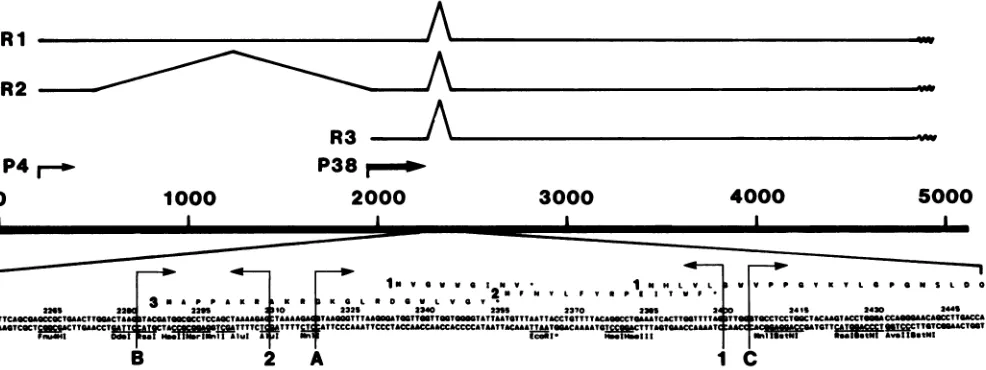
FIG. 4. Potentialsplice junctionsatmapunit-45.Theupperportionof thefigureillustrates the RNAtranscriptsandsplicing patternfor MVM(p) (41).As discussed in thetext,acomparisonofsplice junctionsat mapunit -45 forMVM(p),MVM(i), Hi,and canineparvovirus indicate thatasplicefrom A(5'donorsite)to1(3'acceptorsite)willgeneratethe mRNAencodingVP1.AlternativesplicingfromB(5'donor site)to1(3'acceptorsite) producestheprobablemRNAencodingVP2(seetextfordetails). Ri, R2,and R3arethemajor spliced transcripts, and P4 and P38arethetwopromoters (41).
acid sequence of VP2 is identical to the C-terminal
three-quartersof VP1.
Transcription studiesonMVM(41) have identifiedaminor splice,commontoalltranscripts,lyingbetweennucleotides 2250 and 2450. It is significant thatthroughthisregion, and for several hundrednucleotidesoneither side ofit,MVM(p)
and MVM(i) are more stronglyconserved than in all other regions of thegenome, as though additional constraintson
randomgenetic drift apply tothisregion and not toothers.
Thereasonfor thismaybe thepotentialuseofasecondopen
reading frame in this region, perhaps encodingpartofNS-2, since theregions showing diminished driftbetweenMVM(p) andMVM(i) delineateextensive dualopenreadingframeson
either side of the minor splice. These dual open reading
frames are conserved between MVM(p) (4), MVM(i) (this paper), Hi (46), andto some extentcanine parvovirus(44). We havenoted previously (4) thatthe DNA sequenceof MVM(p) around the minor splice regionoffers several close matchestoconsensussplice donor andacceptorsplice sites (38), andweused both the conservation anddivergence of
sequence between MVM(p), MVM(i), Hi, and canine
par-vovirus in this regiontoexplore which splicing options are
most likely used. We matched sequences from nucleotides 2251 through 2450 in MVM(i) with equivalent regions from MVM(p),Hi, and canine parvovirus, using the University of Wisconsin Genetics Computer Group GAP program. This region from each of the four genomes was then searched individually for the 10 best fits to both donor and acceptor
consensussequences(38), usingtheUniversity of Wisconsin
Genetics Computer Group FITCONSENSUSprogram. Po-tentialsplice sites commontoallfourwerethen ranked(A,
B, C, etc. for donors and 1, 2, etc. foracceptors) by their
average quality of fit and are displayed on the MVM(p)
sequence in Fig. 4. Three potential donor splice sites and
two potential acceptor sequences conserved between the
fourgenomeswereidentified in thisway. (Note that
accep-torsite 1wasnotrecognized earlier [4] becauseoursearchat
that timewasrestrictedtoTNCAG.) Wecandiscount donor site C since it is downstream of both potential acceptor
sequences.TheDNAsequencedownstreamofacceptorsite
2has translation terminators in all threereadingframes and
so wouldnotallow translation of the VP1-specificregionof thelong right-handopenreading frame. While acceptor 1 is a 12-of-16-base fittotheconsensus sequence, acceptor2 is only a 9-of-16-base fit and has an AG dinucleotideat posi-tions -4, -3, and -11, -10, from the A6 of the potential splice site which is never seen within 14 nucleotides of a functionalacceptorsite(38). Onthe basisofthisanalysis,we would predict that VP1 is synthesized starting with the methionineatnucleotide 2287inMVM(i), with thesequence
MAPPAKRA,and that thistranscriptissplicedfrom donor Atoacceptor1, joininga10-amino acid N-terminal segment
ontotheright-hand longopenreadingframethroughafused glycine codon. An alternatively spliced transcript in which donor B is joined to acceptor 1 would circumvent the initiator methionineatnucleotide2287 andallow the synthe-sis of VP2tooccurby delayingtranslation initiation until the ribosome had reached the methionine atnucleotide 2795 in MVM(i). For completeness, in Fig. 3 a lineup of the right-handopenreadingframes(frame 1)ofMVM(i) (upper line) and MVM(p) (lower line) includes potential leader regions (frames 1, 2, and 3) discussed earlier (4). However, assuming that VP1 begins in frame 3 at position 2287 as discussed aboveand issplicedtoframe 1 with the 5' donor site A and 3'acceptorsite1(Fig. 4),therearein theVP-1coding region 12 amino acid changes between MVM(i) and MVM(p). Again, conservative changes predominate: Gly-*Ser, Ile--Val, Ala-+Thr, Val-Ile, Arg-*Lys, Ala--Ser, Asn--Ser,Arg-+Lys,and Val-3Ala. Therearethreeradical
changes: Ser-*Leu at position 3272, Pro--Ser at position 3619, and Glu-*Gly atposition 3755. It is noteworthy that theamino-terminalregion uniquetoVP1(i.e.,nottranslated in VP2 if VP2 does begin at 2795) is invariant between MVM(i) andMVM(p).
Comparison of transcription signals between the two
genomes. Two promoters with overlapping transcription
units have been characterized for MVM(p) (41). The TATAAG of theleft promoter(at position 177) isidentical in i and p, as is the TATAAA of the second, much stronger promoteratposition 1977. Whether the nucleotide changes in the vicinities of theseconsensus sequences are function-ally significantis notknown.
P4
0
R3
on November 10, 2019 by guest
http://jvi.asm.org/
[image:10.612.65.558.74.259.2]666 ASTELL ET AL.
MVM(p)
C-strand
4720
4784
(4785)
(4849)
5' TAATGTTAGATAGAATAAGAAGATCATGTATAATGAATAA
AjAGGTGG3GGTGGTTGGTAGGT
3'c
C
a a-b
b
d
H-
IC-strand
4716 (477Ai
4770
(4828)
I I
I _, .
5' AATAAATATAGT
AGTTGGTTAA
TG TAGAT AGAATATAAAAAGATTTTGTATTT 3'e
d
C
e
b
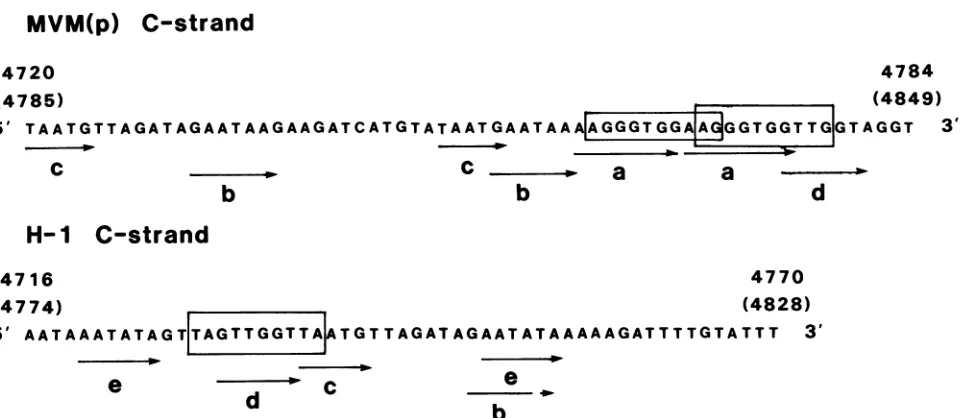
FIG. 5. Nucleotide sequencesofthe 65-and 55-bprepeatsfound in MVM(p) andHi. Arrowsbelow thesequencecorrespondtoshort repeatedsequencesfoundwithin andbetweenthesetandem repeats from the MVM(p) andHigenomes. Theboxedregions are regions which sharesomehomology with theconsensus sequence for enhancers.
Themostobvious difference betweeniandpin transcrip-tion signals involves potential polyadenylation sites, AATAAA. Thesecondpolyadenylation signalinMVM(p)at nucleotide 4755(repeatedat4820)ismutatedtoGGTAAAin MVM(i) (nucleotide 4756). Because this is within the 65-bp repeatinMVM(p), therearefourcanonicalpolyadenylation signals in MVM(p), at nucleotides 4602, 4755, 4820, and 4885, comparedwithonlytwoinMVM(i)atnucleotides 4603 and 4821.
DISCUSSION
We constructed clones of the genome of MVM(i), the immunosuppressive strain of MVM, and determined the complete nucleotidesequenceoftheseclones. Thesequence isvirtually identicaltothat of MVM(p) (4)withtheexception
that the sequence of MVM(p) was found to contain a
duplication of 65 bp which was missed in the original
sequence (4). The presence of the 65-bp duplication in
MVM(p) relative to MVM(i) explains the size difference between the XbaI-MspI fragment (map units 86 to 99) observed by McMaster et al. (29) and confirmed by our-selves. Itis noteworthy that asimilar tandem repeat (of 55 bp) has been observed in another autonomous parvovirus
genome (H1) as well asin defective interferingparticles of
Hi (45), though it isnot present inthegenome ofaclosely related virus, H3 (45). Both tandem repeats [MVM(p) and Hi] (Fig. 5) contain apolyadenylation signal. The repeated
sequencein Hi is84% A+T in contrast with therepeat in
MVM(p)which isonly 66%A+T. Whenonecompares the
sequencesofthe65-bpMVM(p) and 55-bpHi repeatsoneof
the most striking features is that on the complementary strand, the 65-bp repeat contains only oneC residue while the55-bprepeatdoes notcontainaC. Within the MVM(p) 65-bp repeat there are several short direct repeats: AAG GGTGG(a),GAATAA (b), and TAATG(c). InHi there is oneshortdirectrepeat,AATATA(e). Sequences b,c,and d (GTTGGT) are common to both the 65- and 55-bp repeat (Fig. 5).
The 65-bp direct repeats in the MVM(p) genome are of particular interest for three reasons. First, there is a polyadenylation signal within the repeat (hence two
polyadenylation sites at4755 and 4820;Fig. 1). In
MVM(i),
these sites are lacking due to a mutation of AATAAA-GGTAAA (nucleotide 4756; Fig. 1). Hence the MVM(i)
genome has two fewerpotential polyadenylation sites than does the MVM(p) genome. It is of possible interest that manygenes possess multiple polyadenylation sites and that
alternativeprocessing ofthe 3' ends of transcriptshas been
documentedforseveral cellulargenesaswell as viralgenes (1, 16, 23, 39,47). Whilethefactors thatdetermine selection ofaparticular polyadenylation site arenotwellunderstood,
it has beensuggestedthatthey probably reflectthe growth stateofthecellor thedifferentiated cell type (34). Second,
Faust et al. (18) have recognized that the MVM genome
contains 26 hexanucleotides, referred to as
t,,
which con-form to the consensus sequenceC2A1_2(C2-3/T2),
andpre-sentedevidence that these sequences may beinitiation sites for
purified
mouseDNApolymeraseaprimaseinvitro. Oneofthese sequences inthe MVM(p)genomein the region of nucleotides 4762 to 4779
(3'-C3AC2T2C3AC2A2C2-5')
is re-peated at nucleotides 4827 to 4844. As yet, there is no evidence that*
sequences areusedbythe DNApolymerasea primase in vivo (18). The third reason why the 65-bp
repeats of MVM(p) are of interest is that they contain
sequences related to transcriptional enhancer elements
whichhave been identified in viral and cellular genes. Some
ofthese enhancersshowtissue-or
cell-specificity
(5,12,15,
21,26,37, 42, 62),althoughit has beenreported recentlythat the simian virus 40 72-bp repeats do not alter thespecies
specificityof
polyomavirus
(10). Hen et al. (22) have com-pared enhancer sequences from 10 genomes and havesug-gested aconsensus sequence
GXTGTGGT.
Weiheretal.(59)havesuggestedacoresequenceof
(G)TGGTTT(G)
based on point mutations ofthe SV40 enhancer andcomparison
with other viral enhancers. Overlapping related sequenceswhichoccurwithin the MVM(p) 65-bp repeatare boxed in
Fig. 5, as is a related sequence in the 55-bp repeat of
Hi.
TheseMVM(p)sequences agree in 7 of 10 nucleotideswith the former enhancer consensus sequence and in 7 of 8nucleotides with the latter (viral) enhancer consensus se-quence.
The structures of the 3' and 5' palindrome
regions
of the J.VIROL.on November 10, 2019 by guest
http://jvi.asm.org/
[image:11.612.68.550.66.275.2]A MVM(p) Astell tal.(3) B MVM(I) thispaper aG
A ; ActiD
a-CyT'- 69
C-.'AiTv
a.,7
..._.
icic-3'
TC AT
C
A0
C MVM(p) ?
AG
ai
A CATC 3'CGe
AG
A a Antil
'c70
~1
S .vA0a,Gt7
yciTCT - 3'
53-A C AG
D
MVM(I)
Shillets:.
(43)it.
G
AOT-c
[image:12.612.60.300.70.300.2]A
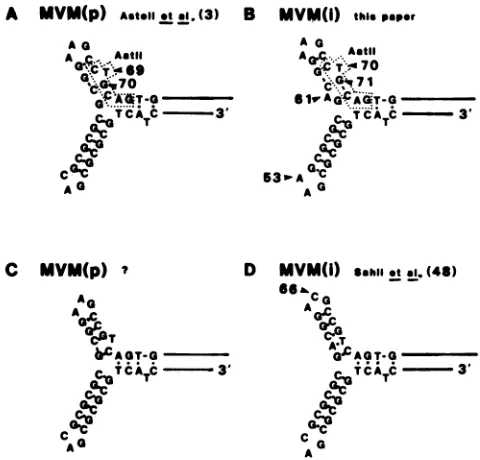
FIG. 6. Structure of the 3'-terminal hairpins fromMVM(p) and MVM(i). The sequencedetermined for MVM(p) (3) is illustratedin
Fig. 6A and that determined for MVM(i) (this paper) is giveninFig. 6B. Nucleotide differences between p and i are indicated by the arrowheads at positions 53 and 61. The sequence for MVM(i) determinedby Sahlietal. (48) is illustrated in Fig. 6D and hasan
additional nucleotidechange at position 66. Because we werenot
able to detect an AatII siteat nucleotide 69 in MVM(i) or 68 in MVM(p), webelievethat thesequence of Sahlietal. (48) ismore
probably correct. The correct sequence for the 3' hairpin of MVM(p) is illustrated in Fig. 6C.
MVM(i)genomeindicate thatthey areverysimilartothose ofMVM(p). The 3' palindrome is identical, except for an additional T at position 61 and a G--T transversion at position 53 inMVM(i). This additional base (an A in viral-strandDNA)occursin theshortarmof theY-shaped hairpin in viral-strand DNA (3) and thus may alter the stability of thisarm.TheG-*Tbasechangeatposition 53 (C-*A change inviral-strandDNA)lies within the3-nucleotide loop ofthe longarmof the Y-shaped hairpin and wouldnotbe expected toalterthe stability of this structure(Fig. 6A and B). The 5' palindrome is also highly conserved. Assuming that the inferredsequenceof the last 21 nucleotides is correct, there aresix single base changes. Each ismatchedby a compen-satory basechange such that in thehairpin configurationof viral-strand DNA, the number of potential base pairs and hence stability ofthe hairpin would not be expected to be altered. Theloop end ofthehairpinis AAA(flip orientation) andTTT (flop orientation), which is oppositeto that ofthe MVM(p)genome. It isinterestingto speculate onhow such a change might have occurred. Possible explanations are three single point mutations, a gene conversion event, a double crossover, a single crossover event at the level of viral-strand DNA, or a single crossover event between flip andflopturnaround forms of RF DNA, distalto the asym-metricunpaired regionof thehairpin. Of the fiveweconsider the lasttobemostlikely.
ComparisonofoursequenceforMVM(i)with that of Sahli etal.(48).WecomparedoursequenceforMVM(i)with that ofSahlietal. (48) andfound 11 differences in basechanges (Table 1). TheACversusCAatposition 70ismostlikelyto be duetotheproblemofresolvingthehairpinongels, noted
TABLE 1. Differences in sequence between MVM(i) of Sahli et al. (48)andMVM(i)of this paper
Nucleotide MVM(i) of MVM(i)of Coding position Astelletal. Sahlietal. changes
66 T G
70 A C
71 C A
90 T C
1566 C G
1572 G A
1962 A G
2050 A C Ile-*Leu
2832 C G Ala- Gly
4390 C A
4698 A G
earlier forMVM(p) (3). At this pointwe arenot sure of the correct order for these nucleotides. We observed both
ordersfor MVM(p) viral-strand DNA (C. Astell and M. B.
Chow, unpublished data). More frequently the order was thatreportedearlier(3)and illustrated here inFig.6A. Also, sequencingstudies ofthecomplementary strand ofMVM(p) RFDNA agreedwith thisorder(2). However, we consider theorder reported by Sahli et al. (48) to be more probably
correct, for the following reason. Repeated attempts to restrict both MVM(p) and MVM(i) clones at a predicted
AatII site at position 70, in this laboratory and in several
other laboratories, have failed. Although the secondary structure in this region is a possible explanation for this problem, we mustalso considerthe likelihood that the site
simplydoesnotexist,asispredicted bytheSahli sequence.
This nucleotidereversaldoes notchange thenetnumberof base pairs in the short arm of the 3' hairpin of MVM(p), although it could possibly increase the stability of the structure. Itincreases byonethe numberofpairedbasesin
the MVM(i) 3' hairpin, thereby significantly increasing its
stability (Fig. 6B through D).
Inadditiontothis difference, there are nine base change differences between the two sequences ofMVM(i). Ofthe sevenchanges withinthecodingsequence, nonewouldlead to radical amino acid differences. We found two changes whichwerenotreported by Sahli et al. (48), and theyfound seven changes whichwedidnot see.
A possible reason for the differences between our se-quence of MVM(i) and that ofSahli et al. (48) is that we clonedfrom differentMVM(i) stockpreparations. Although
both laboratories use stocks derived from the same geneti-cally purified MVM(i) stock (52), our virus is routinely
growninS49.1 TB2cells; inthecaseofthepreparation from whichtheMVM(i)terminalplasmid clones were derived, the virus was grown in 324K cells. Sahli et al. (48) grew their
preparation of MVM(i) in EL-4 lymphoma cells. Perhaps
growth in these different host-cell types has allowed for some degree of geneticdrift.
ACKNOWLEDGMENTS
We would like to thank M. Thomson for expert technical assistance.
Thework wassupported bygrantsfrom theBCHCRFandMRC (Canada) toC.R.A. and byPublic Health Service grant CA29303 from the National InstitutesofHealth to P.T.
ADDENDUM
After submission of this report, Rhode (J. Virol.
55:886-889, 1985) reportedthat sequencesin theHi genome
on November 10, 2019 by guest
http://jvi.asm.org/
[image:12.612.317.558.93.218.2]668 ASTELL ET AL.
including the 55-bp repeat do not enhance expression of
chloramphenicolacetyltransferase activity.
LITERATURE CITED
1. Alt, F. E., A. L. M. Bothwell, M. Knapp, E. Siden, E. Mather, M.Koshland, and D. Baltimore. 1980. Synthesis of secreted and membrane-bound immunoglobulin mu heavy chains is directed by mRNAs that differ at their 3' ends. Cell 20:293-301. 2. Astell, C. R., M. B. Chow, and D. C. Ward. 1985. Sequence
analysis of the termini of virion and replicative form of minute virus of mice DNA suggests a modifiedrollinghairpin model for autonomous parvovirus DNA replication. J. Virol. 54:171-177. 3. Asteli, C. R., M. Smith, M. B. Chow, and D. C. Ward. 1979. Structure of the 3' hairpin termini of four rodent parvovirus genomes: nucleotide sequence homology at origins of DNA replication. Cell 17:691-703.
4. Astell, C. R., M. Thomson, M. Merchlinsky, and D. C. Ward. 1983. The complete DNAsequence ofminute virus of mice, an autonomous parvovirus. Nucleic Acids Res. 11:999-1018. 5. Banerji, J., L. Olson, and W. Schaffner. 1983. A
lymphocyte-specific cellular enhancer is located downstream of the joining region in immunoglobulin heavy chain genes. Cell 33:729-740. 6. Ben Asher, E., and Y. Aloni. 1984.Transcription ofminute virus
of mice, an autonomous parvovirus, may be regulated by attenuation. J. Virol. 52:266-276.
7. Boissy, R., and C. R. Astell. 1985.Escherichia coli recBC sbcB recF hosts permit thedeletion-resistant propagation of plasmid clones containing the 5'-terminalpalindrome of minute virus of mice. Gene35:179-185.
8. Bonnard, G. D., and R. B. Herberman. 1975. Supression of lymphocyte proliferative responses by murine lymphoid cells, p. 817. In A. S. Rosenthal (ed.), Immunerecognition. Academic Press, Inc., New York.
9. Bourguignon, G. J., P. J. Tattersall, and D. C. Ward. 1976. DNA of minute virus of mice: self-priming, nonpermuted, single-stranded genome with a 5'-terminal hairpin duplex. J. Virol. 20:290-306.
10. Campbell, B. A., and L. P. Villarreal. 1985. Host species specificity ofpolyomavirus DNA replication is not altered by simian virus 40 72-base-pair repeats. Mol. Cell. Biol. 5: 1534-1537.
11. Campbell, D. A., Jr., S. P. Staal, E. K. Manders, D. G. Bonnard, R. K. Oldman, L. A. Salzman, and R. B. Herberman. 1977. Inhibition of in vivo lymphoproliferative responses by in vivo passaged rat 13762 mammary adenocarcinoma cells. ll. Evidence that Kilham ratvirus isresponsible for the inhibitory effect. Cell. Immunol. 33:378-391.
12. Chandler, V. L., B. A.Maler, and K. R. Yamamoto. 1983. DNA sequence boundspecifically byglucocorticoid receptor in vitro renders aheterologous promoter hormone responsive in vivo. Cell 33:489-499.
13. Cotmore,S. F., L. J.Sturzenbecker, and P.Tattersall. 1983.The autonomous parvovirus MVMencodes twonon-structural pro-teins in addition to its capsid polypeptides. Virology 129: 333-343.
14. Delaney, A. 1982. ADNA sequence handling program. Nucleic Acids Res. 10:61-67.
15. DeVilliers, J.L., L.Olson, C.Tyndall, andW.Schaffner. 1982. Transcriptional enhancers fromSV40 and polyoma virus show a cell type preference. Nucleic Acids Res. 10:7965-7976. 16. Early, P.,J. Rogers, M. Davis, K. Calame, M. Bond, R. Wall,
and L.Hood. 1980.TwomRNAs can be produced from a single immunoglobulin ,u gene by alternative RNA processing path-ways. Cell20:313-319.
17. Engers, H. D., J. A. Louis, R. H. Zubler, and B. Hirt. 1981. Inhibition ofTcell-mediated functions by MVM(i), a parvovirus closely related to'minute virus of mice. J. Immunol. 127: 2280-2285.
18. Faust, E. A., R. Nagy, and S. K. Davey. 1984. Mouse DNA polymerasea-primaseterminates and reinitiates DNA synthesis 2-14 nucleotides upstream of
C2A1-2(C2-3/T2)
sequences on aminute virus ofmice DNA template. Proc. Natl. Acad. Sci. USA82:4023-4027.
19. Feunteun, J., and T. L. Benjamin. 1982. Isolation of transfor-mation-defective host-range mutants ofpolyoma viruson
nor-malmousecells. Virology 119:310-316.
20. Fields, B.N., and M. I.Greene. 1982. Genetic and molecular mechanisms of viral pathogenesis: implications forprevention and treatment. Nature(London) 300:19-23.
21. Gillies,S. E., S. L. Morrison, V. T. Oi, and S. Tonegawa. 1983. Atissue-specifictranscription enhancer element is located inthe major intron ofarearrangedimmunoglobulinheavychaingene. Cell 33:717-728.
22. Hen, R., E. Borrelli, P. Sassone-Corsi, and P. Chambon. 1983. Anenhancerelement islocated 340base pairs upstreamfrom the adenovirus-2 ElA capsite. Nucleic Acids Res. 11: 8747-8760.
23. Henikoff, S., J. S. Sloan, andJ. D. Kelly. 1983. ADrosophila metabolic gene transcript is alternatively processed. Cell 34:405-414.
24. Holland, J. J.1961. Receptoraffinitiesasmajor determinantsof enterovirus tissuetropisms in humans. Virology 12:312-326. 25. Kilham, L., and G. Margolis. 1966. Spontaneous hepatitis and
cerebellar hypoplasia in suckling rats due to congenital infec-tions with ratvirus. Am. J. Pathol. 49:457-475.
26. Kriegler, M., and M. Botchan. 1983. Enhanced transformation byasimian virus recombinant viruscontainingaHarveymurine sarcomaviruslong terminal repeat. Mol. Cell. Biol.3:325-339. 27. Lum, G. S. 1970. Serological studies ofratvirusesinrelationto
tumors. Oncology24:335-343.
28. Maxam, A.,and W.Gilbert. 1977. A newmethod forsequencing DNA. Proc. Natl. Acad. Sci. USA 74:560-564.
29. McMaster, G. K., P. Beard, H. D. Engers, and B. Hirt. 1981. Characterization ofan immunosuppressive parvovirus related to the minute virus of mice. J. Virol. 38:317-326.
30. Merchlinsky, M., P. J. Tattersall, J. J. Leary, S. F. Cotmore, E. M. Gardiner, and D. C. Ward. 1983. Construction of an infectious molecular clone oftheautonomousparvovirusMVM. J.Virol. 47:227-232.
31. Messing, J., R. Crea, and P. H. Seeburg. 1981. A system for shotgunDNAsequencing. Nucleic Acids Res. 9:309-321. 32. Miller, R.A., D.C. Ward, and F. H. Ruddle. 1977. Embryonal
carcinoma cells (and their somatic cell hybrids)areresistantto infection by the murine parvovirus MVM, which does infect other teratocarcinoma-derived cell lines. J. Cell. Physiol. 91:393-402.
33. Mohanty, S. B., and P. A. Bachman. 1974. Susceptibility of fertilized mouse eggsto minute virus ofmice. Infect. Immun. 9:762-763.
34. Moore, C. L.,and P. A.Sharp. 1984. Site-specific polyadenyla-tion in a cell-free reacpolyadenyla-tion. Cell 36:581-591.
35. Morishima, T., P. R. McClintock, G. S. Aulakh, L. C. Billups, and A. L. Notkins. 1982. Genomic and receptor attachment differences between Mengovirus and encephalomyocarditis vi-rus. Virology 122:461-465.
36. Morishima, T., P. R. McClintock, L. C. Billups, and A.L. Notkins. 1982.Expression and modulation ofvirusreceptors on lymphoidandmyeloid cells:relationshiptoinfectivity. Virology 116:605-618.
37. Mosthaf, L., M. Pawlita, and P. Gruss. 1985. A viral enhancer element specifically active in human hematopoietic cells. Na-ture (London) 315:597-600.
38. Mount, S. M. 1982. A catalogue ofsplicejunction sequences. Nucleic Acids Res. 10:459-472.
39. Nevins,J. R., and S. Chen-Kiang. 1981. Processingof adenovi-rus nuclear RNA to mRNA. Adv. VirusRes. 26:1-35. 40. Paradiso, P. R., K. R. Williams, and R. L. Costantino. 1984.
Mapping ofthe amino terminus of the H-1 parvovirus major capsid protein. J. Virol. 52:77-81.
41. Pintel, D., D. Dadachanji, C. R.Astell, and D. C. Ward. 1983. The genome of minute virus ofmice, an autonomous parvovi-rus, encodes twooverlapping transcription units.Nucleic Acids Res. 11:1019-1038.
42. Queen, C.,and D. Baltimore. 1983. Immunoglobulingene tran-J. VIROL.
on November 10, 2019 by guest
http://jvi.asm.org/
scription is activated by downstream sequenceelements. Cell 33:741-748.
43. Rhode, S. L., III. 1973. Replication process of theparvovirus H-1. I. Kinetics in a parasychronous cell system. J. Virol. 11:856-861.
44. Rhode, S. L.,III. 1985. Nucleotidesequence of the coat protein geneof canine parvovirus. J.Virol. 54:630-633.
45. Rhode, S. L., III, and B. Klassen. 1982. DNA sequence of the 5' terminus containingthereplication originof parvovirus replica-tive formDNA. J. Virol. 41:990-999.
46. Rhode, S. L.,III,and P. R. Paradiso. 1983.Parvovirusgenome: nucleotide sequenceofH-1 andmappingof its genes by hybrid-arrestedtranslation.J. Virol.45:173-184.
47. Rosenfeld, M. G., J.-J. Mermod, S. G. Amara, L. W. Swanson, P. E.Sawchenko, J. Rivier, W. W. Vale, and R. M. Evans. 1983. Production ofanovel neuropeptide encoded by thecalcitonin gene via tissue-specific RNA processing. Nature (London) 304:129-135.
48. Sahli,R., G. K. McMaster, and B.Hirt. 1985. DNA sequence comparison betweentwotissue-specific variantsof the autono-mous parvovirus, minute virus of mice. Nucleic Acids Res. 13:3617-3632.
49. Sanger, F.,S.Nicklen, and A. R. Coulson. 1977. DNA sequenc-ing with chain terminatsequenc-ing inhibitors. Proc. Natl. Acad. Sci. USA 74:5463-5467.
50. Siegl, G., and M. Gautschi. 1973. The multiplication of parvo-virus Lulll in a synchronized culture system. I. Optimum conditions for virus replication. Arch. Gesamte Virusforsch. 40:105-118.
51. Smith, A.L., and G. H. Tignor. 1980. Host cell receptors for twostrainsof Sindbis virus. Arch. Virol. 66:11-26.
52. Spalholz, B. A., and P. Tattersall. 1983. Interaction of minute virus of mice with differentiated cells: strain-dependenttarget cell specificity is mediated by intracellular factors. J. Virol. 46:937-943.
53. Tattersall, P. 1972. Replication of the parvovirus MVM. I. Dependenceof virusmultiplication and plaque formation on cell growth. J. Virol. 10:586-590.
54. Tattersall, P. 1978. Susceptibilityto minutevirus of mice as a function of host-celldifferentiation,p. 131-149. In D.C. Ward and P.Tattersall(ed.),Replication of mammalian parvoviruses. ColdSpring Harbor Laboratory, ColdSpring Harbor, N.Y. 55. Tattersall, P., and J. Bratton. 1983. Reciprocal productiveand
restrictive virus-cell interactions of immunosuppressive and prototype strainsof minute virus of mice. J.Virol.46:944-955. 56. Tattersall, P., A. J. Shatkin, and D. C. Ward. 1977.Sequence homologybetweenthe structural polypeptides of minutevirus ofmice.J.Mol. Biol. 111:375-394.
57. Tattersall, P., and D. C. Ward. 1978. The parvoviruses: an introduction, p. 3-12. In D;C. Ward and P. Tattersall (ed.), Replication of mammalian parvoviruses. Cold Spring Harbor Laboratory, ColdSpring Harbor, N.Y.
58. Tennant, R. W.,K. R.Layman, and R. E. Hand, Jr. 1969. Effect of cell physiological state on infection by rat virus. J. Virol. 4:872-878.
59. Weiher, H., M. Konig, and P. Gruss. 1983. Multiple point mutations affecting the simian virus 40 enhancer. Science 219:626-631.
60. Weiner, H. L., K.A. Ault, and B. N. Fields. 1980. Interactionof reovirus with cell surface receptor. I. Murine and human lymphocytes have a receptorforthehemagglutinin of reovirus type 3. J. Immunol. 124:2143-2148.
61. Weiner, H. L., D. Drayna, D. R.Averill, and B. N. Fields. 1977. Molecular basisof reovirus virulence: role of the S1gene. Proc. Natl. Acad. Sci. USA 74:5744-5748.
62. Yanisch-Perron, C., J. Vieira, and J. Messing. 1985. Improved M13 phage cloning vectors and host strains: nucleotide se-quencesof the M13mpl8 andpUC19vectors.Gene 33:103-119. 63. Yaniv, M. 1982. Enhancingelementsfor activation of
eukary-oticpromotors. Nature(London) 297:17-18.