Abstract: Road construction is the important division in the construction industry and the most predominant part of a society. The roadway defines the development of a country or a state and brings in the economic development of the same. The reasons for choosing a project on the roadways are its vast scope of day to day development and progress in this area.
Thus it is clearly seen that roadways is the most essential in todays world without which progress and development cannot take place at full fledge. Therefore any delay in completion of a road constructing project may have its impact in degrading of a society. Also at the same time the budget overrun or cost overrun of such project is highly unbearable.
Key Word:Roadway, Cost Over Run
I. INTRODUCTION
Deferral as alluded in development is delayed development period and interruptions of occasions that exasperate the development program. Deferrals and Cost overwhelm are among the difficulties looked throughout executing development ventures. Postponements just as cost invade are wellsprings of potential dangers that present examinations are investigating approaches to oversee. Development postponement is characterized as "the time overwhelm either past fulfillment date indicated in an agreement, or past the date that the gatherings settled upon for conveyance of a venture." Delay is likewise characterized as a "demonstration or occasion which stretches out expected time to perform or finish work of the agreement shows itself as extra long stretches of work"
Revised Manuscript Received on July 22, 2019.
Anish . C, Assistant Professor, Department of Civil Engineering, Bharath Institute Of Higher Education and Research, Chennai, Tamil [email protected]
Kiruthiga.K, Assistant Professor, Department of Civil Engineering, Bharath Institute Of Higher Education and Research, Chennai, Tamil Nadu email:[email protected]
Vinoth.S, Assistant Professor, Department of Civil Engineering, Bharath Institute Of Higher Education and Research, Chennai, Tamil Nadu. [email protected]
.
.II. METHODOLOGY
The Data are collected through two methods namely questionnaire and case study. Questionnaires are conducted from few concerned persons. This survey helps in finding the Relative
Importance Index (RII), later this value is used in determining cost variation that occurs in project that are concerned under case study.
Likewise, for the finding out time delay process, time schedules and activity schedules are collected from the case study of specified projects.
Finally, factors leading for both cost overrun and time delay are displayed in charts, so that the intensity of the factors and its performance to hinder the actual cost budget and time schedule of the project are clearly studied.
III. RESULTSANDDATAANALYSIS
A. Data Collection
Simple questionnaire survey were conducted to individuals concerned in the highway projects. The result of the survey was the input to determine the Relative Importance Index (RII). Relative Importance Index (RII) calculation is used to determine relative significance and ranking of cost and overrun factors.
B. Data Analysis
The The data received through the survey had 16 respondents and they are categorised in the fig .1
Figure.1.Data Analysis
Analysis of Time Delay and Cost Overrun in
In Charts)
The Various surveys are conducted as mentioned and the results are expressed using charts for convenient purpose. These charts shows the ranking positions of each factor which is numbered then using the mean value obtained from the survey conducted. The result of the survey are processed and analysed in the SPSS software tool.
D. Factors Related To Financial Groups
In this chart, factors are ranked from very high influencing factors to very low influence factors as shown in figure 6.2 and they are denoted by,
Ca1 -Market demand
Ca2 - Increase in tax
Ca3 - Poor financial control in site
Ca4 - Delay in payment to supplier/sub-contractor
[image:2.595.311.522.56.197.2]Ca5 - Bureaucracy in tendering method
Figure.2. Factors related to financial groups
E. Factors Related To Construction Parties
In this chart, factors are ranked from very high influencing factors to very low influence factors as shown in Figure 5.5 and they are denoted by,
Cb1 - Lack of information flow between parties
Cb2 - Lack of co-ordination between projects
Cb3 - Lack of communication between parties
Cb4 - Lack of qualified project manager
[image:2.595.55.277.360.506.2]Cb5 -Lack of experience in line of work
Figure.3. Factors related to construction parties
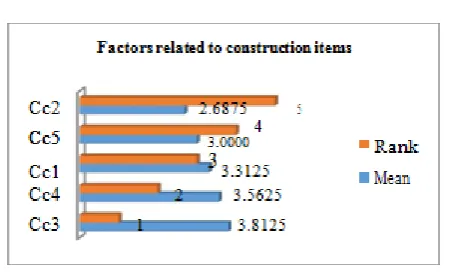
F. Factors Related To Construction Items
Use In this chart, factors are ranked from very high influencing factors to very low influence factors as shown in figure 5.6 and they are denoted by,
Cc1 - Incomplete design and drawing
Cc2 - Slow inspection of completed work
Cc3 - Wastage of materials in the site
Cc4 - Inadequate review of contract documents and specifications
Cc5 - Inadequate quantity takeoff
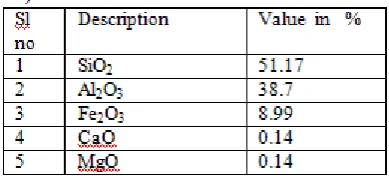
Then the sample was fused with 0.1 N of NaOH with the removal of iron and tested for CEC which yielded a value of 20meq/L.
Then the sample was fused with sodium aluminate without the addition of NaOH and tested for CEC which yielded a value of 20 meq/L.
[image:2.595.308.533.435.574.2][image:3.595.315.540.68.225.2]
NaoH and the concentration of Sodium Aluminate .
Figure.4. Factors related to construction items
G. Factors Related To Environmental Group
In this chart, factors are ranked from very high influencing factors to very low influence factors as shown in figure 5.7 and they are denoted by,
Cd1 - Weather condition
[image:3.595.64.259.95.189.2]Cd2 - Geological condition of project site Cd3 - Social and cultural impacts Cd4 - Law and regulations Cd5 - Location of project
Figure.5. Factors related to environmental
H. Factors Related To External Group
In this chart, factors are ranked from very high influencing factors to very low influence factors as shown in figure 5.8 and they are denoted by,
Ce1 - Exclusive control of certain group of material suppliers Ce2 - Difficulty in importing materials and equipments Ce3 - Political situation
Ce4 - Dealing with suppliers and traders
Ce5 - Permits or Approvals for land procurement and acquisition
Figure.6. Factors related to external group
I. Factors Related To Materials
[image:3.595.66.290.336.511.2]In this chart, factors are ranked from very high influencing factors to very low influence factors as shown in figure 5.9 and they are denoted by,
Cf1 - Shortage of material Cf2 - Late delivery of materials Cf3 - Escalation of material price Cf4 - Change in material specification Cf5 - Wastage of materials
Figure.7. Factors related to materials
J. Factors Related To Labor And Equipment
In this chart, factors are ranked from very high influencing factors to very low influence factors as shown in figure 5.10 and they are denoted by,
Cg1 - Lack of availability of equipment Cg2 - Inadequate labour productivity Cg3 -High cost of machinery and labour
Cg4 -Frequent breakdown of construction plant and equipment
[image:3.595.303.526.366.540.2]Figure.8. Factors related to labor and equipment
K. Factors Related To Owners
In this chart, factors are ranked from very high influencing factors to very low influence factors as shown in figure 5.11 and they are denoted by,
[image:4.595.305.527.46.202.2]Ch1 - Additional work at owner’s request Ch2 - Owner’s unwillingness to help Ch3 - Delay in progress payment by owner Ch4 - Owner’s emphasis on high quality Ch5 - Delay in decision making
Figure.9.Factors related to owners
L. Factors Related to Project Delays
In this chart, factors are ranked from very high influencing factors to very low influence factors as shown in figure 5.12 and they are denoted by,
Ta1 - Inconvenient site access Ta2 - Disturbance to public activities Ta3 - Limited construction area Ta4 - Poor terrain condition
Ta5 - Poor soil drillability and laying suitability
Figure.10.Factors related to Projrect Group
M. Factors Related To Internal Delay Factors
In this chart, factors are ranked from very high influencing factors to very low influence factors as shown in figure 5.13 and they are denoted by,
Tb1 - Change orders by the owner during construction Tb2 - Delay in progressing payments
Tb3 - Ineffective planning and scheduling by the contractor Tb4 - Poor site management by the contractor
Tb5 - Shortage of labours
[image:4.595.49.270.374.551.2]Tb6 - Difficulties in financing the project by the contractor
Figure.11.Internal delay factors
N. Factors Related To Managerial Group
In this chart, factors are ranked from very high influencing factors to very low influence factors as shown in figure 5.14 and they are denoted by,
Tc1 - Poor communication between construction parties Tc2 - Delays in decision making
Tc3 - Unreasonable project time frame Tc4 - Improper construction method
[image:4.595.306.545.401.539.2]
Figure.12. Factors related to managerial groups
O. Factors Related To Consultant Group
In this chart, factors are ranked from very high influencing factors to very low influence factors as shown in figure 5.15 and they are denoted by,
Td1 - Mistakes in design
[image:5.595.51.271.72.222.2]Td2 - Design changes & inappropriate design Td3 - Late inspection and late approval Td4 - Insufficient and incapable inspectors
Figure.13. Factors related to consultant group
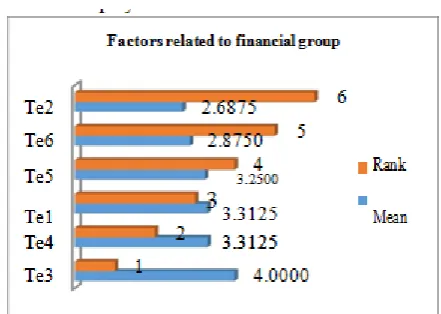
K. Factors Related To Financial Group
In this chart, factors are ranked from very high influencing factors to very low influence factors as shown in figure 5.16 and they are denoted by,
Te1 - Payments delay by the owner Te2 - Financial status of contractor Te3 - Financial status of contractor Te4 - Exchange rate fluctuation Te5 - Inflation
Te6 - Monopoly
Figure.14. Factors related to financial group
L. Factors Related To External Group
In this chart, factors are ranked from very high influencing factors to very low influence factors as shown in figure 5.17 and they are denoted by,
Tf2 - Segmentation of West bank Tf3 - Weather condition
[image:5.595.306.529.366.534.2]Tf4 - Natural disaster
Figure.15. Factors related to external group
K. Factors Related To Construction Item Group
In this chart, factors are ranked from very high influencing factors to very low influence factors as shown in figure 5.18 and they are denoted by,
Tg1 - Insufficient labours
[image:5.595.50.269.378.547.2]Figure.16. Factors related to construction items Group
IV. CONCLUSION
Road construction is the important division in the construction industry and the most predominant part of a society. The delay in completion of a road constructing project may have its impact in degrading of a society. Delays are insidious often resulting in time overrun, cost overrun, disputes, litigation, and complete abandonment of projects. The factors analyzed in this project are evitable practically if the correct source starts repairing the root cause. The rectification cost overrun and time delay can bedone only by the cooperation of all the groups associated with theconstruction industry. This project does not mean if things are done as per stated in this paper would rectify all the problems and difficulties faced in the industry, but a considerable amount ofchanges can be brought which may save a lot of amount and time.
REFERENCES
1. Iyappan L., Dayakar P., Identification of landslide prone zone for coonoortalukusing spatial technology, International Journal of Applied Engineering Research,V-9,I-22,PP-5724-5732,Y-2014.
2. Kumar J., Sathish Kumar K., Dayakar P.,Effect of microsilica on high strength concrete, International Journal of Applied Engineering Research,V-9,I-22,PP-5427-5432,Y-2014.
3. Dayakar P., Vijay Ruthrapathi G., Prakesh J., Management of bio-medical waste, International Journal of Applied Engineering Research,V-9,I-22,PP-5518-5526,Y-2014.
4. Swaminathan N., Dayakar P., Resource optimization in construction project, International Journal of Applied Engineering Research,V-9,I-22,PP-5546-5551,Y-2014.
5. Venkat Raman K., Dayakar P., Raju K.V.B.,An experimental study on effect of cone diameters in penetration test on sandy soil, International
Journal of Civil Engineering and
Technology,V-8,I-8,PP-1581-1588,Y-2017.
6. Saritha B., Chockalingam M.P.,Photodradation of malachite green DYE using TIO2/activated carbon composite,International Journal of Civil Engineering and Technology,V-8,I-8,PP-156-163,Y-2017
7. Shendge R.B., Chockalingam M.P., Saritha B., Ambica A.,Swat modelling for sediment yield: A case study of Ujjani reservoir in Maharashtra, India,International Journal of Civil Engineering and Technology,V-9,I-1,PP-245-252,Y-2018
8. Chockalingam M.P., Balamurgan V.,Modernisation of an existing urban
chromium from aqueous medium using modified natural adsorbent,International Journal of Civil Engineering and Technology,V-8,I-8,PP-1382-1387,Y-2017
11. Chockalingam M.P., Palanivelraja S.,Retrospective analysis of a theoretical model used for forecasting future air quality near the north Chennai thermal power plant,International Journal of Civil Engineering and Technology,V-8,I-8,PP-1457-1467,Y-2017
12. Saritha B., Chockalingam M.P.,Photodegradation of methylene blue dye in aqueous medium by Fe-AC/TiO2 Composite,Nature Environment and Pollution Technology,V-17,I-4,PP-1259-1265,Y-2018
13. Shendge R.B., Chockalingam M.P., Kaviya B., Ambica A.,Estimates of potential evapotranspiration rates by three methods in upper Bhima Basin, In Maharashtra, India,International Journal of Civil Engineering and Technology,V-9,I-2,PP-475-480,Y-2018
14. Shendge R.B., Chockalingam M.P.,The soil and water assessment tool for Ujjani Reservoir,International Journal of Mechanical Engineering and Technology,V-9,I-2,PP-354-359,Y-2018
15. Shendge R.B., Chockalingam M.P.,A review on soil and water assessment tool,International Journal of Mechanical Engineering and Technology,V-9,I-2,PP-347-353,Y-2018
16. Sachithanandam P., Meikandaan T.P., Srividya T.,Steel framed multi storey residential building analysis and design,International Journal of Applied Engineering Research,V-9,I-22,PP-5527-5529,Y-2014 17. Meikandaan T.P., Ramachandra Murthy A.,Study of damaged RC
beams repaired by bonding of CFRP laminates,International Journal of Civil Engineering and Technology,V-8,I-2,PP-470-486,Y-2017 18. Meikandaan T.P., Ramachandra Murthy A.,Retrofittng of reinforced
concrete beams using GFRP overlays,International Journal of Civil Engineering and Technology,V-8,I-2,PP-423-439,Y-2017
19. Meikandaan T.P., Ramachandra Murthy A.,Flexural behaviour of RC beam wrapped with GFRP sheets,International Journal of Civil Engineering and Technology,V-8,I-2,PP-452-469,Y-2017
20. Meikandaan T.P., Murthy A.R.,Experimental study on strengthening of rc beams using glass Fiber,International Journal of Civil Engineering and Technology,V-9,I-11,PP-959-965,Y-2018
21. Meikandaan T.P., Hemapriya M.,Use of glass FRP sheets as external flexural reinforcement in RCC Beam,International Journal of Civil Engineering and Technology,V-8,I-8,PP-1485-1501,Y-2017 22. Saraswathy R., Saritha B.,Planning of integrated satellite township at
Thirumazhisai,International Journal of Applied Engineering Research,V-9,I-22,PP-5558-5560,Y-2014
23. Saritha B., Ilayaraja K., Eqyaabal Z.,Geo textiles and geo synthetics for soil reinforcement,International Journal of Applied Engineering Research,V-9,I-22,PP-5533-5536,Y-2014
24. Ambica A., Saritha B., Changring G., Singh N B., Rajen M., Salman Md.,Analysis of groundwater quality in and around Tambaram taluk, Kancheepuram district,International Journal of Civil Engineering and Technology,V-8,I-8,PP-1362-1369,Y-2017
25. Arunya A., Sarayu K., Ramachandra Murthy A., Iyer N.R.,Enhancement of durability properties of bioconcrete incorporated with nano silica,International Journal of Civil Engineering and Technology,V-8,I-8,PP-1388-1394,Y-2017
26. Ilayaraja K., Krishnamurthy R.R., Jayaprakash M., Velmurugan P.M., Muthuraj S.,Characterization of the 26 December 2004 tsunami deposits in Andaman Islands (Bay of Bengal, India),Environmental Earth Sciences,V-66,I-8,PP-2459-2476,Y-2012
27. Ilayaraja K.,Morphometric parameters of micro watershed in Paravanar sub-basin, Cuddalore District,International Journal of Civil Engineering and Technology,V-8,I-8,PP-1444-1449,Y-2017
28. Ilayaraja K., Singh R.K., Rana N., Chauhan R., Sutradhar N.,Site suitability assessment for residential areas in south Chennai region using remote sensing and GIS techniques,International Journal of Civil Engineering and Technology,V-8,I-8,PP-1468-1475,Y-2017 29. Ilayaraja K., Reza W., Kumar V., Paul S., Chowdhary R.,Estimation of
land surface temperature of Chennai metropolitan area using Landsat images,International Journal of Civil Engineering and Technology,V-8,I-8,PP-1450-1456,Y-2017
30. Chitra R.,Experimental study on beam using steel fiber and latex,International Journal of Civil Engineering and Technology,V-8,I-8,PP-1395-1403,Y-2017
31. Chitra R.,Analysis of traffic and management at Kovilambakkam intersection,International Journal of Civil Engineering and Technology,V-8,I-8,PP-1433-1443,Y-2017
Technology,V-8,I-8,PP-1413-1421,Y-2017
34. Kiruthiga K., Anandh K.S., Gunasekaran K, Assessment of influencing factors on improving effectiveness and productivity of construction engineers, 2015, International Journal of Applied Engineering Research, V - 10,I -17,p -13849-13854
AUTHORSPROFILE
Anish . C ,Assistant Professor, Department of Civil Engineering, Bharath Institute of Higher Education and Research, Chennai, India
Kiruthiga.K ,Assistant professor, Department of Civil Engineering, Bharath Institute of Higher Education and Research, Chennai, India