International Journal of Innovative Technology and Exploring Engineering (IJITEE) ISSN: 2278-3075, Volume-8 Issue-8S2, June 2019
Abstract Background/Objectives: The purpose of this study is to develop a method to control the operation status of street lights and security lights in a single terminal and to improve the communication failure rate using LoRa module.
Methods/Statistical analysis: In this study, it is intended to configure integrated road-light controlling H/W deriving the integrated supervising/controlling measures and realizing the functions in each module. Afterwards, it aims to manufacture security light and test boards to connect them with integrated controlling unit.
Findings: Network algorithm has been developed to design the LoRa-based road light controlling system and LoRa-based H/W, establish the measures for connection, and minimize the communication failure between integrated street light controlling unit and individual street lights.
Improvement/Applications: LoRa-based wireless communication interface applied technologies are expected to be used as a foundation for establishing U-City infrastructure, and there is a need to conduct a follow-up research in extended scope on 6LoWPAN mesh network.
Keywords: LoRa(Long Range) Module, 6LoWPAN,Street lights, PLC(Power line communication), Modularization ,Integrated control system
I.INTRODUCTION
Due to the global warming, there have been many researches conducted in various countries in the world dealing with the efficiency of controlling road lights as well as technologies for efficient reduction of energy. Road lights are divided into street lights and security lights. In the past, they were managed separately with remote control system[1,2]. In addition, Zigbee is used to control the security lights. According to the characteristics of street lights that are installed at residential areas or hills, there are many of them under poor control due to an increasing failure rate of communication from buildings as an obstacle. In addition, due to the limited number of specialized maintenance manpower, it is difficult to seamlessly identify the current status of thousands of street light facilities[3,4]. At the same time, specialized maintenance manpower tends to come to the field without identifying the causes of problems in advance. Therefore, it is inefficient in terms of time and expense [5,6]. Therefore, systematic management is now required through the establishment of system for supervising and controlling the diffusing light facilities from
Revised Manuscript Received on May 22, 2019.
Gwang-Hyun Kim Dept. Convergence Software,277 Hyodeok-ro,
Gwangju University, Nam-gu Gwangju city, 61743 , KOREA [email protected]
wire and wireless communication by installing integrated control server on the control room of local communities due to the limit for the control from an increasing number of street lights and expanded scope of cities[7,8].
Development of web-based control system and mobile application is expected to satisfy maintenance and managing associates with integrated road lights controlling method and also to improve convenience of lives for citizens [3,4].
It is feasible to apply advanced technology such as IoT on social overhead capital (SOC) such as road streets utilizing it as reference technology on businesses such as reduction of social capital and establishment of smart city in the perspective of maintenance and management[9,10].
The purpose of this study is to verify the potential of application of design/development system for module-oriented integrated control devices and systems by applying Sub-GHz-based LoRa on the communication between security lights to overcome an issue of aforementioned issues and also 6LoWPAN-based PLC communication between street lights to minimize the communication failure and performing the functions of street lights and security lights at the same time.
II.RESEARCHBACKGROUND
In this study, it is planned to design network algorithm for LoRa-based control on road streets and communication protocol between modules in each unit while applying LoRa-based IoT on street lights and designing H/W, S/W, and communication protocol. Hereupon, it is intended to design integrated LoRa-based road streets control system and LoRa-based H/W, establish communication protocol and connected plans, and come up with communication of individual street lights and security lights with integrated control devices for street lights and security lights and network algorithm for minimizing communication failure. Integrated control system for road streets is configured as shown in Figure 1.
Development of LoRa-based on Road Lighting
Integrated Control System using IoT
Figure 1.Integrated road street control system
In this study, it is intended to configure integrated road street controller H/W deriving the plans for supervision/control and realizing the functions in each module. Afterwards, it is to manufacture street lights test board and connect it with integrated controller. Lastly, it is to establish the web-based integrated control system and realize to connect with integrated control.
III.DESIGNANDREALIZATIONOFINTEGRATED CONTROLSYSTEM
3.1 Configuration of integrated control system
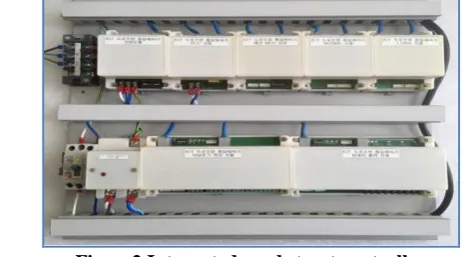
The integrated controller H / W consists of main module, I / O module, communication module, and power module. The main module consists of MCU, Key input and display (LCD). It is a main control module for controlling each module, and it is able to enter menu and various setting values through LCD screen. In the I / O module, the output section controls the output of the electronic switch in the distributing box by operating the relay for each streetlight channel, and the input section proceeds sampling of the voltage, current, and leakage current values and transmitting them to the MCU through SPI communication. The communication modules include a CDMA module for communicating with the central control server by SMS short message and TCP / IP method, a LoRa module for communication by 920MHz band radio RF method, a PLC module for 6LoWPAN based power line communication [7]. The integrated controller power converts the AC 220V input to the voltage required by each module using a transistor, constant voltage circuit, and DC-DC converter. The shape of the integrated controller of road lighting isshown inFigure 2.
Figure2.Integrated road street controller
As for the methods of integrated supervision and control, it is to configure street lights with regular lights and interval lights and operate them by controlling I/O module output
relay. For the supervision, voltage, current in each channel, and short circuit value are collected from I/O module input (ADC) while regularly reading status data from the street light controller to identify the abnormal conditions of lamp or SMPS. Communication between modules in integrated controller is applied with FC method. Data configuration of FC BUS is shown asFigure 3.
Figure3. I²C-BUS Data
Case for each module of integrated controller is manufactured in an order of rendering and assembly. As for basic design direction, work costs are minimized by reducing the wiring tasks by making integrated controller as a module while considering electronic performance, protective structure, or maintenance. It is required to manufacture integrated controller for the design or review to supplement insufficient parts and consider expandability for convenient embedded control board, sensor, and communication modules.
3.2 Design and Realization of System
6LoWPAN-based power line communication (PLC) is used for communication between the integrated controller and the streetlamp. The PLM (Power Line Modem) network configuration for streetlight control uses the STEVAL-IHP007V1 module for test transmission and reception as an alternative to RF network communications for streetlights. Combined with HID or LED ballast modules, it can be used as a power line communication board implementing a streetlight control system. It incorporates a data link layer firmware protocol optimized for streetlight applications and incorporates collision avoidance and repetition algorithms. To test the communication between the PLC modules, the module power is supplied using an 8-type connector that connects the power line communication line and an AC-DC converter with 5.0V 400mA output. In addition, considering the expansion, DIP switch for communication speed setting is arranged, and RS-485 communication and 5.0V power connector are intertwined, and LED board is used to display the operation status of the module. PLC communication frame structure for streetlight control consists of Flag, Custom code, User Data, and CRC-16.
Configuration of PLC communication packet is as follows in Table 1.
Table1.Configuration of PLC communication packet
Flag Custom
Code User Data CRC-16 Flag
4byte 2byte 1~128 byte 2byte 1~2byte
As for the realization of PLC-based 6LoWPAN network, it is required to re-define adaptation layer for streetlights controller to use IPv6. In
International Journal of Innovative Technology and Exploring Engineering (IJITEE) ISSN: 2278-3075, Volume-8 Issue-8S2, June 2019
on or off based on IPv6, simplifying function, header compressing function, and multi-home transmitting function are added on the adaptation layer equipping with IPv6-based
protocol and 6LoWPAN protocol for integrated controller to 6LoWPAN to convert two protocols.
[image:3.595.91.525.96.242.2]Structure of 6LoWPAN is follows as shown in Figure 4.
Figure 4. 6LWPAN structure
Communication between integrated controller and electrical circuits uses LoRa (Long-Range) method. For the wide usage later, it is designed as LoRa-based RF interface. LoRa module is comprised of RN2903 chip, RF connector, and Interface Connector from Micro Chip Company. Interface Connector is comprised of RX, TX, RESET, VCG, and GND. Drawing of LoRa module hardware is follows as shown in Figure 5.
Figure5.Drawing of LoRa module hardware
The module is manufactured according to the embedded board development methodology, and sample production and module unit test are performed using the PCB manufacturing facility. The AVR Studio Compiler is used to make
preliminary reviews, while dividing roles as base station and radio station based on LoRa based MiWi Protocol. The base station corresponds to the integrated controller, and the radio station corresponds to the individual security. Source coding can be completed with MPLAB X IDE v3.45 while debugging with Microchip PICkit 3.
For the LoRa RF communication test, the .Net Framework 3.5 base communication test program is manufactured based on LoRa-based MiWi communication protocol from Microchip Company while setting the RTU module as Coordinator and End Node to implement the LoRa channel-specific TX environment and analyze the frequency spectrum. The center frequency of the LoRa channel is derived as 921.9MHz (25CH) considering the characteristics that the controller such as the integrated controller and the security controller are configured as Star Topology.
LoRa module frequency spectrum analysis test is follows as shown in Figure 6.
Figure6.Spectrum analysis of LoRa module frequency
To build a Web-based integrated control system, Windows Server 2008 R2 is firstly installed as an OS on the test workstation followed by implementing .NET-based middleware for TCP communication between the streetlight controller and the server. It stores the overall operation status of street lamps and security lights in DBMS and installs APM to build web service so that manager can easily access them. For the web control, the database installs MySQL 5.0.4. As for detailed tables, basic information, configuration data, bi-directional groups, branch information, and status
information for streetlamps and management are generated. Tables for internal processes for interworking between middleware and web interface are created, while adding visual system tables, individual histories, illumination data, log data, and lighting time tables based on latitude / longitude for common functions.
header table plug-in is adopted. In order to indicate events received from devices in the form of pop-up, messenger skin is used. Using the cycling library, it dynamically shows recently received lists, while including jquery.jcarousel.js to display the summary of photos in control panel. In addition, plug-ins for cookie, print, and excel download are applied.
3.3 Result Analysis
Map display output API is implemented based on JavaScript SDK for web. Static Map API and address - coordinate API can be used as REST API type that it is easy to link with middleware. Based on the map API, it is possible to display the integrated controller and streetlight equipment as markers and click them to pop up the information window layer or move the location by dragging& dropping. In addition, standard library is applied to maintain consistency with PC environment even in mobile environment. JavaScript libraries from Cross-Platform, jQuery, and Cascading Style Sheets (CSS3) designed to simplify client-side manipulation of HTML are applied.
The latest version of the HTML standard, HTML5, supports an extension technology for developing Web applications that make it easier and more efficient for users and local data to be exchanged between Web servers. It is also developed as an Android application so that maintenance personnel can easily use it in mobile environment. In order to configure the development environment, Android Studio 3.0, an IDE for Android app development that is officially supported by Google, is firstly used. As for Android app UX / UI design, basic configuration principles for icon and task design are defined along with the size and color according to the resolution, adjusting the bottom alignment of the content grid screen considering the scrolling, clarifying the structure, and grouping related information. In application development, procedures have been followed to create a special adapter to receive the json status data from the http server through the function, the activity work per page, and the xml layout matching operation and to display it on the grid.
As for integrated supervising and controlling method, streetlights are controlled with two channels of regular lights and interval lights while operating the inner control panel through the relay control in I/O module output. For the supervision, voltage, and current/short circuit values are collected through I/O module input (ADC) while reading the status data from streetlights supervising unit to identify the abnormal conditions of lamp or SMPS. For the integrated controller and communication test, test bed has been manufactured for streetlights and security lights. Streetlights are granted with individual IDs in each quarter as they are to be used as regular light and interval light channels while sharing the multi-tap with integrated controller. Test bed of streetlights is shown as Figure 7.
Figure7. Streetlight test bed
As a result of applying to the integrated control system of Hoengseong-gun road for the demonstration test of the research output, 87 out of 550 security lights in the existing Zigbee environment had failure rate that was represented as 15% due to communication failure. Failure rate was confirmed to reduce to less than 3% happening only on 14 devices after replacing with LoRa based integrated control system.
IV.CONCLUSION
This study has designed and implemented integrated LoRa - based road lights control system by using IoT. In order to solve the problem when using Zigbee for the communication between individual security in the existing security system such as security, the 920MHz band LoRa module was applied to minimize the communication shadow. In case of streetlight, 6LoWPAN communication algorithm is applied to power line communication to strengthen the relay function.
The LoRa-based wireless communication interface application technology is expected to be utilized as a base technology for building U-City infrastructure and expanded to 6LoWPAN mesh network to apply to the street lamp monitor and security flasher to maximize in saving energy and improving control efficiency
ACKNOWLEDGMENT
This Study was conducted by research funds from Gwangju University in 2019, Korea
REFERENCES
1. Nehring, H. Lora Wildenthal. The Language of Human Rights in West Germany. The American historical review.2014; 119(2): 624-625. 2. Yao, Y. , Chen, X. , Rao, L. , Liu, X. , Zhou, X. LORA: Loss
Differentiation Rate Adaptation Scheme for Vehicle-to-Vehicle Safety Communications. IEEE Transactions on Vehicular Technology VT.2017; 66(3): 2499-2512.
3. Kinghan, Don. STREET LIFE: LED street lights are prompted as offering more directional light and less spill light. But the reality is more complex, and is something the industry needs to be discussing. LIGHTING JOURNAL -RUGBY-.2016; 81(5): 24-27.
4. Grimland, M. , Apter, A. Commentary: Street lights on the dark side of the net. ISRAEL JOURNAL OF PSYCHIATRY AND RELATED SCIENCES.2009; 46(3): 167-170.
5. Gates, Megan. LEAVE THE LEDS ON As companies seek to cut their energy consumption, security embraces LED technology to keep the lights on longer for a lower cost. Security management. 2014; 58(11): 54-55. 6. de Paula, M. EU acts to keep
International Journal of Innovative Technology and Exploring Engineering (IJITEE) ISSN: 2278-3075, Volume-8 Issue-8S2, June 2019
encouraging an increase in power production. POWER ENGINEERING INTERNATIONAL.2004; 12(3): 16-20.
7. Neil, S. PLC: The PLC, is still going strong after four decades.MANAGING AUTOMATION.2005; 20(5): 44-47.
8. Shang, Y. , Xia, B. , Zhang, C. , Cui, N. , Yang, J. , Mi, C. A Modularization Method for Battery Equalizers Using Multiwinding Transformers. IEEE Transactions on Vehicular Technology VT.2017; 66(10): 8710-8722.
9. Harold Fellermann , Maik Hadorn , Rudolf M. Füchslin , Natalio Krasnogor . Formalizing Modularization and Data Hiding in Synthetic Biology. ACM journal on emerging technologies in computing systems.2014; 11(3): article.24.