Ames Laboratory Publications
Ames Laboratory
2011
Millimeter-wave study of London penetration
depth temperature dependence in
Ba(Fe0.926Co0.074)2As2 single crystal
A. A. Barannik
National Academy of Sciences of Ukraine
N. T. Cherpak
National Academy of Sciences of Ukraine
Ni Ni
Iowa State University
Makariy A. Tanatar
Iowa State University, [email protected]
S. A. Vitusevich
Forschungszentrum JuelichSee next page for additional authors
Follow this and additional works at:
http://lib.dr.iastate.edu/ameslab_pubs
Part of the
Condensed Matter Physics Commons
The complete bibliographic information for this item can be found at
http://lib.dr.iastate.edu/
ameslab_pubs/211
. For information on how to cite this item, please visit
http://lib.dr.iastate.edu/
howtocite.html
.
Millimeter-wave study of London penetration depth temperature
dependence in Ba(Fe0.926Co0.074)2As2 single crystal
Abstract
In-plane surface Ka-band microwave impedance of optimally dopedsingle crystals of the Fe-based
superconductor Ba(Fe0.926Co0.074)2As2(Tc= 22.8 K) was measured. Sensitive sapphire disk quasi-optical
resonator with high-Tccuprate conducting endplates was developed specially for Fe-pnictide
superconductors. It allowed finding temperature variation of London penetration depth in a form of power law, namely Δλ(T) ∼Tnwithn= 2.8 from low temperatures up to at least 0.6Tcconsisted with
radio-frequency measurements. This exponent points towards nodeless state with pairbreaking scattering, which can support one of the extendeds-pairing symmetries. The dependence λ(T) at low temperatures is well described by one superconducting small-gap (Δ≅0.75 inkTcunits, wherekis Boltzmann coefficient) exponential
dependence.
Keywords
Physics and Astronomy, Superconductors, Microwave Spectroscopy, Superconductivity, Microwaves, Surface conductivity
Disciplines
Condensed Matter Physics
Comments
The following article appeared inLow Temperature Physics37 (2011): 725 and may be found at
http://dx.doi.org/10.1063/1.3660321.
Rights
Copyright 2011 American Institute of Physics. This article may be downloaded for personal use only. Any other use requires prior permission of the author and the American Institute of Physics.
Authors
A. A. Barannik, N. T. Cherpak, Ni Ni, Makariy A. Tanatar, S. A. Vitusevich, V. N. Skresanov, Paul C. Canfield, Ruslan Prozorov, V. V. Glamazdin, and K. I. Torokhtii
Millimeter-wave study of London penetration depth temperature dependence in
Ba(Fe0.926Co0.074)2As2 single crystal
A. A. Barannik, N. T. Cherpak, N. Ni, M. A. Tanatar, S. A. Vitusevich, V. N. Skresanov, P. C. Canfield, R. Prozorov,
V. V. Glamazdin, and K. I. Torokhtii
Citation: Low Temperature Physics 37, 725 (2011); doi: 10.1063/1.3660321
View online: http://dx.doi.org/10.1063/1.3660321
View Table of Contents: http://scitation.aip.org/content/aip/journal/ltp/37/8?ver=pdfcov
Published by the AIP Publishing
Articles you may be interested in
Pressure effects on magnetic pair-breaking in Mn- and Eu-substituted BaFe2As2
J. Appl. Phys. 115, 17D702 (2014); 10.1063/1.4861577
Quasiparticle relaxation across the multiple superconducting gaps in the electron-doped BaFe1.85Co0.15As2
J. Appl. Phys. 111, 07E134 (2012); 10.1063/1.3677659
Angular dependence of pinning potential, upper critical field, and irreversibility field in underdoped BaFe1.9Co0.1As2 single crystal
Appl. Phys. Lett. 100, 102601 (2012); 10.1063/1.3692582
Flux pinning and vortex transitions in doped BaFe2As2 single crystals
Appl. Phys. Lett. 100, 072603 (2012); 10.1063/1.3685507
Magnetic states of BaFe2–x Co x As2 single crystals: Magnetization and electron spin resonance study
J. Appl. Phys. 109, 07E124 (2011); 10.1063/1.3556915
LETTERS TO THE EDITOR
Millimeter-wave study of London penetration depth temperature dependence
in Ba(Fe
0.926Co
0.074)
2As
2single crystal
A. A. Barannik and N. T. Cherpaka)
A. Usikov Institute of Radiophysics and Electronics of the National Academy of Sciences of Ukraine 12 Acad. Proskura Str., Kharkiv 61085, Ukraine
N. Ni
Department of Physics and Astronomy, Iowa State University, Ames, Iowa 50011, USA
M. A. Tanatar
Ames Laboratory USDOE, Ames, Iowa 50011, USA
S. A. Vitusevich
Peter Gru¨nberg Institut, Forschungszentrum Juelich, 1 Leo-Brandt Str., Juelich 52425, Germany
V. N. Skresanov
A. Usikov Institute of Radiophysics and Electronics of the National Academy of Sciences of Ukraine 12 Acad. Proskura Str., Kharkiv 61085, Ukraine
P. C. Canfield and R. Prozorov
Department of Physics and Astronomy, Iowa State University, Ames, Iowa 50011, USA and Ames Laboratory USDOE, Ames, Iowa 50011, USA
V. V. Glamazdin
A. Usikov Institute of Radiophysics and Electronics of the National Academy of Sciences of Ukraine 12 Acad. Proskura Str., Kharkiv 61085, Ukraine
K. I. Torokhtii
Physical Engineering Department, National Technical Institute "KhPI" 21 Frunze Str., Kharkiv 61002, Ukraine
(Submitted April 4, 2011)
Fiz. Nizk. Temp.37, 912–915 (August 2011)
In-plane surface Ka-band microwave impedance of optimally doped single crystals of the Fe-based superconductor Ba(Fe0.926Co0.074)2As2(Tc¼22.8 K) was measured. Sensitive sapphire disk
quasi-optical resonator with high-Tccuprate conducting endplates was developed specially for Fe-pnictide
superconductors. It allowed finding temperature variation of London penetration depth in a form of power law, namelyDk(T)Tnwithn¼2.8 from low temperatures up to at least 0.6Tcconsisted with
radio-frequency measurements. This exponent points towards nodeless state with pairbreaking scattering, which can support one of the extendeds-pairing symmetries. The dependencek(T) at low temperatures is well described by one superconducting small-gap (D%0.75 inkTcunits,
wherekis Boltzmann coefficient) exponential dependence.VC 2011 American Institute of Physics.
[doi:10.1063/1.3660321]
The discovery of superconductivity in Fe-based com-pounds1 stimulated tremendous efforts to establish their physical properties. Fe-based materials are similar to cuprate high-Tcsuperconductors, for which the mechanism of
super-conductivity still remains a mystery, although the symmetry of their energy gap was identified.2In Fe-based compounds the gap structure, particularly the presence or absence of nodes, is still a controversial issue despite the large number of the published works (see e.g. Refs.3–7and references therein). So far, full spectrum of possible gap structures, nodeless and nodal, single and multivalued, constant and sign-changing, has been suggested for Fe-based superconductors.2–9
London penetration depth is a very informative directly measurable quantity. It connects temperature-dependent superfluid density with the superconducting gap and elec-tronic band structure.8 One of effective ways to determine temperature dependence of London penetration depthkis to measure surface impedance depending on temperature by using microwave resonators.2 Since k is much larger than crystal lattice spacing, microwave measurements probe bulk properties, as opposite to surface techniques, such as ARPES and scanning tunnel spectroscopy. Combining a temperature dependence of the sample microwave surface impedance with a value of the known k measured by means of other
1063-777X/2011/37(8)/4/$32.00 725 VC 2011 American Institute of Physics
LOW TEMPERATURE PHYSICS VOLUME 37, NUMBER 8 AUGUST 2011
technique we obtain possibility to determine absolute values of complex conductivity and its temperature dependence.
There has been a large number of studies of the penetra-tion depth in FeAs-based superconductors by using tunnel-diode resonator technique at radio frequencies,10–12by SQUID susceptometer and magnetic-force microscopy at low frequen-cies13as well as by static muon-spin rotation experiments.11,14 At the very high frequency end, THz and optical spectroscopy has been reported.15–18 However, we are aware of only two reports as for the microwave response of Fe-based supercon-ductors, namely, in electron-doped PrFeAsO1y(y%0.1) (Ref.
3) and hole-doped Ba1xKxFe2As2(x%0.55) (Ref.4) crystals.
Both works have concluded multi-gap superconductivity without nodes and Ref.4emphasized possible influence of the impurity scattering effects.
Early radio-frequency measurements ofkhave revealed power-law behavior, DkTb (b2),7,18 which was inter-preted to be either due to point nodes in clean case or due to scattering. Later systematic studies, however, showed that in order to understand variety of experimental results,19,20one has to conclude that in-plane superconductivity in optimally doped samples is fully gapped, but shows definite features of so-calledsþ/pairing.
Important advantages of microwave impedance meas-urements are high accuracy under condition of high Q-factor of microwave resonator and possibility to deter-mine physical properties of superconductor electron sys-tem. In this Letter, we focus on the Ba(Fe1xCox)2As2
member of the 122 Fe-pnictide family, for which high qual-ity single crystals are available. We report measurements of the in-plane temperatudependent microwave surface re-actance,Xs, as a part of impedanceZs¼RsþiXsin optimally
doped single crystals Ba(Fe0.926Co0.074)2As2 with critical
temperature, Tc¼22.8 K. The more detailed results
con-cerning surface impedance properties of this superconduc-tor will be presented elsewhere. The crystals were grown from FeAs:CoAs flux, as described in Ref.21. Microwave measurements were performed in a Ka-band (35–40 GHz range) using sapphire disk quasi-optical resonator excited at whispering gallery modes (WGM). The known resonator with conducting endplates (CEP) (Ref. 22) was modified into the disk resonator with a radial slot (see inset in Fig.
1). This resonator geometry was applied for the first time in Ref. 23 by using CEPs made of YBa2Cu3O7d films of Tc%90 K. It was developed specifically for Zs precision
measurements of small-sized superconductors with
Tc<90 K, i.e.,Tcof Yba2Cu3O7d.
All of peculiarities of the resonator allow one to obtain high Q-factor, namely, Q%105in temperature interval from LHe temperatures up to about 30 K. We also developed a novel technique for processing the frequency response of the resonators with partial removal of mode degeneration22and perturbed resonance Lorenz line, which allowed us precise determination of the resonance frequency and the Q-factor and thus accurate findingZs.
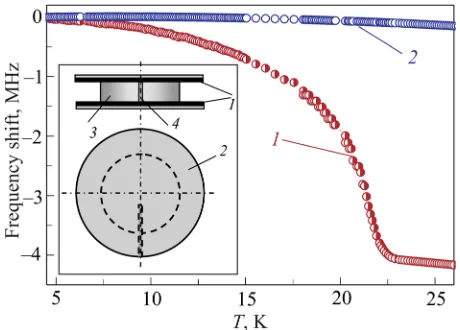
The results of resonant frequency f(T) measurement of the resonator with and without the studied crystal are shown in Fig.1.
To obtain Xs(T) from measured f(T) we use the
well-known expressions (see, e.g., Refs.22,24, and25). One can obtain expression for temperature variation of the surface
re-actanceDXs(T) through the temperature changing the
resona-tor frequencyDx(T),
AsDXsðTÞ ¼ 2DxðTÞ=xðTÞ; (1)
wherex¼2pf,As is the inclusion coefficient of the sample
under test. It depends on geometry and dimensions of the sample and field structure (mode) in the resonator. In a given workAswas evaluated by simulation of the resonator using
Microwave Studio CST. We obtainAs¼2.83104mOhm1
at interaction of HEnm0-mode with a sample of
2.503.500.10 mm dimensions.
Evidently, in a case of WGM slotted resonator (see inset in Fig. 1), analogously to other resonator techniques, the most appropriate approach can be one, at which variation
Xs(T) is determined25as
DXsðT;TrefÞ ¼XsðT;TrefÞ XsðTrefÞ; (2)
where Tref is a certain reference temperature. Because Xs(T)¼x(T)l0k(T) atT< <Tc, we can write
DXsðT;TrefÞ ¼xðTÞl0DkðT;TrefÞ; (3)
whereDk(T,Tref)¼k(T)k(Tref). From(1)and(3)Dk(T,Tref)
can be expressed as
DkðT;TrefÞ ¼
2DxðT;TrefÞ Asx2ðTÞl0
; (4)
whereDx(T,Tref)¼x(T)x(Tref).
The experimental temperature lawDk(T,Tref) allows one
to extrapolate it toT!0 and, knowingk(0) from other meas-urements, to determinek(T).
It is worthy to note that in Dx(T,Tref) the variations Dxe(T,Tref) and Dxd(T,Tref) conditioned by temperature
[image:5.630.332.562.50.215.2]dependences both of sapphire permittivity e and the disk dimensions are deducted by means of subtracting the
FIG. 1. The resonant frequency shift of the resonator with (curve1) and without (curve 2) single crystal Ba(Fe1xCox)2As2 sample depending on
temperature. Inset shows the slotted sapphire disk resonator with a single crystal Ba(Fe1xCox)2As2in a slot. The superconducting films (1) are
sput-tered on the single crystal sapphire substrates (2), a sapphire disk (3) with a single crystal Ba(Fe1xCox)2As2(4) in a radial slot is sandwiched between
superconducting YBa2Cu3O7dendplates (1).
726 Low Temp. Phys.37(8), August 2011 Baranniket al.
corresponding curves off(T)¼x/2pin Fig. 1. The value of
Xs(T) was determined from the measured dependence DXs(T), calibrated using the value k(0)¼208 nm known
from the previous measurement.19
The temperature variation of London penetration depth,
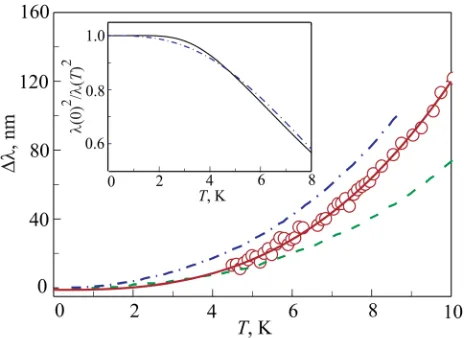
Dk(T), determined from microwave data is presented in Fig.2. The observed dependence ofDk(T) follows a power law,Dk(T)Tnwithn¼2.8 from low temperatures up to at least 0.6Tc. The obtained dependence is similar to
radio-frequency range measurements,7,16,26,27althoughnis rather distinguished from them. When the given work results were processed, a work28 was arrived indicating n%2.66. The difference Dk(T)¼k(T)k(0) and the superfluid density,
ns(T)¼[k(0)/k(T)]
2
, are commonly used to analyze penetra-tion depth data and compare the calculapenetra-tions making cer-tain assumptions regarding the superconducting gap structure.29
The temperature dependence [k(0)/k(T)]2 is shown in Fig.2 (see inset), where one can see the calculated curves for a power law Dk(T)T2.8 and for exponential law
Dk(T)(pD(0)/2kT)1/2 exp(D(0)/kT) with D(0)¼0.75 in
kTcunits, wherekis Boltzmann coefficient. At low
tempera-turesD(0)%D(T) up toT%Tc/3. One can see that at least at
low temperatures both functional laws are very close. The fact means that the temperature dependences of both London penetration depth and the superfluid density indicate evident absence of nodes of superconducting gap function and allow concluding about one of the expendeds-wave symmetries of the studied pnictide.
In summary, we carried out microwave surface imped-ance measurements of the optimally doped single crystal Ba(Fe1xCox)2As2 (x¼0.074) with critical temperature Tc¼22.8 K and found the power-law exponent n¼2.8 in
temperature dependence of the London penetration depth. The obtained dependence is similar to radio-frequency meas-urements indicating no noticeable frequency dependence of the response.7This exponent points towards nodeless state with pairbreaking scattering, which can support one of the
extended s-pairing symmetries.26 The temperature depend-ence [k(0)/k(T)]2 calculated for a power law Dk(T)T2.8
and exponential law for one superconducting small-gap (D/kTc¼0.75) superconductor are very close. If another gap
exists, it has a small weight coefficient.
a)
Email: [email protected]
1Y. Kamihara, T. Watanabe, M. Hirano, and H. Hosono,J. Am. Chem. Soc.130, 3296 (2008).
2
D. A. Bonn and W. N. Hardy, inHandbook of High Temperature Super-conductivity, edited by J. R. Schriffer and J. S. Brooks (Springer, 2007).
3K. Hashimoto, T. Shibauchi, T. Kato, K. Ikada, R. Okazaki, H. Shishido,
M. Ishikado, H. Kito, A. Iyo, H. Eisaki, S. Shamoto, and Y. Matsuda,
Phys. Rev. Lett.102, 017002 (2009).
4
K. Hashimoto, T. Shibauchi, S. Kasahara, K. Ikada, S. Tonegawa, T. Kato, R. Okazaki, C. J. Van der Beek, M. Konczykowski, H. Takeye, K. Hirata, T. Terashima, and Y. Matsuda,Phys. Rev. Lett.102, 207001 (2009).
5
T. Shibauchi, K. Hashimoto, R. Okazaki, and Y. Matsuda,PhysicaC469, 590 (2009).
6
T. Goko, A. A. Aczel, E. Baggio-Saitovitch, S. L. Bud’ko, P. C. Canfield, J. P. Carlo, G. F. Chen, Pengcheng Dai, A. C. Hamann, W. Z. Hu, H. Kageyama, G. M. Luke, J. L. Luo, B. Nachumi, N. Ni, D. Reznik, D. R. Sanchez-Candela, A. T. Savici, K. J. Sikes, N. L. Wang, C. R. Wiebe, T. J. Williams, T. Yamamoto, W. Yu, and Y. J. Uemura, e-print arXiv: 0808.1425.
7
R. T. Gordon, N. Ni, C. Martin, M. A. Tanatar, M. D. Vannette, H. Kim, G. D. Samolyuk, J. Schmalian, S. Nandi, A. Kreyssig, A. I. Goldman, J. Q. Yan, S. L. Bud’ko, P. C. Canfield, and R. Prozorov,Phys. Rev. Lett.
102, 127004 (2009); M. A. Tanatar, N. Ni, C. Martin, R. T. Gordon, H. Kim, V. G. Kogan, G. D. Samolyuk, S. L. Bud’ko, P. C. Canfield, and R. Prozorov,Phys. Rev. B79, 094507 (2009).
8L. Luan, O. M. Auslaender, T. M. Lippman, C. W. Hicks, B. Kalisky,
J.-H. Chu, J. G. Analytis, I. R. Fisher, J. R. Kirtley, and K. A. Moler, e-print arXiv: 0909.0744.
9
K. Hashimoto, A. Serafin, S. Tonegawa, R. Katsumata, R. Okazaki, T. Saito, H. Fukazawa, Y. Kohori, K. Kihou, C. H. Lee, A. Iyo, H. Eisaki, H. Ikeda, Y. Matsuda, A. Carrington, and T. Shibauchi, e-print arXiv: 1003.6022.
10
R. Prozorov, R. W. Giannetta, A. Carrington, and F. M. Araujo-Moreira,
Phys. Rev. B62, 115 (2000).
11R. Prozorov, R. W. Giannetta, A. Carrington, P. Fournier, R. L. Greene, P.
Guptsarma, D. G. Hinks, and A. R. Banks,Appl. Phys. Lett.77, 4202 (2000).
12
L. Luan, O. M. Auslaender, T. M. Lippman, C. W. Hicks, B. Kalisky, J. H. Chu, J. G. Analytis, I. R. Fisher, J. R. Kirtley, and K. A. Moler,Phys. Rev. B81, 100501 (2010).
13
T. J. Williams, A. A. Aczel, E. Baggio-Saitovitch, S. L. Bud’ko, P. C. Canfield, J. P. Carlo, T. Goko, J. Munevar, N. Ni, Y. J. Uemura, W. Yu, and G. M. Luke,Phys. Rev. B80, 094501 (2009).
14D. Nakamura, Y. Imai, A. Maeda, T. Katase, H. Hiramatsu, and H.
Hosono, e-print arXiv: 0912.4351.
15
M. Nakajima, S. Ishida, K. Kihou, Y. Tomioka, T. Ito, Y. Yoshida, C. H. Lee, H. Kito, A. Iyo, H. Eisaki, K. M. Kojima, and S. Uchida, e-print arXiv: 1003.5038.
16
K. W. Kim, M. Ro¨ssle, A. Dubroka, V. K. Malik, T. Wolf, and C. Bern-hard,Phys. Rev. B81, 214508 (2010).
17T. Fischer, A. V. Pronin, J. Wosnitza, K. Iida, F. Kurth, S. Haindl,
L. Schultz, B. Holzapfel, and E. Schachinger, e-print arXiv: 1005.0692.
18
R. T. Gordon, C. Martin, H. Kim, N. Ni, M. A. Tanatar, J. Schmalian, I. I. Mazin, S. L. Bud’ko, P. C. Canfield, and R. Prozorov,Phys. Rev. B79, 100506(R) (2009).
19K. Terashima, Y. Sekiba, J. H. Bowen, K. Nakayama, T. Kawahara, T.
Sato, P. Richard, Y.-M. Xu, L. J. Li, G. H. Cao, Z.-A. Xu, H. Ding, and T. Takahashi,Proc. Natl. Acad. Sci. U.S.A.106, 7330 (2009).
20M. A. Tanatar, J.-Ph. Reid, H. Shakeripour, X. G. Luo, N.
Doiron-Leyr-aud, N. Ni, S. L. Bud’ko, P. C. Canfield, R. Prozorov, and L. Taillefer, e-print arXiv: 0907.1276.
21
N. Ni, M. E. Tillman, J.-Q. Yan, A. Kracher, S. T. Hannahs, S. L. Bud’ko, and P. C. Canfield,Phys. Rev. B78, 214515 (2008).
[image:6.630.68.300.50.219.2]22N. Cherpak, A. Barannik, Y. Filipov, Y. Prokopenko, and S. Vitusevich, IEEE Trans. Appl. Supercond.13, 3570 (2003).
FIG. 2. The variation of London penetration depthDk(T) in a single crystal Ba(Fe1xCox)2As2at low temperatures. The open circles represent
experi-mental data, the solid line refers to power lawT2.8
. The dashed and dash-dot lines correspond to the experimental data in Refs.7and27accordingly. Inset shows the temperature dependence of superconducting electron com-ponent under condition both of the power lawDk(T)T2.8(solid line) and
the exponential law with a small gapD/kTc¼0.75 (dash-dot line) at low temperatures.
Low Temp. Phys.37(8), August 2011 Baranniket al. 727
23A. Barannik, N. Cherpak, N. Ni, M. A. Tanatar, S. Vitusevich, K.
Torokh-tii, V. Skresanov, P. C. Canfield, and R. Prozorov,International Confer-ence on Superconductivity and Magnetism (ICMS 2010)(Antalya, Turkey, 2010), p. 305.
24D. A. Bonn and W. N. Hardy, inPhysical Properties of High Temperature Superconductors, edited by M. Ginsberg (World Scientific, 1996).
25
N. Cherpak, A. Barannik, S. Bunyaev, Yu. Prokopenko. K. Torokhtii, and S. Vitusevich,IEEE Appl. Supercond.21, 591 (2011).
26H. Kim, R. T. Gordon, M. A. Tanatar, J. Hua, U. Welp, W. K. Kwok,
N. Ni, S. L. Bud’ko, P. C. Canfield, A. B. Vorontsov, and R. Prozorov, e-print arXiv:1003.2959.
27R. T. Gordon, H. Kim, N. Salovich, R. W. Giannetta, R. M. Fernandes,
V. G. Kogan, T. Prozorov, S. L. Bud’ko, P. C. Canfield, M. A. Tanatar, and R. Prozorov,Phys. Rev. B82, 054507 (2010).
28J. S. Bobowski, J. C. Baglo, J. Day, P. Dosanjh, R. Ofer, B. J. Ramshaw,
R. Liang, D. A. Bonn, and W. N. Hardy, e-print arXiv:1009.394.
29
R. Prozorov and R. W. Giannetta, Supercond. Sci. Technol. 19, R41 (2006).
This article was published in English in the original Russian journal. Reproduced here with stylistic changes by AIP.
728 Low Temp. Phys.37(8), August 2011 Baranniket al.