Supporting High Performance Molecular Dynamics in
Virtualized Clusters using IOMMU, SR-IOV, and GPUDirect
Andrew J. Younge
1, John Paul Walters
2, Stephen P. Crago
2, Geoffrey C. Fox
11
School of Informatics and Computing
Indiana Univerisity
Bloomington, IN 47408
{ajyounge,gcf}@indiana.edu
2
Information Sciences Institute
University of Southern California
Arlington, VA 22203
{jwalters,crago}@isi.edu
Abstract
Cloud Infrastructure-as-a-Service paradigms have recently shown their utility for a vast array of computational prob-lems, ranging from advanced web service architectures to high throughput computing. However, many scientific com-puting applications have been slow to adapt to virtualized cloud frameworks. This is due to performance impacts of virtualization technologies, coupled with the lack of ad-vanced hardware support necessary for running many high performance scientific applications at scale.
By using KVM virtual machines that leverage both Nvidia GPUs and InfiniBand, we show that molecular dy-namics simulations with LAMMPS and HOOMD run at near-native speeds. This experiment also illustrates how vir-tualized environments can support the latest parallel com-puting paradigms, including both MPI+CUDA and new GPUDirect RDMA functionality. Specific findings show ini-tial promise in scaling of such applications to larger produc-tion deployments targeting large scale computaproduc-tional work-loads.
1.
Introduction
The cloud computing paradigm has become pervasive for commodity computing, but has not yet become widely ac-cepted in the High Performance Computing (HPC) commu-nity. Various platform tools such as Hadoop and MapRe-duce, among others, have already percolated into data in-tensive computing within HPC [20]. In addition, there are efforts to support traditional HPC-centric scientific comput-ing applications in virtualized cloud infrastructure. There are
Permission to make digital or hard copies of all or part of this work for personal or classroom use is granted without fee provided that copies are not made or distributed for profit or commercial advantage and that copies bear this notice and the full citation on the first page. Copyrights for components of this work owned by others than ACM must be honored. Abstracting with credit is permitted. To copy otherwise, or republish, to post on servers or to redistribute to lists, requires prior specific permission and/or a fee. Request permissions from [email protected].
VEE ’15, March 14–15, 2015, Istanbul, Turkey.. Copyright c2015 ACM 978-1-4503-3450-1/15/03. . . $15.00. http://dx.doi.org/10.1145/2731186.2731194
a multitude of reasons for supporting parallel computation in the cloud[12], including features such as dynamic scalabil-ity, specialized operating environments, simple management interfaces, fault tolerance, and enhanced quality of service, to name a few. There is a growing effort to support advanced scientific computing using virtualized infrastructure which can be seen by a variety of new efforts, including the Comet resource within XSEDE at San Diego Supercomputer Center [25].
Nevertheless, there exists a past notion that virtualization used in cloud infrastructure is inherently inefficient. His-torically, cloud infrastructure has done little to provide the necessary advanced hardware capabilities that have become almost mandatory in supercomputers today, most notably advanced GPUs and high-speed, low-latency interconnects. Instead, cloud infrastructure providers have favored com-modity homogeneous systems. The result of these notions has hindered the use of virtualized environments for parallel computation, where performance is paramount.
This is starting to change, however, as today’s cloud providers seek improved performance at lower power. This has resulted in a heterogeneous cloud. Amazon EC2 ports GPU accelerators in EC2 [5], and OpenStack sup-ports heterogeneity using flavors [8]. These advancements in cloud level support for heterogeneity combined with bet-ter support for high-performance virtualization makes the use of cloud for HPC much more feasible for a wider range of applications and platforms.
Still, performance remains a concern within virtualized environments. To that end, a growing effort is currently underway that looks to systematically identify and reduce any overhead in virtualization technologies. While some of the first efforts to investigate HPC applications on cloud infrastructure like the DOE Magellan project [37] docu-mented many shortcomings in performance, recent efforts have proven to be largely successful [24, 38], though further research is needed to address issues of scalability and I/O.
also with HPC workloads. While virtualization will almost always include some additional overhead in relation to its dynamic features, the eventual goal for supporting HPC in virtualized environments is to minimize what overhead ex-ists whenever possible. To advance the placement of HPC applications on virtual machines, new efforts are emerging which focus specifically on key hardware now common-place in supercomputers. By leveraging new virtualization tools such as I/O memory management unit (IOMMU) de-vice passthrough and Single Root I/O Virtualization (SR-IOV), we can now support such advanced hardware as the latest Nvidia Tesla GPUs [36] as well as InfiniBand fabrics for high performance networking and I/O [21, 26]. While previous efforts have focused on single-node advancements, our contribution in this paper is to show that real-world ap-plications can operate efficiently in multi-node clusters and cloud infrastructure.
The remainder of this paper is organized as follows. In Section 2 we describe the background and related work nec-essary for high performance virtualization. In Section 3, we describe a heterogeneous cloud platform, based on Open-Stack. This effort has been under development at USC/ISI since 2011 [14]. We describe our work towards integrating GPU and InfiniBand support into OpenStack, and we de-scribe the heterogeneous scheduling additions that are neces-sary to support not only attached accelerators, but any cloud composed of heterogeneous elements.
In Sections 4 and 5 we describe the LAMMPS and HOOMD benchmarks and our experimental setup. In Sec-tion 6 we characterize the performance of LAMMPS and HOOMD in a virtual infrastructure complete with both Kepler GPUs and QDR InfiniBand. Both HOOMD and LAMMPS are used extensively in some of the world’s fastest supercomputers and represent example simulations that HPC supports today. We show that these applications are able to run at near-native speeds within a completely virtualized environment. Furthermore, we demonstrate the ability of such a virtualized environment to support cutting edge technologies such as RDMA GPUDirect, illustrating that the latest HPC technologies are also possible in a virtu-alized environment. In Section 7, we provide a brief discus-sion before concluding in Section 8.
2.
Background and Related Work
Virtualization technologies and hypervisors have seen wide-spread deployment in support of a vast array of applica-tions. This ranges from public commercial cloud deploy-ments such as Amazon EC2 [1], Microsoft Azure [19], and Google’s Cloud Platform [6] to private deployments within colocation facilities, corporate data centers, and even na-tional scale cyberinfrastructure initiatives. All these look to support various use cases and applications such as web servers, ACID and BASE databases, online object storage, and even distributed systems, to name a few.
The use of virtualization and hypervisors to support var-ious HPC solutions has been studied with mixed results. In [38], it is found that there is a great deal of variance be-tween hypervisors when running various distributed mem-ory and MPI applications, and that overall, KVM performed well across an array of HPC benchmarks. Furthermore, some applications may not may fit well into default virtualized en-vironments, such as High Performance Linpack [24]. Other studies have looked at interconnect performance in virtu-alization and found the performance of conventional tech-niques to be lacking even in the best-case scenario, with up to a 60% performance penalty [28].
Recently, various CPU architectures have added support for I/O virtualization mechanisms in the CPU ISA through the use of an I/O memory management unit (IOMMU). Of-ten, this is referred to as PCI Passthrough, as it enabled de-vices on the PCI-Express bus to be passed directly to a spe-cific virtual machine (VM). Spespe-cific hardware implemen-tations include Intel’s VT-d [29], AMD’s IOMMU [9] for x86_64 architectures, and recently ARM System MMU [11]. All of these implementations effectively look to aid in the usage of DMA-capable hardware to be used within a spe-cific virtual machine. By using these features, a wide array of hardware can be utilized directly within VMs and enable fast and efficient computation and I/O capabilities.
2.1 GPU Passthrough
Nvidia GPUs comprise the single most common accelerator in the Nov 2014 Top 500 List [15] and represent an increas-ing shift towards accelerators for HPC applications. Histori-cally, GPU usage in a virtualized environment has been diffi-cult, especially for scientific computation. Various front-end remote API implementations have been developed to pro-vide CUDA and OpenCL libraries in VMs, which translate library calls to a back-end or remote GPU. One common im-plementation of this is rCUDA [16], which provides a front-end CUDA API within a VM or any compute node, and then sends the calls via Ethernet or InfiniBand to a separate node with 1 or more GPUs. While this method provides the de-sired functionality, it has the drawback of relying on the in-terconnect itself and the bandwidth available, which can be especially problematic on an Ethernet based network. Fur-thermore, as this method consumes bandwidth, it can leave little remaining for MPI or RDMA routines, thereby con-structing a bottleneck for some MPI+CUDA applications that depend on inter-process communication. Another mech-anism of using GPUs in VMs is hypervisor based virtualiza-tion [33].
high performance across a range of hypervisors and GPUs, the efforts have been limited to investigating single node performance until now.
2.2 SR-IOV and InfiniBand
With almost all parallel HPC applications, the interconnect fabric which enables fast and efficient communication be-tween processors becomes a central requirement to achiev-ing good performance. Specifically, a high bandwidth link is needed for distributed processors to share large amounts of data across the system. Furthermore, low latency becomes equally important for ensuring quick delivery of small mes-sage communications and resolving large collective barri-ers within many parallelized codes. One such interconnect, InfiniBand, has become the most common implementation used within the Top500 list.
Supporting I/O interconnects in VMs has been aided by Single Root I/O Virtualization (SR-IOV), whereby multiple virtual PCI functions are created in hardware to represent a single PCI device. These virtual functions (VFs) can then be passed to a VM and used by the guest as if it had direct ac-cess to that PCI device. SR-IOV allows for the virtualization and multiplexing to be done within the hardware, effectively providing higher performance and greater control than soft-ware solutions.
SR-IOV has been used in conjunction with Ethernet de-vices to provide high performance 10Gb TCP/IP connectiv-ity within VMs [23], offering near-native bandwidth and ad-vanced QoS features not easily obtained through emulated Ethernet offerings. Currently Amazon EC2 offers a high per-formance VM solution utilizing SR-IOV enabled 10Gb Eth-ernet adapters. While SR-IOV enabled 10Gb EthEth-ernet solu-tions offers a big forward in performance, Ethernet still does not offer the high bandwidth or low latency typically found with InfiniBand solutions.
Recently SR-IOV support for InfiniBand has been added by Mellanox in the ConnectX series adapters. Initial evalu-ation of SR-IOV InfiniBand within KVM VMs has demon-stration point-to-point bandwidth to be near-native, but with up to 30% latency overhead for very small messages [21, 30]. However, even with the noted overhead, this still sig-nifies up to an order of magnitude difference in latency be-tween InfiniBand and Ethernet with VMs. Furthermore, ad-vanced configuration of SR-IOV enabled InfiniBand fabric is taking shape, with recent research showing up to a 30% reduction in the latency overhead [26]. However, real appli-cation performance has not yet been well understood until now.
2.3 GPUDirect
NVIDIA’s GPUDirect technology was introduced to reduce the overhead of data movement across GPUs [2, 32]. Cur-rently, there exists three distinct versions of GPUDirect. GPUDirect v1 adds accelerated communication with net-work and storage devices through the use of a single CPU
buffer, and GPUDirect v2 provides peer-to-peer communica-tion between discrete GPUs on a single node. GPUDirect v3, the most recent version and what is used in this manuscript, provides support for direct RDMA between GPUs across an InfiniBand interconnect for Kepler-class GPUs. This allevi-ates the need for staging data to/from host memory in or-der to transmit data via InfiniBand between GPUs on sepa-rate nodes, although it does require application code to target GPUDirect.
GPUDirect relies on three key technologies: CUDA 5 (and up), a CUDA-enabled MPI implementation, and a Kepler-class GPU (RDMA only). Both MVAPICH and OpenMPI support GPUDirect. Support for RDMA over GPUDirect is enabled by the MPI library, given supported hardware, without requiring changes to the MPI calls. In this paper, we demonstrate scaling a MD simulation to 4 nodes connected via QDR InfiniBand and show that GPUDirect RDMA improves both scalability and overall performance by approximately 9% at no cost to the end user.
3.
A Cloud for High Performance Computing
With support for GPU Passthrough, SR-IOV, and GPUDi-rect, we have the building blocks for a high performance, heterogeneous cloud. In addition, other common accelera-tors (e.g. Xeon Phi [4]) have similarly been demonstrated in virtualized environments. We envision a heterogeneous cloud that supports both high speed networking and accel-erators for tightly coupled applications.
To this end we developed a heterogeneous cloud based on OpenStack [7]. In our previous work, we demonstrated the ability to rapidly provision GPU, bare metal, and other het-erogeneous resources within a single cloud [14]. Building on this effort we have added support for GPU passthrough to OpenStack as well as prototyped SR-IOV support for ConnectX-2 and ConnectX-3 Infiniband devices. Mellanox has since added an OpenStack InfiniBand networking plugin for OpenStack’s Neutron service [3]. While OpenStack sup-ports services for networking (Neutron), compute (Nova), identity (Keystone), storage (Cinder, Swift), and others, our work focuses entirely on the compute service.
Scheduling is implemented at two levels: the cloud level and the node level. In our earlier work, we have developed a cloud level heterogeneous scheduler for OpenStack that allows scheduling based on architectures and resources [14]. In this model, the cloud level scheduler dispatches jobs to nodes based on resource requirements (e.g. Kepler GPU) and node level resource availability.
scheduler. For reporting, we augment OpenStack’s existing reporting mechanism to provide a low overhead solution.
4.
Benchmarks
We selected two molecular dynamics (MD) applications for evaluation in this study: LAMMPS and HOOMD [10, 27]. These MD simulations are chosen to represent a subset of advanced parallel computation for a number of fundamental reasons:
•MD simulations provide a practical representation of N-Body simulations, which are one of the major computa-tionalDwarfs[13] in parallel and distributed computing.
•MD simulations are one of the most widely deployed
applications on large scale supercomputers today.
•Many MD simulations have a hybrid MPI+CUDA
pro-gramming model, which has become commonplace in HPC as the use of accelerators increase.
As such, we look to LAMMPS and HOOMD to provide a real-world example for running cutting-edge parallel pro-grams on virtualized infrastructure. While these applications by no means represent all parallel scientific computing ef-forts (see 13 Dwarfs [13]), we hope these MD simulators offer a more pragmatic viewpoint than traditional synthetic HPC benchmarks such as High Performance Linpack.
LAMMPS The Large-scale Atomic/Molecular Parallel Simulator is a well-understood highly parallel molecular dynamics simulator. It supports both CPU and GPU-based workloads. Unlike many simulators, both MD and other-wise, LAMMPS is heterogeneous. It will use both GPUs and multicore CPUs concurrently. For this study, this het-erogeneous functionality introduces additional load on the host, allowing LAMMPS to utilize all available cores on a given system. Networking in LAMMPS is accomplished using a typical MPI model. That is, data is copied from the GPU back to the host and sent over the InfiniBand fab-ric. LAMMPS does not include GPUDirect support, and no RDMA is used for these experiments.
HOOMD-blue The Highly Optimized Object-oriented Many-particle Dynamics – Blue Edition is a particle dynam-ics simulator capable of scaling into the thousands of GPUs. HOOMD supports executing on both CPUs and GPUs. Un-like LAMMPS, HOOMD is homogeneous and does not sup-port mixing of GPUs and CPUs. HOOMD supsup-ports GPUDi-rect using a CUDA-enabled MPI. In this paper we focus on HOOMD’s support for GPUDirect and show its benefits for increasing cluster sizes.
5.
Experimental Setup
Using two molecular dynamics tools, LAMMPS[27] and
HOOMD [10], we demonstrate a high performance
sys-tem. That is, we combine PCI passthrough for Nvidia
Kepler-class GPUs with QDR Infiniband SR-IOV and show that high performance molecular dynamics simulations are achievable within a virtualized environment. For the first time, we also demonstrate Nvidia GPUDirect technology within such a virtual environment. Thus, we look to not only illustrate that virtual machines provide a flexible high per-formance infrastructure for scaling scientific workloads, in-cluding MD simulations, but also that the latest HPC features and programming environments are available and efficient in this same model.
5.1 Node configuration
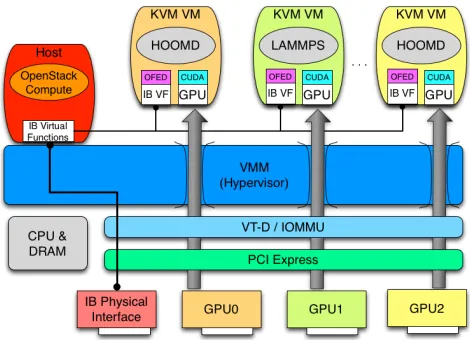
To support the use of Nvidia GPUs and InfiniBand within a VM, specific host configuration is needed. This node config-uration is illustrated in Figure 1. While our implementation is specific to the KVM hypervisor, this setup represents a design that can be hypervisor agnostic.
[image:4.612.319.554.470.640.2]Each node in the testbed uses CentOS 6.4 with a 3.13 upstream Linux kernel for the host OS, along with the latest KVM hypervisor, QEMU 2.1, and thevfiodriver. Each guest VM runs CentOS 6.4 with a stock 2.6.32-358.23.2 kernel. A Kepler GPU is passed through using PCI Passthrough and directly initiated within the VM via the Nvidia 331.20 driver and CUDA release 5.5. While this specific implementation used only a single GPU, it is also possible to include as many GPUs as one can fit within the PCI Express bus if desired. As the GPU is used by the VM, an on-board VGA device was used by the host and a standard Cirrus VGA was em-ulated in the guest OS. OFED version 2.1-1.0.0 drivers are used with Mellanox ConnectX-3 VPI adapter with firmware 2.31.5050. The host driver initiates 4 VFs, one of which is passed through to the VM where the default OFED mlnx_ib drivers are loaded.
Figure 1. Node PCI Passthrough of GPUs and InfiniBand
5.2 Cluster Configuration
with K40 GPUs, demonstrating the potential for a more heterogeneous deployment. Each server is composed of 2 Intel Xeon E5-2670 CPUs, 48GB of DDR3 memory, and Mellanox ConnectX-3 QDR InfiniBand. CPU sockets and memory are split evenly between the two NUMA nodes on each system. All InfiniBand adapters use a single Voltaire 4036 QDR switch with a software subnet manager for IPoIB functionality.
For these experiments, both the GPUs and InfiniBand adapters are attached to NUMA node 1 and both the guest VMs and the base system utilized identical software stacks. Each guest was allocated 20 GB of RAM and a full socket of 8 cores, and pinned to NUMA node 1 to ensure optimal hardware usage. For a fair and effective comparison, we also use a native environment without any virtualization. This na-tive environment employs the same hardware configuration, and like the Guest OS runs CentOS 6.4 with the stock 2.6.32-358.23.2 kernel.
6.
Results
In this section, we discuss the performance of both the LAMMPS and HOOMD molecular dynamics simulation tools when running within a virtualized environment. Each application set was run 10 times, with the results averaged accordingly.
[image:5.612.320.558.69.243.2]6.1 LAMMPS
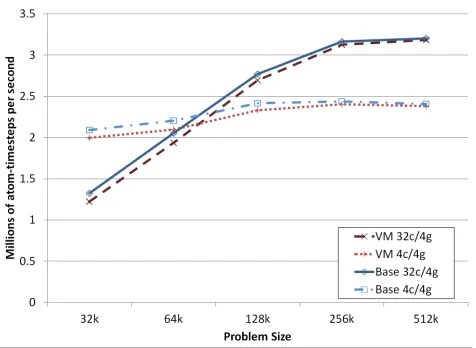
Figure 2. LAMMPS LJ Performance
Figure 2 shows one of the most common LAMMPS gorithms used - the Lennard-Jones potential (LJ). This al-gorithm is deployed in two main configurations - a 1:1 core to GPU mapping and a 8:1 core to GPU mapping, labeled in Figures 2 and 3 as 4c/4g and 32c/4g, respectively. With the LAMMPS GPU implementation, a delicate balance be-tween GPUs and CPUs is required to find the optimal ratio for fastest computation, however here we just look at the two most obvious choices. With small problem sizes, the 1:1 mapping outperforms the more complex core
deploy-Figure 3. LAMMPS RHODO Performance
ment, as the problem does not require the additional com-plexity provided with a multi-core solution. As expected the multi-core configuration quickly offers better performance for larger problem sizes, achieving roughly twice the perfor-mance with all 32 available cores. This is largely due to the availability of all 8 cores to keep the GPU fully utilized.
The important factor for this manuscript is the relative performance of the virtualized environment. From the re-sults, it is clear the VM solution performs very well com-pared to the best-case native deployment. For the multi-core configuration across all problem sizes, the virtualized deployment averaged 98.5% efficiency compared to native. The single core per GPU deployment reported better-than native performance at 100% native. This is likely due to caching effects, but further investigation is needed to fully identify this occurrence.
Another common LAMMPS algorithm, the Rhodopsin protein in solvated lipid bilayer benchmark (Rhodo), was also run with results given in Figure 3. As with the LJ runs, we see the multi-core to GPU configuration resulting in higher computational performance for the larger problem sizes compared to the single core per GPU configuration, as expected.
Again, the overhead of the virtualized configuration re-mains low across all configurations and problem sizes, with an average 96.4% efficiency compared to native. We also see the gap in performance decrease as the problem size in-creases, with the 512k problem size yielding 99.3% of native performance. This finding leads us to extrapolate that a vir-tualized MPI+CUDA implementation could scale to a larger computational resource with similar success.
6.2 HOOMD
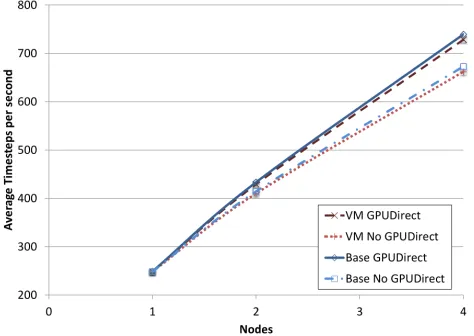
[image:5.612.57.293.397.580.2]RDMA for GPUDirect. From Figure 4 we can see that HOOMD simulations, both with and without GPUDirect, perform very near-native. The GPUDirect results at 4 nodes achieve 98.5% of the base system’s performance. The non-GPUDirect results achieve 98.4% efficiency at 4 nodes. These results indicate the virtualized HPC environment is able to support such complex workloads. While the effective testbed size is relatively small, it indicates that such work-loads may scale equally well to hundreds or thousands of nodes. The advantage of using GPUDirect RDMA is also evident in Figure 4, with a 9% performance boost realized for both virtualized and non-virtualized experiments.
Figure 4. HOOMD LJ Performance with 256k Simulation
7.
Discussion
From the results, we see the potential for running HPC ap-plications in a virtualized environment using GPUs and In-finiBand interconnect fabric. Across all LAMMPS runs, we found only a 1.9% overhead between the KVM virtualized environment and native. For HOOMD, we found a similar 1.5% overhead, both with and without GPU Direct. These results go against conventional wisdom that HPC workloads perform poorly in VMs. In fact, we show two N-Body type simulations programmed in an MPI+CUDA implementation perform at roughly near-native performance in tuned KVM virtual machines.
With HOOMD, we see how GPUDirect RDMA shows a clear advantage over the non-GPUDirect implementation, achieving a 9% performance boost in both the native and vir-tualized experiments. While GPUDirect’s performance im-pact has been well evaluated previously [2], it is the authors’ belief that this manuscript represents the first time GPUDi-rect has has been utilized in a virtualized environment.
Another interesting finding of running LAMMPS in a virtualized environment is that as workload increases from a single node to 32 cores, the overhead does not increase. These results lend credence to the notion that this solution would also work for a much larger deployment, assuming
system jitter can be minimized [31]. Specifically, it would be possible to expand such computational problems to a larger deployment in FutureGrid [17], Chameleon Cloud [22], or even the planned NSF Comet machine at SDSC, scheduled to provide up to 2 Petaflops of computational power. Effectively, these results provide evidence that HPC computations can be supported in virtualized environment with minimal overhead.
8.
Conclusion
The ability to run large-scale parallel scientific applica-tions in the cloud has become possible, but historically has been limited by both performance concerns and infrastruc-ture availability. In this work we show that advanced HPC-oriented hardware such as the latest Nvidia GPUs and In-finiBand fabric are now available within a virtualized infras-tructure. Our results find MPI + CUDA applications, such as molecular dynamics simulations, run at near-native per-formance compared to traditional non-virtualized HPC in-frastructure, with just an averaged 1.9% and 1.5% overhead for LAMMPS and HOOMD, respectively. We also show the utility of GPUDirect RDMA for the first time in a cloud environment with HOOMD. The support of these work-loads coalesce to provide an open source Infrastructure-as-a-Service framework using OpenStack. Our future efforts will be twofold. We first hope to increase the scale to sigi-ficantly larger cloud infrastructure on a new experimental system and confirm near-native performance is acheivable in a virtualized environment. We also look to expand the workload diversity and support many other HPC and big data applications running efficiently in virtual clusters.
Acknowledgments
This work was developed with support from the National Science Foundation (NSF) under grant #0910812 to Indi-ana University and with support from the Office of Naval Research under grant #N00014-14-1-0035 to USC/ISI. An-drew J. Younge also acknowledges support from The Per-sistent Systems Fellowship of the School of Informatics and Computing at Indiana University.
References
[1] Amazon elastic compute cloud (Amazon EC2). Website, August 2010. URLhttp://aws.amazon.com/ec2/.
[2] NVIDIA GPUDirect. Website, November 2014. URL https://developer.nvidia.com/gpudirect.
[3] Mellanox Neutron Plugin. Website, November 2014. URL https://wiki.openstack.org/wiki/ Mellanox-Neutron.
[4] Getting Xen working for Intel(R) Xeon Phi(tm) Co-processor. Website, November 2014. URL https: //software.intel.com/en-us/articles/
[5] AWS high performance computing. Website, November 2014. URLhttp://aws.amazon.com/hpc/.
[6] Google Cloud Platform. Website, November 2014. URL https://cloud.google.com/.
[7] OpenStack cloud software. Website, November 2014. URL http://openstack.org.
[8] OpenStack flavors. Website, November 2014. URL
http://docs.openstack.org/openstack-ops/content/flavors.html.
[9] AMD Corporation. AMD I/O virtualization technology (IOMMU) specification. Technical report, AMD Corporation, 2009.
[10] J. Anderson, A. Keys, C. Phillips, T. Dac Nguyen, and S. Glotzer. HOOMD-blue, general-purpose many-body dy-namics on the GPU. InAPS Meeting Abstracts, volume 1, page 18008, 2010.
[11] ARM Limited. ARM system memory management unit archi-tecture specification. Technical report, ARM Limited, 2013.
[12] M. Armbrust, A. Fox, R. Griffith, A. D. Joseph, R. Katz, A. Konwinski, G. Lee, D. Patterson, A. Rabkin, I. Stoica, and M. Zaharia. A view of cloud computing. Commun. ACM, 53 (4):50–58, Apr. 2010. ISSN 0001-0782.
[13] K. Asanovic, R. Bodik, B. C. Catanzaro, J. J. Gebis, P. Hus-bands, K. Keutzer, D. A. Patterson, W. L. Plishker, J. Shalf, S. W. Williams, et al. The landscape of parallel computing research: A view from Berkeley. Technical report, Technical Report UCB/EECS-2006-183, EECS Department, University of California, Berkeley, 2006.
[14] S. Crago, K. Dunn, P. Eads, L. Hochstein, D.-I. Kang, M. Kang, D. Modium, K. Singh, J. Suh, and J. P. Walters. Het-erogeneous cloud computing. InCluster Computing (CLUS-TER), 2011 IEEE International Conference on, pages 378– 385. IEEE, 2011.
[15] J. Dongarra, H. Meuer, and E. Strohmaier. Top 500 supercom-puters. Website, November 2014. URLhttp://top500. org/.
[16] J. Duato, A. J. Pena, F. Silla, J. C. Fernández, R. Mayo, and E. S. Quintana-Orti. Enabling CUDA acceleration within vir-tual machines using rCUDA. InHigh Performance Computing (HiPC), 2011 18th International Conference on, pages 1–10. IEEE, 2011.
[17] G. Fox, G. von Laszewski, J. Diaz, K. Keahey, J. Fortes, R. Figueiredo, S. Smallen, W. Smith, and A. Grimshaw. Fu-tureGrid—a reconfigurable testbed for Cloud, HPC and Grid computing. Contemporary High Performance Computing: From Petascale toward Exascale, Computational Science. Chapman and Hall/CRC, 2013.
[18] N. Huber, M. von Quast, M. Hauck, and S. Kounev. Eval-uating and modeling virtualization performance overhead for cloud environments. InCLOSER, pages 563–573, 2011.
[19] R. Jennings.Cloud Computing with the Windows Azure Plat-form. John Wiley & Sons, 2010.
[20] S. Jha, J. Qiu, A. Luckow, P. K. Mantha, and G. C. Fox. A tale of two data-intensive paradigms: Applications, abstractions,
and architectures. In Proceedings of the 3rd International Congress on Big Data, 2014.
[21] J. Jose, M. Li, X. Lu, K. C. Kandalla, M. D. Arnold, and D. K. Panda. SR-IOV support for virtualization on InfiniBand clusters: Early experience. InCluster, Cloud and Grid Com-puting (CCGrid), 2013 13th IEEE/ACM International Sympo-sium on, pages 385–392. IEEE, 2013.
[22] K. Keahey, J. Mambretti, D. K. Panda, P. Rad, W. Smith, and D. Stanzione. NSF Chameleon cloud. Website, November 2014. URLhttp://www.chameleoncloud.org/.
[23] J. Liu. Evaluating standard-based self-virtualizing devices: A performance study on 10 GbE NICs with SR-IOV support. In
Parallel Distributed Processing (IPDPS), 2010 IEEE Interna-tional Symposium on, pages 1–12, April 2010.
[24] P. Luszczek, E. Meek, S. Moore, D. Terpstra, V. M. Weaver, and J. Dongarra. Evaluation of the HPC challenge bench-marks in virtualized environments. InProceedings of the 2011 International Conference on Parallel Processing - Volume 2, Euro-Par’11, pages 436–445, Berlin, Heidelberg, 2012. Springer-Verlag.
[25] R. L. Moore, C. Baru, D. Baxter, G. C. Fox, A. Majumdar, P. Papadopoulos, W. Pfeiffer, R. S. Sinkovits, S. Strande, M. Tatineni, et al. Gateways to discovery: Cyberinfrastructure for the long tail of science. InProceedings of the 2014 Annual Conference on Extreme Science and Engineering Discovery Environment, page 39. ACM, 2014.
[26] M. Musleh, V. Pai, J. P. Walters, A. J. Younge, and S. P. Crago. Bridging the virtualization performance gap for HPC using SR-IOV for InfiniBand. InProceedings of the 7th IEEE In-ternational Conference on Cloud Computing (CLOUD 2014), Anchorage, AK, 2014. IEEE.
[27] S. Plimpton, P. Crozier, and A. Thompson. LAMMPS-large-scale atomic/molecular massively parallel simulator. Sandia National Laboratories, 2007.
[28] L. Ramakrishnan, R. S. Canon, K. Muriki, I. Sakrejda, and N. J. Wright. Evaluating interconnect and virtualization per-formance for high perper-formance computing. SIGMETRICS Perform. Eval. Rev., 40(2):55–60, Oct. 2012. ISSN 0163-5999.
[29] M. Righini. Enabling IntelR virtualization technology fea-tures and benefits. Technical report, Intel Corporation, 2010.
[30] T. P. P. D. L. Ruivo, G. B. Altayo, G. Garzoglio, S. Timm, H. Kim, S.-Y. Noh, and I. Raicu. Exploring InfiniBand hard-ware virtualization in OpenNebula towards efficient high-performance computing. InCCGRID, pages 943–948, 2014.
[31] S. Seelam, L. Fong, A. Tantawi, J. Lewars, J. Divirgilio, and K. Gildea. Extreme scale computing: Modeling the impact of system noise in multicore clustered systems. InParallel Dis-tributed Processing (IPDPS), 2010 IEEE International Sym-posium on, pages 1–12, April 2010. .
[33] Y. Suzuki, S. Kato, H. Yamada, and K. Kono. GPUvm: why not virtualizing GPUs at the hypervisor? InProceedings of the 2014 USENIX conference on USENIX Annual Technical Conference, pages 109–120. USENIX Association, 2014.
[34] K. Tian, Y. Dong, and D. Cowperthwaite. A full GPU virtual-ization solution with mediated pass-through. InProc. USENIX ATC, 2014.
[35] L. Vu, H. Sivaraman, and R. Bidarkar. GPU virtualization for high performance general purpose computing on the ESX hy-pervisor. InProceedings of the High Performance Computing Symposium, HPC ’14, pages 2:1–2:8, San Diego, CA, USA, 2014. Society for Computer Simulation International.
[36] J. P. Walters, A. J. Younge, D.-I. Kang, K.-T. Yao, M. Kang, S. P. Crago, and G. C. Fox. GPU-Passthrough performance: A comparison of KVM, Xen, VMWare ESXi, and LXC for CUDA and OpenCL applications. In Proceedings of the 7th IEEE International Conference on Cloud Computing (CLOUD 2014), Anchorage, AK, 2014. IEEE.
[37] K. Yelick, S. Coghlan, B. Draney, R. S. Canon, et al. The Magellan report on cloud computing for science. Technical report, US Department of Energy, 2011.
[38] A. J. Younge, R. Henschel, J. T. Brown, G. von Laszewski, J. Qiu, and G. C. Fox. Analysis of Virtualization Technologies for High Performance Computing Environments. In Proceed-ings of the 4th International Conference on Cloud Computing (CLOUD 2011), Washington, DC, 2011. IEEE.