D o m a i n D e c o m p o s i t i o n i n D i s t r i b u t e d a n d S h a r e d M e m o r y E n v i r o n m e n t s I: A U n i f o r m Decomposition and Performance Analysis
for the N C U B E a n d JPL Mark IIIfp Hypcrcubes
Geoffrey C. Fox t
Calteeh C o n c u r r e n t Computation Program Mail Code 158-79
California Institute of Technology Pasadena, CA 91125
June 8, 1987
Invited Paper at ICS 87, International Conference on Supercomputing, June 8-12, 87, Athens, Greece. To be published as a Lecture Note in Computer Science by Springer-Verlag, and edited by Constantine Polychronopoulos.
Abstract:
We describe how explicit domain decomposition can lead to implementations of large scale scientific applications w h i c h r u n with near optimal performance on concurrent supercomputers with a variety of archi- tectures. In particular, we show how one can discuss from a uniform point of view two architectural charac- teristics; distributed m e m o r y and hierarchical m e m o r y where a large relatively slow m e m o r y is buffered by a faster cache or local memory. We consider two hypercubes in particular; the commercial N C U B E and JPL's Mark IIIfp with hierarchical m e m o r y at each node o f a hypercube. We remark on the application of these ideas to other architectures and other concurrent computers. We present a performance analysis in terms of basic parameters describing the hardware and the applications.
I: I n t r o d u c t i o n
This paper is the first of a series from Caltech that will discuss some of the issues in developing decom- position and software tools for concurrent supercomputers. In particular we n e e d to develop implementations of major scientific problems that r u n well on concurrent supercomputers with a variety of different architec- tures. At Caltech, there is widespread support among m a n y o f the computational scientists and engineers for the use o f concurrent supercomputers [1]. However, there is clearly no agreement a m o n g either research groups or commercial vendors as to the "right" architectures either at the present or in the future. It is impor- tant that we can find techniques that will allow (Caltech) users to develop code w h i c h will be useable not only on today's prototypes but will not need major revision for future machines.
Presently available concurrent supercomputers suitable for scientific computations can be divided into three classes [2-4]
Small grain size, SIMD, Distributed Memory: Such as the ICL DAP, Goodyear MPP, and Connection Machine.
Large grain size, M I M D Distributed Memory: Such as the various hypercubes a n d the transputer based systems like the M E I K O Computing Surface.
Large grain size, tk~MD Shared Memory: Such as the C R A Y , E T A , ELXSI, A L L I A N T , E N C O R E , S E Q U E N T , C E D A R , B U T T E R F L Y , and RP3.
Here we will concentrate on a version of domain decomposition that is appropriate for the large grain size m a c h i n e s a n d not consider the SIMD architectures. This is not due to lack of interest - the SIMD machines have been very successful in m a n y scientific problems - rather I am largely constrained by ignorance. Further, we will not consider dataflow which could in the future be an interesting approach to supercomputers. In order to focus the paper further, we will not discuss shared m e m o r y m a c h i n e s in general but rather concentrate on one aspect of s o m e o f these machines - n a m e l y a hierarchical m e m o r y where good performance requires data to lie in a cache or local m e m o r y and not fetched from a relatively slow shared m e m o r y each time. We note that a m e m o r y hierarchy is difficult to avoid in high performance machines with pipelined floating point units. We will not discuss important issues s u c h as the contention in a shared m e m o r y access network nor will we consider alternative programming methodologies such as automatic (user or com- puter generated) parallelization o f do and for loops even though these techniques have h a d important successes [28, 29, 32].
I have chosen domain decomposition because it is the natural a n d at present required method for pro- gramming the hypercube. Further, we u n d e r s t a n d it reasonably well a n d shared m e m o r y m a c h i n e s typically support it elegantly [5] whereas the favored shared m e m o r y methodologies are not easy to port to the simpler hardware o f the distributed m e m o r y machines. I will sharpen the h y p e r c u b e discussion further by consider- ing two particular machines.
The commercial N C U B E hypercube with 1/2 megabyte of m e m o r y on each node and up to 1024 nodes. Our initial 512 node machine has 0,25 gigabytes of m e m o r y and 0.05 gigaflops peak performance. The so-called Mark IIIfp hypercube u n d e r construction at Caltech's Jet Propulsion Laboratory (JPL). This will have 128 nodes each with 4 megabytes o f slow m e m o r y and a high performance W E I T E K X L chip based floating point unit buffered by a 64 - 128K bytes data cache i.e., each node has a hierarchical memory. The total machine has 0.5 gigabytes o f m e m o r y and up to 1 gigaflop performance.
We expect these two machines to be the initial hardware facility around w h i c h we will build our new "Concurrent Supercomputing Initiative at Caltech" or CSIC [4,6].
In Sec. II, we describe the target machines in greater detail and introduce and quantify the necessary hardware parameters to measure performance. In the third section, we describe domain decomposition, its application to distributed a n d hierarchical memories and relation to the theory of complex systems [2 ! 7].
T h e heart o f the paper lies in Sec. IV where we analyze several specific scientific algorithms including particle dynamics, iterative m e t h o d s for partial different equations (PDE), fast fourier transform (FFT), matrix inversion and multiplication and finally neural network simulation. We conclude in Sec. V.
II: Charaeterlzation of Concurrent Machines
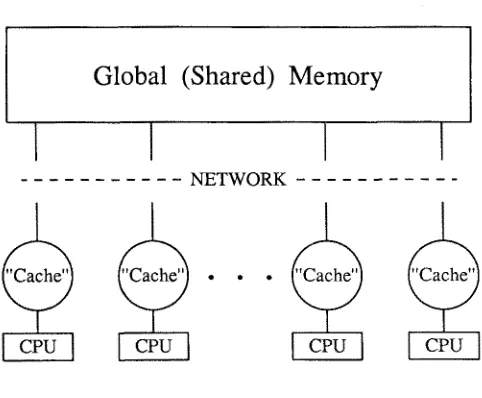
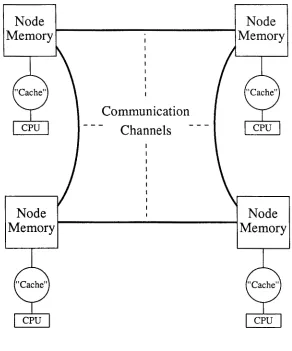
The hardware architectures considered here are s h o w n in Fig. 1. In l(a) we show a generic sequential machine with a cache as a buffer to a main memory. It should be noted that this conventional m a c h i n e is not the focus o f this article; however, the techniques described here could allow coding s u c h m a c h i n e s in a way that m a k e s excellent u s e of t h e cache. In Figs. t(b) and (c), we generalize this architecture in two ways. Firstly in l(b), we s h o w a hierarchical shared m e m o r y m a c h i n e with a group o f C.P.U?s connected by an unspecified network to a large global shared memory. This model is a reasonably accurate description of such machines as the CRAY-2, ETA-10, ELXSI, B U T T E R F L Y , a n d RP3 a m o n g others. This design, or variants of it, is more or less required if one either has a large n u m b e r of nodes (as in the B U T T E R F L Y or RP3) or very fast C.P.U.'s (as in the other cases). We note that the m e m o r y denoted as "cache" in Fig. 1 should often be more properly called local memory. The functions of cache and local m e m o r y are similar; both provide faster access to variables t h a n is possible from the main memory. Our discussion will apply to b o t h m e m o r y constructs b u t is perhaps m o r e natural for local m e m o r y w h i c h is u s e r (software) controlled rather t h a n the hardware controlled cache. We will hereafter use the term "cache" to describe the dual concept. T h e neces- sity o f a multistage network connecting nodes to the global m e m o r y implies the importance of the "cache" for machines like the RP3 a n d B U T T E R F L Y with very m a n y nodes. T h e use o f a fast C.P,U., even with a small n u m b e r of processors, also typically needs a "cache" to get good performance. Presumably the future will see shared m e m o r y m a c h i n e s with m a n y very high-performance nodes; these m a y d e p e n d on the "cache" to an even greater extent. We note that there is no reason for the m e m o r y hierarchy to only h a v e two levels; m a n y machines h a v e more. F o r instance, the R P 3 h a s global memory, local m e m o r y , a n d a true cache. T h e analysis presented h e r e can be e x t e n d e d to a multilevel hierarchy or just applied to one part o f it. For instance on the RP3, the high-speed network gives good access to the shared m e m o r y a n d it would probably be most natural to apply the analysis here with the "cache" being the hardware cache on each node and the local a n d global m e m o r y being l u m p e d together at a single level.
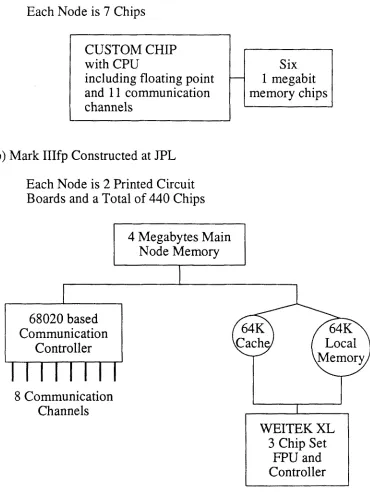
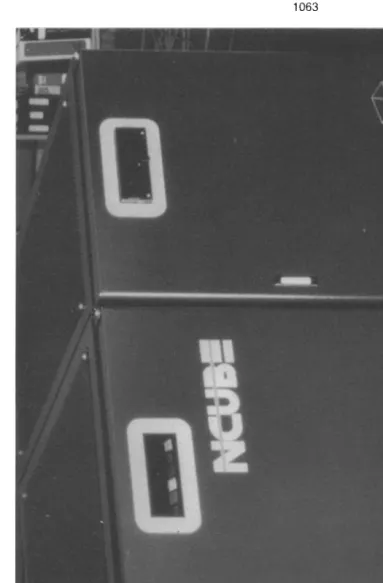
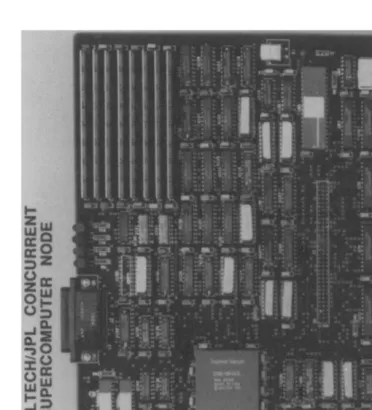
but n e w e r m a c h i n e s have gone to hierarchical node designs to obtain high p e r f o r m a n c e . Examples of the latter include the I N T E L iPSC-VX a n d the n e w JPL Mark IIIfp design, We will concentrate on the latter h e r e as we u n d e r s t a n d it better a n d I N T E L ' s current tools do not, we believe, allow the V X hypercube to be p r o g r a m m e d in the fashion we will suggest. T h e Mark IIIfp uses complex nodes with large m e m o r y and potentially high performance on each node. These N C U B E and M a r k IIIfp nodes are contrasted in Fig. 2 and pictured in Figs. 3 and 4.
T h e N C U B E does actually have a small on chip cache but for our purposes it should be viewed as a sim- ple uni-level m e m o r y at each node. We need a reasonably large "cache" - at a m i n i m u m the 64 - 128K bytes of the Mark IIIfp - for our considerations to be relevant. This will become clearer later w h e n in Sees. III a n d IV we quantify the role o f the "cache" size. Similarly, in the transputer based system, the on chip m e m o r y of 2 K bytes is probably usually too small to be used as a "cache" in the sense advocated in this paper.
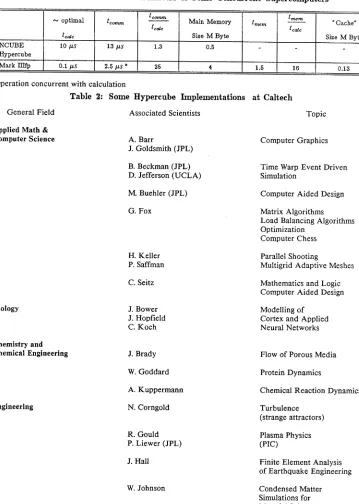
In Fig. 5 and Table 1, we introduce three basic parameters t,~t,, t,~,~ a n d t,~,,~ w h i c h we use for our performance analysis. We will restrict ourselves to considering 32-bit arithmetic as this is sufficient for m a n y calculations and the W E I T E K X L chip set u s e d on the Mark IIIfp currently only supports 32-bit arithmetic. tea c represents t h e typical time to perform a floating point application including any overheads s u c h as m e m o r y ("cache") access a n d i n d e x i n ~ t,,~,~ and t,~,,~ are effectively communication parameters, t,o,,~ is the time taken to transmit a 32-bit word between nodes of a h y p e r c u b e a n d t,,~,~ the time taken to send a word back and forth between "cache" and main memory. We n o w need to m a k e several c o m m e n t s and caveats on these parameters.
Firstly, we note that these three parameters are a very incomplete description of the hardware. For this paper, we will need the "cache" and node m e m o r y sizes as well. We will describe these in application depen- dent fashion as n~,~h~, n , ~ e , and n ~ a for the n u m b e r of basic entities (e.g., matrix elements in a matrix prob- lem or particles in a dynamics problem) that can be held in the "cache", node o f h y p e r c u b e or total m e m o r y respectively. The performance of a system will also depend crucially on whether c o m m u n i c a t i o n (either node to node or "cache" to memory) is concurrent or sequential with other operations. For the Mark IIIfp, node to node c o m m u n i c a t i o n (governed by t,o,,~) is concurrent with calculation while "cache" to node m e m o r y transfers can not be overlapped with calculation. For the N C U B E , c o m m u n i c a t i o n is presently not concurrent with calculation.
T h e N C U B E has a scalar processor and the speed t , ~ o f typical floating-point operations will not depend drastically on circumstances although, even here, factors of two variations can be expected. Pipelined or vector m a c h i n e s like the Mark IIIfp, ETA-10, a n d C R A Y - 2 can expect very different values of t ~ , on dif- ferent applications. We have listed the approximately smallest possible value of t ~ , as this will be the pacing value for the performance analysis. T h e techniques described here are in some sense designed to improve tea, by ensuring minimal "cache" misses.
All three parameters t~a,, t,o,,~, and tree m depend on the size o f the operation performed i.e., on the size of the vector (t~,a~) or size o f the "message" (tco,,~, t,,,~,~). We will ignore the startup time for small vectors and messages e v e n though these are usually important. The techniques n e e d e d to mininalze startup effects are interesting but are outside the scope o f this paper.
T h e parameter t,~,,~ has been defined in a somewhat unnatural fashion in Fig. 5 as the time to read a n d write a word between "cache" and main memory. This makes the definition symmetric with t,~,,~ and indeed if one uses a shared m e m o r y m a c h i n e to emulate a distributed m e m o r y environment, t h e n with our definition t,,~,,~ is the appropriate value o f t,~,~.~ to use to describe node to node communication in the emulation. This assumes that in the emulation, a h y p e r c u b e node process is fully contained in the "cache". We will describe in Sec. III how one takes care o f the case w h e n the problem is too large for all the processes to fit into "cache". In Sec. IV, we will use 1/2 tm~,,, as the transfer time w h e n we are just reading or writing. We again emphasize that the shared m e m o r y value and indeed our later discussion of t,,~,~ completely ignores any contention w h e n accessing the global memory.
ble to improve performance in m a n y cases if full overlap h a d been allowed in the Mark IIIfp design.
In discussing the hypercubes, we have listed too,,~ as the node to node transmission time; messages between nodes that are not directly connected in the hypercube topology will be characterized by a larger value of t,o,,~. We will accommodate this by reflecting this as an application d e p e n d e n t effect w h i c h will be seen in Sec. IV as a I / 2 log N~-o~ factor in the communication overhead for the FFT. We will use Nr~o~ as the n u m b e r of physical processors throughout this paper.
We will use the term hypercube broadly in this paper to include simple nodes like the N C U B E or more complex designs such as the Mark Illfp. When we wish to single out m a c h i n e s like the N C U B E , we will use the term homogeneous hypercube while terming machines like the Mark IIIfp as a hierarchical hypercube.
Finally, we summarize m a n y o f the caveats by noting that a performance analysis in terms o f simple parameters such as tco,,~, t,,~m, t,ac is usually accurate but the simplifications imply that the parameters are not universal but n e e d to be adjusted by different, but usually modest and understandable factors for each application [9].
III: Domain Decomposition and Complex Systems
One can formulate concurrent computation as a mapping of a problem onto a c o m p u t e r [2, 7, 8]. We consider both the problem and the computer as complex systems; for our purposes, these can be considered as a set of, in general, dynamically interconnected entities. T h e performance of a particular implementation can be related to the structure of the systems describing the problem and computer [2, 3, 9]. In this paper, we are only considering large grain size concurrent computers i.e., each node has substantial memory. In this case, it is natural to consider the problem, or more precisely its underlying complex system, as being divided up into s u b d o m a i n s which we will call grains. At any one time, each node of the concurrent c o m p u t e r is responsible for a single grain. In this context, domain decomposition is the division of the problem, or typically its defin- ing data domain, into appropriate grains. We can make this clearer by considering the map of the problem onto the computer in more detail. We can isolate four stages. T h e use o f a vectoring or parallelizing computer corresponds to the map:
Problem ~ Algorithm ~ Code --~ Compiler Generated Decomposition ---, (1) Concurrent Computer
i.e., performing the m a p onto the concurrent computer between the last two stages. We will consider domain decomposition corresponding to the m a p being generated by:
Problem ---, Algorithm --~ Domain Decomposition ~ Code ---, Concurrent Computer (2) w h e r e one forms the basic grains not from the code as in (1) but from the basic algorithm or problem in (2). The advantage of (1) is that one directly uses existing software on concurrent m a c h i n e s whereas in (2) it is implied that one m u s t generate code that describes individual grains. (1) is presently only practical on shared m e m o r y machines a n d indeed the ability to use this programming methodology is a key advantage of this architecture over distributed m e m o r y systems.
The hypercube and other distributed m e m o r y machines are traditionally p r o g r a m m e d by domain decom- position as described above. This methodology has advantages o f generality (it is potentially useable over a broad range of architectures) but it does require significantly more user involvement in the c o n c u r r e n c y and software. In particular, there is no easy way to m a k e use of existing sequential software a n d at Caltech, we have typically recoded our hypercube applications from scratch. As will become clear, we are interested in domain decomposition for the shared m e m o r y architecture, not only because it allows the porting of hyper- cube targeted programs but also because it m a y give near optimal performance for some problems on shared
m e m o r y machines.
In a series of papers, we have developed a set of optimization methods, in particular, neural networks and simulated annealing, for choosing the optimal definition of the grains for a particular problem [7, 8, 10, I 1, 12]. This work was in the context of a simple h y p e r c u b e as the target machine. We will not discuss this research here but note that the discussion of the current paper lays the g r o u n d w o r k for extending the earlier work to give optimal domain decompositions for complicated hypercubes like the Mark IIIfp a n d some shared m e m o r y machines.
T h e optimal decomposition for a simple hypercube divides the problem into grains satisfying two cri- teria:
T h e a m o u n t o f communication between grains is minimized.
We can now see qualitatively the possible importance of domain decomposition for hierarchical memory systems. The latter p e r f o r m well as long as references to m e m o r y are largely local to the "cache" a n d do not require access to the slower m a i n memory. This is clearly analogous to minimizing communication in a distri- buted m e m o r y machine. We will see that there are important quantitative differences in the "locality" con- straints for hierarchical and distributed memories. However, the purpose of the current paper is to explore and explain their similarities and derive the ground rules for a uniform user interface w h i c h can be imple- m e n t e d well on either architecture.
T h e second constraint o f the hypercube decomposition given above corresponds to load balancing the work of the nodes. We will not stress this here as it is not central to our discussion. We will choose as our examples regular problems for which load balancing is not a difficulty [2, 7]. In the future explicit realizations of the ideas presented here the constraints of load balancing may, in fact, be very important. In particular, an elegant dynamic load balancer for the hypercube appears to require a full multitasking e n v i r o n m e n t with each node responsible for several ( ~ 10) processes or grains [13-15]. We will adopt a simpler point o f view here With, in the case o f the N C U B E and other h y p e r c u b e s with simple nodes, only one process per node. This is sufficient for the problems discussed here and will be pedagogically clearer. In fact, the multitasking environ- m e n t already introduces hierarchy into a simple h y p e r c u b e environment as now one has different process to process c o m m u n i c a t i o n speeds depending on w h e t h e r or not the communicating processes lie in the same or different nodes. T h u s the multitasking e n v i r o n m e n t will tend to unify the ideas across architectures and we will include it in future discussions. In this paper, we are not attempting to discuss the detailed user environ- m e n t a n d explicit software implementation but rather the functional structure of the software environment as "seen" by the machine. We will address the (very important) implementation issues elsewhere.
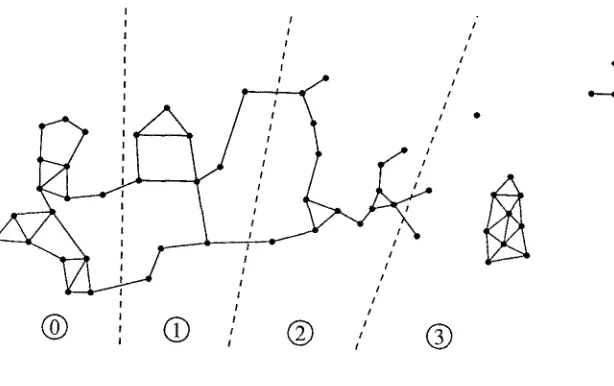
Let us focus our ideas by considering a specific problem of particle dynamics with a short-range interac- tion. A n example is s h o w n as a complex system in Fig. 6. Typically, the computation involves particles linked by a force a n d the n u m b e r o f such links measures the calcutational complexity. Consider the underly- ing complex system as a graph whose nodes are the particles and nodes are linked if and only if the corresponding particles interact with each other. T h e n the calculation complexity is m e a s u r e d by the n u m b e r of edges in the graph. Domain decomposition will divide the graph into grains (subgraphs) such that each grain has approximately equal n u m b e r s of edges and we minimize the n u m b e r of edges that cross grain boun- daries. When implemented on a homogeneous hypercube, the ratio f c of c o m m u n i c a t i o n to calculation is m e a s u r e d by the ratio o f the n u m b e r o f edges crossing grain boundaries to the total inside a given grain. In m a n y previous papers, we have s h o w n that this leads to the result [2,3,7,9]
f o - constant t c o , ~ (3)
n l/a gioir~ t c ~
Where n g , ~ is the n u m b e r o f entities ( n u m b e r o f nodes o f graph i.e., particles in our example) in each grain a n d the parameters t,o,~.~ a n d t,,a~ were introduced in Sec. II.
T h e application d e p e n d e n t constant in Eq. (3) is typically of order unity. The connection dimension d has been defined generally in Refs. [2] and [7] and coincides with the geometric dimension for short-range or nearest-neighbor problems.
In architectures where communication is serial with calculation such as all the initial.(Caltech's Cosmic Cube a n d Mark II, I N T E L iPSC, N C U B E ) hypercubes, one aims for f c -< 0.25 w h i c h was obtained for the initial Caltech applications as long as
- - - <_ 3 ; non overlapped (4)
t eate
T h e goal f o <- 0.25, corresponds to a speed-up S = e N ~ with efficiency e given as I
e = l+f--- c- ; non overlapped (5)
_> 0.8 for f o < 0 . 2 5
This is a phenomenological result averaged over the values o f nu,~/,~ , d, and constant seen in typical appli- cations. In table 2, we give a current list o f Caltech hypercube applications to indicate the problem areas from which our results have been obtained. We do not wish to discuss here the m a n y issues underlying the validity of (3) but rather refer the reader to the detailed discussions in Refs. [2, 3, 7, 9]
In the case where communication is overlapped with calculation, one can afford an order of magnitude more message traffic with a typical goal o f r e <_ 1.25 or the less stringent constraint:
tcor~r~
< 15 ; overlapped (6)
with efficiency
= m i n ( l , t / f c ) ; overlapped (7)
_>0.8 f o r f c _ < 1.25
We see that the difference between (6) and (4) partly explains w h y the Mark IIIfp and N C U B E can both give good performance even though the former has an order of magnitude larger value for t~o,~/tc,ao. As we see from (3) a n d is explored in detail in Ref. [16], the Mark IIIfp will also have the value o f f c lowered by the larger value o f no,an allowed by the larger m e m o r y o f the Mark IIIl'p. Explicitly for systems o f dimension d=3, we see that I/nj~/4,~ is decreased by a factor (4/0.5) ~/~ = 2 in comparing the Mark IIIfp to the N C U B E .
Now return to the original particle d y n a m i c s example a n d consider its implementation on a variety o f architectures. In the case o f a homogeneous hypercube we have already described h o w we divide the particles into groupings and assign each grouping to an individual hypercube node. We have a n u m b e r No,~ . of grains equal to the n u m b e r of processors N~.o~ in the concurrent machine. U s i n g the notation o f Sect. II, we also have the n u m b e r of particles in each grain, n o ~ . = n,,a, and a total n u m b e r ntoua of particles given by
n ~ = Nr, ~ no,a, (8)
N o w consider a hierarchical shared m e m o r y m a c h i n e s u c h as that pictured in Fig. l(b). A s explained earlier, we w o u l d naturally expect best performance if m e m o r y references were largely local to each "cache" and this will be achieved if one can assume that each "cache" contains a complete grain. However, there is a crucial complication that in general, one can not expect that the full problem can be held in the "caches". Some fraction o f it can be in "cache" with the remainder "waiting" in the large shared memory. In contrast, it is reasonable to assume that the homogeneous hypercube will be able to contain the full problem in the aggre- gate o f it's n o d e s ' memories. In general, we will define a grain so that it can be contained in the "cache" or lowest level o f the m e m o r y hierarchy u n d e r consideration; this grain can contain ng~,~ m e m b e r s (nodes o f graph). We can now define an effective or virtual n u m b e r Na~- ~ o f processors so that the total system can be contained in Nq,~. nodes. T h u s
nt,~a = Na,a,no,~, (9)
In general, Ng,~, is larger than the real n u m b e r Nr, ~ of nodes a n d we can a s s u m e that the grains have been defined so that the ratio r,~,~ = Ng,~i,/Nr, o~ is an integer.
We can n o w summarize three relevant circumstances: Homogeneous Hypercuhe
n,~ae = ngr, a,~ entities fit in a single node N¢~. = N~o~
r~/~,,o 2 = 1 Hierarchical Shared Memory Machine
n~.~a~ entities fit in a single "cache"
r ,~innat >-- 1
processes "waiting" for loading (r,~n~a- 1)No,~, into "cache"
(10a)
(10b)
Hierarchical Hypercube
ng,.,a,~ entities fit in a single "cache" (10c) Ngr~, = n t ~ / n o , ~ .
r~n~a _> 1 grains in each node n,o~ = r~,~,a n g ~ entities fit in a single node
lier in Eqs. (3 to 7) for h o m o g e n e o u s hypercubes. In this case, one can substitute t,,~,~ for t , o , ~ on these equations w h e n considering the shared m e m o r y case. However, it is the purpose o f this paper to consider the more general and interesting case r,~n,,a > i.
Consider an example of the consequence of these ideas comparing the 1024 n o d e N C U B E , each node having 0.5 megabytes of m e m o r y with the 128 node Mark IIIfp, each node having 4 megabytes of memory. Normally one considers the latter m a c h i n e as having larger grain size but consider the use of these machines to solve a problem requiring the full 512 megabytes available on each machine. T h e N C U B E has 1024 grains each o f 0.5 megabyte size but the Mark Illfp with r,i,t~ = 32 has 4096 grains e a c h o f 0.125 megabytes! The addition o f the floating point unit has, in fact, given the Mark IIIfp a smaller grain size and required one to decompose the problem into more and not less (than for the N C U B E ) grains. Note that if the total problem size h a d been 128 megabytes, then both m a c h i n e s would be used with 1024 grains, each of 128 kilobytes.
Let us consider some of the issues from a more fundamental, or perhaps philosophical, point of view. In the particle d y n a m i c s example, we have a spatially distributed system w h i c h nature evolves simultaneously in time. O n a h o m o g e n e o u s hypercube, the spatial complex system corresponding to the problem is directly m a p p e d onto a spatially distributed m e m o r y o f the hypercube. T h e n as in nature, each node evolves different parts of the spatial system simultaneously. In this case, we have a rather clean association.
Space in Problem --* Space in Homogeneous Hypercube ( l l a ) Time in Problem --* Elapsed Time in Computer Execution
Tl~is association is particularly precise in the case w h e n each node o f the c o m p u t e r holds a single parti- cle. In the normal case, where each grain has several particles, then we have an intermediate situation when the spatial system within each node is evolved sequentially in time by the node; i.e., we have partially mapped the spatial extent o f the system into a temporal extent in the computer implementation,
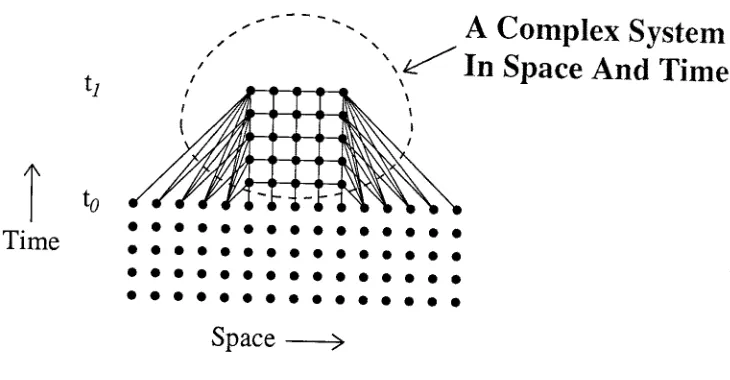
To extend the above picture, we generalize the concept of a complex system to include both the spatial and temporal aspects of a problem. This is illustrated in Figs. 7 and 8, and in the particle dynamics case, we would consider the e x t e n d e d complex system as the physical system or a graph generated by, for instance, a space-time region defined by some condition such as:
Ix_ - x_ol -< r (1 lb)
In Fig. 7, we show this for one spatial dimension and a regular lattice. In our previous work [2,7], we have only n e e d e d to consider the spatial aspects of complex systems because of the rather clean correspon- dence o f space and time, expressed in Eq. (t la), between the computer and problem present for the homo- geneous hypercube.
R e t u r n i n g to Fig. 1, we now see that the sequential computer s h o w n in Fig. l(a) corresponds to: Space a n d Time Elapsed Time in
in Problem --~ Sequential Computer (1 lc)
Typically one cycles through individual particles and processes t h e m sequentially. If we now consider the hierarchical m e m o r y systems l(b) a n d l(c), we find the intermediate situation:
Space a n d Time
Space in Problem --* in Heirarchical Memory Machine (1 ld) Time in Problem ---, Time in Computer
( l i d ) would reduce to ( l l a ) in the degenerate case where the problem can be contained in the "caches" - s u m m e d over nodes.
A b o v e we have pointed out that varying degrees o f parallelism correspond to mapping spatial aspects of the problem into different mixes o f space a n d time on the computer system. Fig. 8 illustrates an important technical reason to introduce a complex system extended in space and time. For a homogeneous hypercube, c o m m u n i c a t i o n costs are related to graph edges crossing spatial boundaries o f the system. For the "cache" based architectures in Fig. l(b) and l(c) we will need to load the initial value of the system at the time to and store back in main m e m o r y after evolution to time t 1- We see that this load and store correspond to the tem- poral boundaries o f the system, t,~,,, a n d t ~ o ~ correspond respectively to the costs associated with temporal a n d spatial limitation o f the system.
We will now quantify this general picture with several examples in the next section. We will find simi- larities and differences between the temporal (t,~,~) and spatial (tco,,~) aspects o f the problems. We will only summarize the results with the intention of providing a detailed analysis elsewhere.
IV: Examples
IVA: The Long Range Force or Complete Interconnect
This case is interesting because we will find low overheads from both the spatial and temporal boun- daries in Fig. 8 with these two overheads having the same dependence on grain size n a ~ ~. The generic prob- lem, that we will consider, is the time evolution of a set of particles interacting with a long-range force; we use the brute force algorithm and not the faster F F T [2] or clustering method [17]. We calculate the force on each particle by summing the contribution of all others [2]. We now consider first homogeneous hypercubes and then hierarchical memory computers.
a) Homogeneous Hypercube
One decomposes the problem with an equal number ng~an of particles in each node [2]. Another set (identical copy) o f the particles travels completely around the cube (which can be mapped into a ring) updating the mutual interaction as the travelers pass through the node containing the fixed particles. There is some care needed to ensure Newton's law o f action and reaction is exploited and each interac- tion is only calculated once [2]. However, the performance analysis is straightforward and if at each step one transports M particles
Calculation Time T,,ac M n a ~ t~,ac (12a)
2
Communication Time T¢o,~n ~ M t¢o,~,~ (12b)
and the overhead f v introduced in Sec. III, Eq. (3), is given by: 1 t,o,~
f c (12c)
nu~in teate independent o f M.
b) Hierarchical Machines
Now M is the total number o f particles cycled from main memory through the "cache". Each grain takes time
T e ~ = nu~,a, t,r~, (13a)
to load and store. The travelling particles must be read from main memory and stored back with their force updated. This takes time:
T ~ = M t,~,, (13b)
These numbers should be compared with the identical values (12a) and (12b) for calculation and com- munication in the case of the hierarchical hypercube. We see that good performance requires that M be chosen large (_> na~n) but this is algorithmically possible and natural. Hence for this case, the calculation time (12a) is much larger than the "cache" overhead and one finds for M_> no~u, that:
1 tmem
f H ~ - - (13c)
n~/~ t~a ~
is the hierarchical memory access overhead to be compared with the communication overhead f a in (12c). The latter needs to be added to fH for the hierarchical hypercube which has both forms o f overhead.
For the hierarchical shared memory machine, the natural value o f M is nu~,a and for the hierarchical hypercube the smaller value M = n,~a, = r , i , ~ n ~ ; in each case Eq. (13e) is valid.
We do find that care is needed to reduce fH. One must cycle all particles through the "cache", i.e., choose a large value o f M, in between reloading the "cache". Further, one needs to update each particle in the cache in a fashion that one only writes out the results after all M particles are considered. In the case of the Mark IIIfp, this implies that one disables the cache "write-through" feature until all M particles have travelled through.
IVB: Two Dimensional Finite Difference
We will consider a finite difference solution to Poisson's equation, V2~b = 4~rp, solved by an iterative (relaxation) m e t h o d on a regular two dimensional mesh. This problem is simple but the discussion generalizes to other short-range problems including wave equations, image processing, particle dynamics, and Monte Carlo. T h e choice o f two dimensions is not essential and at the e n d we will generalize to higher dimensions. We will u s e the simplest stencil where the value at the n e x t iteration only d e p e n d s on the original value and its four neighbors at the current step. This is shown in Fig. 9(a); as discussed in Ref. [2] and later in this paper, m o r e complicated stencils such as that in 9(b), do not alter one's conclusions. We are not underestimating the difficult implementation issues in realistic problems, but we believe that our simple case embodies the essen- tial issues for the performance estimate.
(a) Homogeneous Hypercube
One performs a simple two dimensional decomposition with each node containing a ~ x ~ submesh. A typical iteration takes a calculation time for each iteration of
T ~ = 5 ng~,~ t~o~ (14a)
and the communication is associated with the edges of the region in each processor and takes time:
T~o,~,,~ = 4x/n0~,~ t~o,,~ (14b)
and one finds a communication overhead
1 tco,~,,~ (14c) f o ~ .. 1/2
etg(ai~ teole
with the form of Eq. (3) and the connection dimension d equal to the topological dimension. (b) Hierarchical Machines
As in the previous example, Eq. (13a), one takes time for load and store of:
T~a~e = n g ~ traera (14d)
The grain is stored in the "cache" and one also needs to load the neighboring points and in analogy to (14b), one finds a c o m m u n i c a t i o n cost.
T~o,,~ =
4-~/ng,~,~
(1/2 t,~,~ or tcom~) (14e) where the communication m a y be from a process in the same or neighboring node; the corresponding com- m u n i c a t i o n time is either I / 2 t,~,~ or t~o,,~. In fact, in terms o f the ratio r,~n~a introduced in See. III, one can rewrite Eq. (14e) asreo,,~, = 4v/na,oi,~ (1/2t,,~,~ ( v / r ~ - l ) + t~o,,~) (14el)
~ 2v/n0,vi~ t,,~,~ (14e n)
in the interesting case with large values o f r,~n~.
If we compare (14a) with the overheads (14d) and ( 1 4 e n ) , we see that cache loading dominates (for large n~,~-,0 and
1 t,,~,~
(14f)
fH 5 tool~
a n d unlike our previous results summarized in Eq. (3), f ~ does not decrease as one increases n g , ~ . The rea- son for this is clear from Fig. 8 and the discussion at the end o f Sec. IV. We have a space-time complex sys- tem stored in our cache, with as shown in Fig. 10(a), a single iteration (time) c o u n t as its temporal extent. We need to reduce the e d g e / a r e a ratio in the temporal direction. This can be achieved by updating the region stored in "cache" by more t h a n one time step. This is a nontrivial issue because it now implies a different decomposition t h a n that usually u s e d for the homogeneous hypercube. In Sec. IVA, we saw a somewhat simi- lar situation where the hierarchical implementation required M large whereas M -~ 1 was sufficient for the homogeneous case. Now the hierarchical case has required that each grain update for several, say M, itera- tions or time cycles.
equation was the underlying problem, Fig. (10b) separates regions by the characteristics of the equation. We see that Fig. (10b) still corresponds to short range (spatial) communication. Te~h, is unchanged. T ~ c a n d T , o , ~ in Eqs. (14a, 14e n ) are increased by a factor equal to the n u m b e r M, o f iterations. Optimal is the choice o f equal extents in the space and time dimensions, M = na,a~ 1/a, w h e n we get back the result
f c,~ ~ n ~ (t,n~r~ or t~o,,~)/Ga¢ (14g)
for a system of dimension d.
A simpler alternative, shown in Fig. (10c), is easier to implement. We chose cylinders with sides parallel to the time axis for our space-time complex systems. These have an interesting property illustrated precisely in Fig. 7 o f cutting m o r e edges with the temporal planes. In fact the n u m b e r o f edges cut is proportional to M ~ where M is the n u m b e r o f temporal steps. This leads to c o m m u n i c a t i o n costs, appearing as additional cal- culations, proportional to M s. We find in with the dimension d = 2,
T~a~ ec na.a~ M (14h)
T~o.,~ o~ na,.,a,, z-zld M 2
Teach e Oc n g m i ~
1 M
T h e ration f e + f n is proportional to ( - ~ + . 7 . ) and is minimized for M ~ "o,~-" 1/2a
¢ t o h~in
and we find the a m u s i n g total overhead
1 (tm,~ or t,o,~) (14i)
f c + f n ~ - z / ~
ngiain t c a e
Although t h e d e p e n d e n c e on the grain size is slower t h a n for Eq, (14g), this overhead does decrease as the grain size increases.
IVC:
Matrix MultiplicationWe n o w consider a simple matrix algorithm w h i c h is not the most important but exhibits interesting con- trasts with the previous two cases. Take the multiplication o f large full matrices
C = Z • B 0 5 )
where each matrix is ~ × n x / ~ . T h e basic ideas in this section are the same as in Refs. [2, Ig, 23, 31].
(a) Homogeneous Hypercube
Here one considers a simple decomposition dividing each matrix into N r ~ square subblocks each o f size V ' ~ g ~ x v / n g , ~ where the dimensions are given by ~ = ~ / x/N~o~. A s discussed in Ref. [18], there is an efficienl algorithm in which the subblocks of A and B are respectively broadcast (along a subcube) and shifted along nearest neighbor links of the hypercube. The basic calculation at each stage involves sub- block multiplication with
Tea, _ ,. a/2 , %,~',~ "ca, (16a)
and overhead
T~o,,~ o~ n g , ~ t~o,~ (16b)
One obtains a conventional overhead formula
f G
corresponding to connection dimension d = 2, (b) Hierarchical Machines
1 t¢or~rt~
n l/Z t~a, (16c)
grh/n
The interesting feature now is that one does not n e e d to modify the algorithm at all because the cache loading time is
Teach ~ e~ ng~n t,~m (16d)
1 t~.~ (16e)
f s N .. i/2 ¢tgfaltt t ~ .
T h e constant in (16e) can be affected by the exact algorithm used as it depends on the n u m b e r of blocks read in between cache stores; this is analogous to the M d e p e n d e n c e in Sec. IVA.
Let us compare this case with that o f the finite difference algorithm in Sec. IVB. As shown in Eqs. (14c) and (16c), both have similar overheads in the case o f the hypercube. However, the matrix multiplication naturally retains this result for hierarchical machines while for IVB, we n e e d e d to change the algorithm to reduce the m e m o r y overhead f R . We can u n d e r s t a n d the issue by comparing Eqs. (14a) and (16a). In the fin- ite difference case, we h a v e a small communication overhead because we are transmitting a few (pc ~ 1/2 variables b u t doing little (0(1) per variable) work with them. In matrix multiplication, we communicate more
" ~/~) for each transmitted variable. The algorithms obtain the variables (o~ ngna,.) but do a lot of work t c~ n g ~ .
same result for f c but for different reasons. In fact the matrix multiplication algorithm "succeeds" on the hierarchical m e m o r y m a c h i n e s for the same reason as the long range problem. Both do a lot o f work per fun- damental entity; in IVA, the work is proportional to no.an and in IVC, proportional to n g ~ . . This is the origin o f the different connection dimensions shown in Eqs. (12c) a n d (16c).
IVD: LU Decomposition
Now let us consider, a more important matrix algorithm; namely L U decomposition o f full matrices or the related problem o f matrix inversion. This has b e e n studied in detail on the h y p e r c u b e in Refs. [2, 19, 20- 24] a n d we will find that the issues are more similar to those of Sec. IVB than those of IVC. We will not con- sider pivoting here; this is an interesting and tricky complication which leaves the results below qualitatively u n c h a n g e d [2, 23]. We note that the issues discussed here and in Sec. IVC are closely related to the important work on the "Level-3 BLAS" discussed by Dongarra at this conference [25].
(a) Homogeneous Hypercube
We use the same square subblock decomposition introduced in INC. A t a typical stage o f L U decompo- sition, one is subtracting the row containing the eliminated variable from all other rows. There is a separate multiplier for each row calculated from the column containing the eliminated variable. This is illustrated in Fig. 11 a n d one sees a situation rather similar to that o f Sec. IVB.
Namely in a typical stage, one has a calculation
a O. --, aij - - c i rj, (17)
taking time
Te,ae = 2ng~,, t~,ae
(i8a)
and a communication
T°o,~. = 2 x / n u ~ . too,,,,. (ISb)
with our standard form
1 tco,~,~ (18c)
Actually Eqs. (18a, b) ignore certain overheads connected with the calculation of the cl and r i as well as load imbalance overhead and the effect of the reduction in value o f n a ~ as one eliminates rows and columns. These effects alter the c o n s t a n t in Eq. (3) but leave the form (18c) unchanged.
(b) Hierarchical Memory
We are faced with the same problem as in Sec. IVB, with a "cache" load and store time which has the same n g ~ d e p e n d e n c e as the calculation in Eq. (18a). T h e solution is similar to that of IVB and involves eliminating several, say M , rows (and columns) at the same time. One can show that the M values of r~ and cj can be calculated in a separate concurrent step which itself can be efficiently implemented. Given this, one will find a simple block algorithm in w h i c h the times in Eqs. (18a, b) are both increased by a factor M
.~ 1 / 2
IVE: Fast Fourier Transform (FFT)
Originally we implemented the F F T in a natural fashion on the h y p e r c u b e [2] using local communication in the h y p e r c u b e topology where necessary. It is well k n o w n that the hypercube architecture exactly matches the pattern o f the binary FFT. However, the discussion here will be easier using a formulation due to Fur- manski [2, 33] w h i c h ingeniously lumps all the communication into a single stage a n d avoids any c o m m u n i c a - tion during the calculation steps.
(a) Homogeneous Hypercube
We will consider a one dimensional F F T and we can label the variables by a binary digit B illustrated in Fig. 12. This example shows the case ntoua = 2 ~4 and Nr,,~ = 2 s. Five digits go-4 o f B are u s e d to label pro- cessor n u m b e r a n d the remaining nine digits lo--s the position within the local m e m o r y of the node. T h e F F T algorithms systematically alters the variable starting at the highest digit o f B (lo in Fig. 12(a)) a n d ending at the lowest (g 4 in Fig. 12a). There are log nta, a steps each o f w h i c h takes calculation time nu~,a.
F u r m a n s k i ' s algorithm does the first nine steps, each altering one digit, as labelled in Fig. 12(a); then it transforms the data to the situation of Fig. 12(b) where the lower order bits are n o w stored locally. This is performed by a c o m m u n i c a t i o n primitive called i n d e x in Ref. [33]. After the transformation the remaining five digits are processed locally in each node. T h e calculation is load balanced at each stage a n d takes total time
1
T,,a~ ~ ~ n ~ l o g ( n ~ a ) t~a, (19a)
= n,~a, log(nt,~a) t,~,
while the c o m m u n i c a t i o n primitive i n d e x takes time
T,o,~,~ ~ n,,oa, log(Nmo, ) t , o ~ (19b)
In this formula the log N m d e p e n d e n c e j u s t represents the typical distance ( 1 / 2 log Nr~,o~ ) between points in a h y p e r c u b e topology. This c o m m u n i c a t i o n time could be r e d u c e d on m a c h i n e s with automatic rout- ing. One finds an overhead
f o ~ log(N~,,~) t,o,,~
log(nu~,a) t~a ~ (19c)
which corresponds to infinite connection dimension in Eq.(3).
T h e discussion o f hierarchical m e m o r y machines is now straightforward. We will use the same idea of calculating a certain n u m b e r of bits in B at a time. Clearly we can perform a n u m b e r of steps corresponding to at most log (n~,~a~) bits at any one time a n d we find a set o f calculations each taking time
T a , , , ~ , ~ y ale ~ F/gra~'n log(ng,~,) t,a~ (19d)
and a cache load a n d store time o f
T~h~ ~ n,,~,~ t,,~,~ (19e)
Thus, we perform log (n~,~,,) steps for each cache loading and obtain an overhead
f s oc 1 t,,~,~
log(n~,~) t , a , (19f)
We have f o u n d a slightly different overhead formula from the original case, Eq. (19c), b u t fortunately we have been able to use the same decomposition to deal with distributed and hierarchical memories. This equivalence would not have been direct if one had used the traditional h y p e r c u b e F F T approach.
IVF: Neural Networks
We can discuss a recent explicit implementation on the hypercube of a m o d e l of the piriform cortex [27]. This corresponds to a nearly full interconnect but an interesting subtlety that changes the analysis from that in IVA. One is calculating the effect G ~ s of neuron i on j . A symmetry of the propagation Green's function ( G ~ s) m e a n s that it is optimal to associate the calculation o f G ~ . with i and not the target neuron j . In the particle d y n a m i c s case in IVA we m a d e the opposite choice o f shipping the information to the target particle a n d t h e n doing the calculation. T h e calculation o f all the Green's functions ( G ~ . ) is local to each grain and involves no communication. T h e latter is n e e d e d as one forms the global s u m s
~] G ~ j for each j (20)
i
Thus, the problem is reduced to the calculation of a large n u m b e r of sums. T h e components of the s u m (i) a n d the storage o f the final result ( j ) are both uniformly distributed throughout the hypercube. This prob- lem was solved in Ref. [33] in terms o f a h y p e r c u b e communication primitive called
fold.
It is straightforward to implementfold
on a hierarchical memory; the issues are similar to those in Sec. IVA.We see that the neural network decomposition can be unified over the various architectures as long as it is i m p l e m e n t e d in terms of the basic primitives
fold
which is then separately implemented in an optimal fashion on each architecture.V: Conclusions
We have considered the issues involved in a unified approach to distributed a n d hierarchical m e m o r y machines. Our techniques also allow optimal implementations o f message passing on shared m e m o r y parallel processors. We have discussed the general approach in See. III and the prettiest result is inclusion of both space and time in the description of complex systems. In Sec. IV, we worked through six problem classes and were able to show decompositions that effected our desired unifications. In all cases, the overheads were small as long as the "cache" size n ~ , was big enough and that the c o m m u n i c a t i o n performance of the com- puter, m e a s u r e d by
t,,~m/t,ol~, t,o,,~/t¢ac
was good enough. Another way of summarizing our results is to say that problems are associated with data domains. Homogeneous machines j u s t n e e d the decomposition of this domain; this is often a spatial decomposition. Hierarchical computers also n e e d one to consider the label (e.g., DO loop index) o f the processing of elements in the domain. These m a c h i n e s require both spatial (data domain) decomposition and that associated with this new label; this label often corresponds to time i.e., hierarchical machines need "space-time" and not just "spatial" decompositions. Our results contain the essen- tial information to make the necessary tradeoffs between m e m o r y / c o m m u n i c a t i o n b a n d w i d t h and "cache" size. We note that technology i m p r o v e m e n t s should permit "cache" sizes to increase in the future. This will increase the applicability o f our techniques.In future papers, we will present details o f the ideas sketched in IV a n d describe the implementation issues in providing the desired portable high performance environments.
We would also point out that the basic ideas presented here are the message passing version of principles that have been used for some time in the field of vectorizing and decomposing compilers [28, 29, 30]. The manipulation of DO loops described by G a n n o n at this conference are similar in spirit to the physical transformations suggested here.
Acknowledgements
I would like to t h a n k the m a n y m e m b e r s o f the Caltech C o n c u r r e n t C o m p u t a t i o n Program
(C3P)
on whose work m a n y of the results discussed here are based. I hope they are content with implied reference in Table 2. T h e ideas presented here were first developed during a study of the use of the RP3 and the porting of h y p e r c u b e applications to it. I would like to thank IBM for their support o f this work and in particular, A. Frey, S. Harvey a n d A. Norton. The support of the Electronic Systems Division of the U. S. Air Force has allowed us to extend our basic h y p e r c u b e research to a variety o f different architectures. Our ELXSI imple- mentations were f u n d e d by SANDIA. I would thank the organizers of ICS '87 for an excellent conference a n d the honor o f the invitation to talk.References
1. C3P-394: "Caltech Supercomputer Initiative: A C o m m i t m e n t to L e a d e r s h i p and Excellence," A. H. Barr, R. W. Clayton, A. K u p p e r m a n n , L. G. Leal, A. Leonard, T. A. Prince, December 29, 1986. 2. G. Fox, M. Johnson, G. Lyzenga, S. Otto, J. Salmon, D. Walker, "Solving Problems on Concurrent Proces-
sors,"
April 1986. To be published by Prentice Hall, 1987.3 C3P-391: "The H y p e r c u b e as a Supercomputer," G. C. Fox, January 7, 1987. Published by the Interna- tional Supercomputing Institute, Inc., St. Petersburg, Florida, May 1987.
5. "Portable Programs for Parallel Processors," J. Boyle, R. Butler, T. Disz, B. Glickfield, E. Lusk, R. Over- beek, J. Patterson, R. Stevens, published by Holt, Rinehart, and Winston, Inc., N. Y. 1987.
6. C3P-435: "The Concurrent Supercomputing Initiative at Caltech," G. Fox and co-authors.
7. C3P-255: "Concurrent Computation and the Theory of Complex Systems," G. C. Fox, S. W. Otto, March 3, 1986. Published in proceedings of 1985 Hypercube Conference at Knoxville, August 1985, edited by M. Heath and published by SIAM.
8. CsP-214: "Monte Carlo Physics on a Concurrent Processor," G. C. Fox, S. W. Otto, E. A. Umland, Nov 6, 1985, invited talk by G. Fox at the "Frontiers of Quantum Monte Carlo" Conference at Los Alamos, September 6, 1985, and published in special issue of Journal of Statistical Physics, Vot. 43,I209, Plenum Press, 1986.
9 C3P-161: "The Performance of the Caltech Hypercube in Scientific Calc)~lations: A Preliminary Analysis:" G. Fox, April 1985, Invited Talk at Symposium in Austin, Texas, March 18-20, 1985, and published in "Supercomputers-Algorithms, Architectures and Scientific Computation," edited by I::. A. Matsen and T. Tajima, University of Texas Press, Austin, 1985.
10. C3P-292: "A Preprocessor for Irregular Finite Element Problems," CALT-68-1405, J. W. Flower, S. W. Otto, M. C. Salama, June 1986.
l 1. C3P-363: "Load Balancing by a Neural Network," CALT-68-t408, G. C. Fox, W. Furmanski, Sep- tember 1986.
12. C3P-327B: "A Graphical Approach to Load Balancing and Sparse Matrix Vector Multiplication on the I:Iypercube," G. C. Fox, December 5, 1986. To be published in proceedings of IMA Workshop, Min- nesota, November 1986.
13. C3P-385: "A Review of Automatic Load Balancing and Decomposition Methods for the Hypercube," G. C. Fox, November 1986. To be published in proceedings of IMA Workshop, Minnesota, November 1986.
14. C3P-328: "The Implementation of a Dynamic Load Balancer," G. Fox, A. Kolawa, R. Williams, November 1986, published in proceedings of 1986 Knoxville Hypercube Conference, edited by M. Heath and published by SIAM as "Hypercube Multiprocessors 1987."
15. C3P-427: "A MOOSE Status Report," J. Salmon, S. Callahan, J. Flower, A. Kolawa, May 6, 1987. 16. C3P-390: "An Evaluation of Mark III and NCUBE Supercomputers," G. C. Fox, December 9, 1986. 17. J. Barnes, P. Hut, "A Hierarchical O(NlogN) Force-Calculation Algorithm," Nature 324,446 (1986). 18. C3P-206: "Matrix Algorithms on the Hypercube I: Matrix Multiplication," G. Fox, A. J. G. Hey, S. Otto,
October 1985, published in Parallel Computing, 4, 17 (1987).
19. C3P-97: "Square Matrix Decompositions: Symmetric , Local, Scattered," G. Fox, August 15, 1984, unpublished.
20. C3P-99: "LU Decomposition for Banded Matrices," G. C. Fox, August 15, 1984, unpublished.
21. C3P-347: "Gauss Jordan Matrix Inversion with Pivoting on the Hypereube," P. Hipes, A. Kuppermann, August 8, 1986.
22. C3P-348: "A Banded Matrix LU Decomposition on the Hypercube," T. Aldcroft, A. Cisneros, G. Fox, W. Furmanski, D. Walker, paper in preparation.
23. C3P-386: "Matrix," G. C. Fox and W. Furmanski, paper in preparation.
24. G . A . Geist, M- T. Heath "Matrix Factorization on a Hypercube Multiprocessor;" C. Moler "Matrix Com- putation on Distributed Memory Multiprocessor." Both these articles are contained in "Hypercube Mul- tiprocessors, 1986", edited by IV[ T. Heath, SIAIVI, 1986.
25. J. Dongarra, Invited talk at 1987 International Conference on Supercomputing, Athens, June 8-12, I987. 26. C3P-405: "Hypercube Communication for Neural Network Algorithms," G. C. Fox, W. Furmanski,
paper in preparation.
27. C3P-404: "Piriform (Olfactory) Cortex Model on the Hypercube," J. M: Bower, M- E. Nelson, M. A. Wil- son, G. C. Fox, W. Furmanski, February 1987.
28. D. Gannon, Invited talk at 1987 International Conference on Supercomputing, Athens, June 8-12, I987. 29. K. Kennedy, Invited talk at 1987 International Conference on Supereomputing, Athens, June 8-12, 1987. 30. A. Sameh, "Numerical Algorithms on the Cedar System," Second SIAM Conference on ParaUel Process-
ing, Norfolk, Virginia, November 1985.
31. W. Jalby and U. Meier, "Optimizing Matrix Operations on a Parallel Multiprocessor with a Hierarchical Memory System," CSRD-555, University of Illinois report, 1986.
33.
Approach," Science 231, 967 (1986).
C~P-314: "Optimal Communication Algorithms on the Hypercube," G. C. Fox, W. Furmanski, July 8, 1986; "Communication Algorithms for Regular Convolutions on the Hypercube," G. C. Fox, W. Furman- ski, September 1, 1986, published in proceedings of 1986 Knoxville Hypercube Conference, edited by IVt Heath and published by SIAM as "Hypercube Multiprocessors, 1987."
Table 1: Hardware Parameters of S o m e Concurrent Supereomputers
NCUBE Hypercube M~rk/l~p optim~l tcat¢ lO ,us
0.1 ,us
tcomm
13 ,US
2.5/~S *
t¢orlm~ tree m
teoge Main Memory tmem "Cache"
tca/e
Size M Byte Size M Byte
1.3 0,5
25 4 1.5 16 0,13
*Operation concurrent with calculation
General Field
Applied Math & Computer Science
Biology
Chemistry and Chemical Engineering
Engineering
T a b l e 2: S o m e H y p e r c u b e I m p l e m e n t a t i o n s a t C a l t e e h
Associated Scientists Topic
A. Barr
J. Goldsmith (JPL)
B, Beckman (JPL) D. Jefferson (UCLA)
M. Buehler (JPL)
G. Fox
H. Keller P. Saffman
C. Seitz
J. Bower J. Hopfield C. Koch
Computer Graphics
Time Warp Event Driven Simulation
Computer Aided Design
Matrix Algorithms Load Balancing Algorithms Optimization
Computer Chess
Parallel Shooting
Multigrid Adaptive Meshes
Mathematics and Logic Computer Aided Design
Modelling of Cortex and Applied Neural Networks
J. Brady
W. Goddard
A. Kuppermann
N. Corngold
R. Gould P. Liewer (JPL)
J. Halt
W. Johnson
Flow of Porous Media
Protein Dynamics
Chemical Reaction Dynamics
Turbulence (strange attractors)
Plasma Physics
(PIC)
Finite Element Analysis
of Earthquake Engineering
[image:15.468.53.412.113.617.2]Geophysics
Physics
Figure Captions
Fig. 1.
Fig. 2.
Fig. 3.
Fig. 4.
Fig. 4.
Fig. 5.
Fig 6.
A. Leonard B. Sturtevant R. McEliece E. Posner F. Pollara (JPL) J. Solomon (JPL)
R. Clayton
B. Hager T. Tanimoto R. Blandford D. Meier (JPL) M. Cross
G. Fox
S. K o o n i n A. R e a d h e a d T. Prince T. Tombrello
Fluid T u r b u l e n c e
in Computational A e r o d y n a m i c s Convolution Decoding
Image Processing Seismic Waves T o m o g r a p h y G e o d y n a m i c s
Normal Modes of Earth Fluid Jets in
Astrophysics C o n d e n s e d Matter Two Dimensional Melting High Energy Physics Lattice Gauge T h e o r y Nuclear Matter
Astronomical Data Analysis
Granular Physics Molecular Dynamics
Block diagram of the three machine architectures considered in this paper. We allow either a hardware controlled cache or user local m e m o r y to be the lowest level of the m e m o r y hierarchy. We ignore the important issues concerning the network connecting the global m e m o r y in (b) to the local "cache" and C P U ' s of the shared m e m o r y architecture.
Block Diagrams of the N C U B E and Mark IIIfp hypercube nodes. We do not show a 68020/68882 based applications controller in (b) as it is irrelevant for this paper. The W E I T E K X L unit is a complete computer.
64 node N C U B E b o a r d and packaging into a 1024 node system
T h e two printed circuit boards making up the Mark IIIfp node. T h e W E I T E K board is functional but will be cleaned up for the production unit.
(a) Main board with 4 megabytes o f m e m o r y and two 68020's.
The two printed circuit boards making up the Mark IIIfp node. The W E I T E K board is functional but will be cleaned up for the production unit.
(b) Floating Point coprocessor built around W E I T E K X L chip set.
Definitions of the three hardware parameters tc,a¢, t,,~,,~, and t,o~o discussed in Sec. II.
Fig. 7.
Fig. 8.
Fig, 9,
Fig. i0.
Fig. 11.
Fig. 12,
A complex system in space and time that corresponds to a regular nearest neighbor problem in one spatial dimension; the finite difference solution of 0 ~ = c 0~2~- would lead to such a complex sys- 2
O x ~ Ot 2
tern.
The boundaries of a space-time complex system o f the type illustrated in Fig. 7, Edges of the graph crossed by spatial boundaries correspond to messages with neighboring systems. Those crossed by temporal boundaries corresponding to the loading and ejection of the grain to and from cache and main memory,
Two stencils for the solution of Poisson's equation in two dimensions.
Three decompositions in space and time o f the one dimensional wave equation discussed in the text o f Sec. IVB.
A typical step in L U decomposition discussed in Sec. IVD,
(a) Generic Sequential Computer
With Hierarchical Memory
Main I
Memory[
(b) Shared Memory Computer
With Hierarchical Memory
Global
[
I
(Shared) Memory
I
I
N E T W O R K . . .
[image:18.468.114.355.296.495.2](c) Hierarchical Memory Hypercube (d=2)
[image:19.468.68.360.92.443.2]Node 1
Node |
Memory]
Communication
Channels
Node 1
Memory /
i
Node ]
Memory I
may be a true cache or user controlled memory
Contrasting Hypercube Nodes
(a) Commercial NCUBE
Each Node is 7 Chips
CUSTOM CHIP
with CPU
including floating point
and 11 communication
channels
Six
1 megabit
memory chips
(b) Mark IIIfp Constructed at JPL
Each Node is 2 Printed Circuit
Boards and a Total of 440 Chips
I
68020 based
Communication
Controller
I I I ! ! ! 1
8 Communication
Channels
4 Megabytes Main
Node Memory
I
WEITEK XL
3 Chip Set
FPU and
Controller
[image:20.468.51.421.104.602.2]Fig.
3.
64
node
NCUBE
board
and
packaging
into
a
1024
node
[image:21.684.49.405.71.532.2]Fig.
3.
64
node
NCUBE
board
and
packaging
into
a
1024
[image:22.684.36.420.43.626.2]Fig.
4.
The
two
printed
circuit
boards
making
up
the
Mark
IIIfp
node.
The
WEITEK
board
is
functional
but
will
be
cleaned
up
for
the
production
unit.
(a)
Main
board
with
4
megabytes
of
memory
and
two
[image:23.684.43.422.59.570.2]