Abstract: Importance of ISO9001 Quality management system (QMS)cannot be ignored by the business world at any cost as it has a direct impact on the organization’s ability to fulfilclient’s requirements.This research identified the gap that a comprehensive framework for quality management maintenance is lacking, and the present quality management frameworks in use are not capable enough to meet the ISO9001 quality standards. This research is contributing to scholarly knowledge by integrating knowledge management and process-based management (PBM) elementsin the quality management system maintenance area. This study is descriptive in nature, and a quantitativeprocedure wasadopted to gather the data from 341 sample sizes. A total of 4 hypotheses were proposed and these form the overall research framework of this study. The quantitative data was analyzed through a technique named as partial least squares structural equation modeling (PLS-SEM). The structural model results showed that process-based management element has a majorinfluence on quality management maintenance while knowledge quality has a significant impact on process-based management element. Surprisingly, the finding shows that there is no important direct effect contributed by knowledge quality on QMS maintenance.This research also discovered that the process-based management element fully mediates the association between knowledge quality and quality management system elements. This new framework can support its users in assessing the strong and week points of their QMS maintenance effort and strategy, directing their improvement areas, making a plan of action for enhancements, and customizing a particular part to the requirements of their organizations. Based on thequantitative results, the researcher has concluded and proposed a new quality management system maintenance framework for ISO9001 certified organizations in Malaysia.
Keywords: ISO9001, Knowledge Quality,Process Based Management Element, Quality Management System.
I. INTRODUCTION
The technological, business and economic changes and challenges require the Quality Management System Maintenance (QMSM) framework to be frequently improved and enhanced. The multi-discipline focus and context on the QMS framework by the academicians and practitioners also found some weaknesses and room for improvement on the existing framework, which shall be improved accordingly.
Revised Manuscript Received on December 05, 2019.
Ishamuddin Mustapha, Universiti Kuala Lumpur Malaysia (UniKL MITECH), Johor Bahru, Malaysia
Muhammad Ashfaq, Universiti Kuala Lumpur Malaysia (UniKL MITECH), JohorBahru, Malaysia
Muhammad Imran Qureshi, Universiti Teknikal Malaysia Melaka (UTeM), Malaysia
The researcher has examined these frameworks and found some limitations and problems towards implementing them by organizations. The problems and opportunities for improvement for both Kanter’s (1994) and Wahid’s (2012) QMS maintenance framework are highlighted in this research paper.
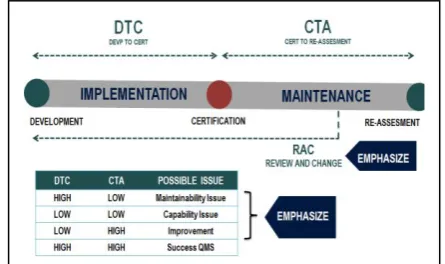
[image:1.595.313.536.409.541.2]This research paper explored the problem related to the maintenance of QMS from two different angles. Firstly, the researcher explored the weaknesses of the current available QMS maintenance framework developed by previous researchers. Additionally, the researcher explored the problem of QMS maintenance from all phases in certification processes within the organization. By having a thorough understanding of problems pertaining to the QMS maintenance from both angles, the researcher can justify the needs of having a new element in the QMS framework. To initiate a better understanding of the problem and issues about QMS maintenance, the researcher illustrates the journey of ISO-9001 certification in Figure 1.
Fig. 1 Illustration of QMS ISO9001 certification journey and important issue for QMS maintenance ISO9001 certification starts with the development activities of the QMS, such as mapping of the core processes, the establishment of quality manual, creation of documentation systems and writing the important procedure or manuals. In the next stage, the organization implements the QMS (DTC) before the certification body assesses and awards the ISO9001 certification. Subsequently, upon obtaining the certificate, the organization should maintain all that has been developed and ensure that they comply with the standard requirements accordingly throughout the maintenance stage before the certification body periodically re-assess the organization’s QMS (CTA).
A New Integrated Framework for ISO 9001
Quality Management System Maintenance in
Malaysia
During this maintenance stage, organization may also continuously make necessary review and changes to the existing QMS as part of improvement initiatives (RAC).
During the ISO9001 certification journey, a few possible scenarios may happen to the organization, contribute to the occurrence of several issues, as shown in Figure 2. For instance, if the organization implements the QMS very well (DTC – High) but difficult to maintain it upon obtaining the certificate (CTA–Low), there are possibilities that maintainability issue occurs. In different scenarios, if the QMS is not very well implemented (DTC – Low) and at the same time, they also face some problems during the maintenance period (ATC-Low), the organization may have some issues on employee capability to implement and maintain the QMS. Another scenario illustrated in Figure1.3 is that the organization improved from DTC-Low to ATC-high. These issues and improvement initiatives shall be emphasized by the organization towards QMS success with specific and suitable strategies as illustrated in Figure 2.
However, the current QMS maintenance framework developed by previous research limitedly focuses on the issue and strategies discussed. The researcher argues that both Kanter’s (1994) and Wahid’s (2012) do not address the issue and strategies that an organization should undertake to ensure the QMS is a success as illustrated in Figure 2. Kanter (1994) and Wahid (2012) only addressed that to maintain QMS, organizations shall conform to all ISO9001:2015 requirements which is something that is understandable. Kanter (1994) and Wahid (2012) also limitedly address the importance of QMS’s review and change that involve the process, people and cultural changes as stressed by other researchers such as Hammer and Champy (1993), Heckl&Moormann (2010) and Cleven et al., (2010).
Fig.2 Illustration of a specific strategy for ISO9001 maintenance issue towards QMS success
Both researchers also limitedly focus on handling the process and its collaboration in QMS, which is highlighted and stressed in the standard Section 0.2 of ISO9001:2015 and ISO9004:2009. The management of processes and its interaction (known as process-based management (PBM) in ISO9000 standard) is essential to the organization as it pushes people to aware of the link between the activities in the process. PBM is established with the belief that ananticipatedoutcome is realized more professionally when activities and related resources are considered as a process (Bhuiyan and Alam, 2004). This is also supported by Fraser (2004), who specified that the identification and
management of processes in an organization are a criticalexplanation of the ISO9001 standard. Without the rightsupervision of the processes and its interface, it will be hard for organizations to fulfill the technical desiresas the compliance of requirements, for ISO-9000,are complicated and deliverssubstantialdifficult to the organization and its workforce. In this context, the researcher believes that PBM can be included in the QMS maintenance framework. The element that drives the organization fulfills all the requirements set in the standard.
II.LITERATURE REVIEW
The management processes which have interrelated elements used to guide and control an organization with regards to quality is known as quality management system (QMS). This is in-line with the definition outlined in ISO9000 that specifically describes QMS as a management system that manages the quality in an organization by establishing and achieving organizational quality objectives and policy. By having the quality management systems, organizations integrate their processes and tools, translate them into operational assistance, monitor and develop the efficiency of the strategy and the operational actions.
The ISO technical committee 176 (TC-176) has established ISO 9000 standards specifically to standardize the practice on quality management in a systematic manner. It describes and outlines the basic elements of the quality system required to guarantee that an organization’s products or services meet clientrequirements and anticipations. ISO9000 is also highly generic. Its principles can be applied to any organization providing any product or services anywhere in the world.
Currently, ISO9000 family standard consists of ISO 9000:2005, ISO 9001:2015 and ISO 9004:2009 with each standard has its specialization and focus. ISO 9000:2015 is a standard that becomes a guidance file. Itdelivers an understanding of the ideas, intent and the application of the “process approach” to the ISO9000 family of QMS standards whereby ISO 9001:2015 specify all the requirements for QMS to be used by all types of organization. ISO9001:2015 which currently still in applications, was published on 15th September 2015 and the only standard in ISO9000 family, which is used for certification purposes. Last but not least, ISO9004:2009 provides guidance to support the achievement of sustained success for any organization in complex, demanding and ever-changing environment by a quality management approach.
The positive impact to organizations from the implementation of QMS and ISO 9000 certification are such as on the clienthappiness, customer care, complaint reduction, distribution, belief, trustworthiness, and reduction to purchasing cost. By the end of 2017, 10380 certificates were issued to organizations in Malaysia. The growth rate of ISO 9000 certificates for Malaysia, on average is around 21.3% per year from 1993 to 2017. InAsia, Malaysia placed in 5th place behind China, Japan, India and South Korea. This indicates that ISO9001 standard is widely accepted in Malaysia with the nearest neighbouring country Singapore for comparison currently just having 3,704 ISO9001 certificates.
However, there are approximately 82,691 certificates that have been withdrawn (until 2014) all over the world due to
various reasons,as shown in Figure 3 below. In Malaysia, there was a total of 2461 certification being withdrawn from 2006 to 2014. This issue is very important to the business community, authority, certification body as well as to the customers indirectly due to the fact that failure to maintain the certification means that organizations having some problems maintaining the quality processes and elements in fulfilling customers’ satisfaction. Given the importance of this issue, many research has been done to investigate the sustainability and maintenance issue of ISO9001:2015 certification such as by Low and Omar, (1997), GoranSvensson (2006), Chin et al., (2000), Zeng et al., (2007), Prajogo (2008), Roslina et al., (2011) and Wahid (2012).
Source: ISO Certification Survey, 2014
Fig.3 ISO 9001 certificate withdrawn per country until 2014 `PBM is one of the main part of TQM philosophy
(Oakland, 1993), and few researches have been done on PBM such as by Koopman& Nicholas (1997), Balzarova et al., (2004) and Carmignani (2015). Commonly, PBM can be defined as the management of the organization by highlighting on maximizing the efficiency of processes rather than the efficiency of departmental or functional units (Harmon, 2003). Carmignani (2008) noted in his article “Process-based management: A structured approach to provide the best answers to the ISO 9001 requirements” that “Process-based approach means, first of all, identifying the process necessary to achieve a product or services, defining the interactions of such process among themselves and applying to their management (control)”. According to Kohlbacher (2010), PBM is not simply about planning, evolving and executing business processes, but also considering the collaboration between these processes. Jeston and Nelis (2006) added that PBM is determined as a comprehensive exercise where features such as organizational management understanding and involvement of the top management of the organization, definite roles, sufficient technical, highlytrained staff and a culture receptive to processes business are important to attain the preferred result.
A ‘process’ gets inputs and executes valuable actions on these inputs to generate output (Marín& Ruiz-Olalla, 2011). Similarly, the vital business processes perform collectively inside an organization to accomplish the organization’s mission and strategic objectives; therefore, managing individual processes is not enough.If an organization’s processes do not work together or work uselessly, then the organization’s performance will be less than best (Marín& Ruiz-Olalla, 2011). According to ISO 9004:2009 standards, processes and activities within each process are particular to an organization and are determined by the kind, dimensions, the distinctive features and level of maturity of the organization.
This is endorsed by Fraser (2004) that the identification and management of processes in an organization are an important part of the ISO-9001 standard. Furthermore, ISO9004:2009 standard stresses that preferred organizational outcomes can be realized more efficiently
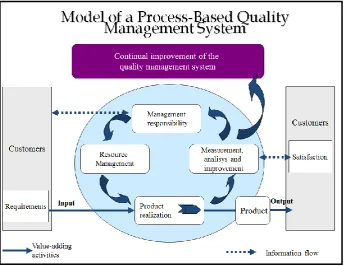
when activities and associated resources are controlled as a process. Besides, the previous version of ISO9001:2008 standard stated that the PBM process would also ensure the PDCA cycle in QMS can be successfully implemented as explains by the PBM model in Figure 4.
[image:4.595.126.473.116.382.2](Source: MS ISO9001:2008 Standard published by Standard Malaysia, 2009)
Fig. 4 Model of a Process-based QMS Process-Based Management (PBM) model in Figure 4
shows the main processes in QMS and how each process is related and interacted. The model, which is based on PDCA (Plan-Do-Check-Action) principles required specific knowledge on the input-output of the process itself. Each interaction between the processes of each process will not be managed effectively if the employees are not having knowledge sharing self-efficacy and knowledgeable in the activity within the processes. The development of each PDCA part will depend on the completeness and efficiency of each approach in each phase itself while the completeness and effectiveness will depend extremely on the worth of information accessible within the employee to take action and decision.
Normally, as knowledge has developed the mainsource for competitive advantage (Soo et al., 2004), hence, nowadays the quality of knowledge acquired and utilized is very critical for most of the industry. For example, it is essential in the hospital, in the aviation and aerospace sector, in the armed-forces activities and even in the education industry. The quality of knowledge attained from numerous knowledge gaining activities will be used in the processes and the organization. That quality knowledge will also need to be used in the maintenance of QMS through effective knowledge within the organization.
From the context of the QMS maintenance framework, the researcher believes that the quality knowledge will fit very well to improve the existing framework by providing significant contribution and effect to the application of technical and non-technical aspects in maintaining QMS.
The quality of knowledge will be very significant for the compliance to ISO9001:2015 requirements, during the management of the processes and its interaction,for solving problems and issue related to human resource aspect, to enhance the level of understanding of QMS and very important in the improvement activities within the certified organization. Apart from that, quality knowledge is very important for quality activity in the organization. According to Dooley et al. (2000), quality knowledge provides valuable input for quality preparation, quality control and quality improvement. For quality planning, knowledge provides valuable input to understand the relationship between product or services and customer satisfaction. For quality control, the quality of knowledge will be very important to evaluate the stability of the processes and diagnose the root cause for defective products or services. The valuable inputs provided by quality knowledge will be significant for quality improvement during the selection of optimal process conditions as well as evaluate the relative capability of processes.
Yoo et al. (2011) addressed the nature of knowledge quality in a team environment, describe its dimensions, and create valid and reliable instruments to measure it. They developed valid and reliable measures of three dimensions of knowledge quality and provides evidence that knowledge
[image:5.595.85.510.133.320.2]quality forms a second-order factor model. They also aimed to examine important antecedents and outcomes of knowledge quality. The detail dimensions of quality knowledge and its characteristic suggested by Yoo et al. (2011) is shown in Table 1.
Table. 1 Knowledge quality dimensions and its criteria (Yoo et al., 2011)
No Dimension of quality
knowledge
Description Proposed Knowledge
Criteria
1 Intrinsic knowledge quality (IKQ)
The amount to which
knowledge has quality in its right.
Precision, Consistency, and Timeliness
2 Contextual knowledge quality (CKQ)
the extent to which knowledge is supposed within the context of the mission.
Significance, Suitability, and
Value-addedness by understanding the environment in which a task functions.
3 Actionable knowledge quality (AKQ)
The extent to which knowledge is expandable, adaptable, or easily applied to tasks.
Expandable, adaptable, or easily applied to tasks.
In doing this study, the researcher also reviewed whether there is a different level of knowledge quality within the organization. Therefore, the researcher has made a thorough research on this matter and found out that there is research that proved that there are various levels of quality knowledge in the organization. The study was conducted by Erden et al. (2008), which suggested a complete model explaining various levels of tacit knowledge quality that a group can achieve within the organization. Erden et al.'s (2008) study has proved that there is a different level of knowledge quality within an organization. Their model is applicable and suitable to be referred to since the research focus is on the quality aspect of knowledge (tacit and explicit), which is created collectively at the organizational level by individual or group which is being shared and transferred within the organization.
The initial understanding,as discussed previously in the literature, summarized that KQ would provide a significant effect on QMS maintenance. However, in daily business and operations of the company, the management of process is
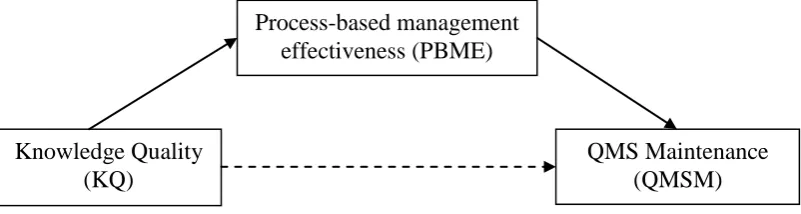
carried out continuously by the management and its employee thus indirectly will influence the quality systems of the organization and will also continuously generates dynamic force to the organization to change and improve the quality systems. It was noted that to ensure effective process-based management; all important resources shall be allocated and made emphasized to it. This is in-line with Siriram (2012) that commented, organization is connected through processes, requiring balancing resources such as people, knowledge and systems. It is likely that in the actual situation, KQ direct effect on QMSM will be degraded since the quality of knowledge of the employee will be much centered to ensure the process-based management is effective. Therefore, it will be interesting to understand further the scenario which PBME potentially becomes the mediator of the relationship between KQ and QMSM. To have better understanding of this scenario, the researcher had undertaken this as part of the research objective and will empirically test it. The path relationships for PBME as mediator between KQ and QMSM is shown in Figure: 5 below.
Fig. 5 Path relationships between KQ and QMSM with PBME as a mediator
Knowledge Quality
(KQ)
Process-based management
effectiveness (PBME)
[image:5.595.85.486.599.706.2]III. METHODOLOGY
The selection of sample size is crucial for accurate findings of this study, as noted by Bartlett et al., (2001). As this study used PLS-SEM as part of the analytical technique, the role of sample size is crucial. However, when using PLS-SEM, so the true sample size is contentious depending on influencing elements on sample size,for example, model complication, departures from normality and methods of estimation. Maximum likelihood estimation can deliveraccurate outcomes with sample sizes of only 50, but it is not suggested (Hair et al., 2010). Gorsuch (1983) has recommended a minimum of 5 participants per variable and not less than 100 participants as total respondents. Schumacker and Lomax (2004) noticed that many researchers hadcompleted studies with 250 to 500 subjects. Moreover, they also proposed that someone can define the sample size by using the general rules of statistics (i.e., 10 or 20 observations per variable). However, for PLS-SEM software, the minimum sample size should be referred to the requirements of 10 times rules (Barclay et al., 1995). Hence it indicates the minimum sample size should be equal to the larger of 10 times the largest number of structural paths directed at a particular construct in the structural model.
Initially, the sampling size technique used for this study is suggested by previous researchers such as Krejcie and Morgan (1970). Based on the sample size developed by Krejcie and Morgan’s (1970) (Table 3.6), 341 samples are required to appropriately represent the population of 3041 companies. This was supported by Comery and Lee (1992), from an inferential statistics perspective, 300 is considered a suitable sample size for the representation of the population. Therefore, based on the basis ofthe above-mentioned guideline and the existing time for this study, the proposed sample size for the study was set to 341 divided amongst the tenth business sectors based on calculated ratio as shown in Table 2.
Table. 2 Sample Size Estimation (reference) Total Population Sample Size Requirement
2000 322
2200 327
2400 331
2600 335
2800 338
3000 341
3500 346
For this study, stratified random sampling was adoptedas a replacement for random sampling based on the business sector. There was diversity in the sampling frame for this study since the different business sectors selected will have different internal cultures, different types of knowledge, diverse activity, different types of challenges and obstacles in maintaining QMS. This is to confirmadequate representation from each business zone to support precise
analysis. According to Sekaran (2003), a stratified random sampling includes a process of stratification; followed by random selection of samples from each stratum.
IV. RESULTS & FINDINGS
The analysis of this research required a measurement model contains indicator reliability, internal consistency reliability as along with convergent and discriminant validity, which target to measure the reliability and validity of the constructs. The first phase of analyzing the measurement model is to inspect the convergent validity of the measurement model. For this, we studied the outer loadings of the indicators and the average variance extracted (AVE). For further analysis, the items that did not fulfil the required least value were deleted. According to Hair et al., (2014), the outer loadings should be 0.708 or higher. Hair et al. (2014) also noted that the AVE value should be a minimum of 0.50. AVE value of 0.50 or higher indicates that, on average, the construct explains more than half of the variance of its indicators. The following table 3 displays that all the CA, CR and AVE values are in the acceptable range as recommended by Hair et al. (2014).
Table. 3 CA, CR and AVE values Cronbach's
Alpha
Composite Reliability
Average Variance Extracted (AVE)
KQ 0.952 0.956 0.547
PBMS 0.966 0.969 0.584
QMSM 0.969 0.972 0.620
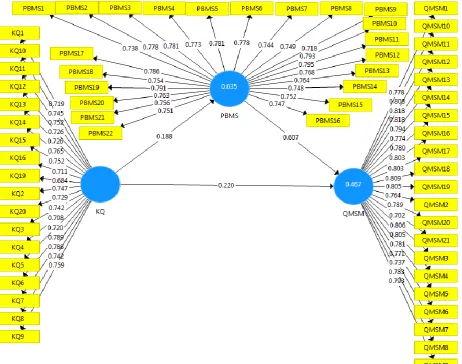
Fig. 6 Algorithm image KQ and QMSM with PBME as a mediator after removing items In this study, Fornell and Larcker (1981) criterion analysis
for testing discriminant validity was applied to study the discriminant validity of the measurement model. It is noticed that the values of the square root of AVE for each construct (i.e. in the bold caption) should be greater than the correspondence row (the correlation value between construct) as shown in Table 4
Table. 4 Fornell and Larcker (1981) criterion analysis for checking discriminant validity
KQ PBM
S
QMS M
KQ 0.740
*
PBMS 0.188 0.764
*
QMSM 0.334 0.648 0.787
*
[image:7.595.323.531.458.507.2]R² value indicates that the amount of variance independent variablesare described by the independent variables. The predictability of the structural model is shown by the large R² value. According to Cohen (1988), the values of R2 ranging from 0.02 - 0.12 are assumed weak, whereas values from 0.13 - 0.25 are considered weak, and values ranging 0.26 and above can be considered as significant.
Table. 5 Coefficient of Determination R2
R2 Result
PBMS 0.035 Weak
QMSM 0.467 Significant
The above table depicts the results of R² values shows that a 3.5% variance in PBMS is having weak value explained by the independent variable KQ, whereas 46.7% variance in QMSM is explained by KQ, and itshowsa significant direct relationship.
[image:7.595.60.278.564.670.2]Effect size (ƒ²) was used to measure the model fitness. According to Cohen (1988),the value of 0.02 – 0.14 displays weak effect, ƒ² values of 0.15 -0.34 shows moderate effect whereas ƒ² values more than 0.35 specifies strong effect. Table 4.5 showsthe effect size values for each path in the model.
Table.6 ƒ2 Values for each Path
Effect Size Result
KQ→PBMS 0.037 Weak Effect
PBMS→QMSM 0.088 Weak Effect
Table 6 is showing the values of overall results are quite. Effect of KQPBMS is Weak effect, and surprisingly it is found a weak effect of PBMSQMSM, there is a weak effect in KQQMSM.
The assessment of the structural model is evaluatedthrough the path coefficient value. By the help of these values, the strength of the association between the two latent variables can be calculated. Bootstrapping output of
smart PLS is applied to assess the connection between independent and dependent variables. To test the significance level, t-statistics and p-value are examined for all paths in both countries Pakistan and Malaysia. When the empirical t-value more than the critical value we say that the coefficient is important at a definite significance level (Hair et al., 2014). This research has used a t-value of 1.96 at 0.05 significance level.
Path Coefficient SE t-value p-value 2.5% 97.5%
KQ-> PBMS 0.188 0.052 3.591 0.000 0.087 0.292
KQ -> QMSM 0.220 0.042 5.252 0.000 0.128 0.294
PBMS-> QMSM 0.607 0.042 14.474 0.000 0.522 0.686
KQ >PBMS ->QMSM
0.114 0.033 3.477 0.001 0.053 0.179
The above tables show the research hypothesis results, H1: There is a relationship between knowledge quality and quality management system maintenance.The results indicated thatthe path coefficient between the KQ and QMSM is 0.607 as shown in figure (6) with standard error 0.042, t value 14.474 and p-value is 0.000. This p-value is greater than the threshold of 0.05 (Hair et al., 2006). This indicates enough empirical evidence to accept the research hypothesis. Thus, H1 has been accepted, and the study established an insignificant relationship withKQ and QMSM.
H2: There is a relationship between KQ and PBMS. The results indicated that the path coefficient between the KQ and PBMS is 0.188as shown in figure (6) with standard error 0.052, t value 3.591 and p-value is 0.00. This p-value is smaller than the threshold of 0.05, and the t-value is also greater than the 1.96 (Hair et al., 2006). This indicates enough empirical evidence to accept the research hypothesis. Thus, H2 has been accepted, and the study established a significant relationship between KQ and PBMS.
H3: There is a relationship between PBMS and QMSM. The results indicated thatthe path coefficient between the PBMS and QMSM is 0.607,as shown in figure (6) with standard error 0.042, t value 14.474 and p-value is 0.00. This p-value is smaller than the threshold of 0.05, and the t-value is also greater than the 1.96 (Hair et al., 2006). This indicates enough empirical evidence to accept the research hypothesis. Thus, H3 has been accepted, and the study established significant relationship between PBMS and QMSM.
[image:8.595.213.527.153.411.2]Hypothesis H4 is based on the mediation of this research. There is a mediating relationship of PBMSin KQ and QMSM. The results indicated that the path of KQ→PBMS→QMSM is 0.114,as shown in figure (6) with standard error 0.033, t value 3.477 and p-value is 0.001. This p-value is smaller than the threshold of 0.05 and the t-value is also greater than the 1.96 (Hair et al., 2006). This indicates enough empirical evidence to accept the research hypothesis. Thus, H4 has been accepted and the study established significant mediating relationship of PBMS in the relationship of KQ and QMSM.
Fig. 7 KQ and QMSM with PBME path coefficient, t-value and p-t-value
V.DISCUSSION
The main objective of this study is to propose a new QMS ISO9001 maintenance framework by adding important variables related to knowledge and process management. To accomplish that objective, it is necessary to reach some prerequisite objectives. Therefore, four (4) research objectives have been identified to support the main objective by incorporating knowledge quality and process-based management effectiveness in the framework. To initiate the empirical support in achieving the objectives, four research hypotheses have been identified.
The quality of knowledge for effective process-based management can also be improved by receivingreliable information on the realdemands and potentials of stakeholders such asclients, traders, staff, and environment etc. (Badreddine et al., 2009). By gainingcorrect information on the requirements of the stakeholders, organizations can fix the essentialprocesses that best suits their desiresin the planning phase of process-based-management. The discussion provides conclusive remarks that the study conducted has managed to achieve the desired objective to study the outcome of knowledge quality on the effectiveness of process-based management and the maintenance of QMS with interesting findings.
Based on previous literature and supported by the expert opinion derived from qualitative data, the initial understanding was that knowledge quality would have a direct and strong positive effect on the maintenance of QMS within the certified organization in Malaysia. Somehow, further analysis in this study found out that high PBME scores would be a positive indicator and was found to be a significant predictor of QMS maintenance ability, partial mediation and accounted for a significant amount of variance in the relationship between quality of knowledge and QMS maintenance ability. The basic idea for the framework is used from Kanter’s (1994) theoretical model of an integrative organization for maintaining a QMS as well as Wahid’s (2012) framework for effective ISO9000 maintenance in service with some additional elements and re-arrangement of elements in the existing framework. To ensure that valuable contribution of previous research work is being adopted, important elements listed in former frameworks have been used in this new framework with a new arrangement of item’s placement and connectivity.
The new QMS maintenance framework is designed for being used by practitioners and will be of interest to quality managers, management representatives, top management, consultants and ISO9001 experts. Third-party auditors and certification managers may also be interested in using the QMS maintenance framework to be used as a reference during an impartial assessment of the QMS. The implication of the results has been viewed from the theoretical and managerial implications. The conclusions contribute to the literature of knowledge management, process-based management concept, as well as to quality management systems area. Practically, the findings contribute to the betterment of effort towards the maintenance of ISO9001 certification and the advancement of the existing QMS maintenance framework.
REFERENCES
1. Ab Wahid, R. and Corner, J. (2009). Critical success factors and problems in ISO 9000 maintenance. International Journal of Quality & Reliability Management, Vol. 26 No. 9, pp. 881-93.
2. Arbaugh, J. B., Bangert, A., & Cleveland-Innes, M. (2010). Subject matter effects and the community of inquiry (CoI) framework: An exploratory study. The internet and higher education, 13(1-2), 37-44.
3. Badreddine, A., Romdhane, T. Ben, & Amor, N. Ben. (2009). A New Process-Based Approach for Implementing an Integrated Management System : Quality , Security, Environment. Proceedings of the International MultiConference of Engineers and Computer Scientists. II, 18–20.
4. Balzarova, M. A., Christopher J, B., John M, Sharp & Sharon, M. (2004). Key success factors in implementation of process-based
management : A UK housing association ex. Business Process Management Journal, 10(4), 387.
5. Barclay, D., Higgins, C. and Thompson, R. (1995). The partial least squares (PLS) approach to causal modelling: personal computer adoption and use as an illustration. Technology Studies, Vol. 2 No. 2, pp. 285-309.
6. Bartlett, J.E., Kotrlik, J.W., Higgins, C. (2001 spring). Organizational Research: Determining Appropriate Sample Size in Survey Research.
Information Technology, Learning, and Performance Journal. Vol. 19, No. 1, 43-50.
7. Bartol, K., & Srivastava, A. (2002). Encouraging knowledge sharing: The role of organizational reward systems. Journal of Leadership & Organizational Studies. Summer, 9(1), 64–76
8. Bhuiyan, N. and Alam, N. (2004). ISO9001:2000 implementation-The North American experience. International Journal of Productivity and Performance Management. 53, ABI/INFORME Global: 10-17. 9. Carmignani, G. (2008). Process-based management: A structured
approach to provide the best answers to the ISO 9001 requirements.
Business Process Management Journal, 14(6), 803–812. doi:10.1108/14637150810915982
10. Chin, K., Poon, G.K. and Pun, K. (2000). The critical maintenance issues of the ISO 9000 system: Hong Kong manufacturing industries perspective.Work Study, Vol. 49 No. 3, pp. 89-96.
11. Ibrahim, Roslina, SamsudinWahab, RasimahCheMohdYusoff, Khalili
Khalil, I. N. S. T. E. D. T. Desaru, and AzizahJaafar. "Student perceptions of educational games in higher education: An empirical study." Issues in Information Systems12, no. 1 (2011): 120-133.
12. Kanter, R. M. (1994). The change masters : corporate entrepreneurs at work(p. 432). London: Unwin Paperbacks. Retrieved from http://trove.nla.gov.au/version/46365233.[Accessed April 2011]. 13. Prajogo, D. I. (2008). The sustainability of ISO 9001 in a legal service
organisation.The Service Industries Journal. 28:5, 603-614
14. Svensson, G. (2006). New aspects of research into service encounters
and service quality. International Journal of Service Industry
Management, 17(3), 245-257.
15. Wahid, R. A. (2012). Beyond certification: a proposed framework for ISO 9000 maintenance in service. The TQM Journal.24(6), 556–568. doi:10.1108/17542731211270115
16. Wang, M., Moormann, J., & Yang, S. J. (2010). Performance-based
learning and knowledge management in the workplace. Knowledge
management and e-learning, 143.
17. KyoonYoo, D., Vonderembse, M. A., & Ragu-Nathan, T. S. (2011). Knowledge quality: antecedents and consequence in project
teams. Journal of Knowledge Management, 15(2), 329-343.