AUTOMATIC CONTROL FOR LEACHING PROCESS
AHMAD YUSRI BIN CHE MAT
AUTOMATIC CONTROL FOR LEACHING PROCESS
AHMAD YUSRI BIN CHE MAT
This Report Is Submitted In Partial Fulfillment of Requirements for the Degree Of Bachelor in Electrical Engineering
(Power Electronic and Drives)
Faculty of Electrical Engineering Universiti Teknikal Malaysia Melaka (UTeM)
ii
“I hereby declared that I have read through this report and found that it has comply the partial fulfillment for awarding the degree of Bachelor of Electrical Engineering (Power
Electronic and Drives)”
Signature : ………
iii
“I hereby declare that this report is a result of my own work except for the excerpts that have been clearly in the references”
Signature : ………...
iv
Specially dedicated to
My beloved father and mother… Che Mat Bin Ngah & Fatimah Binti Jusoh
My beloved brother and sisters … Ahmad Shazril Imri, Asma, Farihah, Nazila
My inspirational motivator…
All my friends,
v
ACKNOWLEDGEMENTS
First of all, I would like to express my thankfulness and gratitude to Allah S.W.T who has given me all the strength that I needed to complete this final year project and also prepare this report.
With this opportunity, I would like to express my gratitude to the Faculty of electrical Engineering (FKE), Universiti Teknikal Malaysia Melaka (UTeM) generally, and especially to my supervisor Mrs Saleha Binti Mohamad Saleh for this help, advices and guidance that he gave during this project.
vi
ABSTRACT
vii
ABSTRAK
TABLE OF CONTENTS
CHAPTER TITLE PAGE
TITLE PAGE ADMISSION DEDICATION ACKNOWLEDGMENT ABSTRACT ABSTRAK
TABLE QF CONTENTS LIST OF TABLES LIST QF FIGURES LIST OF APPENDICES
INTRODUCTION
1.1 Background 1.2 Problem Statement 1.3 Objectives of the Project 1.4 Scope of the Project
LITERATURE REVIEW
1
..
I1I iv v vi vii viii xii xiii xv
2.1 Control Valve System 4
2.2 PLC Programming 5
2.3 Research study from ANZAG Industries 6
2.3.1 What is Nata de Coco 6
\ 2.3.3 Process of Nata de Coco 2.4 Process Control
2.4.1 Liquid Level Control
2.5 Theory Programmable Logic Controller (PLC) 2.5.1 Basic operation of PLC
2.5.2 PLC Programming Language 2.5.2.1 Ladder Diagram 2.5.2.2 Instruction List
2.5.2.3 Sequential Function Chart (SFC) 2.5.2.4 Function Block Diagram (FBD) 2.5.2.5 Structured Text (ST)
2.5.3 The Advantages of Programmable Logic Controller (PLC)
2.6 Theory of RS-232 Serial Port 2.7 Theory of Valve System 2.8 Theory of pH Measurement
2.8.1 WhatispH? 2.8.2 pH Measurement
METHODOLOGY
3.1 Methodology of the Project 3.1.1 Literature review 3.1.2 Gather data and analysis 3.1.3 Learn about controller 3.1.4 Design and Development
Mechanical Part
3.1.4.1 Aluminium Profile 3.1.4.2 Iron Plate
3.1.4.3 Tanks 3.1.4.4 Ball Valve 3.1.4.5 Pipe
3.1.5 Design and Development 3 0 Electrical Part
3.1.5.1 Power Supply 30 3.1.5.2 Miniature Circuit Breaker (MCB) 3 2
3.1.5.3 Relay 32
3.1 S.4 Push Button 3 2 3.1.5.5 Isolator switch 33 3.1 S.6 Solenoid Valve 34 3.1.5.7 Programmable Logic Controller 34 3.1 S.8 Touch Screen 36 3.1.5.9 Control Panel Box 3 7 3.1.6 Designing software 3 8 3.1.6.1 Input and Output Address 3 8 3.1.6.2 Ladder Diagram of 40
Leaching Process
3.1.6.3 Display Programming 4 1
RESULTS AND ANALYSIS
4.1 P r ~ t ~ t y p e Development 42
4.2 First Experiment 44
4.2.1 Procedure of First Experiment 44 4.2.2 Results of First Experiment
4.2.3 Discussi~n ~f First Experiment 4.3 Second Experiment
4.3.1 Procedure of Second Experiment 4.3.2 Results of Second Experiment 4.3.3 Discussion of Second Experiment 4.4 Third Experiment
4.4.1 Procedure of Third Experiment
4.5 Fourth Experiment 56
4.5.1 Procedure of Fourth Experiment 56
4.5.2 Results of Fourth Experiment 57
4.5.3 Discussion of Fourth Experiment 5 8
DISCUSSION OF RESULT
5.1 Discussion 60
5.2 Based on Experiment QQ
5.3 Calculation to find the size of tank for 50kg 64
h a d of Nata de Goco
5.4 Comparison output between prototypes (upsizing) 66
And Amag Industries for SQkg lead in future
application
CONCLUSION AND RECOMMENDATION
6.1 Conclusion
6.2 Recommendation
LIST OF TABLES
TABLE TITLE PAGE
RS-232 pin assignments (DB9 PC signal set)
Input and Output Address Results of first experiment
Calculation results of first experiment Results of second experiment
Calculation results of second experiment Results of third experiment
Calculation results of third experiment Result of f ~ u r t h experiment
Calculation results of fourth experiment Result for used the 5Qkg Nata de Coco Result based on prototype
LIST OF FIGURES
FIGURE TITLE PAGE
Dimension of Nata de Coco
Leaching process with manually Flow chart of production Nata de Coco Programmable Logic Control (PLC) Application of PLC
Block diagram of PLC process Ladder diagram
Grafcet
Handshake looping a PC serial connector Solenoid Valve
The pH scale
Flow chart of project methodology
Design prototype using Solidwork software Aluminium profile
Irsn Plate
Dimension surface of iron plate
Tanks and dimension
Ball Valve PVG Pipe Water filter
2 4 V K Power supply
(A) MCB and (B) inside of a circuit breaker Relay
Isolator switch Solenoid valve
Panasonic PLC NAIS FPO Series
Communication of PLC with computer and display Touch screen Panasonic GTO 1
Connection touch screen with plc Control panel box
A ribbon cable
Flow chart of leaching process of Nata de Coco Prototype of automatic control for leaching process of Nata de Coco
Diagram of first experiment Diagram of second experiment Diagram of third experiment Diagram of fourth experiment Graf of pH value versus Time
Graph of Total Time Taken and Total Water Consumption versus Leaching Time
Size tank for prototype (500gram) Size tank for large scale (50kg)
LIST OF APPENDICES
APPENDIX A
TITLE
Journal: Comparison of Friction Models Applied
to a Control Valve
Journal: Converting PLC Instruction Sequence into
Logic Circuit: A Preliminary Study Datasheet: Solenoid valve
Datasheet: PLC FPO Series
Datasheet: Touch Screen GTOl
Wiring connection in control panel box
Ladder diagram of Automatic Control for Leaching Process
Menu display process on touch screen
CHAPTER 1
INTRODUCTION
This chapter explained about the importance of this project. The discussion included the background of the project, problem statement, objectives and scopes of project.
1.1 Background
The leaching process is a process by which inorganic, organic contaminants or radio nuclides are released from the solid phase into the water phase. This process is ready under the influence of mineral dissolution, desorption, complexation processes as affected by pH, redox, dissolved organic matter and biological (micro) activity. The leaching process itself is universal, as any material exposed to contact with water will leach components from its surface or its interior depending on the porosity of the material considered.
2 Control of industrial processes is a broad field of concern that cuts across virtually every area of science and technology. The basic operating principles utilized by the control function are so specialized and unique that a whole new field of study has been created. Such terms as process control automation, computer integrated manufacturing, computer numerical control, process instrumentation, and flexible manufacturing systems are commonly used to describe this particular function in industry. Control is an essential function of manufacturing.
Process control is a unique part of industry that deals with the control of variables that influence materials and equipment during the development of a product. It may range from a relatively simple operation, such as filing bottles, to maintaining a proper level in an analytical procedure that determines the content of a complex chemical solution. The end result of the operation, in most cases, is a procedure that initiates some type of control function. Controlling manufacturing process is the basis of industrial automation today.
1.2 Problem Statement
Present in era technology becomes vital part in existence diurnal. Technology can help and facilitate human make any job. This entered into manufacturing process and production Nata de Coco. Previously, manufacturing process and production the Nata de Coco carried out in manual process. With this method, need lot of staff to control stated process. The conventional method for Nata de Coco leaching process takes in excess of the time and has a low efficiency.
3 To solve these problems, an automated water system is able to designed and implemented on the leaching process of Nata de Coco. First of all, a water system can be designed for Nata de Coco leaching process. After the design of the water system, the automation system process can be designed subsequently. The automation system process designed using the Programmable Logic Controller (PLC). The PLC is open-off nature and the automation system process is an on-off system.
1.3 Objectives of the Project
To accomplish the target in this project, the objective below have been fixing as a guide in how to execute this project to improve its ability. The main objectives for Final Year Project (FYP) are:
i. To design and build one prototype for leaching process of Nata de Coco. ii. To control leaching process by automatic control.
iii. To control acidity level of Nata de Coco.
iv. To develop a program that can control leaching process automatically.
v. To study and analyze the load capacity for large scale of Nata de Coco production.
1.4 Scope of the Project
To guarantee that the objectives of the project are achieved, a few important elements must be considered. The scopes for this project are as follows:
i. Design the prototype for leaching process of Nata de Coco by automatic control. ii. Build the automatic control leaching process for 2 tanks with ½ kg load each tank. iii. Using the PLC to control the leaching process of Nata de Coco.
CHAPTER 2
LITERATURE REVIEW
Literature review is the study relating with the project would be exercised. Where, project want to be carried out must base to the theory, observation, recitation, understanding and documentation those related with field irons in the fire and have process arrangement and work procedure to make sure travel orderly project. Therefore, the projects want to be implemented must include building aspect project, material and equipment which are used. This matter very important for achieve objective of the project and it can also help in implementing project with more effectiveness, fluent and perfect.
2.1 Control Valve System
Comparison of Friction Models Applied to a Control Valve (Author: Claudia Garcia-2008) [1]
The purpose of this paper is to implement and test different friction models applied to control valves. Control valves are the most common final control elements in industry. One of the main factors that affect the behavior of the control loops is friction in control valves. Performance assessment of control loops is an important research theme, and there are many tools to detect variability in control loops.
5 wherever exact adjustment to the actual requirements is needed. There is a choice of different designs to suit the application and requisite accuracy.
2.2 PLC Programming
Converting PLC Instruction Sequence into Logic Circuit: A Preliminary Study
(Author: Shuichi Ichikawa, Masanori Akinaka, Ryo Ikeda and
Hiroshi Yamamoto) [2]
A Programmable Logic Controller (PLC) is a kind of computer, which has been widely adopted for sequence control of industrial machinery. Although PLC is flexible and well established, the performance of PLC does not always satisfy the requirements in large and highly responsive systems
By implementing a control program with hard-wired logic using reconfigurable devices a flexible and highly responsive system could be realized. Since an FPGA chip can contain maximally ten million logic gates, a very large control system could be implemented with a single chip. This may sometimes lead to downsizing and reduction of system components.
The ladder diagram has been widely accepted to describe PLC programs. A ladder diagram consists of one or more rungs, each of which consists of a condition part and a process part. Either the condition part or the process part can be an input/output or an instruction. The output of a rung is activated if the corresponding input condition is satisfied; otherwise, the output is deactivated. The instruction of a rung is executed if its input condition is satisfied.
Rungs are ordered, and interpreted in due order. A ladder diagram is executed in the following manner:
i. At the beginning of a ladder, all inputs are collected and stored into the corresponding internal memory elements, which are read and modified by rungs (input phase).
ii. Rungs are interpreted in due order
iii. When the bottom of a ladder is reached, all output ports are updated by the corresponding internal memory value.
6 2.3 Research study from ANZAG Industries
ANZAG Industries Sdn. Bhd is a local company that categorized in small medium industry. This company specializes in manufacturing Nata de Coco. ANZAG Industries is located at small medium industries area at Bemban, Melaka.
2.3.1 What is Nata de Coco?
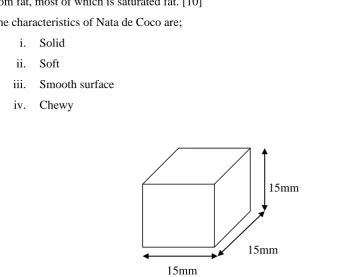
Nata de Coco is a chewy, translucent, jelly-like food product produced by the bacterial fermentation of coconut water. Nata de Coco is most commonly sweetened as a candy or dessert, and can accompany many things including pickles, drinks, ice cream, puddings and fruit mixes. The product originates from the Philippines. The primarily coconut water dessert is produced through a series of steps ranging from water extraction, mixing, fermentation, separating, cleaning, cutting to packaging. Commercial nata de coco is made by small farmers in the Philippines. It requires glacial acetic acid, however, and spillage of this ingredient will make the topsoil acidic. The nutritional values of coconut products vary according to the different stages of development. The mature coconut is a good source of iron and potassium. Approximately 86% of the calories in coconuts are from fat, most of which is saturated fat. [10]
The characteristics of Nata de Coco are; i. Solid
ii. Soft
iii. Smooth surface iv. Chewy
15mm
[image:22.595.95.444.463.740.2]15mm 15mm
7 2.3.2 Leaching Process of Nata de Coco
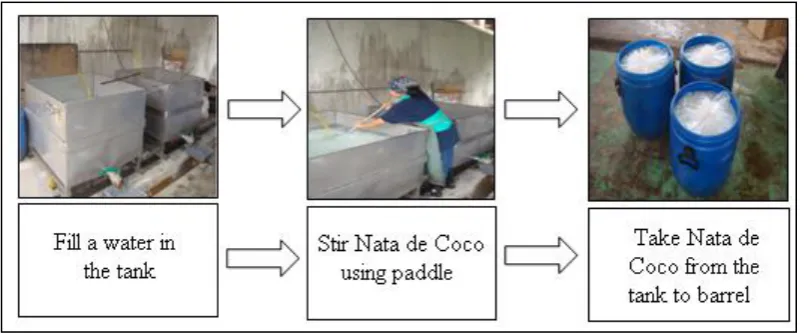
From research study in ANZAG Industries, Nata de Coco leaching process is done by using one tank. The inlet of the tank is connected using hose to the water supply and the outlet is not connected to anything. The outlet of the tank is for draining the acidic water after leaching process. At the start of leaching process of Nata de Coco, the worker pours Nata de Coco into the tank. The inlet of the tank to the water supply by using hose and the valve of the outlet is closed so that water cannot flow out. The leaching tank is stirred in the estimated interval time of every one hour. Each estimated 3 to 4 hours, the worker will drain the water from the leaching tank by opening the valve at outlet and once again the inlet is connected to water supply and water is directed to the tank again to refill the tank as shown in figure 2.2 . This is to drain out the acidic water due to leaching process and refill the tank with clean water. All these stirring, draining and refilling process is repeated for 2 to 3 days until the pH of the water that leach the Nata de Coco becomes neutral, that is pH 7. The leaching process is completed when the pH of the water reaches 7 and it takes about 2 to 3 days to complete.
[image:23.595.105.510.436.603.2]
8 2.3.3 Process of Nata de Coco
Mixing the ingredients
Filling the mixture into nata mold
Fermenting Nata de Coco in temperature 23-32°C
Cleaning nata de coco by scrapping the fungus until white layer appear
Soaking clean nata by keeping immerse in water
Cutting into cube Preparing the ingredients:
Water Dissolving sugar Extracting coconut milk