Abstract: Robotics and automation are leading humanity to a new era. Sustainability and growth are being met in the industrial sectors due to automation. The same automation can do miracles in agriculture to increase productivity. Machine vision is a primordial element in enabling the complete automation. This paper discusses about the design and development of an automated system that utilizes machine vision for chilli segregation. The image of the chilli is captured by a camera and the ripeness is found by analyzing it in a machine vision software following which it is sorted into being ripe and unripe. This process of automation in the agriculture will reduce manpower for segregation process during the harvest time. Implementing at a larger scale can be profitable. This method can also be tailored for sorting other vegetables like tomato, lemon, and other fruits and vegetables based on ripeness.
I. INTRODUCTION
The agricultural production rates are increasing due to the introduction of the hybrid crops to meet the growing demand for the food for the ever-growing population. Owing to this, there also arises a need for effective automation systems to be introduced in the agricultural sector from the production of the food crops for delivering it to the consumer to ensure the quality. There are many processes in the agricultural sectors that should be automated in order to meet these demand more effectively. This new wave of smart automation will make it possible to produce more and higher quality food with less manpower. The technological solutions for better farming are not scalable at a large scale for everyone due to different ecological and demographic situations, so these technologies have to be developed indigenously at lower costs for mass adoptions which in turn increases the economy of the local farmers and other agricultural industries. Among many automation in agricultural sectors, segregation and sorting of the fruits and vegetable are unproductive to employ the human labours. This process can be automated with current technologies such as Machine vision, Image processing etc.
Revised Manuscript Received on May 22, 2019.
K.Akila, Faculty, Department of Mechatronics Engineering, Kumaraguru College of Technology, Coimbatore, Tamil Nadu, India
B.Sabitha, Faculty, Department of Mechatronics Engineering, Kumaraguru College of Technology, Coimbatore, Tamil Nadu, India
K. Balamurugan, UG student, Department of Mechatronics Engineering, Kumaraguru College of Technology, Coimbatore, Tamil Nadu, India
K.Balaji, UG student, Department of Mechatronics Engineering, Kumaraguru College of Technology, Coimbatore, Tamil Nadu, India
T. Ashwin Gourav, UG student, Department of Mechatronics Engineering, Kumaraguru College of Technology, Coimbatore, Tamil Nadu, India
The main objective of this paper is to develop an automated system that utilizes the machine vision for a sorting process involving chilli segregation at a rate which can be afforded by the farmers.
There are some fruits and vegetables like chillies, orange, lemon, eggplant, tomato, etc. whose maturity or ripeness can be found out by seeing its colour and texture. This change in colour difference can be easily identified by using a machine vision system and the fruits or vegetables are sorted with appropriate conveyor set up and sorting mechanism. Now let us discuss various ideas and hypotheses from different published papers and other internet sources in the following pages.
The inspection and sorting of fruits and vegetables can be very tedious work. In countries with cheap labour, inspectors classify fruits and vegetables manually, but differences between visual standards and lack of experience produce undesirable results. chilli sorting is done manually by experienced people and a machine was developed to classify chillies automatically taking their sorting judgment into consideration. But for this proposed system, the consideration is prioritized to the colour of the chillies and area of the chilli’s surface instead of other parameters like size, width etc.
II. LITERATURE REVIEW
Chilli is a common ingredient in many food varieties. India has the average chilli production around 1551 kg/ha. Annual chilli production in India during 2005-06 was 1014.60 million tonnes. These chillies were cultivated with the area around 654 million hectares. The leading chilli producing states in India includes Andhra Pradesh (49%), Karnataka(15%), Maharashtra (6%) and Tamilnadu (3%). The above-mentioned statistics are mentioned by Pravin Jagtap in his journal [1].
These chillies after the harvesting are sorted into green and red chillies based of colour, whereas green chillies are sold directly in the market and red chillies are further processed and dried, which can be used to make chilli powder [2]. This sorting process in farmland is usually done manually. The process of sorting the vegetables by a human by preset visual standards which is undesirable and unproductive [3]. The process of sorting of different vegetables and fruits like chillies, tomatoes, lemons are automated by the use of different methods and technologies like machine vision, image processing etc.. F.Hahn constructed a system to grade the chillies based on the length/width utilizing a
Mechatronics System Design for Automated Chilli
Segregation
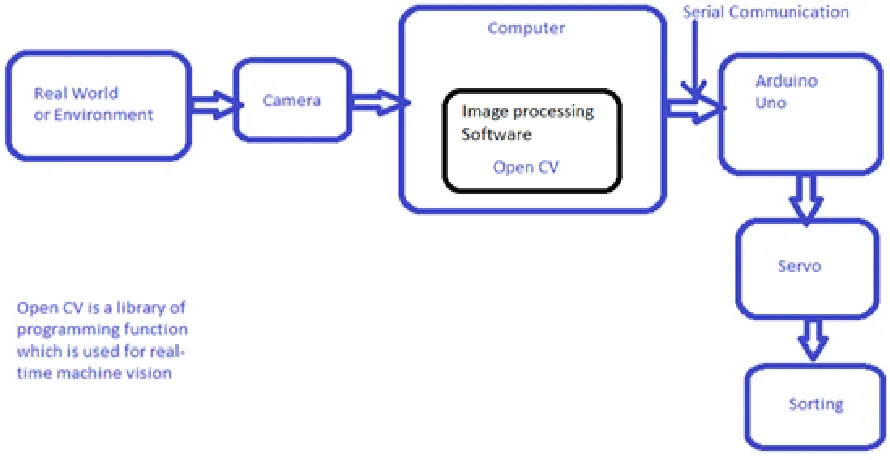
Fig. 1 Block diagram of Proposed System camera system. He relied on structured light that is produced
by a group of lasers which are made to fall onto the chillies then these lights are captured by a camera in his case he used monochromatic charge coupled device (CCD). Then the image is processed to find the length and width of the chillies which is used to grade them accordingly [4]. O. Arjenakiand et al. sortted the tomatoes by using machine vision systems. For the sorting system, they used a CCD camera with polarizing films from Sony, Atmega8 microcontroller, Computer with 2.8 Mhz. The software program that was used in this sorting system was developed using Visual Basic 2008. The methods involved in the sorting processes are getting the images of the tomatoes from the conveyer belt and processing it with the HSI and RGB threshold spaces to sort the tomatoes. The tomatoes are sorted into unripe, half ripe and fully ripe based on the shape, maturity, size and average colour components [5]. S. Laykin and his other project members created a similar tomato classification or sorting system using advanced image processing algorithm. They used three cameras(CCD) with a halogen spotlight setup for the image capturing purposes in their project. The algorithm and program to classify the tomatoes were developed using Matlab. The tomatoes were classified into ten grades and four main categories like red, pink, green and rejected. The program in this system utilizes the RGB and HSV spaces in the acquired images and does the further image processing like edge detection, thresholding certain colour spaces in the image, calculating roundness of the tomatoes etc. to classify accordingly [6]. Pla and his other project members developed an industrial fruit and vegetable sorting system by machine vision. The machine vision system used by them for the sorting processes contained the sensors like weight sensors and three cameras where one is colour CCD camera and the other two are monochrome CCD
cameras with infrared and ultraviolet filters respectively. The infrared filtered camera is to detect the presence of fruit or vegetable in the conveyor system(localization), the ultraviolet filtered camera is to detect the defects and the colour camera is used to find the maturity and other factors in the fruits or vegetables during the sorting processes. The data acquired from the weight sensor, three cameras are sent to the control unit with a mainframe computer with Pentium III processor @ 500 MHz in a LAN and based on the sorting process the output to the actuators are sent from the control unit via CAN protocol. This system is capable of sorting 15 fruits or vegetable per second [7].
III. PROPOSED SYSTEM FOR CHILLI SEGREGATION
The chilli segregation system consists of the following components.
a. Vibrating conveyor assembly b. Belt conveyor setup
c. Sorting system
d. Software and algorithm
Vibrating Conveyor Assembly
The vibrating conveyor assembly is a mechanical structure in which the chillies are loaded for the sorting process. This assembly will deliver the chillies in order of small numbers of one at a time to the conveyor setup from the loading process. The components present in the vibrating conveyor assembly are as follows, Custom made pan and stand, Vibration motor, and ‘V’ shaped slider
The custom-made pan and stand are the structural components in which the vibration motor and ‘V’ shaped slider are attached. The chillies will be loaded onto the pan and vibration motor is switched on. Due to the jerking motion exhibited by the motor to the pan, the chillies will start sliding downward through the slope as the pan is attached to the stand with some small tilt and they will fall onto the ‘V’ shaped slider, which will fall onto the belt in the belt conveyor setup for further processing.
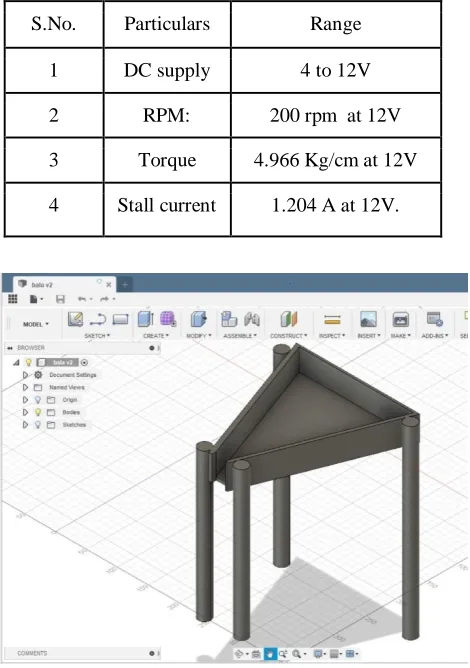
[image:3.612.322.555.273.402.2]The vibrating conveyor pan is made from GI sheets with triangular dimensions of a height of 600 mm and base of 400 mm, the frame of the stand is made from steel tubes with the average height of 1000 mm, the vibrating motors are powered by DC power source. The inertial weight attached to the shaft of the DC motor creates unbalanced forces during the rotation of it, which generates the vibrations for our process.
Table. 1 Motor Specifications
Fig. 2 Isometric View of Vibrating conveyor assembly designed in Autodesk Fusion 360
Belt Conveyor Setup
The belt conveyor setup is a set of conveyor belts and its driving systems which receive the chillies from the vibrating conveyor assembly. The main purpose of this belt conveyor is to deliver the chillies form the vibrating conveyor assembly to sorting system and after sorting out the red or ripen chillies from the green ones, the remaining chillies are delivered to a separate container by this setup.
The components used in this setup are, Metallic conveyor frame, Belt, Pulley Motors, Motor driver, and Arduino Nano The metallic conveyor frame acts as the platform on which all the remaining listed components are present. It is made of MS plates of 0.5 mm. This frame is made for prototypic purpose so its dimensions are small with a length of 800 mm, breadth of 150 mm and height of 150 mm. There are two motors attached to this frame for powering the conveyor belts and they are DC motor with the following specifications
Fig. 3 Belt conveyor setup
The motors are attached to the pulleys through which the belt is wound and looped. The dimensions of the belt are 1400 mm X 100 mm. The colour of the belt should be chosen barring red or reddish shade as it might affect the image processing in the machine vision system. In this system, the red colour belt is painted to make it look black for the above-mentioned purpose. The two motors in the conveyor belt setup are operated by the motor driver L298n, this driver is capable of operating in the voltage range of 5V to 35V. This motor controller is programmatically controlled from the Arduino by sending the PWM signals. The speed of the motors is set to some moderate values that are effective for sorting process by trial and error process. The Arduino used in this process is Arduino Nano. Arduino Nano is a 32-bit microcontroller with ATmega328P chip.
Sorting System
The sorting system is the system which is used to sort out the chillies based on the ripeness. The camera unit mounted on the conveyor belt setup captures the images of the incoming chillies and will send it to the PC which will process those images through the Open CV software in the python environment. Based on the ripeness of chilli algorithm, the S.No. Particulars Range
[image:3.612.56.291.372.706.2]python program running on the PC will send the commands to Arduino that is described in the Conveyor setup which will sort the chillies by using a servo as the actuation tool. The subcomponents in the sorting systems are Camera, Servo, Computer, and Arduino Nano.
[image:4.612.324.553.240.345.2]A camera is used to capture the images of the chillies that are conveyed via the belt. The camera used in our system is Logitech C310 HD Webcam with the specifications as follows.
Table. 2 Logitech C310 HD Webcam specifications
S.No. Particulars Range
1 Resolution 1280 x 720
2 Frame rate 30 fps
3 Interface Connectivity USB 2.0
4 Megapixels 5 MP
This camera unit used to send the images of the chillies captured on the conveyor belt to transfer it to the computer via the USB 2.0 port, which is then processed on the computer. The computer used for our system is a DELL XPS 15 (2010) with Intel i5 2430m (2nd Gen) as CPU and NVIDIA GT 525M as GPU and 6GB RAM. The computer is running on a Windows 10 professional OS. These systems specifications are enough to run our applications. The images sent from the Logitech camera is received via USB 2.0 by this computer and are processed by the python program running in this machine and required commands are sent to the Arduino Nano via a serial communication port (USB). The Arduino Nano mentioned in the conveyor setup is again used in this sorting system to receive the commands from the PC via COM port for the actuation of the servo motor for the sorting process. That servomotor is mounted at the leading end of the chillies exit for tossing the ripen chillies out of the conveyor line by rotating action. The control for the servo motor is given by the Arduino as pulse width modulation using which the motors will able to do the desired rotation with precise angles. This precise control of servo helps in tossing out the ripen chillies from the green chillies in the conveyor setup at another end. Software and Algorithm
The software used in the proposed system are Python and Open CV software package. Arduino IDE is used to program the Arduino Nano for operating the motors in the belt conveyor setup and turning the servo shaft for tossing out the ripen chillies after it receives the command from the python program running for machine vision in the computer. The Python programming language is used to create and develop the machine vision program for sorting out the chillies. The python program utilizes an open source machine vision package called OpenCV for doing the image processing and machine vision.
The algorithm used in the proposed system is given below,
The image is taken using the camera fitted over the conveyor belt.
Using HSV filters red color chillies are filtered out into binary images with the HSV Range for red chillies,
Lower limits: h = 0/179, s = 155/255, v = 106/255.
Higher limits: h = 179/179, s = 255/255, v = 255/255 On applying contour function to the filtered out image, the area of the white region can be calculated (Red chilli surface). If the area is above the specified range (changes based on the camera mounting), red chillies are identified. This identification data is then passed to the Arduino Nano via Serial Communication to actuate the servo, to toss out the red chillies.
The combination of both red and green chillies in color captured by the camera is shown in Fig.4
Fig. 4 Color images of combination red and green chillies The binary image that is generated after the red chillies are filtered out from the above-shown fig.5 with the HSV values
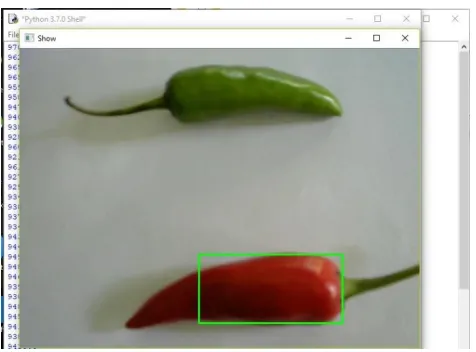
[image:4.612.328.562.404.536.2]This method also eliminates the unwanted tossing of the green chillies due to a small patch of redness in them. Currently, the only downside to this method is that sorting of multiple red chillies at a given time is not possible and can be used to sort them one at a time. The contoured and boxed image of red chilli is shown in fig.6.
Fig. 6 Boxed red chilli.
IV. CONCLUSIONS
We used machine vision, which is a primordial element in enabling the complete automation to develop an automated system that utilizes machine vision for chilli segregation. The image of the chilli is captured by a camera and the ripeness is found by analyzing it in a machine vision software following which it is sorted into being ripe and unripe. This will greatly reduce the unproductive human need for the chilli segregation during the harvesting time. Implementing at a larger scale can be profitable and flexibility factor can be obtained for sorting of various other vegetables. Needs a good amount of computational power to process. Initial setup cost may be high.
V. SCOPE FOR FURTHER STUDIES
The automation in the agricultural sector are innovated day by day, so there is a good scope in creating and developing projects like automated irrigation, logistics, crop monitoring, automated fruit grading, and sorting etc. The process of sorting the fruits, vegetables, nuts, and other agricultural products based on grade, ripeness, length, damage, maturity etc. using machine vision technologies will increase productivity and eliminate un-resourceful human effort for this process. From our study, this machine vision system and automated sorting process can be easily tailored for sorting the fruits and vegetables like tomato, lemons, guava, orange, eggplant, etc.
REFERENCES
1. JAGTAP, P., SHINGANE, U. AND KULKARNI, K., "ECONOMICS OF PRODUCTION OF CHILLI IN INDIA", Research gate, 2012. [Online]. Available:https://www.researchgate.net/publication/235762030_ECONO
MICS_OF_PRODUCTION_OF_CHILLI_IN_INDIA. [Accessed: 01- Jan- 2019].
2. "Chilli (Capsicum annuum L.) Solanaceae", TNAU AGRITECH PORTAL, 2015. [Online]. Available: http://agritech.tnau.ac.in/horticulture/horti_vegetables_chilli.html. [Accessed: 01- Jan- 2019].
3. K. Peleg, Produce handling, packaging, and distribution. Westport, Conn.: AVI Publishing Company, 1985.
4. F. Hahn, "PH—Postharvest Technology", Biosystems Engineering, vol. 83, no. 4, pp. 433-440, 2002. Available: https://www.sciencedirect.com/science/article/pii/S153751100290139X. [Accessed 1 January 2019].
5. O. ARJENAKI, P. MOGHADDAM and A. MOTLAGH, "Online tomato sorting based on shape, maturity, size, and surface defects using machine vision", Turk J Agric For, vol. 37, pp. 62-68, 2013. Available: https://www.researchgate.net/publication/259678249_Online_tomato_sort ing_based_on_shape_maturity_size_and_surface_defects_using_machine _vision. [Accessed 1 January 2019].
6. S. Laykin, V. Alchanatis, E. Fallik and Y. Edan, "IMAGEPROCESSING ALGORITHMS FOR TOMATO CLASSIFICATION", Transactions of the ASAE, vol. 45, no. 3, p. 851, 2002. Available:
https://www.researchgate.net/publication/279567908_Image-processing_algorithms_for_tomato_classification. [Accessed 1 January 2019].
7. F. Pla, J. Sanchiz and J. Sanchez, "An integral automation of industrial fruit and vegetable sorting by machine vision", ETFA 2001. 8th International Conference on Emerging Technologies and Factory Automation. Proceedings (Cat. No.01TH8597), vol. 2, pp. 541-546, 2001. Available: