i
APPROVAL
“I hereby declare that I have read this thesis and in my opinion this thesis is sufficient in term of scope and quality for the award of Bachelor of Mechanical
Engineering (Design & innovation)”
ii
DECLARATION
“I hereby, declare this thesis is result of my own research except as cited in the references”
Signature : ………..
iii
DEDICATION
Special Dedication to my family members, my friends, my fellow colleague and all faculty members for all your
iv
ACKNOWLEDGEMENT
First of all, I would like to thanks Gods that have given me the opportunity to complete my ‘Project Sarjana Muda’ (PSM). Alhamdulillah, His Willingness has made it possible for me as the author to complete the PSM in time. I worked hard in completing this
project within a semester.
I would like to take this opportunity to give my special thanks to my dedicated previous supervisor, Associate Professor Ir. Mustafar Bin Ab Kadir and also my new supervisor Professor Dr. Md.Razali Bin Ayob for guiding this project at every stage with clarity, spending much time to discuss and help with this project, and that priceless gift of getting things done by sharing his valuable ideas as well as share his knowledge. I would also like to thank to all UTeM lecturers whom had helped directly or indirectly in what so ever manner thus making this PSM a reality.
Not forgotten are my best colleagues for their openhandedly and kindly guided, assisted, supported and encouraged me to make this project successful. My heartfelt thanks to my dearest family which always support and pray on me throughout this project. Their blessing gave me the high-spirit and strength to face any problem occurred and to overcome them rightly.
v
ABSTRACT
The air conditioner is a medium to get an environment pleasant reply. The air condition will generate cool air to the environment such as in homes, offices and building. There are different types of air conditioner such as window unit air conditioner, split unit,
vi
ABSTRAK
Penyaman udara merupakan satu medium untuk mendapatkan keadaan persekitaran yang sejuk dan nyaman. Penyaman udara akan menghasilkan udara sejuk kepada persekitaran seperti di dalam rumah, pejabat dan juga banggunan. Terdapat berbagai jenis penyaman udara
vii
LIST OF CONTENT
CHAPTER ITEM PAGE
ACKNOWLEDGEMENT iv
ABSTRACT v
ABSTRAK vi
LIST OF CONTENT vii
LIST OF FIGURE x
LIST OF TABLE xii
LIST OF SYMBOL/ABBREVIATION xiii
CHAPTER 1 1.0 INTRODUCTION 1
1.1 Objective 1
1.2 Problem Statement 2
1.3 Scope 2
CHAPTER 2 2.0 LITERATURE REVIEW 3
2.1 Air conditioning 3
2.1.1 Compressor 4
2.1.2 Condensers 5
2.1.3 Expansion Devices 6
2.1.4 Evaporator 7
2.2.1.1Mechanical Air Conditioning and Ventilation 8
2.2.1.2Split Unit Air Conditioning 9
2.2.2 Split Unit Flow rate 10
2.2.3 Air Change per Hour (ACH) 11
2.3 Solar Air Condition 11
2.3.1 Solar Cooling Technology 12
2.3.2 Components of a solar cooling system 12
2.4 Solar Water Heater 12
2.5 Types of solar collectors 13
viii
2.5.1.1 Liquid collectors 14
2.5.1.2 Air Collector 15
2.6 Evacuated tube collectors 16
2.6.1 Glass Evacuated tubes 17
2.7 Benefit of the solar water heater 17
2.8 Solar boosting panel 18
2.9 Cooling tower 19
2.9.1 Cooling Tower Design 21
2.10 Absorption Chillers 22
2.10.1 Absorption Chiller Energy Efficiency 23 2.10.2 Lithium bromide/water cycle machines 25 2.11 Market potential for the solar air conditioning 26
2.12 Green Technology 27
CHAPTER 3 3.0 METHODOLOGY 29
3.1 Identify problem statement, objective and scope 30
3.2 Literature review 31
3.3 System Definition 31
3.4 Parameter for the system 31
3.4.1 Site Study 31
3.4.1.1Solar Evacuated Tube Temperature 33
3.4.2 Advantages 34
3.4.2.1 Benefits of Using Solar Air-Conditioning 35
3.4.3 Efficiency 36
3.4.4 Engineering Hardware 38
3.4.5 Design Theory 40
3.4.2.1 Absorption chillers process flow 41
CHAPTER 4 4.0 RESULT 43
4.1 Number of tube required 43
4.2 Price 49
CHAPTER 5 5.0 DISCUSSION 50
CHAPTER 6 6.0 CONCUSION AND RECOMMENDATIONS 52
6.1 Conclusion 52
6.2 Recommendations 53
ix
BIBLIOGRAPHY 56
x
LIST OF FIGURE
FIGURE PAGE
Figure 1: Air condition diagram 3
Figure 2: The diagram for air conditioning process 4
Figure 3: Condenser 5
Figure 4: Expansion Device 7
Figure 5: Evaporator 7
Figure 6: Z array collector 14
Figure 7: U array collector 14
Figure 8: Solar air collector 15
Figure 9: Evacuated tube collector 16
Figure 10: Glass Evacuated Tubes 17
Figure 11: Solar Boosting Panel 18
Figure 12: Cooling Tower 19
Figure 13: Basic process scheme of thermally driven chillers 20 Figure 14: Schematic overview of a generic cooling tower flow 22
Figure 15: Chillers 23
Figure 16: Principle of absorption chillers 23
Figure 17: Diagram of two-shell lithium bromide cycle water chillers. 25
Figure 18: Annual sales room air conditioner (RAC) 27
Figure 19: Process flow chart 30
Figure 20: Schematic diagram of the Solar Air condition system 32 Figure 21: The solar evacuated tube was located at the roof with temperature multi
meter. 33
Figure 22: The temperature after 15 minutes, 97°C 34
Figure 23: Overview of absorption cooling and electrical cooling 38
Figure 24: Schematic Building Automation system 39
Figure 26: Simple graphic from solar district cooling 40
xi
Figure 28: Solar evacuated tube seido 1-16 45
Figure 29: The area of the solar evacuated tubes 47
Figure 30: Sample of arrangement of 8set solar evacuated tube. 48
Figure 31: The arrangement of the solar evacuated set. 48 Figure 32: Roadmap for Solar Cooling (Source: Solar district cooling) 49
xii
LIST OF TABLE
TABLE PAGE
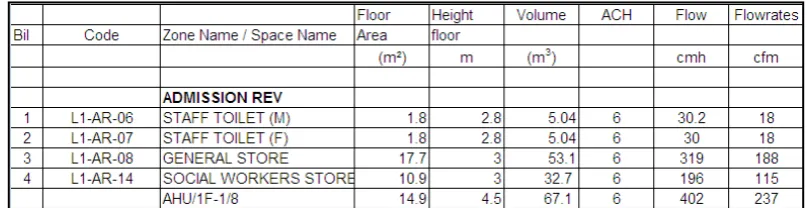
Table 1: Split unit flow rate schedule 10
Table 1: COP Absorption chillers 24
Table 3: Annual Electricity Saving 35
Table 4: Electricity Consumption for Conventional Air conditioning System 36 Table 5: Electricity Consumption for Solar Air Conditioning System 37
Table 6: Schedule of the Chiller 44
1
CHAPTER 1
INTRODUCTION
Air conditioning that powered by solar energy has great potential in the cooling system design nowadays. It is because of high demand for cooling usually coincides with plentiful sunlight. Solar air conditioning at an economically competitive level could reduce electricity costs for residential and small commercial customers. This would cut the growth of peak electric demand and ease the increasing pressures on generating capacity, transmission, and distribution. Currently available technologies are neither practical nor cost-effective. Photovoltaic (PV) systems require a large roof area and cost many times more than a conventional air conditioner. Thermally driven absorption cooling requires costly, high-temperature collectors and undesirable cooling towers. Furthermore, these systems have a disconnect of several hours between peak cooling capacity and peak cooling demand. That in turn requires electric or thermal storage in order to maximize the solar contribution. A solar
air-conditioning system employing relatively inexpensive low-temperature collectors, coupled with an innovative desiccant dehumidification and evaporative process, provides a new prospect for cost-effective solar cooling.
2
solar thermal and cooling obviously has a high potential to replace conventional cooling machines based on electricity. Larger solar cooling systems have been
successfully demonstrated and smaller machines, which could be used in (small) residential and office buildings, are entering the market.
1.1 Objective
The main objective of this project are to do the feasibility study in applying the solar absorption system in the cooling system at the Univertiti Teknikal Malaysia Melaka (UTeM) main hall and establish the number of set solar evacuated tube panel required for the air conditioning by using absorption system.
1.2 Problem Statement
The uses of air condition are widely, air condition is very important for the people because it can make a better environment for the people. Nowadays the temperature of the earth is increasing. That why the air condition is very important. But the uses of the air condition will increase the uses of electrical energy. To settle this problem, this research will come out to decreasing the uses of the electrical energy. The concept of this air condition is use a solar energy to produce a hot water
that can transfer to the air condition and will generate the cold air. The hot water helps to produce a cold air by using the absorption chillers and cooling tower.
1.3 Scope
3
CHAPTER 2
LITERATURE REVIEW
2.1 Air conditioning
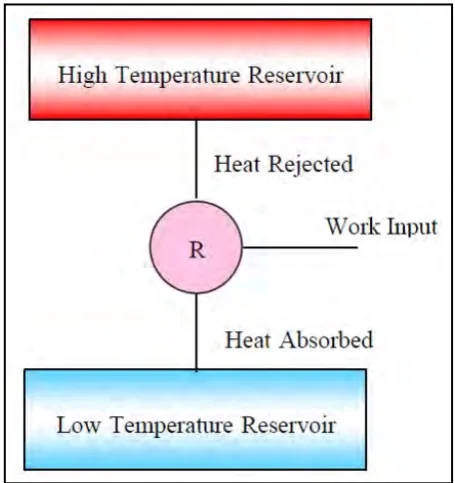
[image:15.595.205.433.475.717.2]An air conditioner is an appliance, system, or machine designed to stabilise the air temperature and humidity within an area typically using a refrigeration cycle but sometimes using evaporation, commonly for comfort cooling in buildings and motor vehicles. The air conditioning system transfers heat from a cooler low-energy reservoir to a warmer high-energy reservoir. (Laurie Mcguire 2003)
4
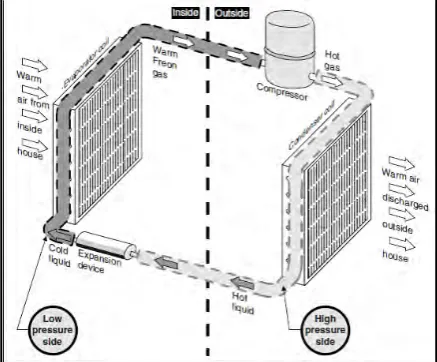
Basically air conditioning system has four components. The first component in the air condition cycle is the compressor. The compressor takes low temperature
refrigerant gas and compresses it into a high pressure, high temperature gas. The refrigerant is then sent to the condenser which sits in front of the radiator. The condenser removes some of the heat from the refrigerant which causes the refrigerant to change phase from a hot gas to a warm liquid. In the expansion valve air condition system, the warm liquid is then passed through a receiver-drier which removes moisture
from the refrigerant to maximize the efficiency of the heat exchange capability of the
[image:16.595.209.428.276.457.2]refrigerant.From there, the refrigerant is then passed through the expansion valve.
Figure 2: The diagram for air conditioning process (Source: principle of air conditioning)
2.1.1 Compressor
5
2.1.2 Condensers
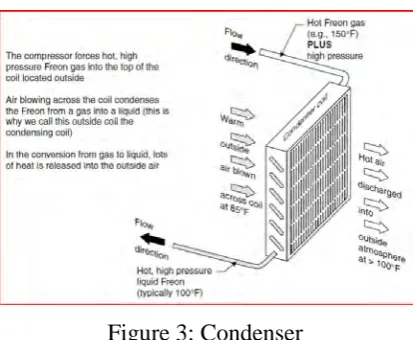
The type of a condenser is generally characterized by the cooling medium used. Thus, there are three types of condensers:
[image:17.595.216.423.211.381.2]a) Air cooled condenser b) Water cooled condenser c) Evaporative condenser
Figure 3: Condenser
(Source: principle of air conditioning)
a) Air cooled condenser
In air cooled condenser, heat is removed by air using forced circulation or by either natural. The condensers are made from steel, cooper or aluminium tubing provided with fins to improve air-side heat transfer. The refrigerant flows inside the tubes and the air outside.
b) Water cooled condensers
6
in the shell. The bottom portion of the condenser also serves the purpose of a sub cooled as the condenser liquid comes in contact with the entering water at
a lower temperature. (Arora CP 2001)
c) Evaporative Condenser
The refrigerant first reject its heat to water and then water rejects its heat to air, mainly in the form of evaporator water. Air leaves with high humidity as in a cooling tower. Thus an evaporative condenser combines the functions of a condenser and cooling tower. (Arora CP 2001)
2.1.3 Expansion Devices
The last of the basic elements in the air conditioner cycle, after the compressor, condenser and evaporator is the expansion devices. The purpose of the expansion devices is twofold: it must reduce the pressure of the liquid refrigerant, and it must regulate the flow of refrigerant to the evaporator. An expansion device is essentially a restriction offering to flow so that the pressures drop, resulting in a throttling process. Basically there are two types of expansion devices;
a) Variable-restriction type b) Constant –restriction type
In variable restriction type, the extant of opening or area flow keeps on
changing depending on the type of control. There are two common types of such control devices. It is automatic expansion valve and the thermostatic expansion valve.
7
Figure 4: Expansion Device (Source: Climate work)
2.1.4 Evaporator
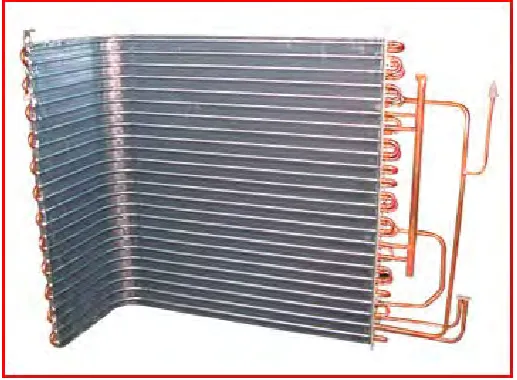
The evaporator is the component of a refrigerant system in which heat is removed from air, water or any other body required to be cooled by the evaporating refrigerant. Evaporators are mainly classified as flooded or direct-expansion such
dry. In flooded evaporator, the liquid refrigerant covers the entire heat-transfer surface. In dry evaporator, a part of the heat transfer surface is used for superheating the vapour. (Gupta J.K 2009).
Figure 5: Evaporator
[image:19.595.209.468.508.698.2]8
2.2 Mechanical Air Conditioning and Ventilation
The purpose of air conditioning in a building is to control the temperature or heat inside a room or space. Ventilation is the intentional movement of air from the outside building to the inside. The determination of the air conditioning air flow are depending on a various factor, such as the area of the room, the sensible heat, latent heat, the location of the room and the function of room. For example, the server
room and control room need a twenty four hour of air condition to maintain it temperature, so that the equipment inside the room were be able to function at it best condition. (J. Hoff,1994).There various types of air conditioning systems available in the market such as;
I. Room Air Conditioners (RAC)
These are also referred to as window units. Essentially, there are compact packaged units housing all components together, namely air cooled condenser, direct expansion evaporator and compressor.
II. Split Units
These are air cooled system comprising an outdoor condensing unit piped to an indoor evaporator unit. The indoor unit may be aesthetically wall mounted, ceiling mounted, concealed ducted or cassette type configuration.
III. Air Cooled Packaged Units
9
IV. Water Cooled Packaged Units
These are similar to air cooled packaged units except that the heat rejection is
not directly to the ambient air but through another medium, normally consisting of a cooling tower and its condenser water circuit.
V. Variable Refrigerant Volume (VRV) Systems
These are essentially multi spilt systems where one outdoor condensing unit can serve up to 8 indoor evaporator units. By means of the VRV feature there are numerous other advantages such as length of refrigerant piping.
2.2.1 Split Unit Air Conditioning
A split air conditioning unit is one that has the two main components separate from each other, with one being inside the building, and the other being outside. A central air conditioning unit is nearly always a split air conditioning unit. There are also air conditioning units called mini split air conditioners. These units operate in a
very similar way, but do not use ducts to send the air. These may provide single room air conditioning, or cooling for multiple rooms, and are often called ductless air conditioning units. The two main components of a split air conditioning system have different functions. The unit situated outdoors, called a compressor, cools the air and handles condensation.
This saves the trouble of having to find a way to drain the water created from the air conditioning process indoors. The inside unit, called the blower, is responsible for distributing the air to the rest of the house. This is done through a forced-air system, usually using a fan and a series of ducts that distribute cool air to each room in the home with a vent. An intake vent will return air to the unit.
10
cost more to buy initially. A miniature system works by installing an air handling piece in the room of choice. Two lines are then connected to an outside unit.
While this will require drilling through an outside wall, it will not require the cutting
needed for air conditioning units with ducts. One line will deliver coolant to the inside component. The other line will take away condensation. For those who need multiple rooms cooled, several inside components can be installed to one outdoor component.
2.2.2 Split Unit Flow rate
The split unit flow rate is needed to be determining to select the suitable split to reach a maximum cooling capacity in the room. The volume of the selected room
[image:22.595.146.550.476.580.2]are been multiple by the air change per hour (ACH) such as shown in Table 1, to get the maximum flow rate.
11
2.2.3 Air Change per Hour (ACH)
Air change per hour is a value representing the number of times each hour that an enclosure's total volume of air is exchanged with fresh or filtered air. An air change doesn't represent a complete change of all air in the enclosure or structure. The actual percentage of an enclosure's air which is exchanged in an air change period depends on the airflow efficiency of the enclosure and the methods used to ventilate it. (Bearg, David W,1993)
ACH equation in Imperial units
(1)
Where:
N = number of air changes per hour
Q = Volumetric flow rate of air in cubic feet per minute (cfm)
Vol = Space volume L × W × H, in cubic feet
2.3 Solar Air Condition
12
2.3.1 Solar Cooling Technology
Solar cooling technologies use solar thermal energy provided through solar collectors to power thermally driven cooling machines. Cooling demand is rapidly increasing in many parts of the world, especially in moderate climates, such as in most EU member states. This results in a dramatic increase in electricity demand on hot summer days, which causes an unwanted increase in the use of fossil and nuclear energy and furthermore threatens the stability of electricity grids. As many cooling applications, such as air conditioning, have a high coincidence with the availability of solar irradiation, the combination of solar thermal and cooling obviously has a high potential to replace conventional cooling machines based on electricity. Larger solar cooling systems have been successfully demonstrated and smaller machines, which could be used in (small) residential and office buildings, are entering the market.
2.3.2 Components of a solar cooling system
A solar cooling installation consists of a typical solar thermal system made up of solar collectors, storage tank, control unit, pipes and pumps and a thermally driven cooling machine. To date, most collectors used in solar cooling systems are the high efficiency collectors available in the market today (often double-glazed flat plate
collectors or evacuated tube collectors). New developments for the medium temperature range (100-250°C) could increase the overall efficiency of the cooling systems.
2.4 Solar Water Heater
These systems use the sun to heat either water or a heat transfer fluid, such as water in collectors generally mounted on the roof. The heated water is then stored in a tank similar to a convectional gas or electric water tank. Some systems use an electric pump to circulate the fluid through the collectors. Some water heaters can