International Journal of Innovative Technology and Exploring Engineering (IJITEE)
ISSN: 2278-3075,
Volume-8 Issue-12, October, 2019
Abstract:Roof fall of the building is the major threat to the society as it results in severe damages to the life of the people. Recently, engineers are focusing on the prediction of roof fall of the building in order to avoid the damage to the environment and people. Early prediction of Roof fall is the social responsibility of the engineers towards existence of health and wealth of the nation. This paper attempts to identify the essential attributes of the Roof fall dataset that are taken from the UCI Machine learning repository for predicting the existence of roof fall. In this paper, the important features are extorted from the various ensembling methods like Gradient Boosting Regressor, Random Forest Regressor, AdaBoost Regressor and Extra Trees Regressor. The extracted feature importance of each of the ensembling methods is then fitted with multiple linear regression to analyze the performance. The same extracted feature importance of each of the ensembling methods are subjected to feature scaling and then fitted with multiple linear regression to analyze the performance. The Performance analysis is done with the performance parameters such as Mean Squared Log Error (MSLE), Mean Absolute error (MAE), R2 Score, Mean Squared error (MSE) and Explained Variance Score (EVS). The execution is carried out using python code in Spyder Anaconda Navigator IP Console. Experimental results shows that before feature scaling, Extra Tree Regressor is found to be effective with the MSE of 0.06, MAE of 0.07, R2 Score of 87%, EVS of 0.89 and MSLE of 0.02 as compared to other ensembling methods. In the same way, after applying feature scaling, the feature importance extracted from the Extra Tree Regressor is found to be effective with the MSE of 0.04, MAE of 0.03, R2 Score of 96%, EVS of 0.9 and MSLE of 0.01 as compared to other ensembling methods.
Index Terms: Machine Learning, Regression, MSLE, MAE, MSE and EVS.
I.
INTRODUCTION
In machine learning dimensionality reduction, the final
prediction results are based on number of input components.
In general many of the attributes in the dataset are correlated
and they may be redundant. This attribute duplication
enlarges the memory space and diminishes the execution time.
The prediction of the target variable will be difficult when the
number of attribute is large. As well, when the number of
Revised Manuscript Received on October 10, 2019
M. Shyamala Devi, Associate Professor, Computer Science and Engineering, Vel Tech Rangarajan Dr. Sagunthala R&D Institute of Science and Technology, Avadi, Chennai, TamilNadu, India.
Shakila Basheer, Assistant Professor, Department of Information Systems, College of Computer and Information Sciences, Princess Nourah Bint Abdul Rahman university, Riyadh-11671, Saudi Arabia
Rincy Merlin Mathew, Lecturer, Department of Computer Science, College of Science and Arts, Khamis Mushayt, King Khalid university, Abha, Asir, Saudi Arabia.
attribute is more, it is tough to visualize the features to predict
the dependent variable. This guarantees the requirement of
dimensionality reduction algorithms.
The paper is organized in such a way that Section 2 deals
with the related works. Section 3 discuss about dimensionality
Reduction. Proposed work is discussed in Section 4 followed
by the implementation and Performance Analysis in Section
5. The paper is concluded with Section 6.
II.
RELATED
WORK
A.
Literature Review
Boundary layer wind tunnel dataset [1] is subjected to
predict the mean, root mean square and peak pressure
coefficient of low rise building patterns. It also predicts the
magnitude and pressure distribution of roof in the building
based on the free stream turbulent flow conditions.
Automatic labeling of roof shape for the building [2] is done
from the GIS data. The roof top detection is done by using
ROC analysis [3] to estimate the cost of error from the aerial
images of building. It also analyzes the performance of both
training and testing image datasets. Roof fall accidents are
predicted using binary logistic regression model [4]. Roof fall
risk is identified using risk assessment classical methodology
[5] with fuzzy based approach. It projects that the roof fall is
due to various features like low resolution, fixed weighting,
sharp class boundaries of the building.
The fuzzy approach prioritizes the features and analyzes
the roof fall susceptibility. The estimation of combined
building frame and roof frame bolting is done in [6] to predict
the roof fall of the building region. The falling speed of the
roof is tensile failure parallel to the heading direction and the
prediction of unsupported instantaneous roof [7] is done by
using the excavation features of the building. The roof fall of
the large road is due to the horizontal tensile stress [8] and it is
predicted by using the surface stress and fault slip of the
surface. The roof fall detection fails due to the low quality of
the digital surface model of the building [9].
A critical review on various feature selection, feature
extraction methods, classification methods and the
performances parameters are examined for predicting the
wine quality [10]-[26].
Exploration of Multiple Linear Regression with
Ensembling Schemes for Roof Fall Assessment
using Machine Learning
III.
PROPOSED
WORK
In our proposed work, machine learning algorithms are
used to predict the disease of Roof Fall data set. Our
contribution in this paper is folded in four ways.
(i)
Firstly,
the important features are extorted from the
Roof Fall dataset using various ensembling
methods like Gradient Boosting Regressor,
Random Forest Regressor, AdaBoost Regressor
and Extra Trees Regressor.
(ii)
Secondly, the extracted feature importance of each
of the ensembling methods is then fitted with
multiple linear regression to analyze the
performance.
(iii) Thirdly, the same extracted feature importance of
each of the ensembling methods are subjected to
feature scaling and then fitted with multiple linear
regression to analyze the performance.
(iv) Fourth, the Performance analysis is done with the
performance parameters such as Mean Squared
Log Error (MSLE), Mean Absolute error (MAE),
R2 Score, Mean Squared error (MSE) and
Explained Variance Score (EVS).
A.
System Architecture
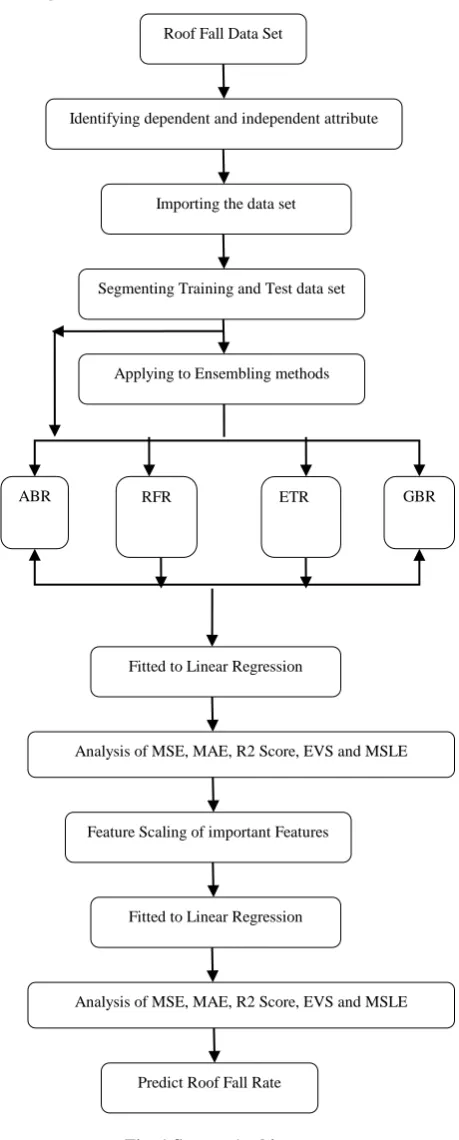
The overall design of this paper work is shown in Fig. 1
IV.
IMPLEMENTATION
AND
PERFORMANCE
ANALYSIS
A.
Roof Fall Prediction for Feature Extraction
The Roof fall dataset from UCL ML Repository is used for
implementation with 19 independent attribute and 1 roof fall
rate dependent attribute. The attribute are shown below.
1)
CMRR
2)
BOLT_LENGTH_ft
3)
BOLT_TENSION
4)
BOLT_GROUT_COLUMN
5)
BOLT_CAPACITY_Kips
6)
BOLTS_PER_ROW
7)
ROW_SPACING_ft
8)
ENTRY_WIDTH_ft
9)
PRSUP
10)
INTERSECTION_DIAGONAL_ft
11)
DEPTH_of_COVER_ft
12)
MINING_HEIGHT_ft
13)
DRIVAGE_10000_ft
14)
No._of_3WAY
15)
No._of_4Way
16)
No._of_SEGMENTS
17)
FALLS_3W
18)
FALLS_4W
19)
SEGMENT_FALLS
[image:2.595.313.543.48.619.2]20)
ROOF_FALL_RATE - Dependent Attribute
Fig. 1 System Architecture
B.
Performance Analysis
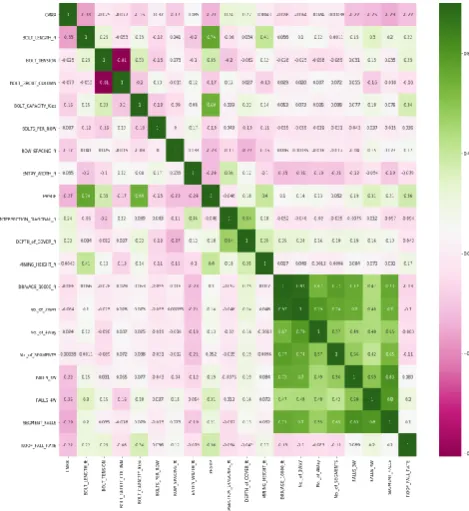
The attribute and component relationship between the
features of the dataset is shown in the fig 2.
Roof Fall Data Set
Identifying dependent and independent attribute
Importing the data set
Segmenting Training and Test data set
Applying to Ensembling methods
ABR RFR GBR
Analysis of MSE, MAE, R2 Score, EVS and MSLE
Predict Roof Fall Rate ETR
Fitted to Linear Regression
Feature Scaling of important Features
Fitted to Linear Regression
International Journal of Innovative Technology and Exploring Engineering (IJITEE)
ISSN: 2278-3075,
Volume-8 Issue-12, October, 2019
Fig. 2. Correlation Matrix of Roof Fall data set
[image:3.595.263.540.60.434.2] [image:3.595.51.294.382.517.2]The important features are extorted from the Roof fall dataset
using AdaBoost Regressor and are shown in fig 3.
Fig. 3. Feature Importance of Ada Boost Regressor
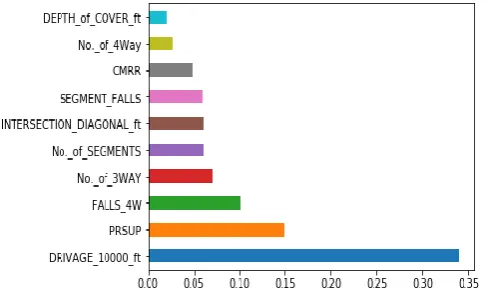
[image:3.595.308.545.506.660.2]The important features are extorted from the Roof fall dataset
using Extra Trees Regressor and are shown in fig 4.
Fig. 3. Feature Importance of Extra Trees Regressor
[image:3.595.51.291.583.729.2]The important features are extorted from the Roof Fall dataset
using AdaBoost Regressor and Extra Trees Regressor and the
features is shown in fig 5.
Fig. 5. Feature Important Attibutes of Ada Boost and Extra Trees Regressor
The important features are extorted from the
Roof Fall
dataset
using Gradient Boosting Regressor and are shown in fig 6.
Fig 6. Feature Importance of Gradient Boost Regressor
Fig. 8. Feature Importance of Random Forest Regressor
[image:4.595.307.547.67.201.2]The important features are extorted from the Roof Fall dataset
using Gradient Boosting Regressor and Random Forest
Regressor and the features is shown in fig 9.
Fig. 9. Feature Important Attibutes of Gradient Boost and Random Foresr Regressor
The Performance analysis is done with the performance
parameters such as Mean Squared Log Error (MSLE), Mean
Absolute error (MAE), R2 Score, Mean Squared error (MSE)
and Explained Variance Score (EVS).and is shown in the
Table 1 -Table 5.
Table. 1 Analysis of MSE, MAE and R2 Score parameters
Ensembling Methods
Fitting to Linear Regression
Before Feature Scaling
MSE
MAE
R2 Score
AdaBoost Regressor
0.14
0.13
0.82
Random Forest
Regressor
0.12
0.12
0.81
Extra Trees Regressor
0.06
0.07
0.87
Gradient Boosting
[image:4.595.313.542.233.382.2]Regressor
0.09
0.11
0.78
Table. 2 Analysis of EVS and MSLE parameters
Ensembling Methods
Fitting to Linear
Regression Before
Feature Scaling
EVS
MSLE
AdaBoost Regressor
0.81
0.16
Random Forest
Regressor
0.78
0.18
Extra Trees Regressor
0.89
0.02
Gradient Boosting
Regressor
0.79
0.17
Table. 3 Analysis of MSE, MAE and R2 Score parameters
after Feature Scaling
Ensembling Methods
Fitting to Linear Regression
after Feature Scaling
MSE
MAE
R2 Score
AdaBoost Regressor
0.26
0.26
0.87
Random Forest
Regressor
0.24
0.24
0.91
Extra Trees Regressor
0.04
0.03
0.96
Gradient Boosting
Regressor
0.19
0.20
0.93
Table. 4 Analysis of EVS and MSLE parameters after
Scaling
Ensembling Methods
Fitting to Linear
Regression after
Feature Scaling
EVS
MSLE
AdaBoost Regressor
0.84
0.06
Random Forest Regressor
0.83
0.05
Extra Trees Regressor
0.92
0.01
[image:4.595.46.290.289.643.2]International Journal of Innovative Technology and Exploring Engineering (IJITEE)
ISSN: 2278-3075,
Volume-8 Issue-12, October, 2019
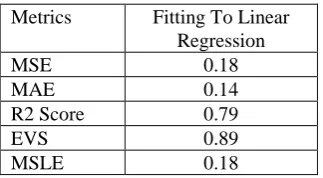
Table. 5 Analysis of MSE, MAE, R2 Score EVS and
MSLE Score for Multiple Linear Regression without
Ensembling.
Metrics
Fitting To Linear
Regression
MSE
0.18
MAE
0.14
R2 Score
0.79
EVS
0.89
MSLE
0.18
[image:5.595.89.251.107.196.2]The analysis of the performance parameter without
ensembling, with ensembling before and after applying
feature scaling is shown in the Fig 10 – Fig 14.
[image:5.595.306.550.125.334.2]Fig.10. Analysis of MSE and Ensembling methods
Fig.11. Analysis of MAE and Ensembling methods
Fig.12. Analysis of R2Score and Ensembling methods
Fig.13. Analysis of EVS and Ensembling methods
Fig.13. Analysis of MSLE and Ensembling methods
V.
CONCLUSION
This paper analyzes the prediction of the existence of
Roof
Fall
of the
Roof Fall
dataset through the ensembling methods
before and after applying attribute scaling method.
Experimental results shows that before feature scaling, Extra
Tree Regressor is found to be effective with the MSE of 0.06,
MAE of 0.07, R2 Score of 87%, EVS of 0.89 and MSLE of
0.02 as compared to other ensembling methods. In the same
way, after applying feature scaling, the feature importance
extracted from the Extra Tree Regressor is found to be
effective with the MSE of 0.04, MAE of 0.03, R2 Score of
96%, EVS of 0.9 and MSLE of 0.01 as compared to other
ensembling methods
REFERENCES
1. L. Fernández Cabán Pedro, J. Masters Forrest, and M. Phillips Brian,
“Predicting Roof Pressures on a Low-Rise Structure From Freestream Turbulence Using Artificial Neural Networks “, Frontiers in Built Environment., vol. 4, Nov. 2018, pp. 68.
2. J. Castagno, and E. Atkins, “Roof Shape Classification from LiDAR and
Satellite Image Data Fusion Using Supervised Learning”. Journal of Sensors (Basel, Switzerland)., vol. 18(11), , Nov. 2018, pp. 3960.
3. M.A. Maloof, P. Langley, T.O. Binford, R. Nevatia, and S.
Sage,”Improved Rooftop Detection in Aerial Images with Machine Learning”, Journal of Machine Learning., vol 53, Oct. 2003, pp. 157-191.
4. Sanjay Kumar Palei, and Samir Kumar Das, “Logistic regression model
for prediction of roof fall risks in bord and pillar workings in coal mines: An approach”, Safety Science., vol 47(1), Jan. 2009, pp. 88-96.
5. Ebrahim Ghasemi, Mohammad Ataei, and Kourosh Shahriar, “
[image:5.595.47.288.255.377.2] [image:5.595.46.289.419.541.2]6. S. I. Ivanov, N. V. Titov, A. A. Privalov, I. T. Trunov, and V. I. Sarychev, “ Calculation of parameters of combined frame and roof bolting”, Earth and Environmental Science., vol. 87, 2017. doi :10.1088/1755-1315/87/5/052009
7. Yang Sen Zhang, Nong Feng, Xiaowei Pan, Dongjiang Qian, and
Deyu, “The Influence of Heading Rate on Roof Stability in Coal Entry Excavation”, Advances in Civil Engineering., 2018.pp. 1-15.
8. Wang, Hongwei Xue, Sheng Jiang, Yaodong Deng, Daixin Shi, Suzhen
Zhang, and Dengqian, “Field Investigation of a Roof Fall Accident and Large Roadway Deformation Under Geologically Complex Conditions in an Underground Coal Mine”, Rock Mechanics and Rock Engineering.. vol. 51, 2018.
9. T. Partovi, F. Fraundorfer, S. Azimi, D. Marmanis, and P. Reinartz, “
Roof Type Selection Based on Patch-Based Classification Using Deep Learning For High Resolution Satellite Imagery”, The International Archives of the Photogrammetry, Remote Sensing and Spatial Information Sciences, vol. XLII-1, Jun. 2017.
10. R. Suguna, M. Shyamala Devi, and Rincy Merlin Mathew, ” Customer
Churn Predictive Analysis by Component Minimization using Machine Learning”, International Journal of Innovative Technology and Exploring Engineering, vol. 8, no.8, June 2019, pp. 2329-2333.
11. Suguna Ramadass, and Shyamala Devi Munisamy, Praveen Kumar P,
Naresh P, “Prediction of Customer Attrition using Feature Extraction Techniques and its Performance Assessment through dissimilar Classifiers”, Springer’s book series “Learning and Analytics in Intelligent Systems, Springer, , LAIS vol. 3, pp. 613-620, 2019.
12. R.Suguna, M. Shyamala Devi, Rupali Amit Bagate, and Aparna
Shashikant Joshi, “Assessment of Feature Selection for Student Academic Performance through Machine Learning Classification”, Journal of Statistics and Management Systems, Taylor Francis, vol. 22, no. 4, 25 June 2019, pp. 729-739.
13. R. Suguna, M. Shyamala Devi, Rincy Merlin Mathew, “Customer
Segment Prognostic System by Machine Learning using Principal Component and Linear Discriminant Analysis”, International Journal of Recent Technology and Engineering, Volume-8 Issue-2, 30 July 2019. pp. 6198-6203.
14. M. Shyamala Devi, Rincy Merlin Mathew, and R. Suguna,”Attribute
Heaving Extraction and Performance Analysis for the Prophesy of Roof Fall Rate using Principal Component Analysis”, International Journal of Innovative Technology and Exploring Engineering, vol. 8, no.8, June 2019, pp. 2319-2323.
15. Shyamala Devi Munisamy, and Suguna Ramadass Aparna Joshi,
“Cultivar Prediction of Target Consumer Class using Feature Selection with Machine Learning Classification”, Springer’s book series “Learning and Analytics in Intelligent Systems, Springer, LAIS vol. 3, pp. 604-612, 2019.
16. M. Shyamala Devi, Rincy Merlin Mathew, R. Suguna, “Feature
Snatching and Performance Analysis for Connoting the Admittance Likelihood of student using Principal Component Analysis”, International Journal of Recent Technology and Engineering, Volume-8 Issue-2, 30 July 2019.pp. 4800-4807.
17. M. Shyamala Devi, Rincy Merlin Mathew, R. Suguna, ” Regressor
Fitting of Feature Importance for Customer Segment Prediction with Ensembling Schemes using Machine Learning”, International Journal of Engineering and Advanced Technology, Volume-8 Issue-6, pp. 952 – 956, 30 August 2019
18. R. Suguna, M. Shyamala Devi, Rincy Merlin Mathew, “Integrating
Ensembling Schemes with Classification for Customer Group Prediction using Machine Learning”, International Journal of Engineering and Advanced Technology, Volume-8 Issue-6, pp. 957 – 961, 30 August 2019.
19. Rincy Merlin Mathew, R. Suguna, M. Shyamala Devi, “Composite
Model Fabrication of Classification with Transformed Target Regressor for Customer Segmentation using Machine Learning”, International Journal of Engineering and Advanced Technology, Volume-8 Issue-6, pp. 962 – 966, 30 August 2019.
20. M. Shyamala Devi, Shefali Dewangan, Satwat Kumar Ambashta, Anjali
Jaiswal, Nariboyena Vijaya Sai Ram, “Backward Eliminated Formulation of Fire Area Coverage using Machine Learning Regression”, International Journal of Innovative Technology and Exploring Engineering, vol. 8, no.12, 10 October 2019. (Accepted for Publication)
21. M. Shyamala Devi, Ankita Shil, Prakhar Katyayan, Tanmay Surana,
“Constituent Depletion and Divination of Hypothyroid Prevalance using Machine Learning Classification”, International Journal of Innovative Technology and Exploring Engineering, vol. 8, no.12, 10 October 2019. (Accepted for Publication)
22. M. Shyamala Devi, Shefali Dewangan, Satwat Kumar Ambashta, Anjali
Jaiswal, Sairam Kondapalli, “Recognition of Forest Fire Spruce Type Tagging using Machine Learning Classification”, International Journal of Recent Technology and Engineering, Volume-8 Issue-3, pp. 4309 – 4313, 16 September 2019.
23. M. Shyamala Devi, Usha Vudatha, Sukriti Mukherjee, Bhavya Reddy
Donthiri, S B Adhiyan, Nallareddy Jishnu, “ Linear Attribute
Projection and Performance Assessment for Signifying the Absenteeism at Work using Machine Learning”, International Journal of Recent Technology and Engineering, Volume-8 Issue-3, pp. 1262 – 1267, 16 September 2019.
24. M. Shyamala Devi, Mothe Sunil Goud, G. Sai Teja, MallyPally Sai
Bharath, “Heart Disease Prediction and Performance Assessment through Attribute Element Diminution using Machine Learning”, International Journal of Innovative Technology and Exploring Engineering, vol. 8, no.11, pp. 604 – 609, 30 September 2019.
25. Shakila Basheer, Rincy Merlin Mathew, M. Shyamala Devi,
“Ensembling Coalesce of Logistic Regression Classifier for Heart Disease Prediction using Machine Learning”, International Journal of Innovative Technology and Exploring Engineering, vol. 8, no.12, 10 October 2019, pp. (Accepted for Publication)
26. Rincy Merlin Mathew, M. Shyamala Devi, Shakila Basheer,”