This is a repository copy of
Laser-driven shock experiments on precompressed water :
Implications for "icy" giant planets
.
White Rose Research Online URL for this paper:
http://eprints.whiterose.ac.uk/44360/
Version: Published Version
Article:
Lee, K.K.M., Benedetti, L.R., Jeanloz, R. et al. (14 more authors) (2006) Laser-driven
shock experiments on precompressed water : Implications for "icy" giant planets. Journal
of Chemical Physics. 014701. ISSN 1089-7690
https://doi.org/10.1063/1.2207618
[email protected] https://eprints.whiterose.ac.uk/ Reuse
Items deposited in White Rose Research Online are protected by copyright, with all rights reserved unless indicated otherwise. They may be downloaded and/or printed for private study, or other acts as permitted by national copyright laws. The publisher or other rights holders may allow further reproduction and re-use of the full text version. This is indicated by the licence information on the White Rose Research Online record for the item.
Takedown
If you consider content in White Rose Research Online to be in breach of UK law, please notify us by
Laser-driven shock experiments on precompressed water:
Implications for “icy” giant planets
Kanani K. M. Leea兲
Department of Earth & Planetary Science, University of California–Berkeley, Berkeley, California 94720-4767 and Department of Physics, New Mexico State University, MSC 3D, Las Cruces, New Mexico 88003-8001
L. Robin Benedetti
Physics Department, University of California–Berkeley, Berkeley, California 94720-7300 and Lawrence Livermore National Laboratory, Livermore, California 94550
Raymond Jeanloz
Department of Earth & Planetary Science, University of California–Berkeley, Berkeley, California 94720-4767
Peter M. Celliers, Jon H. Eggert, Damien G. Hicks, Stephen J. Moon, Andrew Mackinnon, Luis B. Da Silva, David K. Bradley, Walter Unites, and Gilbert W. Collins
Lawrence Livermore National Laboratory, Livermore, California 94550
Emeric Henry, Michel Koenig, and Alessandra Benuzzi-Mounaix
Laboratoire LULI, Ecole Polytechnique, 91128 Palaiseau, France
John Pasley
Center for Energy Research, University of California at San Diego, San Diego, California 92093-0417
David Neely
Central Laser Facility, Rutherford Appleton Laboratory, Oxfordshire OX11 0QX, United Kingdom
共Received 11 November 2005; accepted 2 May 2006; published online 5 July 2006; publisher error corrected 29 November 2006兲
Laser-driven shock compression of samples precompressed to 1 GPa produces high-pressure-temperature conditions inducing two significant changes in the optical properties of water: the onset of opacity followed by enhanced reflectivity in the initially transparent water. The onset of reflectivity at infrared wavelengths can be interpreted as a semiconductor↔electronic conductor transition in water, and is found at pressures above⬃130 GPa for single-shocked samples precompressed to 1 GPa. Our results indicate that conductivity in the deep interior of “icy” giant planets is greater than realized previously because of an additional contribution from electrons. ©2006 American Institute of Physics.关DOI:10.1063/1.2207618兴
I. INTRODUCTION
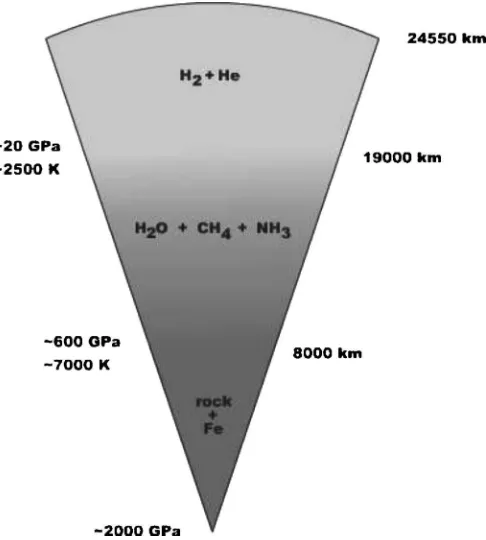
Although giant gas planets such as Jupiter and Saturn are mostly comprised of hydrogen and helium, others such as Neptune and Uranus are additionally believed to contain as much as⬃50% water共by mass兲 and significant amounts of methane and ammonia.1In the astronomical literature, these compounds are labeled “ices” regardless of physical state, in order to distinguish them from hydrogen, helium, or the heavier elements 共“metals”兲and to emphasize their molecu-lar character at low pressures and temperatures. In fact, most of the water in Neptune and Uranus is expected to be present as a dense fluid layer共possibly in a dissociated state兲at pres-sures ranging between 20 and 600 GPa and temperatures be-tween 2500 and 7000 K 共Fig.1兲, and it is hypothesized that it is in this “icy” layer that the planet’s magnetic field is produced.1
Planetary magnetic fields are prevalent in our Solar
Sys-tem, are expected to be common among extrasolar planets, and can reveal important information about the interiors and evolutionary histories of planets.2 Three potential mecha-nisms can generate planetary magnetic fields: permanent magnetism, which is produced at the microscopic level and is inherent to the material 共e.g., ferromagnetism兲, induction from external sources, or production through electrical cur-rents generated by a dynamo. Although some of the magne-tism in our Solar System can be attributed to permanent magnetism from iron-rich minerals共e.g., Moon and Mars兲or by induction by varying external magnetic fields 共Galilean satellites兲, most must be formed by a dynamo sustained by convection of an electrically conducting fluid deep inside the planet. Together with moment of inertia measurements, mag-netic field observations offer some of the most direct infor-mation about the constitution and processes of planetary interiors.
The magnetic fields of Neptune and Uranus were first measured during the Voyager 2 mission.3 The surface field was shown to be about the same for both planets, ⬃2
⫻10−5 T, comparable in strength to the Earth’s magnetic
a兲
Author to whom correspondence should be addressed. Electronic mail: [email protected]
field value of ⬃5⫻10−5T. Although it is expected that the “icy” giant planets have a core of “ice,” rock, and metal about the size of the Earth, the mostly quadrupolar nature of their observed magnetic fields suggests that an Earth-type iron-dominated geodynamo near the center of the planet is unlikely to be the source of the magnetism. The large radius of an icy giant planet dictates that for such a strong quadru-pole field to be observed, with its strength falling as r−4
where r is radial distance, the source must be at shallower depths. It is thus thought that an ionic or perhaps metallic form of water, existing at the high pressures共20– 600 GPa兲 and temperatures 共2500– 7000 K兲 in the shallower depths 共⬃6000– 17 000 km deep兲 of the planet, sustains the neces-sary electric currents for the planetary dynamo共Fig.1兲.1
An electrical conductivity of at least ⬃10共⍀cm兲−1 is thought to be required to generate the observed magnetic fields.4 Conductivity values of up to ⬃10–⬃200 共⍀cm兲−1 have been measured for both shock-compressed water5–7and for a “synthetic Uranus”8 mixture of fluids, and have been predicted by molecular dynamics simulations.9 A larger value of conductivity relaxes the velocity and length scales for a self-sustaining dynamo.2 For instance, the magnetic Reynolds number, Re, is proportional to the product of the conductivity, length, and velocity scales. With a Re value of 10 or more a dynamo is self-sustaining,2 and if the conduc-tivity value is increased the length and velocity scales can be decreased for a given Re. This is of interest because a recent dynamo model suggests that in order to match the magnetic field morphology for a planet such as Neptune or Uranus, the
dynamo is formed by a thin, conducting fluid shell above a stably stratified, conducting fluid interior and small solid core.10
High-pressure and high-temperature conditions have been simulated in the laboratory with diamond-anvil cells 共DACs兲 and through shock-wave experiments. Successful DAC experiments have been carried out on water to 210 GPa at temperatures near 300 K共Refs.11and12兲and at lower pressures but higher temperatures,13–19 leaving much of the pressure range relevant to the icy layer uninvestigated 共Fig. 1兲. Shock compression produces high pressures and temperatures during the time that the shock wave is passing through the sample. The time scales are short 共⬃10−10– 10−6 s兲, but longer than the time required for ther-mal equilibrium共⬃10−14– 10−11s兲. Early Soviet shock-wave experiments, produced by nuclear explosions, reached up to 3200 GPa in water.20,21More recently, laser-driven shock ex-periments on water have reached pressures up to nearly 800 GPa with estimated temperatures greater than 30 000 K.22Reverberating-shock experiments on water have reached 180 GPa 共Ref. 7兲 and ⬃5400 K 共temperatures re-evaluated in a separate study22,23兲. Previous single-shock gas gun experiments were limited to pressures below 100 GPa.6,24–26
Static compression typically yields an equation of state 共EOS兲 along an isotherm, and at pressures above 100 GPa, static methods are often difficult to implement at tempera-tures greater than⬃3000 K. Single-shock methods probe the EOS along a well-defined pressure-temperature 共P-T兲 path 共Hugoniot兲yielding quantitative measures of density共兲and internal energy共E兲, however, only intersect a planet’s isen-trope at one point. By combining the two methods, laser-driven shock experiments on precompressed samples access conditions unreachable by either static or single-shock tech-niques alone, covering a broad range of P--T space and increasing access to the isentrope.27,28
Knowing the initial pressure and density of the precom-pressed sample, it is possible to infer the P--E conditions achieved in the sample under shock compression via the Rankine-Hugoniot relations,29
0US=1共US−up兲, 共1兲
P1−P0=0USup, 共2兲
E1−E0=1
2共P0+P1兲
冉
1 0− 1 1
冊
, 共3兲
where is density,USis shock velocity,upis particle veloc-ity,Pis pressure,Eis internal energy, and subscripts 0 and 1 are the initial and final states. Equations共1兲–共3兲describe the conservation of mass, linear momentum, and energy.
Here we present EOS and optical measurements using laser-driven shock waves on precompressed samples of wa-ter. The EOS measurements are expected to lie between the principal isentrope and principal Hugoniot of water, due to the increased initial density of the precompressed sample, thereby approaching conditions close to those of the icy lay-ers of Neptune and Uranus. We also observe optical changes in the shock-compressed water under planetary-interior
con-FIG. 1. Interior model of “icy” giant planets Uranus and Neptune, showing the approximate chemical makeup as a function of depth共Ref.1兲. Left-hand side yields model pressure and temperature for the H–He envelope, “icy” mantle layer, and rocky core for Neptune. The right-hand side shows the corresponding radii for each layer. It is expected that it is in the icy mantle that the strong quadrupolar magnetic field is produced.
[image:3.612.53.296.49.319.2]ditions, and these provide evidence for a change in the elec-trical conduction mechanism in H2O relevant for understand-ing the production of magnetic fields in the icy giant planets.9,22
II. METHODS
The sample consists of a layer of pure共doubly distilled兲 water compressed between two diamond windows, with an aluminum foil embedded in the water layer and placed against the diamond window from which the shock wave enters共Fig.2兲. The aluminum foil is used for calibration of the shock-wave velocity: it is stepped, such that the shock wave traverses two distinct thicknesses before entering the
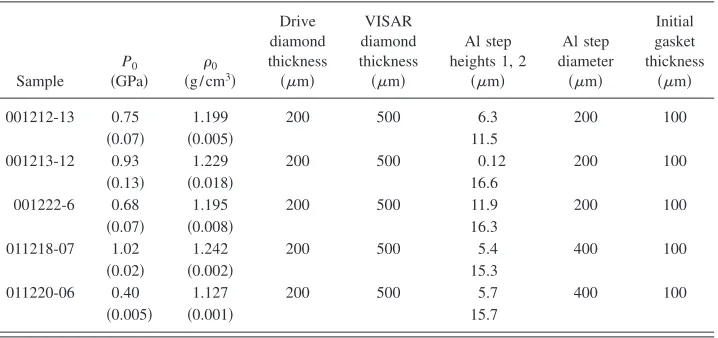
water.22,27,28 Modified DACs fit with 200– 500m thick, 1.0 mm in diameter diamond windows, were used to com-press water to a finite initial density and com-pressure共see Table I兲, and were shocked by a high-power laser pulse 共Table II兲.30 A detailed description of the design of the precom-pressed targets has been given elsewhere.27 These experi-ments were performed at the Vulcan Laser Facility at the Rutherford Appleton Laboratory.30 Shots identified with a “00” prefix were driven with a 4 ns square laser pulse com-posed of a series of stacked 1 ns pulses, whereas a “01” prefix identifies experiments driven with a 1 ns square pulse. The longer-duration pulses yield a more steady shock throughout the sample; the short pulses have increased power density, so provide stronger shocks.
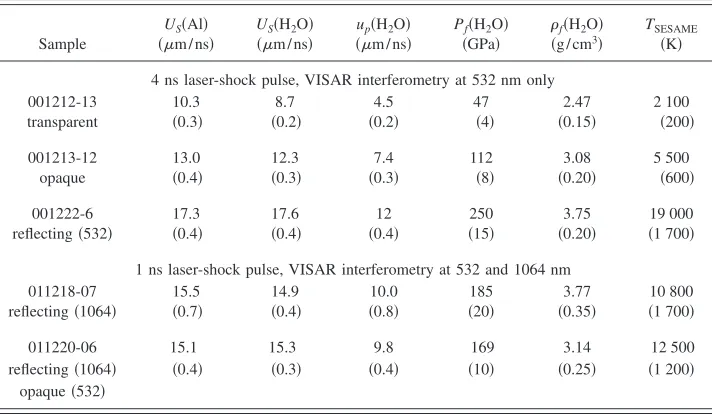
For each shot, there were three probes monitoring the sample: two velocity interferometer system for any reflector 共VISAR兲 interferometers 共Figs. 3 and 4兲 and an optical pyrometer.28,31–33 For all 00 shots, both interferometers were operated at 532 nm, whereas all 01 shots were recorded by an interferometer operating at 532 nm and a second operat-ing at 1064 nm. A streaked optical pyrometer was also used to measure the blackbody radiation emitted from the shocked sample. The absolute calibration on the pyrometric measure-ment was not accurate enough to determine temperatures to better than ⬃35% uncertainty at the highest pressures. For this reason, we calculate the temperatures of the shocked precompressed water using the model of Ree,34 available in the SESAME database,35 TSESAME 共TableII兲. This equation-of-state model matches the measured principal Hugoniot of water to over 800 GPa,22and we use it to estimate the shock temperatures for water off the principal Hugoniot.
III. ANALYSIS
[image:4.612.49.298.50.231.2]The analysis of the VISAR records reveals changes in the optical properties of water from its initially transparent state: with increasing shock pressures and temperatures, wa-ter becomes optically opaque 共TSESAME⬎⬃3000 K兲 and then reflecting 共TSESAME⬎⬃6000 K兲. Because VISAR re-quires a reflecting surface, the changing optical properties of
FIG. 2. Schematic cross section of diamond-cell configuration used for laser-driven shock experiments on precompressed samples. Wide openings 共300m radius holes兲 in tungsten carbide 共WC兲 supports allow ample shock-laser entry共35° opening兲and VISAR access 共18.5° opening兲. Thin diamonds are pushed together to apply pressure on a small sample of water 共⬃30 nl兲, held in a hole within a stainless steel gasket 100m thick. A stepped Al foil is glued on the thinnest diamond and used to measureUS共Al兲
with VISAR. A few ruby spheres are placed in the sample chamber for precompression pressure measurements via ruby fluorescence 共Ref. 45兲. There is a 1000 Å Al flash coating on the laser-shock side of the thinnest diamond, in order to lower the critical depth of shock ablation, and an antireflection coating on the thicker diamond for the VISAR measurement.
TABLE I. Experimental conditions for precompressed samples. Initial pressures P0are measured by ruby fluorescence共Ref.45兲, while initial water densities0are calculated fromP0共Ref.46兲. Diamond thicknesses and Al step heights are known to better than 2%. Uncertainties are listed below each measured value in parentheses.
Sample
P0 共GPa兲
0 共g / cm3兲
Drive diamond thickness 共m兲
VISAR diamond thickness 共m兲
Al step heights 1, 2
共m兲
Al step diameter
共m兲
Initial gasket thickness
共m兲
001212-13 0.75 1.199 200 500 6.3 200 100
共0.07兲 共0.005兲 11.5
001213-12 0.93 1.229 200 500 0.12 200 100
共0.13兲 共0.018兲 16.6
001222-6 0.68 1.195 200 500 11.9 200 100
共0.07兲 共0.008兲 16.3
011218-07 1.02 1.242 200 500 5.4 400 100
共0.02兲 共0.002兲 15.3
011220-06 0.40 1.127 200 500 5.7 400 100
[image:4.612.127.486.588.757.2]the sample must be considered and are described below for each optical character observed. Reflectivity is estimated by determining the intensity of light measured after the shock breaks out from the Al step共reflectivity of⬃80% in a spec-tral range of 550– 580 nm兲.36 In samples that remain trans-parent共TSESAME⬍⬃3000 K兲, the intensity of the light after breakout is within 5% of that reflected from unshocked Al; that is, the water continues to stay transparent to the light being reflected off the moving Al step 共Fig.3兲. For opaque samples 共⬃3000 K⬍TSESAME⬍⬃6000 K兲, the intensity of light after breakout from the Al step drops to less than 5% of that reflected from unshocked Al. We estimate that the ab-sorption of light takes place, within an optical depth of less than 1m. Samples identified as reflecting were observed to reflect the probe light from the shock front, rather than from the moving Al-water interface, and are identified as such with Al-shock velocities that are greater than those that have been identified as opaque 共Fig.4, TableII兲. Uncertainties in the absolute value of the reflectivity are significant 共up to 20%–40%兲owing to imperfections in the Al surface and the antireflection coatings we use, as well as the presence of ice VI crystal formation for the highest precompression pres-sures. However, the onset of reflectivity was clearly observed at a detection limit of ⬃3 % – 5%. Initial conditions, mea-sured and calculated velocities, and final conditions as deter-mined by the Rankine-Hugoniot relations and impedance matching29are listed in TablesIandII.
IV. RESULTS
We determine the shock velocity of Al,US共Al兲, from the difference between the breakout times in the low and high steps of the Al foil, the thicknesses of which were measured
by white-light interferometry before and after precompres-sion. We find that the thickness of the step height does not change appreciably during precompression, due to the low pressures applied and the relatively high bulk modulus of Al. We calculate the particle velocity of the Al,up共Al兲, through empirical linearUS-uprelations.37For transparent samples, it is also possible to measure the particle velocity in the water,
up共H2O兲, by the VISAR data.31,33,38,39 Uncertainties in the
US共Al兲determination are reduced due to the redundant inter-ferometers, but can be as large as 5%. To determine the conditions reached in the shocked precompressed water, we use impedance matching techniques29 and the SESAME tables.34,35
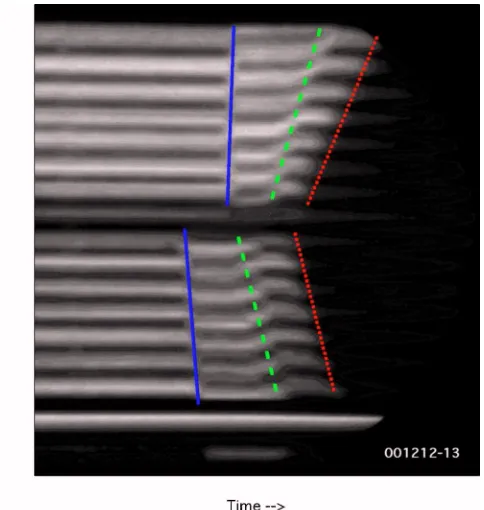
Water is transparent at ambient conditions, and continues to be so along the principal Hugoniot until⬃30 GPa.26,40In one of our shots, we find that water remains transparent at pressures exceeding 100 GPa at temperatures less than 3000 K. In this shot, 001212-13共Fig.3兲, we observe a lead-ing shock as it is overtaken by a second, stronger shock. The first discontinuity in the VISAR image is the first shock wave as it breaks through the Al step into the precompressed wa-ter: the water remains transparent and the observed reflection originates from the Al-water interface. The next discontinuity indicates the arrival of the second shock at the Al-water in-terface, and the final discontinuity indicates the second shock overtaking the first shock, producing conditions that make the water opaque. Calculations designed to match the ob-served interface velocities indicate that the two shocks com-pressed the sample to two distinctive P-T conditions at which the water continues to be transparent: ⬃47 GPa and 2100 K, and⬃125 GPa and 2800 K.
At pressures above ⬃50 GPa along the single-shock Hugoniot of normal water, previous studies have shown
wa-TABLE II. Final-state values共determined at the shock breakout from the Al兲of our shocked precompressed water samples. The shock velocities for Al are measured by VISAR. Particle and shock velocities for water,
up共H2O兲andUS共H2O兲, are determined by the fringe shift in the short step of the Al, where attenuation is less, for transparent共reflecting兲water. For opaque and reflecting shots,up共H2O兲is determined by impedance match with the Al step共Refs.34,35, and37兲. Italicized values are calculated from the SESAME database共Ref.35兲 Table 7150共Ref.34兲. The final pressures and densities are calculated through the Rankine-Hugoniot relations 共Ref.29兲. Optical properties are given in the first column. Temperature estimates from the SESAME database 共Ref.35兲, Table 7150共Ref.34兲, are given in the final column. Uncertainties are listed below each measured value in parentheses.
Sample
US共Al兲
共m / ns兲
US共H2O兲 共m / ns兲
up共H2O兲 共m / ns兲
Pf共H2O兲 共GPa兲
f共H2O兲 共g / cm3兲
TSESAME 共K兲
4 ns laser-shock pulse, VISAR interferometry at 532 nm only 001212-13
transparent
10.3 共0.3兲
8.7 共0.2兲
4.5 共0.2兲
47 共4兲
2.47 共0.15兲
2 100 共200兲
001213-12 opaque
13.0 共0.4兲
12.3 共0.3兲
7.4 共0.3兲
112 共8兲
3.08 共0.20兲
5 500 共600兲
001222-6 reflecting共532兲
17.3 共0.4兲
17.6 共0.4兲
12 共0.4兲
250 共15兲
3.75 共0.20兲
19 000 共1 700兲
1 ns laser-shock pulse, VISAR interferometry at 532 and 1064 nm 011218-07
reflecting共1064兲
15.5 共0.7兲
14.9 共0.4兲
10.0 共0.8兲
185 共20兲
3.77 共0.35兲
10 800 共1 700兲
011220-06 15.1 15.3 9.8 169 3.14 12 500
reflecting共1064兲 共0.4兲 共0.3兲 共0.4兲 共10兲 共0.25兲 共1 200兲 opaque共532兲
[image:5.612.128.484.142.349.2]ter to be opaque.24 We also observe water to be opaque at high pressures and temperatures. The opacity of the water is confirmed by a low reflectivity and the lack of fringe shift after the Al-shock breakout in both VISAR records共low in-tensity fringes remain as a result of ghost reflections from the external surface of the diamond window兲.
An example of a reflecting VISAR record is shown in Fig. 4. The first two fringe discontinuities are due to the Doppler shift of the moving Al-water interface. Since the reflected light originates from the shock front, the fringe shift yields the shock velocity in the water, US共water兲. As the water is precompressed, the pressudependent index of re-fraction of water 共n= 1.37– 1.45 at our initial compressions of 0.40– 1.02 GPa, as opposed to 1.33 at ambient pressure兲41 was taken into account in determining the shock velocities.33 We also observe the intensity of reflected light decrease as the shock wave decays in amplitude, with the water becom-ing opaque in the infrared at⬃130 GPa along the precom-pressed 1 GPa Hugoniot of water 共Figs. 4 and 5兲. This is similar to previous observations along the principal Hugo-niot, showing the onset of reflectivity near ⬃100 GPa.22 Combining these observations, the transition from opaque to reflecting behavior is found to be pressure and temperature dependent with a transition slope of approximately −12 K / GPa, although the uncertainties could be as much as ±9 K / GPa.
V. DISCUSSION
In a previous work22we modeled the reflectivity using a semiconductor formalism to estimate the free carrier density with a Drude model to calculate the electronic conductivity
e. In this model, we empirically fit reflectivity data at 532 and 1064 nm along the principal Hugoniot and calculated the free carrier density ande. A linear temperature and density dependence of the gap energy was included in the fit.22 We find that this model is consistent with our current observa-tions of shocked precompressed water, and it is used in our current analyses.
In Fig. 5, we plot the 1, 10, 100, and 1000共⍀cm兲−1 electronic conductivity contours as derived from this model. To compare, the conductivity of pure, distilled water at room conditions is 10−5 共⍀cm兲−1, more than six orders of magni-tude lower in value than we determine under shock conditions,42 while the conductivity of iron at room condi-tions is⬃105共⍀cm兲−1. The observed reflectivity can thus be attributed to the production of thermally activated electrons, however, not as high in conductivity as standard metals at room conditions. Our observations are consistent with reflec-tivity observed for laser-driven single-shock experiments on normal 共not precompressed兲 water samples at pressures above 100 GPa, for which temperatures are higher at any given pressure than for the precompressed samples共Fig.5兲.22 This agreement suggests that the model may also be reliable in representing the electronic conductivity of water along the isentrope. If the onset of reflectivity is an indication of an increased electronic contribution to the conductivity, and is both pressure and temperature dependent, our new measure-ments help to constrain the relative contributions of ionic and electronic conductivities along the icy giant isentrope. From the model, the 10共⍀cm兲−1
econtour intersects the Neptune isentrope near 125 GPa, while the 100共⍀cm兲−1
[image:6.612.56.298.48.303.2]econtour, a
FIG. 3. VISAR streaked image at 532 nm for sample 001212-13. The time duration for this shock record is⬃5 ns and the vertical axis is⬃200m. Al step breakouts are outlined in blue for the high and low steps. The water is transparent and continues to be so after another shock enters the sample 共green dashed line兲. A final shock enters the sample, finally making the water opaque共red dotted outline兲.
[image:6.612.312.559.49.235.2]conductivity value approaching that of a poor metal, inter-sects the isentrope near 250 GPa. This suggests that the con-ductivity in the outer layers is sufficient for dynamo produc-tion and involves a combinaproduc-tion of electronic and ionic conductions.
Our results compare well with previous observations of the optical properties of water under conditions of high pres-sure and temperature. Early shock-wave experiments on wa-ter along the principal Hugoniot have also documented transparency,26,40 opacity,24and reflectivity.22An increase in water’s electrical conductivity to ⬃25共⍀cm兲−1 with in-creasing pressure up to⬃30 GPa, followed by constant con-ductivity to 60 GPa, was inferred to be due to ionic conduction.6This conclusion is derived from Raman spectra of single-shocked water up to 26 GPa at a calculated tem-perature of 1700 K, which remained transparent.26The tem-peratures have been measured in experiments for only the opaque samples 共pressures ⬎⬃50 GPa兲 and are up to 4100 K at 60 GPa共Ref.24兲 共Fig.5兲.
Recent DAC experiments document transparent water up
to 56 GPa and 1500 K, with Raman spectra interpreted as showing evidence of superionicity.16For DAC water samples compressed between 6 and 43 GPa and heated to tempera-tures above ⬃2000 K, the water was observed to be opaque.13
Reverberated-shock experiments to pressures between 70 and 180 GPa show a further increase in conductivity, from 30 to 210共⍀cm兲−1, also interpreted as due to ioniza-tion of water:5,7H2O→H++ OH−. Although the temperatures were not measured in these experiments, they are estimated to be ⬃5400 K at the highest pressures,22,23 and are likely lower than our own temperatures.
For comparison, the conductivity of shocked metallic hydrogen is⬃2000共⍀cm兲−1at 140 GPa and 4400 K,43and
that of shocked metallic oxygen is ⬃1000共⍀cm兲−1 at 120 GPa and 4500 K 共Ref. 44兲 共the shock temperatures are calculated values in both cases兲. These conductivities are far higher than the values we infer from our optical measure-ments, suggesting that if dissociation takes place under shock loading it is not complete over the range of conditions achieved in the present study.
VI. CONCLUSIONS
With five experimental shots, we observe hot, dense wa-ter up to⬃250 GPa and up to⬃19 000 K. Due to the lower temperatures achieved with precompressed samples than in traditional single-shock experiments, we obtain densities that are greater than those measured on the principal Hugoniot 共Fig.6兲.6,24–26We observe three distinct regimes of differing optical properties upon shock compression: transparent, opaque, and reflecting共TableII, Fig.5兲.For the experiments at lowest pressures and temperatures, water remains transpar-ent. Our observations cannot verify the previous6,26
interpre-FIG. 5. Pressure vs temperature共TSESAME兲phase diagram for shocked pre-compressed water. Samples that remained transparent at 532 nm共green out-lined squares兲, opaque at 532 nm共green filled square兲, reflecting at 532 nm 共green hatched square兲, and reflecting at 1064 nm 共red hatched square, shaded region along 1 GPa precompression Hugoniot兲are plotted with their calculated temperatures. Green dashed line between transparent samples 共green outlined squares兲shows transparency for the same sample after suc-cessive shocks共see description in text and Fig. 3兲. We interpret opaque water samples as semiconducting, whereas, and reflecting water as due to electronic conduction. The regions are separated by a thick, dashed line with a slope of⬃−12 K / GPa. The thick solid curve represents Neptune’s isen-trope共Ref.48兲. The single-shock 共precompressed to 1 GPa兲Hugoniot of water is plotted as the black共red兲curve共Refs.34and35兲. For reference, we summarize single-shock experiments on water observed to be transparent 关open triangles共Ref.26兲兴, opaque关closed triangles共Ref.24兲兴, and reflecting 关shaded region above⬃100 GPa along single-shock Hugoniot共Ref.22兲兴. Additionally, the results of shock-reverberation experiments 共Ref. 7兲 are shown关with revised temperature estimates共Ref.22兲兴as blue circles. Addi-tionally, we plot the electronic conductivityeas thin, dotted, black lines
[image:7.612.52.294.45.303.2]representing the 1, 10, 100, and 1000共⍀cm兲−1contours.
FIG. 6. Density vs pressure phase diagram for shocked precompressed wa-ter. This study’s measurements are shown as black squares labeled with the optical properties observed: transparent, opaque, or reflecting. Observations of reflecting water along the single-shock共Ref.22兲and 1 GPa precompres-sion Hugoniots are shaded as in Fig. 5. The thick curve represents the isentrope of water centered at 300 GPa共Refs.34and35兲along Neptune’s isentrope共Ref.48兲. The single-shock共precompressed to 1 GPa兲Hugoniot of water is plotted as the black共red兲curve共Refs.34and35兲. For reference, early single-shock experiments on water are shown as black triangles共Refs. 6,24, and25兲, and the results of shock-reverberation experiments共Ref.7兲 are shown as blue circles. Additionally, the principle isentrope of water is shown as the black, dashed line共Refs.34and35兲.
[image:7.612.312.559.46.227.2]tation of high conductivity as due to the ionization of water, but are compatible with this interpretation. Upon transition to the opaque state, water behaves as a semiconductor at tem-peratures of ⬃3000– 6000 K: the measured conductivity is likely no longer just ionic but also has an electronic contri-bution and is likely pressure dependent. Above ⬃6000 K along the precompressed 1 GPa Hugoniot, the concentration of thermally-activated carriers is sufficient to produce metallic-like optical reflectivity with conductivities greater than 100共⍀cm兲−1, approaching that of a poor metal共Fig.5兲. This has been observed in previous experiments,22 and is interpreted as the onset of electronic conduction in water caused by the high temperatures reached during shock load-ing. At pressures and temperatures greater than ⬃130 GPa and 6600 K, water becomes reflecting at 1064 nm, although it is still opaque at 532 nm. At the most extreme pressure and temperature that we achieved, ⬃250 GPa and ⬃19 000 K 共TSESAME兲, we observe water reflecting at visible wave-lengths.
Figures5 and6show our measurements compared with the previous investigations of high-pressure and -temperature water. Some of our measurements cluster near Neptune’s ex-pected isentrope and suggest that this planet’s magnetic field could be sustained by pressure-induced semiconducting 共rather than ionic兲 water at pressures as low as⬃100 GPa, more than an order of magnitude lower than the peak pres-sure achieved in Neptune. Our results thus reinforce the con-clusion that water can sustain a magnetic dynamo at fairly shallow levels in the planet, compatible with the strongly quadrupolar nature of the observed magnetic field.3
ACKNOWLEDGMENTS
We thank Paul Loubeyre and Agnes Dewaele for exten-sive experimental and technical help, and R. Chau for help in reanalyzing the results of Ref. 7. We thank the operations staff of the Vulcan Laser Facility at Rutherford Appleton Laboratory for their support. This research was supported by the National Science Foundation and under the auspices of the U.S. Department of Energy by the University of Califor-nia, Lawrence Livermore National Laboratory under Con-tract No. W-7405-Eng-48.
1W. B. Hubbard,
Planetary Interiors共Van Nostrand Reinhold, New York, 1984兲.
2D. J. Stevenson, Earth Planet. Sci. Lett. 208, 1共2003兲. 3E. C. Stone and E. D. Miner, Science 246, 1417共1989兲. 4R. L. Kirk and D. J. Stevenson, Astrophys. J. 316, 836共1987兲. 5V. V. Yakushev, V. I. Postnov, V. E. Fortov, and T. I. Yakysheva, J. Exp.
Theor. Phys. 90, 617共2000兲.
6A. C. Mitchell and W. J. Nellis, J. Chem. Phys. 76, 6273共1982兲. 7R. Chau, A. C. Mitchell, R. W. Minich, and W. J. Nellis, J. Chem. Phys.
114, 1361共2001兲.
8W. J. Nellis, N. C. Holmes, A. C. Mitchell, D. C. Hamilton, and M.
Nicol, J. Chem. Phys. 107, 9096共1997兲.
9C. Cavazonni, G. L. Chiarotti, and S. Scandolo, Science 283, 44共1999兲. 10S. Stanley and J. Bloxham, Nature共London兲 428, 151共2004兲. 11A. F. Goncharov and V. V. Struzkhin, Science 273, 218
共1996兲. 12R. J. Hemley, A. P. Jephcoat, H. K. Mao, C. S. Zha, L. W. Finger, and D.
E. Cox, Nature共London兲 330, 737共1987兲.
13L. R. Benedetti, Ph.D thesis, University of California, Berkeley, 2001. 14B. Schwager, L. Chudinovskikh, A. Gavriliuk, and R. Boehler, J. Phys.:
Condens. Matter 16, S1177共2004兲.
15J.-F. Lin, B. Militzer, V. V. Struzkhin, and E. Gregoryanz, J. Chem. Phys.
121, 8423共2004兲.
16A. F. Goncharov, N. Goldman, L. E. Fried, J. C. Crowhurst, I.-F. W. Kuo, C. J. Mundy, and J. M. Zaug, Phys. Rev. Lett. 94, 125508共2005兲. 17M. R. Frank, Y. Fei, and J. Hu, Geochim. Cosmochim. Acta 68, 2781
共2004兲.
18T. Kawamoto, S. Ochiai, and H. Kagi, J. Chem. Phys. 120, 5867共2004兲. 19Y. Fei, H. K. Mao, and R. J. Hemley, J. Chem. Phys.
99, 5369共1993兲. 20E. N. Avrorin, B. K. Vodolaga, L. P. Volkov, A. S. Vladimirov, V. A.
Simonenko, and B. T. Chernovolyuk, JETP Lett. 31, 727共1980兲. 21M. A. Podurets, G. V. Simakov, R. F. Trunin, L. V. Popov, and B. N.
Moiseev, Sov. Phys. JETP 35, 375共1972兲.
22P. M. Celliers, G. W. Collins, D. G. Hickset al., Phys. Plasmas 11, L41 共2004兲.
23In the course of analyzing our data and previous results, we discovered that the temperatures listed in Table I of Ref.7are incorrect. We recal-culated the conditions of Ref.7two ways. First, by computing the first shock state transmitted from the first anvil, followed by the reflected shock state at the second anvil and then following the isentrope to the final pressure. Second, we simulated the reverberation impact with a La-grangian hydrocode共which follows the entire multiple shock sequence兲, and found that most of the entropy is deposited in the first two shocks. Both calculations employed the SESAME 7150 equation of state for water共Ref.34兲, which is known to agree with the temperature measure-ments along the Hugoniot by Lyzengaet al.共Ref.24兲, and the SESAME 7410 or 7411 EOS共Ref.35兲tables for the sapphire anvils. The estimated temperatures calculated with both methods and using either of the sap-phire EOS tables agreed to better than 2% for all cases in Ref.7. 24G. A. Lyzenga, T. J. Ahrens, W. J. Nellis, and A. C. Mitchell, J. Chem.
Phys. 76, 6282共1982兲.
25L. P. Volkov, N. P. Voloshin, R. A. Mangasarov, V. A. Simonenko, G. V. Sin’ko, and V. L. Sorokin, JETP Lett. 31, 513共1980兲.
26N. C. Holmes, W. J. Nellis, and W. B. Graham, Phys. Rev. Lett.55, 2433 共1985兲.
27K. K. M. Lee, L. R. Benedetti, A. Mackinnon, D. G. Hicks, S. J. Moon,
P. Loubeyre, F. Occelli, A. Dewaele, G. W. Collins, and R. Jeanloz, AIP Conf. Proc. 620, 1363 2002.
28P. Loubeyre, P. M. Celliers, D. G. Hicks
et al., High Press. Res. 24, 25 共2004兲.
29Y. B. Zeldovich and Y. P. Raizer,Physics of Shock Waves and High
Temperature Phenomena共Academic, New York, 1967兲.
30I. N. Ross, M. S. White, J. E. Boon, D. Craddock, A. R. Damerell, R. J. Day, A. F. Gibson, P. Gottfeldt, D. J. Nicholas, and C. J. Reason, IEEE J. Quantum Electron. QE-17, 1653共1981兲.
31L. M. Barker and R. E. Hollenbach, J. Appl. Phys. 43, 4669共1972兲. 32P. M. Celliers, G. W. Collins, L. B. DaSilva, D. M. Gold, and R. Cauble,
Appl. Phys. Lett. 73, 1320共1998兲.
33P. M. Celliers, D. K. Bradley, G. W. Collins, D. G. Hicks, T. R. Boehly, and W. J. Armstrong, Rev. Sci. Instrum. 75, 4916共2004兲.
34F. H. Ree, J. Chem. Phys. 76, 6287共1982兲
35S. P. Lyon and J. D. Johnson, Los Alamos National Laboratory Report No. LA-UR-92-3407, 1992共unpublished兲..
36A. V. Bessarab, N. V. Zhidkov, S. B. Kormer, D. V. Pavlov, and A. I. Funtikov, Sov. J. Quantum Electron. 8, 188共1978兲.
37Experimental Data on Shock Compression and Adiabatic Expansion of
Condensed Matter, edited by R. F. Trunin共RFNC-VNIIEF, Sarov, 2001兲. 38M. Takeda, H. Ina, and S. Kobayashi, J. Opt. Soc. Am.
72, 156共1982兲. 39L. M. Barker and K. W. Schuler, J. Appl. Phys. 45, 3692共1974兲. 40Y. B. Zeldovich, Sov. Phys. Dokl. 6, 494共1961兲.
41A. Dewaele, J. Eggert, P. Loubeyre, and R. LeToullec, Phys. Rev. B
67, 094112共2003兲.
42A. A. Brish, M. S. Tarasov, and V. A. Tsukerman, Sov. Phys. JETP 11, 15共1960兲.
43S. T. Weir, A. C. Mitchell, and W. J. Nellis, Phys. Rev. Lett. 76, 1860 共1996兲.
44M. Bastea, A. C. Mitchell, and W. J. Nellis, Phys. Rev. Lett. 86, 3108 共2001兲.
45H. K. Mao, P. M. Bell, J. W. Shaner, and D. J. Steinberg, J. Appl. Phys.
49, 3276共1978兲.
46A. Saul and W. Wagner, J. Phys. Chem. Ref. Data 18, 1537共1989兲. 47H. Shimizu, T. Nabetani, T. Nishiba, and S. Sasaki, Phys. Rev. B 53,
6107共1996兲.