Journal of Chemical and Pharmaceutical Research, 2013, 5(4):126-132
Research Article
CODEN(USA) : JCPRC5
ISSN : 0975-7384
Study of the accelerated stability of amoxicillin made in DR Congo
C. Kalonji Mubengayi
1,3*, Y. Ramli
*2,
M. El Karbane
2,3, M. Azougagh
2, Y. Cherrah
3and E. M. Essassi
11
Laboratoire de Chimie Hétérocyclique, Pole de Compétence Pharmacochimie, Université´
Mohammed V-Agdal, Rabat, Maroc
2
Laboratoire National de Contrôle des Médicaments, Direction du Médicament et de Pharmacie,
Ministère de la santé, Rabat, Maroc
3
Equipe de recherche de pharmacocinétique, Laboratoire de pharmacologie. Faculté de
Médecine et de Pharmacie, université Mohammed V, Souissi, Rabat, Maroc
_____________________________________________________________________________________________
ABSTRACT
The objective of this work was to study the accelerated stability of amoxicillin 500mg sold on the Congolese market. Four specialties of Amoxicillin were examined: three locally manufactured generics and the originator. Two analytical tests were made to study the change during the storage: The dosage of active ingredient by HPLC and dissolution profile by UV / Visible spectrophotometer. The results of this study reveal a problem with the manufacturing processes of Congolese generics. That is caused because they all present an abnormal drop of active ingredient and a release below the limit, from the third month of storage at a temperature and relative humidity of 40 °C and 75%.
Keywords: Stability, amoxicillin, generic, capsule, DR Congo.
_____________________________________________________________________________________________
INTRODUCTION
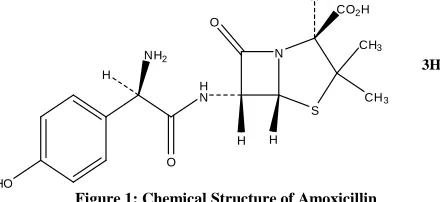
Amoxicillin is a beta-lactam bactericidal antibiotic of the aminopenicillins family indicated for the treatment of bacterial infections caused by bacteria susceptible.It is also used as part of the eradication of Helicobacter pylori (which causes recurrent peptic ulcers), in Lyme disease and in the prevention of bacterial endocarditis. It is commonly used for pigs and poultry treatment, in food or drinking water in veterinary medicine. After its oral absorption, effective blood concentrations are quickly reached and broad spectrum of activity (Gram positive and negative) [1-3] gives many therapeutic indications [4-6].
In DR Congo, amoxicillin is on the essential medecines list, and is at the top of most antibiotics consumed [7, 8]. To promote the national pharmaceutical production, the Ministry of Health has banned since 2006, the import of generic amoxicillin. The monopole production is given to local industries [9, 10].
HO
H NH2
H N
O
N
S
H H
O
CO2H
H
CH3
CH3
[image:2.595.193.413.78.179.2]3H2O
Figure 1: Chemical Structure of Amoxicillin
In this study, two tests will be monitored as a tool for quality assurance on the originator and different generics: The dosage of the active ingredient, and the profile of dissolution. They will be done before incubation, 3 months later, then after 6 months.
EXPERIMENTAL SECTION
2.1 Apparatus
UV-Visible spectrophotometer Perkin Elmer Lambda Series 35 made in the USA, the Mettler Toledo scale made in Switzerland, pH meter used was from Schott (Germany). Dissolution Test of Hanson SR8-Plus™ (USA). The chromatographic system consisted of Waters 2695 pump, auto sampler and Waters 2998 photodiode-array detector (PDA). Data acquisition was performed by the Empower Software data registration TM. The enclosure for the accelerated stability BINDER GmbH brand made in Germany.
2.2 Reagents and Materials:
All chemical products were of analytical grade and were supplied by the National Laboratory of Drugs Control (LNCM) Rabat, Morocco.
The amoxicillin standard (86.2%) was provided by the National Laboratory of Drug Control of Morocco. Sodium phosphate monobasic was from Riedel-de Haeri AG (Germany), while phosphoric acid from Merck KGaA (Germany). Sodium acetate was supplied by Merck KGaA (Germany), while acetonitrile by Sigma-Aldrich (Germany) Acetic acid was from Riedel de Haen (Germany).
Amoxicillin generics 500 mg capsule made by three pharmaceutical industries in DR Congo, with a duration of three years were collected from the market in Kinshasa and appointed Generic 1, 2, 3. A originator from France also on the market manufactured a year ago and still had 2 years before the expiry date was used for comparison.
2.3 Storage conditions:
Blisters containing amoxicillin 500mg capsules were placed in the accelerated stability enclosure set at 40 °C and 75 % relative humidity for a period of six months.
2.4 Chromatographic Conditions
Separation was by isocratic elution with the apparatus Waters ODS C18 column Thermo-5µm 4.6 mm x 250 mm, at a temperature of 30 ° C. The flow rate was 1mL/min, the wavelength 254 nm and the injection volume was 25 µL.
The mobile phase consisted of a mixture of phosphate buffer (pH 4.4) with acetonitrile (97/3 v / v), vacuum filtered with a filter of pore size 0.45 microns.
The solvent was prepared by dissolving 4.1 g / l of sodium acetate; the pH is adjusted to 6.0 by acetic acid [22].
Validation of the analytical method Specificity
Figure 2: Specificity of validated method
Linearity
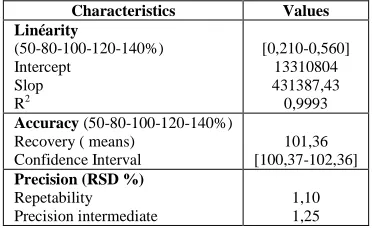
To the linearity of the analytical method, we have chosen the following concentrations (including 100%): 50, 80, 100.120 and 140%, the linearity of responses according to the concentration is demonstrated by the least squares regression. The linear regression equation was Y = 13310804 + 431387, 43 X (r2 = 0, 9993).
Characteristics Values Linéarity
(50-80-100-120-140%) Intercept
Slop R2
[0,210-0,560] 13310804 431387,43 0,9993
Accuracy (50-80-100-120-140%)
Recovery ( means) Confidence Interval
101,36 [100,37-102,36]
Precision (RSD %)
Repetability Precision intermediate
1,10 1,25
Table I: Criteria and values of validation analytical method
The accuracy
For the same concentrations used in the linearity was found a recovery rate equal to 101.36 with a confidence interval using [100.37 to 102.36]
Repeatability
The coefficient of variation for six injections of STD (100%) is 1.1% lower to 2% see Table I
2.6 Standards solutions
The Standard solution for HPLC contained 20mg of standard amoxicillin in 50mL of dilution solvent. Stir the solution for 15 min in ultrasound. The standard for dissolution was obtained by diluting 55mg amoxicillin in 100mL of water.
2.7 Samples solutions
[image:3.595.213.399.371.485.2]RESULTS AND DISCUSSION
Dosages of active ingredient and dissolution profiles were made on amoxicillin found on the Congolese market. Three generics manufactured in the DRC and an originator from France, were subjected to accelerated stability study. The results found before, after three and six months of incubation are summarized as follows:
3.1 Determination of the active ingredient
Before storage in the enclosure at 40°C and 75% RH.
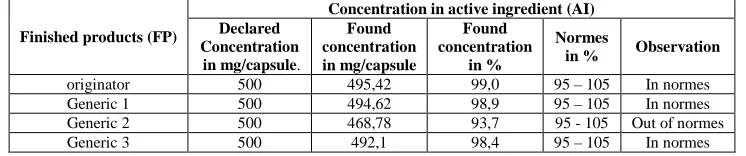
[image:4.595.120.493.223.301.2]Two out of three generics (1 and 3) of amoxicillin are reported in terms of the amount of active ingredient with respectively 98.9% and 98.4%. The originator is leading with 99.0% active ingredient. Generic (2) is under-dosed with 93.7%. The upper and lower limits set by the standards vary between 95-105.The results are represented in Table II.
Finished products (FP)
Concentration in active ingredient (AI) Declared
Concentration in mg/capsule.
Found concentration in mg/capsule
Found concentration
in %
Normes
in % Observation
originator 500 495,42 99,0 95 – 105 In normes
Generic 1 500 494,62 98,9 95 – 105 In normes
Generic 2 500 468,78 93,7 95 - 105 Out of normes
Generic 3 500 492,1 98,4 95 – 105 In normes
Table II. Determination of Amoxicillin in the finished products before incubation
The second generic was under dosed that is why it could not be part of the study of dissolution profiles because the content of active ingredient released in the dissolution depends on the total amount contained in the capsule.The case of under-dosing is common in medicines from countries in development as reported in other studies of large numbers of samples, as in the study on malaria,anti antibiotics and others specialites taken in Rwandan Tanzanian and Libyan markets[18,19-21]. The cause of this problem is often related to non-compliance with good manufacturing practices (GMP).
After three months of storage:
Exposed to temperature and humidity (40 °C/75% RH), all amoxicillin generics manufactured in DR Congo (1, 2, 3) proved to be outsized with a remarkable decline in active ingredient, respectively (86.3%, 90.8%, 89.6%). With the exception of the originator which remained in the standards with 95.9% of active ingredient. The upper and lower limits remain at 95-105%. The results are represented in Table III.
Finished products (FP)
Concentration in active ingredient (AI) Declared
Concentration in mg/capsule.
Found concentration in mg/capsule
Found concentration
in %
Normes
in % Observation
originator 500 479,57 95,9 95 – 105 In normes
Generic 1 500 431,72 86,3 95 – 105 In normes
Generic 2 500 454,44 90,8 95 - 105 Out normes
[image:4.595.123.491.480.558.2]Generic 3 500 448,10 89,6 95 – 105 Out normes
Table III. Determination of Amoxicillin in the finished products after three months of incubation
After three months of incubation, the temperature and humidity influence (40 ° C and 75% RH) is remarkable with a decrease in active ingredient of 12, 8% on the generic 1and 8, 8% the generic 3, and 3.1% on the originator. This decrease in generics more than 5% compared to the initial value in the third month has resulted in the dosage, which for antibiotics can cause resistance of certain bacteria [12].These large variations in three months reflect the rapid degradation of generics and question their validity period of three years listed on the boxes.Penicillins (amoxicillin) are known for their instability vis-à-vis changes in pH, temperature, pressure and humidity. This is due to the chemical properties related to the active ingredient and constraints of manufacturing process. This was reported in manufacturing medicated feed containing this molecule for treatment in veterinary medicine .The solutions were found with the manufacture of stable amoxicillin [20].
Six months after conservation.
Table IV: Determination of Amoxicillin in the finished product after six months of incubation
Finished products (FP)
Concentration in active ingredient (AI) Declared
Concentration in mg/capsule.
Found concentration in mg/capsule
Found concentration
in %
Normes
in % Observation
originator 500 479,57 93,8 90 – 105 In normes
Generic 1 500 431,72 74,9 90 – 105 Out normes
Generic 2 500 454,44 87,6 90 - 105 Out normes
Generic 3 500 448,10 85,5 90 – 105 Out normes
It is important to note a total decrease of 5% in the originator in relation to the initial value before storing. This important change that is significant for the stability could be attributed to the expiry of its validity remaining two years. The degradation of generics reached 24% for the first and 12.9% for the second. This shows that the instability may be due to a lack of validation of manufacturing process.
The dissolution profiles of amoxicillin.
In a study with six amoxicillins capsules, USP states that the minimum percentage of active ingredient released at 60 minutes in the dissolution medium must be 85% (Q +5%) [15,16].
The results of dissolution profiles of amoxicillin three specialties that are in the norms before storage are summarized in Figure 3. In fact after 60 minutes the originator released in 96.16% of amoxicillin while generics 1 and 3 have released respectively 89.07% and 95.71%.
Figure 3: Dissolution profiles before incubation.
Generic 1, 3 and the originator are in terms of dissolution profiles as shown in Figure 3. After the dissolution profiles, the calculation of F1 and F2 was done to show the similarity between the generics (1, 3) and the originator.
Similarity factor.
This parameter has two basic functions: 1°) relative difference function (F1). This is a measure of the relative error
n
R T
∑
0 20 40 60 80 100 120
0 15 30 45 60
%
of
D
ru
g r
el
eas
e
Time (minutes)
Originator
Géneric 1
2°) Similarity function (F2) its structural formula is: 2
{
[
2]
0.5}( )
1
50.log
1 (1 / )
(
)
.100
2
n
t t i
f
n
R
T
=
=
+
∑
−
Concerning the similarity: F1 is less than or equal to 10 and when F2 is more than or equal to 50. It varies between 50 and 100 [14].
Similarity factor calculation.
Generic 1: F1 = F2 = 5.755 and 85.685. Generic 3: F1 = F2 = 3.811 and 80.433.
Both generic amoxicillin are therefore consistent with the originator
The dissolution profile of amoxicillin after three months of incubation
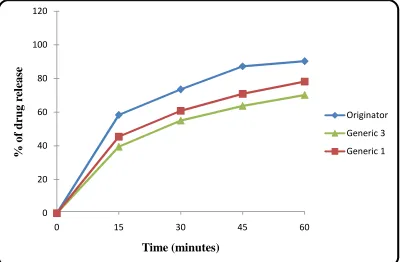
[image:6.595.108.508.325.587.2]The incubation in accelerated stability conditions for three months is marked by a decline in the percentage of amoxicillin released in the dissolution by all specialties. However, the amount released by the originator remains in norms with 90, 29% after 60 minutes. Generics are no longer able to release the required minimum of 85% in the month. The first is limited to 78.18%, and the second to 70.19%. The results are summarized in Figure 4. It should be noted that all generics are under dosed in the third month, the study of the dissolution profile after six months no longer continued.
Figure 4: Dissolution profile after three months of incubation.
The dissolution rate of generics in Figure 4 is less than the limit required by the USP 85% for 60 minutes. This reduction causes a decrease of bioavailability and therapeutic efficacy.
CONCLUSION
From this work, it seems important to emphasize the instability of amoxicillins generic capsules manufactured in DR Congo toward conditions of temperature and humidity recommended by the WHO for zone IV. These generics on the Congolese market in a tropical and humid climate degrade rapidly and lose their effectiveness. Congolese pharmaceutical industries must improve their manufacturing processes. This will allow people to have stable and efficient amoxicillin as is the case with the originator.
0 20 40 60 80 100 120
0 15 30 45 60
%
of
d
ru
g r
el
eas
e
Time (minutes)
Originator
Generic 3
REFERENCES
[1] Brander G.C., Pugh D.M., Veterinary applied pharmacology and therapeutics, Londres, 4th Edition, 1982, 382-383.
[2] Palmer G.H., Buswell J.F., Dowrick J.S., Yeoman g.h. Veterinary Record, 1976, 99, 84-85. [3] Prescott J.F. ET Desmond Baggot J, Blackwell Scientific Publications, Boston, 1988, 87. [4] Deyoe C.W. et Longbottom R.A.. Anim. Health Prod.,(Symp.) 1978, 115-125.
McKellar Q.A., Baxter P., Taylor D. ET Bogan J.A..Veterinary Record, 1987, 121, 347-350
[5] McKellar Q.A., Baxter P., Taylor D. ET Bogan J.A.: Penicillin therapy of spontaneous streptococcal meningitis in pigs. Veterinary Record, 1987, 121, 347-350.
[6] Mandell G.L. ET Sande M.A.; 7th ed., New York, MacMillan, 1066.
[7] MSH/R.P.M PLUS : Liste Nationale des médicaments essentiels République Démocratique du Congo. Ministère de la Santé. RDC. Révision 2007. Page 6
[8] OMS : Evaluation du secteur pharmaceutique en République Démocratique du Congo Juillet 2006. Page 26 [9] Ministère de la santé RDC : Arrêté ministériel N°1250/CAB/MIN/S/027/DS/2006. 2006
[10] Ministère de la santé RDC : Arrêté N°1250/CAB/MIN/SP/069/CJ/OMK/2010. 2010
[11] Lignes directrices pour l’étude de la stabilité des formes pharmaceutiques classiques contenant des principes actifs connus.OMS, 1996.
[12] Boudendouna : Stabilité des médicaments. Novembre 2006.
[13] OMS. 34ème Rapport du comité OMS d’experts des spécifications Relatives aux préparations pharmaceutiques
1996.
[14].US Department of Health and Human Services, Center for Drug Evaluation and Research (CDER) 1997. [15] USP 30 Official Monograph, Edition 2007, 1403.
[16] USP 35 Official Monograph, Edition 2013, 2198-2199.
[17] Kayumba. P.C.. J. Clin. Pharm. Therapeut. , 2004, 29, 331-338;
[18] Bhattacharyya P.K. et Cort W.M. : Amoxicillin. Anal. Profiles Drug Subst. 1978, 7, 19-41.
[19] Arwa M. Elhagi, Tariq K. Almog Mosbah A. ElMajri, Mssoud A. S. Anwair, Mohamed M. M. Sian J. Chem.
Pharm. Res., 2012, 4(9):4393-4399
[20] Derrieu G. et Raynier B.: Principes actifs pulvérulents stabilisés, compositions les contenant, leur procédé d'obtention et leurs applications. Brevet Européen, EP 0 600 775.
[21] E. Owusu-Ansah1, O.N. Ametepe , L. K. Boamponsem, I. Asiamah, J.E Koranteng- Addo, J.K. Tuffour J.
Chem. Pharm. Res., 2010, 2(4):378-386