w w w . s y n g r e s s . c o m
Syngress is committed to publishing high-quality books for IT Professionals and delivering those books in media and formats that fit the demands of our cus-tomers. We are also committed to extending the utility of the book you pur-chase via additional materials available from our Web site.
SOLUTIONS WEB SITE
To register your book, visit www.syngress.com/solutions. Once registered, you can access our [email protected] Web pages. There you may find an assort-ment of value-added features such as free e-books related to the topic of this book, URLs of related Web sites, FAQs from the book, corrections, and any updates from the author(s).
ULTIMATE CDs
Our Ultimate CD product line offers our readers budget-conscious compilations of some of our best-selling backlist titles in Adobe PDF form. These CDs are the perfect way to extend your reference library on key topics pertaining to your area of expertise, including Cisco Engineering, Microsoft Windows System Administration, CyberCrime Investigation, Open Source Security, and Firewall Configuration, to name a few.
DOWNLOADABLE E-BOOKS
For readers who can’t wait for hard copy, we offer most of our titles in down-loadable Adobe PDF form. These e-books are often available weeks before hard copies, and are priced affordably.
SYNGRESS OUTLET
Our outlet store at syngress.com features overstocked, out-of-print, or slightly hurt books at significant savings.
SITE LICENSING
Syngress has a well-established program for site licensing our e-books onto servers in corporations, educational institutions, and large organizations. Contact us at [email protected] for more information.
CUSTOM PUBLISHING
Many organizations welcome the ability to combine parts of multiple Syngress books, as well as their own content, into a single volume for their own internal use. Contact us at [email protected] for more information.
Foreword by Stephen Northcutt,
President, The SANS Technology InstituteToby Kohlenberg
Technical EditorRaven Alder • Dr. Everett F. (Skip) Carter, Jr • James C. Foster • Matt Jonkman •
Raffael Marty • Eric Seagren
Snort
®
IDS and IPS Toolkit
Featuring Jay Beale
and Members of the Snort Team
Andrew R. Baker
Joel Esler
NETWORK
(collectively “Makers”) of this book (“the Work”) do not guarantee or warrant the results to be obtained from the Work.
There is no guarantee of any kind, expressed or implied, regarding the Work or its contents.The Work is sold AS IS and WITHOUT WARRANTY.You may have other legal rights, which vary from state to state.
In no event will Makers be liable to you for damages, including any loss of profits, lost savings, or other inci-dental or consequential damages arising out from the Work or its contents. Because some states do not allow the exclusion or limitation of liability for consequential or incidental damages, the above limitation may not apply to you.
You should always use reasonable care, including backup and other appropriate precautions, when working with computers, networks, data, and files.
Syngress Media®, Syngress®, “Career Advancement Through Skill Enhancement®,” “Ask the Author UPDATE®,” and “Hack Proofing®,” are registered trademarks of Syngress Publishing, Inc. “Syngress:The Definition of a Serious Security Library”™, “Mission Critical™,” and “The Only Way to Stop a Hacker is to Think Like One™”are trademarks of Elsevier, Inc. Brands and product names mentioned in this book are trade-marks or service trade-marks of their respective companies.
Snort and the Snort logo are registered trademarks of Sourcefire, Inc.
KEY SERIAL NUMBER
001 HJIRTCV764 002 PO9873D5FG 003 829KM8NJH2 004 854HLM329D 005 CVPLQ6WQ23 006 VBP965T5T5 007 HJJJ863WD3E 008 2987GVTWMK 009 629MP5SDJT 010 IMWQ295T6T PUBLISHED BY Syngress Publishing, Inc. Elsevier, Inc.
30 Corporate Dr. Burlington, MA 01803
Snort Intrusion Detection and Prevention Toolkit
Copyright © 2007 by Syngress Publishing, Inc. All rights reserved. Except as permitted under the Copyright Act of 1976, no part of this publication may be reproduced or distributed in any form or by any means, or stored in a database or retrieval system, without the prior written permission of the publisher, with the exception that the program listings may be entered, stored, and executed in a computer system, but they may not be reproduced for publication.
1 2 3 4 5 6 7 8 9 0 ISBN-10: 1-59749-099-7 ISBN-13: 978-1-59749-099-3
Sourcefire is a registered trademark of Sourcefire, Inc.
Publisher: Andrew Williams Page Layout and Art: Patricia Lupien Acquisitions Editor: Erin Heffernan Copy Editor: Audrey Doyle Technical Editor:Toby Kohlenburg Indexer: Julie Kawabata Cover Designer: Michael Kavish
Acknowledgments
v
A special thanks to Marty Roesch and the rest of the Snort developers for all their efforts to maintain Snort: Erek Adams, Andrew R. Baker, Brian Caswell, Roman D., Chris Green, Jed Haile, Jeremy Hewlett, Jeff Nathan, Marc Norton, Chris Reid, Daniel Roelker, Marty Roesch, Dragos Ruiu, JP Vossen. Daniel Wittenberg, and Fyodor Yarochkin.
vii
Technical Editor
Toby Kohlenbergis a Senior Information Security Specialist for Intel Corporation. He does penetration testing, incident response, malware analysis, architecture design and review, intrusion analysis, and various other things that paranoid geeks are likely to spend time dealing with. In the last two years he has been responsible for devel-oping security architectures for world-wide deployments of IDS technologies, secure WLANs, Windows 2000/Active Directory, as well as implementing and training a security operations center. He is also a handler for the Internet Storm Center, which provides plenty of opportunity to practice his analysis skills. He holds the CISSP, GCFW, GCIH, and GCIA certifications. He currently resides in Oregon with his wife and daughters, where he enjoys the 9 months of the year that it rains much more than the 3 months where it’s too hot.
Raven Alderis a Senior Security Engineer for IOActive, a con-sulting firm specializing in network security design and implemen-tation. She specializes in scalable enterprise-level security, with an emphasis on defense in depth. She designs large-scale firewall and IDS systems, and then performs vulnerability assessments and pene-tration tests to make sure they are performing optimally. In her copious spare time, she teaches network security for LinuxChix.org and checks cryptographic vulnerabilities for the Open Source Vulnerability Database. Raven lives in Seattle, WA. Raven was a contributor to Nessus Network Auditing (Syngress Publishing, ISBN: 1931836086).
Raven Alder is the author of Chapters 1 and 2.
viii
Andrew R. Bakeris the Product Maintenance Manager for Sourcefire, Inc. His work experience includes the development and use of intrusion detection systems, security event correlation, as well as the use of vulnerability scanning software, network intrusion anal-ysis, and network infrastructure management. Andrew has been involved in the Snort project since 2000. He is the primary devel-oper for Barnyard, which he started working on in 2001 to address performance problems with the existing output plugins.
Andrew has instructed and developed material for the SANS Institute, which is known for providing information security training and GIAC certifications. He has an MBA from the R.H. Smith School of Business at the University of Maryland and a Bachelors of Science in Computer Science from the University of Alabama at Birmingham.
Andrew R. Baker is the author of Chapters 5 and 13.
Dr. Everett F. (Skip) Carter, Jr.is President of Taygeta Network Security Services (a division of Taygeta Scientific Inc.).Taygeta Scientific Inc. provides contract and consulting services in the areas of scientific computing, smart instrumentation, and specialized data analysis.Taygeta Network Security Services provides security ser-vices for real-time firewall and IDS management and monitoring, passive network traffic analysis audits, external security reviews, forensics, and incident investigation.
Skip holds a Ph.D. and an M.S. in Applied Physics from Harvard University. In addition he holds two Bachelor of Science degrees (Physics and Geophysics) from the Massachusetts Institute of Technology. Skip is a member of the American Society for
Industrial Security (ASIS). He was contributing author of Syngress Publishing’s book,Hack Proofing XML(ISBN: 1931836507). He has authored several articles for Dr. Dobbs Journal and Computer Language
as well as numerous scientific papers and is a former columnist for
Forth Dimensionsmagazine. Skip resides in Monterey, CA, with his
wife,Trace, and his son, Rhett.
ix Joel Esler(GCIA, SnortCP, SFCP, SFCE) is a Senior Security Consultant at Sourcefire. He began his post-school career in the Army and was honorably discharged in 2003. After 6 years of ser-vice, Joel continued to work for the Department of Defense as a Security Analyst for the Regional Computer Emergency Response Team — South, contracted through Lockheed Martin Professional Services. Starting out as a Network Security Analyst, Joel developed and deployed his own IDS system, based on Snort, tcpdump, p0f, and pads throughout the Army’s networks. With successful results, he quickly advanced to be the Director of Computer Defense and Information Assurance Branch of the RCERT-S, which held him responsible for many aspects of Vulnerability Scanning, IDS Deployment, and Snort Rule creation for the Army. In August of 2005, Joel left the RCERT-S to work for Sourcefire, Inc. His duties currently include installing and configuring Sourcefire and Snort deployments for customers nation wide, in addition to teaching three different Sourcefire and Snort classes. On occasion, you might even see him speaking at various user groups and conventions. In an effort to continue his growth and development, Joel recently
became an Incident Handler for SANS at the Internet Storm Center, as well as a GIAC Gold Advisor responsible for assisting people through the SANS Gold certification process.
Joel would like to thank the professionals who wrote much of the Snort documentation on which a significant part of this chapter is based.
Joel Esler is the author of Chapter 6.
James C. Fostercurrently heads the secure development practice for a large firm near Washington D.C. Prior to this, James was the Deputy Director of Global Security Solution Development for Computer Sciences Corporation where he was responsible for the global service architecture and operations for CSC managed infor-mation security services and solutions. Additionally, he is a Fellow at the Wharton School of Business, a contributing Editor at
x
on the Mitre OVAL Board of Directors. Preceding CSC, James was the Director of Research and Development for Foundstone Inc. (acquired by McAfee) and was responsible for all aspects of product, consulting, and corporate R&D initiatives. Prior to joining
Foundstone, James was the Chief Scientist and Executive Advisor with Guardent Inc. (acquired by Verisign) and an adjunct author at Information Security Magazine (acquired by TechTarget).This was all subsequent to working as Security Research Specialist for the Department of Defense. With his core competencies residing in high-tech remote management, international expansion, and product prototype development, James has helped three security companies successfully launch new commercial product offerings and reach their go-to-market strategy. James has experience in application security testing, protocol analysis, and search algorithm technology; he has conducted numerous code reviews for commercial OS com-ponents, Win32 application assessments, and reviews on commer-cial-grade cryptography implementations.
James is a seasoned speaker and has presented throughout North America at conferences, technology forums, security summits, and research symposiums with highlights at the Microsoft Security Summit, BlackHat USA, BlackHat Windows, MIT Wireless Research Forum, SANS, MilCon,TechGov, InfoSec World 2001, and the Thomson Security Conference. He also is commonly asked to comment on pertinent security issues and has been cited in USAToday, Information Security Magazine, Baseline, Computer World, Secure Computing, and the M IT Technologist. He holds an A.S., B.S., MBA and numerous technology and management certifi-cations.
James C. Foster is the author of Chapters 8 and 10.
Matt Jonkmanhas been involved in Information Technology since the late 1980s. He has a strong background in banking and network security, network engineering, incident response, and Intrusion Detection. Matt is founder of Bleeding Edge Threats
xi
Bleeding Edge Threats is an open-source research community for Intrusion Detection Signatures and much more. Matt spent 5 years serving abroad in the Army before attending Indiana State
University and the Rose-Hulman Institute. After several years as a general consultant he became Lead Technician for Sprint’s Internal and Managed Security division. Matt then moved to the financial sector as Senior Security Engineer for a major bank and financial services corporation.Then, he worked to build Infotex, a security firm focused on Managed IPS and Vulnerability Assessment. Matt currently is the Director of Intelligence Gathering for GNTC, the Global Network Threat Center. GNTC focuses on Open Research and collaboration of many open-source projects to mitigate and dis-cover the complex threats facing today’s information systems and organizations.
Matt Jonkman is the author of Chapter 7.
Chad Keeferis the founder of Solirix, a computer network secu-rity company specializing in Information Assurance. Chad is a former developer of Sourcefire’s RNA product team. Chad has over 13 years of industry experience in security, networking, and software engineering. He has worked extensively with the federal govern-ment and in a wide range of commercial industries to redefine and sharpen the current perception of security. He has also been a lead architect in this space, overseeing initiatives to redesign and build many security infrastructures. Chad holds a B.S. in Computer Science from the University of Maryland. He currently lives in Annapolis, MD with his wife and daughter.
Chad Keefer is the author of Chapter 3.
xii
holds responsibility for all of the product’s content, ranging from correlation rules, dashboards and visualizations, to vulnerability map-pings and categorization of security events. Before joining ArcSight, Raffael worked as an IT security consultant for PriceWaterhouse Coopers and previously was a member of the Global Security Analysis Lab at IBM Research.There, he participated in various intrusion detection related projects. His main project,Thor, was the first approach to testing intrusion detection systems by means of correlation tables.
Raffael is a log analysis and correlation expert. He has a passion for visualization of security event data and is the author of an open source visualization tool. He has been presenting on a number of security topics at various conferences and occasions. Raffael also serves on the MITRE OVAL (Open Vulnerability and Assessment Language) advisory board, is involved in the Common Vulnerability Scoring System (CVSS) standard, and participates in various other security standards and organizations.
Raffael Marty is the author of Chapter 9.
xiii
few years as an IT architect and risk analyst, designing and evalu-ating secure, scalable, and redundant networks.
Eric has worked on several books as a contributing author or technical editor.These include Hardening Network Security (McGraw-Hill),Hardening Network Infrastructure(McGraw-Hill),Hacking
Exposed: Cisco Networks (McGraw-Hill),Configuring Check Point
NGX VPN-1/FireWall-1 (Syngress),Firewall Fundamentals(Cisco
Press), and Designing and Building Enterprise DMZs (Syngress). He has also received a CTM from Toastmasters of America.
xiv
Stephen Northcutt,SANS Institute (Fellow), founded the GIAC certification and currently serves as President of the SANS
Technology Institute, a post graduate level IT Security College, www.sans.edu. Stephen is author/coauthor of Incident Handling Step-by-Step, Intrusion Signatures and Analysis, Inside Network Perimeter Security, Second Edition, IT Ethics Handbook, SANS Security Essentials, SANS Security Leadership Essentials and Network Intrusion Detection,
Third Edition.He was the original author of the Shadow Intrusion
Detection system before accepting the position of Chief for Information Warfare at the Ballistic Missile Defense Organization. Stephen is a graduate of Mary Washington College. Before entering the field of computer security, he worked as a Navy helicopter search and rescue crewman, white water raft guide, chef, martial arts instructor, cartographer, and network designer.
Jay Bealeis an information security specialist, well known for his work on mitigation technology, specifically in the form of operating system and application hardening. He’s written two of the most popular tools in this space: Bastille Linux, a lockdown tool that introduced a vital security-training component, and the Center for Internet Security’s Unix Scoring Tool. Both are used worldwide throughout private industry and government.Through Bastille and his work with CIS, Jay has provided leadership in the Linux system hardening space, participating in efforts to set, audit, and implement standards for Linux/Unix security within industry and government. He also focuses his energies on the OVAL project, where he works with government and industry to standardize and improve the field of vulnerability assessment. Jay is also a member of the Honeynet Project, working on tool development.
Jay has served as an invited speaker at a variety of conferences worldwide, as well as government symposia. He’s written for
Information Security Magazine,SecurityFocus, and the now-defunct SecurityPortal.com. He has worked on four books in the informa-tion security space.Three of these, including the best-selling Snort
2.1 Intrusion Detection (Syngress, ISBN: 1931836043) make up his
Open Source Security Series, while one is a technical work of fic-tion entitled Stealing the Network: How to Own a Continent (Syngress,
ISBN: 1931836051).
Jay makes his living as a security consultant with the firm Intelguardians, which he co-founded with industry leaders Ed Skoudis, Eric Cole, Mike Poor, Bob Hillery and Jim Alderson, where his work in penetration testing allows him to focus on attack as well as defense.
xv
Prior to consulting, Jay served as the Security Team Director for MandrakeSoft, helping set company strategy, design security prod-ucts, and pushing security into the third largest retail Linux distribution.
xvii
Contents
Foreword . . . xxxiii
Chapter 1 Intrusion Detection Systems. . . 1
Introduction . . . .2
What Is Intrusion Detection? . . . .2
Network IDS . . . .5
Host-Based IDS . . . .6
Distributed IDS . . . .7
How an IDS Works . . . .8
Where Snort Fits . . . .10
Intrusion Detection and Network Vulnerabilities . . . .11
Identifying Worm Infections with IDS . . . .11
Identifying Server Exploit Attempts with IDS . . . .12
Decisions and Cautions with IDS . . . .13
Why Are Intrusion Detection Systems Important? . . . .15
Why Are Attackers Interested in Me? . . . .16
What Will an IDS Do for Me? . . . .17
What Won’t an IDS Do for Me? . . . .18
Where Does an IDS Fit with the Rest of My Security Plan? . . . .20
Doesn’t My Firewall Serve As an IDS? . . . .20
Where Else Should I Be Looking for Intrusions? . . . .21
Backdoors and Trojans . . . .21
Physical Security . . . .22
Application and Data Integrity . . . .22
What Else Can You Do with Intrusion Detection Systems? . .23 Monitoring Database Access . . . .24
Monitoring DNS Functions . . . .24
E-Mail Server Protection . . . .25
Using an IDS to Monitor My Company Policy . . . .25
What About Intrusion Prevention? . . . .25
Summary . . . .27
Solutions Fast Track . . . .27
Chapter 2 Introducing Snort 2.6 . . . 31
Introduction . . . .32
What Is Snort? . . . .33
What’s New in Snort 2.6 . . . .35
Engine Improvements . . . .35
Preprocessor Improvements . . . .36
Rules Improvements . . . .36
Snort System Requirements . . . .37
Hardware . . . .37
Operating System . . . .38
Other Software . . . .38
Exploring Snort’s Features . . . .39
Packet Sniffer . . . .41
Preprocessor . . . .41
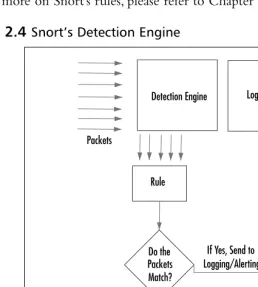
Detection Engine . . . .42
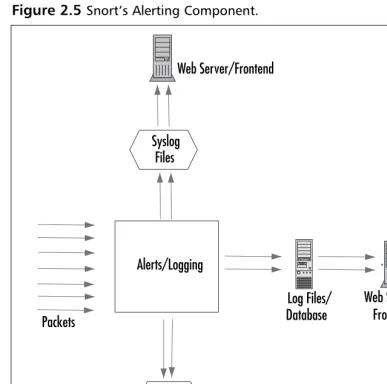
Alerting/Logging Component . . . .44
Using Snort on Your Network . . . .47
Snort’s Uses . . . .49
Using Snort as a Packet Sniffer and Logger . . . .50
Using Snort as an NIDS . . . .55
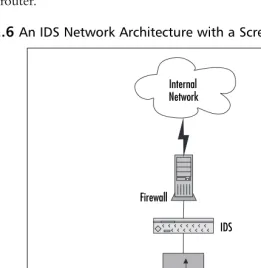
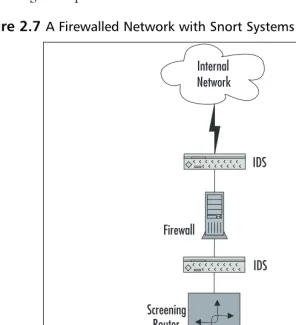
Snort and Your Network Architecture . . . .55
Snort and Switched Networks . . . .59
Pitfalls When Running Snort . . . .60
False Alerts . . . .61
Upgrading Snort . . . .61
Security Considerations with Snort . . . .62
Snort Is Susceptible to Attacks . . . .62
Securing Your Snort System . . . .63
Summary . . . .65
Solutions Fast Track . . . .65
Frequently Asked Questions . . . .67
Chapter 3 Installing Snort 2.6 . . . 69
Introduction . . . .70
Choosing the Right OS . . . .70
Performance . . . .71
The Operating System and the NIC . . . .75
Stability . . . .76
Security . . . .77
Support . . . .77
Cost . . . .77
Stripping It Down . . . .78
Removing Nonessential Items . . . .80
Debian Linux . . . .81
CentOS . . . .82
Gentoo . . . .82
The BSDs . . . .84
OpenBSD . . . .84
Windows . . . .88
Bootable Snort Distros . . . .88
The Network Security Toolkit As a Snort Sensor . . . .89
Hardware Platform Considerations . . . .90
The CPU . . . .91
Memory . . . .91
Memory’s Influence on System Performance . . . .93
Virtual Memory . . . .93
The System Bus . . . .93
PCI . . . .94
PCI-X . . . .95
PCI-Express . . . .95
Theoretical Peak Bandwidth . . . .96
Dual vs. Single Bus . . . .96
The NIC . . . .96
Disk Drives . . . .98
Installing Snort . . . .98
Prework . . . .99
Installing pcap . . . .99
Installing/Preparing Databases . . . .99
Time Synchronization (NTP) . . . .101
Installing from Source . . . .102
Benefits and Costs . . . .102
Compile-Time Options . . . .103
Chapter 4 Configuring Snort and Add-Ons . . . 133
Placing Your NIDS . . . .134 Configuring Snort on a Windows System . . . .136 Installing Snort . . . .137 Configuring Snort Options . . . .140 Using a Snort GUI Front End . . . .146 Configuring IDS Policy Manager . . . .146 Configuring Snort on a Linux System . . . .153 Configuring Snort Options . . . .153 Using a GUI Front-End for Snort . . . .158 Basic Analysis and Security Engine . . . .159 Other Snort Add-Ons . . . .166 Using Oinkmaster . . . .166 Additional Research . . . .168 Demonstrating Effectiveness . . . .169 Summary . . . .171 Solutions Fast Track . . . .171 Frequently Asked Questions . . . .173
Chapter 5 Inner Workings . . . 175
Rule Options . . . .189 The Content Option . . . .190 The bytejump and bytetest Options . . . .190 The PCRE Option . . . .191 The flowbits Option . . . .191 The Pattern-Matching Engine . . . .192 Building the Pattern Matcher . . . .192 Performance of the Different Algorithms . . . .193 The Dynamic Detection Engine . . . .196 Using the Engine . . . .196 Configuring the Engine . . . .197 Stub Rules . . . .198 The Dynamic Detection API . . . .198 The Rule Structure . . . .198 The Rule Options . . . .200 Dynamic Detection Functions . . . .209 Writing a Shared Object Rule . . . .210 Creating the Module Framework . . . .211 A Simple Shared Object Rule . . . .214 The Rule Evaluation Function . . . .219 Summary . . . .221 Solutions Fast Track . . . .221 Frequently Asked Questions . . . .223
Chapter 6 Preprocessors . . . 225
TCP Statefulness . . . .238 Configuring stream4 for Stateful Inspection . . . .241 Session Reassembly . . . .247 A Summary of the State Preprocessors . . . .251 Preprocessor Options for Decoding
and Normalizing Protocols . . . .251 The Application Preprocessors . . . .251 Telnet Negotiation . . . .252 Configuring the telnet_decode Preprocessor . . . .252 telnet_decode Output . . . .252 HTTP Inspect . . . .253 Hex Encoding (IIS and Apache) . . . .254 Double Percent Hex Encoding . . . .254 First Nibble Hex Encoding . . . .254 Second Nibble Hex Encoding . . . .254 Double Nibble Hex Encoding . . . .254 UTF-8 Encoding . . . .255 UTF-8 Barebyte Encoding . . . .255 Microsoft %U Encoding . . . .255 Mismatch Encoding . . . .255 Request Pipelining . . . .255 Parameter Evasion Using
rpc_decode Output . . . .267 Preprocessor Options for Nonrule
or Anomaly-Based Detection . . . .267 sfPortscan . . . .267 sfPortscan Configuration . . . .267 sfPortscan Tuning . . . .269 Back Orifice . . . .271 Configuring the Back Orifice Preprocessor . . . .272 Performance Monitoring . . . .272
Configuring the Performance
Monitoring Preprocessor . . . .272 Configuring the Rule Performance Monitor . . . .274 Rule Profiling . . . .274 Preprocessor profiling . . . .276 Dynamic Preprocessors . . . .277 SMTP Dynamic Preprocessor . . . .277 Examples . . . .280 SMTP Output . . . .281 FTP_Telnet Dynamic Preprocessor . . . .282 DNS Preprocessor Configuration . . . .287 Experimental Preprocessors . . . .288 arpspoof . . . .288 Summary . . . .290 Solutions Fast Track . . . .291 Frequently Asked Questions . . . .292
Chapter 7 Playing by the Rules . . . 295
Parts of a Rule: Options . . . .305 Rule Title . . . .306 Flow . . . .306 Content . . . .307 Parts of a Rule: Metadata . . . .310 Reference . . . .311 Classtype . . . .312 Sid . . . .312 Rev . . . .313 Other Advanced Options . . . .314 Flowbits . . . .314 Bytetest and Bytejump . . . .315 PCRE . . . .315 Ordering for Performance . . . .317 Anchors . . . .317 Thresholding . . . .318 Suppression . . . .320 Packet Analysis . . . .321 Rules for Vulnerabilities, Not Exploits . . . .321 A Rule: Start to Finish . . . .322 Rules of Note . . . .326 Stupid Rule Tricks . . . .329 Keeping Rules Up to Date . . . .332 Updating Rules . . . .333 Managing Rules the ‘Hard’ Way . . . .335 Why Do I Need to Keep My Rules up to Date? . . .335 Summary . . . .340 Solutions Fast Track . . . .340 Frequently Asked Questions . . . .341
Chapter 8 Snort Output Plug-Ins . . . 343
XML Logging . . . .353 Syslog . . . .354 SMB Alerting . . . .358 pcap Logging . . . .358 Snortdb . . . .360 Unified Logs . . . .367 Why Should I Use Unified Logs? . . . .368 What Do I Do with These Unified Files? . . . .369 Writing Your Own Output Plug-In . . . .370 Why Should I Write an Output Plug-In? . . . .370 Setting Up Your Output Plug-In . . . .372 Creating Snort’s W3C Output Plug-In . . . .375 Minimum Functions Required . . . .376 Creating the Plug-In . . . .377 Running and Testing the Snort W3C Output Plug-In 392 Dealing with Snort Output . . . .393 Troubleshooting Output Plug-In Problems . . . .396 Add-On Tools . . . .398 Barnyard . . . .399 Cerebus . . . .400 Mudpit . . . .401 Summary . . . .406 Solutions Fast Track . . . .407 Frequently Asked Questions . . . .408
Chapter 9 Exploring IDS Event Analysis, Snort Style 411
Step 2: Installing Sguild, the Server . . . .446 Step 3: Install a SGUIL Client . . . .448 Step 4: Install SANCP . . . .448 Step 5: Install the Sensor Scripts . . . .449 Using SGUIL . . . .450 Data Processing Scripts . . . .453 Snort_stat.pl . . . .453 SnortSnarf . . . .456 SnortALog . . . .461 Visualization Tools . . . .462 EtherApe . . . .463 Shoki–Packet Hustler . . . .464 AfterGlow . . . .466 Real-Time Monitoring Tools . . . .470 Swatch . . . .470 Tenshi . . . .473 Pig Sentry . . . .476 Analyzing Snort Events . . . .476 Finding Events of Interest . . . .476 Visualization . . . .479 Correlating Snort Events . . . .480 Web Server Correlation . . . .484 Simple Event Correlator . . . .485 Free Security Information Management Tools . . . . .487 Commercial Correlation Solutions . . . .489 Reporting Snort Events . . . .490 Summary . . . .493 Solutions Fast Track . . . .494 Frequently Asked Questions . . . .496
Chapter 10 Optimizing Snort. . . 499
Chapter 11 Active Response . . . 557
Chapter 12 Advanced Snort. . . 621
Introduction . . . .622 Monitoring the Network . . . .622 VLAN . . . .622 Configuring Channel Bonding for Linux . . . .623 Snort Rulesets . . . .624 Plug-Ins . . . .628 Preprocessor Plug-Ins . . . .629 Detection Plug-Ins . . . .636 Output Plug-Ins . . . .637 Snort Inline . . . .638 Solving Specific Security Requirements . . . .638 Policy Enforcement . . . .638 Catching Internal Policy Violators . . . .639 Banned IP Address Watchlists . . . .639 Network Operations Support . . . .639 Forensics and Incident Handling . . . .639 Summary . . . .642 Solutions Fast Track . . . .642 Frequently Asked Questions . . . .644
Chapter 13 Mucking Around with Barnyard . . . 645
alert_syslog . . . .669 alert_syslog2 . . . .671 log_dump . . . .675 log_pcap . . . .678 acid_db . . . .679 sguil . . . .681 Running Barnyard in Batch-Processing Mode . . . .681 Processing a Single File . . . .682 Using the Dry Run Option . . . .683 Processing Multiple Files . . . .685 Using the Continual-Processing Mode . . . .686 The Basics of Continual-Processing Mode . . . .686 Running in the Background . . . .687 Enabling Bookmark Support . . . .688 Only Processing New Events . . . .689 Archiving Processed Files . . . .689 Running Multiple Barnyard Processes . . . .690 Signal Handling . . . .690 Deploying Barnyard . . . .691 Remote Syslog Alerting . . . .691 Database Logging . . . .693 Extracting Data . . . .695 Real-Time Console Alerting . . . .696 Writing a New Output Plug-In . . . .697 Implementing the Plug-In . . . .698 Setting Up the Source Files . . . .698 Writing the Functions . . . .700 Adding the Plug-In to op_plugbase.c . . . .706 Finishing Up . . . .707 Updating Makefile.am . . . .707 Building Barnyard . . . .708 Real-Time Console Alerting Redux . . . .708 Secret Capabilities of Barnyard . . . .709 Summary . . . .710 Solutions Fast Track . . . .710 Frequently Asked Questions . . . .714
Snort Intrusion Detection and Prevention Toolkit is one of the most important books on information security; that is, if you not only read the book, but also put the knowledge into practice. There is an increasing and troubling gap between the people who manage by security policy frameworks and the people who actually know how to create security. The pragmatics of informa-tion security are becoming lost. There are books about things and books on
how to do things. This is a book on how to do things. If you are reading this foreword, this may be your moment to decide whether you want to hide behind policy and 10 domains or actually learn security? If you decide to try the policy route, expect to become increasingly irrelevant as the years go by. Information security is like everything else in life; you will receive in propor-tion to what you give.
There are two basic skills a professional must have to avoid being impotent as a security practitioner: understanding the network traffic entering, leaving, and within your network; and understanding how a system must be configured so that it can operate safely while attached to a network.Whether you are in the trenches as a technical worker, or even if you are a manager, if you lack either of those skills at the appropriate level, you are faking it and hoping you aren’t held accountable. I teach a successful security course for managers for the SANS Institute, and we have a section of the course called “Packet Reading for Managers.”We are teaching managers up to the Vice President level to read and understand critical fields in a packet that any good network analyst should understand.They aren’t learning this so that they can run around reading packets; they are becoming equipped to hire employees who can actually do the work.Snort Intrusion Detection and Prevention Toolkitis a great book, and it can teach you the core network traffic acquisition and analysis skills; this is a tested and proven guide to operate Snort. At one point, the creator of Snort,
xxxiii
Marty Roesch, referred to Snort as a lightweight intrusion detection system; however, times change. In addition to being a powerful sniffer and rule-based IDS Snort also has a large family of supporting tools. Snort and friends will give you the capability to understand the traffic entering and leaving your net-work if you are willing to master the skills needed.
The book teaches the fundamentals of the network-analysis craft, how to install Snort, configuration of the machine to get maximum value, the architec-tural issues to consider when deploying this capability, and tuning the rules to get the results you need, and how to test to make sure it is operating in the manner you need it to operate. Guess what! You have made it through only Chapter 4. Now that you have an operational Snort box, you are ready to begin Chapter 5: “Inner Workings.”There are probably fewer than 2,000 truly skilled analysts on the planet. If you can master this chapter, you can become one of them. So plan some quiet time.Work with a buddy, join a mailing list, and don’t give up if you hit a hard spot.Truly own this knowledge.
There is no point covering the rest of the material in the book in depth; you have a table of contents for that.What I want you to know is that you are not in for fluff.You will learn to write rules and to configure preprocessors and plugins.Then, you will begin your analysis journey in Chapter 9. I look for-ward to reading about your novel detects on the internet storm center.
I applaud the author team of Toby Kohlenberg, Jay Beale, Raven Alder, Chad Keefer, Andrew Baker, Matt Jonkman, Joel Esler, James Foster, Raffy Marty, Eric Seagren, and Skip Carter.Writing a book is hard work, and I know they have a sense of mission to relay the importance of passing on the craft. You are coming to the end of this foreword.What have you decided? If you plan to devote yourself to the craft, please allow the authors and me to wel-come you to the community. I love the years that I have worked with the net-work analysis community as a practitioner and now a bit more as a leader that makes opportunities for others.The willingness to give and share in this fairly small group has always impressed me.Take Snort Intrusion Detection and
Prevention Toolkit home with you; don’t let it languish on the shelf. Let it be your friend and guide; you will be glad you did.
Intrusion
Detection Systems
Solutions in this chapter
■ What Is Intrusion Detection?
■ How an IDS Works
■ Why Are Intrusion Detection Systems
Important?
■ What Else Can You Do with Intrusion
Detection Systems?
■ What About Intrusion Protection?
Chapter 1
1
Summary
Solutions Fast Track
Introduction
The principle of intrusion detection isn’t new. Whether it’s car alarms or closed-cir-cuit televisions, motion detectors or log analyzers, many folks with assets to protect have a vested interest in knowing when unauthorized persons are probing their defenses, sizing up their assets, or running off with crucial data. In this book, we’ll discuss how the principles of intrusion detection are implemented with respect to computer networks, and how using Snort can help overworked security administra-tors know when someone is running off with their digital assets.
All right, this might be a bit dramatic for a prelude to a discussion of intrusion detection, but most security administrators experience a moment of anxiety when a beeper goes off. Is this the big one? Did they get in? How many systems could have been compromised? What data was stored on or accessible by those systems? What sort of liability does this open us up to? Are more systems similarly vulnerable? Is the press going to have a field day with a data leak?
These and many other questions flood the mind of the well-prepared security administrator. On the other hand, the ill-prepared security administrator, being totally unaware of the intrusion, experiences little anxiety. For him, the anxiety comes later.
Okay, so how can a security-minded administrator protect his network from intrusions? The answer to that question is quite simple. An intrusion detection system (IDS) can help to detect intrusions and intrusion attempts within your net-work, allowing a savvy admin to take appropriate mitigation and remediation steps. A pure IDS will not prevent these attacks, but it will let you know when they occur.
What Is Intrusion Detection?
Webster’s defines an intrusion as “the act of thrusting in, or of entering into a place or state without invitation, right, or welcome.” When we speak of intrusion detec-tion, we are referring to the act of detecting an unauthorized intrusion by a computer
on a network.This unauthorized access, or intrusion, is an attempt to compromise, or otherwise do harm, to other network devices.
However, all the definitions go on to further require theft of government secrets, financial records, government data, or other such things. “Knowingly accessed without authorization or exceeding authorized access” doesn’t appear to be enough in and of itself.There is also a lack of legislative clarity regarding what “access” is. For example, a portscan gathers data about which ports on the target computer are listening, but does not attempt to use any services. Nevertheless, some people argue that this constitutes accessing those services. A security scanner such as Nessus or Retina may check the versions of listening services and compare them against a database of known security vulnerabilities.This is more intrusive than a simple portscan, but merely reports the presence of vulnerabilities rather than actually exploiting them. Is this accessing the service? Should it count as an intrusion? Finally, there are the blatant cases where the system is actually compromised. Most people would agree that this counts as an intrusion. For our purposes, we can define an intrusion as an unwanted and unauthorized intentional access of computerized network resources.
An IDS is the high-tech equivalent of a burglar alarm, one that is configured to monitor information gateways, hostile activities, and known intruders. An IDS is a specialized tool that knows how to parse and interpret network traffic and/or host activities.This data can range from network packet analysis to the contents of log files from routers, firewalls, and servers, local system logs and access calls, network flow data, and more. Furthermore, an IDS often stores a database of known attack signatures and can compare patterns of activity, traffic, or behavior it sees in the data it’s monitoring against those signatures to recognize when a close match between a signature and current or recent behavior occurs. At that point, the IDS can issue alarms or alerts, take various kinds of automated actions ranging from shutting down Internet links or specific servers to launching back-traces, and make other active attempts to identify attackers and collect evidence of their nefarious activities.
By analogy, an IDS does for a network what an antivirus software package does for files that enter a system: it inspects the contents of network traffic to look for and deflect possible attacks, just as an antivirus software package inspects the contents of incoming files, e-mail attachments, active Web content, and so forth to look for
virus signatures(patterns that match known malware) or for possible malicious actions
servers where firewalls, proxies, or other boundary services operate, though separate IDS sensors and managers are more popular. Nevertheless, an IDS not running on the same device or server where the firewall or other services are installed will mon-itor those devices with particular closeness and care. Although such devices tend to be deployed at network peripheries, IDSes can detect and deal with insider attacks as well as external attacks, and are often very useful in detecting violations of corporate security policy and other internal threats.
You are likely to encounter several kinds of IDSes in the field. First, it is possible to distinguish IDSes by the kinds of activities, traffic, transactions, or systems they monitor. IDSes that monitor network links and backbones looking for attack signa-tures are called network-based IDSes, whereas those that operate on hosts and defend and monitor the operating and file systems for signs of intrusion and are called
host-based IDSes.Groups of IDSes functioning as remote sensors and reporting to a
cen-tral management station are known as distributed IDSes (DIDSes). A gateway IDS is a network IDS deployed at the gateway between your network and another network, monitoring the traffic passing in and out of your network at the transit point. IDSes that focus on understanding and parsing application-specific traffic with regard to the flow of application logic as well as the underlying protocols are often called
application IDSes.
In practice, most commercial environments use some combination of network-, host-, and/or application-based IDSes to observe what is happening on the network while also monitoring key hosts and applications more closely. IDSes can also be dis-tinguished by their differing approaches to event analysis. Some IDSes primarily use a technique called signature detection.This resembles the way many antivirus programs use virus signatures to recognize and block infected files, programs, or active Web content from entering a computer system, except that it uses a database of traffic or activity patterns related to known attacks, called attack signatures. Indeed, signature detection is the most widely used approach in commercial IDS technology today. Another approach is called anomaly detection. It uses rules or predefined concepts about “normal” and “abnormal” system activity (called heuristics) to distinguish anomalies from normal system behavior and to monitor, report, or block anomalies as they occur. Some anomaly detection IDSes implement user profiles.These profiles are baselines of normal activity and can be constructed using statistical sampling, rule-base approaches, or neural networks.
capabilities, but these usually concentrate on automated traffic filtering, blocking, or disconnects as a last resort. Although some systems claim to be able to launch coun-terstrikes against attacks, best practices indicate that automated identification and back-trace facilities are the most useful aspects that such facilities provide and are therefore those most likely to be used.
IDSes are classified by their functionality and are loosely grouped into the fol-lowing three main categories:
■ Network-based intrusion detection system (NIDS)
■ Host-based intrusion detection system (HIDS)
■ Distributed intrusion detection system (DIDS)
Network IDS
The NIDS derives its name from the fact that it monitors the entire network from the perspective of the location where it is deployed. More accurately, it monitors an entire network segment. Normally, a computer network interface card (NIC) oper-ates in nonpromiscuous mode. In this mode of operation, only packets destined for the NIC’s specific media access control (MAC) address (or broadcast packets) are forwarded up the stack for analysis.The NIDS must operate in promiscuous mode to monitor network traffic not destined for its own MAC address. In promiscuous mode, the NIDS can eavesdrop on all communications on the network segment. In addition, the NIDS should be connected to either a span port on your local switch, or a network tap duplicating traffic on the link you want to monitor. Operation of the NIDS’s NIC in promiscuous mode is necessary to protect your network.
However, in view of emerging privacy regulations and wiretap laws, monitoring net-work communications is a responsibility that must be considered carefully.
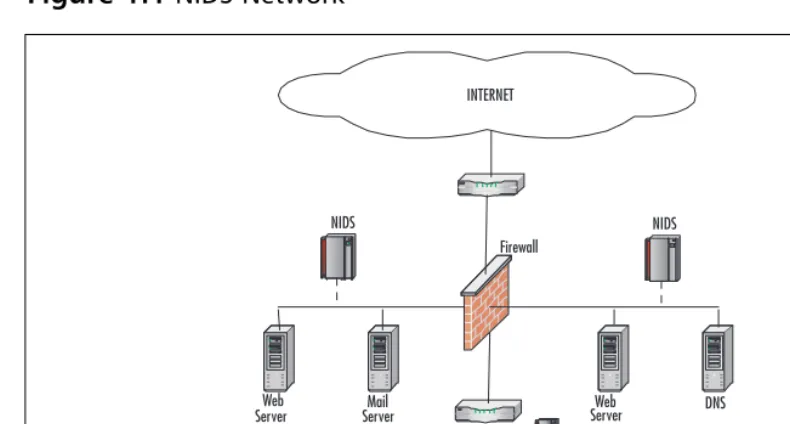
Figure 1.1 depicts a network using three NIDS.The units have been placed on strategic network segments and can monitor network traffic for all devices on the segment.This configuration represents a standard perimeter security network topology where the screened subnets housing the public servers are protected by NIDS. When a public server is compromised on a screened subnet, the server can become a launching platform for additional exploits. Careful monitoring is necessary to prevent further damage.
Figure 1.1NIDS Network
Host-Based IDS
HIDS differ from NIDS in two ways. HIDS protects only the host system on which it resides, and its network card operates by default in nonpromiscuous mode.
Nonpromiscuous mode of operation can be an advantage in some cases, because not all NICs are capable of promiscuous mode. In addition, promiscuous mode can be CPU-intensive for a slow host machine. Due to their location on the host to be monitored, HIDS are privy to all kinds of additional local information with security implications, including system calls, file system modifications, and system logs. In combination with network communications, this provides a robust amount of data to parse through in search of security events of possible concern.
Another advantage of HIDS is the capability to tailor the ruleset very finely for each individual host. For example, there is no need to interrogate multiple rules designed to detect DNS exploits on a host that is not running Domain Name Services. Consequently, the reduction in the number of pertinent rules enhances performance and reduces processor overhead for each host.
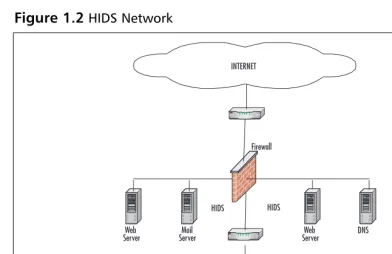
Figure 1.2 depicts a network using HIDS on specific servers and host com-puters. As previously mentioned, the ruleset for the HIDS on the mail server is cus-tomized to protect it from mail server exploits, and the Web server rules are tailored for Web exploits. During installation, individual host machines can be configured
INTERNET
Server ServerWeb DNS Web
Server
NIDS
NIDS NIDS
with a common set of rules. New rules can be loaded periodically to account for new vulnerabilities.
Figure 1.2HIDS Network
Distributed IDS
The standard DIDS functions in a Manager/Probe architecture. NIDS detection sen-sors are remotely located and report to a centralized management station. Attack logs are periodically uploaded to the management station and can be stored in a central database; new attack signatures can be downloaded to the sensors on an as-needed basis.The rules for each sensor can be tailored to meet its individual needs. Alerts can be forwarded to a messaging system located on the management station and used to notify the IDS administrator.
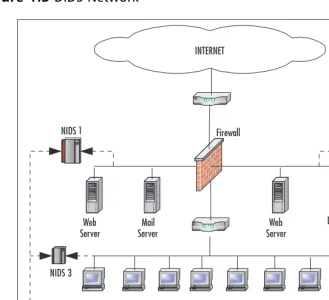
Figure 1.3 shows a DIDS composed of four sensors and a centralized manage-ment station. Sensor NIDS 1 and NIDS 2 are operating in stealth promiscuous mode and are protecting the public servers. Sensor NIDS 3 and NIDS 4 are pro-tecting the host systems in the trusted computing base.
The network transactions between sensor and manager can be on a private net-work, as depicted, or the network traffic can use the existing infrastructure. When using the existing network for management data, the additional security afforded by encryption, or virtual private network (VPN) technology, is highly recommended.
INTERNET
Server ServerWeb DNS
Web Server
Firewall
HIDS
HIDS HIDS
HIDS
Figure 1.3DIDS Network
In a DIDS, complexity abounds.The scope and functionality vary greatly from manufacturer to manufacturer, and the definition blurs accordingly. In a DIDS, the individual sensors can be NIDS, HIDS, or a combination of both.The sensor can function in promiscuous mode or nonpromiscuous mode. However, in all cases, the DIDS’s single defining feature requires that the distributed sensors report to a cen-tralized management station.
How an IDS Works
We’ve already touched on this to some degree in our survey of the different kinds of IDSes out there, but let’s take a look at exactly what makes an IDS tick. First, you have to understand what the IDS is watching.The particular kinds of data input will depend on the kind of IDS (indeed, what sorts of information an IDS watches is one of the hallmarks used to classify it), but in general there are three major divisions:
INTERNET
Server ServerWeb
DNS Web
Server
NIDS 1 Firewall NIDS 2
NIDS 3 NIDS 4
NIDS MANAGEMENT
STATION
Private management Network Private management
■ Application-specific information such as correct application data flow
■ Host-specific information such as system calls used, local log content, and file system permissions
■ Network-specific information such as the contents of packets on the wire or hosts known to be attackers
A DIDS may watch any or all of these, depending on what kinds of IDSes its remote sensors are.The IDS can use a variety of techniques in order to gather this data, including packet sniffing (generally in promiscuous mode to capture as much network data as possible), log parsing for local system and application logs, system call watching in the kernel to regulate the acceptable behavior of local applications, and file system watching in order to detect attempted violation of permissions.
After the IDS has gathered the data, it uses several techniques to find intrusions and intrusion attempts. Much like firewalls, an IDS can adopt a known-good or a known-bad policy. With the former technique, the IDS is set to recognize good or allowed data, and to alert on anything else. Many of the anomaly detection engines embrace this model, triggering alerts when anything outside of a defined set of sta-tistical parameters occurs. Some complex protocol models also operate on known-good policies, defining the kinds of traffic that the protocol allows and alerting on anything that breaks that mold. Language-based models for application logic also tend to be structured as known-good policies, alerting on anything not permitted in the predefined structure of acceptable language or application flow.
Known-bad policies are much simpler, as they do not require a comprehensive model of allowed input, and alert only on data or traffic known to be a problem. Most signature-based IDS engines work from a known-bad model, with an ever-expanding database of malicious attack signatures. Known-good and known-bad policies can work in conjunction within a single IDS deployment, using the known-bad signature detection and the known-good protocol anomaly detection in order to find more attacks.
Finally, we should consider what the IDS does when it finds an attempted attack.There are two general categories of response: passive response, which may generate alerts or log entries but does not interfere with or manipulate the network traffic, and active response (discussed at length in Chapter 11), which may send reset packets to disrupt Transmission Control Protocol (TCP) connections, drop traffic if the IDS is inline, add the attacking host to block lists, or otherwise actively interact with the flow of dubious activity.
Where Snort Fits
Snort is an open source network IDS capable of performing real-time traffic analysis and packet logging on Internet Protocol (IP) networks. Snort can perform protocol analysis and content searching/matching, and you can use it to detect a variety of attacks and probes, such as buffer overflows, stealth port scans, Common Gateway Interface (CGI) attacks, Server Message Block (SMB) probes, operating system fin-gerprinting attempts, and much more. Snort is rapidly becoming the tool of choice for intrusion detection.
You can configure Snort in three main modes: sniffer, packet logger, and net-work intrusion detection. Sniffer mode simply reads the packets off the netnet-work and displays them in a continuous stream on the console. Packet logger mode logs the packets to the disk. Network intrusion detection mode is the most complex and configurable, allowing Snort to analyze network traffic for matches against a user-defined ruleset and to perform one of several actions, based on what it sees.
In addition to the community signatures provided with Snort and the Sourcefire VDB signatures available for download to registered users, you can write your own signatures with Snort to suit the particular needs of your network. We’ll discuss how to do this in Chapter 7.This capability adds immense customization and flexibility to the Snort engine, allowing you to suit the unique security needs of your own network. In addition, there are several online communities where leading-edge intrusion analysts and incident responders swap their newest Snort rules for detecting fresh exploits and recent viruses.
Snort’s network pattern matching behavior has several immediately practical applications. For example, it allows the detection of hosts infected with viruses or worms that have distinctive network behavior. Because many modern worms spread by scanning the Internet and attacking hosts they deem vulnerable, signatures can be written either for this scanning behavior or for the exploit attempt itself. Although it is not the job of the IDS to clean up infected machines, it can help identify infected machines. In cases of massive virus infection, this identification capability can be immensely useful. In addition, watching for the same behavior after supposed virus cleanup can help to confirm that the cleanup was successful. Later in this chapter, we will examine Snort rules that characterize the network behavior of a worm.
making for easy device identification.The vast majority of exploits that end up in popular tools such as Metasploit have signatures in the Snort rulebases, making them detectable by their network behavior.
Intrusion Detection and Network Vulnerabilities
Of all the areas of concern for network administrators, two omnipresent threats loom large on the horizon of potential threats: a major virus or worm outbreak, and a successful malicious intrusion. Fortunately, IDSes can assist in identifying and com-bating both of these situations. Let’s first consider a worm infestation.
Identifying Worm Infections with IDS
The Dabber worm rather rudely exploits a previously-worm-exploited host. Riding on the coattails of the extremely damaging Sasser worm (which exploited the MS04-011 LSASS vulnerability), Dabber scans on TCP port 5554 for Sasser-com-promised machines, then exploits the FTP server that Sasser installs and deletes the Sasser Registry keys, replacing them with its own. Several versions of the Dabber worm have been identified in the wild, and many organizations scrambling to patch and clean up Sasser didn’t find all the compromised boxes in time before they were compromised again and differently by a new worm.
At the scene of a crime, one of the first tasks of the forensic evidence technician is to gather fingerprints.These fingerprints can be used to determine the identity of the criminal. Just as in criminal forensics, network forensics technicians gather fin-gerprints at the scene of a computer crime.The finfin-gerprints are extracted from the victim computer’s log and are known as signaturesor footprints. Almost all exploits have a unique signature. When new exploits are released into the wild, incident responders and security administrators collaborate to identify the signature of the exploit, and to write IDS rules that will alert on that signature.
Although we reiterate that it is the job of antivirus software to address virus and worm-infected machines, Snort can help identify which hosts need attention from your friendly local antivirus staffers. Consider the following Snort rules, from the community-virus.rules:
alert tcp $EXTERNAL_NET any -> $HOME_NET 5554 (msg:"COMMUNITY VIRUS Dabber PORT overflow attempt port 5554"; flow:to_server,established,no_stream; content:"PORT"; nocase; isdataat:100,relative;
pcre:"/^PORT\s[^\n]{100}/smi"; reference:MCAFEE,125300; classtype:attempted-admin; sid:100000110; rev:1;)
content:"PORT"; nocase; isdataat:100,relative;
pcre:"/^PORT\s[^\n]{100}/smi"; reference:MCAFEE,125300; classtype:attempted-admin; sid:100000111; rev:1;)
The first rule alerts on the attempted PORT overflow exploit attempt to TCP port 5554, showing the buffer overflow of the vulnerable Sasser-installed server.The second rule shows a similar attempt to TCP port 1023. We’ll get more into rule analysis and writing in later chapters, but the basic structure should be visible from these rules. Note that it is not the Registry keys or file changes that the NIDS rules detect (although a HIDS on the infected host could notice this behavior), but the network-visible traffic of the worm with its distinctive payload.
N
OTEFor a thorough description of the Dabber worm, the associated Registry keys modified, and its behavior, look at www.lurhq.com/dabber.html.
Although worms can be troublesome and bandwidth-clogging, many security administrators are still more afraid of a targeted exploit attempt against a high-value server. Let’s look at an attack against Oracle database servers.
Identifying Server Exploit Attempts with IDS
alert tcp $EXTERNAL_NET any -> $SQL_SERVERS 3339 (msg:"COMMUNITY ORACLE TNS Listener shutdown via iSQLPlus attempt"; flow:to_server,established;
content:"isqlplus"; nocase; content:"COMMAND"; nocase; distance:0;
content:"STOP"; nocase; distance:0; content:"LISTENER"; nocase; distance:0; pcre:"/isqlplus\x2F[^\r\n]*COMMAND\s*\x3D\s*STOP[^\r\n\x26]*LISTENER/si"; reference:bugtraq,15032;
reference:url,www.red-database-security.com/advisory/oracle_isqlplus_shutdown.html; classtype:attempted-user; sid:100000166; rev:1;)
As you can see, this rule will create an alert whenever a TCP connection goes to an SQL server on port 3339 with a command that contains the words isqlplus,
COMMAND,STOP, and LISTENERin appropriate places. (Again, we’ll cover
rule syntax in depth in later chapters; this rule is here just to illustrate the capabili-ties of IDSes to match known attack patterns and alert the administrators when that happens.)
N
OTEFor a thorough description of the Oracle TNS Listener vulnerability, look at Kornbrust’s write-up at
www.red-database-security.com/advisory/oracle_isqlplus_shutdown.html. Also, note that this URL is helpfully referenced within the preceding Snort rule!
Decisions and Cautions with IDS
With any IDS, there will be some false positives and some false negatives. A false posi-tiveis an alert that triggers on normal traffic where no intrusion or attack is
N
OTEDespite the claims made by many vendors and even some experienced intrusion analysts, just because you don’t care about a specific event doesn’t mean it is a false positive! It is okay to say you are getting true positives that are unimportant in your environment or at this time, but don’t be confused about what a false positive or a false negative is. An event is a false positive only if the rule misfired and identified traffic incorrectly.
It is also important to remember that IDSes are not foolproof. In the early days of IDS, a seminal paper by Tim Newsham and Tom Ptacek titled “Insertion, Evasion, and Denial of Service: Eluding Network Intrusion Detection” brought some of the original shortcomings of IDSes to the widespread attention of the security commu-nity. By creatively fragmenting packets, or writing them with overlaps that would be reassembled differently than the individual fragments would suggest, it was possible to send attacks right under the noses of most IDSes of the time. Many of these problems have since been addressed through the introduction and refinement of net-work flow and stream-aware preprocessors and fragment reassembly tools, but it would be exceedingly optimistic to think that no other flaws could possibly exist in the handling of network traffic by today’s NIDS. One of the strengths of defense-in-depth security design is that flaws in the operation of one defense are more likely to be covered by another part of the defense strategy.
Speaking from a practical business point of view, many CIOs and CSOs will want to know what the expected ROI is for this sort of deployment. Most depart-ments have a limited security budget, and want to spend it as wisely as possible. If the cost of building and deploying a complex IDS is far greater than the value of the information you’re ever likely to protect on that network, you may want to recon-sider your security strategy.
packet payloads reliably, as the content is encrypted and therefore not matchable without a view into the encryption. Although some devices on the market can decrypt encrypted traffic specifically for the purposes of IDS signature matching, in general, encrypted traffic escapes many IDS rules and might trigger false positives randomly with its encrypted payloads. When looking at places to deploy an IDS sensor in your network, be sure to place it on the unencrypted side of encrypted tunnels, and have other ways of analyzing devices which rely on encrypted traffic. We’ll talk about all these factors in greater detail later in the book, but we want you to be aware of the issues early on.
O
INK!
Did I mention that Snort is free? That’s right, free.
Why Are Intrusion
Detection Systems Important?
Everyone is familiar with the oft-used saying, “What you don’t know can’t hurt you.” However, anyone who has ever bought a used automobile has learned firsthand the absurdity of this statement. In the world of network security, the ability to know when an intruder is engaged in reconnaissance, attempted system compromise, or other malicious activity can mean the difference between being compromised and not being compromised. In addition, in some environments, what you don’t know can directly affect employment—yours. With the increasing prevalence of consumer privacy laws in states such as Washington and California, corporations and other institutions are being legally compelled to disclose data breaches and compromises to their affected customers.This can have profound effects upon the compromised company, including bad press, loss of customer trust, and the resultant effects on stock. Needless to say, many executives are keen to prevent this sort of embarrass-ment to their companies.
IDSes provide the security administrator with a window into the inner workings of the network, analogous to an X-ray or a blood test in the medical field.The ability to analyze the internal network traffic and to determine the existence of net-work viruses and worms is not altogether different from techniques used by the medical profession.The similarity of network viruses and worms to their biological counterparts has resulted in their medical monikers. IDSes provide the microscope necessary to detect these invaders. Without the aid of intrusion detection, a security administrator is vulnerable to exploits and will become aware of the presence of exploits only after a system crashes or a database is corrupted.
Why Are Attackers Interested in Me?
“The Attack of the Zombies”—sounds a lot like an old B-grade movie, doesn’t it? Unfortunately, in this case, it is not cinema magic. Zombie attacks are real and cost corporations and consumers billions of dollars. Zombies are computerized soldiers under the control of nefarious hackers, and in the process of performing distributed denial-of-service (DDoS) attacks they blindly carry out the will of their masters.
In February 2000, a major DDoS attack blocked access to eBay, Amazon.com, AOL-TimeWarner, CNN, Dell Computer, Excite,Yahoo!, and other e-commerce giants.The damage done by this DDoS ranged from slowdown to complete system outages.The U.S. Attorney General instructed the FBI to launch a criminal investi-gation.This historic attack was perpetrated by a large group of compromised com-puters operating in concert. More recently, the DDoS attack on provider Akamai’s DNS system in May and June of 2004 caused major and well-connected sites such as Microsoft, Google,Yahoo!, and the antivirus update services of Symantec and
TrendMicro to become unavailable to the Internet at large. Hundreds of thousands of compromised computers can take down even the biggest networks, and you don’t want your network to be a part of attacks such as these.
may find that this raises some obstacles in business. As will be detailed in later chap-ters, Snort has many rules that can alert the system administrator to the presence of zombies and other unauthorized remote access tools. Between the war on terrorism, government-sponsored hacking, and hacktivists taking politics into their own digital hands (such as in the India-Pakistan conflict), the use of an IDS such as Snort can prove crucial in the protection of the world’s network infrastructure.
However, your CPU cycles and bandwidth aren’t the only thing that attackers are after. Free disk space is often handy to digital ne’er-do-wells, allowing them to set up warez servers where they can trade exploits, pornography, and pirated digital media.You don’t want to get slapped with a Digital Millenium Copyright Act law-suit for pirated music that you didn’t even know you were hosting! And if you do happen to run a network that has any sort of sensitive or private corporate data on the servers, well, there’s a thriving black market in industrial espionage.
What Will an IDS Do for Me?
The strengths of IDSes are their capability to continuously watch packets on your network, understand them in binary, and alert you when something suspicious that matches a signature occurs. Unlike human security analysts, the speed of IDS detec-tion allows alerting and response almost immediately, even if it’s 3 A.M.and everyone’s
sleeping. (The alerting capability of IDSes can allow you to page people and wake them up, or, if you’re deploying an IDS in inline mode or an intrusion prevention system [IPS], block the suspicious traffic, and potentially other traffic from the attacking host.) An IDS can allow you to read gigabytes of logs daily, looking for specific issues and violations.The potential enhancement of computing and analysis power is tremendous, and a well-tuned IDS will act as a force multiplier for a com-petent system/network administrator or security person, allowing them to monitor more data from more systems. By letting you know quickly when it looks like you are under attack, potential compromises may be prevented or minimized.
It is important to realize that any IDS is likely to create tremendous amounts of data no matter how well you tune it. Without tuning, most IDSes will create so much data and so many false positives that the analysis time may swamp response to the legitimate alerts in a sea of false alerts. A new IDS is almost like a new baby—it needs lots of care and feeding to be able to mature in a productive and healthy way. If you don’t tune your IDS, you might as well not have it.
of how an IDS can supplement your other network defenses, working cooperatively to enact a defense-in-depth strategy.
What Won’t an IDS Do for Me?
No IDS will replace the need for staffers knowledgeable about security.You’ll need skilled analysts to go through those alerts that the IDS produces, determining which are real threats and which are false positives. Although the IDS can gather data from many devices on a network segment, they still won’t understand the ramifications of threats to each machine, or the importance of every server on the network.You need clever, savvy people to take action on the information that the IDS provides.
In addition, no IDS will catch every single attack that occurs, or prevent people from trying to attack you.The limitations of any kind of IDS and the timing between the development of new attacks and the development of signatures or the ability to hide within acceptable parameters of an anomaly-based system make it exceedingly likely that there will be a small window in which 0-day attacks will not be detected by a given IDS.The Internet can be a cruel and hostile place, and although it’s advisable to implement strong network defenses and prepare to be attacked, IDSes cannot psychically make people decide not to attack your network after all. In most cases, an IDS will not prevent attacks from succeeding automati-cally, as its function is primarily to detect and alert.There are some mechanisms that do address this problem—inline IDS, or IPS, for example—but in most cases, an IDS will not automatically defeat attacks for you.This is one of the reasons that an IDS should be seen as a complement to your other network defenses such as firewalls, antivirus software, and the like, rather than as a replacement for them.
Notes from the Underground….
What to Look for in an Intrusion Analyst
We’ve discussed the need for skilled security analysts to address the information that your IDS turns up, but how do you find or assign the right people for the job? Here, we attempt to highlight some of the traits that make for a good intru-sion analyst, in order to help you find the right people for the job.
■ A good intrusion analyst understands networking. Being able to understand and dissect packet captures and determine what trig-gered them requires an understanding of the basic and not-so-basic