This is a repository copy of
Violation of particle number conservation in the it GW
approximation
.
White Rose Research Online URL for this paper:
http://eprints.whiterose.ac.uk/4036/
Article:
Schindlmayr, A. (1997) Violation of particle number conservation in the it GW
approximation. Physical Review B. pp. 3528-3531. ISSN 2469-9969
https://doi.org/10.1103/PhysRevB.56.3528
[email protected] https://eprints.whiterose.ac.uk/
Reuse
Items deposited in White Rose Research Online are protected by copyright, with all rights reserved unless indicated otherwise. They may be downloaded and/or printed for private study, or other acts as permitted by national copyright laws. The publisher or other rights holders may allow further reproduction and re-use of the full text version. This is indicated by the licence information on the White Rose Research Online record for the item.
Takedown
If you consider content in White Rose Research Online to be in breach of UK law, please notify us by
promoting access to White Rose research papers
Universities of Leeds, Sheffield and York
http://eprints.whiterose.ac.uk/
White Rose Research Online URL for this paper:
http://eprints.whiterose.ac.uk/4036
Published paper
Schindlmayr, A (1997) Violation of particle number conservation in the it GW
approximation
Physical Review B 56 7 (3528-3531)
arXiv:cond-mat/9709275v1 [cond-mat.mtrl-sci] 25 Sep 1997
Violation of particle number conservation in the
GW
approximation
Arno Schindlmayr∗
Cavendish Laboratory, University of Cambridge, Madingley Road, Cambridge CB3 0HE, United Kingdom
(Received 5 February 1997)
We present a nontrivial model system of interacting electrons that can be solved analytically in the GW approximation. We obtain the particle number from the GW Green’s function strictly analytically, and prove that there is a genuine violation of particle number conservation if the self-energy is calculated non-self-consistently from a zeroth order Green’s function, as done in virtually all practical implementations. We also show that a simple shift of the self-energy that partially restores self-consistency reduces the numerical deviation significantly.
INTRODUCTION
Many-body perturbation theory for condensed-matter physics allows the Green’s function of a system of inter-acting electrons to be formulated in a picture of inde-pendent quasiparticles moving in an effective potential. The key quantity that incorporates the contributions of dynamic exchange and correlation to this effective po-tential is the self-energy operator Σ, which in general is both nonlocal and energy dependent. It is itself a func-tional of the Green’s function that can formally be ex-pressed through an infinite series of Feynman diagrams. In practice, however, approximations for the functional form are required, of which the most popular is theGW approximation introduced by Hedin.1
This approach re-places the infinite series of Feynman diagrams for the self-energy operator by a single Fock-like diagram that is the product of the Green’s function Gand the dynami-cally screened Coulomb interactionW, hence the name of the scheme. Originally theGW approximation was de-vised to be applied self-consistently on an equal footing with the Hartree and Hartree-Fock approximations, in the sense that the Green’s function used to generate the self-energy be identical to that obtained from it, but the computational cost proved prohibitive. Thus GW self-energies are traditionally calculated from a zeroth order Hartree or LDA Green’s function, although a small de-gree of self-consistency is sometimes introduced by rigidly shifting the zeroth order Green’s function on the energy axis in such a way that its chemical potential agrees with that of theGW Green’s function derived from it. It is in this fashion that theGW approximation has in the past been successfully applied to a wide range of materials including semiconductors,2,3simple metals,4 and transi-tion metals.5 The first fully self-consistentGW calcula-tions for model systems were reported only recently,6,7 but these consistently showed an undesired loss of struc-tural features in the Green’s function in disagreement with experiment.8
As future GW calculations for realistic materials are therefore unlikely to adopt a fully self-consistent ap-proach, the question of particle number conservation, long since a subject of debate in this context, has gained renewed significance. Since the imaginary part of the
Green’s function is directly related to the density of states as well as to the real-space charge density, it must in-tegrate to the correct number of electrons contained in the system, a condition frequently used to determine the numerical accuracy in practical implementations. How-ever, while the fully self-consistentGW scheme is known to conserve the exact particle number,9
the same, while tacitly assumed, has never actually been proven for the approximation used in practice, in which the self-energy is calculated from a zeroth order Green’s function. Nu-merical simulations appeared to corroborate this posi-tive assumption, with deviations below one percent fully within the range expected due to systematic numerical errors, and this has already prompted occasional confir-mative conjectures in the literature.5
However, in this paper we shall show that upon elimination of these er-rors, which arise from numerical integration, transfor-mation to Fourier space with a finite broadening of the quasiparticle peaks, alignment of the chemical potentials only within second order perturbation theory, etc., there still remains a genuine albeit numerically small viola-tion of particle number conservaviola-tion, as was previously demonstrated by accurate molecular calculations for the analogous scheme based on time-dependent Hartree-Fock rather than Hartree theory that is frequently employed in quantum chemistry.10
We also demonstrate that restor-ing a degree of self-consistency by means of an appropri-ate shift in the zeroth order Green’s function, which in practice is often omitted because of its negligible influ-ence on the band structure, further significantly reduces the deviation. The significance of this result is that it provides a way to minimize the fundamental limit on the accuracy with which quantities such as the charge den-sity or the total energy can be calculated in the GW approximation.
DESCRIPTION OF MODEL SYSTEM
For our proof we consider as an analytically solvable counter-example a four-site Hubbard cluster with tetra-hedral symmetry, populated by two electrons. To the best of our knowledge this is in fact the first model system forwarded in the literature for which the Green’s
tion and particle number in theGW approximation can be calculated strictly analytically, without any numeri-cal errors. Its significance for theoretinumeri-cal investigations therefore stretches beyond the objective of this paper, and for the benefit of the reader we will thus present all derivations in sufficient detail. The Hamiltonian is
H=
ǫ−U
2
X
R,σ
ˆ
nRσ−t
X
R,R′,σ
c†RσcR′σ+U
X
R
ˆ
nR↑ˆnR↓,
(1)
where c†Rσ and cRσ are the creation and annihilation
operators for an electron at site R with spin σ, and
ˆ
nRσ = c†RσcRσ. We set ǫ = 4t and t = 1 while
leav-ing the onsite interaction strength U variable. To con-struct theGW self-energy we start from a zeroth order Green’s function in the Hartree approximation, noting that the exchange-correlation potential in a correspond-ing density-functional treatment is a mere constant due to spatial symmetries and would not affect the following arguments. Spatial symmetries and degeneracy inσalso require a uniform fractional site occupation of one half and accordingly a Hartree potential ofU/2 on all sites. Analytic diagonalization of the Hartree 4×4 Hamiltonian matrixHH
RR′ =ǫδRR′−t for each spin orientation then
yields a nondegenerate ground state at zero energy and a threefold degenerate excited state at energyǫ. With the electrons in the ground state|0ithe zeroth order Green’s function becomes
GH
RR′(ω) =
hR|0ih0|R′i
ω−iη +
3 X
ν=1
hR|νihν|R′i
ω−ǫ+iη , (2)
where we have omitted the spin index. η denotes a pos-itive infinitesimal. Using the relationhR|0ih0|R′i= 1/4
for the components of the ground-state vector we proceed to calculating the polarization propagator in the random-phase approximation (RPA), defined through
PRPA
RR′(ω) =−2
i 2π
Z
GH
RR′(ω+ω′)G
H
R′R(ω)dω′
=1 2
3 X
ν=1
hR|νihν|R′i
1
ω−ǫ+iη −
1
ω+ǫ−iη
,
(3)
including a factor 2 for the spin summation. The polar-ization propagator is diagonal in eigenvector space, and can thus be analytically inverted to yield the screened interaction
WRPA
RR′(ω) =U δRR′+U
X
R′′
PRPA
RR′′(ω)W
RPA
R′′R′(ω)
=U δRR′+
ǫU2
2z 3 X
ν=1
hR|νihν|R′i
×
1
ω−z+iη−
1
ω+z−iη
, (4)
withz= [ǫ(ǫ+U)]1/2
. A similar analytic expression for the screening in a related model system was previously given in Ref. 11. The self-energy in theGW approxima-tion is a convoluapproxima-tion of the zeroth order Green’s funcapproxima-tion and the RPA screened interaction,
ΣGWRR′(ω) =
i 2π
Z
GH
RR′(ω−ω′)W
RPA
RR′(ω′)e
iδω′
dω′
=−U
4δRR′+ 3ǫU2
8z
hR|0ih0|R′i
ω−z−ǫ+iη
+ǫU 2 8z 3 X ν=1
hR|νihν|R′i
×
2
ω−z−ǫ+iη+
1
ω+z−iη
, (5)
whereδdenotes a positive infinitesimal. We have written ΣGW in such a way as to emphasize that it is diagonal
in the eigenvectors|νiof the initial Hartree system. On the other hand, diagonalization of the full Hamiltonian including the self-energy yields the quasiparticle states of the interacting electron system, so for our model the two are in fact identical, although the corresponding energy eigenvalues are not. In this way we can calculate the chemical potential µ of the interacting electron system exactly from its true quasiparticle properties. By defi-nition the chemical potential is identical to the energy eigenvalue of the highest occupied quasiparticle state, which is zero for the original Hartree system, and at the GW level is given implicitly through the self-energy cor-rection,
µ= 0 + ΣGWν=0(µ−ω˜). (6)
Here we have allowed for the possibility of using a self-energy derived from a zeroth order Green’s function whose chemical potential has been shifted by ˜ω on the energy axis. To simulate the effect of a self-consistent calculation we determine the shift by requiring the chem-ical potentials of the shifted zeroth order Green’s func-tion and the GW Green’s function obtained from it to be identical. While this equation is usually solved within second order perturbation theory, the simple form of the self-energy for our model (5) allows us to derive the exact analytic solution
˜
ω=−U
4 − 3ǫU2
8z(z+ǫ), (7)
which correctly approaches zero asU →0. Accordingly we solve Dyson’s equation
GGWν (ω) =G
H
ν(ω) +G
H
ν(ω)ΣGWν (ω−ω˜)GGWν (ω) (8)
quasiparticle peak of the Hartree Green’s function and yields a quadratic equation for the positions of the poles of GGW. Similarly the quasiparticle and satellite
struc-ture of the ν > 0 matrix elements is obtained from the zeroes of a third order polynomial, reflecting the richer spectrum in the self-energy. The GW Green’s function therefore takes the analytic form
GGWRR′(ω+ ˜ω)
=hR|0ih0|R′i ω−z−ǫ
(ω−x1−iη)(ω−x2+iη)
+ 3 X
ν=1
hR|νihν|R′i
× (ω−z−ǫ)(ω+z)
(ω−y1−iη)(ω−y2+iη)(ω−y3+iη)
, (9)
where we have defined the symbols
x1,2=
z+ǫ−ω˜−U
4 2 ∓ v u u u u t
z+ǫ+ ˜ω+U
4 2 2
+3ǫU 2
8z
(10)
together with y1 = −(b/3)−2rcos(φ/3) and y2,3 =
−(b/3) + 2rcos[(π∓φ)/3] as well as the auxiliary quanti-tiesr=±p|p|,φ= arccos(q/r3
),q=b3
/27−bc/6+d/2,
p= (3c−b2
)/9, and the polynomial coefficients
b=−2ǫ+ ˜ω+U
4, (11a)
c=−z(z+ǫ) +ǫ
ǫ−ω˜−U
4
−3ǫU
2
8z , (11b)
d=z(z+ǫ)
ǫ−ω˜−U
4
+(ǫ−z)ǫU 2
8z . (11c)
RESULTS
From the Green’s function in theGW approximation (9) the particle number may be obtained by an analytic contour integration along a path closed across the upper half plane, to sample all occupied states below the chem-ical potential. By inspection we note that these are the states at x1 and y1. For the total particle number we thus obtain
N= 2X
R
1 2πi
Z
GGW
RR(ω)eiδωdω
= 2(x1−z−ǫ)
x1−x2
+6(y1−z−ǫ)(y1+z) (y1−y2)(y1−y3)
, (12)
including a factor 2 for spin summation. If the parti-cle number in theGW approximation was conserved,N
0.0 2.0 4.0 6.0 8.0 Interaction strength U
2.5 0.0 2.5 5.0 7.5 10.0
Relative error (per cent)
1.95 2.00 2.05 2.10 2.15 2.20
Total particle number
N
[image:5.612.319.565.63.234.2]including self−consistency shift no shift applied
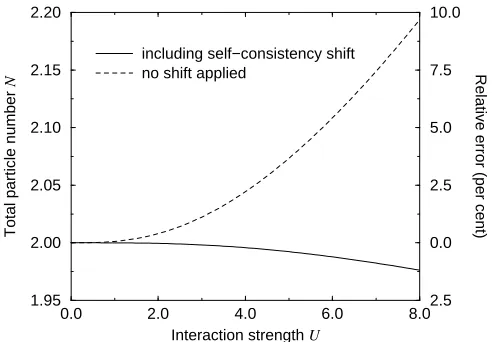
FIG. 1. Analytically calculated particle number in theGW
approximation for our two-electron model system as a func-tion of the interacfunc-tion strengthU. Applying a rigid shift to the zeroth order Green’s function such as to align its chem-ical potential self-consistently with that of theGW Green’s
function significantly reduces the violation of particle number conservation, but fails to remove it completely.
would have to be a constant with a value of two. In particular, it would also have to be independent of the interaction strength U, which so far we have not speci-fied, but an analysis of the expression (12) confirms that this is not the case. In Fig. 1 we show the calculated par-ticle number as a function ofU, both with and without applying the shift ˜ω in the zeroth order Green’s function. In either case the growing deviation from the true value asUincreases is clearly visible, evidence of a genuine and fundamental violation of particle number conservation in theGW approximation as usually applied. In absolute terms, however, we find that the discrepancy is much re-duced when the chemical potentials are aligned in the prescribed way, and that it depends only very weakly on the interaction strength up to high values of U. For a medium correlation of U = 4 the numerical deviation amounts to an underestimation of merely 0.21% of the true particle number.
A comparison of the weight factors ofGGW with those
of the exact Green’s function, calculated by numerical diagonalization of the Hamiltonian matrix, shows that in the absence of the self-consistency shift ˜ωthe main error inN stems from a serious overestimation of the satellite spectrum, while the weight of the quasiparticle peak at x1 deviates relatively little from the correct value up to high correlation strength. When the self-consistency shift is applied the satellites are also overestimated, although by a lesser amount. In this case, however, this is the result of a balanced weight transfer from the quasiparticle peaks that has little influence on the integrated spectral weight and yields a total particle number in much better agreement with the correct value.
SUMMARY
In summary, we have presented a two-electron model system for which the particle number from the Green’s function in theGWapproximation can be derived strictly analytically, without any additional inaccuracies that have previously beset numerical calculations. Through an analysis of this model system we have demonstrated that there is a genuine violation of particle number conservation in the GW approximation as it is usually applied, i.e., with the self-energy calculated non-self-consistently from a zeroth order Green’s function. How-ever, we also find that the numerical deviation from the exact particle number can be kept low even for an ex-tremely strong correlation by introducing a small degree of self-consistency in the form of a simple rigid shift of the zeroth order Green’s function on the energy axis in such a way as to align its chemical potential with that of theGW Green’s function, which is calculated from it through Dyson’s equation. While the effect of this shift on the quasiparticle band structure may be small, our re-sults clearly indicate its significance for the calculation of quantities such as the particle number and charge density that are derived through integration over the complete spectral function.
ACKNOWLEDGMENTS
The author wishes to thank R. W. Godby, M. M. Rieger, and T. J. Pollehn for useful discussions, and ac-knowledges financial support from the Deutscher Aka-demischer Austauschdienst under its HSP III scheme, the Studienstiftung des deutschen Volkes, the Gott-lieb Daimler- und Karl Benz-Stiftung, Pembroke College Cambridge, and the Engineering and Physical Sciences Research Council.
∗ Electronic address: [email protected]
1
L. Hedin, Phys. Rev.139, A796 (1965). 2
M. S. Hybertsen and S. G. Louie, Phys. Rev. Lett.55, 1418 (1985); Phys. Rev. B34, 5390 (1986).
3
R. W. Godby, M. Schl¨uter, and L. J. Sham, Phys. Rev. Lett.56, 2415 (1986); Phys. Rev. B35, 4170 (1987); 37, 10 159 (1988).
4
J. E. Northrup, M. S. Hybertsen, and S. G. Louie, Phys. Rev. Lett.59, 819 (1987); Phys. Rev. B39, 8198 (1989). 5
F. Aryasetiawan, Phys. Rev. B46, 13 051 (1992).
6
H. J. de Groot, P. A. Bobbert, and W. van Haeringen, Phys. Rev. B52, 11 000 (1995).
7
E. L. Shirley, Phys. Rev. B54, 7758 (1996).
8
U. von Barth and B. Holm, Phys. Rev. B54, 8411 (1996);
B. Holm and U. von Barth (unpublished).
9
G. Baym and L. P. Kadanoff, Phys. Rev.124, 287 (1961); G. Baym,ibid.127, 1391 (1962).
10
R. Moccia, R. Resta, and M. Zandomeneghi, Chem. Phys. Lett.37, 556 (1976).
11