Munich Personal RePEc Archive
The systemic dimension of operational
decision in complex systems work
Sampaio, José João
SOCIUS – Research Centre in Economic and Organizational
Sociology
15 October 2009
The Systemic Dimension of Operational Decision in
Complex Systems Work
José João Martins Sampaio SOCIUS – ISEG/UTL
http://pascal.iseg.utl.pt/~socius/socius/membros_uk.shtml
This paper refers to some of my research findings on Decision Making processes in complex systems work. Starting as a complex cognitive process strongly contextualized in the operating environment, it ends up, in complex systems work, as an equally complex network of actors and systems (human and technological) that are confronted, in real time, with uncertainty , a large amount of information and feedback and with multiple standards and operating procedures...
"The Society of the Future will be a cognitive society"
European Commission White Paper on Education and Training, 1997.
Although one can identify small differences in work organization, according to the specificity
of each operational context, complex systems work appear as open systems in continuous
evolution of the interactions that are established, at all levels and dimensions, among their
constituents and respective environments. Thus, Operational Decision shall not be considered
as the linear processing of information available in a given operational context (in a direct
recursion perspective) but, essentially, as the combination of that processing with its
environmental constraints1 and with the global systemic dynamics2, which are controlled by
rules and instructions (operational or of a strategic nature) that are responsible for maintaining
system stability.
1
Organization of airspace, operating characteristics of aircraft and systems navigation support, safety parameters, etc.
2
This reality requires a high capacity for managing the flow of information (direct or
retrospective) with the aim of reducing the uncertainty underlying the inherent complexity of
the system. But, the truth is that the ability to decide resides exclusively on the human element,
which, in its multiple dimensions, characteristics and potential, is assumed to be the most
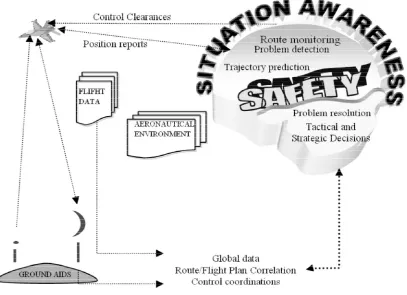
complex component (sub-system) of the whole process – See Fig.1.
For this reason, the operational decision can hardly be circumscribed by rules and procedures
resulting from a linear approach, and thus, ethologically reductive.
In a contingency perspective, the human element is assumed as an open individual subsystem,
which interacts in a transactional way, at multiple levels and dimensions, with the surrounding
[image:3.595.96.503.314.609.2]environment.
Figure 1 – Air Traffic Control. The Human element as an open Sub-System
Source: Sampaio, José João (2009)
Therefore, Operational Decision is not a unique event, well established in space and time, but it
represents the best answer (action scheme) to the mental stimulation provided by a specific
operational situation. Operational Decision thus results in a cognitive process in constant
evolution / adaptation, during which, through a set of interim evaluations, the operational
between the perceived operational context and the more plausible assumptions (mental model)
of what this perception may represent. So, there is some uncertainty, ambiguity and even
(in)credibility, for the data which underpins the process of decision making, maintaining that
feature throughout the whole process of knowledge / understanding of reality environment, ie
building operational situation awareness3.
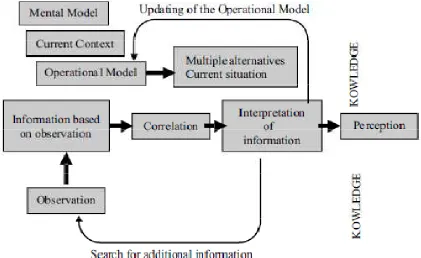
The result is an adaptation /update of the operational mental model4, through a set of actions appropriate to the perceived situation which are supported by schemes of action based on
accumulated experience – See Figure 2.
3
SITUATION AWARENESS – Situation awareness is a relatively recent concept that emerged during the 1980s, although it is a concept that is not easy to explain and for which there is no universally accepted definition. In the Eurocontrol study, Situation Awareness, Synthesys of Literature Search, Dominguez (1994) established a table containing diverse definitions of situation awareness as suggested by diverse authors, coming to the conclusion that there were common aspects to be considered. Dominguez goes on to define Situation Awareness as “...the continuous extraction of environmental information and the integration of this information with previous knowledge to form a coherent mental picture, and the use of that picture in directing further perception and anticipating future events” (Eurocontrol, 2000, p.4). Again according to the Eurocontrol study, Endsley (1995) considers that Situation Awareness is not limited to the mere perception of the information on the operational environment presented. It includes the comprehension of what that information means, in an integrated form, comparing it with the operator’s objectives and supplying indications on the future status of the environment, which are important for the decision making. The Eurocontrol Human Resources unit accordingly adopted a comprehensive and inclusive definition:
“Situation Awareness is the perception of the elements in the environment within a volume of time and space, the comprehension of their meaning and the projection of their status in the near future. This also means the continuous extraction of environmental information and the integration of this information with previous knowledge to form a coherent mental picture and the use of that picture in directing further perception and anticipating future events. Situation awareness is established by a continuous comparison between anticipation (predicted state of the system) and environmental input (actual state of the system)”, (Eurocontrol, 2000, § 2.4).
4
Figure 2 – Knowledge and Situation Awareness
Source : Adapted from Marsh, S. and al., 2001
The aviation sector is a good example of a complex system work, where the entire process of
operational decision-making evolves in real time and often at very short time intervals, leading
operators to develop very specific cognitive abilities, in order to obtain the most possible
efficacy of their operational performances.
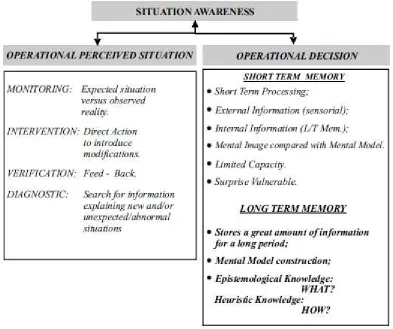
Research on air traffic controllers - ATCOs – decision making process, shows they maintain
active different plans of action, at working memory level, using long-term memory whenever the monitoring of the carried out planning shows a failure to meet the foreseen objectives – See
Fig.3.
Similarly, the ATCOs select only the most relevant information sources in a given operational
context, allowing them to maintain a dynamic ability to memorize and forget, thus rapidly
eliminating, from the cognitive process of operational decision making, all the information
already treated or deemed irrelevant.
This dynamic is also an important catalyst element in the real time operational decision making
process and is the reason why many ATCOs seek to work in a medium/high workload
environment, as to achieve a level of cognitive activity that allows them to maintain a degree of
CONSCIÊNCIA DA SITUAÇÃO
SITUAÇÃO OPERACIONAL PERCEBIDA DECISÃO OPERACIONAL
MONITORIZAÇÃO: Situação esperada versus realidade observada.
INTERVENÇÃO : Actuação directa para introduzir modificaçõ es.
VERIFICAÇÃO: Retro-Informação.
DIAGNÓSTICO: Busca de informação explicativa de situações novas e/ou inesperadas.
MEMÓRIA DE TRABALHO: •Process amento de curto prazo; •Informação ext erna (sensorial); •Informação interna (Mem. L/P); •Imagem Mental comparada com
Modelo mental. •Capacidade limitada; •Vulnerável a surpresas;
MEMÓRIA LONGO PRAZO
•Armazena grande quantidade de informação, durante um longo período;
•Construção Modelo Mental; •Conhecimento Epistemológico :
O QUÊ? •Conhecimento Heurístico :
[image:6.595.97.490.102.431.2]COMO?
Figure 3 – Situation Awareness and Operational Decision
Source: Sampaio, José João (2009)
Being a complex system work, the operating environment of commercial aviation, includes
different human agents (aircraft operators, flight crews, service providers, air traffic controllers,
etc...) and technology (terrestrial and airborne surveillance and safety systems, flight
management systems, flight data processing, etc..) that act as actors of a distributed cognition,
meaning that knowledge and cognition are not limited to the individual, but emerge as factors
essential to understanding the relationship between humans, machines and the environment in
which they interact. Our research applied to the air traffic control reality, (see Sampaio, José
João, 2009) shows clearly this systemic dimension, when 75% of the ATCOs state they can
perceive what other colleagues think, in general work situations, while 31% of them consider
that there is a comprehensive cognitive dimension of the whole working team, which
configures a scenario of enlarged operational situation awareness:
[...] Over time we learn to know how our colleagues work. But, this does not mean
that we all function the same way. What happens is that we know each other and
know each one operates [...] So, to know what is going on each other’s head is a
On the other hand, developments in operational contexts, allow us to conclude for the existence
of a trend towards gradual disappearance of some existing operational decisions, either by
planned anticipation of the work processes, or by its breakdown into a set of automated tasks.
The self concept of operational decision will then need to be reviewed, as it is now departing
from its individual and individualistic nature, as a process primarily focused on the individual
and on the working post, to assume a systemic cognitive perspective that integrates all the actors
involved, independently of their human or technological nature.
Therefore, the greater the degree of technology/automation of the operating environments, the
more evident is the need for operator's mental model to integrate the structural and functional
characteristics of human and technological agents. The new paradigm requires thus the study of
work organizing strategies, supported on the evolution from a structure founded on the
one-dimensional relationship – Working post / Qualification / Systems Operator – to a systemic
complexity - Individual / Competence / Systems Manager - where the human and the
technological dimensions emerge concurrently through professional competencies, as
determinant to the understanding and development of the work processes.
In fact, far goes the time where the work environment was confined to a one-dimensional,
discrete and specialized working post. In complex systems work, each action is a cause and
effect of other actions/processes either upstream or downstream in/of the production process in
which they operate. Operational decision thus results of a new framework of human agents, as
part of a functional network, where the search for operational balances requires a holistic
approach to work processes as well as the development of new professional competencies
enabling the interaction between all actors involved.
In this new systemic order, although each one is responsible for deciding at their own action
level, the truth is that the final result depends on each one’s comprehension of the overall
Far goes the time where the work environment was confined to a one-dimensional, discrete and specialized working post.
References:
Cañas, José J. et al., (1995), Mental Models And Working Memory, Spain, Universidad De Granada, Facultad De Psicología, Departamento De Psicología Experimental.
Dominguez, C. Et al., (1994), Situational Awareness: Papers And Annotated Bibliography, Interim Report AL/CF-TR-1994-0085, Armstrong Laboratory, Air Force Materiel Command, Wright-Patterson Air Force Base, OH.
Endsley, Mica e Georgia, Mariett (2000) , “Situation Models: An Avenue To The Modeling Of Mental Models”, Proceedings 14th Trienniel Congress Of The International Ergonomics Association And The 44th Annual Meeting Of The Human Factors And Ergonomics Society.
Endsley, Mica (1995), “Toward A Theory of Situation Awareness in Dynamic Systems”, Human Factors, (37, 1), pp.32-64.
Eurocontrol (2000), Situation Awareness Synthesys Of Literature Search, Bretigny, ECC Note 16/00 Project Asa – 2- Ec.
Marsh, S. Et al., “Tactical Decision Making: The Interaction Of Human Perception And Judgment With Automated Information Processing And Presentation – Situational awareness and Presentation” in Crovella (2002), Tactical Decision Aids And Situational Awareness, Neully-Sur-Seine, RTO-EN-019, AC/323(SCI-113) TP/41.
Rouse, W. e Morris, N. (1985), On Looking Into The Black Box: Prospects And Limits In The Search For Mental Models, DTIC # AD-A159080, Atlanta, GA: Center For Man-Machine Systems Research, Georgia Institute Of Technology.