Guided Weapon Safety Template Generation – A
Probabilistic Approach
Duncan Fletcher
DSTO Weapons Systems Division, Adelaide
[email protected]
Shaun Wilson
Aerospace Concepts Pty Ltd, Canberra
[email protected]
Michael Jokic
DSTO Weapons Systems Division, Adelaide
[email protected]
Ivan Vuletich
Aerospace Concepts Pty Ltd, Sydney
[email protected]
ABSTRACT
In this paper, we outline an approach for the generation of guided
weapon safety templates via probabilistic means. This approach
involves the calculation of a ground impact distribution database for
each weapon via Monte Carlo simulations performed on a ‘farm’ of
computers. A safety template specific to a user-defined firing envelope
is then generated. The template is a probability density function of the
ground impacts for the specified firing parameters. We are currently
building a two-part system to provide this capability to the Australian
Department of Defence for weapon test and evaluation purposes. The
first part is a data preparation process that weapon experts can use to
produce the weapon-specific ground impact distribution databases. The
second part of the system is a software tool intended for operational
users and range managers. This tool references the weapon database
to generate a safety template for a specific firing envelope. We intend
that the system be accepted for general use by the Department of
Defence; hence, we are building it in accordance with departmental
quality assurance requirements for complex aerospace systems.
KEYWORDS
1. INTRODUCTION
A range safety template is an important method for the assessment of risk associated with weapon launches. The template can take a number of forms, including:
• A curve representing an area where the weapon might land with a specific probability
• A contour plot representing different regions of ground impact probabilities.
These plots are overlayed on maps of the intended launch area and used to assess if there is a high risk of the launch affecting the safety of people and/or equipment. The results of the risk assessment can lead to the conditions of the launch being changed. For example, if the curve representing an impact area with a probability of 1×10⁻⁶ lies outside the firing range boundary the launch might be planned for a lower altitude or a different location.
Various organisations within the Australian Department of Defence have produced and used range safety templates over many years. However, there is no broadly-accepted methodology to generate the templates. Each weapon has been dealt with on an ad hoc basis by the organisation with responsibility for developing and/or authorising templates for that particular weapon. In response, DSTO’s Weapons Systems Division has proposed a generic Range Safety Template Toolkit (RSTT).
The initial RSTT will be a functional prototype designed both to generate safety templates for the ASRAAM air-to-air missile within a limited firing envelope, and to serve as a risk reduction exercise for the full RSTT, which will be capable of broad use.
Our main justifications for development of the ‘full’ Range Safety Template Toolkit are as follows:
• A need exists to generate probabilistic range safety templates for ASRAAM.
• The current approach to template development and approval is ad hoc; there is no ‘system’ as such.
• There is not adequate support for longer-range weapons, particularly for future ground-based air defence and, possibly, ballistic missile defence applications.
The information used to generate templates supplied with weapon systems purchased from foreign countries may be partially or completely restricted. This can hinder the certification of the templates for use by the Australian Department of Defence. In addition, we can rarely modify the supplied template for Australia’s needs. If limited data is available on a particular weapon the local generation of a safety template might not be possible. In this situation the Australian Department of Defence can prescribe the methodologies of the RSTT as the required standard. This will ensure that all Departmental legal and technical requirements are met by the organisation supplying the weapon and safety template. One of the elements of the RSTT will therefore be a data item description for use with the Australian Department of Defence’s standard acquisition contracting template. A weapon manufacturer will be required to:
• Enable the Australian Department of Defence to generate a template from raw data about the weapon, or
2. RANGE SAFETY REQUIREMENTS
We derived a number of RSTT requirements by canvassing all elements of Defence with potential interest in range safety. The following sections summarize the requirements of the evolving RSTT. (Aerospace Concepts 2005a)
2.1 Air Weapon Types
The RSTT must provide safety templates and associated outputs for ‘legacy’ air weapons, weapons under procurement and future air weapon developments/acquisitions.
The RSTT could also be used for unguided weapons, such as iron bombs, if necessary since an unguided weapon is analogous to a guided weapon.
Additionally, the RSTT could support foreign and commercial use of the AOSG-managed Woomera range. The processes and techniques developed for the RSTT will potentially meet the requirements of a number of aerodyne systems and commercial applications. Space vehicle launch and re-entry are examples that could take advantage of the RSTT with minimal changes.
2.2 Weapon Lifecycle
The RSTT must support the testing of air weapons in all stages of the lifecycle from experimental/conceptual development through to in-service exercises and to life-of-type extension validation.
2.3 Users and Usage
The following are potential users of, and uses for, the RSTT:
• Operational staff (aircrew and ship’s crew) to support trials planning and other operationally-focused activities.
• Technical staff to support analysis, flight trials, and the development of operating procedures and similar.
• Capability development staff to support development of capability requirements; for example, whether or not a given weapon needs a flight termination system based on likely operating areas.
2.4 Useability
All identified classes of user must be able to use the RSTT. Furthermore, the information generated by the RSTT should be easily understandable by operational and technical staff and relevant outside parties; for example, legal advisers and public officials.
The RSTT must provide ‘quick look’ results to aid rapid assessment of options for operational planning and also provide more detailed results to support technical assessments and similar activities.
2.5 Policy
The RSTT must conform to applicable Australian Department of Defence policy.
The list of policy documents (and their impact on the Range Safety Template Toolkit) must continue to be updated throughout the project to ensure that policy requirements have been properly captured.
2.6 Economy
The Range Safety Template Toolkit should only demand as much user input, and consume as much computational resource, as is necessary to satisfy the particular safety template generation requirement being addressed. For example, one of the most obvious and conservative ways to obtain a safety template is to compute the Maximum Energy Boundary (MEB), which is the theoretical maximum distance a missile can fly after launch. Hence, the first step in using the RSTT process should be the calculation of an MEB:
• If the MEB falls within the range boundary (assuming that a bounded range is the firing location in all directions), then no further assessment is necessary.
• If, however, the MEB falls outside the range boundary, then a probabilistic approach should be employed to calculate a smaller range boundary that is within specified safety limits.
2.7 Confidence
The RSTT must be able to produce safety templates and associated outputs in which there is a sufficient degree of confidence to support safety-of-life safety case decisions defensible in a court of law.
This need assumes, of course, that there is sufficient information about a given weapon and employment scenario with which to calculate high-confidence safety templates and associated outputs.
Consequently, the RSTT must be able to provide some indication of the level of confidence in calculated safety templates and associated outputs as a function of quality or completeness of inputted information.
2.8 Assurance
The apparent need for a ‘legal standard’ of confidence in the results implies that the RSTT may need to meet yet-to-be-specified assurance requirements to ensure that the:
• Mathematical theory upon which the range safety templates are generated is valid (correct design),
• Implementation of this mathematical theory into processes and software is correct (correct build),
• Generated weapon data-set accurately represents weapon behaviour (correct model),
• Correct weapon data set is used to generate templates (correct weapon), and
These assurance requirements may, in turn, affect the RSTT development process by, for example, demanding that development be done in accordance with a particular software development standard or that specific verification and validation techniques be employed.
Service-specific assurance regimes also need to be accommodated.
2.9 Robustness
A full set of template-related weapon information is not always available. This is because of the varied nature of the weapons to be supported by the RSTT and the need to support testing of air weapons in all stages of the lifecycle:
• In-service weapons. Obtaining template-related information for in service weapons is often problematic. The reason for this is that a major motivation for supplying detailed technical information (the promise of a major acquisition contract) is lacking and there may be no residual contractual right to the required information.
• To-be-acquired weapons. Template-related information for to-be-acquired weapons is usually obtained from the Original Equipment Manufacturer via the contracting process. This means that there is a reasonable likelihood that sufficient template-related data can be obtained as necessary.
• Experimental and developmental weapons. For those that are not mature enough to have undergone detailed engineering analysis, such as FMECA, template-related information may not exist.
Consequently, the RSTT must be able to calculate safety templates in the absence of full weapon technical information, albeit with a potentially-degraded level of confidence in the templates and associated outputs.
2.10 Traceability
The RSTT should provide insight into the effect of air weapon failure modes, or design features, on range safety; for example:
• ‘The reason the maximum energy bubble transgresses a particular range boundary is due to a guidance system failure at 10 seconds into the flight.’
• ‘The reason that debris lands within 500m of the road is that the weapon was at 1500ft when an engine failure occurred 15 seconds after launch.’
The RSTT tool should, as far as is practicable, provide traceability right from initial failure modes and flight paths through to effects on the ground.
2.11 Geographical Situation
The RSTT must be useable for activities contained entirely within land and sea test ranges and, for those weapons that demand it, for activities conducted beyond established range boundaries.
• ‘The maximum energy bubble shall not be within 500m of the range boundary.’
• ‘The probability of any debris impacting within 500m of any road or railway shall be less than 10-5.’
• ‘The maximum individual risk to any member of the general public shall be less than 10-7.’
The Range Safety Template Toolkit must be flexible enough to accommodate range safety requirements arising during use rather than prescribing them all during RSTT development.
Finally, consideration should be given to having the RSTT produce three-dimensional templates as an aid to airspace management.
3. THE FUNCTIONAL PROTOTYPE
3.1 System Concept
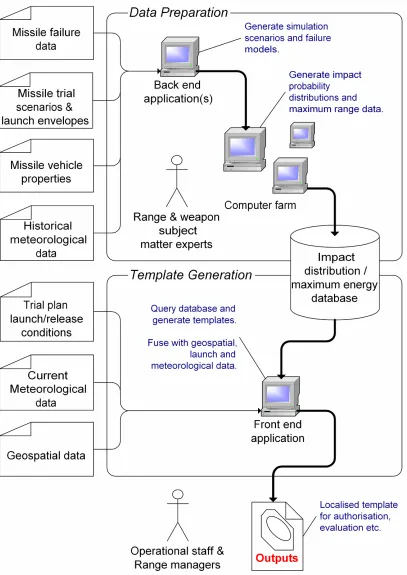
Our Range Safety Template Toolkit consists of two sub-systems linked by an impact distribution/maximum energy database as shown in Figure 1.
The data preparation sub-system is used by subject matter experts to produce the weapon-specific impact distribution/maximum energy databases. We prepare data through simulations, weapon-specific information and statistical analysis. Both maximum energy and probabilistic methodologies will be supported.
The template generation sub-system is a user-friendly software tool that produces a template from a user’s flight envelope selections. We plan to create the templates through careful application of selection, mixing and plotting algorithms to the impact distribution/maximum energy databases. The front-end tool will be integrated with a Geospatial Information System (GIS) to allow the templates to be compared with range boundaries, allow for calculation of expected casualty estimates and so on.
3.2 Probabilistic Templates
Figure 1: Schematic of the Range Safety Template Toolkit.
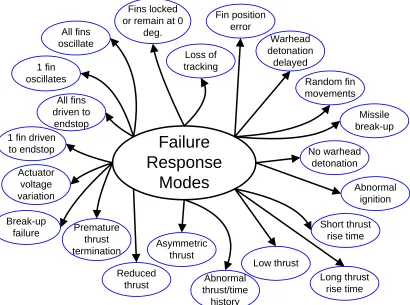
assembly can all cause the fins to drive to their endstops. This is a case of three failure modes giving rise to one FRM. Figure 2 shows some potential FRMs. Systematic failures, such as software and guidance failures, are included if they can be accurately described and assigned probabilities of occurrence. If failures of this type cannot be quantified, the MEB must be considered.
Failure
Response
Modes
Loss of tracking Warhead detonation delayed Random fin movements No warhead detonation Abnormal ignition Short thrust rise time Asymmetric thrust Reduced thrust Premature thrust termination Long thrust rise time Break-up failure Missile break-up All fins oscillate Fins locked or remain at 0deg. 1 fin oscillates All fins driven to endstop 1 fin driven
[image:8.595.104.514.135.440.2]to endstop Actuator voltage variation Fin position error Abnormal thrust/time history Low thrust
Figure 2: Possible Failure Response Modes for guided weapons.
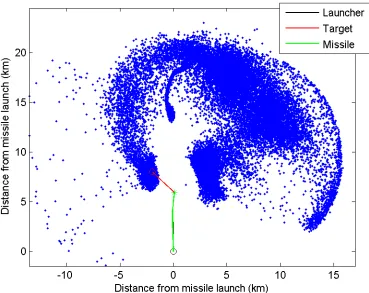
Figure 3: 50000 ground-impact locations for a fictitious guided weapon with fins locking to zero degree deflection at random times.
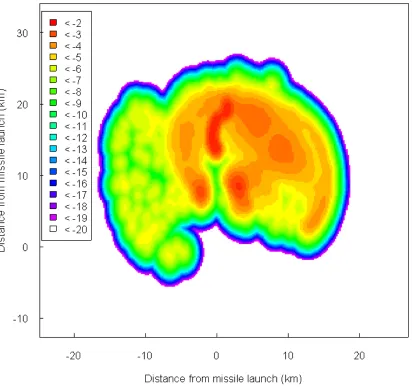
We have selected a Kernel Density Estimation technique (Silverman 1982, 1986) to create a smooth two-dimensional Probability Density Function (PDF) for each scenario/failure combination. Figure 4 shows an example PDF derived from the scenario represented in Figure 3.
Combining the PDFs for each FRM, given the probability of occurrence extracted from the failure analysis, is quite straightforward. The problem is that this produces a template valid only for a point in the operational envelope of the weapon. In an air-to-air engagement for example, even a test pilot would be hard pressed to take the shot when travelling at exactly 210 knots with the target exactly 5.3 nautical miles away. So the final template must be valid for a user-selected region of the envelope. We achieve this by establishing the PDFs at the corners and other critical points of the envelope, and then using conservative interpolation techniques to cover the variable space.
Figure 4: Probability Density Function (log10 scale) for a fictitious guided weapon with fins locking to zero degree deflection at random times.
We have yet to determine the appropriate balance between how much of the analysis and calculation should be performed in the data preparation system or on-demand in the end-user software tool.
3.3 Implementation Considerations
We currently envisage the RSTT as a stand alone system that will not be integrated with other hardware and/or software systems. There will not be any direct ‘feeds’ into or out of weapon computers or mission planning systems. The RSTT front-end software is expected to run on standard Defence computing infrastructure.
Our RSTT requires data from a number of sources/agencies external to the RSTT system. These include:
• Meteorological data
o Required for trial planning
• Air-weapon technical data
o Required for template generation
o Must be certified by weapon manufacturers
• Trial scenario data
o Required for trial planning
o Must be authorised by operations unit commanders
• Geospatial data
o Required for trial planning
o Must be authorised by range authorities
4. RANGE SAFETY ASSURANCE
A major issue in providing advice to the acceptance authority (who will authorise the system’s output for operational use) is ensuring that all facets of the RSTT system are correct. For example, if the process by which the template is generated is flawed (i.e. the input data is incorrect, the software malfunctions or the user misinterprets the output) then safety will likely be compromised.
In reviewing Defence’s guidance on the authorisation of range safety templates, we found AOSG’s Standing Instruction (Operations) 4-34 – Authorisation Of Weapon Safety Templates (Aerospace Operational Support Group) most useful. This instruction directs that the process of review of weapon safety templates be based on the Air Force design acceptance process defined in Australian Air Publication 7001.053 – Technical Airworthiness Management Manual (Australian Defence Force 2005):
• Specification of requirement. Ensure the definition of the launch conditions and the requirements of the Weapon Safety Template are complete and acceptable.
• Determination of competence. Verify the competence of the organisation developing the Weapon Safety Template.
• Verification of requirement satisfaction. Verify that the Weapon Safety Template is acceptable to the Commonwealth.
• Certification of requirement satisfaction. Certification by the organisation that the Weapon Safety Template satisfies the requirements of the launch conditions.
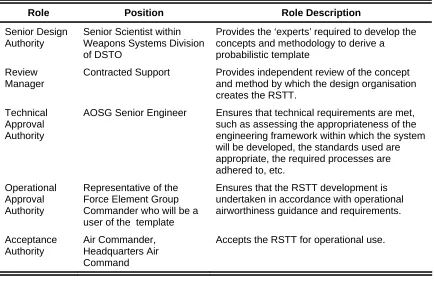
Using the current framework, a network of personnel from a variety of Defence areas will be used to develop and review the template generating tools. For the functional prototype, Table 1 provides an overview of the personnel selected (and their role) in the RSTT development.
5. CONCLUSIONS
processes and methodologies of the proposed system. For the Australian Department of Defence, the Range Safety Template Toolkit will be a valuable asset for the assessment and safe testing of existing and future weapon systems.
Table 1: Development assurance roles. (Aerospace Concepts 2005b)
Role Position Role Description
Senior Design Authority
Senior Scientist within Weapons Systems Division of DSTO
Provides the ‘experts’ required to develop the concepts and methodology to derive a probabilistic template
Review Manager
Contracted Support Provides independent review of the concept and method by which the design organisation creates the RSTT.
Technical Approval Authority
AOSG Senior Engineer Ensures that technical requirements are met, such as assessing the appropriateness of the engineering framework within which the system will be developed, the standards used are appropriate, the required processes are adhered to, etc.
Operational Approval Authority
Representative of the Force Element Group Commander who will be a user of the template
Ensures that the RSTT development is undertaken in accordance with operational airworthiness guidance and requirements.
Acceptance Authority
Air Commander, Headquarters Air Command
Accepts the RSTT for operational use.
6. REFERENCES
Aerospace Concepts 2005a, Range Safety Template Tool Development Project Plan, Aerospace Concepts Pty Ltd.
Aerospace Concepts 2005b, Notes from System Assurance Workshop, Aerospace Concepts Pty Ltd, DSTO Edinburgh.
Aerospace Operational Support Group Standing Instruction (Operations) 4-34, Authorisation of Weapon Safety Templates, AOSG.
Australian Defence Force 2005, Australian Air Publication 7001.053, Technical Airworthiness Management Manual, ADF.
Silverman, BW 1982, 'Kernel Density Estimation using the Fast Fourier Transform', Applied Statistics, vol. 31, pp. 93-9.