Solving High Order Ordinary Differential
Equations with Radial Basis Function Networks
N. Mai-Duy
∗School of Aerospace, Mechanical and Mechatronic Engineering,
The University of Sydney, NSW 2006, Australia
Submitted to
Int. J. Numer. Meth. Engng, January 2004; revised
July 2004
SUMMARY
This paper is concerned with the application of radial basis function networks
(RBFNs) for numerical solution of high order ordinary differential equations (ODEs).
Two unsymmetric RBF collocation schemes, namely the usual direct approach based
on a differentiation process and the proposed indirect approach based on an
inte-gration process, are developed to solve high order ODEs directly and the latter is
found to be considerably superior to the former. Good accuracy and high rate of
convergence are obtained with the proposed indirect method.
KEYWORDS: RBFNs; approximation; high order; derivatives; ordinary differential
1
INTRODUCTION
The mathematical modelling of many problems in science and engineering leads to
ordinary differential equations (ODEs). Depending upon the form of the boundary
conditions to be satisfied by solution, problems involving ODEs can be divided into
two main categories, namely initial value problems (boundary conditions prescribed
at one end of the domain of analysis) and boundary value problems (boundary
conditions prescribed at both ends of the domain of analysis). Analytic solutions
for these problems are not generally available and hence numerical methods must
be resorted to. The traditional numerical methods (Dahlquist et al [1] and Press
et al [2]) consist of two stages. At the first stage, new variables are introduced to
transform the governing high order ODEs into coupled sets of first order differential
equations. At the second stage, the domain of interest is divided into a number of
intervals over which the equivalent first order systems obtained from the first stage
are integrated for a numerical solution.
For initial value problems, considering an ith interval with two extreme pointsx(i)
and x(i+1). The solution is assumed to be known at x(i) and the solution at x(i+1)
is then found by integrating the governing ODEs over the interval i. Note that the
solution atx(i) is taken using an initial solution ifi= 1 or the solution at the second
end-point of the immediately preceding interval (i−1) ifi >1. Errors can thus tend
to accumulate and cause the solution to recede from the exact solution. Depending
on the way of integrating ODEs over finite intervals, there are different numerical
methods available in literature, for example, the Euler’s method, the Runge-Kutta
method and the Bulirsch-Stoer method (Dahlquist et al [1] and Press et al [2]).
For boundary value problems, which are generally more difficult than initial value
problems, two methods, namely the shooting method and the relaxation method,
values is introduced at the starting point to convert the boundary value problem into
the initial value problem, from which the initial value methods can be applied. In
addition, the Newton-Raphson technique is employed to compute those unspecified
initial values by satisfying the boundary conditions at the other boundary point. In
the relaxation method, first order ODEs are replaced by finite difference equations
on a mesh of points that covers the range of integration, which yield the system of
algebraic equations. Further details can be found in many textbooks (e.g. Dahlquist
et al [1] and Press et al [2]).
The transformation of the governing high order ODEs into coupled sets of first order
ODEs can result in relatively large requirements for memory and computation. On
the other hand, it is possible to develop other numerical methods capable of solving
high order ODEs directly in an effective and efficient manner. In this regard, many
attempts based on high order approximation schemes were made (e.g. Viecelli [3];
Sallam and El-Hawary [4]; Esmail et al [5]; Gutierrez and Laura [6]; Wu and Liu
[7,8,9]). For example, the Cauchy problems governed by second order and fourth
or-der equations were solved successfully using deficient spline function approximations
by Sallam and El-Hawary [4] and Esmail et al [5] respectively. Recently, the
differen-tial quadrature (DQ) method (Bellman and Casti [10]) was developed to solve fourth,
sixth and eighth order ODEs without using theδ-point technique for the treatment
of multiple boundary conditions in the papers of Wu and Liu [8,7,9] respectively.
Note that the construction of a finite difference or finite element approximation (i.e.
low order methods) to high order ODEs is not a trivial task (Viecelli [3]; Wood
and Morton [11]). This paper presents alternative high order methods based on
radial basis function networks (RBFNs) for solving ODEs directly. In the proposed
method, the well-known difficulties in dealing with multiple boundary conditions
are naturally overcome via a means of the integration process associated with the
The concept of solving DEs by using RBFNs was first introduced by Kansa [12].
Since then, it has received a great deal of attention from researchers. As a result,
many further interesting developments and applications have been reported (e.g.
Sharan et al [13]; Zerroukat et al [14]; Mai-Duy and Tran-Cong [15,16]; Fedoseyev
et al [17]). Essentially, in a typical RBF collocation method, each variable and
its derivatives are all expressed as weighted linear combinations of basis functions,
where the sets of network weights are identical. These closed form representations
are substituted into the governing equations as well as boundary conditions, and the
point collocation technique is then employed to discretize the system. If all basis
functions in networks are available in analytic forms, the RBF collocation methods
can be regarded as truly meshless methods. There are two basic approaches for
obtaining new basis functions from RBFs, namely the direct approach (DRBF)
based on a differential process (Kansa [12]) and the indirect approach (IRBF) based
on an integration process (Mai-Duy and Tran-Cong [15,18]). Both approaches were
tested on the solution of second order DEs and the indirect approach was found to
be superior to the direct approach (Mai-Duy and Tran-Cong [15]). In this paper,
they are further developed for solving high order ODEs without prior conversion into
the equivalent systems of first order ODEs. In contrast to the traditional methods,
the domain of analysis in the present procedures using multiquadrics is discretized
into a number of distinct points (instead of a number of intervals) since there are
no intervals required for both processes: integration of ODEs and interpolation of
the field variable (see Jin, Li and Aluru [19], Atluri and Shen [20], Li and Liu
[21] and Liu [22] for an overview on meshless methods). It should be emphasized
that the integration process here is employed only for the purpose of deriving new
basis functions from RBFs. The case of using the integration formulations
(weak-form/inverse statement) with the direct RBF interpolation schemes can be found
in, for example, Liu and Gu [23], Wang and Liu [24,25], Wang et al [26], Gu and
gives accurate results using relatively low numbers of data points.
The paper is organized as follows. In section 2, the direct and indirect RBFN
approaches for the approximation of high order derivatives are presented. Analytic
and numerical techniques for obtaining new basis functions from RBFs are discussed
in Section 3. Section 4 is to demonstrate the workings of the RBF collocation
methods in the solution of high order ODEs. The present methods are then verified
through a number of numerical examples in section 5, which are first carried out for
the approximation of derivative functions and then for boundary value, eigenvalue
and initial value problems governed by fourth, sixth and eighth order ODEs. Section
6 gives some concluding remarks. In the appendix, the analytic form of new basis
functions used in the direct and indirect approaches is given.
2
RADIAL BASIS FUNCTION NETWORKS
An 1D function y(x) to be interpolated or approximated can be represented by an
RBF network as follows (Haykin [29])
y(x)≈f(x) = m
i=1
w(i)g(i)(x), (1)
where x is the input, m is the number of radial basis functions (neurons), {g(i)}mi=1
is the set of RBFs and {w(i)}mi=1 is the set of network weights to be found. Two
radial basis functions of particular interest in the present study are
1. Multiquadrics (MQ)
g(i)(x) =
2. Gaussian functions
g(i)(x) = exp
−(x−c(i))2
a(i)2
, (3)
where {c(i)}mi=1 is the set of RBF centres and {a(i)}mi=1 is the set of RBF widths.
In order to keep the design of RBFN simple (i.e. using only linear algebra), the
centres and widths of the radial basis functions in the network (1) need be chosen in
advance. In general the performance of RBFNs critically depend on these choices.
Small or large values of the RBF width make the response of a neuron too peaked or
too flat respectively and therefore should be avoided (Haykin [29]). In the present
study, the width of the ith RBF is determined according to the following simple
relation
a(i) =βd(i), (4)
where β is a factor, β > 0, and d(i) is the distance from the ith centre to the
nearest centre. This relation (4) allows the RBF width a to be broader in the area
of lower data density. By providing a set of the input {x(j)}n
j=1 where n is the
number of collocation points and the corresponding desired output set{y(j)}n
j=1, the
set of network weights {w(i)}m
i=1 can be found using the general linear least square
methods.
2.1
Direct approach (DRBFN)
In the direct method, the closed form RBFN approximating function (1) is first
obtained from a set of training points, and its derivative of any order, e.g. pth
order, can then be calculated in a straightforward manner by differentiating such a
closed form RBFN as follows
dpf(x)
dxp =
dp dxp
m
i=1
w(i)g(i)(x)
= m
i=1 w(i)
dpg(i)(x) dxp
= m
i=1
whereh([pi)] denotes thepth order derivative of the radial basis function g. Once the
set of network weights in (1) is obtained, the derivative (5) at any point is easily
computed provided that new basis functions {h([pi)]}m
i=1 are given in analytic forms.
Since the direct approach is based on a differentiation process, all derivatives
ob-tained here are very sensitive to noise arising from the interpolation of RBFNs from
a set of discrete data points. Any noise here, even at the small level, will be badly
magnified with an increase in the order of derivative. In contrast, the integration
process, where each integral represents the area under the corresponding curve, is
much less sensitive to noise. Based on this observation, it is expected that through
the integration process, the approximating functions are much smoother and
there-fore have higher approximation power.
2.2
Indirect approach (IRBFN)
In the indirect method, the formulation of the problem starts with the
decomposi-tion of the highest order derivative under consideradecomposi-tion into RBFs. The derivative
expression obtained is then integrated to yield expressions for lower order derivatives
and finally for the original function itself. The expression of the original function
is employed in the general linear least square formulation for the unknown weights
under consideration, a part of the process above can be summarized as follows
dpf(x)
dxp =
m
i=1
w(i)g(i)(x), (6)
dp−1f(x)
dxp−1 =
m
i=1
w(i)g(i)(x)dx+c1 = m
i=1 w(i)
g(i)(x)dx+c1 = m
i=1
w(i)H[(pi)−1]+c1
= m+1
i=1
w(i)H[(pi)−1], (7)
dp−2f(x)
dxp−2 =
m
i=1 w(i)
H[(pi)−1]dx+c1x+c2 = m
i=1
w(i)H[(pi−)2]+c1x+c2
= m+2
i=1
w(i)H[(pi)−2], (8)
...
df(x)
dx =
m
i=1 w(i)
H[2](i)dx+c1 x p−2
(p−2)!+c2 xp−3
(p−3)!+· · ·+cp−2x+cp−1
=
m+p−1 i=1
w(i)H[1](i), (9)
f(x) = m
i=1 w(i)
H[1](i)dx+c1 x p−1
(p−1)!+c2 xp−2
(p−2)!+· · ·+cp−1x+cp
= m+p
i=1
w(i)H[0](i), (10)
where {H[(.i])}m
i=1 are new basis functions obtained from integrating the radial basis
function g. For convenience, integration constants which are unknowns here and
their associated known basis functions (polynomial) on right hand sides in (6)-(10)
are also denoted by the notationsw(i) and H[(.i]) respectively but with i > m.
For 2D or 3D problems, the integration constants ci become functions and can be
approximated by IRBFNs. The detailed implementation was reported previously in
3
BASIS FUNCTIONS
In an RBF collocation method, the original function and its derivatives are all
ex-pressed as linear combinations of basis functions, which are associated with the
same set of network weights. In most cases, e.g. the direct approach with
multi-quadrics/Gaussian functions and the indirect approach with multiquadrics,
expres-sions for new basis functions can be found analytically as shown in the appendix,
which yield truly meshless methods. However, in some cases, analytic expressions
are not available. For example, explicit integrals of Gaussian functions in (6)-(10)
of the indirect approach can not be found and hence numerical integrations must be
resorted to. The remainder of this section provides a numerical integration scheme
for the purpose of obtaining these new basis functions. Let t be the variable, then
the approximate function f together with its derivatives are expressed in terms of
basis functions as
dpf(t)
dtp =
m
i=1
w(i)g(i)(t), (11)
dp−1f(x) dtp−1 −
dp−1f(a)
dtp−1 =
m
i=1 w(i)
x
a
g(i)(t)dt, (12)
dp−2f(x) dtp−2 −
dp−2f(a)
dtp−2 =
m
i=1 w(i)
x
a dt2
t2
a
g(i)(t)dt, (13)
. . . .
df(x)
dt −
df(a)
dt =
m
i=1 w(i)
x
a
dtp−1. . .
t3
a dt2
t2
a
g(t)dt, (14)
f(x)−f(a) = m
i=1 w(i)
x
a dtp
tp
a
dtk−1. . .
t3
a dt2
t2
a
g(t)dt, (15)
where a and x are two reference collocation points. Fortunately, integrals on right
hand sides over the finite interval betweenaandxcan be reduced to one dimensional
e.g.
x
a dtk
tk
a
dtk−1. . .
t3
a dt2
t2
a
g(t)dt= (x−a) k
(k−1)!
1
0
tk−1g(x−(x−a)t)dt. (16)
for which Gaussian quadrature can now be applied. Some background mesh is thus
necessary for the indirect approach with the use of Gaussian functions.
4
NUMERICAL SOLUTION OF ODES
In the case of traditional numerical methods, it is known that the boundary value
problems can require considerably more effort to solve than the initial value
prob-lems. However, in the present case, the unsymmetric RBF collocation methods work
in a similar fashion for both problems and they are quite simple as illustrated here
on the initial-value problem governed by the following pth order ODE
y[p]=F(x, y, y, . . . , y[p−1]) (17)
with initial conditions
y(a) =α1, y(a) =α2, . . . , y[p−1](a) = αp, (18)
where a ≤ x ≤ b, y[i](x) = diy(x)
dxi , F is a known function and {αi}
p
i=1 is a set of
prescribed conditions. In solving (17)-(18), for both direct and indirect approaches,
the interior collocation points are enforced to satisfy the governing ODEs while
the boundary collocation points are employed to satisfy not only the boundary
errors n j=1 m i=1
w(i)h[(pi)](x(j))−F
x(j), m
i=1
w(i)g(i)(x(j)), m
i=1
w(i)h([1]i)(x(j)), . . . , m
i=1
w(i)h[(pi)−1](x(j))
2
+ m
i=1
w(i)g(i)(a)−α1
2
+ m
i=1
w(i)h([1]i)(a)−α2
2
+. . .+ m
i=1
w(i)h[(pi)−1](a)−αp
2
→0
(19)
for the direct approach and
n j=1 m i=1
w(i)g(i)(x(j))−F
x(j), m+p
i=1
w(i)H[0](i)(x(j)), m+p−1
i=1
w(i)H[1](i)(x(j)), . . . , m+1
i=1
w(i)H[(pi)−1](x(j))
2
+ m+p
i=1
w(i)H[0](i)(a)−α1
2
+
m+p−1 i=1
w(i)H[1](i)(a)−α2
2
+. . .+ m+1
i=1
w(i)H[(pi−)1](a)−αp
2
→0
(20)
for the indirect approach, in which m is the number of centres (RBFs) and n is
the number of collocation points. From a neural network approximation point of
view, the system of equations obtained directly from (19) or (20) can be square or
non-square depending on the number of centres m and the number of collocation
pointsn to be used. The former decides the number of columns of the design matrix
while the latter determines the number of rows. In the field of numerical solution of
differential equations, the set of collocation points is widely chosen to be the same
as the set of centres. As a result, the obtained system is overdetermined for the
direct approach, even for the case that the governing ODE (17) is applied to the
interior collocation points only (not to the boundary collocation points as stated
above). However, for the indirect approach, owing to the appearance of integration
constants whose number is equal to the order of ODE, the system obtained is always
determined, irrespective of the order of ODE. This is a clear advantage of the indirect
approach over the direct approach in the treatment of multiple boundary conditions.
some special techniques are normally required. For example, in the DQ method (e.g.
Gutierrez and Laura [6]), some points adjacent to the boundaries are introduced
and enforced to act as boundary points (δ−point technique) or in the Generalized
Differential Quadrature Rule (GDQR) (e.g. Wu and Liu [7,8,9]), the derivatives at
boundary points are also regarded as independent variables.
After solving (19) by the general least squares or (20) by Gaussian elimination, the
set of network weights is obtained and hence the dependent variable together with
its derivatives at any point will be computed easily.
There are some reasons that multiquadrics (MQ) are recommended for practical use.
Firstly, the MQ function yields greater accuracy than other RBFs in approximating
a smooth input-output mapping (Haykin [29]). Secondly, it has exponential
conver-gence with the refinement of spatial discretization (Madych and Nelson, [31,32]) and
thirdly, for the indirect approach, the need for the element-based discretization of
the domain is completely eliminated here (truly meshless method). In the remainder
of this paper, for both unsymmetric direct and indirect collocation approaches, only
multiquadrics are considered.
5
NUMERICAL EXAMPLES
In the following examples, the set of collocation points is chosen to be the same
as the set of centres, i.e. {c(i)}m
i=1 = {x(i)}mi=1. The accuracy of numerical solution
produced by an approximation scheme is measured via the norm of relative errors
of the solution as follows
Ne=
nt
i=1[y(x(i))−f(x(i))]
2
nt
i=1y(x(i))2
where nt is the number of test points, x(i) is the ith test point, f and y are the
calculated and exact functions respectively. Another important measure is the
con-vergence rate of the solution with the refinement of spatial discretization
Ne(h)≈γhα =O(hα) (22)
in whichhis the centre spacing, andαandγare the exponential model’s parameters.
Given a set of observations, these parameters can be found by the general linear least
squares.
5.1
High order derivatives
Consider the following function of one variable
y= sin(x), (23)
with 0 ≤ x ≤ 2π. The derivative of any order of function (23) can be found
analytically without difficulty. A wide range of the order of derivative from 1 to 8 is
considered here. Two data sets of 21 and 101 points with uniform distributions are
employed for training and testing respectively. The global error of the computed
solution is measured through the norm of relative errors of the solution at test
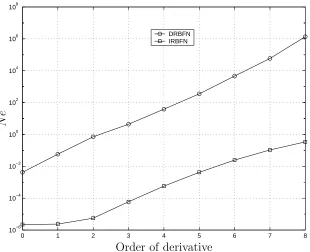
points as defined in (21). Results ofN eobtained by two approaches using the same
network parameters (β = 1, n = m = 21, nt = 101) are displayed in Figure 1,
which show that the performance of the indirect approach is clearly superior to
that of the direct approach on both function and derivative approximations. For
both approaches, the error norm is an increasing function of the order of derivative.
Some plots of derivatives are displayed in Figure 2, which indicates that the direct
while the indirect approach is able to capture all the derivative functions. For low
orders, there is no discernible difference between the IRBF and the exact solutions
(Figure 2).
In the case of the indirect approach, two aspects are further studied here. Firstly,
how does the “order” of the IRBFN scheme affect the accuracy of numerical solution.
Theith order IRBFN scheme, IRBFN-i, is regarded as an indirect scheme in which
the ith order derivative is decomposed into a set of RBFs. There are two concepts
of the order used throughout the present study, namely the order of derivative/ODE
and the order of an IRBFN scheme. To represent anith order derivative, the indirect
scheme needs be employed with at least ith order. Increasing the order of IRBFN
can improve the solution accuracy as shown in Figure 3. Secondly, the effect of β
on the solution accuracy is also investigated. It is known that large or small values
of the RBF width make the response of the corresponding basis function too flat or
too peaked respectively and therefore both of these two extreme conditions should
be avoided (Haykin [29]). Figure 4 shows that better approximations are obtained
with an increase in β up to the value of about 7.
The approximation of 6th order derivative of function (23) is reconsidered. By
increasing
• the value ofβ up to 7, or
• the order of IRBFN up to 10, or
• a number of centres up to 41,
the obtained solution is improved as displayed in Figure 5. The corresponding
error-nomrs are reduced from 0.0245 (IRBFN-8, β = 1) to 0.0030 (IRBFN-8, β = 7),
5.2
High order ODEs
The theoretical determinant for the optimum value of the RBF width has not been
established yet. For the approximation of a function and its derivatives, the
numer-ical example above indicated that the indirect approach performs well for a wide
range ofβ. In solving second order DEs (Mai-Duy and Tran-Cong [16]), experience
showed that the value of β can be chosen in the range 1 ≤ β ≤10. In the present
study, all values ofβ are simply fixed to be 7. Furthermore, the order of IRBFN is
chosen to be the same as that of ODE. In the indirect approach, Gaussian elimination
is applied to solve the systems of equations because all design matrices obtained here
are square. In the direct approach, the design matrices are non-square so that the
corresponding systems are solved in the least square sense unless otherwise stated.
5.2.1 Fourth order ODE - Boundary value problem
The problem here is to find a function y(x) satisfying the following fourth order
ODE
x4y[4]−4x3y+x2(12−x2)y+ 2x(x2−12)y+ 2(12−x2)y= 2x5, (24)
over a specified interval of thexaxis, 1≤x≤11, subject to the boundary conditions
fory and y at both ends of the domain. Note that this is a nonhomogeneous ODE
with coefficients being functions of x. The exact solution of (24) can be verified to
be
y=x+x2−x3+xexp(x) +xexp(−x).
To study convergence, four sets of 6, 11, 17 and 21 equally spaced points (m =n =
{6,11,17,21}) are employed for the design of networks in both DRBF and IRBF
transformed into
x4 m
i=1
w(i)h([4]i)(x)−4x3 m
i=1
w(i)h([3]i)(x) +x2(12−x2) m
i=1
w(i)h([2]i)(x)
+ 2x(x2−12) m
i=1
w(i)h([1]i)(x) + 2(12−x2) m
i=1
w(i)g(i)(x) = 2x5, (25)
m
i=1
w(i)g(i)(1) = 1 + exp(1) + exp(−1), (26)
m
i=1
w(i)h([1]i)(1) = 2 exp(1), (27)
m
i=1
w(i)g(i)(11) = 11 + 112−113+ 11 exp(11) + 11 exp(−11), (28)
m
i=1
w(i)h([1]i)(11) = 1 + 2(11)−3(11)2+ 12 exp(11)−10 exp(−11), (29)
for the direct approach and
x4 m
i=1
w(i)g(i)(x)−4x3 m+1
i=1
w(i)H[3](i)(x) +x2(12−x2) m+2
i=1
w(i)H[2](i)(x)
+ 2x(x2−12) m+3
i=1
w(i)H[1](i)(x) + 2(12−x2) m+4
i=1
w(i)H[0](i)(x) = 2x5, (30)
m+4 i=1
w(i)H[0](i)(1) = 1 + exp(1) + exp(−1), (31)
m+3 i=1
w(i)H[1](i)(1) = 2 exp(1), (32)
m+4 i=1
w(i)H[0](i)(11) = 11 + 112−113+ 11 exp(11) + 11 exp(−11), (33)
m+3 i=1
w(i)H[1](i)(11) = 1 + 2(11)−3(11)2+ 12 exp(11)−10 exp(−11), (34)
for the indirect approach, in which the unknowns are network weights {w(i)}. The
evaluation of (25) or (30) at a set of collocation points{x(i)}ni=1plus the discretization
the form
Aw =b,
where A is an (n+ 4)−by−m matrix for the direct approach and an (n+ 4)−
by−(m + 4) matrix for the indirect approach. For all study cases, error norms
of the solution y are calculated at a test set of 101 uniformly distributed points.
Figure 6 shows that the indirect approach yields very accurate results and also a
high convergence rate while the opposite is true for the direct approach. Solutions
converge apparently as O(h−0.0447) and O(h7.1594) with h being the centre spacing
for the direct and indirect approaches respectively. At the finest discretization used
here (i.e. 21 training data points), error norms of the solution are 2.48 and 1.23e−6
for the direct and indirect approaches respectively.
It can be seen from Figure 6 that the performance of the direct approach is very
poor, for example, no “mesh” convergence is observed there. As discussed above,
the obtained system is overdetermined for the direct approach, but determined for
the indirect approach. The question here is whether the performance of the direct
approach can be improved when its design matrices are square. To make the matrix
of the direct approach square, the following relation needs be satisfied
n+p=m, (35)
where p is the order of ODE. In other words, the number of collocation points
used to approximate the strong form of the governing equation must be chosen less
than the number of centres (i.e. n < m). For the problem under consideration
here, by not applying the ODE at two boundary points together with two interior
points (for example, interior points adjacent to the boundaries are set aside here),
the relation (35) is satisfied and Gaussian elimination can be applied to solve the
where the convergence rate is of O(h2.1744) (h is the centre spacing) and the error
norm is 0.0591 at the finest discretization. However, they are still far less accurate
than those obtained by the proposed indirect approach and also have much lower
convergence rate.
5.2.2 Fourth order ODE - Eigenvalue problem
Consider the transverse vibration of an uniform beam of length l for which the
general equation takes the form
∂4y ∂x4 +
ρA EI
∂2y
∂t2 = 0, (36)
where ρ, E and I are the mass per unit length, the elastic module and the area
moment of inertia about the neutral axis respectively. Assuming that the deflection
at any point of the beam varies harmonically with time
y(x, t) =φ(x)sin(ωt). (37)
Substitution of (37) into (36) yields
∂4φ ∂x4 −λ
4φ= 0, (38)
where λ4 = ρAω2/EI. The following are three types of boundary condition to be
considered here
• Pinned-pinned beam
• Clamped-clamped beam
φ(0) =φ(0) = 0, φ(l) = φ(l) = 0; (40)
• Clamped-pinned beam
φ(0) =φ(0) = 0, φ(l) =φ(l) = 0. (41)
Eigenvalue problems require more effort to form the final system of equations than
boundary value problems. Substitution of the closed form IRBFN representations
of the variable φ and its derivatives (6)-(10) into the governing equation (38) and
also boundary conditions, e.g. (39) for the case of pinned-pinned beam, yields
m
i=1
w(i)g(i)(x)−λ4 m+4
i=1
w(i)H[0](i)(x) = 0, (42)
m+4 i=1
w(i)H[0](i)(0) = 0, (43)
m+2 i=1
w(i)H[2](i)(0) = 0, (44)
m+4 i=1
w(i)H[0](i)(l) = 0, (45)
m+2 i=1
w(i)H[2](i)(l) = 0, (46)
or in the matrix form,
Aw−λ4Bw = 0, (47)
or
(A1,A2)(w1,w2)T −λ4(B1,B2)(w1,w2)T = 0, (49)
(C1,C2)(w1,w2)T = 0, (50)
where the dimensions of submatrices aren×n(A1),n×p(A2),n×n(B1),n×p(B2),
p×n(C1), p×p(C2), 1×n(w1) and 1×p(w2) in which n and pare the number of
collocation points (centres) and the order of ODE respectively (p= 4 here). With
some manipulations on (49) and (50), the final system of equations takes the form
[(A1−A2C2−1C1)−λ4(B1 −B2C−21C1)]w1T =0. (51)
Results ofλobtained withl = 1 are displayed in Tables 1, 2 and 3 for pinned-pinned,
clamped-clamped and clamped-pinned beams respectively. The analytic solution is
also given for comparison. The proposed method achieves accurate results and also
high rates of convergence for all study cases.
It is observed that when increasing data densities, the computed results are
consis-tently more accurate, but their values slightly oscillate about the exact values, e.g.
the case: λ4, pinned-pinned beam (Table 1). The reason for this behaviour is not
clear, probably due to the combined effect of the centre density and the value of β.
5.2.3 Sixth order ODE - Vibrations of ring-like structures
The vibrational behaviour of ring-like structures, which is important in engineering
applications, is considered in this section. The vibration problem governed by the
sixth order differential equation was studied by Gutierrez and Laura [6] using the
differential quadrature method (DQM) and the optimized Rayleigh-Ritz method
The structural element is a ring of rectangular cross-section of constant width and
thickness which varies parabolically according to the relation (Figure 7):
h( ¯α) =h(0)
− 4
π2(r−1) ¯α
2+ 4
π(r−1) ¯α+ 1
=h(0)f( ¯α), (52)
wherer =h(π/2)/h(0). The case of normal, in-plane modes of vibration is studied
here, where only flexural effects are taken into account and one disregards stretching
in the axial direction.
A circular ring with supports (Figure 7-a): Since the structure is symmetric,
only half of the domain is considered. Introducing the dimensionless variable α =
¯
α/π, the governing differential equation can be expressed in the form
β1v[6]+β2v[5]+β3v[4]+β4v +β5v +β6v −Ω2
f v+fv −π2f v
= 0, (53)
subject to the boundary conditions
v(0) =v(0) =v(0) = 0, v(1) =v(1) =v(1) = 0,
wherev is the tangential displacement, Ω is the dimensionless frequency and
0 ≤ α≤1
β1 = φ/π4, β2 = 3φ/π4, β3 = (2φ/π2) + (3φ/π4),
β4 = (4φ/π2) + (φ/π4), β5 =φ+ (3φ/π2), β6 =φ+ (φ/π2), φ = [f(α)]3.
The solution procedures are similar to the problem of transverse vibration of a beam
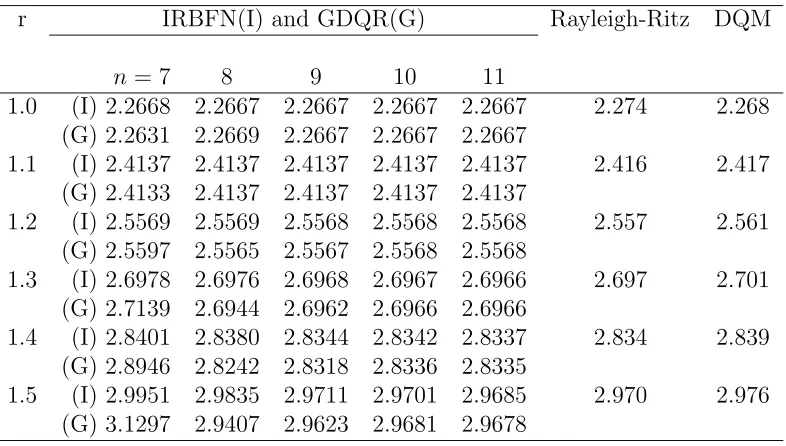
in the previous section and therefore omitted here for brevity. Five data sets of 6, 7,
coefficients of in-plane, inextensional vibration obtained are listed in Table 4. The
values predicted by the DQM, the optimized Rayleigh-Ritz method and the GDQR
method are also given for comparison purpose. Good agreements are observed.
Both GDQR and IRBF collocation methods yield good results even if only 8 points
are used for r < 1.4. For the DQM, it was found necessary to take n = 12 for
r={1.0; 1.1; 1.2; 1.3} and n= 14 for r ={1.4; 1.5} (Gutierrez and Laura [6]).
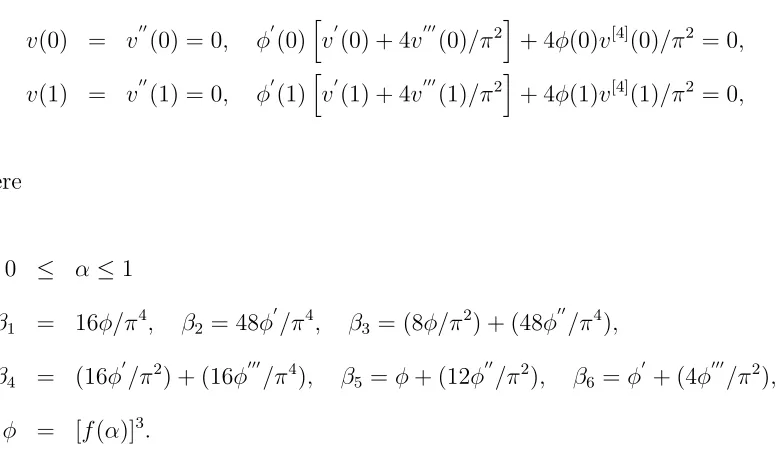
A completely free ring(Figure 7-b): In this case, a quarter of the ring structure
is considered. It is convenient to introduce the dimensionless variable α = 2 ¯α/π
here and the governing equations can be written as
β1v[6]+β2v[5]+β3v[4]+β4v+β5v+β6v−Ω2
f v +fv−π2f v/4
= 0, (54)
subject to the boundary conditions
v(0) = v(0) = 0, φ(0)
v(0) + 4v(0)/π2
+ 4φ(0)v[4](0)/π2 = 0,
v(1) = v(1) = 0, φ(1)
v(1) + 4v(1)/π2
+ 4φ(1)v[4](1)/π2 = 0,
where
0 ≤ α≤1
β1 = 16φ/π4, β2 = 48φ/π4, β3 = (8φ/π2) + (48φ/π4),
[image:23.612.104.492.397.628.2]β4 = (16φ/π2) + (16φ/π4), β5 =φ+ (12φ/π2), β6 =φ+ (4φ/π2), φ = [f(α)]3.
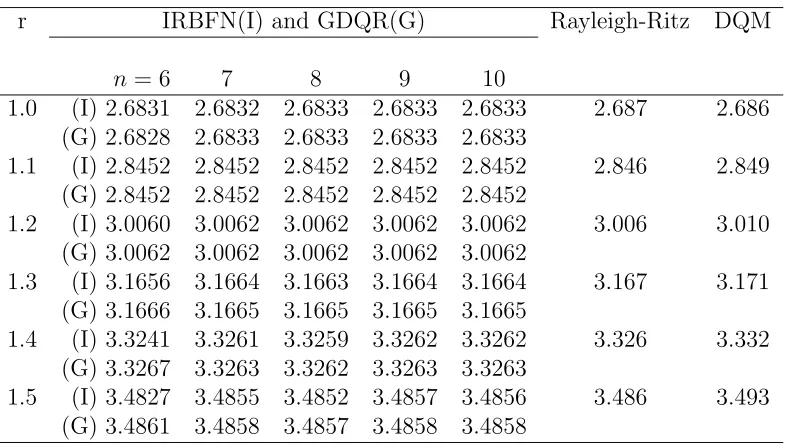
Table 5 displays the results obtained by the present method together with those
obtained by the DQM, GDQR and Rayleigh-Ritz methods. Values differ only in
the third or fourth significant digit so all solutions are reasonable approximations.
IRBF collocation methods. Note that the DQM was reported to use 12 data points
for this case.
5.2.4 Eighth order ODE - Initial value problem and boundary value
problem
The unsymmetric IRBF collocation method is further verified here in the solution
of eighth order ODE
y[8]+y[7]+y[6]+y[5]+y[4]+y+y+y+y= 9 exp(x), (55)
over the interval 0≤x≤1.
Firstly, the initial value problem governed by (55) with initial values
y(0) =y(0) =y(0) =y(0) =y[4](0) =y[5](0) =y[6](0) =y[7](0) = 1, (56)
is considered. The exact solution of (55) and (56) can be verified to bey(x) = exp(x).
A number of uniform data sets whose sizes vary from 3 to 6 with an increment of 1
are chosen to be the sets of centres. For comparison purpose, the fourth order
Runge-Kutta method is also applied here to solve this problem using the same data sets, in
which the centre spacing is interpreted as time step. Good accuracy and high rate
of convergence are obtained for both methods especially for the proposed method
(Figure 8). Solutions converge apparently asO(h3.8408) and O(h5.8484) with h being
the centre spacing for the Runge-Kutta and IRBF collocation methods respectively.
The present method achieves error-norms at least three order lower than the
Runge-Kutta method. For example, at the centre spacing of 1/5, error-norms are 8.70e−6
Secondly, the boundary value problem governed by the eighth order ODE above is
considered. Four boundary conditions fory, y, yandy[3]whose values are computed
from the exact solutiony(x) = exp(x) are imposed at both-ends of the domain. Five
data densities of 5, 6, 7, 8 and 9 equally spaced points together with 101 test points
are employed to investigate this problem. The proposed method yields very good
results for all densities with the corresponding error-norms being 4.48e−13,9.34e−
14,1.54e−14,4.70e−15 and 1.32e−15 respectively. Figure 9 shows that a high
convergence rate up to O(h8.4703) (h is the centre spacing) is achieved with the
present method.
5.2.5 Eighth order ODE - Simply supported single-barrel shell with free
edges
This problem is taken from reference (Kelkar and Sewell [33]) and was studied by Wu
and Liu [9] using the GDQR (Figure 10). The shell parameters are a longitudinal
length of L = 42 ft, a barrel radius of a = 12.5 ft and a shell thickness of t = 0.25
ft. The half angle of the barrel is 40o. The circular cylindrical single-barrel roof is
free at the two edges along the longitudinal x-direction with 0≤x≤L and simply
supported at the other two circular edges x = 0 and x = L. An equivalent dead
distributed load of p= 62.5 lb/ft2 is considered. Since the L/aratio is greater than
3, the Schorer theory can be applied to solve this problem. The shell only for the
first harmonic of the Fourier series expansion for the loading is analyzed here. The
radial displacement is thus expressed as follows
v(x, φ) =V(φ) sinπx
The analysis of Kelkar and Sewell [33] leads to the following governing eighth order
ODE
V[8]+λ8V =−−8pa
4cosφ
πK , (58)
subject to the four boundary conditions for stress at free edges as follows
Mφ = 0, Qφ = 0, Nφ= 0 and Nxφ= 0, (59)
whereλ8 = 12π4a6/(L4t2),K =Et3/12 andE is the Young’s modulus.
The solution V can be decomposed into a homogeneous part Vh and a particular
solution partVp as
V =Vh+Vp.
The membrane solution is adopted as the particular solution whose form for some
bending stresses of particular interest here is
Mφp = 0, (60)
Qpφ = 0, (61)
Nφp = −4pa
π cosφsin
πx
L , (62)
Nxφp = 8pL
π2 sinφcos πx
L , (63)
Nxp = −8pL
2
π3a cosφsin πx
L . (64)
resultants are given by
Mφh = K
a2 d2V
dφ2 sin πx
L , (65)
Qhφ = K
a3 d3V
dφ3 sin πx
L , (66)
Nφh = −K
a3 d4V
dφ4 sin πx
L , (67)
Nxφh = −KL
πa4 d5V
dφ5 cos πx
L , (68)
Nxh = KL
2
π2a5 d6V
dφ6 sin πx
L , (69)
The task now is to find the solution of the homogeneous governing equation
corre-sponding to (58)
Vh[8]+λ8Vh = 0, (70)
subject to the four boundary conditions at each edge
Mφh =−Mφp, Qhφ=−Qpφ, Nφh =−Nφp and Nxφh =−Nxφp ,
or
d2Vh dφ2 = 0,
d3Vh dφ3 = 0,
d4Vh
dφ4 =−
4pa4
πK cosφ, and
d5Vh
dφ5 =
8pa4
πK sinφ. (71)
The unsymmetric IRBF collocation procedure to solve (70)-(71) is similar to the
previous numerical examples. Results obtained (Vh and its derivatives) are then
substituted into (65)-(69) to produce the force and moment resultants. The analytic
homogeneous results can be found in (Kelkar and Sewell [33]) and (Wu and Liu [9]).
Note that the coefficients of the analytic results provided in (Kelkar and Sewell [33])
are only accurate to two significant figures. To obtain higher accuracy, Wu and Liu
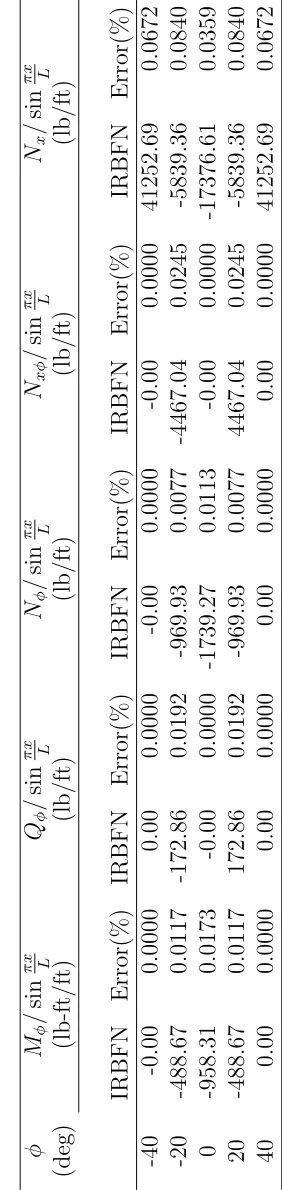
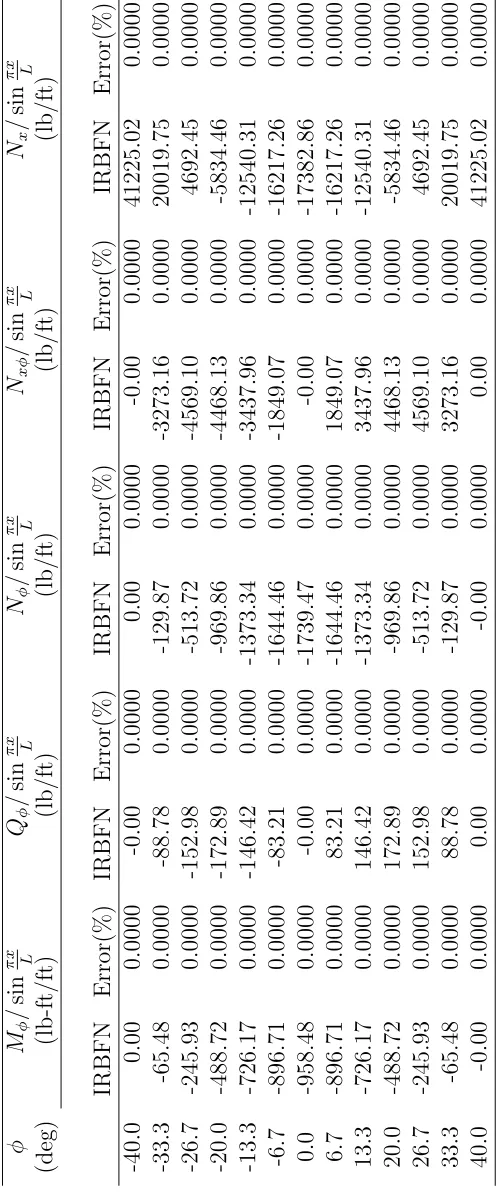
used here for comparison. Tables 6-8 present the final computed force and moment
resultants using 5, 9 and 13 equally spaced points. With only a few equally spaced
points, the IRBF results are in very good agreement with the analytic results. It also
shows that the finer density yields a better approximation to the true value. The
difference is less than 0.085 % in all cases. At the finest data density (n = 13), the
maximum error is 0.00004%. It is remarkable because the computed stress resultants
here involve derivatives up to 7th order. For the GDQR method, the cosine-type of
the sampling points is employed. With the same numbers of data points used (i.e.
5, 9 and 13 points), the maximum error of the force and moment resultants is about
0.62% (Wu and Liu [9]), which is slightly greater than that obtained by the present
method (0.085%).
6
CONCLUDING REMARKS
This paper reports new meshless numerical methods based on RBFNs for solving
high order ODEs directly. Two unsymmetric RBF collocation approaches are
em-ployed to approximate the strong form of the governing equations and the boundary
conditions. Like other meshless numerical methods (e.g. smoothed particle
hydro-dynamics, the vortex method, the generalized finite difference method and many
others), the direct RBF collocation approach here is based on the differential
pro-cess to represent the solution. By contrast, in the proposed indirect RBF collocation
approach, the closed forms representing the dependent variable and its derivatives
are obtained through the integration process. The use of the integration process
results in higher approximation power for RBFNs. Furthermore, in the case of
solv-ing high order ODEs, the well-known difficulties to deal with multiple boundary
conditions are naturally overcome via means of integration constants. Two present
and initial value problems. It requires no extra effort when increasing the order
of ODE. Analytic and numerical techniques for obtaining new basis functions from
RBFs are discussed. Among RBFs, multiquadrics are preferred for practical use.
Numerical results show that the proposed indirect approach performs much better
than the usual direct approach. High convergence rates and good accuracy are
ob-tained with the proposed method using relatively low numbers of data points. The
proposed unsymmetric IRBF collocation method can be extended to the solution of
APPENDIX
The following are new basis functions derived from RBFs by using
MATHEMAT-ICA.
Direct approach - Multiquadrics
h([1]i) = x−c(i) [(x−c(i))2+a(i)2]1/2, h([2]i) = a(i)2
[(x−c(i))2+a(i)2]3/2, h([3]i) = −3a(i)2(x−c(i))
[(x−c(i))2+a(i)2]5/2, h([4]i) = 3a(i)2[4(x−c(i))2−a(i)2]
[(x−c(i))2+a(i)2]7/2 ,
h([5]i) = −15a(i)2(x−c(i))[4(x−c(i))2−3a(i)2] [(x−c(i))2+a(i)2]9/2 , h([6]i) = 45a(i)2[8(x−c(i))4−12a(i)2(x−c(i))2+a(i)4]
[(x−c(i))2+a(i)2]11/2
h([7]i) = −315a(i)2(x−c(i))[8(x−c(i))4−20a(i)2(x−c(i))2+5a(i)4] [(x−c(i))2+a(i)2]13/2 ,
h([8]i) = 315a(i)2[64(x−c(i))6−240a(i)2(x−c(i))4+120a(i)4(x−c(i))2−5a(i)6] [(x−c(i))2+a(i)2]15/2 .
Direct approach - Gaussians
h([1]i) = −2(x−c(i)) a(i)2 exp
−(x−c(i))2 a(i)2
,
h([2]i) = 2[2(x−c(i))2−a(i)2]
a(i)4 exp
−(x−c(i))2 a(i)2
,
h([3]i) = −4(x−c(i))[2(x−c(i))2−3a(i)2]
a(i)6 exp
−(x−c(i))2 a(i)2
,
h([4]i) = 4[4(x−c(i))4−12(x−c(i))2a(i)2+3a(i)4]
a(i)8 exp
−(x−c(i))2 a(i)2
,
h([5]i) = −8(x−c(i))[4(x−c(i))4−20(x−c(i))2a(i)2+15a(i)4]
a(i)10 exp
−(x−c(i))2 a(i)2
,
h([6]i) = 8[8(x−c(i))6−60(x−c(i))4a(i)2+90(x−c(i))2a(i)4−15a(i)6]
a(i)12 exp
−(x−c(i))2 a(i)2
,
h([7]i) = −16(x−c(i))[8(x−c(i))6−84(x−c(i))4a(i)2+210(x−c(i))2a(i)4−105a(i)6]
a(i)14 exp
−(x−c(i))2 a(i)2
,
h([8]i) = 16[16(x−c(i))8−224(x−c(i))6a(i)2+840(x−c(i))4a(i)4−840(x−c(i))2a(i)6+105a(i)8]
a(i)16 exp
−(x−c(i))2 a(i)2
Indirect approach - Multiquadrics
H[1](i) = (x−2c(i))A+ a(2i)2B,
H[2](i) =
−a(i)2
3 + (x−c
(i))2
6
A+ a(i)2(x2−c(i))B,
H[3](i) =
−13a(i)2(x−c(i))
48 +(x−c
(i))3
24
A+
−a(i)4
16 + a
(i)2(x−c(i))2
4
B,
H[4](i) =
a(i)4
45 − 83a
(i)2(x−c(i))2
720 + (x−c
(i))4
120
A+
−3a(i)4(x−c(i))
48 +4a
(i)2(x−c(i))3
48
B,
H[5](i) =
113a(i)4(x−c(i))
5760 − 97a
(i)2(x−c(i))3
2880 +(x−c
(i))5
720
A+
a(i)6
384 −3a
(i)4(x−c(i))2
96 + 2a
(i)2(x−c(i))4
96
B,
H[6](i) =
−a(i)6
1575 + 593a
(i)4(x−c(i))2
67200 − 253a
(i)2(x−c(i))4
33600 + (x−c
(i))6
5040
A
+
5a(i)6(x−c(i))
1920 −20a
(i)4(x−c(i))3
1920 + 8a
(i)2(x−c(i))5
1920
B,
H[7](i) =
−1873a(i)6(x−c(i))
3225600 + 4327a
(i)4(x−c(i))3
1612800 −551a
(i)2(x−c(i))5
403200 +(x−c
(i))7
403200
A
+
−a(i)8
18432 + 15a
(i)6(x−c(i))2
11520 − 30a
(i)4(x−c(i))4
11520 +8a
(i)2(x−c(i))6
11520
B,
H[8](i) =
a(i)8
99225 −54511a
(i)6(x−c(i))2
203212800 + 20939a
(i)4(x−c(i))4
33868800 − 5309a
(i)2(x−c(i))6
25401600 +(x−c
(i))8
362880
A
+
−35a(i)8(x−c(i))
645120 +280a
(i)6(x−c(i))3
645120 −336a
(i)4(x−c(i))5
645120 +64a
(i)2(x−c(i))7
645120
B,
whereA=(x−c(i))2+a(i)2 and B = ln(x−c(i)) +(x−c(i))2+a(i)2.
ACKNOWLEDGEMENTS
The author is grateful to Professor R.I. Tanner for fruitful discussions and for
care-fully reading the paper and correcting errors. The author would like to thank the
referees for their helpful comments.
REFERENCES
1. Dahlquist G, Bjorck A, Anderson N. Numerical Methods; Prentice-Hall: New
Jersey, 1974.
2. Press WH, Flannery BP, Teukolsky SA, Vetterling WT.Numerical Recipes in
C: The Art of Scientific Computing; Cambridge University Press: Cambridge,
3. Viecelli JA. Exponential difference operator approximation for the sixth order
Onsager equation. Journal of Computational Physics 1983; 50: 162-170.
4. Sallam S, El-Hawary HM. A deficient spline function approximation of
second-order differential equations. Applied Mathematical Modelling 1984; 8(6):
408-412.
5. Esmail MN, Fawzy T, Ahmed M, Elmoselhi HO. A deficient spline function
approximation to fourth-order differential equations. Applied Mathematical
Modelling1994; 18(12): 658-664.
6. Gutierrez RH, Laura PAA. Vibrations of non-uniform rings studied by means
of the differential quadrature method. Journal of Sound and Vibration 1995;
185(3): 507-513.
7. Wu TY, Liu GR. Application of the generalized differential quadrature rule to
sixth-order differential equations. Communications in Numerical Methods in
Engineering2000; 16: 777-784.
8. Wu TY, Liu GR. The generalized differential quadrature rule for fourth-order
differential equations. International Journal for Numerical Methods in
Engi-neering2001; 50: 1907-1929.
9. Wu TY, Liu GR. Application of the generalized differential quadrature rule to
eighth-order differential equations. Communications in Numerical Methods in
Engineering2001; 17: 355-364.
10. Bellman R, Casti J. Differential quadrature and long term integration. Journal
of Mathematical Analysis and Application1971; 34: 235-238.
11. Wood HG, Morton JB. Onsager’s pancake approximation for the fluid
12. Kansa EJ. Multiquadrics-A scattered data approximation scheme with
appli-cations to computational fluid-dynamics-II. Solutions to parabolic, hyperbolic
and elliptic partial differential equations. Computers and Mathematics with
Applications1990; 19(8/9); 147-161.
13. Sharan M, Kansa EJ, Gupta S. Application of the multiquadric method for
numerical solution of elliptic partial differential equations. Journal of Applied
Science and Computation1997; 84: 275-302.
14. Zerroukat M, Power H, Chen CS. A numerical method for heat transfer
prob-lems using collocation and radial basis functions. International Journal for
Numerical Methods in Engineering 1998;42: 1263-1278.
15. Mai-Duy N, Tran-Cong T. Numerical solution of differential equations using
multiquadric radial basis function networks. Neural Networks 2001; 14(2):
185-199.
16. Mai-Duy N, Tran-Cong T. Numerical solution of Navier-Stokes equations
us-ing multiquadric radial basis function networks. International Journal for
Numerical Methods in Fluids2001; 37: 65-86.
17. Fedoseyev AI, Friedman MJ, Kansa EJ. Improved multiquadric method for
elliptic partial differential equations via PDE collocation on the boundary.
Computers & Mathematics with Applications2002; 43(3-5): 439-455.
18. Mai-Duy N, Tran-Cong T. Approximation of function and its derivatives using
radial basis function network methods. Applied Mathematical Modelling2003;
27: 197-220.
19. Jin X, Li G, Aluru NR. On the equivalence between least-squares and kernel
approximations in meshless methods. Computer Modeling in Engineering and
20. Atluri SN, Shen S. The Meshless Local Petrov-Galerkin Method; Tech Science
Press: Encino, 2002.
21. Li S, Liu WK. Meshfree and particle methods and their applications. Applied
Mechanics Reviews2002; 55(1): 1-34.
22. Liu GR. Mesh Free Methods - Moving Beyond The Finite Element Method;
CRC Press: Boca Raton, 2003.
23. Liu GR, Gu YT. A local radial point interpolation method (LRPIM) for free
vibration analyses of 2-D solids. Journal of Sound and Vibration2001;246(1):
29-46.
24. Wang JG, Liu GR. A point interpolation meshless method based on radial
basis functions. International Journal for Numerical Methods in Engineering
2002;54: 1623-1648.
25. Wang JG, Liu GR. On the optimal shape parameters of radial basis functions
used for 2-D meshless methods. Computer Methods in Applied Mechanics and
Engineering2002; 191: 2611-2630.
26. Wang JG, Liu GR, Lin P. Numerical analysis of Biot’s consolidation process
by radial point interpolation method. International Journal of Solids and
Structures 2002; 39(6): 1557-1573.
27. Gu YT, Liu GR. A boundary radial point interpolation method (BRPIM) for
2-D structural analyses. Structural Engineering and Mechanics 2003; 15(5):
535-550.
28. Wu YL, Liu GR. A meshfree formulation of local radial point interpolation
method (LRPIM) for incompressible flow simulation. Computational
29. Haykin S.Neural Networks: A Comprehensive Foundation; Prentice-Hall: New
Jersey, 1999.
30. Abramowitz M, Stegun IA. Handbook of Mathematical Functions; Dover
Pub-lications: New York, 1972.
31. Madych WR, Nelson SA. Multivariate interpolation and conditionally positive
definite functions. Approximation Theory and its Applications1989; 4: 77-89.
32. Madych WR, Nelson SA. Multivariate interpolation and conditionally positive
definite functions, II.Mathematics of Computation 1990;54(189): 211-230.
33. Kelkar VS, Sewell RT.Fundamentals of the Analysis and Design of Shell
Table 1: Fourth order ODE, free vibration, pinned-pinned beam: eigenvalues. For
each eigenvalue λi, the error is consistently reduced with increasing density.
Density λ1(error %) λ2(error %) λ3(error %) λ4(error %) λ5(error %)
6 3.1415(0.003) 6.2824(0.012) 9.2931(1.397) 11.7987(6.109) —
8 3.1416(0.000) 6.2830(0.003) 9.4224(0.025) 12.5683(0.015) 15.1874(3.314)
10 3.1416(0.000) 6.2831(0.001) 9.4243(0.005) 12.5657(0.005) 15.7002(0.049)
12 3.1416(0.000) 6.2832(0.000) 9.4246(0.002) 12.5660(0.003) 15.7066(0.008)