Copyright © 2002, American Society for Microbiology. All Rights Reserved.
Addition of a Single gp120 Glycan Confers Increased Binding to
Dendritic Cell-Specific ICAM-3-Grabbing Nonintegrin and
Neutralization Escape to Human Immunodeficiency
Virus Type 1
James Lue,
1† Mayla Hsu,
1David Yang,
1Preston Marx,
2Zhiwei Chen,
1and Cecilia Cheng-Mayer
1*
Aaron Diamond AIDS Research Center, The Rockefeller University, New York, New York 10016,
1and
Tulane Regional Primate Research Center and Department of Tropical Medicine,
Tulane Health Sciences Center, New Orleans, Louisiana
2Received 5 April 2002/Accepted 11 July 2002
The potential role of dendritic cell-specific ICAM-3-grabbing nonintegrin (DC-SIGN) binding in human
immunodeficiency virus transmission across the mucosal barrier was investigated by assessing the ability of
simian-human immunodeficiency chimeric viruses (SHIVs) showing varying degrees of mucosal
transmissi-bility to bind the DC-SIGN expressed on the surface of transfected cells. We found that gp120 of the highly
transmissible, pathogenic CCR5-tropic SHIV
SF162P3bound human and rhesus DC-SIGN with an efficiency
threefold or greater than that of gp120 of the nonpathogenic, poorly transmissible parental SHIV
SF162, and this
increase in binding to the DC-SIGN of the SHIV
SF162P3envelope gp120 translated into an enhancement of
T-cell infection in
trans
. The presence of an additional glycan at the N-terminal base of the V2 loop of
SHIV
SF162P3gp120 compared to that of the parental virus was shown to be responsible for the increase in
binding to DC-SIGN. Interestingly, this glycan also conferred escape from autologous neutralization, raising
the possibility that the modification occurred as a result of immune selection. Our data suggest that
more-efficient binding of envelope gp120 to DC-SIGN could be relevant to the enhanced mucosal transmissibility of
SHIV
SF162P3compared to that of parental SHIV
SF162.
Infection of macaques with simian-human
immunodefi-ciency virus (SHIV) has provided not only a model system for
the evaluation of vaccines and therapies against AIDS but also
valuable information on human immunodeficiency virus (HIV)
pathogenesis and transmission (6). Through adaptation or
se-rial passaging in vivo, pathogenic variants of CXCR4-tropic
(X4) and CCR5-tropic (R5) SHIVs that replicate to high titers,
induce CD4
⫹-T-cell depletion in various anatomical
compart-ments, and cause an AIDS-like illness in infected macaques
have been derived (27, 33, 40, 52, 57). Furthermore, some of
these adapted or passaged viruses are transmitted efficiently
across mucosal surfaces (26, 29, 32, 40). Studies conducted in
our laboratory have focused on the use of two pathogenic
SHIVs, X4-SHIV
SF33Aand R5-SHIV
SF162P3(26, 27, 29, 40).
Atraumatic application of pathogenic X4-SHIV
SF33Ato the
cervico-vaginal mucosa of four rhesus macaques resulted in
infection of all four animals that was accompanied by a
tran-sient but dramatic loss of peripheral CD4
⫹T cells at acute
viremia (29). In comparison, the parental SHIV
SF33infected
two of three animals by the vaginal route but did not induce
CD4
⫹-T-cell depletion (summarized in Table 1). In contrast,
none of the three animals exposed to R5-SHIV
SF162by the
vaginal route showed signs of infection, as indicated by the
absence of seroconversion and of cell-associated proviral DNA
(Table 1). Mucosal transmission efficiency of the pathogenic
R5-SHIV
SF162P3, however, was significantly increased. All four
macaques exposed to a single inoculum of SHIV
SF162P3were
infected, with two animals progressing to simian AIDS
(SAIDS) at 24 and 44 weeks postinfection (wpi), respectively
(26). The genetic determinants for enhanced pathogenicity of
SHIV
SF33Ain vivo have been mapped to the V1 to V5 region
of the external glycoprotein gp120 (28). Sequence changes in
this region are associated with several phenotypic
characteris-tics in vitro that could account for the in vivo virulence of the
virus (13). Compared to the parental SHIV
SF33envelope
gly-coprotein, SHIV
SF33Agp120 mediates better entry, increases
membrane fusogenicity, and confers resistance to
neutraliza-tion by antibodies. Similar envelope-determined properties
have also been shown to be associated with other pathogenic
X4- and X4/R5-SHIVs (SHIV-HxBc2P, SHIV
Ku-1,
SHIV-89.6P) (11, 17, 34, 38). However, properties of the virus that
could be associated with enhanced transmission across the
mucosal barrier are less well defined.
During sexual transmission, immature dendritic cells (DCs)
present in mucosal tissues are among the first cells to be
en-countered by HIV (19, 20, 30, 59). DCs themselves are either
not infected or infected poorly but rather capture and transfer
viruses efficiently to target T cells (5, 10, 24, 39, 49–51, 62). This
latter property is mediated in part by the DC-specific
ICAM-3-grabbing nonintegrin (DC-SIGN) molecule, a
404-amino-acid (aa)-long type II transmembrane mannose binding C-type
lectin expressed on the surface of immature DCs that interacts
with envelope glycoprotein gp120 (15, 21, 48). It has been
* Corresponding author. Mailing address: Aaron Diamond AIDS
Research Center, 455 First Ave., New York, NY 10016. Phone: (212)
448-5080. Fax: (212) 448-5159. Email: [email protected].
† Present address: School of Medicine, University of California, San
Francisco, Calif.
10299
on November 8, 2019 by guest
http://jvi.asm.org/
suggested that, as a consequence of the normal cellular
traf-ficking of DCs, DC-SIGN plays a major role in HIV
transmis-sion and dissemination at the mucosal surfaces by capturing
and transporting the virus to peripheral lymph nodes and
gut-associated lymphoid tissues (9, 21, 25, 54). The availability of
viruses that differ in their transmission efficiency provides the
tools necessary to assess the potential role of DC-SIGN
bind-ing in infection across the mucosal barrier and to dissect the
sites on gp120 that modulate this property. We therefore
com-pared the ability of the envelope glycoproteins of parental
SHIV
SF162and the pathogenic, mucosally transmissible variant
SHIV
SF162P3to bind DC-SIGN-expressing cells, with gp120s
from SHIV
SF33and SHIV
SF33Aserving as controls.
MATERIALS AND METHODS
Cells.Human embryonic kidney (HEK-293T) cells used for transfection were maintained in Dulbecco’s modified Eagle medium supplemented with 10% fetal calf serum (FCS) and antibiotics. The CEMx174 5.25 M7 cell line (a generous gift from N. R. Landau, Salk Institute, La Jolla, Calif.) was stably transduced with an HIV-1-LTR-GFP and HIV-1-LTR-Luc reporter construct and with CCR5. These cells were maintained in RPMI 1640 medium supplemented with 10% FCS, 1g of puromycin/ml, and 200-g/ml concentrations each of G418 and hygromycin. Human peripheral blood mononuclear cells (PBMCs) were pre-pared by Ficoll gradient centrifugation and cultured in RPMI 1640 medium supplemented with 10% FCS and 20 U of recombinant interleukin-2 (Chiron Corp., Emeryville, Calif.)/ml.
PCR and sequencing of viral DNA.Viral DNA sequences containing the HIV type 1 (HIV-1) envgene were amplified from the lymph node PBMCs of SHIVSF162P3-infected animal T353 at week 20 postinfection by nested PCR with ED3 and ED14 as first-round primers and ED5 and ED12 as second-round primers as described previously (29). The amplified products were cloned into the pCR 2.1 TA vector (Invitrogen, Carlsbad, Calif.), and the consensus se-quence for the PCR products was obtained.
Viruses.Full-length proviral DNAs expressing the envelope glycoproteins of SHIVSF33, SHIVSF33A, SHIVSF162, and SHIVSF162P3were constructed on the genomic backbone of HIV-1 R7/3, a proviral HXB2 clone in which thenefopen reading frame had been restored (a gift from M. Muesing, Aaron Diamond AIDS Research Center, New York, N.Y.). To replace the HIV-1 R7/3envgene with that of SHIVSF33, theBbsI-BamHI fragment of clone R7/3 (nucleotides 6219 to 8475) was replaced with the corresponding sequences in HIV-1SF33. The
BamHI site, which was not conserved in HIV-1SF33, was introduced at position 2720 by site-directed mutagenesis (numbering refers to sequence M38427 in GenBank) using the QuikChange kit (Stratagene, San Diego, Calif.). The result-ing proviral construct, HIV-1 R7/3-33, expressed an envelope glycoprotein iden-tical to that of HIV-1SF33except for the last 106 aa of the cytoplasmic domain, which originated from the R7/3 clone. The similar constructs R7/3-33A and R7/3-162 were obtained by replacing theBbsI-BamHI fragment in R7/3 with sequences from SHIVSF33A2 and HIV-1SF162 (GenBank accession numbers AF373044 and M38428, respectively). TheBamHI site was also absent in HIV-1SF162and was introduced first into the pSM/162 Env expression plasmid (61) by using the complementary oligonucleotides SF162BF (5⬘-CCA TTA GTG CAT GGA TCC TTA GCA CTC ATC TGG GAC G) and SF162BR to generate pSM/162(B). For construction of the R7/3-162P3 clone, a 1.14-kbDraIII/BsgI fragment containing the V1 to V5 region of pSM/162(B) was replaced with the corresponding sequences amplified from SHIVSF162P3. Viruses were generated by lipofection with 3.0g of each proviral DNA construct into HEK-293T cells plated at 4⫻105per well in 6-well plates. The lipofection was performed with DMRIE-C reagent (Gibco Life Technologies, Gaithersburg, Md.) according to the manufacturer’s recommendations. Cell culture supernatants were harvested 48 h posttransfection, centrifuged at 800⫻g, filtered through 0.45-m-pore size filters, and stored at⫺70°C until use. The viral content was quantified by using a p24 Gag enzyme-linked immunosorbent assay (ELISA) from Abbott Labora-tories (Chicago, Ill.).
To generate R7/3-162 glycosylation mutant viruses, site-directed mutagenesis was performed by using the pSM/162(B) Env plasmid and the complementary mutagenic oligonucleotides SF162(g138)F (5⬘-GCT ACT AAT ACC ACG AGT AGT AAT TGG) and SF162(g138)R and SF162(g158)F (T TGC TCT TTC AAC GTC ACC ACA AGC) and SF162(g158)R to introduce potential glyco-sylation sites in the V1 region (aa 138) and at the base of the V2 region (aa 158),
respectively. TheBbsI-BamHI fragments of the mutagenized plasmids were prepared and exchanged with the corresponding region of the R7/3-162 proviral construct. The double glycosylation mutant virus R7/3-162 (g138/158) was gen-erated by introducing the g158 mutation on the backbone of the pSM/162B (g138) plasmid, followed by preparation and substitution of theBbsI-BamHI fragment into the corresponding regions of the proviral R7/3-162 DNA. The presence of the mutations was confirmed by DNA sequencing. Mutant viruses were generated by transfection of HEK-293T cells with proviral DNAs.
Amplification and cloning of human and rhesus DC-SIGN.Total RNA was extracted from purified DCs with Trizol reagent (Gibco Life Technologies) and treated with 10 U of RNase-free DNase (Promega, Madison, Wis.). cDNA was prepared from 5g of RNA by using Superscript II reverse transcriptase (Gibco Life Technologies) and resuspended in 60l of TE buffer (10 mM Tris [pH 8.0], 1 mM EDTA). Specific cDNAs were amplified according to the manufacturer’s specifications in a 100-l reaction mixture containing 5l of cDNA; 10 mM Tris-HCl (pH 8.5); 50 mM KCl; 1.5 mM MgCl2; 0.1% Triton X-100; 200M (each) dATP, dGTP, dCTP, and dTTP; 20 pmol of each primer; and 2.5 U of EXPAND high-fidelity DNA polymerase (Roche Diagnostic Corp., Indianapolis, Ind.). PCR primers hybridizing to the 5⬘- and 3⬘-untranslated regions of rhesus and human DC-SIGN were as follows (restriction sites for cloning are under-lined): first round, DC-SIGNf1 (5⬘-TCT GGA CAC TGG GGG AGA GTG G-3⬘) and DC-SIGNb1 (5⬘-GGA TGG AGA GAA GGA ACT GTA G-3⬘); second round, DC-SIGNf2 (5⬘-TCGAG GGATCCGAATTC GGA GAG TGG GGT GAC ATG AGT G-3⬘) and DC-SIGNb2 (5⬘-TCGA GCGGCCGCTCT AGA GCT TAA AAG GGG GTG AAG TTC TG-3⬘). Amplification cycles were 95°C for 2 min, followed by 35 cycles at 94°C for 15 s, 50°C for 45 s, and 72°C for 1 min and then an incubation at 72°C for 8 min. Products from the second-round amplifications were electrophoresed on a 1% agarose gel and visualized by staining with ethidium bromide. PCR products were purified with the PCR-Prep kit (Promega) and cloned into the expression vector pcDNA4/HisMaxC (Invitro-gen). The expression of human and rhesus DC-SIGN was confirmed by Western blot and fluorescence-activated cell sorter (FACS) analysis (data not shown).
FACS analysis of DC-SIGN expression.HEK-293T cells transfected with the indicated expression plasmids were harvested 48 h posttransfection and washed with phosphate-buffered saline containing 1% FCS and 0.05% sodium azide (FACS buffer). Transfected cells were incubated with a monoclonal antibody specific for human DC-SIGN (Pharmingen, San Diego, Calif.) or with isotypic control antibodies for 15 min at room temperature. Cells were then washed with FACS buffer, fixed in 2% paraformaldehyde, and analyzed by using a FACS apparatus (FACScan; Becton Dickinson, Mountain View, Calif.). Geometrical mean channel fluorescence intensity was determined and used as a measure of relative DC-SIGN expression.
Virus binding and transmission.Binding of virus particles to DC-SIGN-expressing HEK-293T cells was assessed by measuring cell-associated p24 levels. Briefly, 4⫻105HEK-293T cells seeded in 6-well plates were transfected with expression vectors encoding human or rhesus DC-SIGN or a pcDNA4 control plasmid by lipofection. Forty-eight hours posttransfection, cells were harvested for FACS analyses of DC-SIGN expression and for virus binding. For binding, 5 or 20 ng of a p24 equivalent of each virus was added in duplicate to 2⫻105 transfected cells in a total volume of 0.5 ml. After 4 to 5 h of incubation at 37°C, the virus inoculum was removed and the cells were extensively washed with Hanks’ medium. Cells were lysed in 100l of 0.5% Triton X-100 in H2O, and the amount of bound virus was determined by p24 ELISA. Binding to pcDNA4-transfected control cells ranged from 0.1 to 0.3% of that of the input viruses, and these values were deducted from the percentage of viruses bound to DC-SIGN-expressing cells in the data presented. For an assessment of DC-SIGN-mediated infection intrans, cells were plated in 48-well plates and 2⫻106human PBMCs were added. Culture supernatants were collected at 2, 5, and 8 days postcocul-tivation and p24 Gag antigen content was determined by ELISA.
To generate cells expressing various amounts of DC-SIGN, HEK-293T cells plated at 4⫻105cells per well in 6-well plates were transfected with 0.02 to 2g of the human or rhesus DC-SIGN expression vector. Cells were collected 48 h later, DC-SIGN expression was measured by FACS, and the cells were used in virus binding studies.
Immunoblot analysis of envelope glycoproteins.HEK-293T cells transfected with proviral constructs were harvested 72 h posttransfection and lysed in a solution containing 50 mM Tris-HCl, 50 mM NaCl, 1 mM EDTA, 10 mM MgCl2, and 1% Triton X-100. Cell lysates were denatured by boiling in sample buffer, and the proteins were separated by sodium dodecyl sulfate–4 to 12% polyacryl-amide gel electrophoresis (NuPAGE; Invitrogen). Envelope gp120s were de-tected by immunoblotting with a goat anti-gp120 antibody (Chiron Corp.).
Neutralization assays.Virus neutralization was performed with CEMx174 5.25 M7 cells in 96-well plates as described previously (14). Briefly, serial
on November 8, 2019 by guest
http://jvi.asm.org/
tions of heat-inactivated serum samples from macaque T353 were incubated in triplicate wells with equal volumes (50l) of each virus (5 ng of p24) for 1 h at 37°C. A total of 2⫻104CEMx174 5.25 M7 cells in a 100-l volume of medium were then added to the virus-serum mixture and cultured for 4 days at 37°C. Control cultures received virus incubated in the absence of antisera. At the end of the incubation period, cells were harvested, lysed, and incubated with the luciferase assay reagents according to the manufacturer’s instructions (Pro-mega). The luciferase activity was measured in an MLX microtiter plate lumi-nometer (Dynex Technologies, Inc., Chantilly, Va.). A neutralization curve was generated by plotting the percent neutralization versus serum dilution. The dilution of antiserum that resulted in 90% inhibition was then interpolated from this curve.
RESULTS
SHIV
SF162P3envelope glycoproteins confer increased
bind-ing to DC-SIGN.
It was previously reported that the
patho-genic isolate SHIV
SF162P3is transmitted efficiently across
mu-cosal barriers (26) (summarized in Table 1). To assess whether
interaction with the DC-SIGN molecule could contribute to
HIV-1 transmission efficiency, the ability of the SHIV
SF162and
SHIV
SF162P3envelope glycoprotein gp120 to bind human and
rhesus DC-SIGN transiently expressed on HEK-293T cells was
examined. Envelope gp120s from SHIV
SF33and SHIV
SF33Aserved as controls in these experiments since these viruses did
not differ substantially in their mucosal transmissibility. For
these studies, chimeric viruses expressing the various envelope
gp120s were constructed in the genomic backbone of the
pro-viral HIV-1 R7/3 clone. The resulting R7/3-33 and R7/3-33A
viruses are isogenic except for 25 aa residues in the V1 to V5
regions of envelope gp120 (13). Similarly, 162 and
R7/3-162P3 are isogenic, with only 14 aa differences in the V1 to V5
domains of gp120 (unpublished data). We found that, whereas
R7/3-33 and R7/3-33A displayed no significant difference in
their binding to 293T cells expressing human DC-SIGN, a
threefold or more increase in the binding of R7/3-162P3
com-pared to that of R7/3-162 was consistently observed (Fig. 1A).
Similar results were obtained with 293T cells expressing rhesus
DC-SIGN (Fig. 1A). This differential binding of R7/3-162 and
R7/3-162P3 viruses was observed over a wide range of
DC-SIGN expression levels (Fig. 1B). We verified that transfecting
increasing amounts of the DC-SIGN plasmid resulted in a
concomitant increase in DC-SIGN surface expression (Fig.
1C). In agreement with previous reports (21, 46), binding of
the viruses to DC-SIGN was dose dependent (data not shown)
and was eliminated in the presence of EGTA and mannan
(Fig. 1D).
Increased binding to DC-SIGN correlates with enhanced
transmission of the virus in
trans
.
Since binding of the virus to
DC-SIGN and its subsequent transfer to receptor-positive cells
can be uncoupled (47), we examined whether the increased
binding of SHIV
SF162P3envelope gp120 to the surface of
DC-SIGN-expressing cells led to increased transmission of the
virus to activated PBMCs in
trans
(Fig. 2). 293T cells
ex-pressing DC-SIGN or vector alone were incubated with the
R7/3-162 and R7/3-162P3 viruses, extensively washed, and
sub-sequently cocultivated with phytohemagglutinin-stimulated
PBMCs. Virus replication was monitored for several days
post-cocultivation. We found that both the human and rhesus
DC-SIGN-transfected cells pulsed with R7/3-162P3 transmitted the
virus more efficiently than did cells pulsed with the R7/3-162
virus (Fig. 2). Thus, increased binding to DC-SIGN-expressing
cells correlates with enhanced transmission in
trans
of the
R7/3-162P3 virus to PBMCs.
DC-SIGN-virus interaction is modulated by gp120
glycosyl-ation.
Binding of HIV-1 Env to DC-SIGN is dependent on the
C-terminal lectin domain of DC-SIGN and carbohydrate
struc-tures on the viral envelope that remain unidentified (21, 46).
Consistent with a potential role of glycan moieties in
modu-lating Env/DC-SIGN interaction, comparison of the V1 to V5
sequence of envelope gp120 revealed no difference in the
extent of glycosylation of the R7/3-33 and R7/3-33A viruses
whereas two additional potential glycosylation sites were
present in R7/3-162P3 Env gp120 compared to R7/3-162 Env.
These sites were located within the V1 domain (aa 138) and at
the N-terminal base of the V2 loop (aa 158) (Fig. 3A). To
assess the contribution of these carbohydrate modifications to
the differences observed in binding to DC-SIGN, these V1 and
V2 glycosylation sites were introduced in the backbone of the
R7/3-162 virus to generate the R7/3-162 (g138) and R7/3-162
(g158) viruses, respectively. A mutant virus containing both
changes, designated R7/3-162 (g138/158), was also constructed
(Fig. 3A). Biochemical analyses revealed a lower mobility of
the envelope gp120 of R7/3-162P3 compared to wild-type R7/
3-162 gp120, indicating that the additional potential
glycosyl-ation sites were utilized. The gp120s of the single mutants g138
and g158 migrated with an apparent molecular mass that was
an intermediate of wild-type R7/3-162 and variant R7/3-162P3
envelope gp120s, whereas the mobility of double-mutant R7/
3-162 (g138/158) gp120 was similar to that of R7/3-162P3.
These findings strongly suggest that the genetic changes
intro-duced resulted in the anticipated carbohydrate modifications
(Fig. 3B).
We found that the glycosylation site mutations did not affect
replication of the viruses; similar kinetics of replication in
human PBMCs were observed for the mutant and wild-type
R7/3-162 viruses (data not shown). In virus binding assays,
R7/3-162 (g138) gp120 bound to human or rhesus
DC-SIGN-expressing cells with an efficiency similar to that of the
wild-TABLE 1. Mucosal transmission of SHIV
SF33, SHIV
SF33A, SHIV
SF162, and SHIV
SF162P3 Virus(coreceptor used) challenged (route)No. infected/no. Clinical symptoms (reference)
SHIVSF33(X4) 2/3 (intravaginal) Seroconversion, stable peripheral CD4⫹-T-cell count, persistent infection with low viral load SHIVSF33A(X4) 4/4 (intravaginal) Seroconversion, acute peripheral CD4⫹-T-cell loss, persistent infection with low viral load (29)
2/2 (oral) Seroconversion; dramatic CD4⫹-T-cell loss; SAIDS at 50 wpi in one animal, with remaining animal
healthy over 2 yr (40)
SHIVSF162(R5) 0/3 (intravaginal) None (seronegative, cell-associated viral load negative)
SHIVSF162P3(R5) 4/4 (intravaginal) Seroconversion; gradual CD4⫹-T-cell loss; SAIDS in two animals at wk 24 and 44, with remaining two animals healthy over 2 yr (26)
on November 8, 2019 by guest
http://jvi.asm.org/
[image:3.587.41.543.84.175.2]type R7/3-162 virus (Fig. 4A). In contrast, the binding
effi-ciency of R7/3-162 (g158) and the double-mutant R7/3-162
(g138/158) virus to DC-SIGN was comparable to that of the
R7/3-162P3 virus. Since glycosylation can differ between cell
types, wild-type and mutant viruses propagated in human
[image:4.587.130.460.71.371.2]PBMCs were examined for their binding to DC-SIGN to
en-sure that the differences observed were not due to
carbohy-drate modifications that are unique to 293T cells. We found
that viruses propagated in human PBMCs displayed a pattern
of binding to rhesus DC-SIGN-expressing cells similar to that
FIG. 1. Increased binding of SHIV
SF162P3envelope gp120 to DC-SIGN-expressing cells. (A) HEK-293T cells transiently expressing human (
e
)
and rhesus (
o
) DC-SIGN were incubated with equal amounts (5 ng of p24) of R7/3-33, R7/3-33A, R7/3-162, and R7/3-162P3 viruses, washed, and
lysed in 0.5% Triton X-100. The amount of p24 bound was quantified by ELISA and expressed as a percentage of total antigen. Values represent
the standard error of the mean from four to five independent experiments. (B) HEK-293T cells were transfected with increasing amounts of the
human DC-SIGN plasmid. Transfected cells were incubated with R7/3-162 (
e
) and R7/3-162P3 (
o
) viruses, and the amount of bound p24 was
determined. Results are representative of two independent experiments. (C) FACScan analysis of DC-SIGN expression. The mean fluorescence
of DC-SIGN monoclonal antibody staining for the transfected cells used in panel B is shown. (D) The binding was performed as described above
except that the cells were incubated with mannan (
d
, 20
g/ml) or EGTA (
f
, 5 mM) prior to the addition of virus.
FIG. 2. Increased binding of SHIV
SF162P3envelope gp120 to DC-SIGN correlates with enhanced transmission to PBMCs in
trans
. A total of
2
⫻
10
5HEK-293T cells transiently expressing human (A) or rhesus (B) DC-SIGN were incubated with equal amounts of the R7/3-162 or
R7/3-162P3 viruses, extensively washed, and cocultivated with 2
⫻
10
6phytohemagglutinin-stimulated PBMCs. p24 Gag antigen in culture
supernatant was determined at 2, 5, and 8 days cocultivation.
E
, R7/3-162;
䊐
, R7/3-162P3.
on November 8, 2019 by guest
http://jvi.asm.org/
[image:4.587.137.450.541.691.2]of viruses derived from 293T cells (Fig. 4A and B). Thus, the
additional carbohydrate side chain at the base of the V2
do-main of HIV-1
SF162Env gp120 is responsible for the enhanced
binding of the R7/3-162P3 virus to DC-SIGN.
The glycosylation change in gp120 that mediates more
effi-cient binding to DC-SIGN also confers escape from immune
recognition.
In addition to maintaining the proper folding and
function of envelope gp120, N-glycans have been shown to play
a critical role in the shielding of neutralization epitopes of
both HIV-1 and simian immunodeficiency virus (4, 12, 14,
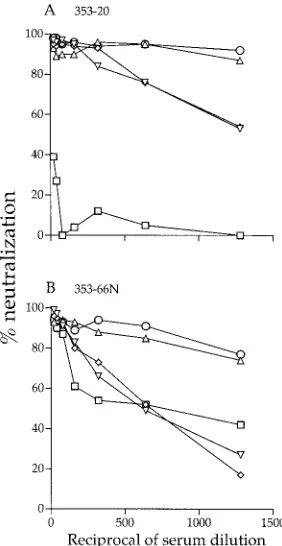
23, 41, 42, 53, 55, 56). We therefore determined the ability
of sera obtained from macaque T353, the animal from which
SHIV
SF162P3was isolated (26), to neutralize wild-type,
mu-tant, and variant viruses. Sera collected at 20 wpi, the time
SHIV
SF162P3was isolated from T353 lymph node PBMCs, and
at necropsy (66 wpi) were used. We found that the variant virus
R7/3-162P3 was highly resistant to neutralization by sera from
macaque T353, which was indicative of immune escape. A 90%
neutralization of the virus was attained with a 1:50 dilution of
week 66 serum but not with the serum collected at the time of
virus isolation at the lowest dilution tested (1:20). In contrast,
greater than 90% neutralization of the wild-type R7/3-162 and
R7/3-162 (g138) mutant viruses was achieved with week 20
serum at 1:1,500 and 1:700 serum dilutions, respectively, but
neutralizing activity against these viruses was noticeably lower
in the week 66 serum (90% inhibitory concentrations of 1:600
and 1:300, respectively). The single R7/3-162 (g158) and
dou-ble R7/3-162 (g138/158) mutant viruses displayed an
interme-diate phenotype. Compared to the wild-type R7/3-162 virus,
both viruses were five- to sevenfold more resistant to
neutral-ization; 90% neutralization required a 1:300 dilution of the
week 20 serum and a 1:100 dilution of the week 66 serum.
Collectively, our findings are in support of a temporal
evolu-tion in antibody responses directed at the envelope
glycopro-tein within the host and are in agreement with previous reports
for HIV-1 and simian immunodeficiency virus infections (1, 3,
7, 8, 12, 18, 44, 61). Importantly, these data show that the
glycan modification that results in better interaction with
DC-SIGN also confers escape from antibody-mediated immune
neutralization.
DISCUSSION
In this study, we address the proposed role of DC-SIGN in
HIV transmission by comparing the ability of envelope
glyco-proteins obtained from SHIVs showing varying degrees of
mu-cosal transmissibility to bind DC-SIGN expressed on the
sur-face of transfected cells. The X4-SHIV
SF33and -SHIV
SF33Aviruses established infection via vaginal transmission with
com-parable efficiency, but the R5-SHIV
SF162P3virus crossed the
FIG. 3. (A) Amino acid alignment of the V1 and V2 regions of
[image:5.587.65.260.75.312.2]wild-type, variant, and mutant envelope glycoproteins. Bold letters
designate amino acid changes.
䡬, presence of glycosylation site. WT,
wild type. (B) Immunoblot analysis of wild-type, P3 variant, and
mu-tant envelope glycoproteins. HEK-293T cells were transfected with
proviral DNAs. Forty-eight hours posttransfection, cells were
har-vested and lysed and proteins were separated by sodium dodecyl
sul-fate–4 to 12% polyacrylamide gel electrophoresis. Envelope gp120s
were detected by immunoblotting with a polyclonal goat anti-gp120
antibody. Positions of gp160 and gp120 are denoted.
FIG. 4. Binding of glycan mutant gp120s to human (Hu) and rhesus
(Rh) DC-SIGN-expressing cells. DC-SIGN-expressing cells were
incu-bated with 293T-cell derived (A) or human PBMC-propagated (B)
wild-type, P3 variant, and gp120 glycan mutant viruses, and the
amounts of bound p24 were determined. Values presented in panels A
and B are the standard error of the mean from three and two
inde-pendent experiments, respectively.
on November 8, 2019 by guest
http://jvi.asm.org/
[image:5.587.332.506.351.661.2]mucosal barrier and spread with a significantly greater
effi-ciency than the parental SHIV
SF162(Table 1). We found that,
whereas the binding of envelope gp120 from X4-SHIV
SF33Ato
DC-SIGN was comparable to that of the parental SHIV
SF33,
there were observable differences for the R5 strains. gp120 of
the pathogenic, highly mucosally transmissible SHIV
SF162P3variant exhibited a threefold or greater increase in binding to
DC-SIGN than that of gp120 from the nonpathogenic, poorly
transmissible parental SHIV
SF162. This difference in the
bind-ing of SHIV
SF162and SHIV
SF162P3was observed with
DC-SIGN from both humans and macaques and was consistent
over a wide range of DC-SIGN expression levels (Fig. 1). This
latter finding is of importance since only moderate levels of
DC-SIGN expression by DCs in vaginal mucosal tissues have
been reported (21, 31). Thus, the difference seen in in vitro
DC-SIGN binding of SHIV
SF162and SHIV
SF162P3envelope
gp120s could be relevant to the differential mucosal
transmis-sibility of SHIV
SF162and SHIV
SF162P3in vivo.
The increase in binding to DC-SIGN of SHIV
SF162P3enve-lope gp120 also translates into an enhancement of T-cell
in-fection in
trans
. Virus containing the variant gp120 (R7/3-P3)
was transferred more efficiently to T cells than virus containing
gp120 from parental SHIV
SF162(R7/3-162) (Fig. 2). A novel
mechanism by which DC-SIGN might enhance HIV infection
has recently been suggested, in which internalization of HIV
particles into a nonlysosomal intracellular compartment
ap-pears to be critical (37). It is proposed that this internalization
increases the amount of virus that can be retained by
DC-SIGN-expressing cells for subsequent transport to secondary
lymphoid tissues and/or induces conformational changes in the
envelope that augment viral infectivity. Regardless of the
mechanism by which DC-SIGN might enhance HIV infection,
it is reasonable to assume that, since more R7/3-P3 viruses are
captured by DC-SIGN-expressing cells, more viruses will be
transmitted to T cells in
trans
. This, in turn, could contribute to
the marked increase in transmission and dissemination of
SHIV
SF162P3in vivo compared to that of SHIV
SF162.
The sites on DC-SIGN to which virus binds have been
in-vestigated extensively (21, 46, 47), but less well defined are the
DC-SIGN binding sites on gp120. We show here that
site-specific gp120 glycosylation, rather than a global increase in
gp120 glycosylation, appears to be responsible for the increase
in binding of SHIV
SF162P3gp120 to DC-SIGN. Compared to
wild-type SHIV
SF162gp120, two additional potential
glycosyl-ation sites are present in SHIV
SF162P3envelope gp120 and
both appear to be utilized (Fig. 3A and B). However, only the
addition of a glycan at the base of the V2 loop (aa 158), and
not at aa 138 within the V1 domain of wild-type SF162 Env,
confers on the mutant virus a DC-SIGN binding efficiency
comparable to that of SHIV
SF162P3gp120 (Fig. 4). This could
be due to differences in the type or orientation of the sugars
located at aa 138 and 158. Alternatively, the glycan at aa 158
does not mediate DC-SIGN binding but may modify the gp120
tertiary structure that participates in DC-SIGN interaction to
increase its affinity. In support of this latter possibility, a recent
study suggested that glycosylations are not necessary for the
interaction of HIV-1 gp120 with DC-SIGN (22).
Interestingly, the same glycan that confers increased binding
to DC-SIGN also confers increased resistance to neutralization
by autologous sera (Fig. 5). It is now recognized that sugar
moieties contribute to steric masking of neutralization
epi-topes on HIV envelope glycoproteins. In the context of
HIV-1
SF162Env, V2 loop glycosylation has been reported to protect
the virus from neutralization by anti-V3 loop and anti-CD4
binding site antibodies (41). The addition of the glycan at
position 158 confers resistance to autologous, but not
heterol-ogous, serum neutralization (Fig. 5 and data not shown),
sug-gesting modulation of recognition by strain-specific rather than
broadly reactive neutralizing antibodies. Indeed,
strain-re-stricted neutralizing antibodies directed against the V2 and V3
domains of HIV-1 gp120 arise relatively early in infection and
are easier to escape from (16, 35, 43–45, 58, 61). The presence
of a single glycan at the base of the V2 loop, therefore, can
change the position of this loop by restricting its movement or
modifying the conformation of the V3 domain. Indeed,
func-tional interactions of the V2 and V3 domains of envelope
gp120 had been reported (2, 36, 63, 64).
[image:6.587.350.491.73.346.2]Macaque T353 seroconverted at 3 wpi, and the sequence
change at aa 158 in gp120 was detected as early as 6 wpi, only
3 weeks after seroconversion (S. Shapiro, M. Hsu, J. Harouse,
C. Cheng-Mayer, and P. Balfe, 9th Conf. Retrovir.
Opportu-nistic Infect., abstr. 358-M, 2002). Thus, it is tempting to
spec-ulate that, as a result of escape from immune recognition, the
virus also alters its ability to interact with DC-SIGN, improving
its transmissibility across mucosal surfaces. It would be of
in-terest to identify the time of emergence of the autologous
neutralizing antibodies that select for the g158 mutation,
pre-sumably between week 3 and week 6 postinfection, as well as
FIG. 5. Autologous neutralization of wild-type, P3 variant, and
gly-can mutant viruses. Sera from macaque T353 at 20 wpi (A) and at
necropsy (66 wpi) (B) were used.
E
, wild-type R7/3-162;
䊐
, variant
R7/3-162P3;
‚
, R7/3-162 (g138);
{
, R7/3-162 (g158);
ƒ
, R7/3-162
(g138/158).
on November 8, 2019 by guest
http://jvi.asm.org/
the temporal changes in gp120 that allow escape of the virus
from recognition by these antibodies. These studies should
provide insights into the selective forces that drive the virus to
change antigenically and, perhaps fortuitously, increase
trans-mission of the virus across mucosal surfaces in vivo.
In summary, our data show a relationship between the more
efficient binding of envelope gp120 to DC-SIGN and the
en-hanced transmission and dissemination of SHIV
SF162P3com-pared to that of parental SHIV
SF162. With regard to the X4
viruses, both SHIV
SF33and SHIV
SF33Ashow mucosal
trans-missibility (two of three for parental SHIV
SF33and six of six for
pathogenic SHIV
SF33A[Table 1]). The difference in infection
between SHIV
SF33and SHIV
SF33Aby the mucosal route as
well as the intravenous route lies principally in the pathological
outcome of the infection (29, 40) and can be explained by
the increased replicative and fusogenic properties of the
SHIV
SF33Aenvelope glycoproteins (13). Both of these X4
vi-ruses bind DC-SIGN with similar efficiency, consistent with the
very modest or absent difference in mucosal transmission of
the two viruses in vivo. In contrast, attempts to infect macaques
with parental R5-SHIV
SF162by the vaginal route have been
unsuccessful, indicating that some intrinsic property of the
virus that mediates efficient mucosal infection is lacking in this
virus. It will be of interest to determine whether SHIV
SF162containing the single g158 mutation can establish vaginal
trans-mission and dissemination in vivo with greater efficiency.
ACKNOWLEDGMENTS
We thank Lisa Chakrabarti and Peter Balfe for critical reading of
the manuscript. We acknowledge the generous gift of the CEMx174
5.25 M7 cell line from Nathaniel Landau, the HIV-1 R7/3 proviral
DNA plasmid from Mark Muesing and Wendy Chen for help with the
graphics.
This work was supported by NIH grants CA72822, AI46980, and AI
41945.
REFERENCES
1.Albert, J., B. Abrahamsson, K. Nagy, E. Aurelius, H. Gaines, G. Nystrom, and E. M. Fenyo.1990. Rapid development of isolate-specific neutralizing antibodies after primary HIV-1 infection and consequent emergence of virus variants which resist neutralization by autologous sera. AIDS4:107–112. 2.Andeweg, A. C., P. Leeflang, A. D. Osterhaus, and M. L. Bosch.1993. Both
the V2 and V3 regions of the human immunodeficiency virus type 1 surface glycoprotein functionally interact with other envelope regions in syncytium formation. J. Virol.67:3232–3239.
3.Arendrup, M., C. Nielsen, J. E. Hansen, C. Pedersen, L. Mathiesen, and J. O. Nielsen.1992. Autologous HIV-1 neutralizing antibodies: emergence of neutralization-resistant escape virus and subsequent development of escape virus neutralizing antibodies. J. Acquir. Immune Defic. Syndr.5:303–307. 4.Back, N. K., L. Smit, J. J. De Jong, W. Keulen, M. Schutten, J. Goudsmit,
and M. Tersmette.1994. An N-glycan within the human immunodeficiency virus type 1 gp120 V3 loop affects virus neutralization. Virology199:431–438. 5.Blauvelt, A., H. Asada, M. W. Saville, V. Klaus-Kovtun, D. J. Altman, R. Yarchoan, and S. I. Katz.1997. Productive infection of dendritic cells by HIV-1 and their ability to capture virus are mediated through separate pathways. J. Clin. Investig.100:2043–2053.
6.Bogers, W. M., C. Cheng-Mayer, and R. C. Montelaro.2000. Developments in preclinical AIDS vaccine efficacy models. AIDS14:S141–S151. 7.Bradney, A. P., S. Scheer, J. M. Crawford, S. P. Buchbinder, and D. C.
Montefiori.1999. Neutralization escape in human immunodeficiency virus type 1-infected long-term nonprogressors. J. Infect. Dis.179:1264–1267. 8.Burns, D. P., C. Collignon, and R. C. Desrosiers.1993. Simian
immunode-ficiency virus mutants resistant to serum neutralization arise during persis-tent infection of rhesus monkeys. J. Virol.67:4104–4113.
9.Cameron, P., M. Pope, A. Granelli-Piperno, and R. M. Steinman.1996. Dendritic cells and the replication of HIV-1. J. Leukoc. Biol.59:158–171. 10.Cameron, P. U., P. S. Freudenthal, J. M. Barker, S. Gezelter, K. Inaba, and
R. M. Steinman.1992. Dendritic cells exposed to human immunodeficiency virus type-1 transmit a vigorous cytopathic infection to CD4⫹T cells. Sci-ence257:383–387.
11.Cayabyab, M., G. B. Karlsson, B. A. Etemad-Moghadam, W. Hofmann, T. Steenbeke, M. Halloran, J. W. Fanton, M. K. Axthelm, N. L. Letvin, and J. G. Sodroski. 1999. Changes in human immunodeficiency virus type 1 envelope glycoproteins responsible for the pathogenicity of a multiply pas-saged simian-human immunodeficiency virus (SHIV-HXBc2). J. Virol.73: 976–984.
12.Chackerian, B., L. M. Rudensey, and J. Overbaugh.1997. Specific N-linked and O-linked glycosylation modifications in the envelope V1 domain of simian immunodeficiency virus variants that evolve in the host alter recog-nition by neutralizing antibodies. J. Virol.71:7719–7727.
13.Chakrabarti, L. A., T. Ivanovic, and C. Cheng-Mayer.2002. Properties of the surface envelope glycoprotein associated with virulence of simian-human immunodeficiency virus SHIVSF33A molecular clones. J. Virol.76:1588– 1599.
14.Cheng-Mayer, C., A. Brown, J. Harouse, P. A. Luciw, and A. J. Mayer.1999. Selection for neutralization resistance of the simian/human immunodefi-ciency virus SHIVSF33Avariant in vivo by virtue of sequence changes in the extracellular envelope glycoprotein that modify N-linked glycosylation. J. Vi-rol.73:5294–5300.
15.Curtis, B. M., S. Scharnowske, and A. J. Watson.1992. Sequence and expression of a membrane-associated C-type lectin that exhibits CD4-inde-pendent binding of human immunodeficiency virus envelope glycoprotein gp120. Proc. Natl. Acad. Sci. USA89:8356–8360.
16.Etemad-Moghadam, B., G. B. Karlsson, M. Halloran, Y. Sun, D. Schenten, M. Fernandes, N. L. Letvin, and J. Sodroski.1998. Characterization of simian-human immunodeficiency virus envelope glycoprotein epitopes rec-ognized by neutralizing antibodies from infected monkeys. J. Virol.72:8437– 8445.
17.Etemad-Moghadam, B., Y. Sun, E. K. Nicholson, M. Fernandes, K. Liou, R. Gomila, J. Lee, and J. Sodroski.2000. Envelope glycoprotein determinants of increased fusogenicity in a pathogenic simian-human immunodeficiency virus (SHIV-KB9) passaged in vivo. J. Virol.74:4433–4440.
18.Fenyo, E. M., J. Albert, and J. McKeating.1996. The role of the humoral immune response in HIV infection. AIDS10:S97–S106.
19.Frankel, S. S., K. Tenner-Racz, P. Racz, B. M. Wenig, C. H. Hansen, D. Heffner, A. M. Nelson, M. Pope, and R. M. Steinman.1997. Active replica-tion of HIV-1 at the lymphoepithelial surface of the tonsil. Am. J. Pathol. 151:89–96.
20.Frankel, S. S., B. M. Wenig, A. P. Burke, P. Mannan, L. D. Thompson, S. L. Abbondanzo, A. M. Nelson, M. Pope, and R. M. Steinman.1996. Replication of HIV-1 in dendritic cell-derived syncytia at the mucosal surface of the adenoid. Science272:115–117.
21.Geijtenbeek, T. B., D. S. Kwon, R. Torensma, S. J. van Vliet, G. C. van Duijnhoven, J. Middel, I. L. Cornelissen, H. S. Nottet, V. N. KewalRamani, D. R. Littman, C. G. Figdor, and Y. van Kooyk.2000. DC-SIGN, a dendritic cell-specific HIV-1-binding protein that enhances trans-infection of T cells. Cell100:587–597.
22.Geijtenbeek, T. B., G. C. van Duijnhoven, S. J. van Vliet, E. Krieger, G. Vriend, C. G. Figdor, and Y. van Kooyk.2002. Identification of different binding sites in the dendritic cell-specific receptor DC-SIGN for intercellular adhesion molecule 3 and HIV-1. J. Biol. Chem.277:11314–11320. 23.Gram, G. J., A. Hemming, A. Bolmstedt, B. Jansson, S. Olofsson, L.
Aker-blom, J. O. Nielsen, and J. E. Hansen.1994. Identification of an N-linked glycan in the V1-loop of HIV-1 gp120 influencing neutralization by anti-V3 antibodies and soluble CD4. Arch. Virol.139:253–261.
24.Granelli-Piperno, A., E. Delgado, V. Finkel, W. Paxton, and R. M. Steinman. 1998. Immature dendritic cells selectively replicate macrophagetropic (M-tropic) human immunodeficiency virus type 1, while mature cells efficiently transmit both M- and T-tropic virus to T cells. J. Virol.72:2733–2737. 25.Grouard, G., and E. A. Clark.1997. Role of dendritic and follicular dendritic
cells in HIV infection and pathogenesis. Curr. Opin. Immunol.9:563–567. 26.Harouse, J. M., A. Gettie, T. Eshetu, R. C. Tan, R. Bohm, J. Blanchard, G.
Baskin, and C. Cheng-Mayer.2001. Mucosal transmission and induction of simian AIDS by CCR5-specific simian/human immunodeficiency virus SHIV (SF162P3). J. Virol.75:1990–1995.
27.Harouse, J. M., A. Gettie, R. C. Tan, J. Blanchard, and C. Cheng-Mayer. 1999. Distinct pathogenic sequela in rhesus macaques infected with CCR5 or CXCR4 utilizing SHIVs. Science284:816–819.
28.Harouse, J. M., A. Gettie, R. C. Tan, T. Eshetu, M. Ratterree, J. Blanchard, and C. Cheng-Mayer.2001. Pathogenic determinants of the mucosally trans-missible CXCR4-specific SHIV(SF33A2) map to env region. J. Acquir. Im-mune Defic. Syndr.27:222–228.
29.Harouse, J. M., R. C. Tan, A. Gettie, P. Dailey, P. A. Marx, P. A. Luciw, and C. Cheng-Mayer.1998. Mucosal transmission of pathogenic CXCR4-utiliz-ing SHIVSF33A variants in rhesus macaques. Virology248:95–107. 30.Hu, J., M. B. Gardner, and C. J. Miller.2000. Simian immunodeficiency
virus rapidly penetrates the cervicovaginal mucosa after intravaginal inocu-lation and infects intraepithelial dendritic cells. J. Virol.74:6087–6095. 31.Jameson, B., F. Baribaud, S. Pohlmann, D. Ghavimi, F. Mortari, R. W.
Doms, and A. Iwasaki.2002. Expression of DC-SIGN by dendritic cells of intestinal and genital mucosae in humans and rhesus macaques. J. Virol. 76:1866–1875.
on November 8, 2019 by guest
http://jvi.asm.org/
32.Joag, S. V., I. Adany, Z. Li, L. Foresman, D. M. Pinson, C. Wang, E. B. Stephens, R. Raghavan, and O. Narayan.1997. Animal model of mucosally transmitted human immunodeficiency virus type 1 disease: intravaginal and oral deposition of simian/human immunodeficiency virus in macaques results in systemic infection, elimination of CD4⫹T cells, and AIDS. J. Virol.
71:4016–4023.
33.Joag, S. V., Z. Li, L. Foresman, E. B. Stephens, L. J. Zhao, I. Adany, D. M. Pinson, H. M. McClure, and O. Narayan.1996. Chimeric simian/human immunodeficiency virus that causes progressive loss of CD4⫹T cells and
AIDS in pig-tailed macaques. J. Virol.70:3189–3197.
34.Karlsson, G. B., M. Halloran, D. Schenten, J. Lee, P. Racz, K. Tenner-Racz, J. Manola, R. Gelman, B. Etemad-Moghadam, E. Desjardins, R. Wyatt, N. P. Gerard, L. Marcon, D. Margolin, J. Fanton, M. K. Axthelm, N. L. Letvin, and J. Sodroski.1998. The envelope glycoprotein ectodomains determine the efficiency of CD4⫹T lymphocyte depletion in simian-human immuno-deficiency virus-infected macaques. J. Exp. Med.188:1159–1171. 35.Kenealy, W. R., T. J. Matthews, M. C. Ganfield, A. J. Langlois, D. M.
Waselefsky, and S. R. Petteway, Jr.1989. Antibodies from human immuno-deficiency virus-infected individuals bind to a short amino acid sequence that elicits neutralizing antibodies in animals. AIDS Res. Hum. Retrovir.5:173– 182.
36.Koito, A., G. Harrowe, J. A. Levy, and C. Cheng-Mayer.1994. Functional role of the V1/V2 region of human immunodeficiency virus type 1 envelope glycoprotein gp120 in infection of primary macrophages and soluble CD4 neutralization. J. Virol.68:2253–2259.
37.Kwon, D. S., G. Gregorio, N. Bitton, W. A. Hendrickson, and D. R. Littman. 2002. DC-SIGN-mediated internalization of HIV is required for trans-en-hancement of T cell infection. Immunity16:135–144.
38.LaBonte, J. A., T. Patel, W. Hofmann, and J. Sodroski.2000. Importance of membrane fusion mediated by human immunodeficiency virus envelope glycoproteins for lysis of primary CD4-positive T cells. J. Virol.74:10690– 10698.
39.Langhoff, E., K. H. Kalland, and W. A. Haseltine.1993. Early molecular replication of human immunodeficiency virus type 1 in cultured-blood-de-rived T helper dendritic cells. J. Clin. Investig.91:2721–2726.
40.Luciw, P. A., C. P. Mandell, S. Himathongkham, J. Li, T. A. Low, K. A. Schmidt, K. E. Shaw, and C. Cheng-Mayer.1999. Fatal immunopathogenesis by SIV/HIV-1 (SHIV) containing a variant form of the HIV-1SF33 env gene in juvenile and newborn rhesus macaques. Virology263:112–127. 41.Ly, A., and L. Stamatatos.2000. V2 loop glycosylation of the human
immu-nodeficiency virus type 1 SF162 envelope facilitates interaction of this pro-tein with CD4 and CCR5 receptors and protects the virus from neutraliza-tion by anti-V3 loop and anti-CD4 binding site antibodies. J. Virol.74:6769– 6776.
42.Malenbaum, S. E., D. Yang, L. Cavacini, M. Posner, J. Robinson, and C. Cheng-Mayer.2000. The N-terminal V3 loop glycan modulates the interac-tion of clade A and B human immunodeficiency virus type 1 envelopes with CD4 and chemokine receptors. J. Virol.74:11008–11016.
43.Montefiori, D. C., K. A. Reimann, M. S. Wyand, K. Manson, M. G. Lewis, R. G. Collman, J. G. Sodroski, D. P. Bolognesi, and N. L. Letvin.1998. Neutralizing antibodies in sera from macaques infected with chimeric simi-an-human immunodeficiency virus containing the envelope glycoproteins of either a laboratory-adapted variant or a primary isolate of human immuno-deficiency virus type 1. J. Virol.72:3427–3431.
44.Moog, C., H. J. Fleury, I. Pellegrin, A. Kirn, and A. M. Aubertin.1997. Autologous and heterologous neutralizing antibody responses following ini-tial seroconversion in human immunodeficiency virus type 1-infected indi-viduals. J. Virol.71:3734–3741.
45.Parren, P. W., J. P. Moore, D. R. Burton, and Q. J. Sattentau.1999. The neutralizing antibody response to HIV-1: viral evasion and escape from humoral immunity. AIDS13:S137–S162.
46.Po¨hlmann, S., F. Baribaud, B. Lee, G. J. Leslie, M. D. Sanchez, K. Hiebenthal-Millow, J. Mu¨nch, F. Kirchhoff, and R. W. Doms.2001. DC-SIGN interactions with human immunodeficiency virus type 1 and 2 and simian immunodeficiency virus. J. Virol.75:4664–4672.
47.Po¨hlmann, S., G. J. Leslie, T. G. Edwards, T. Macfarlan, J. D. Reeves, K. Hiebenthal-Millow, F. Kirchhoff, F. Baribaud, and R. W. Doms.2001. DC-SIGN interactions with human immunodeficiency virus: virus binding and transfer are dissociable functions. J. Virol.75:10523–10526.
48.Pohlmann, S., E. J. Soilleux, F. Baribaud, G. J. Leslie, L. S. Morris, J. Trowsdale, B. Lee, N. Coleman, and R. W. Doms.2001. DC-SIGNR, a DC-SIGN homologue expressed in endothelial cells, binds to human and simian immunodeficiency viruses and activates infection in trans. Proc. Natl. Acad. Sci. USA98:2670–2675.
49.Pope, M., M. G. Betjes, N. Romani, H. Hirmand, P. U. Cameron, L. Hoff-man, S. Gezelter, G. Schuler, and R. M. Steinman.1994. Conjugates of dendritic cells and memory T lymphocytes from skin facilitate productive infection with HIV-1. Cell78:389–398.
50.Pope, M., S. Gezelter, N. Gallo, L. Hoffman, and R. M. Steinman.1995. Low levels of HIV-1 infection in cutaneous dendritic cells promote extensive viral replication upon binding to memory CD4⫹T cells. J. Exp. Med.182:2045– 2056.
51.Reece, J. C., A. J. Handley, E. J. Anstee, W. A. Morrison, S. M. Crowe, and P. U. Cameron.1998. HIV-1 selection by epidermal dendritic cells during transmission across human skin. J. Exp. Med.187:1623–1631.
52.Reimann, K. A., J. T. Li, R. Veazey, M. Halloran, I. W. Park, G. B. Karlsson, J. Sodroski, and N. L. Letvin.1996. A chimeric simian/human immunode-ficiency virus expressing a primary patient human immunodeimmunode-ficiency virus type 1 isolate env causes an AIDS-like disease after in vivo passage in rhesus monkeys. J. Virol.70:6922–6928.
53.Reitter, J. N., R. E. Means, and R. C. Desrosiers.1998. A role for carbohy-drates in immune evasion in AIDS. Nat. Med.4:679–684.
54.Rowland-Jones, S. L.1999. HIV: the deadly passenger in dendritic cells. Curr. Biol.9:R248–R250.
55.Rudensey, L. M., J. T. Kimata, E. M. Long, B. Chackerian, and J. Over-baugh.1998. Changes in the extracellular envelope glycoprotein of variants that evolve during the course of simian immunodeficiency virus SIVMne infection affect neutralizing antibody recognition, syncytium formation, and macrophage tropism but not replication, cytopathicity, or CCR-5 coreceptor recognition. J. Virol.72:209–217.
56.Schonning, K., B. Jansson, S. Olofsson, J. O. Nielsen, and J. S. Hansen. 1996. Resistance to V3-directed neutralization caused by an N-linked oligo-saccharide depends on the quaternary structure of the HIV-1 envelope oligomer. Virology218:134–140.
57.Shibata, R., F. Maldarelli, C. Siemon, T. Matano, M. Parta, G. Miller, T. Fredrickson, and M. A. Martin.1997. Infection and pathogenicity of chi-meric simian-human immunodeficiency viruses in macaques: determinants of high virus loads and CD4 cell killing. J. Infect. Dis.176:362–373. 58.Shotton, C., C. Arnold, Q. Sattentau, J. Sodroski, and J. A. McKeating.1995.
Identification and characterization of monoclonal antibodies specific for polymorphic antigenic determinants within the V2 region of the human immunodeficiency virus type 1 envelope glycoprotein. J. Virol.69:222–230. 59.Spira, A. I., P. A. Marx, B. K. Patterson, J. Mahoney, R. A. Koup, S. M. Wolinsky, and D. D. Ho.1996. Cellular targets of infection and route of viral dissemination after an intravaginal inoculation of simian immunodeficiency virus into rhesus macaques. J. Exp. Med.183:215–225.
60.Stamatatos, L., A. Werner, and C. Cheng-Mayer.1994. Differential regula-tion of cellular tropism and sensitivity to soluble CD4 neutralizaregula-tion by the envelope gp120 of human immunodeficiency virus type 1. J. Virol.68:4973– 4979.
61.Tsang, M. L., L. A. Evans, P. McQueen, L. Hurren, C. Byrne, R. Penny, B. Tindall, and D. A. Cooper.1994. Neutralizing antibodies against sequential autologous human immunodeficiency virus type 1 isolates after seroconver-sion. J. Infect. Dis.170:1141–1147.
62.Weissman, D., Y. Li, J. M. Orenstein, and A. S. Fauci.1995. Both a precursor and a mature population of dendritic cells can bind HIV. However, only the mature population that expresses CD80 can pass infection to unstimulated CD4⫹T cells. J. Immunol.155:4111–4117.
63.Westervelt, P., D. B. Trowbridge, L. G. Epstein, B. M. Blumberg, Y. Li, B. H. Hahn, G. M. Shaw, R. W. Price, and L. Ratner.1992. Macrophage tropism determinants of human immunodeficiency virus type 1 in vivo. J. Virol.66: 2577–2582.
64.Ye, Y., Z. H. Si, J. P. Moore, and J. Sodroski.2000. Association of structural changes in the V2 and V3 loops of the gp120 envelope glycoprotein with acquisition of neutralization resistance in a simian-human immunodeficiency virus passaged in vivo. J. Virol.74:11955–11962.
on November 8, 2019 by guest
http://jvi.asm.org/