Combining Web Data Mining Techniques for
Web Page Access Prediction
A Dissertation submitted by
Faten Khalil M.IT.
For the award of
Doctor of Philosophy
Abstract
Web page access prediction gained its importance from the ever increasing
num-ber of e-commerce Web information systems and e-businesses. Web page
pre-diction, that involves personalising the Web users’ browsing experiences, assists
Web masters in the improvement of the Web site structure and helps Web users in
navigating the site and accessing the information they need. The most widely used
approach for this purpose is the pattern discovery process of Web usage mining
that entails many techniques like Markov model, association rules and clustering.
Implementing pattern discovery techniques as such helps predict the next page to
be accessed by the Web user based on the user’s previous browsing patterns.
How-ever, each of the aforementioned techniques has its own limitations, especially
when it comes to accuracy and space complexity. This dissertation achieves better
accuracy as well as less state space complexity and rules generated by
perform-ing the followperform-ing combinations. First, we combine low-order Markov model and
association rules. Markov model analysis are performed on the data sets. If the
Markov model prediction results in a tie or no state, association rules are used for
prediction. The outcome of this integration is better accuracy, less Markov model
methods individually. Second, we integrate low-order Markov model and
clus-tering. The data sets are clustered and Markov model analysis are performed on
each cluster instead of the whole data sets. The outcome of the integration is better
accuracy than the first combination with less state space complexity than higher
order Markov model. The last integration model involves combining all three
techniques together: clustering, association rules and low-order Markov model.
The data sets are clustered and Markov model analysis are performed on each
cluster. If the Markov model prediction results in close accuracies for the same
item, association rules are used for prediction. This integration model achieves
better Web page access prediction accuracy, less Markov model state space
Certification of Dissertation
I certify that the work reported in this thesis is entirely my own effort, except
where otherwise acknowledged. This report is original and contains no material
offered for the award of any other academic qualification at this or any other
in-stitution, or material previously published, except where due reference is made in
the text.
Signature of Candidate Date
Acknowledgements
I heartily thank my former principal supervisor Dr Jiuyong Li for his research
direction of this project, his support, patience and guidance. Dr Li, provided
me with clear direction and encouragement, thoughtful and constructive feedback
on my work in a timely manner, as well as assistance and advice when needed
even after he left USQ. I sincerely thank my current supervisor, Dr Hua Wang,
for his continuous guidance, encouragement, valuable insights and support. Dr
Wang was always there for me when I needed assistance and advice both as my
associate supervisor as well as my principal supervisor later on. My gratitude also
goes to the Department of Mathematics and Computing, University of Southern
Queensland (USQ) for the financial support provided for attending conferences.
I am extremely grateful to the Head of Department Professor Ron Addie and his
secretary Ms Helen Nkansah. Lastly, but not least, I greatly appreciate the support
from my parents and my family. Their care and love are what keeps me going
Publications
The publications arising from this dissertation are as follows:
1. Khalil, F., Li, J. and Wang, H. (2006). A Framework of Combining Markov
Model with Association Rules for Predicting Web Page Accesses. In Proc.
Aus-tralasian Data Mining Conference (AusDM’06), Sydney, Australia. CRPIT, 61.
pp 177-184.
2. Khalil, F., Li, J. and Wang, H. (2007). Integrating Markov Model with
Clus-tering for Predicting Web Page Accesses. In Proc. Australian World Wide Web
(AusWeb’07), Coffs Harbour, Australia. pp 63-74.
3. Khalil, F., Li, J. and Wang, H. (2008). Integrating Recommendation Models
for Improved Web page prediction accuracy. In Proc. Thirty-First Australasian
Computer Science Conference (ACSC’08), Wollongong, Australia. CRPIT, 74.
pp 91-100.
4. Khalil, F., Li, J. and Wang, H. (In progress). Improving Web Page Prediction
Accuracy by Integrating Markov model, Association rules and Clustering. Journal
Contents
1 Introduction 1
1.1 Research Objectives. . . 2
1.2 Dissertation Structure . . . 4
1.3 Applications. . . 5
2 Background 9 2.1 Introduction . . . 9
2.2 Web Data Mining . . . 11
2.2.1 Web Structure Mining . . . 11
2.2.2 Web Content Mining . . . 12
2.2.3 Web Usage Mining . . . 13
2.2.3.1 Preprocessing . . . 13
2.2.3.2 Pattern Discovery . . . 15
2.3 Web Usage Mining Techniques and Web Page Prediction . . . 18
3 Prediction Techniques 21 3.1 Introduction . . . 21
3.2 Markov Model . . . 23
3.3 Association Rules . . . 27
3.4 Clustering . . . 31
3.5 Conclusion . . . 41
4 Integrating Markov Model with Association Rules 43 4.1 Introduction . . . 43
4.2 Markov Model . . . 44
4.2.1 Limitations of Markov Models . . . 45
4.2.2 Markov Model State Space Complexity . . . 47
4.2.3 Using Markov Model Order for Prediction . . . 49
4.3 Association Rules . . . 50
4.3.1 Limitations of Association Rules. . . 51
4.3.3 Error Estimation of Association Rules Based Prediction . 56
4.4 Integration Process . . . 57
4.4.1 Motivation for Integration . . . 57
4.4.2 Integration Algorithm . . . 62
4.4.2.1 Markov Model Implementation . . . 63
4.4.2.2 Implementation of Association Rule Mining . . 65
4.4.3 Integration Example . . . 69
4.5 Experimental Evaluation . . . 73
4.5.1 Experiments Results . . . 76
4.5.2 Integration Model (IMAM) Accuracy Results . . . 81
4.5.3 Comparing IMAM to a Higher Order Markov Model . . . 85
4.5.3.1 State Space Complexity . . . 85
4.5.3.2 Accuracy . . . 86
4.6 Conclusion . . . 87
5 Integrating Markov Model with Clustering 89 5.1 Introduction . . . 89
5.2.1 Limitations of Clustering Techniques . . . 91
5.2.2 Using Markov Model and Clustering for Prediction . . . . 92
5.3 Integration Process . . . 94
5.3.1 Motivation for Integration . . . 95
5.3.2 Integration Algorithm . . . 98
5.3.2.1 Feature Selection . . . 99
5.3.2.2 Session Categorisation. . . 101
5.3.2.3 k-means Distance Measures . . . 104
5.3.2.4 Number of Clusters(k) . . . 110
5.3.2.5 Markov Model Implementation . . . 112
5.3.2.6 Item-Cluster Proximity . . . 113
5.3.3 Integration Example . . . 114
5.3.4 IMC Algorithm Efficiency Analysis . . . 115
5.3.4.1 Clustering Complexity. . . 115
5.3.4.2 Prediction Complexity. . . 116
5.4 Experimental Evaluation . . . 116
5.4.2 Number of Clusters(k) . . . 118
5.4.3 Distance Measures Evaluation . . . 118
5.4.4 Experiments Results . . . 122
5.4.5 Comparing IMC, Clustering and MM Accuracy . . . 128
5.4.6 Comparing IMC To a Higher Order Markov Model . . . . 130
5.4.6.1 Comparing State Space Complexity . . . 130
5.4.6.2 Comparing Accuracy . . . 131
5.4.7 IMC Complexity . . . 132
5.5 Conclusion . . . 134
6 Integrating Markov Model with Association Rules and Clustering 135 6.1 Introduction . . . 135
6.2 Integration Process . . . 136
6.2.1 Motivation For Integration . . . 136
6.2.2 IPM Algorithm . . . 138
6.2.2.1 Algorithm Training process . . . 139
6.2.2.2 Algorithm Prediction Process . . . 143
6.2.4 IPM Algorithm Efficiency Analysis . . . 147
6.3 Experimental Evaluation . . . 148
6.3.1 Clustering, Markov Model and Association Rules . . . 148
6.3.2 Experiments Results . . . 149
6.3.3 Comparing All Models Accuracy Results . . . 152
6.3.4 Comparing Results to a Higher Order Markov Model . . . 154
6.3.4.1 State Space Complexity Comparison . . . 154
6.3.4.2 Accuracy Comparison . . . 157
6.4 Conclusion . . . 157
7 Conclusions 159 7.1 General Discussions. . . 159
7.2 Conclusion of Results . . . 160
7.3 Strengths of Findings . . . 161
7.4 Limitations and Future Directions . . . 162
List of Figures
1.1 Dissertation structure. . . 5
2.1 Web data mining architecture. . . 10
2.2 Web usage mining architecture. . . 18
4.1 Accuracy of all 1-, 2-, 3- and 4- frequency pruned Markov model orders. . . 50
4.2 The Integrated Markov and Association Model (IMAM) archi-tecture. . . 61
4.3 Online computer store Web page structure. . . 70
4.4 Example Web log. . . 74
4.5 Frequency chart for the most frequent visited pages. . . 76
4.6 Accuracy of 1st, 2nd, 3rd and 4thorder Markov models and all 1st,
2nd, 3rd and 4th order frequency pruned Markov models for data
set D1. . . 77
4.7 Accuracy of 1st, 2nd, 3rd and 4thorder Markov models and all 1st,
2nd, 3rd and 4th order frequency pruned Markov models for data
set D2. . . 78
4.8 Accuracy of 1st, 2nd, 3rd and 4thorder Markov models and all 1st,
2nd, 3rd and 4th order frequency pruned Markov models for data
set D3. . . 79
4.9 Accuracy of 1st, 2nd, 3rd and 4thorder Markov models and all 1st,
2nd, 3rd and 4th order frequency pruned Markov models for data
set D4. . . 80
4.10 Number of rules generated according to different support
thresh-old values and a fixed confidence factor: 90%. . . 80
4.11 No. of rules generated according to a fixed support threshold: 4%. 81
4.12 Time complexity in seconds for different support value. . . 81
4.13 Portion of association rules results. . . 82
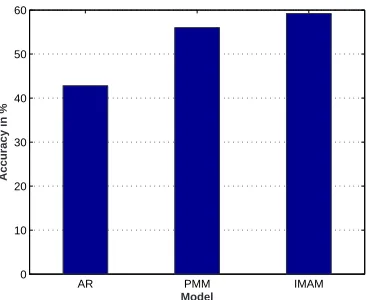
4.14 Accuracy of Association rules (AR), Frequency Pruned all 2nd
4.15 Accuracy of Association rules (AR), Frequency Pruned all 2nd
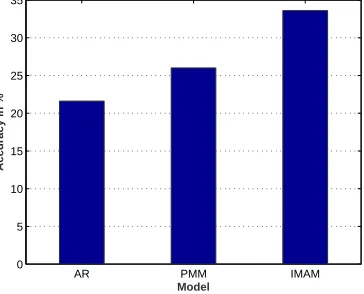
order Markov model (PMM) and IMAM model for data set D2. . 85
4.16 Accuracy of Association rules (AR), Frequency Pruned all 2nd order Markov model (PMM) and IMAM model for data set D3. . 86
4.17 Accuracy of Association rules (AR), Frequency Pruned all 2nd order Markov model (PMM) and IMAM model for data set D4. . 87
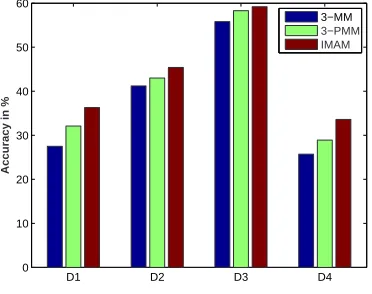
4.18 Accuracy of 3rd order Markov model (3-MM), frequency pruned all 3rd order Markov model (3-PMM) and IMAM model for all four data sets. . . 88
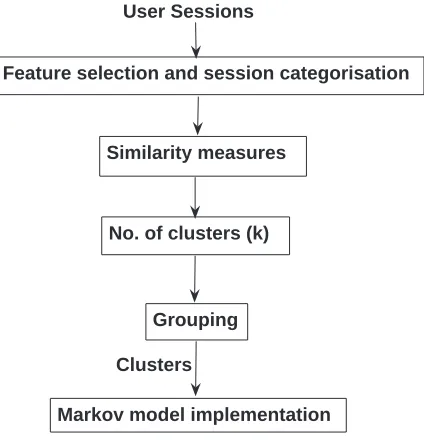
5.1 The stages of clustering before Markov model implementaion. . . 95
5.2 The integration model (IMC) architecture. . . 98
5.3 ISODATA improves the k-means clusters. . . . 111
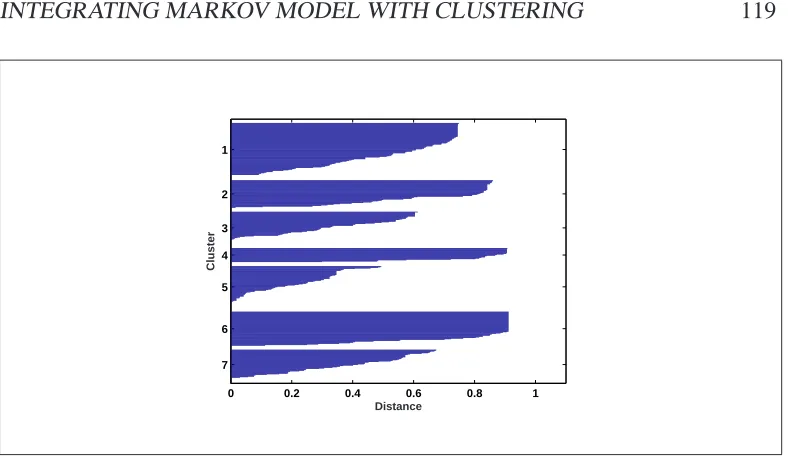
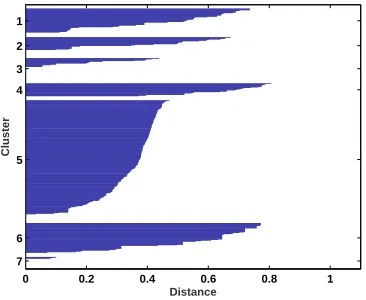
5.4 Silhouette value of D1 with 7 clusters. . . 119
5.5 Silhouette value of D2 with 9 clusters. . . 119
5.6 Silhouette value D3 with 14 clusters. . . 120
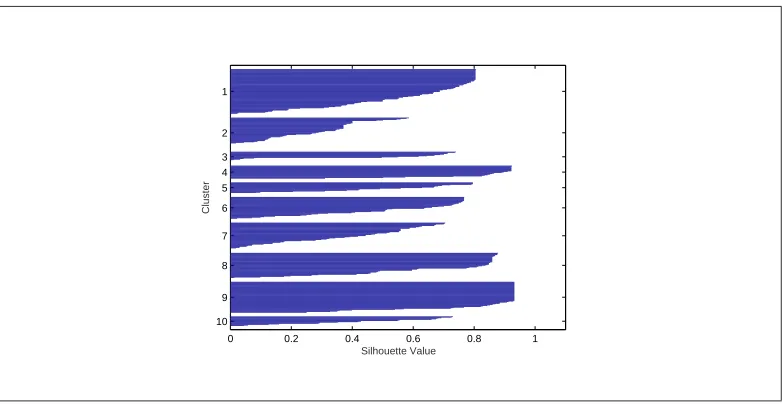
5.7 Silhouette value of D4 with 10 clusters. . . 120
5.8 Silhouette value of Euclidean distance measure with 7 clusters. . 122
5.10 Silhouette value of City Block distance measure with 7 clusters. . 123
5.11 Silhouette value of Correlation distance measure with 7 clusters. . 124
5.12 Silhouette value of Cosine distance measure with 7 clusters. . . . 124
5.13 The mean value for 2...10 clusters using different distance mea-sures. . . 124
5.14 Flowchart illustrating prediction accuracy calculation process. . . 127
5.15 Accuracy of clustering, Markov model of whole data set and Markov model accuracy using clusters based on Euclidean, Cor-relation and Cosine distance measures with k=7 for data set D1. . . . 128
5.16 Accuracy of clustering, PMM and IMC for data set D1. . . 129
5.17 Accuracy of clustering, PMM and IMC for data set D2. . . 130
5.18 Accuracy of clustering, PMM and IMC for data set D3. . . 130
5.19 Accuracy of clustering, PMM and IMC for data set D4. . . 131
5.20 Accuracy of 3rd order Markov model (3-MM), frequency pruned all 3rd order Markov model (3-PMM) and IMC model for all four data sets. . . 132
5.21 Running time of clusters for all four data sets. . . 133
6.1 IPM model architecture. . . 139
6.2 Accuracy of Clustering, AR, PMM, and IPM for data set D1. . . 150
6.3 Accuracy of Clustering, AR, PMM, and IPM for data set D2. . . 151
6.4 Accuracy of Clustering, AR, PMM, and IPM for data set D3. . . 151
6.5 Accuracy of Clustering, AR, PMM, and IPM for data set D4. . . 152
6.6 Accuracy of Clustering, AR, PMM, IMAM, IMC and IPM for
data set D1. . . 153
6.7 Accuracy of Clustering, AR, PMM, IMAM, IMC and IPM for
data set D2. . . 154
6.8 Accuracy of Clustering, AR, PMM, IMAM, IMC and IPM for
data set D3. . . 155
6.9 Accuracy of Clustering, AR, PMM, IMAM, IMC and IPM for
data set D4. . . 156
6.10 Accuracy of Clustering, AR, PMM, IMAM, IMC and IPM for all
four data sets. . . 157
6.11 Accuracy of 3-MM and 3-PMM compared to that of IMAM, IMC
List of Tables
4.1 Number of states of all 1- to 4- Markov model orders. . . 48
4.2 Number of states of frequency pruned Markov model orders. . . . 49
4.3 Example: Four Web transactions . . . 51
4.4 User sessions . . . 69
4.5 Pageviews frequencies . . . 70
4.6 User sessions after frequency and support pruning . . . 70
4.7 User sessions history . . . 71
4.8 Confidence of accessing page M using subsequence association rules . . . 72
4.9 Confidence of accessing page N using subsequence association rules 72 4.10 Sessions . . . 76
4.11 IMAM number of states. . . 86
5.1 Example: initial Web sessions . . . 103
5.2 Example: Preprocessed Web sessions . . . 103
5.3 Web sessions after categorisation . . . 103
5.4 Sessions . . . 109
5.5 Sessions distances . . . 109
5.6 Example of user sessions. . . 114
5.7 The first cluster. . . 114
5.8 The second cluster. . . 115
5.9 Number of categories . . . 117
5.10 Session categorisation . . . 117
5.11 Entropy measures for different clusters. . . 121
5.12 Web sessions grouped into 7 clusters . . . 126
5.13 IMC number of states . . . 131
6.1 Accuracy according to zα/2value . . . 142
6.2 User sessions. . . 145
6.3 First cluster. . . 145
6.5 User sessions history . . . 146
6.6 Confidence of accessing page E using subsequence association rules147
6.7 Confidence of accessing page G using subsequence association rules147
6.8 Prediction accuracy using all models for all four data sets. . . 154
6.9 Number of states for 3-PMM, IMAM, IMC and IPM and 3-MM
using D1, D2, D3 and D4. . . 155
Chapter 1
Introduction
Data mining research interest is the result of the vast amount of data that forms part
of our daily activities. Web data mining gains its importance with the increasing
amount of Web information that is becoming much larger than any traditional
data sources. Web data mining involves applying data mining techniques to Web
data. It focuses on the Web pages link structure, their content and their usage.
Web usage mining concentrates on tools and techniques used to predict users’
navigational paths by discovering their Web access patterns. It includes three
stages: preprocessing, pattern discovery and pattern analysis. The field of pattern
discovery has been a major study for improving the efficiency of numerous Web
based applications including e-commerce. Web applications today are driven to
provide a more personalised experience for their users. Therefore, it is extremely
important to form some kind of interaction with Web users and always be one
step ahead of them when it comes to predicting next accessed pages. For instance,
knowing the user’s browsing history on the site grants us valuable information as
to which one of the most frequently accessed pages will be accessed next. Also, it
provides us with extra information like the type of users we are dealing with and
the users preferences as well. Pattern discovery achieves this by extracting useful
knowledge and patterns applying different tools and techniques. Some of these
tools are association rules, clustering and Markov models. Each of these pattern
discovery techniques has its own strengths and weaknesses. Discovered patterns
of accessed Web pages helps predict the next page to be accessed by the user.
1.1
Research Objectives
The immense volume of online information covering almost all types of
applica-tions turns the Web into a huge mine that is susceptible to a wide range of
infor-mation discovery and retrieval tools. There has been a lot of research covering
advanced data mining techniques to extract useful knowledge from large amount
of data. Association rules, clustering and Markov models have been widely used
for this purpose.
Association rule mining is a major pattern discovery techniqueMobasher et al.
(2000),Agrawal & Srikant(1994). The patterns are discovered based on previous
history. The original goal of association rule mining is to solve market basket
sum-marise relationships illustrated by the following example. Customers who buy
bread and milk will most likely buy eggs, or, bread and milk→eggs. Association rules are mainly defined by two metrics: support and confidence. The main
lim-itation of association rules is that they tend to generate many rules, which result
in contradictory predictions for a user session. Markov models are also becoming
very commonly used in the identification of patterns based on the sequence of
previously accessed itemsBouras & Konidaris(2004), Chen et al.(2002),
Desh-pande & Karypis (2004), Eirinaki et al. (2005), Jespersen et al. (2003), Sarwar
et al.(2001),Zhu et al.(2002a,b). However, Markov model implementations have
been hindered due to the fact that low order Markov models do not use enough
history and therefore, lack accuracy, whereas, high order Markov models incur
high state space complexity. Clustering is defined as the classification of patterns
into groups (clusters) based on similarity between common activitiesAdami et al.
(2003),Cadez et al.(2003),Strehl et al.(2000). The main clustering limitation is
that clustering methods are unsupervised methods, and normally are not used for
classification directly.
Each of the mentioned pattern discovery techniques has been widely used for
Web page access prediction, as discussed in later chapters. However, the
limita-tions associated with them hinder their improvements when it comes to Web page
access prediction and state space complexity. The main purpose behind
imple-menting such tools for Web page access prediction is to achieve reliable
in-dividual implementation of these tools fails to achieve higher prediction accuracy
together with lower state space complexity. This dissertation aims at improving
the Web page access prediction accuracy while keeping the state space
complex-ity to a minimum by using different integration models based on Markov models,
association rules and clustering and according to certain constraints.
1.2
Dissertation Structure
The dissertation consists of seven chapters. Chapter 2 gives an insight into the
background of data mining, Web data mining and Web usage mining in particular
and their importance in Web page access prediction and applications. Chapter 3
introduces the three Web usage mining tools: Markov model, association rules
and clustering emphasizing on their importance in Web page prediction and listing
their limitations. Chapter 4 presents a new model that integrates Markov model
with association rules. Association rule mining is only applied when Markov
model implementation results in no states or in two or more similar conditional
probabilities forming a tie. Chapter 5 integrates both Markov model and clustering
techniques. During the prediction process, the new state is assigned to an
appro-priate cluster and Markov model is implemented on that particular cluster only.
Chapter 6 further integrates the three models together: Markov model, clustering
and association rules. During the prediction process, after assigning the new state
do not belong to the majority class, association rules are implemented. Chapter 7
concludes our work emphasizing its importance and listing some limitations and
future directions.
Figure 1.1 summarises the structure of the dissertation chapters where MM
stands for Markov model, AR stands for association rules and Clust stands for
clustering techniques.
1. Introduction
2. Background
3. Prediction Techniques
4. MM + AR 5. MM + Clust 6. MM + AR + Clust
7. Conclusion
Figure 1.1: Dissertation structure.
1.3
Applications
The main motivation behind this dissertation is the correlation between Web usage
mining and Web personalisation. The work on Web usage mining can be a source
of ideas and solutions towards realizing Web personalisation. The ultimate goal of
Web personalisation is to provide Web users with the next page they will access
comparing the discovered patterns to similar patterns in history. Traditionally,
this has been used to support the decision making process by Web site operators
in order to gain better understanding of their visitors, to create a more efficient
structure of the Web sites and to perform a more effective marketing. A number
of other functions can be provided in the following areas as a result of Web page
access prediction including, but not limited to:
• Guiding the Web site users by providing them with recommendations of a
set of hyperlinks that are related to the users’ interests and preferences and
improve the users navigational experience and providing users with
person-alised and customised page layout, hyperlinks and content depending on
their interests and preferences.
• Performance of the system of some actions on behalf of users such as
send-ing e-mail, downloadsend-ing items, completsend-ing or enhancsend-ing the users’ queries,
or even participating in Web auctions on behalf of Web users.
• Learning and predicting user clicks in Web based search facilitiesZhou et al.
(2007). This offers an automated explanation of Web user activity. Also,
the measurement of the likelihood of clicks can infer a user’s judgement of
search results and improve Web page ranking.
• Minimizing latency of viewing pages especially image files, by pre-fetching
et al.(2003),Pons(2006). Despite the apparent similarity between Web
pre-fetching and Web cachingChen et al. (2002), Bouras & Konidaris (2004),
Web pre-fetching goes one step further by anticipating the Web users’ future
requests and pre-loading the predicted pages into a cache. This is a major
method to reduce Web latency which can be measured as the difference
be-tween the time when a user makes a request and when the user receives the
response. Web latency is particularly important to Web surfers e-commerce
Web sitesSu et al.(2000),Zuckerman et al.(1999).
• Customizing Web site interfaces by predicting the next relevant pages or
products and overcoming the information overload by providing multiple
short-cut links relevant to the items of interest in a pageChen et al.(2003),
Deshpande & Karypis(2004,2001),Yan et al.(1996).
• Improving site topology as well as market segmentation.
• Improving the Web advertisement area where a substantial amount of money
is paid for placing the correct advertisements on Web sites. Using Web
page access prediction, the right ad will be predicted according to the users’
Chapter 2
Background
2.1
Introduction
The ongoing increase in the amount of Web data has led to the explosive growth
of Web data repositories. Web pages and their contents are accessed and provided
by a wide variety of applications and they are added and deleted every day.
More-over, the Web does not provide its users with a standard coherent page structure
across Web sites. These facts make it very difficult to analyze the content of Web
pages by automated tools. Therefore, there arises a need for Web data mining
techniques.
Data mining involves the study of data-driven techniques to discover and model
hidden patterns in large volumes of raw data. The application of data mining
tech-niques to Web data is referred to as Web data mining. Web data mining can be
divided into three distinct areas: Web content mining, Web structure mining and
Web usage mining. Web content mining involves efficiently extracting useful and
relevant information from millions of Web sites and databases. Web structure
mining involves the techniques used to study the Web pages schema of a
collec-tion of hyper-links. Web usage mining on the other hand, involves the analysis
and discovery of user access patterns from Web servers in order to better serve the
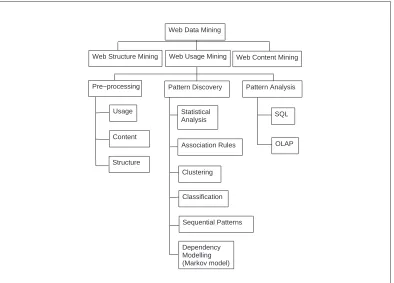
users’ needs. Figure 2.1 below summarises the processes involved in each of the
Web data mining phases.
Web Data Mining
Web Structure Mining Web Usage Mining Web Content Mining
Pattern Discovery Pattern Analysis Pre−processing
SQL
OLAP Statistical
Analysis
Association Rules Content
Usage
Structure
Clustering
Classification
Sequential Patterns
[image:32.595.87.481.366.649.2]Dependency Modelling (Markov model)
2.2
Web Data Mining
With the advancement in computer technologies, there has been a major need
to apply data mining techniques to electronic data as the amount of information
stored is increasing at a very high pace. This makes traditional data analysis tools
very limited in making use of stored data for businesses to gain an edge over
their competitors. Data mining is the analytical process to explore large amounts
of data with the purpose of extracting patterns Cooley et al. (1997). The data
mining process is composed essentially of three different stages: data preparation
which is the initial exploration, search for patterns or pattern identification, and
the knowledge interpretation and evaluation that involves deployment of patterns
to new data.
Web data mining is the process of applying data mining techniques to Web
data. Research in this area has the objectives of helping e-commerce businesses
in their decision making, assisting in the design of good Web sites and assisting
the user when navigating the Web. The World Wide Web data mining focuses on
three issues: Web structure mining, Web content mining and Web usage mining.
2.2.1
Web Structure Mining
Web structure mining aims at generating structured summary about Web sites and
information, which is an important aspect of Web data. Web structure mining can
be used to reveal the structure or schema of Web pages which would facilitate
Web document classification and clustering on the basis of its structure Spertus
(1997).
Web structure mining is very useful in generating information such as visible
Web documents, luminous Web documents and luminous path which is the path
common to most of the results returnedBhowmick et al.(1998). Another related
work in the area of schema discovery of structured and semi-structured documents
is apparent inWang & Liu(1998,1997).
2.2.2
Web Content Mining
Web content mining involves mining Web data contents. It focuses on various
techniques that assist in searching the Web for documents whose content meets a
certain goal. Those documents, once found, are used to build a knowledge base.
The emphasis here is on analysing the Internet hypertext material. The Internet
data that is available in digital form has to be prepared for analysis. A large
num-ber of researches have been conducted in this area in the past few years. For
instance, Zaiane & Han (2000), focused on resource recovery on the Web. The
authors made use of a multi-layered database model to transform the unstructured
data on the Web into a form acceptable by database technology. Moreover,
Web agents have been developed for information retrieval and for organisation of
structured and semi-structured information on the WebCooley et al.(1997).
2.2.3
Web Usage Mining
Web usage mining involves the automatic discovery and analysis of patterns in
data as a result of the user’s interactions with one or more Web sites. It focuses
on tools and techniques used to study and understand the users’ navigation
pref-erences and behavior by discovering their Web access patterns. These techniques
are effective means that help e-commerce businesses improve their Web sites in
an efficient manner Heer & Chi(2002). The goal of Web usage mining is to
cap-ture, model and analyse the users’ behavioural patterns. It, therefore, involves
three phases: Preprocessing of Web data, pattern discovery and pattern analysis
Srivastava et al.(2000). Of these, only the latter phase is performed in real-time.
The discovered patterns are represented as collections of pages that are frequently
accessed by groups of users with similar interests within the same Web site.
2.2.3.1 Preprocessing
Before starting any mining technique, Web data has to be cleaned and preprocessed.
Preprocessing prepares data for the pattern discovery stage. It transforms Web log
files into Web transaction data that can be processed by data mining tasks. Web
that include Web server access logs and application server logs. Also, additional
data sources may include operational databases, domain knowledge, site files and
meta-data. This additional data can be available from client-side or proxy level
data collection as well as from external clickstream or demographic data sources.
The most important and the most easily accessed data is the Web server log
re-port that keeps track of every single user access to the server. In general, the log
entries include information like date, time, client IP, URL of the source, name
of the script or file requested and the server status Zaiane et al. (1998). There
are three types of preprocessing: usage preprocessing, content preprocessing and
structure preprocessingSrivastava et al.(2000). Usage preprocessing is the most
difficult task as it deals with the incomplete log entries and the wide usage of local
caches and proxy servers. Often there is a need for using more accurate data from
other sources like cookies or a client side collection method. Client side collection
methods can get very complex like using a remote agent, such as Javascripts or
Java applets, or by modifying the source code of the browser. Both of these
meth-ods require user cooperation. With usage preprocessing, the data usually needs to
be transformed and aggregated at different levels of abstraction. The most basic
level of data abstraction is pageview which represents a collection of Web objects
displayed as a result of a single user action. A collection of pageviews for a single
user during a single visit forms a session. Sessions may be used to analyse the
user’s behavioural browsing patterns.The second type of preprocessing is content
classifica-tion and clustering techniques. Static Web pages can be easily preprocessed by
parsing the HTML and reformatting the information or by running additional
al-gorithms. However, dynamic Web pages that are the result of database accesses or
personalisation algorithms are usually more difficult to preprocess. Also, limiting
preprocessing to certain pages that are generated by a combination of database
ac-cesses will not give definitive results. The third type of preprocessing is structure
preprocessing. It consists of preprocessing the inter-page structure information or
the Hyperlinks that connect one page to another. Again, pages that have a
pre-defined structure are easily preprocessed. However, dynamically structured pages
can be more difficult. Dynamic structure creates problems since a different site
structure may have to be constructed for each server session.
2.2.3.2 Pattern Discovery
During this stage, algorithms are run on the data and patterns are extracted from
it. Pattern discovery involves the employment of sophisticated techniques from
artificial intelligence, data mining techniques, psychology and information theory
in order to extract knowledge from collected and preprocessed data. Some of the
most widely used pattern discovery approaches are statistical analysis, association
rule mining, clustering, classification, sequential patterns and dependency
model-ingSrivastava et al. (2000). Statistical analysis techniques are the most common
tools used to extract knowledge about Web site users. These tools could provide
a certain page, average time the user spends browsing a certain site etc... This
type of knowledge can never have 100% accuracy as in most cases it is based on
incomplete log reports. However, knowledge extracted using statistical analysis
could be very useful for improving the system performance and for providing
sup-port for marketing purposes especially for e-commerce applicationsCooley et al.
(1999). Association rule mining refers to the sets of pages that are accessed
to-gether in a single server session. They are used to identify items that are likely
to be purchased or viewed in a similar session. These rules are very helpful for
marketing purposes. They also help Web designers improve their hyperlinks and
reduce user latency when downloading a page Srivastava et al.(2000).
Cluster-ing aims at identifyCluster-ing a finite set of categories to describe a data set. It groups
together data items with same characteristics. One type of clustering is usage
clusters which involves finding users with same browsing habits. It is useful in
providing personalized Web content to users. Another type of clustering is page
clusters which discovers pages that have related content. This kind of clustering
is very useful for Internet search engines. Classification aims at finding common
properties among a set of objects and mapping those objects into a set of
prede-fined classesCooley et al.(1997). An example is the classification of the clients of
an insurance company according to the probability of submitting a claim. Clients
classified in the higher risk classes have to pay higher premiums. Sequential
pat-terns is another type of pattern discovery. A sequence is defined as an ordered list
a set of items is followed by another item within a certain period of time and in
a certain server session. This can be useful in predicting users future browsing
patterns . Dependency modeling consists of techniques that are aimed at finding
a model describing dependencies between variables in the Web domain. This is
potentially useful for predicting future Web resources consumption. For example,
it could help develop strategies to increase the sales of products offered by a Web
siteSrivastava et al.(2000).
Pattern Analysis: Not all discovered patterns are useful and this step aims at
identifying the patterns which represent new and potentially useful knowledge.
Pattern analysis involves filtering out the unneeded patterns or rules discovered
through the pattern discovery phase. The most common pattern analysis technique
is the use of query language like SQL. Another technique could be the usage of
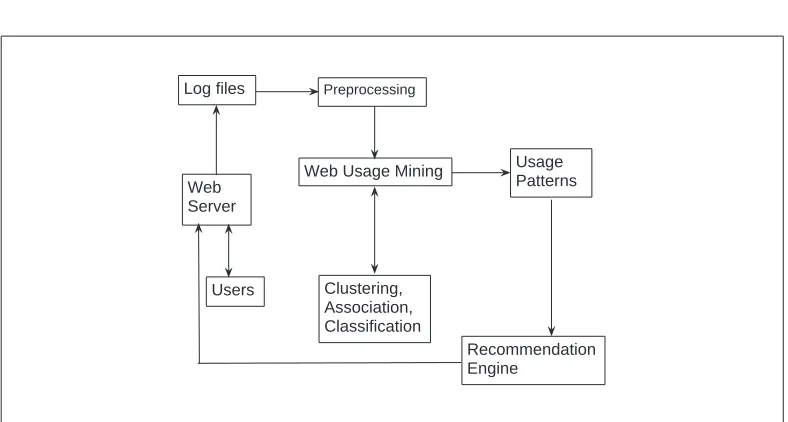
online analytical processing (OLAP) tools Srivastava et al. (2000). Figure 2.2
summarises the Web usage mining architecture.
This dissertation examines some of the pattern discovery techniques in the
Web usage mining stage. However, data preprocessing is beyond this dissertation
scope and is implemented simply for the purpose of our experiments that rely on
Preprocessing
Web Usage Mining Usage Patterns
Clustering, Association, Classification
Recommendation Engine
Log files
Web Server
[image:40.595.86.480.106.317.2]Users
Figure 2.2: Web usage mining architecture.
2.3
Web Usage Mining Techniques and Web Page
Prediction
Personalising the Web users’ content and recommending appropriate Web pages
imply that we are able to supply users with what they require based on their
previ-ous interactions within the same Web site. This task is viewed as a prediction task
for we are trying to predict the users’ level of interest in specific pages and rank
these pages according to their predicted values. Different types of Web usage
min-ing algorithms have been used to make predictions. This dissertation concentrates
on model-based algorithmic approaches which are briefly discussed in chapter
3. The prediction process is achieved using the following algorithms: Markov
model, association rules and clustering individually. The three models are
of the specific Web page probability to the overall probability measure of the Web
existence. The individual models prediction accuracy and efficiency is subject
to some limitations. Therefore, combinations of these models are implemented.
First, Markov model and association rules are integrated together to yield better
accuracy results with fewer number of states and number of rules. Then, Markov
model and clustering are integrated together resulting in improvement in
predic-tion accuracy and predicpredic-tion time complexity. Last, all three models are integrated
together based on some constraints. This kind of integration results in improved
Chapter 3
Prediction Techniques
3.1
Introduction
The prediction process forms part of the automatic personalisation process that
consists of a data collection phase and a learning phase. Data collection phase can
take many forms and it is beyond the scope of this dissertation. The learning phase
can be classified into memory based learning or model based learning depending
on whether the learning is performed online while prediction takes place or
of-fline using training data. Standard user-based and content based personalisation
systems rely on the memory based approach while item or page based
personali-sation systems rely on the model based approach. Memory based systems simply
memorise all the data and generalise from it online real time. Their
computa-tional complexity is O(MN)in the worst case where M refers to the number of
users and N refers to the number of items. Using memory based systems involves
scanning all users to find similar users and then scanning all the items that the
similar users have selected. This online computation complexity becomes a
prob-lem with typical electronic commerce Web sites. They are, however, extensively
used in research and practice. Model based systems, on the other hand, can have
heavier computation than user based systems, but their heavy computation is
per-formed offline and their online computations are light. Model based techniques,
including those used in the pattern discovery phase of Web usage mining, use a
two stage process for predictionSuryavanshi et al.(2005). During the first phase,
the data collected is mined offline and a model is generated. During the second
phase, prediction takes place online as a new site visitor begins interacting with
the Web site. The new visitor session is scored based on the model constructed in
the first phase. Model based systems computational complexity could be O(N2M)
in the worst case because they first scan the items, then for each item, they scan all
the users, and finally, they find similar items by scanning the items again. Their
online computational complexity is O(N)in the worst case, but on average, the
complexity is O(constant)because the online computation depends on the
num-ber of items to look up, not on the total numnum-ber of users or items. This reduction in
computational complexity makes model based systems more suited for the online
prediction stage than memory based systems. On the other hand, memory based
systems are better at adopting to changes in the data sources. In the case of new
(2000). More reasons why model based systems outperform user based systems
for predicting Web pages is that model based are item based and computations
are based on the items that are usually easily accessed from a Web server log
file. Also, item data is more static than user data that changes with users’
circum-stances and environment. Since this dissertation focuses on Web personalisation
where the data source is a repository of Web pages linked together according to
some structure in a particular Web site, the prediction process is based on model
based systems. In this chapter, we briefly describe a number of data mining
al-gorithms used for offline model building techniques including Markov models,
association rules and clustering.
3.2
Markov Model
Markov models (MMs) are commonly used in the identification of the next page
to be accessed by the Web site user based on the sequence of previously accessed
pages Bouras & Konidaris (2004), Chen et al. (2002), Deshpande & Karypis
(2004), Eirinaki et al.(2005), Jespersen et al.(2003), Sarwar et al.(2001), Zhu
et al. (2002a,b). They are the natural candidates for sequential pattern
discov-ery for link prediction due to their suitability to modelling sequential processes.
Markov models have been proposed as the underlying modelling techniques for
Web prefetching applications Pons(2006), to minimize system latency or to
dis-cover high-probability user navigational paths in a Web siteDeshpande & Karypis
(2004),Pitkow & Pirolli(1999),Sarukkai(2000),Srivastava et al.(2000).
Let P={p1,p2, . . . ,pm} be a set of pages in a Web site. Let W be a user
session including a sequence of pages visited by the user in a visit. Assuming that
the user has visited l pages, then Prob(pi|W)is the probability that the user visits
pages pinext. Page pl+1the user will visit next is estimated by:
Pl+1=argmaxp∈P{Prob(Pi= p|W)}
=argmaxp∈P{Prob(Pi= p|pl,pl−1, . . . ,p1)} (3.1) This probability, prob(pi|W), is estimated by using all W sequences of all users
in history (or training data), denoted by W . Naturally, the longer l and the larger
W , the more accurate prob(pi|W). However, it is infeasible to have very long l
and large W and this leads to unnecessary complexity. Therefore, to overcome this
problem, a more feasible probability is estimated by assuming that the sequence
of the Web pages visited by users follows a Markov process. The Markov process
imposed a limit on the number of previously accessed pages k. In other words,
the probability of visiting a page pi does not depend on all the pages in the Web
session, but only on a small set of k preceding pages, where k<<l.
The equation becomes:
of the Markov model. The resulting model of this equation is called the kth-order
Markov model. Of course, Markov model starts calculating the highest probability
of the last page visited because during a Web session, the user can only link the
page he/she is currently visiting to the next one.
Let Skjbe a state with k as the number of preceding pages denoting the Markov
model order and j as the number of unique pages in a Web site.
Skj =pl−(k−1),pl−(k−2), . . . ,pl
®
.Using the maximum likelihood principleDuda
et al.(2000), the conditional probability of P
³
pi|Skj
´
is estimated as follows from
a history (training) data set.
P
³
pi|Skj
´
= frequency ³D
Skj,pi
E´
frequency
³
Skj
´ . (3.3)
This formula calculates the conditional probability as the ratio of the frequency
of the sequence occurring in the training set to the frequency of the page occurring
directly after the sequence.
The fundamental assumption of predictions based on Markov models is that
the next state is dependent on the previous k states. The longer the k is, the more
accurate the predictions are. However, longer k causes the following two
prob-lems: The coverage of the model is limited and leaves many states uncovered; and
the complexity of the model becomes unmanageable. Therefore, the following
are three modified Markov models for Predicting Web page accessDeshpande &
1. Allkth Markov model: This model is to tackle the problem of low coverage of a high order Markov model. For each test instance, the highest order
Markov model that covers the instance is used to predict the instance. For
example, if we build an all 4-Markov model including 1-, 2-, 3-, and 4-, for
a test instance, we try to use 4-Markov model to make prediction. If the
4-Markov model does not contain the corresponding states, we then use the
3-Markov model, and so forthPitkow & Pirolli(1999).
2. Frequency pruned Markov model: Though all-kth order Markov models re-sult in low coverage, they exacerbate the problem of complexity since the
states of all Markov models are added up. Note that many states have low
statistically predictive reliability since their occurrence frequencies are very
low. The removal of these low frequency states affects the accuracy of a
Markov model. However, the number of states of the pruned Markov model
will be significantly reduced.
3. Accuracy pruned Markov model: Frequency pruned Markov model does not capture factors that affect the accuracy of states. A high frequent state
may not present accurate prediction. When we use a means to estimate
the predictive accuracy of states, states with low predictive accuracy can
be eliminated. One way to estimate the predictive accuracy using
condi-tional probability is called confidence pruning. Another way to estimate
pruning.
The evaluation of the pruning has shown that up to 90% of the states can be
pruned leading to less state space complexity and increased coverage but
accu-racy remains unchanged. This proposed solution to the state space complexity of
the all-kth order model may not be feasible in some instances, especially when
it comes to very large data sets. It requires a lot of time and effort to build the
all-kth order models and prune the pages according to the above three criteria. It
also involves a great deal of calculations (different types of thresholds for different
pruning methods).
3.3
Association Rules
Association rule mining is a major pattern discovery technique as proved byMobasher
et al. (2000). Association rule discovery on usage data results in finding groups
of items or pages that are commonly accessed or purchased together. The original
goal of association rule mining is to solve market basket problem. The
applica-tions of association rules are far beyond market basket applicaapplica-tions and they have
been used in various domains including Web mining. In Web mining context,
association rules help optimize the organisation and structure of Web sites.
Asso-ciation rules are mainly defined by two metrics: support and confidence. Support
min-imum support threshold) and confidence is defined as the discovery of association
rules from these frequent itemsetsAgrawal & Srikant(1994).
Let P={p1,p2, ,pm}be a set of pages in a Web site. Let W be a user session
including a sequence of pages visited by the user in a visit, and D includes a
collection of user sessions. Let A be a subsequence of W , and pi be a page. We
say that W supports A if A is a subsequence of W , and W supportshA,piiifhA,pii
is a subsequence of W . The support for sequence A is the fraction of sessions
supporting A in D as follows:
σ=supp(A) = {W ∈D : A⊆W}
|D| (3.4)
The confidence of the implication is:
α=conf(A) = supp(hA,Pi)
supp(A) (3.5)
When we use the same terminologies of Markov model, supp(hA,pii) =prob(hA,pii)
and confidence (A,pi) = prob(pi|A) . An implication is called an association
rule if its support and confidence are not less than some user specified minimum
thresholds.
The minimum support requirement dictates the efficiency of association rule
mining. One major motivation for using the support factor comes from the fact
that we are usually interested only in rules with certain popularity. Support
cor-responds to statistical significance while confidence is a measure of the rules
in a transaction given that item pb occurred in the same transaction. Support and
confidence are the most commonly used metrics when using association based
approaches to personalisation.
Since a full session in Web usage mining context includes many items (pages),
it gets very difficult to find matching rule antecedents. Therefore, association rule
algorithms usually use a sliding window w whose size is iteratively decreased until
an exact match with the antecedent of a rule is found.
There are four types of sequential association rules presented byYang et al.
(2004):
1. Subsequence rules: they represent the sequential association rules where the items are listed in order.
2. Latest subsequence rules: They take into consideration the order of the items and most recent items in the set.
3. Substring rules: They take into consideration the order and the adjacency of the items.
4. Latest substring rules: They take into consideration the order of the items, the most recent items in the set as well as the adjacency of the items.
The immense number of generated rules gives rise to the need of some predictive
the rules that were never applied. Yang et al. (2004), introduced the following
predictive models:
1. Longest match: This method assumes that longer browsing paths produce higher quality information about the user access pattern. Therefore, in the
case where we have more than one rule, all with support above a certain
threshold and they match an observed sequence, the rule with the longest
length will be chosen for predication purposes and the rest of the rules will
be disregarded.
2. Most-confidence matching: This is a very common method where the rule with the highest confidence is chosen amongst the rest of all the applicable
rules whose support values are above a certain threshold.
3. Least error matching: This is a method to combine support and confidence, based on the observed error rate and the support of each rule, to form a
uni-fied selection measure and to avoid the need to set a minimum support value
artificially. The observed error rate is calculated by dividing the number of
incorrect predictions by the number of training instances that support it. The
rule with the least error rate is chosen amongst all the other applicable rules.
As a result of the experiments performed by the authors concerning the precision
of association rule representations using different selection methods, the latest
substring rules were proven to have the highest precision with fewer number of
to the same results regardless of the window size. Therefore, with a window of
size one, they can be considered like first order Markov Model and they will be
less accurate. Also, an increase in window size will lead to reduced efficiency and
coverage.
Although not as widely used as clustering for Web personalisationKim et al.
(2004), Mobasher et al.(2001), Yong et al.(2005), the results of association rule
mining on Web sessions can result in models that can be used for Web page
pre-diction.
3.4
Clustering
The primary motivation behind the use of clustering as a model-based pattern
dis-covery algorithm in Web usage mining stage of Web mining is to improve the
ef-ficiency and scalability of the real-time personalisation tasksAdami et al.(2003),
Cadez et al.(2003),Papadakis & Skoutas(2005),Rigou et al.(2006),Strehl et al.
(2000). Generally speaking, clustering aims at dividing the data set into groups
(clusters) where the inter-cluster similarities are minimised while the
similari-ties within each cluster are maximised Srivastava et al. (2000). Clustering Web
sessions can be achieved through page clustering or user clustering. Web page
clustering is performed by grouping pages having similar content. Page clustering
can be simple if the Web site is structured hierarchically. In this case, clustering
the other hand, clustering user sessions involves selecting an appropriate data
ab-straction for a user session and defining the similarity between two sessionsWang
et al. (2004). This process can get complicated due to the number of features
that exist in each session. Wang et al. (2004) addressed this issue by using three
different data features for grouping sessions. These features are service request,
navigation pattern and resource usage. The authors proved using an E-rental
ap-plication that all three criteria yield similar results and it is sufficient to group
customers according to any one of these features. The authors suggest grouping
customers by services requested because it yields better results and is simple to
implement. Collaborative filtering is achieved when personalisation is performed
based on both page and usage clusteringRigou et al.(2006).
Clustering can be model-based or distance-based. With model-based
cluster-ing Zhong & Ghosh (2003), the model type is often specified a priori and the
model structure can be determined by model selection techniques and
parame-ters estimated using maximum likelihood algorithms, e.g., the Expectation
Max-imization (EM). Distance-based clustering involves determining a distance
mea-sure between pairs of data objects, and then grouping similar objects together into
clusters. The most popular distance-based clustering techniques include
parti-tional clustering and hierarchical clustering. A partiparti-tional method partitions the
data objects into K groups and is represented by k-means algorithm. A
hierarchi-cal method builds a hierarchihierarchi-cal set of nested clusterings, with the clustering at the
bot-tom level containing one cluster for each data object. Model-based clustering have
been shown to be effective for high dimensional text clustering Zhong & Ghosh
(2003). Whereas, hierarchical distance-based clustering proved to be unsuitable
for the vast amount of Web data. Partitional distance-based clustering is
disadvan-taged by the large number of proposed different distance measures for clustering
purposes and defining a good similarity measure is very much data dependent
and often requires expert domain knowledge. The most commonly used distance
measures are Euclidean distance and Manhattan or Cosine distance for data that
can be represented in a vector space. Although distance-based clustering methods
are computationally more complex than model-based clustering approaches, they
have displayed their ability to produce more efficient Web documents clustering
resultsStrehl et al.(2000),Gunduz & OZsu(2003).
Clustering can also be supervisedEick et al.(2004),Finley & Joachims(2005),
semi-supervisedBasu et al.(2004) and unsupervisedAlbanese et al.(2004). The
difference between supervised and unsupervised clustering is that with supervised
clustering, patterns in the training data are labeled. New patterns will be labeled
and classified into existing labeled groups. Eick et al. Eick et al.(2004) examined
supervised clustering and presented four representative-based supervised
cluster-ing algorithms: TDS, SCEC, SRIDHCR and SPAM. The authors show through
experiments that supervised clustering improves the traditional clustering class
purity. The greedy algorithms SPAM, SRIDHCR and TDS did not perform well
ran-domized exploration provides better solutions. Finley et al. Finley & Joachims
(2005) used an SVM algorithm Tsochantaridis et al. (2004) for supervised
clus-tering in order to train a clusclus-tering algorithm by adapting the item-pair similarity
measure. The algorithm optimizes the performance of correlation clustering on
a variety of performance measures. The authors applied the algorithm to
noun-phrase and news articles clustering. For the supervised clustering task, the users
provided complete clusterings of a few of the documents to express their
prefer-ences. From these training examples, the authors learn to cluster future sets of
items.
This kind of labeling is not possible with Web page classification because of
the enormous volume of data. Therefore, a number of novel approaches have
been proposed that involve a combination of labeled with unlabeled data. This
is known as semi-supervised clustering. The problem associated with this
co-training method is the type of Web data and the difficulty to draw generalizations
of such algorithm. InBasu et al.(2004), the authors identify a semi-supervised
clustering framework based on Hidden Markov Random Fields. The supervision
is provided by the must-link and cannot-link constraints. The authors’ proposed
model involves a combination of constraints and Euclidean distance learning. The
authors generalize on this combination through the handling of non-Euclidean
measures by using Bregman divergence. The main problem associated with this
model is the difficulty of applying such a supervision to large Web data sets. New
data. For instance, The work presented by Rigou et al. Rigou et al. (2006)
fo-cuses on providing an effective personalised clustering state for Web documents.
The authors proposed an algorithm, based on a range tree structure, that reduces
the number of Web documents the users receive in result to their queries. They
focused on improving the online retrieval of Web documents and therefore, the
clustering algorithm was used as a final stage after filtering the documents
ac-cording to users’ preferences. Relying on the document clustering algorithm, the
authors helped solve the means algorithm time complexity problem by using
k-windows algorithm and relying on the pre-existing range tree structure. The main
limitation associated with this type of clustering however, is the changing nature
of Web documents. It becomes very difficult to implement such algorithm on Web
documents that require frequent updates.
Unsupervised clustering is where no labeling of either of the data sets is
avail-able. Unsupervised clustering of Web documents was presented by Albanese et al.
Albanese et al.(2004). The authors addressed the issue of Web page
personaliza-tion based on short user navigapersonaliza-tion history. They performed a two phase clustering
technique. In the first phase, they used unsupervised clustering algorithm for
pat-tern analysis and classification using the static user registration information. This
static information helped determine the number of classes the users can belong
to. For this purpose, the authors used two clustering techniques: AutoClass C,
a fuzzy clustering algorithm based on the Bayesian theory, and the Rival
compet-itive neural network. In the second phase, they iteratively used re-classification
to overcome the inaccuracy of the registration information based on users’
navi-gational behavior. Re-classification was repeated until a suitable convergence in
attributing each user to a class was achieved. It was accomplished by content
management and log analysis based on the dynamic user navigational behavior.
Content management involved identifying significant keywords by a domain
ex-pert and associating the keywords with content categories. Whereas log analysis
was used to provide users’ activities in order to attribute each content category to
a specific user class.
Unsupervised clustering can be classified as hierarchical or non-hierarchical
Jain et al.(1999). Using hierarchical clustering, data is clustered in the form of a
tree where each datum in the lowest level is defined as a cluster. Larger clusters
will be formed moving up to higher levels in the tree. The problem related to
such technique is that it can become computationally complex with large data sets
and can be difficult to analyze with the absence of logical hierarchical structure
in the data. On the other hand, non-hierarchical clustering is where the samples
are divided into a predefined number of clusters according to the distance between
the data and specific centers. A common method of non-hierarchical clustering is
the k-means algorithm that tends to cluster data into even populations. The
non-hierarchical clustering main concern is the partitioning of data into a specified
number of clusters. Not all data types are suitable for such partitioning. Numerous
k-means, and attempted at improving the algorithm. Xiong et al. Xiong et al.(2006)
investigate the impact data distributions can have on the performance of k-means
clustering. The paper illustrates the relationship between k-means and the true
cluster sizes as well as the entropy measure. The authors prove experimentally
that:
• k-means results in uniform cluster sizes,
• regardless of the coefficient of variation(CV)of the true cluster sizes, the
CV values of the clustering results range between 0.3 and 1.0,
• the entropy measure has the favorite on k-means and can be an unsuitable
k-means clustering validation measure.
Other work that attempts at improving the traditional k-means algorithm is
pre-sented by Geraci et al. (2006) where the authors propose a clustering method
that is more accurate and faster than classical k-means algorithm when it comes to
clustering large amount of data with real-time nature like Web snippets. Web
snip-pets are the search engine results that are composed of the name of the document,
the URL address and few statements describing the content of the document. The
authors presented the furthest-point-first algorithm for k-center clustering in
met-ric spaces coupled with a filtering scheme based on the triangular inequality. In
another work Meneses & Rodriguez-Rojas (2006), Meneses et al. extended the
traditional k-means algorithm that uses the vector model for representing
than individuals. Symbolic objects are vectors that could be of any type. They
add semantic power to Web clustering by providing the user with more
informa-tion about the content of the objects. The authors proved through experiments that
symbolic models can be more accurate and efficient than vectorial representations.
Hierarchical clustering algorithms can be obtained using either agglomerative
or partitional algorithms. With agglomerative algorithm, each object is assigned
to its own cluster and then pairs of clusters are merged to form a tree. With
par-titional algorithms, on the other hand, the tree is formed by a series of repeated
bisections. Partitional algorithms are better suited for clustering large data sets
be-cause of their low computational requirements but they are less effective than
ag-glomerative algorithms. The work presented byZhao & Karypis(2002) compares
both algorithms using six partitional methods and nine agglomerative methods.
The authors introduced constrained agglomerative algorithms that generate
hier-archical trees using both partitional and agglomerative methods. Using
agglom-erative algorithms, they build a hierarchical subtree for each of the intermediate
partitional clusters. Then, an upper tree is built using the subtrees as leaves. The
experiments performed using twelve data sets from various sources showed that
partitional algorithms produced better hierarchical solutions than agglomerative
methods, and that the constrained agglomerative methods improved the clustering
solutions obtained by either agglomerative or partitional algorithms. These results
suggest that the poor performance of agglomerative algorithms is associated with
with both agglomerative and partitional clustering was presented by Cheng et al.
(2005). It introduced a divide-and-merge process for clustering that combines a
top-down phase with a bottom-up phase.
Due to the diversity of clustering applications and the large number of distance
measurements and data groupings, there exists a large number of clustering
algo-rithms . Data could be represented by different patterns and could have different
types of clusters. Therefore, it is essential to study most clustering algorithms
well before deciding on the one algorithm that applies most to the data at hand.
Adami et al. (2003) introduced a special kind of hierarchical supervised
cluster-ing in order to solve the problem of high amount of labels associated with
boot-strapping or page labeling. As a solution, the authors used a baseline approach
where documents are classified according to their class labels and a constraint
k-means clustering approach at topological and terminological levels. Most recent
research that addressed supervised hierarchical clustering did not take into
con-sideration the complexity involved with bootstrapping, or page labeling, because
with supervised clustering the target classes are known in advance. They are
usu-ally conducted by a human expert. Bootstrapping can get very complex due to the
large number of labels with the increase of the number of categories or classes.
The authors address the issue of bootstrapping and provide a preliminary
cate-gorisation hypothesis on the classification of the documents resulting in reduced
human effort where a human expert is only needed to weed out wrong
effi-cient in cases where the documents descriptions are made of labels of wrong class
together with labels of the correct class. The main limitation associated with
Tax-SOM is its undirected graph topology. Poor results were obtained when taking
into consideration the parent-child relationships. Restrictive clustering methods
were introduced by Siersdorfer & Sizov (2004). The authors presented an
ap-proach for automatically structuring heterogenous document collections by using
restrictive clustering methods. Usual clustering methods may result in cluster
im-purity because the entire data set is partitioned into clusters. The paper solves this
problem by clustering only a subset of the data leaving out data not assigned to any
clusters. The a