This is a repository copy of
Accurate robot simulation
.
White Rose Research Online URL for this paper:
http://eprints.whiterose.ac.uk/74645/
Monograph:
Nehmzow, U., Kerr, D. and Billings, S.A. (2009) Accurate robot simulation. Research
Report. ACSE Research Report no. 992 . Automatic Control and Systems Engineering,
University of Sheffield
[email protected] https://eprints.whiterose.ac.uk/ Reuse
Unless indicated otherwise, fulltext items are protected by copyright with all rights reserved. The copyright exception in section 29 of the Copyright, Designs and Patents Act 1988 allows the making of a single copy solely for the purpose of non-commercial research or private study within the limits of fair dealing. The publisher or other rights-holder may allow further reproduction and re-use of this version - refer to the White Rose Research Online record for this item. Where records identify the publisher as the copyright holder, users can verify any specific terms of use on the publisher’s website.
Takedown
If you consider content in White Rose Research Online to be in breach of UK law, please notify us by
Accurate Robot Simulation
Ulrich Nehmzow
1Dermot Kerr
1S A Billings
21Intelligent Systems Research Centre, University of Ulster, Londonderry, BT48 7JL, UK
2Department of Automatic Control and Systems Engineering, University of Sheffield, Sheffield, S1 3JD, UK
Abstract
Robot simulators are valuable tools for re-searchers to develop control code in a fast and efficient manner without spending time setting up physical experiments. Most simulators, however, do not model the real world accurately. As a con-sequence, when a program is run on a real robot it may behave differently from when run in simula-tion. In this paper we present a method of devel-oping a robot simulator that models the operation of a real robot in a real environment accurately, using real robot data and system identification to construct the simulator’s model.
1.
Introduction
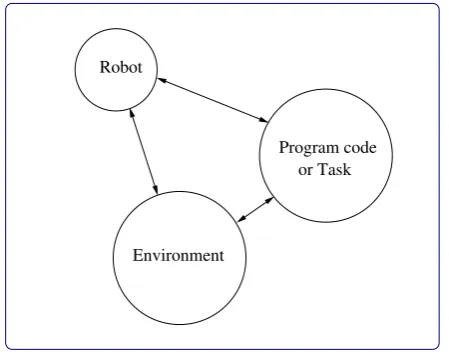
When considering the behaviour of a robot, there are three components that influence the system: (i) robot hardware, (ii) the program being executed, and (iii) the robot’s environment. Thus, the interaction of these three components, as illustrated in Figure 1, constitutes a highly complex system from which the overall robot behaviour emerges.
Environment
[image:2.595.64.289.481.657.2]or Task Program code Robot
Figure 1: Overall robot behaviour emerges from the
interaction between robot, task and environment
The common procedure to develop a control program is for the robot programmer to write the program “as best as possible” whilst considering the desired task.
However, it is unlikely that the desired behaviour will be obtained immediately, as the robot programmer has to make (often idealistic, simplifying) assumptions about the robot’s hardware and properties of the environment. Typically, the desired robot behaviour is eventually ob-tained by a process of iterative refinement of the control program.
Robot simulators are therefore useful for researchers to develop and test new controllers. Simulators can save time and effort by concentrating on the development of the controller, rather than spending time on i) setting-up real world experiments and ii) waiting for experiments to complete, as using a simulator allows the researcher to run experiments faster than real-time. Additionally, simulators are the only way to provide a consistent rep-etition of experiments.
Traditional trial-and-error-based approaches of pro-gramming robots lack a rigorous design methodology, they are costly, time consuming and error prone. In this paper we present an alternative, describing a de-sign method for a mobile robot simulator that accurately models and simulates a physical robot’s interaction with its environment, performing a particular task.
The overall aim of this research is theautomatic
gen-eration of control code, without the need for an experi-enced robot engineer to perform iterative refinement and trial-and-error procedures. As a step towards this goal, in this paper we present our experiments to create ac-curate robot simulators that make precise predictions of robot sensor measurements based on the robot’s position in the environment.
1.1
Motivation
A number of existing robot simulators exist within the robotics community, some are generic such as Player-Stage (Gerkey et al., 2003) and Webots (Michel, 2004), others are platform dependent such as the Kephera sim-ulator (Michel, 1996). The ability of these robot simu-lators to predict accurately depends on three models: i) the robot model, ii) the task model, and iii) the envi-ronment model. The envienvi-ronment model provides the robot’s sensory perception based on the robot’s posi-tion and orientaposi-tion and is of the main interest to this
work. This model is dependent on the structure of
environment is composed of. However, being generic, they are based on general assumptions of environment properties and fail to model extreme perceptions such as specular reflections. As argued in (Lee et al., 1998, Kyriacou et al., 2008) we believe that faithful simulation
is only obtainable when specific environmental
scenar-ios are modelled using data obtained fromreal
environ-ments.
1.1.1
Possible Approaches
In the simulator developed by Lund and
Miglino (Lund and Miglino, 1996), logged data is
stored in a lookup table and values are interpolated to predict sensory perception at unvisited locations. In (Lee et al., 1998) a neural network is used to model the input-output relationships between robot location
and sensor perception. This approach works well,
however, neural networks produce an opaque model that cannot be used to investigate the characteristics of the inputs and outputs further (such as stability analysis, sensitivity of the behaviour to particular sensor (Saltelli et al., 2000) or environmental features, sensor redundancy etc). Additionally, the structure of a neural network does not allow straightforward comparison between different models. Here, we therefore propose a transparent modelling method, which is most closely related to the work presented in (Kyriacou et al., 2008). In Kyriacou’s paper, a robot simulator is built using mathematical models representing the sensor perception based on the robots location. Our work differs from (Kyriacou et al., 2008), however, in that we create parsi-monious sensor models based on the robot’s orientation
ϕ, rather than having many separate sensor models for
each (x, y) location in the robot’s environment.
2.
Modelling Method
We propose the use of system identification, as used in (Kyriacou et al., 2008), to develop accurate robot simulation. We determine the relevant input-output pa-rameters of the sensor simulation process — the accurate simulation of laser perception based on a robot’s posi-tion, and validate the resulting laser perception against the robot’s real laser perception along a (separately logged) validation path.
In this work we adopt the use of system identification, rather than alternative modelling approaches such as ar-tificial neural networks or lookup tables, because it offers numerous benefits: the obtained models are compact, as they consist of a single polynomial with a small num-ber of terms; and the obtained models are transparent and can be examined using standard techniques such as sensitivity analysis (Saltelli et al., 2000).
NARMAX (Non-linear Auto-Regressive Moving Av-erage model with eXogenous inputs) is a parameter
es-timation methodology to identify the important model terms and their associated parameters of a non-linear polynomial model of an unknown non-linear dynamic system. The NARMAX methodology breaks the mod-elling problem into the following steps: i) Structure de-tection, ii) parameter estimation, iii) model validation, iv) prediction, and v) analysis. A detailed procedure of these steps is presented in (Chen and Billings, 1989, Billings and Voon, 1986, Korenberg et al., 1988), and details of the application of NARMAX to mobile robot simulation in (Kyriacou et al., 2008).
In this work we obtain a model that relates the robot’s
positional location to its laser perception. The fact
that we obtain the model as a transparent polynomial representation makes the model easily and accurately transferable to any robot platform with the same sen-sor type and configuration. Another benefit of the com-pact mathematical form of the model is that it can be directly implemented in any computer language using
standard mathematical libraries. This minimises the
time to translate programs between robot platforms and languages. Increased execution time and reduced mem-ory requirements are also obtained due to the task code being condensed into a single polynomial with the mod-elling process.
3.
Experiments
The experiments in this paper where carried out in the robotics arena of the Intelligent Systems Research Centre in the University of Ulster. The robotics arena measures
100 m2
and is equipped with a powered floor, a Vicon
motion tracking system and a large number of robots. In all the experiments described in this paper we used the
MetralabsSCITOS G5 autonomous robotSwilly, shown
in Figure 2. The robot is equipped with 24 sonar
sen-sors distributed around its circumference and a SICK
laser range finder, which scans the front of the robot ([0◦,270◦]) with a radial resolution of 0.5◦. In our
exper-iments the laser range finder was configured to scan the front semi-circle of the robot in the range ([0◦,180◦]).
3.1
Experimental Set-Up
During the experiments the input from the robot’s laser, position, orientation, transitional and rotational veloci-ties were logged every 250 ms. In addition, the robot’s
actual x, y, zpositions obtained from the Vicon motion
tracking system are logged simultaneously at 50 Hz, at this speed the positional error was less than 1 mm.
Figure 2: Swilly, the Metralabs SCITOS G5 mobile robot used in the experiments
Figure 3: Robot arena setup
3.1.1
The
Sensorgraph
In our experiments we first construct what we term a
sensorgraph — a detailed log of sensor perceptions ob-tained in the environment — by using the robot to collect data from the environment that is being modelled. The data that is collected during this process are the robot’s position, orientation, laser perception and ground truth
position (obtained using theVicon motion tracking
sys-tem). A random walk obstacle avoidance program
us-ing the laser sensor is run on Swilly, involving obstacle
avoidance and random rotations to the robot’s move-ment at predefined intervals. The basis of introducing the random rotations is to try and ensure that the robot explores as much of the environment as possible at dif-ferent orientations. In Figure 4 we show the actual
posi-tions where Swilly logged data, over 1400 data samples
in these experiments.
It is important that the robot has logged adequate data throughout this data collection stage, as the
ob-−200 −100 0 100 200
−100 −50 0 50 100 150 200 250
Vicon x−axis displacement [cm]
[image:4.595.91.264.319.462.2]Vicon y−axis displacement [cm]
Figure 4: Data sampling points
tained model’s accuracy will depend on the data con-tained in the sensorgraph. Therefore, to ensure that we have a good distribution of values we computed
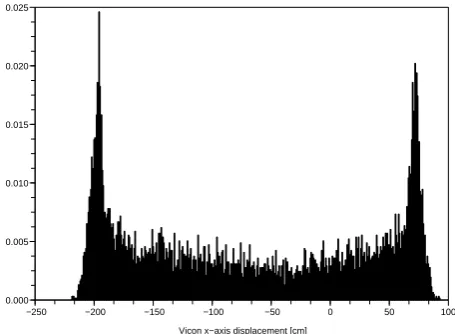
his-tograms for the robot’s position obtained using theVicon
tracking system along thex-axis andy-axis (Figures 5
and 6). Although the histograms show a denser
distri-bution of thesensorgraph data at the arena edges, they
show that all possiblyxandylocations are equally often
visited (uniform distribution) — a desirable property for a sensorgraph.
−250 −200 −150 −100 −50 0 50 100 0.000
0.005 0.010 0.015 0.020 0.025
Vicon x−axis displacement [cm]
Figure 5: Histogram of visitedxpositions
It is also important to consider the robot’s heading, because the modelling process needs to consider all pos-sible orientations of the robot. In Figure 7 we illustrate the histogram representing the rotational angles where the robot has logged data as contained in the sensor-graph, again a good almost-uniform distribution.
After the data was collected we median-filtered the
laser data over 30◦segments. Thus, rather than 360 laser
readings ([0◦,180◦] ×0.5◦ resolution), we then used the
[image:4.595.321.549.414.581.2]−250 −200 −150 −100 −50 0 50 100 150 200 0.000
0.002 0.004 0.006 0.008 0.010 0.012 0.014
[image:5.595.62.289.68.236.2]Vicon y−axiz displacement [cm]
Figure 6: Histogram of visitedy positions
−200 −150 −100 −50 0 50 100 150 200 0.000
0.001 0.002 0.003 0.004 0.005 0.006
[image:5.595.63.288.264.438.2]phi
Figure 7: Histogram of headings ϕ at data-logging
points
L15=median[0◦,30◦] L45=median[30◦,60◦] L75=median[60◦,90◦]
L105=median[90◦,120◦] L135=median[120◦,150◦] and
L165=median[150◦,180◦]
as input to our modelling process.
3.1.2
Models For Different
ϕ
After logging the sensorgraph data, it is required to com-pute a model which predicts the robot’s sensor percep-tion, given the robot’s position and orientation. When computing this model we need to consider all the possible (x,y) positional locations the robot may visit, as well as
the robots orientationϕat these positions. The
dimen-sionality of this space is very high, and in order to
man-age the task of constructing a model we have restricted
the number of models to only 12 models, modelling 30◦
segments, thus covering the entire 360◦ range of
possi-ble robot headings with 12 models. Put differently, we
constructed 12 models, one for each 30◦segment, of the
form Lk =f(x, y)∀ϕ = k, where Lk is a model of the
laser reading when the robot assumes a headingϕof k
degrees.
3.1.3
Validation Trajectories
To validate the robot’s predicted sensor perceptions
based on the robot’s position (x, y) and orientation ϕ,
a number of independent validation runs were logged by manually driving the robot along a novel path immedi-ately after the logging of the sensorgraph. During these validation runs the robot’s position (obtained using the
Vicontracking system) and laser perception were logged. In Figure 8 and Figure 9 we show the trajectory of two validation runs, along with the original sampling points used to obtain the sensorgraph.
−200 −100 0 100 200
−100 −50 0 50 100 150 200 250
Vicon x−axis displacement [cm]
[image:5.595.324.550.331.501.2]Vicon y−axis displacement [cm]
Figure 8: Validation trajectory 1
−200 −100 0 100 200
−100 −50 0 50 100 150 200 250
Vicon x−axis displacement [cm]
Vicon y−axis displacement [cm]
[image:5.595.325.549.543.714.2]These validation runs allow us to compare, measure and validate how the actual real sensor perception com-pares with the model’s predicted values along a new tra-jectory.
3.2
Initial Results
After collection of the data in the sensorgraph we use the NARMAX system identification procedure to esti-mate the robot’s laser perception as a function of the
the robot’s location, obtained using the Vicon tracking
system and using the logged training data. As described earlier, 12 polynomials were obtained in total, express-ing the laser perception of the robot as a function of
the robots location and heading to the nearest 30◦. The
models were chosen to be of fourth degree and no regres-sion was used in the inputs and outputs.
For example, for ϕ =−75◦±15◦ and laser segment
L75 this resulted in a NARMAX polynomial structure
containing 9 terms
Lp75/cm= +223.74
+ 1.47∗x + 0.68∗y
−0.002∗x2
−0.001∗y2
−0.0001∗x3
−0.00000036∗x4
+ 0.00000006∗y4
+ 0.000012∗y∗y2.
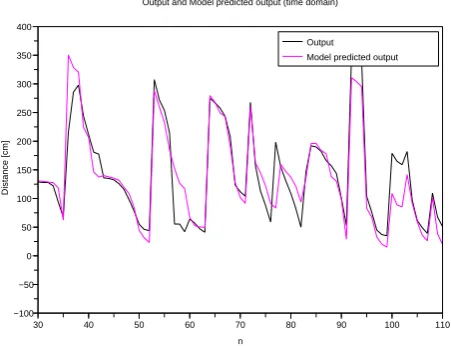
The difference between model prediction and true value is shown in Figure 10.
30 40 50 60 70 80 90 100 110 −100
−50 0 50 100 150 200 250 300 350 400
Output and Model predicted output (time domain)
n
Distance [cm]
Output Model predicted output
Figure 10: Actual and predicted laser readings along
validation trajectory 1
For ϕ =−165◦±15◦ and laser segment L75 this
re-sulted in a NARMAX polynomial structure containing 4 terms
Lp75/cm= +234.84
+ 0.85∗x + 0.30∗y + 0.0014∗x∗y,
the model validation is illustrated in Figure 11.
190 200 210 220 230 240 250 260 270 280 290 0
50 100 150 200 250 300 350
Output and Model predicted output (time domain)
n
Distance [cm]
[image:6.595.324.548.217.388.2]Output Model predicted output
Figure 11:Actual and predicted laser readings along
validation trajectory 2
In a similar manner we computed all 12 models for the
range of orientationsϕand for each laser segment.
3.2.1
Assessment 1
To assess the performance of the obtained polynomial models we used the validation trajectory 1 (Figure 8). In Figure 12 we plot the predicted laser values for the
segment ˜L75 against the actual laser valuesL75.
In Figure 13 we plot the predicted laser values for the
segmentL105˜ against the actual laser valuesL105.
Mean error and standard error for validation trajec-tory 1 are given in Table 1.
3.2.2
Assessment 2
We also assessed the performance of the obtained poly-nomial models for a more complex non-linear trajectory, such as the one given in validation trajectory 2 (Fig-ure 9). Fig(Fig-ure 14 shows the predicted laser values for
the segment ˜L75against the actually logged laser values
[image:6.595.63.289.532.705.2]L75.
Figure 15 shows the predicted laser values for the seg-mentL105˜ against the actual laser valuesL105.
0 10 20 30 40 50 60 70 80 0
50 100 150 200 250 300 350
Time [250ms]
Laser range [cm]
[image:7.595.65.289.89.259.2]Logged laser Predicted laser
Figure 12: Predicted laserL˜75 values against actual
logged laserL75 values for validation trajectory 1
0 10 20 30 40 50 60 70 80
0 50 100 150 200 250 300 350
Time [250ms]
Laser range [cm]
[image:7.595.323.551.90.257.2]Logged laser Predicted laser
Figure 13:Predicted laserL105˜ values against actual
logged laserL105 values for validation trajectory 1
Table 1: Absolute Mean error and Standard error in
centimetres for validation trajectory 1
Laser Mean and Standard error [cm]
˜
L15 60±5
˜
L45 53±5
˜
L75 31±4
˜
L105 17±4
˜
L135 21±2
˜
L165 20±2
0 50 100 150
0 50 100 150 200 250 300 350 400 450 500
Time [250ms]
Laser range [cm]
[image:7.595.64.289.335.505.2]Logged laser Predicted laser
Figure 14: Predicted laser L˜75 values against actual
logged laserL75 values for validation trajectory 2
0 50 100 150
0 50 100 150 200 250 300 350 400
Time [250ms]
Laser range [cm]
Logged laser Predicted laser
Figure 15:Predicted laserL˜105 values against actual
logged laserL105values for validation trajectory 2
Table 2: Absolute Mean error and Standard error in
centimetres for validation trajectory 2
Laser Mean and Standard error [cm]
˜
L15 62±3
˜
L45 46±4
˜
L75 66±4
˜
L105 39±3
˜
L135 29±4
˜
[image:7.595.323.551.335.503.2] [image:7.595.345.528.614.715.2] [image:7.595.84.265.617.713.2]Further Statistical Evaluations We also
per-formed numerical tests to determine the performance of the simulator for this second validation trajec-tory, and compared the error of the simulator model against the error of a “random guess” simulator that generates random predictions from the range of
valid laser measurements. The Mann-Whitney U
-test (Snedecor and Cochran, 1989, Barnard et al., 1993) was performed on both pairs of distributions in order to check if they are significantly different or not. Both tests indicated that the distributions are different at the 5% significance level as illustrated in Figure 16 for the
laser segment ˜L75and in Figure 17 for the laser segment
˜
L105. In other words, the obtained model performs
sig-nificantly better than a random guess.
Frequency
Error [cm]
Frequency
Error [cm] 0 50 100 150 200 250 300 350 400 450 500 0
5 10 15 20 25 30 35
0 50 100 150 200 250 300 350 400
0 2 4 6 8 10 12 14
Error distribution of random guess prediction of laser range Error distribution of model−predicted laser range
Figure 16: U-statistic illustrating comparison of
pre-dicted laser error with random guess error for laserL75
[image:8.595.323.548.70.284.2]The Spearman rank correlation coefficients between actual laser perception and predicted laser perception are given in Table 3, they are all significant (p <0.05).
Table 3: Spearman rank correlation coefficients
be-tween predicted and actual laser readings for val-idation trajectory 2. All correlations are statisti-cally significant (p <0.05).
Laser segment SR
1 0.7264930
2 0.3045180
3 0.9775737
4 0.9275737
5 0.7720901
6 0.7360612
Frequency
Error [cm]
Frequency
Error [cm]
0 50 100 150 200 250 300 350 400
0 2 4 6 8 10 12 14
Error distribution of random−guess prediction of laser range
0 50 100 150 200 250 300 350 400
0 5 10 15 20 25 30 35 40
[image:8.595.60.290.265.477.2]Error distribution of model−predicted laser range
Figure 17: U-statistic illustrating comparison of
pre-dicted laser error with random guess error for laserL105
4.
Summary And Conclusions
4.1
Summary
In this paper we have presented an approach to model a robot’s laser perception based on position and orien-tation, using the NARMAX model estimation method-ology. The mobile robot is used to explore the envi-ronment whilst logging sensor perception and its actual position. This data is then used to construct models that predict the robot’s perception based on its position and orientation. To evaluate the performance accuracy of the obtained models we compared the robot’s real sensor perception along two independent validation runs with the sensor perception predicted by our model.
4.2
Conclusions
We have shown how to model a robot’s laser perception as a function of its position, using compact polynomial models, and how the NARMAX modelling approach can be used to produce transparent mathematical functions that can be related directly to the modelling task.
This method of simulating the robot’s perception has a number of important benefits. Simulator development is fast and the obtained model is very compact. The model is transparent, i.e. represented as a polynomial function that can be analysed mathematically.
4.3
Future Work
code. The goal of this research is to have a robot observe a human performing a task, and for the robot to gener-ate control code automatically from this observation to perform the same task. The experiments presented here illustrate that it is possible to create a model of sensor perception as a function of the robot’s position within the environment. The next stage in this research is to
model a human task, using theVICON tracking system.
Using the demonstrator’s trajectory we will estimate the robot’s perception at these positions, using the method described in this paper, to create a new model that mim-ics the task performed by the human demonstrator.
5.
Acknowledgements
The authors gratefully acknowledge the support of the Leverhulme trust under grant number F00430F.
References
Barnard, C., Gilbert, F., and McGregor, P. (1993).
Ask-ing questions in biology. Longman, Harlow, UK.
Billings, S. and Voon, W. S. F. (1986). Correlation
based model validity tests for non-linear models.
In-ternational Journal of Control, 44:235–244.
Chen, S. and Billings, S. A. (1989). Representations
of non-linear systems: The narmax model. Int. J.
Control, 49:1013–1032.
Gerkey, B., R.Vaughan, and Howard, A. (2003). The player/stage project: Tools for multi-robot and
dis-tributed sensor systems. In Proceedings of the
In-ternational Conference on Advanced Robotics.
Korenberg, M., Billings, S., Liu, Y., and McIlroy, P. (1988). Orthogonal paramter estimation for
non-linear stochastic systems. Int. J. Control, 48:193–
210.
Kyriacou, T., Nehmzow, U., Iglesias, R., and Billings, S. A. (2008). Accurate robot simulation through
system identification. Robotics and Autonomous
Systems, 56:1082–1093.
Lee, T., Nehmzow, U., and Hubbold, R. J. (1998). Mo-bile robot simulation by means of acquired neural
network models. InESM, pages 465–469.
Lund, H. H. and Miglino, O. (1996). From simulated
to real robots. In Proceedings IEEE International
Conference on Evolutionary Computation.
Michel, O. (1996). Kephera simulator version 2.0 user manual.
Michel, O. (2004). Webots: Professional mobile robot
simulation. Advanced Robotic Systems, 1:40–43.
Saltelli, A., Chan, K., and Scott, E. M. (2000).
Sensi-tivity analysis. Wiley.
Snedecor, G. W. and Cochran, W. G. (1989).Statistical