University of Liverpool School of Psychology
How processing of visual symmetry
relates to preference for regular
patterns, and the role of attention on
preference formation
Thesis submitted in accordance with the requirements of the University of Liverpool for the degree of Doctor in Philosophy
by
Giulia Rampone
They walked on rather aimlessly.
He hoped she wouldn't notice he was touched,
because he wouldn't have known
how to explain why.
Table of Contents
Abstract ... 6
1 Introduction and Overview ... 7
Part 1 ... 25
2 Electrophysiological analysis of the affective congruence between pattern regularity and word valence ... 26
2.1 Abstract ... 26
2.2 Introduction ... 27
2.3 Experiment 1 ... 31
2.3.1 Methods ... 32
2.3.1.1 Participants ... 32
2.3.1.2 Apparatus ... 32
2.3.1.3 Stimuli ... 32
2.3.1.4 Procedure ... 35
2.3.1.5 EEG analysis ... 35
2.3.2 Results ... 36
2.3.3 Discussion of Experiment 1 ... 42
2.4 Experiment 2 ... 44
2.4.1 Method ... 44
2.4.2 Results ... 45
2.5 General discussion ... 47
2.6 Conclusions ... 50
Part 2 ... 52
3 The role of exogenous attention on visual preference formation for abstract patterns ... 53
3.1 Abstract ... 53
3.2 Introduction ... 54
3.3 Experiment 1 ... 59
3.3.1 Method ... 60
3.3.1.1 Participants ... 61
3.3.1.2 Apparatus and Stimuli ... 61
3.3.1.3 Procedure ... 62
3.3.1.4 Design ... 63
3.3.1.5 Data Analysis ... 63
3.3.2 Results ... 64
3.3.3 Discussion of Experiment 1 ... 67
3.4 Experiment 2 ... 69
3.6.2 Results ... 80
3.6.3 Discussion of Experiment 3a, 3b ... 82
4 Preference modulation elicited by exogenous cueing extends to non-target stimuli presented at non-target location ... 84
4.1 Abstract ... 84
4.2 Introduction ... 85
4.2.1 Method ... 91
4.2.1.1 Participants ... 91
4.2.1.2 Apparatus and Stimuli ... 91
4.2.1.3 Procedure ... 92
4.2.1.4 Design ... 93
4.2.1.5 Data Analysis ... 93
4.2.2 Results ... 95
4.2.3 Discussion of Experiment 1 ... 95
4.3 Experiment 2 ... 97
4.3.1 Method ... 97
4.3.1.1 Participants ... 97
4.3.1.2 Design and Data Analysis ... 97
4.3.2 Results ... 98
4.3.3 Discussion of Experiment 2 ... 99
4.4 Experiment 3 ... 100
4.4.1 Method ... 100
4.4.1.1 Design and Data Analysis ... 100
4.4.2 Results ... 101
4.4.3 Discussion of Experiment 3a ... 102
4.5 General Discussion ... 103
5 Modulation of preference ratings with predictive and counter-predictive exogenous cues ... 109
5.1 Abstract ... 109
5.2 Introduction ... 110
5.3 Experiment 1 ... 115
5.3.1 Method ... 115
5.3.1.1 Participants ... 115
5.3.1.2 Apparatus and Stimuli ... 115
5.3.1.3 Procedure ... 118
5.3.1.4 Design ... 118
5.3.1.5 Data Analysis ... 119
5.3.2 Results ... 120
5.3.3 Discussion Experiment 1 ... 122
5.4 Experiment 2 ... 122
5.4.1 Method ... 123
5.4.2 Results. ... 124
5.4.3 Discussion of Experiment 2 ... 125
5.5 General Discussion. ... 128
6 Testing whether dwelling gaze for a longer period in valid conditions causes preference modulation ... 131
6.1 Abstract ... 131
6.2 Introduction ... 132
6.3 Previous Studies ... 135
6.3.1 Method ... 135
6.3.2 Results and discussion ... 136
6.4 Current study ... 138
6.4.1 Method ... 139
6.4.1.2 Apparatus and Stimuli ... 139
6.4.1.3 Procedure ... 140
6.4.2 Design and Data Analysis ... 141
6.4.3 Results ... 142
6.5 Discussion ... 143
Part 3 ... 145
7 The role of eccentricity on preference for abstract symmetry ... 146
7.1 Abstract ... 146
7.2 Introduction ... 147
7.3 Experiment 1 ... 150
7.3.1 Method ... 151
7.3.1.1 Participants ... 151
7.3.1.2 Apparatus and stimuli ... 151
7.3.1.3 Procedure ... 153
7.3.1.4 Analysis ... 154
7.3.2 Results ... 156
7.3.3 Discussion ... 158
7.4 Experiment 2 ... 160
7.4.1 Experiment 2a ... 161
7.4.1.1 Method ... 161
7.4.1.2 Data analysis ... 163
7.4.1.3 Results and Discussion ... 164
7.4.2 Experiment 2b ... 166
7.4.2.1 Method ... 167
7.4.2.2 Data Analysis ... 167
7.4.2.3 Results and Discussion ... 168
7.5 General Discussion ... 169
8 The role of the fixation cross in modulating symmetry detection speed at different eccentricities ... 173
8.1 Abstract ... 173
8.2 Introduction ... 174
8.3 Experiment 1 ... 177
8.3.1 Method ... 177
8.3.1.1 Participants ... 177
8.3.1.2 Apparatus and stimuli ... 178
8.3.1.3 Procedure ... 180
8.3.1.4 Eye data analysis ... 182
8.3.2 Analysis ... 182
8.3.3 Results and Discussion ... 183
8.4 Experiment 2 ... 186
8.4.1 Method ... 187
8.4.1.1 Participants ... 187
8.4.1.2 Apparatus and stimuli ... 188
8.4.1.3 Procedure ... 188
Abstract
1
Introduction and Overview
Humans often enjoy visual experience. Whether in an art museum or driving down the road, incoming information from the senses is routinely evaluated. People’s behaviour inevitably depends on the valence attributed to objects: Do we like this object or dislike it? People orientate towards positively valenced objects and away from those with negative valence.
Can preference for visual stimuli be predicted? If yes, what are the determining factors? These are the key questions addressed in this thesis. Research has for years looked for the ‘aesthetic primitives’ within images: the essential visual attributes of the world that are positively evaluated. One such aesthetic primitive might be symmetry, which is positively rated by most people. The aim of Part 1 was to characterize the neural basis of this link.
What factors determine valance?
Psychologists have studies the perception, production, and response to a visual object as well as interactions with objects that evoke affective responses. Here I list some of the factors determining whether stimuli are evaluated positively or negatively.
Intrinsic property of the stimulus
One hypothesis is that there is a lawful relationship between stimulus properties and preference (see Spehar, Wong, van de Klundert et al., 2015). Some researchers believe that there are aesthetic universals, and thus some stimuli are liked by everyone (Aitken, 1974; Berlyne, 1971; Martindale, Moore, & Borkum, 1990). One example is visual symmetry, especially bilateral symmetry (henceforth ‘symmetry’ in this thesis). When people explicitly evaluate abstract patterns, symmetry is the best predictor of preference (Jacobsen & Höfel, 2003). Under certain conditions, there is an automatic association of symmetry with positive valenced words, and random configurations with negative words (Bertamini, Makin, & Pecchinenda, 2013; Bertamini, Makin, & Rampone, 2013; Makin, Pecchinenda, & Bertamini, 2012; Pecchinenda, Bertamini, Makin, & Ruta, 2014). However, mere presentation of symmetrical patterns has not been found to spontaneously produce a physiologically detectable emotional reaction. For example, Makin, Wilton, Pecchinenda, & Bertamini, (2012) recorded Electromyography (EMG) activity in response to abstract symmetry only when symmetry was categorized as target (task instruction: “report whether a reflection pattern has been seen: yes/no”).
The association between symmetry and beauty is longstanding (e.g. (Enquist & Arak, 1994). Symmetry has been classified as one of the key principles of the aesthetic experience (Jacobsen & Höfel, 2003; Ramachandran & Hirstein, 1999). Indeed, the physicist and mathematician Herman Weyl claimed that “Beauty is bound up with symmetry”, thanks to the “concordance of several parts by which they integrate into a whole” (Weyl, 1952, p.3).
avoid parasites and accidents, they develop a symmetrical body plan. Animals could be attracted to this when seeking mates, evaluating food, or the strength of rivals (Grammer, Fink, Møller, & Thornhill, 2003). Preference for symmetry could be a generalization of this sensitivity to health and fitness.
There are alternatives to this evolutionary explanation. Basic properties of the stimuli, such as shape, size and brightness can alter the speed and efficiency of visual processing. Things that are fluently processed by the visual system are often positively evaluated, and those that are difficult and dis-fluently processed are negatively evaluated (Reber, Schwarz, & Winkielman, 2004b). Symmetry could be liked purely because it is fluently processed (Treder, 2010). This resembles the Gestalt psychologists’ concept of “goodness” (or Prägnanz, Wertheimer, 1938), with goodness being the combination of maximum perceptual efficiency with minimum invested energy in perceptual processing (Koffka, 1935).
In other words, harmonious arrangements of the individual visual elements that form the object can make the holistic properties of the object immediately obvious (Redies, 2007). This kind of perceptual efficiency could be hedonically positive, and the symmetrical pattern positively evaluated. It could be that the resulting positive valence is an integral component of object perception, similarly to other properties like colour, shape or size (Lebrecht, Bar, Barrett, & Tarr, 2012) and an “emergent property in the brain of the beholder” (Zaidel, 2015).
Contextual factors.
Visual preference does not uniquely rely on the intrinsic properties of a stimulus. A neutral object may acquire different affective valence as a function of the context under which it is encountered.
Oppenheimer, 2009; Oppenheimer, 2008; Reber, Winkielman, & Schwarz, 1998).
As well as perceptual fluency, there is also sensory-motor fluency. Some objects are easily acted upon, and sensory-motor transformation is fluent. Others objects are awkward, and action planning and execution is difficult. It could be that people sensitive to the fluency of their own sensory motor transformations, and again, they could like objects which allow fluent action, and dislike those which are not fluently acted upon (Cannon, Hayes, & Tipper, 2009; Hayes, Paul, Beuger, & Tipper, 2008). Both perceptual and motor fluency depends on experience, so the fluency effect on preference formation can vary among individuals (Constable, Bayliss, Tipper, & Kritikos, 2013).
Preference is also intimately related to anticipation and expectation. The brain constantly makes predictions about future inputs. Sometimes these predictions are confirmed, but not always. When (top-down) predictions enter in conflict with up-coming (bottom-up) information, a “prediction error” signal is computed (see Van de Cruys & Wagemans, 2011). Cases in which predictions are confirmed could be rewarding (O’Doherty, 2004; Schoenbaum, Takahashi, Liu, & McDannald, 2011) and lead to higher preference (Ogawa & Watanabe, 2011). Alternatively, emotional responses may arise from discrepancies between expected and actual situations (Mandler, 2003; Van de Cruys & Wagemans, 2011), which may be converted into either positive or negative experiences depending on the situation (Mandler, 2003).
Preference is linked to inhibition of our own actions (Doallo et al., 2012; Fenske, Raymond, Kessler, Westoby, & Tipper, 2005; Kiss, Raymond, Westoby, Nobre, & Eimer, 2008). This has been tested with Go/No-Go tasks. Participants were presented with series of (Go) stimuli and were instructed to perform an action (i.e. pressing the button) until a No-Go signal commanded them to withhold a response. This inhibition signal is likely to occur when preparatory processes, leading to the motor action, are already underway. This inhibition causes devaluation of the stimulus.
reward/punishment related states (Elliott & Dolan, 1999; Elliott, Friston, & Dolan, 2000; Horn, Dolan, Elliott, Deakin, & Woodruff, 2003; Nobre, Coull, Frith, & Mesulam, 1999; Schoenbaum et al., 2011)
A recent study used a variation of the Go/No-go task that was functionally opposite to the stop-signal task (Schonberg et al., 2014). It showed that preference for an item could be modulated by the presentation of an infrequent auditory cue to which subjects had to make a simple motor response (cue-motor approach). Stimuli associated with the Go signal were preferred to the No-Go stimuli. fMRI data revealed that enhanced preference was reflected on amplified activity in Ventromedial Prefrontal Cortex, which is involved in computation of goal-values during decision-making processes (Chib, Rangel, Shimojo, & O’Doherty, 2009; Hare, Malmaud, & Rangel, 2011; Hare, O’Doherty, Camerer, Schultz, & Rangel, 2008; Lim, O’Doherty, & Rangel, 2011; McNamee, Rangel, & O’Doherty, 2013; Tom, Fox, Poldrack, & Trepel, 2007).
Same anatomical areas might be associated with the monitoring of conflict that is triggered by the competition between tendencies to execute or inhibit a specific response (see also Nieuwenhuis, Yeung, van den Wildenberg, & Ridderinkhof, 2003; Yeung, Botvinick, & Cohen, 2004). It is interesting that behavioural evidence for response control correlate with the magnitude of neural activation. This provides clear evidence that the brain can compute context-modulated value signals, which remain accessible until the evaluative or choice period.
This pattern of results suggests that endogenous attentional processes exert an influence on affective responses.
Affective values are not only modulated by intentional selection (i.e. the observer knows what he/she is looking for). The experimental manipulation of attention orienting, without performer’s conscious intentions, has also been demonstrated to influence preference formation for the attended stimulus (Armel, Beaumel, & Rangel, 2008; Hare et al., 2011; Lim et al., 2011; Shimojo, Simion, Shimojo, & Scheier, 2003). An important role is attributed to task-irrelevant bottom-up variables that capture attention and influence preference in favour of the attended item (see Orquin & Mueller Loose, 2013). In particular these studies stress the concept that modulating the shift of attention is not enough. The involvement of oculomotor responses is fundamental for the formation of preference, because it is through the deployment of gaze that people select preferred information in the visual space.
Finally, object valence also depends on other people’s gaze direction. Objects looked at are preferred over those looked away from (see the pioneer study from (Bayliss, Paul, Cannon, & Tipper, 2006), and this has nothing to do with attention itself but it is related to the social connotation of processing other people’s gaze. However, the tendency of interpreting the other’s gaze shifts as indicators of preference may be intimately linked with observations showing a causative role of gaze orienting in the construction of preference (e.g. Krajbich et al., 2010; Shimojo, Simion, Shimojo, & Scheier, 2003).
There is an extensive literature on the causative factors of preference formation, and this section provided a brief overview. In this thesis I seek to investigate three main issues: 1. Finding a neural correlate of the implicit link between symmetry and positive valence. 2. Testing whether and how (exogenous) attention influences evaluation of abstract patterns 3. Looking at how the appreciation of symmetry changes across the visual field. In the next session I indicate how these issues are addressed in the respective chapters.
Chapters’ overview
Part 1
The thesis begins with an electrophysiological study exploring the congruency between symmetry and valence (Chapter 2). As already mentioned in this chapter, reflection symmetry is often judged as beautiful. Previous reaction-time based studies have shown that reflection symmetry facilitates processing of positive words, whilst random patterns facilitate negative words (Bertamini, Makin, & Pecchinenda, 2013). The present study explored the neural correlates of affective responses to symmetry. Several electroencephalography (EEG) studies have documented a consistent and sustained response to visual symmetry, over the lateral occipital cortex (LOC), on later components of the visual event related potential (ERP) (see Bertamini & Makin, 2014 for a review). This response is referred to as Sustained Posterior Negativity (SPN) and it represents a difference wave between symmetry and random, with the amplitude in symmetrical conditions being more negative than amplitude in random conditions.
In Experiment 1(2)1 SPN was recorded from a cluster of posterior
electrodes while participants viewed reflection or random patterns with either a positive or negative word superimposed. In the Discriminate
Regularity task, participants categorized the patterns (reflection or random).
Part 2
Throughout our lives we are bombarded by relevant and irrelevant visual information. As a consequence, human brains selectively attend to, and process, this incoming information. This ability is adaptive because it allows selection of the most relevant information at a given point in time (e.g., Posner, Snyder, & Davidson, 1980).What we selectively attend to is a result of a dynamic interplay between two main competing factors: the observer’s current needs or goals driving the allocation of attention, and the ability of task-irrelevant information to capture attention regardless of the observer’s goals.
The abrupt onset of a peripheral cue is one of the most effective stimulations known to drive attentional allocation, independently of the individual’s current goals (Jonides & Long, 1981; Jonides & Yantis, 1988; Yantis, 1993). This part investigates whether and how exogenous peripheral cues modulates preference evaluation of abstract patterns, which already possess an affective value (symmetry and random).
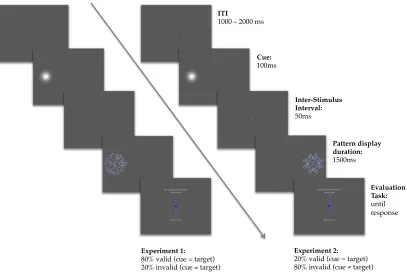
In Chapter 3, a variation of the classic exogenous orienting paradigm
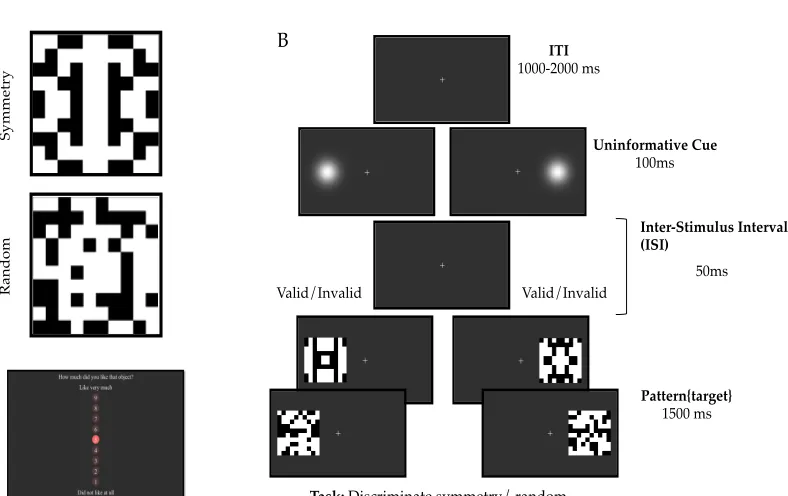
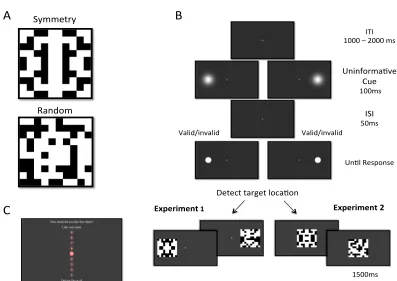
(Posner, 1980) was employed. An uninformative peripheral cue was briefly presented (100ms) at either left or right of a fixation cross. This cue was followed by a novel abstract pattern after a short interval of 50ms. Participants performed a discrimination task reporting whether the pattern was symmetry or random as fast and accurately as they could. Participants saw a novel pattern on each trial and had to evaluate it immediately after offset. Evaluation consisted on selecting a value from 9 (like very much) to 1 (not like at all) on a vertical rating scale.
In Experiment 1(3), one group of participants gazed and looked at the
demonstrated that the value of objects with intrinsic valence could change as a function of attention orienting.
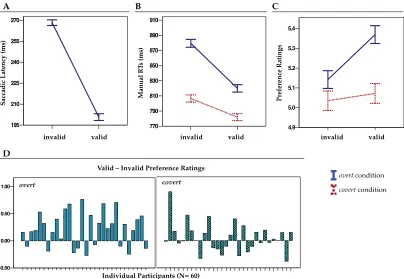
In the same experiment, I tested a condition in which participants performed the task maintaining eyes at fixation throughout the whole experiment (Experiment 1(3), covert condition). In this condition participants covertly attended the patterns that they had to evaluate. When attention is captured at a given location, the oculomotor system is prompted to respond to that location. Gazing at an object, leads to its foveation for deeper processing. Shimojo et al. (2003) suggested that the first instantiation of preference formation emerges from implicit, reflexive overt orienting mechanisms.
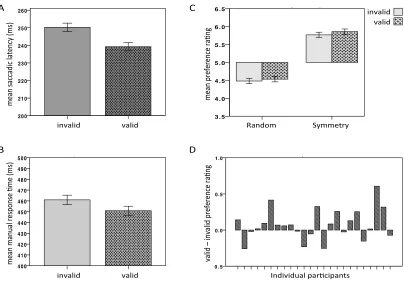
It is well known that covertly attending and efficiently processing information in the periphery is possible (e.g. Posner, Cohen, Choate, Maylor, & Hockey, 1984). The so-called ‘covert’ deployment of attention produces biases in behavioural performance and neural processing in absence of ‘overt’ orienting (i.e. head or eye movements, Moore, Armstrong, & Fallah, 2003). However, I wanted to examine whether applying endogenous control on oculomotor response to the target pattern would interfere with the cueing effect on preference (although cuing was still expected to affect the speed of the discrimination task in covert attention). Pattern discrimination was faster at valid locations, as expected. However, preference ratings were only driven by pattern regularity and unaffected by attention modulation. Although not significantly, ratings in covert condition were also more negative overall than in the ‘overt’-condition.
performance and evaluation was observed. This suggested that the valid – invalid effect emerged from a combination between enhanced responses and preference at the validly cued location, and costs associated with disengaging and reorienting attention in invalid conditions.
The results described in Chapter 3 evidenced that exogenous capture of attention could create a first instantiation of preference. When cuing failed in indicating the correct location of the target, the shift of attention that had been activated required an effortful process of inhibition and reprogramming of a new oculomotor response. The interplay of these processes might have played an important role in favouring a valid – invalid effect on preference. I also observed that constant level of inhibition applied on oculomotor response towards the to-be-evaluated pattern was responsible for cancelling any effect on evaluation. Therefore shifting attention is necessary but not sufficient for preference modulation. Gazing is necessary.
At the end of Chapter 3, I reported preliminary results from an experiment in which I tested valid – invalid cueing effect with longer cue-to-target intervals (or interstimulus intervals) (Experiment 3a(3), 3b(3)). The magnitude of the valid – invalid effect on SRTs and MRTs was expected to decrease or disappear with increasing ISI, and this should reflect on preference. For consistency with the aforementioned experiments only one ISI was employed in each sub-experiment. In Experiment 3a(3) ISI was 475ms and I expected to find no effect in any of the variables. In Experiment
3b(3) ISI was 900ms and an inhibitory mechanism (Inhibition of return, IOR;
The second study (Chapter 4) employed a variation of the spatial cueing procedure. The onset of the peripheral uninformative cue preceded the appearance of a target, which was a simple circle. Participants in this study performed a detection task, reporting the location of the target (left/right). The abstract pattern (identical to Chapter 3) appeared immediately after response. Participants observed the pattern without making any explicit regularity-classification. At pattern offset, they rated their liking on a 9-points scale. In Experiment 1(4) patterns were presented at the same location as the target (either valid or invalid). In Experiment 2(4) the patterns appeared always at fixation. Target detection was facilitated by valid cueing in both experiments. Patterns evaluation was more positive for patterns in valid trials than patterns in invalid trials, but only when patterns appeared at the same location as the target (Experiment 1(4)).
The first important result from this study was that exogenous cuing was found to affect preference even when the to-be-evaluated patterns were irrelevant for the cuing task.
This study also tested two hypotheses. First, valid – invalid effect on preference might be associated with increased subjective experience of perceptual fluency on valid cue-to-target contingencies (see Reber, Wurtz, Zimmermann, 2001; Constable et al. 2013). This hypothesis was rejected: if valid cue-to-target contingencies increased experience of fluency, cue validity should bias evaluation also in Experiment 2(4). Moreover, these results suggested that preference was modulated at the moment in which attention was directed towards (or away) the cued location and dwelled at that location where the pattern was due to appear. In Experiment 2(4), gazing back to fixation on every trial was sufficient to cancel the valid – invalid effect on preference.
Experiment 3a(4), 3b(4) replicated the design of the two previous
this could extend to non-target stimuli presented at the valid/invalid location. It also confirmed that shifting attention is not enough but gazing towards the location of interest favours the formation of preference. Finally it showed that endogenous control plays an important role over exogenous control, as it can cancel the exogenous effects.
Chapter 5 employed another variation of the cuing paradigm. In
Experiment 1(5) the cue indicated the valid location of the incoming pattern
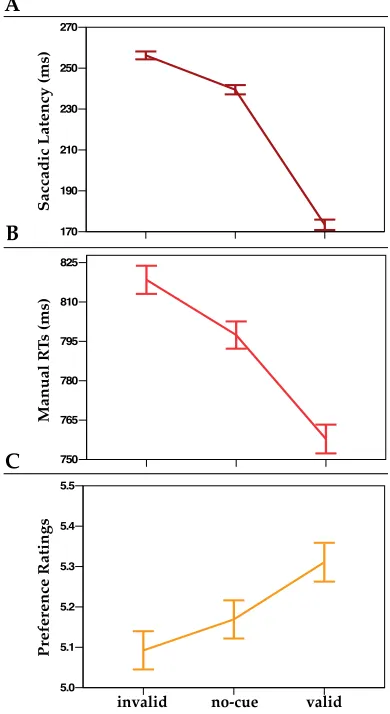
on 80% of the trials (predictive cues). In Experiment 2(5) the proportion of valid:invalid was reversed (20% valid 80% invalid) (counter-predictive cues). The cues preceded the appearance of either abstract symmetric or random patterns, and we asked participants to rate their liking for the patterns. This study explored the effect of learned predictability and violation of expected contingency on preference evaluation. In the first case the predictable condition was valid condition: endogenous expectation and exogenous cueing synergistically cooperated. As expected response reactions and preference were enhanced for stimuli appearing at validly cued (and predicted) locations. In the second case endogenous and exogenous dimensions had opposite directions. The valid – invalid difference was cancelled in this experiment. Hence, as already suggested by previous experiments, endogenous control can overwhelm exogenous influence.
The studies conducted so far have only observed that endogenous (inhibitory) control cancels the exogenous effects. It would be interesting to obtain a condition in which endogenous control uses the exogenous information to enhance attention orienting at the invalid location. Observing how this inhibitory process influences preference evaluation would add to the current set of results. This is what future studies should address, in order to understand whether and how endogenous and exogenous attention interact in creating a first instantiation of preference.
In Chapter 6 I reported the results from a further analysis on
eye-movement data from previous experiments (Experiment 1(3) and 2(3), Chapter 3; Experiment 1(5), Chapter 5). I observed that the time eyes dwelled over patterns significantly varied as a function of validity. In valid trials gaze-dwelling times were significantly longer than in invalid trials. This difference was likely to originate from the fact that pattern display duration was fixed (1500ms). Depending on the time required to a saccade to be initiated, duration of patterns’ exposure to foveal processing could vary considerably. In a new study I tested the possible impact of pattern exposure duration on preference modulation. With a gaze-contingent technique, dwell duration over the pattern was controlled. A pattern display time of 1500ms was triggered in the moment in which eyes reached the pattern. Gaze thus could dwell over valid and invalid location for the exact same amount of time. Results showed a significant valid – invalid effect on preference even if gaze dwelled over patterns for the same amount of time.
In this study I ruled out a role of exposure duration on the preference effect elicited by peripheral cues.
2010), which implies that the affective value of an object can be processed in the periphery. However, all the information related to the object can be extracted only through foveal processing. For example, a person in a shoe shop would be able to discriminate a beautiful shoe form an ugly one, located in the peripheral field. However, one would need to carefully look at each item to be able to express an opinion about it and make the right choice. It is thus conceivable to think that the evaluation of a stimulus would be more positive at fovea than in periphery. Moreover, the amount of information accessible to perception depends on the distance from the fovea. The same stimulus may be differently appreciated when processed at different locations. This study investigated whether preference evaluation of an item is inversely proportional to increasing eccentricity.
locations on the retina. It is thus conceivable to hypothesize that retinal eccentricity would not predict modulation of aesthetic preference for random patterns.
In the study, dot patterns (4-fold reflection symmetry and random) were presented for 200ms within a large region. Participants were instructed to select a fixation location arbitrarily on each trial. Eccentricity values were calculated a posteriori by comparing ocular coordinates at pattern onset and coordinates for the centre of the pattern. Experiment 1(7) consisted of two Tasks. In Task 1, participants detected pattern regularity as fast as possible.
In Task 2 participants did not actively discriminate symmetry and evaluated
of fully processing the object at fovea, are fundamental requirements for a first instantiation of preference.
The study described in Chapter 8 followed up the first study (Experiment 1(7)), but did not focus on preference. It explored whether the absence of eccentricity effect on symmetry discrimination was caused by methodological factors. In particular this study focused on the role played by the presence/absence of the fixation mark.
As previously mentioned symmetry in extra-foveal vision can be efficiently discriminated from random configuration. However, detectability of symmetry considerably drops with axis eccentricity (Barrett, Whitaker, McGraw, & Herbert, 1999; Gurnsey, Herbert, & Kenemy, 1998; Jukka Saarinen, 1988; Sally & Gurnsey, 2001), and it can be equated to foveal performance only by scaling up stimulus size proportionally with eccentricity (Tyler & Hardage, 1996). In our study, patterns’ size was maintained unvaried across eccentricities. Therefore, the discrimination of symmetry from random patterns should be affected by distance from the fovea. Experiment 1(7) required participants to change fixation in every trial by choosing any location within the central circle, which was not identified by a fixation mark. The fixation mark is commonly used in almost every paradigm in experimental psychology. The principal function played by this stimulus is to engage attention on a specific point prior to target appearance, to minimize noise due to spreading of attention in the periphery. The absence of a physical fixation point in our experiments is likely to have facilitated the deployment of attention to the periphery (see Mackeben & Nakayama, 1993). This was combined with the fact that the incoming pattern location was totally unpredictable for the participant, and the probability of getting a pattern at fovea was very low.
In Experiment 1(8), two procedures were compared to test symmetry
detection across eccentricity: in the first task observers selected where to look (similarly to Experiment 1(7)) and in the second task they were provided with a fixation mark. Like in the previous study the display consisted of a large grey central circle in which an abstract dot pattern (bilateral symmetry or random) was presented for 200ms at a randomly selected location. In
circle. There was no physical stimulus to fixate, so participants maintained fixation on an empty space. In Task-FC(Fixation Cross) was identical, but a fixation cross was presented at different locations within the circle. Manual reaction time and accuracy were recorded. Eccentricity was found to not affect manual responses in Task-NoF, although a decrement in accuracy was observed. Both accuracy and speed of manual reaction decreased with increasing eccentricity in Task-FC. Experiment 2(8) showed eccentricity effect on manual reaction times by using a central fixation mark, despite a reduced range of eccentricity values. This study confirmed that the fixation cross plays an important role in the deployment of attention in the visual field. In the General Discussion of Chapter 8, I speculate that sensitivity to symmetry probably declined with increasing eccentricity in a similar fashion in all tasks, as eccentricity always predicted impaired accuracy. Manual response speed instead may be under the influence of participant’s pre-attentional status, which in turn is biased by a number of factors (i.e. presence/absence of the fixation cross).
This finding has implications not only for the study of symmetry perception, but also for traditional paradigms used to study attention. First, it highlights that manual reaction times may not be a reliable index of perceptual or attentional facilitation. Instead, RTs are deceptively complex and may be biased by the pre-attentional state of the participant. Second, it suggests that effects observed with paradigms providing fixation marks might not generalise to the case of freely chosen fixations. Finally, this study provides insights about the way in which attentional phenomena are studied in the lab and advocates for combining highly controlled experimental designs with ecologically valid measures.
Part 1
2
Electrophysiological analysis of the
affective congruence between pattern
regularity and word valence
* This study has been published as: Rampone, G., Makin, A. D. J., & Bertamini, M. (2014).
Electrophysiological analysis of the affective congruence between pattern regularity and word valence. Neuropsychologia, 58(1), 107–117.
2.1
Abstract
2.2
Introduction
Symmetry is linked to beauty, and is associated with positive valence. In this study we explore the visual processing of symmetry using a paradigm in which symmetric patterns are presented together with positive or negative words. It has been suggested that reward mechanisms exist along all stages of visual processing and that these networks produce aesthetic experiences. Therefore, we predicted that event related potentials should respond to congruency between visual regularity and word valence.
Perception of symmetry
“goodness” to symmetrical patterns (Wertheimer, 1938; Koffka, 1935) and Palmer (1991) confirmed that symmetrical structures are rated high in “goodness”. Preference for symmetry can also be explained by the fluency hypothesis (Winkielman, Schwarz, Fazendeiro, & Reber, 2003), which states that people are sensitive to the ease of their own perceptual or cognitive operations, and that fluent processing is experienced as hedonically positive (Reber, Schwarz, et al., 2004; Reber, Wurtz, & Zimmermann, 2004).
There have been several neuroimaging studies looking at symmetry (see Treder, 2010). Functional MRI studies have discovered symmetry-related activations in the Lateral Occipital Cortex (Yuka Sasaki, Vanduffel, Knutsen, Tyler, & Tootell, 2005; Tyler et al., 2005) and other extrastriate regions like V3a, V4, V7 (Yuka Sasaki et al., 2005). Of particular interest for our work, Jacobsen & Höfel (2003) reported a symmetry related ERP component at occipital sites, called the Sustained Posterior Negativity (SPN). After the visual evoked potential, amplitude was more negative for symmetrical than random patterns, at least up to 1100ms post stimulus onset. The authors suggested that the SPN results from accurate and sustained visual analysis of the pattern before deciding whether it was symmetrical. However, the SPN can also be recorded when participants do not attend to regularity (Höfel & Jacobsen, 2007) and when either random or reflection patterns are targets (Makin et al., 2012). The LORETA source localization technique identified the SPN neural generator in the lateral extrastriate visual cortex (Makin et al., 2012), providing evidence that the brain regions identified in fMRI studies generate this ERP.
Makin, Rampone, Pecchinenda, & Bertamini, (2013) further demonstrated that the SPN is sensitive to different visual regularities: reflection, rotation and translation. However, reflection symmetry seems to be the preferred stimulus for visual regularity detectors, producing the largest SPN. This is in agreement with psychophysical studies, which have repeatedly shown reflection symmetry to be the most salient regularity (Bertamini, Friedenberg, & Kubovy, 1997; Friedenberg & Bertamini, 2000; Makin, Pecchinenda, & Bertamini, 2012).
presented, and then a word appeared. Participants had to classify the word as positive (e.g. Love) or negative (e.g. Hate) as quickly as possible. It was predicted that people would have been quicker to respond in the congruent conditions, where a positive word followed a symmetrical pattern or a negative word followed a random pattern than, in the incongruent conditions (symmetry then negative or random then positive). The expected reaction time advantage for congruent conditions was found, but only when participants had to attend to the prime as well as the word. Nevertheless, these results confirmed a link between the symmetry-random and positive– negative dimensions. It might be possible this happened at the level of conceptual categories, and the results do not have to be explained by an immediate affective response to the stimuli (but see Pecchinenda, Bertamini, Makin, & Ruta, 2014), for behavioural evidence for automatic affective responses).
The current work re-examined the congruence effects found in affective priming studies by using EEG techniques. The experiment was a modified version of the affective picture-word interference task (Glaser & Düngelhoff, 1984; Houwer & Hermans, 1994; Stroop, 1935) in which two stimuli – a target and a distractor – are presented superimposed. There are four possible relations between pictures and words: both target and distractor have positive or negative valence (congruent conditions); target is positive and distractor is negative or target is negative and distractor is positive (incongruent conditions). It is possible that presenting words and patterns superimposed would induce participants to process regularity and valence dimensions simultaneously.
sensitive potentials overlapped considerably with the SPN, it would suggest that visual networks that are sensitive to symmetry are also sensitive to valence.
We also focused on ERP components usually modulated by emotional variables. The Early Posterior Negativity (EPN) is the first ERP response to the emotional content of visual stimuli. It peaks around 200–300ms after stimulus onset with lateroccipital scalp distribution (see Citron, 2012; Hajcak, MacNamara, & Olvet, 2010). The EPN responds preferentially to high emotional valence and arousal, and is larger for stimuli with either positive or negative valence than stimuli with neutral valence (Junghöfer, Bradley, Elbert, & Lang, 2001; Schacht & Sommer, 2009a, 2009b; Harald T Schupp et al., 2004; Harald T Schupp, Junghöfer, Weike, & Hamm, 2003; Scott, O’Donnell, Leuthold, & Sereno, 2009). This emotional response is thought to be automatic and effortless (Kissler, Herbert, Winkler, & Junghofer, 2009) and could reflect spontaneous attention capture by emotionally salient stimuli (Schacht & Sommer, 2009a, 2009b; Schupp et al., 2007). ERPs associated with early emotion discrimination and symmetry recognition share similar topography, and the SPN begins around the same time as the EPN. If the congruent/incongruent difference emerges at this early time point, it would suggest the evaluation of the patterns happens immediately after the initial visual analysis is complete.
observed on LPP, would indicate the link between symmetry/random and positive/negative dimensions happens at a later conceptual level.
Additionally, possible alterations of Visual Evoked Potentials (VEP) were also contemplated. After all, the N1 component is sensitive to regularities (Makin et al., 2012b) with greater amplitude for reflection and rotation patterns than random or translation patterns (Makin et al., 2013). N1 amplitude modulations have also been observed in response to arousing and valenced words (Kissler et al., 2009; Scott et al., 2009). In light of previous literature showing N1 sensitivity to both pattern regularity and word valence, we investigated whether N1 amplitudes would differ between congruent and incongruent trials.
This study consisted of two experiments. Experiment 1 was divided in two tasks. Half of the subject classified the valence of the words in the first task, and classified the regularity of the pattern in the second task. The other half of subjects performed the same tasks but with opposite order. In Experiment 2, all participants attended to word valence and pattern regularity simultaneously. After each trial, they classified either regularity or word valence, but they did not know in advance which response was required (for this reason, they were forced to pay attention to both patterns and words). We considered this to be an important factor, since previous studies suggest that symmetry and words must be attended to produce a congruency effect (Bertamini et al., 2013).
2.3
Experiment 1
subjects performed the Discriminate Regularity task first and Discriminate Word task second, while the order was switched for the other participants.
We focused our analysis on ERPs described in previous literature. First, We were interested in whether the amplitude of Sustained Posterior Negativity (SPN), which is sensitive to symmetry, would differ on congruent and incongruent trials. Second, we explored possible modulations of ERP usually involved in the processing of valence, such as EPN and LPP, In addition, we also investigated whether congruent and incongruent conditions would alter visual evoked potentials, like P1 and N1.
2.3.1 Methods
2.3.1.1 Participants
Forty participants were involved in this study (aged 18 to 40, 9 males, 3 left handed). Participants had normal or corrected to normal vision. The study had local ethics committee approval and was conducted in accordance with the Declaration of Helsinki (revised 2008).
2.3.1.2 Apparatus
EEG was recorded using a BioSemi Active-Two amplifier in an electrically shielded, and darkened room. EEG was sampled continuously at 512 Hz from 64 AgCl scalp electrodes arranged according to the international 10–20 systems. Two additional electrodes, called Common Mode Sense (CMS) and Driven Right Leg (DRL) were used as reference and ground. Biopolar VEOG and HEOG electrodes were positioned above and below the right eye, and on the outer canthi of both eyes, respectively. The EOG data was obtained from 4 external channels of the same BioSemi amplifier.
2.3.1.3 Stimuli
Figure. 1. Trial structure of the Experiments In both Experiments trials began with a fixation screen of variable duration from 1.5 to 2 s. Stimuli were presented at fixation for 2 s. They consisted of abstract novel patterns, reflection or random, superimposed on a word with positive or negative valence. Therefore there were four possible combinations: random-negative and reflection-positive were the congruent conditions; random-positive and reflection-negative were the incongruent conditions. In the Discriminate Word task of Experiment 1, the response-screen asked participants to report the valence of the word as positive or negative. In Discriminate Regularity task of Experiment 1, the response screen asked them to report the patterns as random or reflection. In Experiment 2, one of the two response-screens might appear after stimulus presentation, and participants could not predict which judgment would be required when viewing the stimuli. The position of words on the response screen indicated whether to press the left or right button to enter a particular response. Positioning was reversed in half the trials.
Random'
Reflec+on'
N
eg
a+
ve
'
Po
si
+ve'
1.
5'
–'
2'
se
co
nd
s'
2'seco
nd
s'
Un
+l
'res
po
ns
e'
Experiment'1'
‘discriminate'regularity'’' ‘discriminate'word’'Experiment'1'
2.3.1.4 Procedure
Participants sat 140 cm from the monitor with no head constraint or chin rest. After the electrodes were attached, participants were told to fixate on a central cross during the baseline period and when the patterns were on the screen.
Participants used the ‘A’ and ‘L’ buttons of a computer keyboard to enter their responses. Each trial started with a variable inter trial interval (ITI, 1.5 to 2 s) in which a fixation cross was presented. After this, a black and white pattern with a valence word written on the top was presented and remained on the screen for 2 s. The trial structure is shown in Fig. 1.
In the Discriminate Regularity task, at the end of each trial the response screen asked to report the regularity of the pattern (“Reflection...Random” or “Random...Reflection”). In Discriminate Word task, participants saw a similar response screen and were required to report the valence of the word (“Positive...Negative” or “Negative...Positive”). The left or right position of the words on the response screen varied between trials, and the position indicated which key to press. For example, if the word Reflection was on the left of the response screen, and the pattern was a reflection, then the correct key was the left key. The configuration of the response screen was counterbalanced across other factors and not predictable for the participants. Participants, therefore, did not know which hand to respond with until the response screen appeared. This procedure was the same used in (Makin et al., 2012) to prevent the development of lateralized motor preparation potentials during the stimulus presentation (Murray, Schrater, & Kersten, 2004).
We used the EEGLAB toolbox in Matlab to analyse the EEG trace offline. Raw data from 64 scalp electrodes were re-referenced to a scalp average, and low pass filtered at 25 Hz. Data was resampled at 128 Hz to reduce file size, and segmented into -0.2 to +2 s epochs, with a -0.2 to 0 s baseline. After this, Independent Components Analysis (Jung et al., 2000) was used to remove artefacts produced by blinks and eye movements. Data was reformed as 64 components, and an average of 7.85 components were removed from each participant (min=4, max=13). After ICA, trials with amplitude greater than ±100!V at any electrode were excluded.
The average proportion of excluded trials did not differ significantly between any of the conditions analysed in both tasks (ranging between 11% and 13% of excluded trials).
Participants were instructed to fixate throughout the trials, and the ICA procedure was employed to eliminate eye movement artefacts. However, this is not enough to remove the cortical consequences of eye movements from the ERP signal. We thus analysed the activation of horizontal and vertical eye movements channel in all conditions. EOG raw data were epoched (-0.2 to 1 s) but were not subjected to any other treatment. Mean EOG activity for the conditions did not differ in any of the two tasks (p> .1). This analysis was necessary to ensure eye artefacts did not distort the results.
In line with previous research on symmetry-related ERPs (Makin et al., 2013; Makin et al., 2012) and emotion words ERPs (Scott et al., 2009) we measured amplitudes of specific ERP deflections in the following time intervals: P1 from 100 to 130ms, N1 from 170 to 200ms, Sustained Posterior Negativity from 250 to 1000ms (Makin et al., 2012). EPN component was analysed at the time window 200–300ms (Kissler, Herbert, Peyk, & Junghofer, 2007; Scott et al., 2009). Grand-average ERPs were computed across four posterior electrodes on the right hemi- sphere (P6 P8 P10 PO8) and homologous electrodes on the left hemisphere (Scott et al., 2009). LPP was analysed from a cluster of four centro-parietal electrodes (Pz P1 P2 POz) accordingly to the main studies on this complex (see Citron, 2012).
Each participant saw 72 random patterns with negative words negative), 72 random patterns with positive words (random-positive), 72 reflection patterns with negative words (reflection-negative) and 72 reflection patterns with positive words (reflection-positive). In the Discriminate Word task they attended to the words written on top of the patterns and reported the valence, as positive or negative. In the Discriminate Regularity task they attended to the patterns and reported the degree of regularity as reflection or random. Participants gave the correct response on most trials both in the Discriminate Word task (Mean correct= 98%, SD= 1.01%) and the Discriminate Regularity task (Mean correct= 97%, SD= .95%)
Figure 2 Grand Average ERPs [N= 40] from Experiment 1 the Discriminate Word task and
the Discriminate Regularity task are plotted. Panels A and C show reflection random
conditions. (B) and (D) show congruent and incongruent conditions. (A’)–(D’) Topographic
difference maps at the time window corresponding to the SPN component (250–1000ms). Each map represents a head, and each black dot represents an electrode. The data show the difference between the two conditions. Red squares indicate the electrodes selected for analysis.
Reflection − Random625
Experiment*1*
Discriminate*Word* Discriminate*Regularity*
−−1006 0 100 200 300 400 500 600 700 800 900 1000
−4 −2 0 2 4 6
Time from stimulus onset (ms)
Amplitude (microvolts)
Congruent Incongruent
−100 0 100 200 300 400 500 600 700 800 900 1000
−6 −4 −2 0 2 4 6
Time from stimulus onset (ms)
Amplitude (microvolts)
Congruent Incongruent
B*
D*
−−1006 0 100 200 300 400 500 600 700 800 900 1000 −4 −2 0 2 4 6
Time from stimulus onset (ms)
Amplitude (microvolts)
Reflection Random
−100 0 100 200 300 400 500 600 700 800 900 1000
−6 −4 −2 0 2 4 6
Time from stimulus onset (ms)
Amplitude (microvolts)
Reflection Random
A*
C*
Reflection − Random625 Congruent − Incongruent625
Reflec<on*–* Random* SPN*(250E1000*ms)* C’* −2 −1.5 −1 −0.5 0 0.5 1 1.5 2 Am pl itu de *+/ E*2 μv * Congruent*–* Incongruent* SPN*(250E1000*ms)* D’* Congruent − Incongruent
Figure 3. Grand Average ERPs [N= 40] of the sub-conditions of the congruent and incongruent trial from Experiment 1 the Discriminate Word task and the Discriminate
Regularity task. (A) and (B) show reflection-positive, reflection-negative, random-positive
and random-negative waveforms. (A’) and (B’) Topographic difference maps at the 250–
1000ms time window for the two sub conditions. Red squares indicate the selected electrodes.
Event related potentials
We were interested in testing the congruency effect in posterior ERPs, which have previously been linked to symmetry and valence processing. The analysis was conducted on the time-windows: 100–130ms (P1), 170–200ms (N1), 200–300ms (EPN) and 250–1000ms (SPN) 500–800ms (LPP). For each time window, we initially performed repeated measure ANOVAs with two
−100 0 100 200 300 400 500 600 700 800 900 1000
−6 −4 −2 0 2 4 6
Time from stimulus onset (ms)
Amplitude (microvolts) ReflectionPositive ReflectionNegative RandomPositive RandomNegative Experiment*1*
Discriminate*Word* Discriminate*Regularity*
E*
−100 0 100 200 300 400 500 600 700 800 900 1000
−6 −4 −2 0 2 4 6
Time from stimulus onset (ms)
Amplitude (microvolts) ReflectionPositive ReflectionNegative RandomPositive RandomNegative
F*
RandomGood − RandomBad625
ReflectionGood − ReflectionBad625
SPN*(250@1000*ms)* −2 −1.5 −1 −0.5 0 0.5 1 1.5 2 Am pl itu de *+/ @*1 .5 μv * SPN*(250@1000*ms)* RandomPosiHve–* RandomNegaHve* ReflecHonPosiHve*–* ReflecHonNegaHve* F’*
RandomGood − RandomBad ReflectionGood − ReflectionBad625
[image:39.595.118.518.86.425.2]Grand-averages ERPs were collapsed across all 40 participants separately for the Discriminate Word (Fig. 2A and B and Fig. 3A) and the Discriminate Regularity tasks (Fig. 2C, D and Fig. 3B). Topographic maps in
Fig. 2A’ and 2C’ show the difference between reflection and random
conditions at the SPN time window (250– 1000ms), while topographic maps
in Fig. 2B’ and 2D’ show the difference between congruent and incongruent
trials. Fig.3A, 3B and 3A’, 3B’ show ERP waveforms and topographic maps of sub conditions separately for the two tasks. The most important effect was the difference between reflection-positive and reflection-negative waves in the discriminate word task. This congruency effect was recorded at posterior electrodes from 200 to 1000ms. This effect was absent in the discriminate regularity task.
Visual evoked potentials
The P1 component was different between the two tasks (F(1,39)= 4.637, p= .04), with a smaller peak in the Discriminate Word task than the Discriminate Regularity. Congruent and Incongruent conditions showed similar P1 in both tasks (F (1,39)= .695, p= .201). In line with previous findings (Makin et al., 2013, 2012a,b), P1 was identical between reflection and random trials (F(1,39)= .003, p= .923) and in both tasks (F(1,39)= .006, p= .940). P1 was also similar for positive and negative words (F(1,39)= .01, p= .923) and in both tasks (Task Word valence: F(1,39)= .068, p= .795).
N1 showed a marginal effect of Task (F(1,39)= 3.069, p= .08), with Discriminate Word eliciting a smaller peak than Discriminate Regularity. Importantly, there was a Task Congruency interaction (F(1,39)= 5.890, p= .02), because in the Discriminate Word task, N1 was marginally larger in the congruent trials than incongruent trials (t(39)= -1.886, p= .06), as shown in
Fig. 2B.
.5). Hence, the congruent interaction between positive words and reflection patterns elicited a unique negative response after 200ms from stimulus onset.
Fig. 2A shows a more negative wave for reflection patterns than for random
patterns (Fig. 2A), although this trend was not significant (F(1,39)= 3.094, p= .086). There were no other effects or interactions.
Early posterior negativity and sustained posterior negativity
ERPs at the EPN and SPN latency were explored by analysing the electrodes over the extrastriate visual area in the time windows 200–300ms and 250–1000ms from stimulus onset, respectively. There was a significant main effect of regularity in both components (EPN: F(1,39)= 27.464, p< .001; SPN: F(1,39)= 25.353, p< .001). Reflection patterns produced negative amplitude compared to random patterns. In the SPN time window, there was also a significant Task X Pattern regularity interaction (EPN: F(1,39)= 3.239, p= .08; SPN: F(1,39)= 20.186, p< .001). In the Discriminate Regularity task the difference between reflection and random was highly significant (t(39)= - 8.284, p < .001); while it was weaker in the Discriminate Word task (t(39)= - 3.220, p< .01) (see Fig. 2A–C). Word valence did not produce any main effect (F(1,39)= 1.064, p = .31), however, there was a significant Task X Valence interaction (F(1,39)= 5.228, p< .03) because positive words elicited more negative deflection than negative words only in task Discriminate Word (t(39)= -2.437, p= .02).
Discriminate Word task the difference between reflection-positive and reflection-negative stimuli was significant (EPN: t(39)= -2.058, p= .04; SPN: t(39)= -3.681, p= .001). Conversely, the amplitudes of random-positive and random-negative conditions were almost identical (EPN: t(39)= 1.210, p= .23; SPN: t(39)= .713, p= .5). Therefore the congruency effect observed in the Discriminate Word task seems to be exclusively related to the association between reflection patterns and positive words (see Fig. 3A).
The analysis of LPP revealed a main effect of Word valence (F(1,39)= 4.889, p= .033) with negative words eliciting a more positive ERP than positive words. There were no other significant main effects or interactions. Finally we also tested whether the above effects might be modulated by task order (Discriminate Word first, Discriminate Regularity first). However, task order had no significant effect on ERPs. In summary the most important effect was the difference between congruent and incongruent waves at posterior electrodes from 250ms onwards. This congruence effect was only present in the discriminate word task, and no such effect was found in the discriminate regularity task.
2.3.3 Discussion of Experiment 1
congruence effect in the Discriminate Word task was not limited only to the EPN latency; it persisted throughout the SPN interval.
The characteristics of other ERPs help explain why we only recorded a congruency effect in the Discriminate Word task. In the Discriminate Regularity task, there was a large SPN, with lower amplitude in the reflection than the random trials. The SPN was reduced, but still present, in the Discriminate Word task. This result suggests that regularity can be processed even if not attended, and other studies have also recorded the SPN under passive viewing conditions (Höfel & Jacobsen, 2007; Makin et al., 2013). Given this evidence that both patterns and words were processed in the Discriminate Word task, it is not surprising that we only found a congruency effect here. Conversely, in the Discriminate Regularity task, resources were focused on pattern regularity, and valence of words cannot be processed as a secondary task.
Note that the term congruent indicates the average of reflection– positive and random-negative conditions and incongruent is the average of reflection-negative and random-positive conditions. However, most of the congruency effect is attributable to the difference between reflection-positive and reflection negative waves, with little difference between random-positive and random-negative waves. Moreover, the reflection random-positive wave was different from the other three waves. We will return to this aspect in the General discussion.
The analysis of LPP revealed that overall negative words elicited a more positive ERP than positive words. The fact that there was no interaction with task suggested that words valence was not totally ignored in the Discriminate Regularity Task, but the contribution of attention would be important for emotional words to influence the processing of patterns (Bayer, Sommer, & Schacht, 2010; Hinojosa et al., 2010).
2.4
Experiment 2
The design of Experiment 2 was identical to Experiment 1, but participants had to report either the regularity of the pattern or the valence of the word at the end of the trial, and they did not know which dimension would be probed in advance, while the stimuli were on the screen. Therefore, they were forced to attend to both shapes and words simultaneously. Experiment 2 essentially combined the two tasks (the Discriminate Word task and the Discriminate Regularity task) described above in Experiment 1 in one single experiment.
2.4.1 Method
Twenty-four participants2 (aged 18 to 35, 5 male, 2 left handed) took
part. None of these people participated in the Experiment 1. The stimuli were generated in the same way of the Experiment 1, whereas the procedure differed slightly. The response screen, presented immediately after the stimuli, might require either to report regularity or valence.
The type of response screen was counterbalanced across other factors, and, importantly, was not predictable for the participants. Participants therefore were forced to attend both to the pattern and the word.
A linear-detrend procedure was used to remove high amplitude drift from 4 participants. An average of 9.05 components were removed from each participant (min= 4, max= 13). The average proportion of excluded trials did not differ significantly either between trials with random and reflection patterns (13% vs 13%, p= 0.7) or between trials with negative and positive words (12% vs 13%, p= 0.7). However, the interaction between regularity and word valence was significant (p= .03). Slightly more trials excluded in the random-positive condition were more than in the random-negative condition (14% vs 12%, p= .02), while there was no significant difference between
2Note that the number of participants in Experiment 2 (twenty-four) differs from the
reflection-positive and reflection-negative conditions (13% vs 12%, p= .4). EOG analysis was also conducted and did not reveal any significant main effect or interaction (p> .1), suggesting eye movement artefacts were equally spread across all experimental conditions.
ERP analysis was identical to the Experiment 1. We took in consideration the time windows: 100–130ms (P1), 170–200ms (N1) and 250– 1000ms (SPN). Mean amplitudes were computed across the same electrodes of the Experiment 1, and conditions analysed were the same as shown in Fig. 4A–C and 4A’–C’. LPP was also analysed in the time window 500–800ms at the same electrodes of Experiment 1.
2.4.2 Results
Figure 4 Grand Average ERPs [N1⁄424] from Experiment 2 at the selected electrodes
(indicated by the red squares). (A) Reflection and random (B) congruent and incongruent (C)
reflection-positive, reflection-negative, random-positive and random-negative. (A’)–(C’)
Topographic difference maps at the 250–1000 ms time window between the conditions.
Event related potentials
Congruent and Incongruent conditions did not differ in amplitude in the EPN or SPN time-windows (EPN: t(23)= 0.245, p= .8; SPN: t(23)= 0.637, p= .5). There was a main effect of regularity: the amplitude of the reflection wave was significantly more negative than the random wave (EPN: F(1,23)= 14.230, p < .001; SPN: F(1,23)= 28.562; p< .001). There were no other effects or interactions (Fs< 1.0 and ps> .1). Also VEPs were not modulated by any factors in this experiment (Fs< 1.0 and ps> .1). We did not find any effect or interaction at the LPP level except for marginally higher amplitude for negative over positive words (F(1,23)= 3.38, p= .08).
2.1.1. Experiment 2 discussion
ReflectionGood − ReflectionBad625
Reflection − Random625
Congruent − Incongruent625
−100 0 100 200 300 400 500 600 700 800 900 1000 −6 −4 −2 0 2 4 6
Time from stimulus onset (ms)
Amplitude (microvolts)
ReflectionPositive ReflectionNegative RandomPositive RandomNegative
−100 0 100 200 300 400 500 600 700 800 900 1000
−6 −4 −2 0 2 4 6
Time from stimulus onset (ms)
Amplitude (microvolts)
Congruent Incongruent
−100 0 100 200 300 400 500 600 700 800 900 1000 −6 −4 −2 0 2 4 6
Time from stimulus onset (ms)
Amplitude (microvolts) Reflection Random A" B" C" Reflec)on"–" Random" A’" −2 −1.5 −1 −0.5 0 0.5 1 1.5 2 Am pl itu de "+/ 8"1 .5 μv " Congruent"–" Incongruent" SPN"(25081000"ms)" B’" RandomPosi)ve–" RandomNega)ve" −2 −1.5 −1 −0.5 0 0.5 1 1.5 2 Am pl itu de "+/ 8"1 .5 μv " Reflec)onPosi)ve"–" Reflec)onNega)ve" C’" SPN"(25081000"ms)" SPN"(25081000"ms)" Experiment"2"
In Experiment 2 we only observed difference between reflection and random patterns. This SPN replicates Experiment 1 and previous work (e.g. Jacobsen and Hofel, 2003; Makin et al., 2013). However, we did not find a difference between congruent and incongruent trials, despite the fact that people had to attend to both regularity and word valence within the same trial. This differs from the significant congruency effect recorded in the Discriminate Word task in Experiment 1. One possibility is that participants did not attend to the words and patterns simultaneously in Experiment 2, but rather classified and remembered one dimension, then the other.
2.5
General discussion
Experiment 2, where participants attended to both word valence and pattern regularity on every trial. We also note that the congruency effect in the Discriminate Word Task of Experiment 1 was largely driven by the unique reflection-positive waveform.
How can we explain these results? It seems that the relationship between word valence and pattern regularity only affects ERP amplitude when participants are deliberately classifying the words as positive or negative and regularity was processed pre-attentively. It could be that participants were put into an evaluative mindset by the word valence classification task, and this overgeneralized, so people spontaneously evaluated the valence of the background patterns as well, and thus noticed relationships between the valence of patterns and words.
The situation was apparently different in the Discriminate Regularity task, in which there were no such congruency effects. Here regularity could have dominated early visual processing, so people did not read the central words at all, or at least did not process word valence. It seems that attention was focused on pattern regularity, and this competed with the processing of word valence. Although emotional words are known to elicit task- independent emotional effects (Kissler, Assadollahi, & Herbert, 2006; Schacht & Sommer, 2009a), some degree of post-perceptual linguistic processing is required for this (Bayer et al., 2010; Hinojosa et al., 2010). It seems that such a process did not occur in the Discriminated regularity task of Experiment 1.
![Figure 2 Grand Average ERPs [N= 40] from Experiment 1 the Discriminate Word task and the Discriminate Regularity task are plotted](https://thumb-us.123doks.com/thumbv2/123dok_us/8045257.222126/38.595.66.480.98.594/figure-grand-average-experiment-discriminate-discriminate-regularity-plotted.webp)
![Figure 3. Grand Average ERPs [N= 40] of the sub-conditions of the congruent and incongruent trial from Experiment 1 the Discriminate Word task and the Discriminate Regularity task](https://thumb-us.123doks.com/thumbv2/123dok_us/8045257.222126/39.595.118.518.86.425/average-conditions-congruent-incongruent-experiment-discriminate-discriminate-regularity.webp)