WHAT'S IN IT FOR ME : A STUDY OF SENATORS ON COMMITTEES
A Thesis submitted for the degree of Master of Arts at the Austral) an National University.
This The si s is my own o r i g i n a l work and a l l s o u r c e s t h a t h a v e b e e n us ed h a v e b e e n c i t e d .
STYLE NOTES
(i ) The us e of m a l e p r o n o u n s in t h i s T h es i s is in no wa y i n t e n d e d to a s s i g n s p e c i a l i m p o r t a n c e or r e l e v a n c e t o a p a r t i c u l a r s e x .
TABLE OF CONTENTS
Page Chapter 1: THE SENATE - IN SEARCH OF A ROLE 1
Searching for a Model of Government 1
In Search of a Role 7
Development of the Current Committee ' 11 system
Senators Discussing Committees 19
Information 27
Chapter 2: WHY CHOOSE THE SENATE 32
The Role of Senators 33
What is the Difference Between a 34 Senator and a Member
Why do Senators Enter the Senate 37 Level of Partisanship in the Senate 39 Power (or is it even Influence) 43 The Stature of our Representatives 45
Chapter 3: WHY JOIN A COMMITTEE 48
Benefits of Committees 54
The General View v.s. the Expert 58
The Education of Senators 62
Chapter 4: ASSISTANCE FOR SENATORS 67
Department of the Parliamentary 68 Library
Department of the Senate 72
(a) Committee Staff 74
(b) Counsel 80
(c) Consultants 82
Assistance for Senators 84
Chapter 5: THE WORK OF COMMITTEES 87
Parliamentary Life • 87
A Week in the Life ... 91
Party Committees 96
Competing Pressures 106
Why Committees 108
When Should Committees Meet 110
REFERENCES Page Chapter Chapter Chapter Chapter Chapter Chapter Chapter Chapter Chapter
6: REFERENCES
7: THE POWERS OF COMMI T T E E S Constitutional Powers Privleges
Crown Privilege
8: THE ROLE OF THE CHAI R M A N State R e p r e s e n t a t i o n Role of the Chairman Media Projection
Chairman as the leader
The C h a i r m a n s h i p as a Stepping Stone
9: SUBMISSIONS
10: VEN U E FOR HEARINGS Interstate
Overseas Travel
11: THE TA K I N G OF EVIDENCE
12: COMMITTEES, THE PUBLIC SERVICE AND MINISTERS
Public Servants as a Source of Ad v i c e
Public Servants as W i t n e s se s Crown Privilege
Implications of the Guide l i n e s Difficulties between Committees
and the Public Service
Neutr a l i t y in a Political E nv ir on m en t Contact with State G o v e r nm en t s
Public Servants before Party Commi t t e e s Ministers and Committees
Ministers, Public Servants and Committees 13: C O M M ITTEE REPORTS
C o n s i d e r a t i o n by the Committees Minority Reports
C o n s i d e r a t i o n of Reports 14: TO WHOM ARE REPORTS DIRE C T E D
The E x e cutive and its A d m i n i s t r a t i o n Go v e r n m e n t Response
Support from Colleagues
Committee Reports - in P er s p e c t i v e Colleagues
The Public
Audience Emerges
Page
Chapter 15: THE MEDIA 215
The role of the Media - the Committee 215 Perspective
Conflict or Consensus - the Problem 219 of Coverage
Chapter 16: CONCLUSION 224
Bibliography 231
Appendix 1: Research Procedure
Methodology 1
Response Rate 2
Appendix 2: Questionnaire for Senators 1
TABLES
Table Page
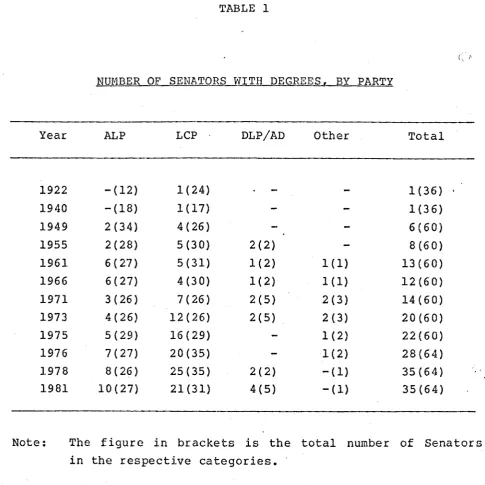
1 Number of Senators with degrees, by Party - 55
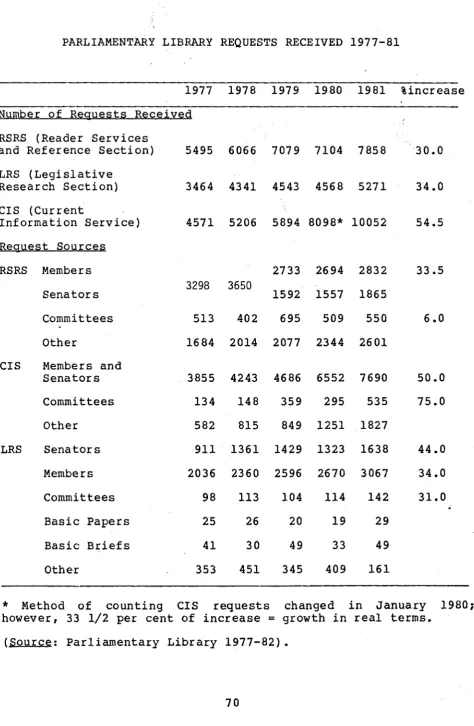
2 Parliamentary Library requests received 70 1977-81
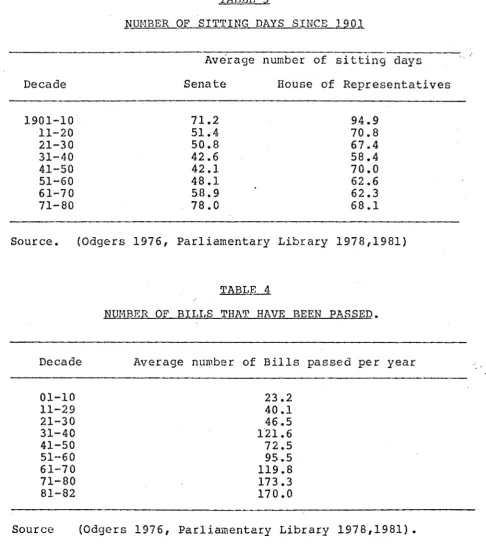
3 Number of sitting days since 1901 89
4 Number of Bills that have been passed 89
5 Workload of Senators 9 0A
6 State representation amongst Chairmen of 127 Committees
CHAPTER 1
THE SENATE - IN SEARCH OF A ROLE
The Senate committee system as it is currently structured has been operating now for just over 13 years. The introduction of the system was heralded with much chest-beating and optimism. The fnotion of the new Legislative and General Purpose Standing Committees was to extend the role of the Senate as a House of Review and improve the flow of information to Senators. It can now be said that the committee system of the Senate has revitalised (and some would say saved) the Senate. Committee activity is seen as synonymous with the Senate.
Notwithstanding their growth in power and authorityf committees have been hamstrung by numerous obstacles. These include: restrictions on the amount of time Senators are able to devote to committee work due to parliamentary, party and electorate commitments? lack of support staff; clashes with the Executive; and lack of information.
Perhaps not suprisingly then, debate still continues on how well committees work, how effective they are, and what Senators get: out of them. Using the results of a series of interviews with Senators themselves, this thesis intends to explore those questions, so that Senate committees can be understood in their proper context.
Searching for a Model of Government
imitation of the mother country) and it was expected that, likewise, the Federal Parliament would have two Houses. Notwithstanding such unanimity, in the late 19th century there was much criticism of the various State Legislative Councils (Clark 1981) for being unrepresentative and delegates were determined that this environment would not be repeated in the federal system.
Initial enthusiasm for an Upper House was motivated by a desire to imitate the British parliamentary system and by a desire to provide a check on the House of Representatives; to
‘check ... progress until such calm discussion has ensued as will really test the merits of any measure .. . f (quoted in Hutchison 1976:34). While the Lower House was expected to be innovative, there was a danger that it could move too fast, and so be subject to defects. 'The instincts of the more conservative body will be caution - de3. iberation - resistive to change if not fairly and fully proved to be beneficial (quoted in Hutchison 1976:34).
Thus it was accepted from the beginning that the parliamentary system that was to be adopted would be based on the Westminster system where the powers of Upper Houses tend to be limited to a Chamber of second thought - and where
responsibility for the Executive resides in the Lower House.
However, as the constitutional debates continued, it soon became clear that the need to accommodate the demands of the smaller States was becoming an overriding concern of delegates and the longer the debates continued, the more it became clear that for federation to succeed, there needed to be safeguards to protect the interests of those States.
Thus t h e d e l e g a t e s t u r n e d t h e i r a t t e n t i o n t o t h e p o w e r f u l Ame r i c a n S e n a t e wh i c h ha d a s t a t u s t h a t many d e l e g a t e s e n v i e d . ' Th e F e d e r a l p r i n c i p l e ' a s e mb o d i e d i n t h e Ame r i c an S e n a t e , was s e e n t o f i t t h e r e q u i r e m e n t s and demands of t h e s m a l l e r S t a t e s who s t o o d i n t h e way o f f e d e r a t i o n .
I n t h e U n i t e d S t a t e s l e g i s l a t u r e , t h e r e we r e i m p o r t a n t d i f f e r e n c e s b e t w e e n t h e two Chambers t h a t we r e t o a f f e c t t h e c o n s t i t u t i o n a l d e b a t e s i n A u s t r a l i a on t h e s t r u c t u r e o f t h e S e n a t e .
1. The met hod o f e l e c t i n g t h e two Chambers was d i f f e r e n t . I n t h e U n i t e d S t a t e s S e n a t e , S e n a t o r s were elect ed by the l e g i s l a t u r e s o f t h e S t a t e s c o n c e r n e d ( S i n c e 1 9 1 3 , U.S S e n a t o r s h a v e b e e n e l e c t e d d i r e c t l y by t h e p e o p l e ) ; t h o u g h t h i s met h o d was r e j e c t e d by d e l e g a t e s a t t h e A u s t r a l i a n C o n v e n t i o n d e b a t e s .
2. Each S t a t e ha d an e q u a l number of S e n a t o r s r e p r e s e n t i n g t hem, i r r e s p e c t i v e of p o p u l a t i o n .
3 . The t e n u r e o f o f f i c e f o r Members and S e n a t o r s was d i f f e r e n t ; 2 y e a r s f o r Members o f C o n g r e s s co mp a r ed t o s i x y e a r s f o r S e n a t o r s .
4. The s i z e o f t h e two Chambers was i n t e n d e d t o be d i f f e r e n t . I t was a l w a y s b e l i e v e d t h a t t h e House of R e p r e s e n t a t i v e s wo u l d be t h e s i g n i f i c a n t l y l a r g e r Chamber and t h a t t h e S e n a t e w i t h i t s s m a l l e r n umber s woul d e n c o u r a g e a b e t t e r s t a n d a r d o f d e b a t e .
While the federal principle created many of these differences, they also reflected the different roles that were envisaged for the two Chambers. Madison saw the six year term as offering a sense of security so that they could 'develop the skills of politics and sense of responsibility, work hard and serve the people well* (Shackleton 1982:235). Senators would be able to stand back and reconsider matters. Because of these differences it was anticipated that the Senate would attract people of greater ability and distinction who would act as a watchdog over the Executive as well as over the Lower House.
Similar hopes were declared at the Australian constitutional convention debates. Yet while most of the differences were incorporated into the Australian Constitution (except Senate ratification of treaties and the method of election), the delegates at the Conventions still supported the adoption of the Westminster system rather than the United States Congressional system. Under the Congressional system the Executive was not responsible to the legislature because of the separation of powers between the two. Thus while there existed a powerful Upper Chamber, it did not pose a direct threat to the Executive.
Thus Australian Senators have to make their Chamber workable despite having these two seemingly contradictory methods of operating an Upper House fused into one. While the Senate attempts to operate as an Upper House in the American mould in working as a House of Review over the Executive, it is hamstrung by the fact that some of its members are also part of
the Executive.
As well as differences in the relationship between the Executive and the legislature, other important areas of differences between the Australian and American Parliaments lie in the method of election, the average tenure of
parliamentarians and the nature and practice of political parties (Hutchinson 1976:447). The effect of such differences is to influence the way in which the two systems of governments operate. This is particularly significant for the subject of this thesis: the behavior and operations of parliamentary committees.
One area where this is most marked is in the behavior and scope of committees. In the United States Congress, committees are more autonomous, self contained and independent than those operating within the Westminster system which tend to be limited in scope or power.
Both Houses in America use committees extensively. Each committee has its own committee room and has a strong support staff. Also, counsel may question witnesses. There is extensive use of television and radio and other Senators and Members often participate in committee hearings.
In his study of committee systems in democratic parliaments in the world shaw has argued that committees operating in the Parliaments of the United States, Italy and West Germany were more inclined to 'put their imprint on the substructure inputs of government . . . committees in the lower reaches of the rank order, (that is Westminster systems) on the other hand, are more likely to perform such non decisional functions as deliberation, representation, legitimation
(they) exercise little independent discretion compared with that exercised by the stronger committees' (Shaw 1979:385).
Executives will operate within the legislature and lead it whereas under the American system the Executive and the
legislature are separate.
(, >v
Shaw also found that committees were strongest where the parties had a low level of influence in committees. This weakening of influence he found, was greatly assisted if the legislature was a multi-party one. This conclusion can help in understanding the Australian Senate. The composition of the Australian Senate has almost always been multi-party one and has frequently been in the position • where the government did not hold the balance of power. This could explain the success in the establishment of the Senate committees and their extensive use over their House of Representatives counter-parts as Shaw found that, generally, a strong unified dominant party in the Chamber was associated with weak committees. ‘ ... Unless non-party conditioners of unusual importance are present* (Shaw 1979:395) committees have little genuine impact on government. But it also raises questions about the way committees are run. In the Australian Senate, the government under standing orders will always have a majority of Senators on committees. However, is\ this a desirable feature? Should the majority of Senators on a committee be from the party in government and should the chairman automatically be a government Senator? If the Senate is to operate independently of the Executive, then would not this independence be enhanced if the chairman and the majority of Senators were not from the same party? If committees act in a truely bipartisan manner, then is it so important to stipulate in standing orders who shall be the chairmen and what shall be the party composition of the committees?
All governments can influence committees in various ways; they may determine their composition, choice of topic, and the restriction of the flow of information. It is up to the Senate and its committees to reduce this influence. The question is, are committees hindered by having a government chairman and
a m a j o r i t y o f S e n a t o r s f r o m t h e g o v e r n m e n t p a r t i e s ? In. a l l t h e d e b a t e s on t h e c o m m i t t e e s y s t e m , no S e n a t o r a r g u e d a g a i n s t a d o p t i n g s t a n d i n g o r d e r s s u p p o r t i n g s u c h a r r a n g e m e n t s n o r d i d S e n a t o r s t h a t I i n t e r v i e w e d s u g g e s t any v a r i a t i o n t o t h e s e a r r a n g e m e n t s . However, we r e t h e y w e a r i n g t h e i r h a t s a s S e n a t o r s o r member s o f a p o l i t i c a l p a r t y i n a g r e e i n g t o s u c h a r r a n g e m e n t s ?
I n s e a r c h o f a r o l e
The r o l e t h a t S e n a t o r s s e e t h e S e n a t e p l a y i n g ( and t h u s i n p a r t , t h e i r own r o l e s ) w i l l d e t e r m i n e t h e s u c c e s s or o t h e r w i s e o f any c o m m i t t e e s y s t e m t h a t o p e r a t e s i n t h e S e n a t e . I f S e n a t o r s b e l i e v e t h a t t h e S e n a t e i s a S t a t e s House t h e n i t w o u l d be e x p e c t e d t o be m i r r o r e d i n t h e s t r u c t u r e , c o m p o s i t i o n and b e h a v i o r o f c o m m i t t e e s . S i m i l a r i t y , i f t h e S e n a t e i s s e e n a s a House o f Re v i e w, t h e c o m m i t t e e s w i l l a l s o r e f l e c t s u c h an i n t e r p r e t a t i o n , t h u s t h e r e i s a n e e d t o d e t e r m i n e w h a t i s t h e r o l e o f t h e S e n a t e .
As a S t a t e s Hous e, t h e S e n a t e was e x p e c t e d t o e n s u r e t h a t a l l m a t t e r s p a s s e d by P a r l i a m e n t wo u l d h a v e t h e c o n s e n t o f S t a t e s , a s r e p r e s e n t e d by t h e S e n a t e , a s w e l l a s t h e c o n s e n t of t h e p e o p l e , a s r e p r e s e n t e d by t h e House o f R e p r e s e n t a t i v e s . Ye t a s C r i s p o b s e r v e s , ‘ t h e e me r g e n c e of t h e two p a r t y s y s t e m by 19C8-09 e n d e d any hope t o w h i c h t h e C o n s t i t u t i o n l e n t c o l o u r t h a t t h e S e n a t e m i g h t be a ‘ S t a t e s Ho u s e ' ( C r i s p 1 9 7 3 : 3 3 0 ) . By t h e n t h e A u s t r a l i a n p o l i t i c a l s y s t e m h a d s e t t l e d i n t o w h a t we now r e c o g n i s e a s a p a r l i a m e n t a r y s y s t e m d o m i n a t e d by two p a r t i e s - l a b o r a n d a n t i - l a b o r .
Wh i l e S e n a t o r s may r e p r e s e n t a c e r t a i n S t a t e , t h e y n e v e r l o s e s i g h t o f t h e f a c t t h a t i t was becc\ us e t h e y g a i n e d p r e - s e l e c t i o n f o r a p o s i t i o n on t h e S e n a t e p a r t y t i c k e t
c o n t e m p o r a r y e x a m i n a t i o n o f t h e r o l e of t h e S e n a t e w i l l n o t t r e a t t h e n o t i o n o f t h e S e n a t e a s a S t a t e s House s e r i o u s l y . For e x a m p l e , S e n a t o r Hamer s a y s t h a t t h e S e n a t e i t s e l f h a s no p a s t and no f u t u r e a s a S t a t e s H o u s e 6 (Hamer 1982A: 5 Se e A l s o Sol omon 1 9 8 2 ; Emy 1974; A i t k i n a n d J i n k s 19 8 0 ; Gr eenwood 1 9 7 6 ) . R a t h e r , t h e f o c u s i s on t h e S e n a t e ’ s r e v i e w c a p a c i t y a n d p o t e n t i a l . (For a l e n g t h y a r g u m e n t s u p p o r t i n g t h e c o n c e p t o f t h e S e n a t e a s a S t a t e s Ho u s e , s e e O d g e r s 1 9 7 6 : 5 - 1 2 . For a d e t a i l e d a r g u m e n t a g a i n s t s u c h a r o l e , s e e H u t c h i s o n 19 7 6 : 2 6 4 - 2 7 3 . )
As a House o f Re v i e w, t h e S e n a t e i s s a i d t o p r o v i d e f o r a s e c o n d o p i n i o n ’ . . . i n r e l a t i o n t o l e g i s l a t i v e a n d o t h e r p r o p o s a l s i n i t i a t e d i n t h e House of R e p r e s e n t a t i v e s ’ ( O d g e r s 1 9 7 6 : 3 ) . C e r t a i n l y p u b l i c p e r c e p t i o n o f t h e S e n a t e c e n t r e s a r o u n d t h e S e n a t e b e i n g a House o f Re v i e w. I n a s u r v e y c a r r i e d o u t by H u t c h i s o n on t h e p u b l i c ’ s p e r c e p t i o n o f t h e S e n a t e , s h e f o u n d t h a t t h e ’ m a j o r i t y o f a r g u m e n t s [73%] f o r r e t e n t i o n o f t h e S e n a t e r e l a t e d t o t h e House o f Revi ew f u n c t i o n . . . ( H u t c h i s o n 1 9 7 6 : 3 5 8 ) .
However , O d g e r s , w h i l e n o n e t h e l e s s m a i n t a i n i n g t h a t t h e S e n a t e i s s t i l l a S t a t e s House a n d a House o f Re v i e w, a l s o g o e s b e yond t h e s e two t r a d i t i o n a l f u n c t i o n s i n s u g g e s t i n g t h a t t h e S e n a t e a l s o :
1 . p r o b e s and c h e c k s ’ t h e a d m i n i s t r a t i o n o f t h e l a w s , t o k e e p i t s e l f a n d t h e p u b l i c i n f o r m e d , and t o i n s i s t on m i n i s t e r i a l a c c o u n t a b i l i t y f o r t h e g o v e r n m e n t ’ s a d m i n i s t r a t i o n ;
2 . e x e r c i s e s s u r v e i l l a n c e o v e r t h e E x e c u t i v e ’ s r e g u l a t i o n - m a k i n g p o w e r ;
3. p r o t e c t s p e r s o n a l r i g h t s a nd l i b e r t i e s wh i c h m i g h t be e n d a n g e r e d i f t h e r e was a c o n c e n t r a t i o n o f u n r e s t r a i n e d power i n t h e House o f R e p r e s e n t a t i v e s ; and
4 . i n g e n e r a l , t h e S e n a t e i s t h e w a t c h - d o g a n d t h e s a f e t y v a l v e o f t h e A u s t r a l i a n f e d e r a l s y s t e m a n d o f t h e n a t i o n ( Od g e r s 1 9 7 6 : 3 - 4 ) .
Yet e v e n i n c a r r y i n g o u t t h i s r e v i e w i n g f u n c t i o n t h e p e r f o r m a n c e o f t h e S e n a t e h a s b e e n i n c o n s i s t e n t . H u t c h i s o n m a i n t a i n s t h a t ' a m a j o r e x p l a n a t i o n f o r t h e une ven r e c o r d o f t h e S e n a t e a s a House o f Re vi e w i s t h e i n f l u e n c e o f p a r t y p o l i t i c s * ( H u t c h i n s o n 1 9 7 6 : v ) . The manne r i n w h i c h t h e S e n a t e o p e r a t e s i n i t s r e v i e w o f t h e e x e c u t i v e h a s . a l w a y s b e e n d e t e r m i n e d by t h e p o l i t i c a l c o m p l e x i o n o f t h e S e n a t e .
The J o i n t C o mmi t t e e on C o n s t i t u t i o n a l Revi ew a r g u e s , i n e x o r a b l e h i s t o r i c a l p r o c e s s e s o f t h e 2 0 t h c e n t u r y h a v e p r e c l u d e d t h e S e n a t e f r o m b e c o m i n g t h e p r a c t i c a l e x p r e s s i o n o f t h e f o u n d i n g f a t h e r s ’ i n t e n t i o n s ' ( J o i n t C o mmi t t e e on C o n s t i t u t i o n a l Review 1 9 5 8 : 1 1 ) . I n p a r t i c u l a r , t h e J o i n t Commi t t e e p l a c e s t h e bl a me on t h e e m e r g e n c e o f p o l i t i c a l p a r t i e s . ' T h e l o y a l t y of S e n a t o r s t o t h e i r p a r t i e s h a s b e e n l a r g e l y r e s p o n s i b l e f o r t h e s u b l i m a t i o n o f t h e o r i g i n a l d u a l
c o n c e p t i o n o f t h e S e n a t e a s a S t a t e s House a nd a House o f Re v i e w' ( J o i n t Co mmi t t e e on C o n s t i t u t i o n a l Revi ew 1 9 5 8 : 3 7 ) ( s e e a l s o Ro y a l Commi s s i on on t h e C o n s t i t u t i o n 1 9 2 9 : 4 6 ) .
As one parliamentarian noted, an important function of parliament is 'to be both the great forum of the nation, where the major issues are debated, and a watch-dog scrutinising the details of legislation and administration in the public interest. It is in these things that Parliament has become increasingly inarticulate and inefficient, too often permitting policies to be framed in secret and implemented by stealth; too often allowing important details to pass without comment and without check (Commonwealth Backbencher 1966:175).
Yet parliamentary committees should not provide a unique opportunity for backbenchers to carry out any function as a Senator that is not already available to him while he is in the Chamber. Questions without notice, motions, general debate, especially the first reading of a money Bill, and committee stages of a Bill should provide a Senator with the opportunity to achieve whatever he wishes without having to serve on committees. That this is not the case is apparent, and so committees are seen as the means whereby Parliament can claw back some influence.
Ministers in both Chambers often treat question time with contempt, questions on notice can remain unanswered for unnecessarily long periods and general business can be curtailed. Overall, Parliament is dominated by party politics and this does not exclude the Senate. As the Joint Committee noted, the Senate has for many years been as susceptible to party political influences as the House of Representatives.
Most amendments that succeed in the Senate are government amendments merely tidying up shoddy drafting. While the free vote is occasionally used, it is with issues which political parties find too difficult on which to develop a policy.
The history of Private Members' Bills in the Senate is a poor one, with Bills not having the support of the Executive having little chance of success„ While Private Members' Bills have been agreed to by the Senate, only 10 of 206 Private Members' Bills introduced since 1901 have been successful (152 in the Senate, 54 in the House of Representatives) . Only 2 of these successful Bills, Disabled Persons Monies (1963) and Immioration Restrction (1912), we re initiated in the House of Representatives (as at the end of 1983).
So if one did critcally examine all of the avenues available to Senators to carry out their roles, then only the functioning of committees would emerge with any credibility.
Development of the Current Committee System
Public perception of the Senate has fluctuated. For most of its life it has not enjoyed a high reputation, being seen as an anachronism or a retirement centre for the party faithful. Moreover, Gallup polls examined by Hutchison up to 1970 ‘demonstrate general ignorance about the functions and purposes of the Senate', with little understanding that the Senate should be functioning as a House of Review, or even what that term means (Hutchison 1976:339).
Nevertheless, the Senate has on occasions acted against the wishes of the government. The change in the voting system for the election of the Senate resulted in a Chamber in which the membership has undergone a gradual, but significant change. Thus as Solomon observes, 'by the 1960s ... few governments ... could be certain that they would have a majority in the Senate'
(Solomon 1981:73).
The government between 1952 and IS 6 5 was defeated in the Senate on 17 occasions and there were a further 35 instances where Senators crossed the floor * In 1967 alone, the government was defeated on 24% of all divisions (Reid 1969:515). In 1975 it was defeated on 95% of all divisions.
It is in this environment that select committees in the Senate were being established throughout the 1960s and culminated in the report by the Standing Orders Committee on Legislative and General Purpose Committees in the Senate (1971) .
The Senate during this period showed signs of exercising its review function without incurring the wrath of the Executive. And it was perhaps not surprising that the level of committee activity also increased. Between 1949-60 five Senate select committees and one joint committee were established and from 1960-70 there were ten Senate select; committees and three joint select committees established.
Reports on Road Safety, Encouragement of Australian Productions on Television, Pollution, Medical Costs and other reports provided Senators with experience in committee work; if for some only limited experience. This contact with select committees, combined with the report of Odgers via the Standing Orders report to the Senate and behind the scenes work by such people as Senator Murphy, swung Senators around to the view that the use of standing committees was the way to bring the Senate into the 20th century.
By the early 1970s the Senate was no longer seen as a joke; ’it is alive and well* said Solomon in 1972. In two consecutive years (1967-68) the Senate established three select committees. Reid wrote optimistically at the time that ‘Senators may yet become the work-horses of the Australian parliament,
(Reid 1969:516).
What Reid was implying here was that the House of Representatives was no longer operating as the legislative Chamber because of the total dominance of the government by the Executive. This dominance of the Executive over the Lower House has particularly affected the establishment of a committee system. While the House has similar committee powers to those of the Senate, it has resisted the creation of such a committee system as exists in the Senate.
Odgers first explored the possibility of an extensive committee system in the Senate in the first edition of his work Australian Senate Practice in 1953, He argued then that committees would relieve 'the Senate of functions which, in the opinion of the Senate, can be more conveniently and appropriately discharged by committees than the Senate itself'
(Odgers 1953:167). By the 197Cs he viewed committees as offering substantially more than mere convenience. In the 5th Edition of Australian Senate Practice he argued that: ' . „ . no modern legislature can discharge its functions fully and effectively without the assistance of committees' (Odgers 1976:467); or as Shaw put it, as Cabinet could not operate without departments, nor can any contemporary legislature function without committees
(Shaw 1977:419).
Odgers justified the establishment of the Senate Standing Committee system by arguing that such a system was
required because of:
1. increasing governmental responsibilities and activities;
2. the impact of science and technology;
4. the inadequacy of opportunities and means on the floor of the House ... to probe and check the administration;
5. the inadequacy of present-day means for the ventilation of citizens' grievances against administrative decisions or acts;
6. growing Executive expertise and secrecy; and
7. the need, in an increasingly expert world, for parliamentarians to be able to call upon scholarly research and advice equal in competence to that relied upon by the Administration* (Standing Orders Committee 1971:33) .
Odgers maintained that time simply did not allow, (nor does the opportunity arise in the Senate today) for Senators to fully discharge the functions that were placed upon them; ’ . . . nor does the floor of Parliament lend itself to the investigatory role' (Odgers 1976:467-468). Thus committees were seen as part of the solution to restore these functions. The functions of the standing committee system would be to:
1. permit a continuing surveillance of defined fields;
2. c.. make progress reports on chosen matters ..<?
3. create an awareness, both within the Public Service and at large, of Senate 'watch-dog functions' in certain fields of government;
4. create within Parliament certain defined areas, as with regulations and ordinances, where there develops a willing disposition to 'leave it to the Senate', thus enhancing the status of the Upper House; and
5. provide a unique opportunity for organisations and others to make presentations and submissions to Parliament regarding the administration of the laws coming within the jurisdiction of the committees
(Standing Orders Committee 1970:7).
Odgers also suggested that certain factors should be taken into account in establishing standing committees. These wer e :
1. that the role of committees is not one of policy making nor policy criticising ... rather of inquiry and counsel and of throwing light into dark corners thus emphasising the investigative role of committees;
2. hot and cold issues ... should be avoided and
3. neglected areas ... are particularly appropriate for committee activity . . . (Standing Orders Committee
1971:8).
Odgers here emphasised the information seeking public education role* thus reducing the possibility of party politics dominating committee work.
The report of the Standing Orders Committee was considered by the Senate in June of 1970. The report recommended the establishment of six Legislative and General Purpose Committees covering the activities of all Departments.
establishment of seven Legislative and General Purpose Committees; and Senator Gair, reflecting the concern of some Senators that a more gradual approach be adopted, moved that two Legislative and General Purpose committees be established immediately and that they report back to the Senate on their operations to determine the feasibility of establishing the other five committees. Much to everybody's surprise, all of these motions were agreed to.
In August 1970 a Standing Commitee on Health and Welfare and a Standing Committee on Primary and Secondary Industry and Trade were established along with the five Estimates Committees. On 6 October 1971 the remaining five Legislative and General Purpose Committees were established. These were: Education Science and the Arts; Social Environment; Foreign Affairs and Defence; Constitutional and Legal Affairs; and Finance and Government Operations. (For detailed discussion of the early development of the Committee system, see Odgers 1976:479-484; Solomon 1982: Hutchison 1976.)
The current committee system has had its supporters and its opponents and the voices on both sides are as loud as when the committees were first introduced. Indyk for example, is unambiguous when he examines the course for committees. He sees Senators 'using the committees to revitalise their institution and thereby challenge the dominance of the Executive . . . they are trying to put the word "responsible" back into Australian government’ (Indyk 1980: 93). He might also have used the word accountable. The central tenet of the argument seems to revolve around the effectiveness of committees or, as Indyk saw it: influence.
Yet; while Senators may try to revitalize the Senate, Indyk nonetheless argues that committees are a waste of time if committees cannot make the Executive listen to their reports which he concludes, they cannot. 'While the Executive dominates
Parliament, the Parliament cannot through its committee system hope to control the Executive' (Indyk 1980:108 See also Uhr 1980; Weller 1979, 1982 and Indyk 1979).
While Indyk is sometimes highly critical of committees (because, in the end, their reports are 'shelved') at other times he can be overly optimistic? such as his vision of committees putting meaning back into the word responsible. That implies a greater control over the Executive. While some public servants may appear before committees with trepidation - and from observation that seems to occur infrequently - committees provide little threat to Ministers; firstly because the subject matter of committees is rarely threatening for a Minister, secondly, if a committee did threaten a Minister, sufficient pressure could normally be bought to bear on backbenchers to ‘back-off; and thirdly, because the Executive takes little notice of committees. Mr Sinclair certainly did not seem perturbed that he had incurred the wrath of the Finance and Government Operations Committee and a previous Minister for Defence, Sir James Killen refused for seven years to co-operate with the Joint Committee on Foreign Affairs and Defence. This latter action did not result in one censure motion from either House and it did not appear to harm his standing in the electorate.
Thus Indyk is correct when, elsewhere in the same article he lamments that 'Committee members have learnt from their experience that they cannot control the Executive - they cannot make policy, they can only attempt to influence it'
(Indyk 1980:106). One must never lose sight of the fact that it is up to the Executive to govern, for it is they who will be held to account for any action which a government undertakes. Even members of the governing parties realise that while they may belong to the ruling group, they do not constitute part of
influence, not direct power; advice, not command, criticism not obstruction, scrutiny, not initiation; and publicity, not secrecy* (Crick 1970:80).
(' A
While authors have focused on the effectiveness of the committee report and the government's response, there has also been discussion on other aspects of the workings of committees. Other limitations and problems of committees that have been noted include:
. the unnecessary restriction (for some) on public servants in being unable to comment on government policy ?
. the apparent lack of administrative review;
. frequent staff shortages;
. Ministers being reluctant to provide evidence;
. fragmentation of committee activity;
. overwork of Senators;
. the fact that Senators serving on committees are first and foremost members of a political party;
. reports being couched in general 'soft* terms so as to not offend members of the committee nor Senators generally (Evans 1982, Hawker 1979, Indyk 1980, Skene 1982, Solomon 1979, Weller 1979, 1982).
These criticisms relate both to the subject matter of reports, the procedures by which they are written and the problems that committees face.
However it is noticeable that these are outsiders* criticisms. There have also been a number of Senators who have commented on the workings of committees.
Senators D iscussing Committees
During discussion on the establishment of the committee system in 1970 (4 June, 11 June and 18 June 1970) , a number of Senators were fulsome in their praise of the committee system that they were ushering in. The committees would provide the Senate with an avenue to undertake short, sharp inquiries into matters that would be of concern to Senators and ipso facto, to the electorate; to examine Bills in far greater detail as we 11 as providing an avenue for citizens to voice disapproval of aspects of such Bills; and to enable Senators to more effectively scrutinize the Executive and its administration. It was universally agreed that the Senate Chamber could be made more effective in operating as a House of Review with an extensive committee system that could concentrate more thoroughly on investigating the important issues that they believed faced the nation.
A number of Senators did express reservations. These focused on the added workload that would be placed on Senators and the need for staff who would be up to the task of assisting the committee; the danger of taking Senators away from the Chamber; and concern that references should not 'cover a wide field and involve a tremendous amount of research and study*
Having agreed to immediately introduce two standing committees, the President of the Senate was requested to present a report to the Senate on the operations of these committees. The President cited the very favourable press coverage of the new committee system as proof of its success. Public interest and participation was high. The President also reported that:
With the specialised knowledge acquired by Senators at committee hearings, debate is noticeably more penetrating. There is a new and valuable rapport with officers of the Public Service. And, with all-party goodwill, there is a recognition of the role of committees in the strengthening of the Parliamentary system (President of the Senate 1971:15) .
The President's report did, however, note several problems that arose from the new committee system. In particular, the staffing of committees was seen to be a problem as w as the need to establish guidelines for the rights of witnesses appearing before committees.
In the debate in the Chamber after the tabling of the President's report, a number of Senators also expressed concern over the staffing arrangements and the increased workload for Senators. It was agreed that in the resolution establishing the committees there should be included a paragraph providing for committees to be 'adequately staffed'. They argued that staff were 'grossly overworked' (Parliamentary Debates - Senate 1971:525). Sir Magnus Cormack warned that without proper support facilities there would be too great a burden placed on Senators
(526).
To ease the workload of Senators it was agreed that the number of Senators on standing committees would be reduced from Ö (as existed for the 2 standing committees introduced in 1970) to 6, though this did not stem the fears by some that the workload would still be excessive (500, 524, 529). To help ease
this workload, it was suggested that perhaps one afternoon a fortnight should be set aside, for committee work while the Senate was meeting (529) .
(' A
However, few Senators took up this suggestion with any enthusiasm. Similarly, there was no support for committees meeting while the Chamber was in progress. As Senator Young
said, ‘it is physically and politically impossible for committees to sit continuously' (529) .
Senators said that staff1 should be of high caliber and that consultants should be used regularly. Cormack said that by using academics as consultants, committees could provide a link between the academic world and the active world of politics„
Senator Poyser warned in these debates that if governments continued to ignore committee reports as they had the select committee reports, then the system of committees 'will break down' (410). He cited the committee on the Australian Constitution (1958) and the Select Committee on Australian Television (1962-3). What was needed, said Senator^ Keeffe, was a system with teeth and he argued that committees should have Ministers appearing before them (522).
Some Senators v/ere critical of the two standing committees already in operation. Senator Davidson said that ' the references put to them are too wide and too complex and require too long a period to be dealt, with adequately and effectively1
Despite these reservations, Senators generally expressed optimistic sentiments, believing that they would enable the Senate to retain control of business of government and provide the Senate with enormous prestige* The high objective in establishing committees was * to make the parliament as effective as possible and to expand and develop its functions to meet the demands of the times' (411). As well, because of the intensity of the work, Senators quickly became specialists in their fields of interest.
In 1974, there was another lengthy debate on the committee system after the government moved to establish a series of joint committees as well as the standing committees. The Opposition, with the assistance of Senator Hall, defeated this proposal. Comments similar to those in 1970 and 1971 were made by Senators, referring to the enhanced reputation of the
Senate, committees being indispensable in the proper functioning of Parliament and allowing Senators to gain knowledge in new areas. Senator Simm saw committees as providing an opportunity for Parliament to put forward a view point that ’might, well differ from our Executive view* (Parliamentary Debates 1974:1154) .
Senator Withers also pointed out that committee work could lead to a better understanding of those Senators on the opposite side of the Chamber. As a result of being on committees ’I made a number of friends, I hope, on the other side of the Chamber. Without having been engaged in committee work and the occasional interstate travelling which is involved, that would never have come about and I would never have understood honourable Senators opposite as people or understood why they hold certain views which I have learned to respect although I disagree with them* (Parliamentary Debates 1974:1133-4).
There was a further reassessment of the standing committees in 1976, This debate arose out of the resolution for the re-appointment of the committees after the 1975 Double-Dissolution. During the debate a number of observations were made.
1. There are a higher percentage of Senators on their Senate party ticket at No 1 or 2 position than Members of the House of Representatives in safe seats. Thus more Senators than Members can significantly contribute to the workings of committees (Senators Withers and Cormack).
2. Senators have a ‘greater capacity* to exert independent action than Members in the House of Representatives
(Senators Withers and Missen).
3. There have been occasions when Ministers have withheld submissions to Cabinet pending the completion of a committee inquiry (McClelland).
4. Inquiries undertaken by standing committees are more expeditious and less costly than Royal Commissions
(Cormack).
S e n a t o r Hamer made h i s m a i d e n s p e e c h i n t h e Chamber on 13 S e p t e m b e r 1978«. The s p e e c h was d e v o t e d e n t i r e l y t o r e f o r m o f t h e Senate«. Hamer saw t h a t c o m m i t t e e s w o u l d be an i n t e r g r a l p a r t o f t h e r e v i s e d Chamber t h a t he o u t l i n e d . A f t e r s t r e s s i n g t h a t t h e S e n a t e ' s p r o p e r r o l e s h o u l d be t o a c t a s a House o f R e v i e w , he u r g e d t h a t mor e B i l l s be r e f e r r e d t o s t a n d i n g c o m m i t t e e s . He a l s o a r g u e d t h a t f o r t h e S e n a t e t o e f f e c t i v e l y f u n c t i o n a s a House o f Revi ew and so p r o v i d e a b a l a n c e t o t h e d o m i n a t i n g E x e c u t i v e , M i n i s t e r s s h o u l d be e x c l u d e d f r o m t h e Ch a mb e r . ‘ The f i v e M i n i s t e r s a r e , i n e f f e c t , f i v e T r o j a n h o r s e s h e r e on b e h a l f o f t h e E x e c u t i v e 1 . To s t r e n g t h e n - t h e c o m m i t t e e s , C h a i r m e n wo u l d be g i v e n t h e p a y , p r i v i l e g e s a n d s t a f f t h a t wo u l d o t h e r w i s e be p r o v i d e d f o r M i n i s t e r s ( P a r l i a m e n t a r y D e b a t e s - S e n a t e 1 9 7 8 : 5 4 5 - 5 4 9 ) .
S e n a t o r Hamer c o n t i n u e d t h i s t h e me when, i n F e b r u a r y 1979, he moved t h a t M i n i s t e r s s h o u l d no l o n g e r be i n t h e S e n a t e and t h a t c h a i r m e n o f t h e s t a n d i n g c o m m i t t e e s ' s h o u l d be g r a n t e d a l l o w a n c e s , s t a f f a n d o t h e r e n t i t l e m e n t s s i m i l a r t o t h o s e c u r r e n t l y g r a n t e d t o M i n i s t e r s . . . * ( P a r l i a m e n t a r y D e b a t e s - S e n a t e 1 9 7 9 : 2 2 9 ) . The m o t i o n was s u p p o r t e d by S e n a t o r s T h o m a s v
( L i b e r a l P a r t y - W e s t e r n A u s t r a l i a ) a n d Mason ( A u s t r a l i a n D e m o c r a t s - New S o u t h W a l e s ) . S e n a t o r T a t e o f f e r e d q u a l i f i e d s u p p o r t f o r t h e c o n c e p t b u t s a i d t h a t i t s h o u l d c o n s i t u t e p a r t o f a n o v e r a l l p a c k a g e of c h a n g e s t h a t s h o u l d be i n t r o u d c e d . A l l S e n a t o r s s p o k e o f t h e n e e d t o s t r e n g t h e n t h e S e n a t e ' s r o l e a s a House o f Re v i e w.
As w e l l a s t h e a b o v e m a j o r d e b a t e s on v a r i o u s a s p e c t s o f t h e c o m m i t t e e s y s t e m , t h e r e h a v e f r e q u e n t l y b e e n r e f e r e n c e s made t o t h e c o m m i t t e e s y s t e m by S e n a t o r s d u r i n g p r o c e e d i n g s o f t h e S e n a t e . The mo s t f r e q u e n t l y d i s c u s s e d t o p i c h a s b e e n t h e G o v e r n m e n t ' s r e s p o n s e t o c o m m i t t e e r e p o r t s . When t h e g o v e r n m e n t i n f o r m e d t h e S e n a t e t h a t t h e r e wo u l d be a r e s p o n s e t o c o m m i t t e e r e p o r t s w i t h i n s i x m o n t h s , o n l y S e n a t o r B u t t o n s p o k e t o t h e s t a t e m e n t . I n w e l c o m i n g t h e d e c i s i o n he s a i d t h a t i t w o u l d g i v e
Senators a 'slightly stronger feeling' of participation in an area that had relevance to .the proceedings of Parliament
(Parliamentary Debates - Senate 1978:1933).
Since this statement was made, Senators on a number of occasions have pointed out that governments have frequently not responded to reports within the six months. Senator Tate, for example used the adjournment debate on 8 March 1979 to criticise the Attorney-General for failing to provide a response to the Constitutional and Legal Affairs Committee's report on 'Priority of Crown Debts' , nine months after it was tabled. In 19 80 the Constitutional and Legal Affairs Committee tabled an Assessment of the Government's Responses to Reports. During the debate that followed, a number of Senators warned of the effect of the increasing disillusionment that was developing among Senators as a result of governments ignoring committee reports.
Following concern by Senators that governments were taking too long to respond to committee reports, the President of the Senate now annually tables a list of outstanding government responses to parliamentary committees reports. The debate that follows the tabling of these reports warns that committees will become meaningless if governments continue to ignore the reports. As Senator Gietzelt said, 'the Government has to accept the responsibility for failing to carry out the work of the Parliament as distinct from the work of the Executive' (Parliamentary Debates 1982:1947).
Senators have also raised the question of whether committees should meet while the Senate is sitting. In 1980, this was referred to the Standing Orders Committee. Those who were for committees meeting while the Senate was sitting
’Parliamentarians are elected for the purpose of performing functions in the Senate . ..' (Parliamentary Debates - Senate 198013:460). The Senate came down against committees meeting while the Senate was sitting arguing that there was already provision in the standing orders for committees to meet during sitting hours with the permission of the Chamber.
The matter was again raised when in September and October 1983 the Joint Committee of Public Accounts sought leave to enable Senators who were members of the committee to attend a series of meetings during the sitting of the Senate. During the debates that followed this motion, Senator Chaney said that ’ the Opposition ... is opposed in general to the proposition that Senate committees should meet during Senate sitting hours
(they) will take from Senators the ability to participate in what happens in this place’ (Parliamentary Debates - Senate 1983:357). This view was also supported by the Australian Democrats (see also Parliamentary Debates - Senate 1983:1306-1311).
Senators have been less willing to write about their perceptions of the committee system outside the Senate Chamber. In 1972, Sir Magnus Cormack wrote that committees had allowed Senators to specialise and gain expertise in particular areas. They were bringing Parliament closer to the elector. He also suggested that committee hearings could be televised (Cormack 1972) .
Parliament and Bureaucracy (Nethercote 1982) represents the most significant single contribution to the writings on committees with Senators Evans, Martin, Missen and Rae all writing about various aspects of committee work. Senators Missen and Martin in separate articles expressed disappointment that more legislation was not referred to committees. Before legislation can be referred to these committees there needs to be an increase in the number of Senators and more staff. Senator
Missen also argued that the low stature of parliamentarians in the community had discouraged the type of people with the ability and the background that the Senate needed. Senator Rae said that the role of comittees should be to scrutinize government activity and make it accountable to Parliament. The difficulty arises however,- when one tries to measure the effectiveness of this scrutiny. As Senator Evans asks 'what is success in the context of Executive monitoring and scrutineering committee activities' (Evans 1982:83).
Information
Among the general discussion of what role committees serve, there is also another underlying theme: the use of information.
Access to the proper understanding of and the best use of knowledge is essential for Parliament in its effort to make government more accountable and so allow the Senate to undertake its responsibility to act as a true House of Review. As McMillan says ’Knowledge will forever govcern ignorance; and a people who mean to be their own governors must arm themselves with the power that knowledge gives' (McMillan 1981:4) . Without information, the effectiveness of all backbenchers is drastically reduced. In the immediacy that dominates the world of parliamentary politics, information plays a prime role ’in determining the balance of power’ (McMillan 1981:4).
The sources of information for Senators can be vast and cover institutions, background briefings, general reading, discussions with coilegues, official statistics, academic articles, the media and other 'reliable sources'.
rationale in their endeavour to obtain this information. Senators can be seen to be filling different roles at different times.
Parliament has been described as being composed of such a wide variety of political elements that it hardly amounts to a single political institution at all. It is rather a cluster of political institutions all of which relate to each other, but most of which are seen to be quite different' (Ovenden 1977:173). When we talk about the power of Parliament, for example, the power of the President or the power of the media, we are talking about distinctly different things.
Similarly, when we talk about the backbencher and his information, information provided to him to participate in a censure motion will be fulfilling a different purpose to information given to him in order to ask a question on a parliamentary committee, which will be different again to the information he may be seeking from a question on notice.
In the Chamber, information is used primarily to attack the opposing parties to gain political advantage. Whilst there may be a technical aspect to information, this is not always the
reason for acquiring it. Barker and Rush argue that 'he needs information only partly for his own intrinsic sake ... beyond that he judges it in the practical political terms of what good it does him and his position to take the trouble to absorb it
...' (Barker and Rush 1979:20). Senators will use information differently when representing a political party, to that when acting out the role of a Senator assisting constituents, and differently again as a Senator scrutinising Qangos.
Question time in particular has always been seen as the classical means for Senators to elicit information. Yet because of the environment in which question time is held, a highly
electric partisan atmosphere, it has all too often failed in this task. As Chalmers and Hutchison point out, 'question time provides the great blood sport of Parliament ... Ministers flagrantly use question time for the purposes of political propaganda, and particulary the leader of the Opposition, is supposed to embarrass the government . . . ' (Chalmers and Hutchison 1983 : 186) . For many commentators, this was one of the most important 'reasons for establishing parliamentary committees . .., to overcome the shortcomings inherent in the functioning of debates and question time' (Indyk, 1980:33).
In contrast, Crossman saw the reason for obtaining information on committees as 'enabling ... members to formulate pertinent questions about policy before decisions had actually been made, and also in the building up within the House of a body of members with greater knowledge and experience of particular fields of government activity' (Morton 1981:130).
When a study of a matter is required in greater detail than Parliament as a whole is capable of or willing to undertake, referral of that matter to a parliamentary committee for examination is by no means automatic. A Minister, with the considerable backing of his department, may ensure that all relevant backbenchers receive the adequate briefing that fulfils such a need, a judicial inquiry may be initiated, or a royal commission may be established.
The circumstances surrounding Senators acquiring and processing information in committees are in many cases different enough to provide a unique forum for information to be digested» The fact that there are only six Senators, little public interest in their deliberations and that the process involves the writing of a report produces an environment, some would suggest (Indyk, Yeend, Weller) where partisanship is normally at a lower level. Should we automatically assume that Senators behave in the same manner on committees as they do in the Chamber? Should we assume information is persued for the same purposes?
The contrast between committee work and Chamber work has been appreciated for many years. In 1930, the Senate Select Committee on the advisability of establishing standing committees heard evidence from the then President of the Seriate, Senator W. Kingsmill. He was asked (Senator R.D. Elliott): 1 Is not the individual ability of members availed of to a greater extent when discussing matters round a table than when they are-debated in the Parliament?1 Answer: ‘There is no doubt about that. In a committee, knowledge is gained which would not be
gained on the floor of the House* (Standing Committee System 1930:3).
This is not to deny that committees still operate within a political environment. As Senators themselves noted during the course of the interviews, because they, and not judges, academics, or other such learned people are investigating a matter, their report will contain that taint created by its authors; it is a political document being conceived in the womb of Parliament, born in Parliament, and some would suggest, destined to die in Parliament. That the report has emerged from such a political environment and yet appears to be bipartisan is a surprise to many. Yet should we be so surprised?
We know w h a t o u t s i d e r s t h i n k c o m m i t t e e s o u g h t t o do - and w h a t p r o b l e m s t h e y h a v e w i t h i n f o r m a t i o n . But we know much l e s s a b o u t S e n a t o r s ’ a t t i t u d e s . As 1 o b s e r v e d e a r l i e r , m e d a n g e r f o r o b s e r v e r s i s i n a s s u m i n g t h a t S e n a t o r s w i l l a l w a y s h a v e o n l y one m o t i v e , and n o m i n a t i n g t h a t m o t i v e w i l l be c o n d i t i o n a l upon t h e a u t h o r s ' p e r c e p t i o n o f how S e n a t o r s a c t or o u g h t t o a c t . The f o c u s o f t h i s T h e s i s i s on t h e S e n a t o r s ? t h e i r a p p r o a c h t o C o m m i t t e e s w i t h i n t h e c o n t e x t o f t h e i r own p e r c e p t i o n s o f t h e m s e l v e s a s p a r l i a m e n t a r i a n s .
T h i s T h e s i s i s c o n c e r n e d w i t h two t h e m e s . F i r s t , g e n e r a l l y , wh a t do t h e y e x p e c t o f c o m m i t t e e s a n d why do t h e y s e r v e on them? how do t h e y r a t e t h e i r s u c c e s s ; w h a t do t h e y s e e a s t h e c o m m i t t e e o b j e c t i v e s a n d hew do t h e s e o b j e c t i v e s c o - i n c i d e w i t h t h e t h e o r e t i c a l o b j e c t i v e s o f t h e c o m m i t t e e s y s t e m ?
S e c o n d l y , why and how do t h e y wa n t t o u s e i n f o r m a t i o n . For e x a m p l e do t h e y u s e i n f o r m a t i o n t o a s s i s t i n t h e i r p a r t y work on p a r t y c o m m i t t e e s o r e v e n i n t h e i r a m b i t i o n s t o be
M i n i s t e r s ?