Asthma in the elderly
By Professor Gregory Peterson and Dr Mark NauntonCase study
M r s GH is a 74-year-old lady who was diagnosed with asthma four years ago after having an upper respiratory infection. She had a hospital admission due to asthma about 18 months ago. She is having her prescriptions dispensed at the pharmacy; these include Seretide
MDI 125/25 and Ventdin inhaler, You notice from her dispensing history that she only obtains her asthma medication sporadically. You
ask
M r s GH how she i s going with her puffers and asthma in general. She replies that she i s 'OK, Upon further probing, M r s G t i reveals that she does not think she gets 'that much benefit out of the puffers' and she has trouble using them with her arthritic hands. She says that she does not get wheezy that often (only every two to three days) and is not sure whether she really needs t o keep using the inhalers.'Asthma
is
under-recognised
and
undertreated
in
older p~pulations.'~.?
.
Background
The prevalence of asthma overall in Australia is relatively high -it occurs in 14-16% of children and 10-1296 of a d ~ l t s . ~ It is nor so well known that asthma in elderly people is also common and is often undertreated.'" An Australian study found
a
large proportion of those aged over 55 years had undiagnosed asthma and that the prevalence of asthma in older people may be as high as15%:
while overseas studies have similarly indicated that the prevalence of asthma in elderly patients may be as high as 17%.2 This is perhaps not surprising given that the elderly reportedly complain about breathlessness often.A
UK survey of older people living inA n A u s h a i a n ~ h n d a ~ ~ o f t h o s e a g e d ~ 5 5 y w s had utx%gws& a s t m
of age.Zl2 Older patients with asthma have also been shown to deteriorate for longer periods before being admitted to hospital with severe acute asthma than younger patients.4 Underestimation of the severity of an acute exacerbation of asthma by both patient and doctor has been suggested as a contributory factor to poor outcome i n older people.13
'Death
due to asthma occurs
rnostiy
in eI&&
patients.
"
the community found that 33% of those aged above 70 years
Asthma definition
became breathless when walking on the flat in company withpeople their own age.la A population-based study of 6,000 Asthma is a chronic inflammatory disorder of the airways men and women aged 65 years and over, performed in 21 with an array of cells, inchding mast cells, eosinophils, general practices in Bristol, south west England. found an T lymphocytes, macrophages and neutrophils, playing a untreated asthma prevalence of approximately 2.5%. with role in its pathophysiology. In susceptible individuals. most subjects (84%) with untreated asthma having moderate this inflammation causes recurrent episodes of wheezing,
or severe disease." breathlessness, chest tightness and coughing, particularly
at night and in the early morning. These episodes usually
'Despite
the frequent
occurrence
of asthma
involve airflow obstruction thatis
often reversible, eitherin the
elderk
it
is
a
diagnosis
that
has
been
spontaneously or with treatment3 The airflow obstructionfrequently ovefiook& and even
when
dimvered
in asthma is a result of ~Ontraction of the airway smoothk
is
often ur~dertreated,
"
muscle and swelling of the airway wall due to a combinationof inflammatory cell infiltration, oedema, smooth muscle Although overall deaths from asthma are declining, this has
hypertrophy,
and
hypersecretion. been most noticeable in vounser ~ e o ~ l e .- . .
and children. Theaged
care,
pathophysiology
Table
1.
Comparisonof
asthmain
the younger versus
it is not possible to distinguish asthma from chronic elderlypatient
(modified
from
Brarnan4)
bronchitis, especially in current or former cigarene smokers.4 Distinguishing between asthma and COP0 is difficult andTreatment Symptoms
Prognosis
common
I
Atopy common
1
Mainly intrins~c (non- YoungMostiy intermittent and mild: allergic rlrinitis
1
atooicl; heqins withI
Elderly may be impossible in some older patients.'"JU6 Asthma that Commonly persistent; has been present for many years, in particular, may lead to
moderate to severe
1
persistent obstructive ventilatory defect and can mimic COPD.?A
lnterminenl for
1
Need conl~nuovsRemission common
irritants (e.g. tobacco or air pollution), cold air exposure, exercise, stress, and some drugs (e.g NSAlDs, p-blockers. ACE inhibitors)."The majority of elderly patients who develop asthma after age 65 have their first asthmatic symptom preceded immediately by, or concomitant with, an upper
respiratory tract infection.'
Diagnosis
'Objective
measvres of lung
function
such
as
spiromety
and
peak
flow
measurerrmts
are
generally unden~tilised
in
elderly
patients,
and
this
also
contributes
to the d&y
or absence
of
diagmk.
"
A major difficulty in diagnosingasthma in the elderly is
that the differential diagnosis of breathlessness includes many conditions common in older people, e.g. heart failure,
obesity, malignancy, infection, gastro-oesophageal reflux. aspiration, and chronic obstwctive pulmonary disease ICOPO).
In addition. the elderly may attribute their breathlessness to
'normal ageing' and not seek help from their doctor? The
most common symptoms reported are cough, wheezing and dyspnoea - similar to younger asthmatics?,'
In addition, research suggests that doctors are often reluctant
to use spirometry and measurement of reversibility when
investigating respiratory symptoms in old people.&l3 This leads to a tendency to label breathless or wheezy elderly patients as having COP0 rather than asthma. Objective measures of pulmonary function can aid in a prompt diagnosis
?I and lead to effective treatment and improved quality of life.'
A
simple strategy for the investigation of breathlessness inolder people should at least include a full blood count, chest
radiograph. ECG, and spirometry with reversibility.'
Both men and women who develop asthma after age 40
usually have prior symptoms of cough and sputum production and often have pulmonary function abnormalities before being diagnosed with asthma. Thus, in many older patients
Also. both conditions may be
If possible, distinguishing asthma from COPD is Important to
allow appropriate management of the respiratory condition and co-morbidities, and accurate prediction of treatment response. The two conditions may be differentiated by clinical features, particularly age at onset, variability of symptoms
and nocturnal symptoms in asthma. supported by the results of reversibility testing A history of heavy smoking, the presence of more prominent lung hyperinflation and chronic
hypoxaemia favour the diagnosisaf COPD, whereas atopy and significant bronchodilator responsiveness favour the diagnosis of asthma.I5
Management of
asthma in
the eldedy
The therapeutic approach to asthma in the elderly is much the
same as for younger asthmatics." but certain aspects take on
greater importance: difficulty using inhaler devices, concerns about osteoporosis with long-term corticosteroid therapy (both oral and inhaled), the risk of arrhythmias with p,-agonist
drugs and the significant side-effects of theophylline.I8
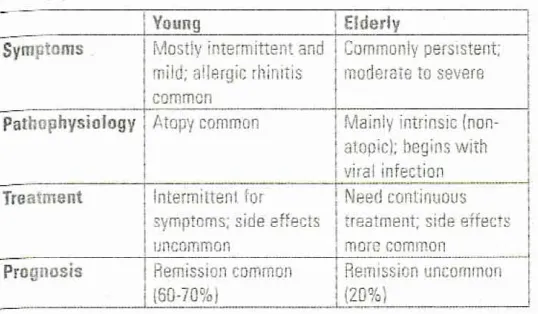
Studies of asthma in the elderly have shown that, unlike many younger adults who often require no medications or just as-needed pjagonist therapy for occasional symptoms, most older asthmatics need continuous treatment programs to control their disease (Table I).' In part, this may be because
the bronchodilator response to inhaled pjagonists declines
with age.' Even in mild disease in older adults, regular
preventive treatment with inhaled corticostemids should be
considered, given the poor perception of bronchoconstriction by older asthmatic patients.' Unfortunately, despite their
proven efficacy, inhaled corticosteroids are typically underused in the elderly asthmatic population!a1718
A
largeUS study showed that. among elderly patients with potentia'lly
life-threatening asthma, only 32% had used preventive therapy during the past year?g
If symptoms persist despite inhaled corticosteroids, addition of long-acting p,-agonists should be considered. While the
elderly with asthma have been under-represented in trials of the long-acting p;agonists, there is solid evidence that the addition of these agents improves asthma control and allows a reduction in the dosage of inhaled cortico~teroids.'~~~ However, regular review of cardiovascular status (and monitoring of
serum potassium concentration) in elderly patients taking long-acting 8,-agonists is important.'
[image:2.553.19.288.93.250.2]aged
care
ICave co-existing COPD.' Theophylline should be prescribed rith extreme caution t o elderly patients with asthma, given ;s narrow therapeutic margin and the risk of adverse effects ncluding nausea and vomiting or sinus and supraventricular ~chycardias), and its propensity for drug
interaction^.^^
Most i ~ o r l a n t l y
for elderly asthrr~tics
is a
-eatrnent regimen
thal
is as simple as possible?
nd B bnckod up
by
a wn'tten se!f-mnanagement
)Ian
thai
will improve outcomes.'ie
Jse
of inhaled drug delivery devises
llder people may be more likely to use asthma medication nd devices incorrectly because of vision and cognitive n~airment.~' In fact, the great majority of elderly patients re unable to properly use metered dose inhalers (MDb), ven after instru~tion.~2~ Inadequate timing of actuation and ihalation is the most frequent error that is made. Impaired ~ental function, weakened or deformed hands, and motor or iusculoskeletal diseases are other reasons for inadequate 11Dl use." Older patients who lack dexterity and grip strength 2.9. arthritis in the hands, tremor with Parkinson's disease) lay have-difficulty with manipulation of an MDI or other
elivety device {Table 2 ) . " p a
1 general, patients with cognitive impairment (dementia) rill have most difficulty learning to use the MDI, followed in rder by the MDI with spacer, then breath-actuated inhalers
-
i.e, breath-actuated inhalers are preferred." In addition, ?e elderly may experience difficulties with maintaining an dequate seal with their mouth on the inhaler device (e.g. ost-stroke or paralysis). Furthermore, the elderly may not ave a sufficient inspiratory flow rate which is required to eliver a dose of medication froma
dry powder inhaler.2a atients' perception of their own inhaler skills often orrelates poorly with their actual use, highlighting the need 3 regularly assess inhaler techniq~e.~"~' However. inhaler schnique is often not checked in older patients. For a more etailed discussion on asthma devices, readers are directed 3 a previous paper written by one of the authors (Naunton M, loggrell S. 1 must see the pharmacist: asthma devices. Aust'harm
2007;26(4):302-4).he delivery device should be selected individually, based n ease of use and cost. Dry powder inhalers may be easier 3r older patients to use.3 When all MDI is chosen, a spacer hould be used.3 The
Australian
Medicines Handbook has etailed descriptions of how each inhalation device should be orrectly used. In addition, pharmacists can view how to use n MDI and spacer device in the following links, which might Iso be useful for patients or carers:r www.youtube.com/watch?v=51Zjwcx7Zbs&feaeature=related (MDI technique)
www.youtube.corn/watch?v=OubDEsal7Gw&feature=related (animated
3D
on how to use MDI)www.youtube.com/watch?v=CEUm-zy8xY&feature=related
(MDI with spacer)
www.youtube.com/watch?v=oHRTiytvuow&feature=related
{peak flow meter)
Steps may need to be taken to simplify inhaler regimens for some older people and, where possible, the same inhaler device should be prescribed for all the patient's inhaled medications. Although currently available inhaled corticosteroids are more effective when used twice-daily (with the exception of ciclesonide [Aivesco], which can be used once-daily), taking the total inhaled corticosteroid dose once a day may be an option to aid adherence in stable patients with mildlmoderate disease." For example, this might be advantageous to those patients with dementia who rely on assistance with medications at home
by
family or carers.'Udc!rly people and children have
specific
problems with inhaler use
and require both
targeted and appropriate help in order to
improvs their inhater technique and
minirnj.9~
waste of
inkled
medication and therebre
lack
of therapeutic efect.
p9Adherence with asthma therapy
Adherence with asthma therapy is frequently poor in elderly patient^.^^^'."^" Reasons include forgetfulness or misunderstanding the correct treatment regimen, and the perceived risk of side-effects of inhaled corticosteroids (Table 3). Patients are less likely to take their medications as prescribed when they think that their asthma symptoms are not as severe as the doctor believes them to be. The intermittent nature of asthma may lead patients to view the disease as an acute condition, rather than a chronic illness, resulting in poor adherence to preventive therapy. For
.Table
2.
Patient-related factors to consider when
choosing
a
delivery system3
:=-
aged
care
:b
g-
example, patients often cease their regular preventive therapy
Table 3.
Reasons
for
non-adherence
t o
asthma
once their symptoms have diminished, feeling that they no
treatment
in
elderly
patients
longer require treatment.(modified from Goernan and DouglassZ3)
Guided self-management of asthma
in
the
elderly
Optimal asthma treatment has adopted the principle of 'guided self-management', which emphasises recognition of worsening symptoms by the patient and self-initiated steps to escalate therapy as appropriate and seek emergency
care
if necessary.23 Guided self-management in asthma involves the health professional and the patient establishing an asthma management plan which is then written down and given tothe patient for future reference: a written action plan.23 The
use of guided self-management plans has been associated with improved asthma outcomes.31 Unfortunately, Australian studies have shown that written action plans are less likety t o be provided to older p e ~ p l e . ~ Thisis
despite studies demonstrating that older people can and do appreciate self- More details on Asthma Management Plans, Asthma Cycle of Care, and Asthma Action Plans are briefly reviewed by Bereznicki etal. in the current issue of Australian Pharmacist (page 41 0).'Patient
education can
be
a
p a m h l
toat h
asthma
control, Family members also can be
helpful, especial& with etderly
adults.
Active
participation
by
a
patient
in monitoring Iung
function,
avoidance
of provoatia/e
agents,
and decisions regarding
medicafions
provide
asthrna management skills that give patients
the
confidence
to
control
their
own disease.
"
Pharmacists
and
asthma
management in
elderly
Elderly people
are less
likely to actively
seek
out
information about
t M r
medication
and
management.
*
Pharmacists are in a pivotal position to contribute to the overall management of asthma, given the importance
of
quality use o f medicines in preventing morbidity and mortalityin asthma. Pharmacists should make certain that patients or
their carers understand the purpose and correct use of the medication/inhaler device. Simple and clear messages are required when counselling all patients with asthma. A quiet location (counselling room) is ideal to ensure the correct messages are received. In addition, written instructions should be given to supplement any discussion.Some important points to consider during initial and follow-up discussion are as follows.
Ccmorbidities (deteriorating mental health status, deprass~on, vision/heartng loss)
Problems with device use [stroke, paralysis, arthritis, tremor, poor insp~ratory flow)
Difficulty accessing
medical
care No carer or family helpRefusal to accept help Poor health literacy
Concern for adverse effects
from
medication ur actuat adverse effects from medication k g . oral thrush, dysphonia, cataracts, glaucoma, osteoporosis) Concerns over tolerance, dependence and addiction to medicationCost of medication
Lack of belief in effectiveness or necessity of medication
Preference for non-pharmacological treatmsntl medication.
Ensure that the prescribed therapy (and device]
is
suitable and can be used by the patient.Regular assessment is required - encourage regular review by doctor.
Environmental influences such as pdlutinn. air born^ dust, smoke, and fumes can induce airway narrowing in patients with asthma. Avoidance i s not always possible; however. ensuring the home and workplace are relatively free of environmental triggers may be useful.
Encourage the patient to cease smoking.
Ensure patient understands signs of poorly controlled asthma.
Offer written fact sheets on the principles of asthma management, including information about medications and potential side effects, ways t o minirnise asthma triggers, and correct device technique.
A practical demonstration
should
ALWAYS supplemsnt any
written information.Ask
pharmaceutical representatives for demonstration models of their products to help patients become familiar with drug delivery systems.Enquire if the patient has an asthma action plan
-
if not,
suggest they discuss this on their next scheduled visit to their doctor. [image:4.595.288.515.62.734.2]a g e d
care
Encourage annual influenza vaccination and five-yemly pneurnococcal vaccination in all elderly patients with asthma, even in those with mild asthma.
Attempt to check inhaler technique at every possible
opportunity.
Ongoing follow-up of patients with persistent asthma by the pharmacist also enables demonstrating and checking inhaler technique, re-evaluating the most convenient delivery device, making sure that the written action plan is understood, and ensuring that any emergency medication (such as a short course of oral corticosteroids) is not out of date or lost. A number of studies, including several from Australia, have demonstrated that community pharmacist-delivered asthma care programs can produce beneficial results, with improved patient
outcome^.*^
Pharmacists can also request home medication review (HMR) referrals from GPs for those patients they think would benefit from an educational intervention on asthma and a management review,When non-adherence is inevitably encountered. it
is
important that pharmacists do not blame patients for non-adherence because they can and do make reasoned decisions; rather, they should openly discuss the reasons for non-adherence. In addition, pharmacists should ensure that any concerns regarding drug side effects are discussed in a manner that is not alarming.Case
study
Returning to our case study, you should provide Mrs GH
with
further information about asthma, emphasising that it is a chronic condition that generally requires continuous preventive therapy. You suggest that there are other forms of respiratory devices available if she is having trouble with the inhalers, and offer to discuss this issue with her doctor. You could also provide some information about HMRs and suggest that she discusses this furtherwith
her doctor. Finally, it would be worthwhile to ascertain whether she has had her annual influenza vaccine.'fitlent
educatjon
in self-management
techniques
and attention to
the
pmblems
of
adhefence
we
essential
fur
kmg-tern?
management.
Ail
health
care
pro@ssionals
have
an important m/e in controlling
this
common
disease
O7Professor Gregory Peterson heads the Unit for Medication Outcomes Research and Education. School of Pharmacy, University of Tasmania and was PSA
Pharmacist of Year for 2007.
References
1. B a r u a P , ( Y M a h ~ M s . ~ ~ m t h ~ m l t m n t o l ~ h ~ p a t i ~ I W I insism, tmnuep nglnpzws:%x1z)no2esa
z u h K. PammkB, Ma&j LAslhma in Me
elm,
Pol Arch Msd WmlZOm;ll7(8):S504. 3. NatlPnalMmmund ~ l k ~@~gmnnt n u Harrdbmk M06 W m e , 2 W . 4 @ a m SS.p&naln~elde+ CUnGefiaIrMed20~19(l)~7-14.5. DuadmL SA, RonmonlA. katwe6af &nU in tha aldslg J & U m 2 C D l ~ 3 7 7 - 8 8 . 6. cousensHE,~op,oou~X~tanldnsCR~neGllPormp~kwilh-llust
Fan Phydclan 2007:36(9):729#.
1.
rn
OH, 5& Adans RJ. Rd'm R hldrlgnmaslhma in OM HB: anlnderestlraslad m
m
.
Med J Awl 20D5.183F Supplld20-2a. Patamsswun K, MlUnlh Al, hadk 0. K e a q 4 T m K, Band sK. Mmnin lh ekbg d x p m % d , unlwdeyaedwd tmtbmaw a mrnnhrnlly W N ~ Resplr Med 16618:W:573-7.
0. Barr RG, Somets SC. Spshar FE, Cantatuo CA Jr. Prmenl lacwra and medlmtion guidsk u J m m mmp &la worm wiA asMIim. Arb Wem Med 20112;162(15r1761-8. 10. HO S. O'U- MS Sbward J4 Way P, M rM, Bn UL ~yploea and qxUy d rb i
om psople at home. &4geBmg 2001;30(2):155-Q.
11. W W / F w k L , ~ L . W r s U , ~ n D , ~ A L e t a l . P n w r l e a c s d u n t r e a $ d a h a
In a ~ulabnsamplaaf 600ttoldor adUk h Brigal UK. lWa 2001,~)H72-6.
12. AuGtraHan C m l m f o r M u n a ~ f b l g . ~ I n A u ~ ~ . ~ ~ ~ s 2.WVHHcat ~ . ~ 6 . h b s n a 1 A C T ) : ~ 2 ( 1 0 5 .
13 b d c DS Connolly MJ. Impmlng oudmross h eldndy pntlmhlvith wgna Dmy@lglq 1999:14(1):1-Q.
14. Ht@h ST, Fabm I4.m drrgnces. and mana(lement 01 S W @ m a Bl rdu& ~ t z w s a ( s s a 7 ) : 7 8 0 - 1 .
15. an & A k k a 0, Suyal S, Oner F. Mlgirilgil LOiIksrenw b masRrrP and WFU in me
ekk4y.J InwUgAllagotf& Immml20Mi;ll(l) 44-50.
la Radsnim F.hrk'ndn G Tmd AB.&hma In l k e l w * flev MaI ~ ~Pt i)!BS;103. ~ 2 ~ 1 17. Sdmk i& H C m MT, JonesML. EfWB d l n ~on n m W ~and ~ i~ f i m
I n ~ h d ~ ~ @ ~ a s a s E s ~ * a p p n [ h t h e r v i d e n c s . IhpYng a006:22(@717-29.
18. Sin W.Tu JV.Undenee of I A h a l e b ~ ~ i n c l d w i y palkmrrlthaslhma. Chst 2 0 o l : l 1 9 ~ ~ .
1% HaM'I\ZTn& A, M l m BG M W Sim& L, MllRl MR. U-nof mnbokr
~ r s s c u s ~ m K 1 a m o n g o l d w ~ ~ ~ ~ b p i t d a u ~ J A m ~ S o c
W ed2(100;W(l):2-9.
ZZ Emman VK, OSmn IN. Baban H, Cdtcblnv A, h r m l ML.Tw device compUm:the need to cadder Wh mmpelem and mdlham -Mad 2005;99[1).97-102.
23. ~ A D M q m & o p t i n a l ~ m e n t d & a I n ~ C ~ r u L s : ~ l a s b l n r p r n w a d k e r n to r e m m n m in$rran8ons Orugs Mng 2007;2#.381-94.
24. h n l ~ J M , l l h m S L inlheehlerly.AgePgehg 19EB;17&275g.
25. ~ n S C . ~ p e $ m ~ l o r t h e u s e d ~ I ~ ~ ~ ~ ~ ~
1-:83-li
%. E B U b n M ~ m ~ I ~ I P n ~ ~ d p w ~ a M 8 d J ~ I n k ~
19a4;Jatl@3lpml.
27. tb SF. Dpbhmy W, Wnnl JA, l%iwR War ML Inhakt Walpue bolder people In Ihe mmmnlLAne Aaoim 2004;3Z@k185-8.
rids. %m Raa ulor;lF1@:2??~82.
34. Mctean WM. M eU). HlhEn daes pharnraceullcslcare h@ he& & m e & A
m n p s r i s m d m m m o n i ~ ~ ~ ~ a f ~ ~ ~ f o r ~ ~ & m a Am Rermamfha -41,82531.
35 Sainl3, h sI . A n n n u r C . ~ , implEmnMm.and ewhMh d a mmWyfkmwy-
bsssdaJmmacar~nrodet.ARnPhawmdhd2001~1~1954-60.
Qg ~ C , B a n C ~ S . B d l U M t M . B I a m n D . E m n a t o n L K r a s s I , s t d . P h ~ MnnCue P m mImproves wtcum for pdlwls In I h e m h ~ m u n l h l . ~ rnr:m496-m.
37, Jamon gflober& J.Aslhma aranaqwnent erross Ihe a6e apareappllcalhns t lhs iuW andoldsr adult W (las Nmlh Am MM;3W675-87.
Or Mark Naumon is a Senior Lecturer in Pharmacy Practice, School of
Environmental and Life Sciences. Charles Darwin University, Northern Territory.