Fragmentation analysis of
88Mo
∗compound nucleus in view of different decay
mechanisms
NehaGrover1,∗,BhaktimaThakur1, andManojK. Sharma1
1School of Physics and Materials Science, Thapar Institute of Engineering & Technology, Patiala 147004, Punjab, India
Abstract.In reference to the experimental data, the decay mechanism of88Mo∗
compound system formed in
48Ti+40Ca reaction is investigated at three beam energies (E
beam=300, 450, and 600 MeV) using the collective
clusterization approach of Dynamical Cluster decay Model (DCM). The calculations are done for spherical choice of fragmentation and with the inclusion of quadrupole (β2) deformations having “optimum”
orienta-tions. According to the experimental evidence88Mo∗
decays via Fusion-Evaporation (FE) and Fusion-Fission (FF) processes, thus the decay cross-sections of this hot and rotating compound system are calculated for both channels. In FF decay mode, the explicit contribution of Intermediate Mass Fragments (IMF), Heavy Mass Fragments (HMF) and fission fragments (symmetric/asymmetric) is detected within DCM framework. The calculated FE and FF decay cross-sections find nice agreement with the available experimental data. Experi-mentally, it has been observed that the total contribution of FE and FF decay cross-sections is less than the total reaction cross-sections possibly due to the presence of some nCN component such as deep inelastic collisions (DIC), which generally contributes above critical angular momentum (`cr). The possibility of DIC contribution
can be addressed as a future assignment in view of diminishing pocket of interaction potential above`cr.
1 Introduction
The quest to understand different nuclear structural properties and related dynamics has always been an in-teresting and challenging topic for both experimental and theoretical nuclear physicists. Heavy ion Fusion-Fission reactions have proved to be immensely useful for this purpose or to understand the exotic nature of different nuclei. Consequently, the decay of different compound nuclei formed in variety of Heavy Ion Induced Reactions (HIRs) at low energy range has become a compelling subject [1], since it helps to produce new isotopes that may not occur naturally. Moreover, such mechanisms also provide comprehensive knowledge of numerous nuclear properties and related structural and dynamical effects. Furthermore, the decay dynamics of compound nuclei having light mass (ACN≤90) provide a lot of interesting
opportunities, such as the exploration of competing nature of different compound nucleus mechanisms such as Fusion-Evaporation (FE; A≤4) and Fusion-Fission (FF) etc. The FF may include the contribution of Intermediate Mass Fragments (IMF; 5<A<20), Heavy Mass Frag-ments (HMF; 20<A<ACN
2 −20) and fission fragments (symmetric/asymmetric; ACN
2 −20≤A≤ ACN
2 +20). Here, ACN represents the mass of compound nucleus and the
term fragments is defined as the nuclei emitted in the decay process. Collisions or fusion processes forming the compound nucleus in the specified mass region (ACN≤90)
may also invite various non compound nucleus (nCN) exotic processes like Quasi Elastic (QE), Deep Inelastic
∗e-mail: [email protected]
Collision (DIC) processes etc. Our main focus here is to analyze FE, FF and DIC mechanisms. Deep inelastic collision is defined as the phenomenon, which maintains the partial memory of incoming channel and forms a dinuclear molecular complex system, which subsequently decays into target and projectile like fragments. It is difficult to differentiate these processes (FF and DIC) for nuclei having fissility less than businaro-gallone point [2]. Many efforts have been made by theoreticians and experimentalists to identify the DIC and FF exclusively [1, 3].
In view of above, the present work is primarily focused on the decay dynamics of compound nucleus (88Mo∗) formed in 48Ti+40Ca reaction. Decay analysis of the above mentioned compound nucleus is worked out using the Dynamical Cluster Decay Model (DCM) [3–5] in context to the recent experimental data [6]. Calculations are done at three beam energies (Elab=300,
2 Dynamical Cluster Decay Model
The Dynamical cluster decay model (DCM) [3–5] is orig-inated from Quantum Mechanical Fragmentation Theory (QMFT) [7].
DCM is worked out in
(i) collective coordinates of mass (ηA=AA11−A+A22) and charge
(ηZ=Z1−Z2Z1+Z2) asymmetries where, 1 and 2 stand,
respec-tively, for heavy and light fragments, (ii) relative separation R and
(iii) multipole deformationsβλi (λ=2, 3, 4) and
orienta-tionsθiof two nuclei or fragments. For decoupled
Hamil-tonion, the Schrödinger wave equation in η co-ordinate reads as: − ~ 2 2p Bηη ∂ ∂η 1 p Bηη ∂
∂η+VR(η,T)
ψ ν(η)
=Eηνψν(η). (1)
whereν=0,1,2... refers to ground, first and second state solutions respectively and Bηηis smooth hydrodynamical mass parameter.
The fragmentation potential VR(η, T) in Eq.1 is
calcu-lated by summation of (i)VLDM(T-dependent liquid drop
energy of Davidson [8]) with its constants at T=0 refit-ted [9] to give the experimental binding energies [10], (ii) δU, the empirical shell corrections of Myers and Swiatecki [11] and (iii)VC,VPandV`are, respectively, T-dependent
Coulomb, nuclear proximity and angular momentum de-pendent potentials for deformed and oriented nuclei. The expression for VR(η, T) is given as:
VR(η,T)= 2 X
i=1
[VLDM(Ai,Zi,T)]+[ 2 X
i=1 [δUi]×
exp(−T2/T02)]+VC+VP+V`. (2)
The formation yield of decaying fragments is worked out by calculating preformation factor (P0) as solution of Eq.1 and the equation for P0is given as:
P0=|ψ(η(Ai))|2
p
Bηη 2 ACN
. (3)
The preformation factor (P0) shown in Eq.3 refers toη -motion. In tunneling process, the barrier penetrability “P” of clusters or fragments refers to R motion and is calcu-lated by using the Wenzel-Kramers-Brillouin (WKB) inte-gral as:
P=exph−2
~
Z Rb
Ra
{2µ[V(R)−Qe f f]}1/2dR
i (4)
where, Ra = R1(α1,T) + R2(α2,T) + ∆R(T) = Ri(αi,T)+ ∆R(T) is the first turning point of the barrier
penetration with ∆R as relative separation distance be-tween two fragments or clusters.∆Ris the only parameter of model, which is optimized in reference to the available data. It decides the first turning point of barrier penetration and Ri(αi,T)(i=1,2) is radius vector defined as:
Ri(αi,T)=R0i(T)
h 1+X
λ
βλiYλ(0)(αi)
i
. (5)
0 8 16 24 32 40 -30 -15 0 15 30 45 60 75 90
0 8 16 24 32 40 -45 -30 -15 0 15 30 45 60 75 90
0 8 16 24 32 40 -30 -15 0 15 30 45 60 75 90 48 Ti + 40
Ca A 1 +A 2 =0 =64 F r a g m e n ta t i o n P o te n t i a l , V ( M e V ) Spherical (a) E beam
= 300 MeV T = 3.266 MeV
48 Ti +
40 Ca A1+A2
E beam
= 300 MeV T = 3.266 MeV
=0 =64
(b)
-deformed
Fragment Mass (A 2 )
48 Ti +
40 Ca A1+A2 E
beam = 300 MeV T = 3.266 MeV
=0 =64 with modified deformation of 17 B (c) -deformed
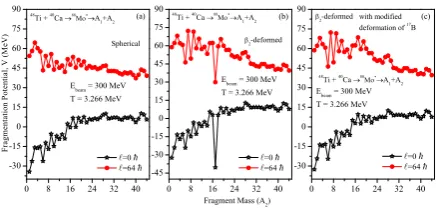
Figure 1. Fragmentation potential with respect to the frag-ment mass for48Ti+40Ca→88Mo∗
reaction at extreme`-values (`=0 & 64) for the spherical andβ2-deformed fragments in exit
channel.
where βλi represents static deformations and are taken
from the theoretical estimates of Moller and Nix [12] and R0i(T) in Eq.5 is T-dependent nuclear radius as per ref.
[13].
By calculating P and P0, the decay cross-sections are cal-culated as:
σ= `max X
`=`min σ`= π
k2 `max X
`=`min
(2`+1)P0P. (6)
where,µ = [A1A2/(A1+A2)]mis the reduced mass,`min
and`maxare the minimum and maximum angular
momen-tum respectively andk=
q 2µEc.m.
~2 .
For CN mechanisms such as FE and FF, the`-window contributing towards decay is 0≤`≤`crand for nCN pro-cess viz. DIC it is`cr<`≤`gr.`cris that (critical) value of
angular momentum above which compound nucleus for-mation is hindered and the grazing angular momentum (`gr) is the upper limit of partial wave above`cr-value upto
which, the contribution of nCN peripheral collisions be ex-plored. The values of`cr and`gr used in present study at
respective energies are taken in reference to [6].
3 Results and discussions
This section presents the DCM-calculated results for different decay modes of88Mo∗composite system formed
in48Ti+40Ca reaction. First, to study the role of defor-mations, two choices of fragmentation paths (spherical and β2-deformed) are considered. Fig. 1 shows the variation of fragmentation potential V(A2) as a function of fragment mass for the decay of88Mo∗at lowest energy Elab=300 MeV. It is important to mention here that
A1 and A2 in 48Ti+40Ca→88Mo∗→A1+A2 subtitle represent the decaying fragments, which may belong to any of the possible compound nucleus decay modes (FE, IMF, HMF, Fission). Here, it is worth mentioning that the fragments having minima in VR(η) are most probable
0 10 20 30 40 50 60 0.0 0.2 0.4 0.6 0.8 1.0
0 10 20 30 40 50 60 0.0 0.2 0.4 0.6 0.8 1.0
0 10 20 30 40 50 60 0.0 0.2 0.4 0.6 0.8 1.0
0 10 20 30 40 50 60 0.0 0.2 0.4 0.6 0.8 1.0 Spherical 2 -Def ormed (a) Fusion Evaporation (FE)
E lab
= 300 MeV
E lab
= 300 MeV Spherical
2 -Def ormed
Intermediate Mass Fragments (IMF) (b)
E lab
= 300 MeV Spherical
2 -Def ormed Heavy Mass Fragments (HMF)
(c) P r e f o r m a t i o n P r o b a b i l i t y ( P 0 ) E lab
= 300 MeV Fission Fragments
(d)
Angular Momentum () Spherical
2
Figure 2. Summed up preformation probability of all possible decay modes: (a) FE, (b) IMF, (c) HMF, and (d) fission, varying as a function of angular momentum (`) for both spherical and
β2-deformed choice of fragments at Elab=300 MeV.
Table 1.Fusion-Evaporation (FE) and Fusion-Fission (FF) cross-sections for48Ti+40Ca→88Mo∗
reaction at three given beam energies calculated using DCM and compared with the
experiment data [6]
Spherical β2-deformed
S. No. Elab Ec.m. Temp. ∆R σDC M ∆R σDC M σE xp.
(MeV) (MeV) (MeV) (fm) (mb) (fm) (mb) (mb)
Fusion-Evaporation (FE)
1 300 136.36 3.27 1.86 848 1.85 859 893±109 2 450 204.54 4.05 2.00 569 1.95 521 545±45 3 600 272.73 4.70 2.18 475 2.10 412 459±115
Fusion-Fission (FF)
1 300 136.36 3.27 1.36 121 1.39 111 115±3 2 450 204.54 4.05 1.62 245 1.67 261 266±37 3 600 272.73 4.70 1.89 383 1.94 388 417±114
value of VR(η) for fission region start comparing with
FE channel, which signifies the prominence of fission fragments at higher values of angular momentum. In other words, Fusion Fission (FF) starts operating at the cost of FE at higher `-values. Further, moving towards the influence of deformations, it may be noticed from Fig. 1(b) that the structure profile remains almost similar for both cases of fragmentation except for a sharp minima at 17B for deformed choice of fragmentation. Interestingly, similar results were observed for the decay of 96Tc∗ nucleus in ref. [4], which state that this abrupt minima at 17B might be due to inappropriate β2-deformation of this fragment. It is relevant to note thatβ2-deformations are taken from Moller and Nix [12], where certain values are obtained after interpolations and extrapolations and hence there exists a possibility that β2-values of certain fragments may not be accurate. Thus to rectify this problem, modified β2-deformation of 17B is used as per ref. [4], and the results are presented in Fig. 1(c), which exhibit the expected behavior of fragmentation potential. Consequently, further calculations are made using modified β2-deformation for 17B fragment (i.e
0 8 16 24 32 40 48 56 64 -3.0 -2.8 -2.6 -2.4 -2.2 -2.0 -1.8 -1.6 -1.4 -1.2 -1.0
0 8 16 24 32 40 48 56 64 0.00 0.05 0.10 0.15 0.20 0.25 0.30 0.35 0.40 0.45 0.50 0.55 0.60 Fusion-Evaporation (FE) E beam
= 300 MeV T = 3.266 MeV
B a r r i e r M o d i f i c a t i o n V B ( M e V ) 2 -deformed Spherical (a) (b) Fusion-Evaporation (FE) E beam
= 300 MeV T = 3.266 MeV 2 -deformed Spherical P e n e t r a b i l i t y ( P )
Angular momentum, (
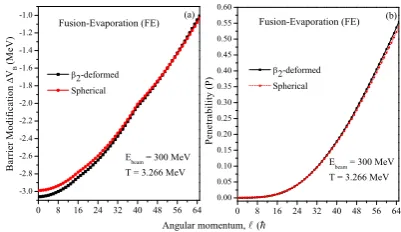
Figure 3. The variation of (a) barrier modification (∆VB) and
(b) Penetrability, P as a function of angular momentum (`) for Fusion-Evaporation channel at Elab=300 MeV for 88Mo∗
nu-cleus.
β2=0.620). Similar results are obtained at maximum energy, Elab=600 MeV (not shown here to avoid
repeti-tion). As the fragmentation potential works as an essential input in Schrodinger Equation (Eq. 1), solution of which defines the preformation probability (P0) of fragments participating in the exit channel. This preformation factor confers significant structural information of compound nucleus that otherwise does not exist in other statistical models.
To investigate the probability of different decay modes participating in the exit channel, the variation of summed up preformation probability (ΣP0) with respect to angular momentum is plotted for possible decay channels: FE, IMF, HMF, and fission and the results are displayed in Fig. 2 at Elab=300 MeV for both
spherical and β2-deformed fragmentation paths. One may clearly see from Fig. 2(a) that for both spherical and deformed case, the preformation probability of FE is maximum for a particular`-window (0≤`≤20~) and then decreases gradually and becomes almost negligible at higher`-values. TheΣP0for IMF region is presented in Fig. 2(b). The figure illustrates thatΣP0is approximately zero up to `≈15~ and then attains the maximum value at higher `-values before reducing to zero at `max. By
6 7 8 9 10 11 12 13 14 40
60 80 100 120 140 160 180 200
E lab
= 300 MeV
10 30 50 64(
cr ) 80
S
c
a
t
t
e
r
i
ng P
ot
e
nt
i
a
l
V
(
M
e
V
)
Range R (fm)
( )
91( gr
) 48
Ti + 40
Ca
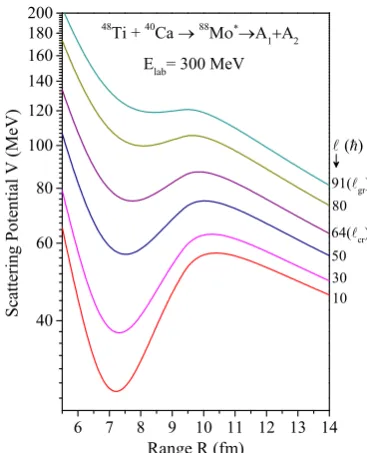
Figure 4.Variation of interaction potential V(R) (sum of VP, VC
and V`) as function of range at different`-values forβ2-deformed
choice of fragments.
to address the cross-sections leads to the corresponding barrier modification (∆VB(`)=V(Ra,`) - VB(`)), which
is an in-built property of DCM and plays very crucial role to fix the tunneling path of decaying fragments. Fig. 3 demonstrates the behavior of ∆VB (panel-a) and
penetrability (panel b) as a function of angular momentum for fusion evaporation channel. One may clearly notice from the Fig. 3(a) that, the magnitude of ∆VB is higher
at lower `-values and decreases with the rise in angular momentum. This signifies that to tunnel the barrier at higher angular momentum, the required barrier modi-fication is less in comparison to that at lower `-values. As a consequence, the penetrability also increases with the increment in angular momentum, as evident from Fig. 3(b). Similar results are obtained for fusion-fission channel (not shown here).
3.1 Future Work
It is claimed [6] that the decay of 88Mo∗ formed via 48Ti+40Ca reaction, might include the Deep Inelastic Col-lision (DIC; nCN component) along with FE and FF. Thus, an attempt is made to analyse the same by plotting interac-tion potential as a funcinterac-tion of range for different`-values (0< `cr≤`gr) in Fig. 4. It is evident from the figure that
with increase in angular momentum, pocket of potential barrier becomes more shallow but still exist upto critical angular momentum. However at` > `cr, the barrier starts
vanishing with rise in angular momentum and almost dis-appears at grazing angular momentum (`gr). The disap-pearance of barrier pocket near grazing angular
momen-tum indicates the possible presence of DIC at higher ` -values. Thus, it would be of future interest to address the DIC cross-sections for the present reaction as a future as-signment.
4 Summary
Summarizing, the present work employs the decay analy-sis of88Mo∗compound system formed in48Ti+40Ca reac-tion at three beam energies (Elab=300, 450 and 600 MeV).
Firstly, the inclusion of deformation effects depict that the structural profile of fragmentation potential remains simi-lar for both the spherical andβ2-deformed choice of frag-ments, which implies that the deformations do not play significant role in decay dynamics of88Mo∗nucleus. The
competing analysis of four different decay modes FE, IMF, HMF and fission reveals that, the FE is the most dominant decay channel and HMF has negligible contribution in the decay of88Mo∗. It is observed that lesser barrier modifi-cation is required at higher`-values for all decay modes. Consequently, penetrability increases with increase in an-gular momentum. The DCM calculated cross-sections are inline with the experimental data. Additionally, as per the experimental evidence, an attempt is also made to advo-cate the presence of nCN process. It is observed that the pocket of potential barrier becomes shallower at higher values of angular momentum and almost disappear above critical angular momentum, which indicates the presence of nCN component such as DIC. It would be of future in-terest to analyse the nCN component associated with such reactions.
Acknowledgements
The financial support from the UGC-DAE Consor-tium for Scientific Research, F. No. UGC-DAE-CSR-KC/CRS/19/NP09/0920 is gratefully acknowledged.
References
[1] S. J. Sanders, D. G. Kovar, B. B. Backet al., Phys. Rev. C40, 2091 (1989); S. J. Sanders, B. B. Back, R. V. F. Janssenset al., Phys. Rev. C41, R1901 (1990). [2] C. Beck, B. Djerroud, B. Heuseh et al., Z. Phys. A
334, 521 (1989).
[3] N. Grover, K. Sharma, and M. K. Sharma, Eur. Phys. J. A53: 239 (2017).
[4] G. Kaur, N. Grover, K. Sandhuet al., Nucl. Phys. A 927, 232–248 (2014).
[5] R. K. Gupta, M. Balasubramaniam, R. Kumaret al., Phys. Rev. C71, 014601 (2005).
[6] S. Valdr´e, S. Piantelli, G. Casiniet al., Phys. Rev. C 93, 034617 (2016).
[7] J. Marhun and W. Greiner, Phys. Rev. Lett. 32, 548 (1974).
[8] N. J. Davidson, S. S. Hsiao, J. Markramet al., Nucl. Phys. A570, 61c (1994).
[10] G. Audi, A. H. Wapstra, C. Thiboult, Nucl. Phys. A 729, 337 (2003); G. Audi, A. H. Wapstra, Nucl. Phys. A595, 4 (1995).
[11] W. Myers, W. J. Swiatecki, Nucl. Phys.81, 1 (1966).
[12] P. Möller, J. R. Nix, W. D. Myers et al., At. Data Nucl. Data Tables59, 185 (1995).