i
THE APPLICATION OF NANOTECHNOLOGY IN THE SEMICONDUCTOR INDUSTRY: THE CASE OF ADVANCED MICRO DEVICES (AMD) GLOBAL
SERVICES SDN. BHD.
NORHIDAYAH BINTI ISMAIL
Report submitted in fulfilment of the requirement for the Bachelor Degree of Technology Management (Hons) in Technology Innovation
Faculty of Technology Management and Technopreneurship UNIVERSITI TEKNIKAL MALAYSIA MELAKA
ii
DECLARATION
“I declare that this thesis is my own work except the citation and excerpts of each of which I have mentioned in the references.”
Signature :
Name : NORHIDAYAH BINTI ISMAIL
iii
DEDICATION
iv
ACKNOWLEDGEMENT
All praise are due to Allah S.W.T who had given blessing, strength, and knowledge in finishing this research entitled „the application of nanotechnology in the semiconductor industry: the case of Advanced Micro Devices (AMD) Global Services Sdn. Bhd.‟ Slawat and salam also propose to the Prophet Muhamad SAW, the Uswatun Hasanah for all Moslems.
I would like to thank to my supervisor, Madam Edna binti Buyong who have given a great deal of time, valuable advice and continuous guidance from beginning until the final revision of this research. Besides, I also would like to thank to my friends and other lecturer that helps me in giving suggestion and advice during the writing of this research
Lastly, I would like to acknowledge with gratitude, the support and love of my parents. They continue gives the moral support and helps me in financial aspects in finishing this research.
v
ABSTRACT
Nanotechnology offers considerable promise extending from business opportunities throughout various industries to broader socio-economic benefits, especially in the context of pressing global challenges such as those related to energy, health care, clean water and climate change. This research is conducted to examine the application of nanotechnology in semiconductor industry at Advanced Micro Devices Global Services (AMD) Sdn. Bhd. The objectives of this research are to determine the factors that influence the semiconductor industry in the application of nanotechnology, to examine the impacts of nanotechnology application on the productivity of semiconductor industry, and to determine the most influencing factor that impact the productivity of the semiconductor industry through the application of
nanotechnology. The research employed sample which comprises 200 questionnaires
vi
ABSTRAK
vii
TABLE OF CONTENT
CHAPTER TITLE PAGE
TITLE i
DECLARATION ii
DEDICATION iii
ACKNOWLEDGEMENT iv
ABSTRACT v
ABSTRAK vi
TABLE OF CONTENTS vii
LIST OF TABLES xii
LIST OF FIGURES xiv
LIST OF APPENDICES xv
CHAPTER 1 INTRODUCTION
1.1 Research Background 1
1.2 Problem Statement 3
1.3 Research Questions 5
1.4 Research Objectives 5
1.5 Scope 6
1.6 Significance of the Study 6
viii
CHAPTER 2 LITERATURE REVIEW
2.1 Introduction 8
2.2 Semiconductor industry 8
2.3 Regulation Response 9
2.3.1 Malaysian Regulatory
Framework 9
2.4 Customer preferences 12
2.4.1 Carbon Footprint 13
2.5 Energy Efficiency 14
2.5.1 Reducing Energy
Consumption 15
2.6 Theoretical Framework 16
2.7 Hypothesis Development 17
2.8 Summary 18
CHAPTER 3 RESEARCH METHODOLOGY
3.1 Introduction 19
3.2 Research Design 19
ix
3.4 Data sources 21
3.4.1 Primary data sources 21
3.4.2 Secondary data sources 22
3.5 Data Analysis 23
3.6 Location of the Research 23
3.7 Research Strategy 23
3.8 Time Horizon 24
3.9 Scientific Canon 24
3.9.1 Reliability 24
3.9.2 Construct Validity 26
3.9.3 Internal Validity 26
3.9.4 External Validity 27
3.10 Pilot Testing 27
3.11 Summary 28
CHAPTER 4 DATA ANALYSIS
4.1 Introduction 29
4.2 Pilot Test 30
4.2.1 Reliability Analysis 30
4.2.2 Validity Analysis of
Each Question 31
x
4.3.1 Section A: Respondents 35
Demographic Profile
4.3.2 Gender 36
4.3.3 Race 37
4.3.4 Work Experiences 38
4.3.5 Education Level 39
4.3.6 Job Category 40
4.4 Data Analysis 41
4.4.1 Section B: Regulation Response 41
4.4.2 Customer Preference 43
4.4.3 Energy Efficiency 45
4.4.4 Section C: Nanotechnology
Application In
Semiconductor Industry 47
4.5 Result of Measurement 49
4.6 Hypothesis Testing and Objectives 50
4.7 Multiple Regression Analysis 50
4.8 Summary 53
CHAPTER 5 CONCLUSION AND RECOMMENDATION
5.1 Introduction 54
xi
5.3 Discussion of Objective and
Hypothesis Testing 55
5.3.1 Objective 1 55
5.3.2 Objective 2 57
5.3.3 Objective 3 59
5.4 Limitations 60
5.5 Recommendation for Future Research 61
5.6 Summary 62
REFERENCES 63
xii
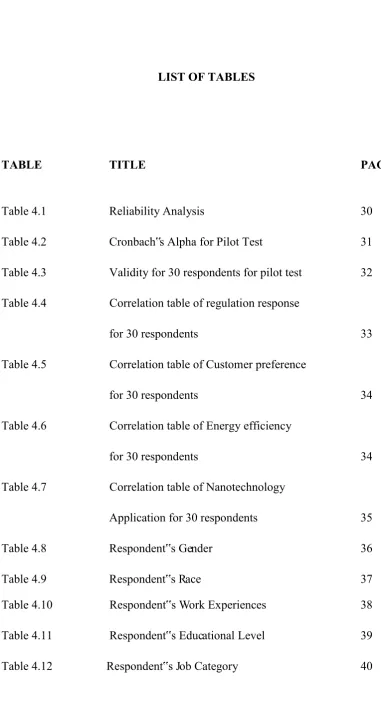
LIST OF TABLES
TABLE TITLE PAGE
Table 4.1 Reliability Analysis 30
Table 4.2 Cronbach‟s Alpha for Pilot Test 31
Table 4.3 Validity for 30 respondents for pilot test 32
Table 4.4 Correlation table of regulation response
for 30 respondents 33
Table 4.5 Correlation table of Customer preference
for 30 respondents 34
Table 4.6 Correlation table of Energy efficiency
for 30 respondents 34
Table 4.7 Correlation table of Nanotechnology
Application for 30 respondents 35
Table 4.8 Respondent‟s Gender 36
Table 4.9 Respondent‟s Race 37
Table 4.10 Respondent‟s Work Experiences 38
[image:12.595.112.494.88.791.2]Table 4.11 Respondent‟s Educational Level 39
xiii
Table 4.13 Statistics of regulation responses 42
Table 4.14 Statistics of customer preference 44
Table 4.15 Statistic of energy efficiency 46
Table 4.16 Statistics of nanotechnology application
in semiconductor industry 48
Table 4.17 Results of Descriptive Statistics for
Regulation responses, Customer
Preferences, and Energy efficiency and
Nanotechnology Application 49
Table 4.18 Model Summary of multiple regressions 51
xiv
LIST OF FIGURES
FIGURE TITLE PAGE
Figure 2.1 Malaysian Nanotechnologies Regulatory
Framework 10
Figure 2.2 Management of Nanotechnology Regulation 12
Figure 2.3 Research frameworks for the application of nanotechnology in the semiconductor industry: the case of Advanced Micro Devices (AMD) Global Services Sdn. Bhd. 16
Figure 4.1 Respondent‟s Gender 36
Figure 4.2 Respondent‟s Race 37
Figure 4.3 Respondent‟s Work Experiences 38
Figure 4.4 Respondent‟s Educational Level 39
xv
LIST OF APPENDICES
APPENDIX TITLE PAGE
A Questionnaire 67
B Gantt Chart for PSM 1 74
1
CHAPTER 1
INTRODUCTION
1.1 Research Background
Advance technology or new innovation has always been facing awareness and acceptance challenges especially from society of developing countries including Malaysia. Furthermore, advance technology is considered as a new technology and it is very crucial to the developing countries as it believe to be able to solve organizational problem and able to increase economic growth (Nash, J., 2012). One of the sophisticated technologies that has been discussed is the nanotechnology. Nanotechnology is defined as "the science of materials and systems with structures and components that display a better novel physical, chemical and biological phenomenon that exist in the size of the nano-scale (1-100 nm)", one nanometer (nm) is one thousand million meters for. In comparison, a single human hair is about
80,000 nm wide (Tegart. G, 2002). People are interested in this nano because the
2
Correspondingly, nanotechnology has become a new industrial revolution and many developed countries like the United States, European Union, Japan, Taiwan and South Korea have made significant investments in technology to maintain their
market competitiveness (Uda Hashim & Elly Nadia, et al, 2008). Although this is
new field of science and technology but it gives a huge potential benefits in industry. Components parts can be measured in a billionth of a metre and this means that nanotechnology is categorized as small science with huge and great potential since it can exploit benefits of ultra-small size allows the use of particles to deliver a range of profound and important benefits (Hassan and Mohamed, 2005).
Recently, nanotechnology has caused a stir around the world because its potential benefits and many countries taken a full attention over the development of nanotechnology including Malaysia. Malaysia launched its nanotechnology initiatives in 2010 which include R&D and education as well as socio-economic nanotechnology plans (Uda Hashim, Elley Nadia, et al, 2009). Malaysia has its own policy on nanotechnology and initiatives as well as a strategic plan for managing the technology, as extensively stressed by the Ministry of Science, Technology and Innovation (MOSTI) has come out with five areas of focus in adopting nanotechnology, namely agriculture, energy, food and environment, manufacturing, as well as electrical and electronics sector (The Straits Times, 10 August 2015).
Furthermore, the exports of electrical and electronic in Malaysia (E & E) are expected to increase by 20-30% in 2020 with nano technology and the rise of the Internet of Things (IOT). Science, Technology and Deputy Innovation Secretary General Dr Zulkifli Mohamed Hashim said: "In 2014, total exports of E & E are RM256 billion, driven by strong global demand for semiconductor applications and the rapid emergence of IOT" (Sun daily, 31July 2015). According to the Development Agency for ICT, Micro and Nano electronics (MIMOS) Chief Executive Officer Datuk Abdul Wahab Abdullah said: “As the national announce a research centre for micro and nano electronics, we have played a major role in the
3
that the Nano Semiconductor Technology Centre nanotechnology will serve as a key enabler and as a catalyst to thrust nanotechnology as a new growth engine.
However, major agencies are also needed to guide the direction of nanotechnology management in order to sustain the technology. The adoption of nanotechnology in manufacturing activities is still in its infancy in Malaysia and this
technology offers a huge potential economic gain if exploited strategically. Another
reason is Malaysia aspires to become a developed nation by 2020 and many of the strategies should be included to implement nanotechnology in many areas in Malaysia including in manufacturing activities. Moreover, economic growth is being driven increasingly by the application of advance technologies (Austin, R. H., & Lim, S., 2008). The beginning of the 21st century already addressed as the nanotechnology growth and Malaysia should ahead in implementing nanotechnology in many industries.
1.2 Problem Statement
4
However, according to National Symposium on Science and Technology on 2010 states that the current development of nanotechnology in Malaysia is still facing of some shortfalls such as nanotechnology is still new to the Malaysia’s expertise, no conclusive plan to develop nanotechnology in industries, no clear road map on nanotechnology R & D will be going on and lack of efforts to promote
awareness in nanotechnology. Against the targeted forecasts, Malaysia's exports of
electrical and electronics (E&E) products will not increase by 20-30% if this problem persist. There must be strategies to implement nanotechnology in electric and electronic industries in order to achieve this target.
5
1.3 Research Questions
The researcher questions in this research are
1. What are the factors that influence nanotechnology application in the
semiconductor industry?
2. What are the impacts of nanotechnology application on the productivity of
the semiconductor industry?
3. What are the most influencing factor that impact the productivity of the
semiconductor industry through the application of nanotechnology?
1.4 Research Objectives
The objectives in this research are
1. To determine the factors that influence the semiconductor industry in the
application of nanotechnology.
2. To examine the impacts of nanotechnology application on the productivity of
semiconductor industry.
3. To determine the most influencing factor that impact the productivity of the
6
1.5 Scope
This research only focuses on the applications of nanotechnologies in Advanced Micro Devices Global Services (AMD) Sdn. Bhd. an electronics firm located in Bayan Lepas, Penang. The respondents consist of the departmental managers, technical staff, process engineers, quality engineers, production staff (manufacturing associates in Advanced Micro Devices Global Services Sdn Bhd. The researcher will distribute the questionnaire to 200 respondents approximately. The questionnaire will help the researcher to obtain more information and accurate data.
1.6 Significance of the Study
The potential benefits of nanotechnology in several fields of manufacturing, nanoelectronics, computer technology, medicine, aeronautics, space exploration, environment, energy, biotechnology, agriculture, national security, science and education has encouraged the government to increase the funding to MOSTI for nanotechnology R&D that enabling the growth of a significant number of research centers pursuing nanoscience and technology (Elley Nadia, 2009).
7
Besides, this new industrial innovation especially nanotechnology needs early integration of science, technology and manufacturing to achieve world class product and services. In specific, nanotechnology is about people and it is about making sure we educate, integrate ideas, technology and knowledge to produce better products which enhances our environment and standard of living. Therefore, it is very crucial for young people and the broader community recognise nanotechnology as crucial innovation to develop a successful economic in the future (Uda Hashim, Elley Nadia, et al, 2009).
1.7 Summary
8
CHAPTER 2
LITERATURE REVIEW
2.1 Introduction
This chapter reviews all the theories and literature which focuses on the key items that are used in this research.
2.2 Semiconductor Industry
9
2020, Malaysia has discover the potential of implementing nanotechnologies in manufacturing industries including AMD industry.
2.3 Regulation Responses
Policy and regulation of industry development of nanotechnology is the need to be supported by an act that provides various bodies and entities the necessary powers to carry out its tasks effectively while developing and sustaining nanotechnology as a competitive and vibrant industry. This may include provisions for the use of public funds in undertaking research and development in nanotechnology. Industrial standards for nanotechnology will ensure it is employed with regards to the definition, terminology, measurement, processes and administration of a national nanotechnology complex. These standards must be based on internationally recognized protocols and definitions.
2.3.1 Malaysian Regulatory Framework
According to Asia Nano Forum Nanotech (2013), based on global regulatory trends in nanotechnology industry, there will be three pillars for the development of a comprehensive regulatory and safety framework for Malaysia as shown in Figure 2.1 below.