First Progress Report on the
Promotion and Use of Energy from
Renewable Sources in Greece
Submitted under Article 22 of Directive
2009/28/EC
PREFACE
Greece’s commitment towards the higher penetration of RES in the Greek energy system is translated in a significant number of regulatory and fiscal initiatives that became active from 2010 and onwards, aiming to streamline and facilitate the growth and use of RES in electricity, heating and transport.
This report presents the efforts and implemented measures since 2009, the achieved results in the different sectors, while it also provides preliminary findings from the progress achieved in 2011.
Ministry of Environment, Energy & Climate Change (MEECC) believes that this progress report along with the national reports and action plans for Energy Efficiency and High- efficiency Cogeneration demonstrate the vision and goal to achieve the 2020 targets and beyond, while the mandates presented here are in line with the strategic national energy planning.
The exploitation of RES in the Greek energy system remains a key driver for achieving sustainable growth, while the significant potential for power production from RES technologies can serve in multifold ways towards the creation of new markets and business opportunities that could contribute significantly to the growth of the Greek economy.
Box 1 – structure of national progress report under Directive 2009/28/EC
The present progress report is following the template provided by the EC and is structured in twelve different thematic sections.
The technical work for the preparation of this progress report was undertaken by Centre for RES (CRES) and MEECC.
The elaboration and finalization of the report was done by CRES under the supervision of the Directorate General for Energy and Climate Change of the MEECC, as well as by the Assistance Office for Renewable Energy Sources Investments of the MEECC.
This report aims to act complementary to the Greek NREAP and the placed tables within this report provide valuable data and information for monitoring the progress and impact from the recent actions in relation to the penetration of RES.
1. SECTORAL AND OVERALL SHARES AND ACTUAL CONSUMPTION OF ENERGY FROM
RENEWABLE SOURCES IN 2009 AND 2010(ARTICLE 22 (1) A OF DIRECTIVE
2009/28/EC).
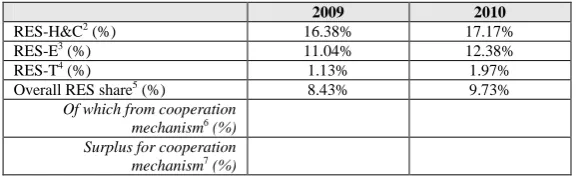
The penetration of RES in the Greek energy system, in terms of share in gross final energy consumption, reached and slightly surpassed the projected figures in the NREAP for the period 2009-2010.
Especially for RES-E, the initially positive findings of 2010 are further augmented in 2011. In specific, the 2011 preliminary findings demonstrate an accelerated growth rate for RES-E applications, a fact that is mainly attributed to the new regulatory framework for RES-E and the maintaining investment interest.
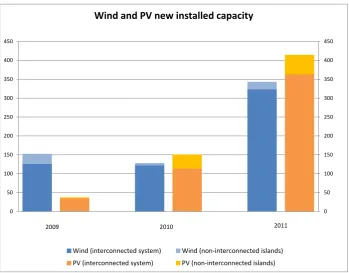
The favourable FIT scheme, especially for certain technologies, along with the rationalization of the administrative and licensing procedure resulted in more than doubling of the new installed capacity for certain technologies (i.e. photovoltaic) in 2011 and the unblocking of some previously observed bottlenecks in the early stages of the licensing procedure.
On top of that, the new legislative framework for RES-H and RES-T (e.g. energy performance of buildings regulation-KENAK), as well as the availability of new market opportunities and mechanisms (e.g. ESCOs) is expected to create the appropriate conditions for the increase share of RES in these end-use sectors.
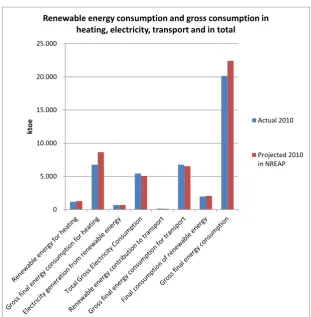
The effects of the economic recession, at least for the time being, seem to mainly affect the absolute levels of final energy consumption, especially in the building and transport sector and at lower extent the use of RES systems at the final energy use stage (i.e. solar thermal systems for domestic hot water and heat pumps for space heating and cooling). In the latter cases (i.e. for RES-H) a restrain in the growth rate is mainly observed, while in some other cases (i.e. biomass for heating uses) an even higher contribution than what was expected seems to be achieved. In specific, the significant drop in the energy demand, even higher than the one projected in the NREAP(see Figure 1), resulted for 2010 to RES shares in line or even higher than the ones initially forecasted.
Figure 1. Renewable energy consumption and gross energy consumption in heating, electricity, transport and in total for the year 2010 (actual and as projected in the NREAP)
The tables that follow present these findings. At the same time it should be noted that different growth rates per technology and/or type of use are observed, thus emphasizing that the advancement of each application/technology is governed by different or even contradicting elements.
The early RES utilization and installation data figures for 2011, already exhibit that the RES-E shares are in accordance with the trajectory presented in the NRRES-EAP, while the penetration and shares in heating and transport continue to demonstrate a slight but steady growth. Figure 2 presents the new installed capacity of wind and photovoltaics parks for the years 2009, 2010 and, provisionally, for 2011 whereas is demonstrated that for both technologies in 2011 there was at least 2.5 times more installed capacity than the one in 2010.
0 5.000 10.000 15.000 20.000 25.000
kt
oe
Renewable energy consumption and gross consumption in heating, electricity, transport and in total
Actual 2010
Figure 2. Newly installed capacity of wind and photovoltaics
However, as stated before, these facts while encouraging should not create complacency, as many constraints/barriers have to be further addressed. The antidote, considering also the difficulties in financing new investments, is a) to further tackle administrative barriers and delays due to lack of coordination among authorities (especially for RES-E), b) to strengthen the investors’ confidence in long-term viability of the RES scheme by rationalizing the feed-in tariffs and c) the further mobilization of the National Strategic Reference Framework for energy efficient actions in all the end-use sectors. Towards this direction, the Greek government in 2011, announced and legislated appropriate tools and programmes, while in 2011 and in the first months of 2012 temporary measures especially for the RES-E support mechanism were taken in order to ensure the sustainability of the RES-E market.
Measures for the improvement of energy efficiency, along with an updated regulatory framework in the different end-use sectors are also seen as supplementing the efforts to exploit the significant potential in Greece for a number of RES-H technologies and at the same time creating new market opportunities in the current business environment.
0 50 100 150 200 250 300 350 400 450
0 50 100 150 200 250 300 350 400 450
Wind and PV new installed capacity
Wind (interconnected system) Wind (non-interconnected islands) PV (interconnected system) PV (non-interconnected islands)
Table 1: The sectoral (electricity, heating and cooling, and transport) and overall shares of energy from renewable sources1
2009 2010
RES-H&C2 (%) 16.38% 17.17%
RES-E3 (%) 11.04% 12.38%
RES-T4 (%) 1.13% 1.97%
Overall RES share5 (%) 8.43% 9.73%
Of which from cooperation mechanism6 (%) Surplus for cooperation
mechanism7 (%)
Table 1a: Calculation table for the renewable energy contribution of each sector to final energy consumption (ktoe)8
2009 2010
(A) Gross final consumption of RES for heating and cooling 1,098 1,160
(B) Gross final consumption of electricity from RES9 703 909
(C) Gross final consumption of energy from RES in transport10 78 128
(D) Gross total RES consumption11 1,879 2,197
(E) Transfer of RES to other Member States 0 0
(F) Transfer of RES from other Member States and 3rd countries 0 0
(G) RES consumption adjusted for target (D)-(E)+(F) 1,879 2,197
1
Facilitates comparison with Table 3 and Table 4a of the NREAPs.
2
Share of renewable energy in heating and cooling: gross final consumption of energy from renewable sources for heating and cooling (as defined in Articles 5(1)b) and 5(4) of Directive 2009/28/EC divided by gross final consumption of energy for heating and cooling. The same methodology as in Table 3 of NREAPs applies.
3
Share of renewable energy in electricity: gross final consumption of electricity from renewable sources for electricity (as defined in Articles 5(1)a) and 5(3) of Directive 2009/28/EC divided by total gross final consumption of electricity. The same methodology as in Table 3 of NREAPs applies.
4
Share of renewable energy in transport: final energy from renewable sources consumed in transport (cf. Article 5(1)c) and 5(5)of Directive 2009/28/EC divided by the consumption in transport of 1) petrol; 2) diesel; 3) biofuels used in road and rail transport and 4) electricity in land transport (as reflected in row 3 of Table 1). The same methodology as in Table 3 of NREAPs applies.
5
Share of renewable energy in gross final energy consumption. The same methodology as in Table 3 of NREAPs applies.
6In percentage point of overall RES share. 7
In percentage point of overall RES share.
8
Facilitates comparison with Table 4a of the NREAPs
9
This figure is the actual electricity generation from RES in 2009 and 2010, not normalized for hydro and wind and not including generation from water previously pumped uphill
10
Not including electricity from RES consumed in transport (only biofuels)
11
Table 1.b: Total actual contribution (installed capacity, gross electricity generation) from each renewable energy technology in Greece to meet the binding 2020 targets and the indicative interim trajectory for the
shares of energy from renewable resources in electricity12
2009 2010
MW GWh MW GWh
Hydro13: 3,201 5,621 (4,287) 3,215 7,498 (4,525)
non pumped 2,502 4,714 2,516 6,597
<1MW 32 115 34 130
1MW–10 MW14 151 543 163 624
>10MW15 2,319 4,056 2,319 5,843
pumped - - - -
mixed16,17 699 907 (268) 699 901 (23)
Geothermal - - - -
Solar: 53 54 203 167
photovoltaic18 53 54 203 167
concentrated solar power - - - -
Tide, wave, ocean - - - -
Wind19: 1,171 2,547 (2,671) 1,298 2,714 (2,905)
onshore 1,171 2,547 1,298 2,714
offshore - - - -
Biomass20: 41 218 43 216
solid biomass - - - -
biogas 41 218 43 216
bioliquids - - - -
TOTAL21 4,466 8,172 4,760 10,572
of which in CHP 0 0 0 0
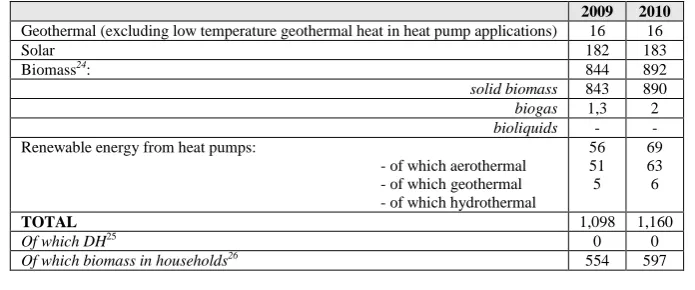
Table 1c: Total actual contribution (final energy consumption22) from each renewable energy technology in Greece to meet the binding 2020 targets and the indicative interim trajectory for the shares of energy from renewable resources in heating and cooling (ktoe)23
2009 2010 Geothermal (excluding low temperature geothermal heat in heat pump applications) 16 16
Solar 182 183
Biomass24: 844 892
solid biomass 843 890
biogas 1,3 2
bioliquids - -
Renewable energy from heat pumps:
- of which aerothermal - of which geothermal - of which hydrothermal
56 51 5
69 63 6
TOTAL 1,098 1,160
Of which DH25 0 0
Of which biomass in households26 554 597
12
Facilitates comparison with Table 10a of the NREAPs.
13
Actual hydro electricity generation. The normalised electricity in accordance with Directive2009/28/EC and Eurostat methodology (not including electricity produced from water previously pumped uphill) is given in the parenthesis.
14
For the Greek case, this category includes hydro plants up to 15MW, since these come under the special feed-in tariff of small hydro plants according to the provisions of L.3468/2006.
15
This figure does not include the gross electricity production from mixed pumped storage plants
16
In accordance with new Eurostat methodology.
17
The figure in the parenthesis refers to the electricity produced from water previously pumped uphill
18
These include stand-alone PV stations that are estimated to be 4,5MW in the end of 2009 and 4,7MW in the end of 2010
19
Actual wind electricity generation. The normalised electricity in accordance with Directive2009/28/EC is given in the parenthesis.
20
Only those complying with applicable sustainability criteria, cf. Article 5(1) of Directive 2009/28/EC last subparagraph, are taken into account.
21
Not including electricity produced from water previously pumped uphill
22
Direct use and district heat as defined in Article 5.4 of Directive 2009/28/EC.
23
Facilitates comparison with Table 11 of the NREAPs.
24
Only those complying with applicable sustainability criteria, cf. Article 5(1) last subparagraph of Directive 2009/28/EC are taken into account.
25
District heating and / or cooling from total renewable heating and cooling consumption (RES- DH).
26
[image:8.595.124.472.408.553.2]Table 1d: Total actual contribution from each renewable energy technology in Greece to meet the binding 2020 targets and the indicative interim trajectory for the shares of energy from renewable resources in the
transport sector (ktoe)27,28
2009 2010
Bioethanol/ bio-ETBE - -
Of which Biofuels29 Article 21.2 - -
Of which imported30 - -
Biodiesel 78 128
Of which Biofuels31 Article 21.2 5 12
Of which imported32 7 15
Hydrogen from renewables - -
Renewable electricity 3 3
Of which road transport 2 2
Of which non-road transport 1 1
Others (as biogas, vegetable oils, etc.) – please specify - -
Of which Biofuels33 Article 21.2 - -
TOTAL 81 131
2. MEASURES TAKEN IN THE LAST TWO YEARSAND/OR PLANNED AT NATIONAL LEVEL
TO PROMOTE THE GROWTH OF ENERGY FROM RENEWABLE SOURCES TAKING INTO
ACCOUNT THE INDICATIVE TRAJECTORY FOR ACHIEVING THE NATIONAL RES
TARGETS AS OUTLINED IN YOUR NATIONAL RENEWABLE ENERGY ACTION
PLAN(ARTICLE 22(1)AOF DIRECTIVE 2009/28/EC).
[image:9.595.119.474.118.259.2]During the last two years various measures have been implemented in order to foster the development of RES in the Greek energy system. These measures are grouped in three main categories, regulatory, technical and financial. The full list of these measures undertaken during the last two years (2010-2011) is presented in table 2, which updates and complements table 5 of the Greek NREAP. It should be highlighted that in March 2012, L.4062/2012 (OG 70A/30.03.2012) came into effect, which fully transposes Directive 2009/28/EC (and 2009/30/EC) into the national legislative framework.
Table 2: Overview of all policies and measures
Name and reference of the measure Type of
measure
Exp.
result Targeted group and or activity
Existing or planned*
Start and end dates of the measure34
1. L.3851/2010 “Accelerating the development of
Renewable Energy Sources to deal with climate change and other regulations in topics under the authority of
MEECC” (OG Α 85/04.06.2010)
Regulatory/
Financial investors, end users, public administration
Existing in
NREAP 2010-2020
2. L.4001/2011 “Operation of energy markets for electricity and natural gas, for research, production and transmission networks of hydrocarbons and other
provisions” (OG Α 179/22.8.2011)
Regulatory
Investors, public administration
Complementary
to NREAP 2011-2020
27
Only biofuels that are compliant with the sustainability criteria, cf. Article 5(1) last subparagraph, are taken into account.
28
Facilitates comparison with Table 12 of the NREAPs.
29
Biofuels that are included in Article 21(2) of Directive 2009/28/EC.
30From the whole amount of bioethanol / bio-ETBE. 31
Biofuels that are included in Article 21(2) of Directive 2009/28/EC.
32
From the whole amount of biodiesel. Regarding biodiesel, the imported quantities refer to biodiesel from production units placed in other EU member-states. From the whole amount of biodiesel, 25 ktoe and 72 ktoe are produced from Greek raw materials, in 2009 and 2010 respectively, according to available data. There are no data available regarding the origin for the rest of the quantities.
33
Biofuels that are included in Article 21(2) of Directive 2009/28/EC.
34
3. Law 3855/2010 “Measures to improve energy efficiency
in end-use, energy services and other provisions”, articles for public buildings and development of the ESCO
market( OG Α 95/23.6.2010)
Regulatory End consumers, energy companies-utilities, public administration
Existing in
NREAP 2010-2020
4. Simplification of environmental licensing procedure and annulment of forest land intervention approval
(L4014/2011, OG A 209/21.09.2011)
Regulatory investors, end users, public administration
Complementary
to NREAP 2011-2020
5. Exemption of electric and /or hybrid and/or low emission vehicles from the fuel consumption tax, the additional special tax, the circulation tax and/or the registration tax
(L.3831/2010, OG Α 34/25.2.2010)
Regulatory, financial
End users Existing in
NREAP 1992-2020
6. Guidelines to RAE for the implementation of L3851/2010 provisions, regarding Article 2, par. 1 and Article 15, par.3 (Circular ΑΥ/Φ1/οικ.14586/19.07.2010)
Regulatory RAE, Investors,
public administration
Complementary
to NREAP 2010-2020
7. Regulation on the licensing for production of electricity by RES and high efficiency co-generation (MD
ΥΑΠΔ/Φ1/14810, OG B 2373/25.10.2011)
Regulatory Investors, public administration
Complementary
to NREAP 2011-2020
8. Registry for licenses and data reporting (MD
Υ.Α.Π.Δ./Φ1/οικ.24840, OG B 1900, 03.12.2010) Regulatory Investors, public administration
Complementary
to NREAP 2010-2020
9. Clarifications on the new provisions for RES licensing procedure set by L4014/2011 concerning the annulment
of forest land intervention approval (Circular οικ.4709.111/14.12.2011) Regulatory Investors, public administration Complementary
to NREAP 2011-2012
10. Clarifications regarding the examination of applications for the installation of RES electricity systems in
agricultural land of high productivity (Circular Υ.Α.Π.Δ./Φ1/οικ.26928/16.12.2010) Regulatory Investors, public administration Complementary
to NREAP 2010-2020
11. Guidelines for the licensing and development of conventional Power Producers in order for them to be
flexible and support RES penetration (RAE, public consultation)
Regulatory Investors, public administration,
planners
Planned in
NREAP 2012-2012
12. Decision for the desired ratio of RES-E installed capacity in time and relevant exemptions of types of RES-E plants (fast track projects, PV buildings, geothermal projects)
from the foreseen threshold (MD A.Y./Φ1/οικ.19598, OG B 1630/11.10.2010)
Regulatory
Investors, public administration
Complementary
to NREAP 2010-2020
13. Implementation of the system for the guarantees of origin of electricity produced by RES and high efficiency
cogeneration (MD Γ6/Φ1/οικ.8786, OG B 646/14.05.2010) Regulatory Investors, public administration Complementary
to NREAP 2010-2020
14. Implementation of the GoO and description of the methodology, mechanism and supervising/issuing bodies
(MD Υ.Α.Π.Δ./Φ1/οικ. 24839, OG B 1901/03.12.2010)
Regulatory Investors, end consumers,
public administration
Complementary
to NREAP 2010-2020
15. Approval of the special terms for the deployment of photovoltaics and solar systems on fields and buildings (MD 40158, OG B 1556/22.09.2010 and MD 36720, OG
376/6.09.2010)
Regulatory Investors, public administration,
planners
Complementary
to NREAP 2010-2020
16. Modifications on the special terms for the deployment of photovoltaics and solar systems on fields and buildings
(MD 539771, OG B 583/14.04.2011)
Regulatory Investors, public administration,
planners
Complementary
to NREAP 2010-2020
17. Supplementation of special technical details for the spatial location criteria of small hydro plants (MD οικ.
196978, OG B 518/05.04.2011)
Regulatory Investors, public administration
Complementary
to NREAP 2011-2020
18. Inclusion of the use of solid biomass (pellets, woodchips, etc) to the permitted fuels for heating purposes in urban
areas (MD οικ.189533, OG B 2654/09.11.2011)
Regulatory End consumers, household sector, small
businesses
Complementary
to NREAP 2011-2020
19. Definition of terms and procedure for research activities and management of the geothermal potential of low
temperature geothermal areas (MD Γ9Β,Γ/Φ166/οικ25158/ΓΓΦΠ4398, OG B
2647/09.11.2011) Regulatory Investors, public administration Complementary
to NREAP 2011-2020
20. Licensing for the distribution of thermal energy exclusively for agricultural purposes by exploiting geothermal potential of low temperature geothermal
areas (MD Γ9Β/Φ166/23880/ΓΓΦΠ4211, OG B 2450/02.11.2011) Regulatory End consumers, public administration, planners Complementary
to NREAP 2011-2020
21. Invitation for the participation in 2010 biodiesel
allocation (JMD Γ1/Α/10085, OG B 750 /19.05.2010) Regulatory producers, Biodiesel public
Complementary
administration
22. Allocation of 164,000 kiloliters of biodiesel for the year 2010, in accordance with the provisions of Art. 15A, par. 7 of L.3054/2002 and its amendment (JMD Γ1/Α/15555, OG B 1174/04.08.2010 as amended by Γ1/A/11079, OG
B 1071/10.05.2011)
Regulatory Biodiesel producers, refineries, oil companies, public administration Complementary
to NREAP 2010-2011
23. Invitation for the participation in 2011 biodiesel
allocation (JMD Γ1/Α/13972, OG B 1307/16.06.2011) Regulatory producers, Biodiesel public administration
Complementary
to NREAP 2011-2011
24. Allocation of 132,000 kiloliters of biodiesel for the year 2011, in accordance with the provisions of Art. 15A, par.
7 of L. 3054/2002 (JMD Γ1/Α/23603, OG B 2432/21.10.2011)
Regulatory Biodiesel producers, public administration
Complementary
to NREAP 2011-2012
25. Approval of the Energy Performance of Buildings
Regulation (MD Γ6/Β/οικ. 5825, OG B 407/2010) Regulatory End consumers, household sector, small businesses, public administration, planners Complementary
to NREAP 2010-2020
26. Methodological framework for measuring and verifying energy saving to meet the national indicative target for
energy efficiency at the end-use sectors – List of indicative eligible measures to improve energy efficiency
– Energy content of fuels for end use (MD Γ6/7094, OG B 918/23.05.2011)
Regulatory
public administration
Complementary
to NREAP 2011-2016
27. Operation, registry and code of conduct for energy services companies (MD Γ6/13280, OG B
1228/14.06.2011)
Regulatory public administration,
companies
Complementary
to NREAP 2011-2020
28. Support of private investment for economic development, entrepreneurship and regional cohesion
(L.3908/2011, OG A 8/1.2.2011)
Financial Investors, public administration
Complementary
to NREAP 2010-2020
29. Feed-in tariff for offshore wind installations (L4030/2011, OG Α 249/25.11.2011)
Financial Investors, public administration
Complementary
to NREAP 2011-2020
30. Tax reliefs on the purchase and installation of RES systems for heating as well as decentralized RES systems
for electricity generation (L.3842/2010, OG Α 58/23.04.2010)
Financial
End consumers, companies
Complementary
to NREAP 2010-2020
31. Special levy and incentives to residential consumers in areas where RES systems are installed (MD Υ.Α.Π.Δ. /Φ1/οικ.28287/12.12.2011, OG Β 3005/28.12.2011)
Financial Investors, end consumers,
public administration
Complementary
to NREAP 2011-2020
32. Supplementation of the special program for the deployment of photovoltaics up to 10kW on buildings
and especially roofs (MD Α.Υ./Φ1/οικ.18513, OG B’1557/22.09.2010)
Financial End consumers, household sector, small
businesses
Complementary
to NREAP 2010–2019
33. Setting of tax issues in regards with PV installations up to 10kW on buildings (Circular Ministry of Finance,
1101/06.08.2009)
Financial End consumers, household sector, small
businesses
Complementary
to NREAP 2009-2020
34. The “Energy Efficiency at Household Buildings”
Program (NSRF 2007-2013, JMD Φ.Β1/Δ2.1/244/6, OG B 54/26.01.2011)
Financial End consumers, household
sector
Complementary
to NREAP 2011-2013
35. “Exoikonomo” Program for public authorities (NSRF
2007-2013, MD Φ.Β1/Δ2.1/244/6, OG Β 54 26.1.2011
Financial public administration,
planners
Complementary
to NREAP 2011-2013
36. “Building the Future – Large Scale Interventions” Program (NSRF 2007-2013)
Financial public administration,
private companies
Complementary
to NREAP 2011-2013
37. “Green Pilot Urban Neighborhood” Program (NSRF 2007-2013)
Financial public administration,
planners, private companies
Complementary
to NREAP 2011-2013
38. “Bioclimatic Renewal of Urban Spaces” (NSRF
2007-2013)
Financial public administration,
planners
Complementary
to NREAP 2011-2013
39. “Green agricultural and island communities – New
development model” Program (NSRF 2007-2013) Financial administration, public
planners
Complementary
40. “Pilot bioclimatic school buildings” and “Pilot RES and
EE projects on existing public school buildings” Programs (NSRF 2007-2013)
Financial public administration,
planners
Complementary
to NREAP 2011-2013
41. “Pilot RES and EE projects in public buildings” Program
(NSRF 2007-2013)
Financial public administration,
planners
Complementary
to NREAP 2011-2013
42. Reinforcement of the interconnection capacity with neighbouring countries (increase of NTC on the existing
interconnections + new interconnection with Turkey). Further actions and projects for the integration of the electricity system into the European grid through western
Balkans Technical Investors, public administration, planners Existing/ planned in NREAP 2010-2020
43. Development of storage facilities in the interconnected system by exploiting hydro pumping system at existing
large hydro plants and new installations (public consultation RAE) Technical public administration, planners Planned in
NREAP 2010-2020
44. Further development of the distribution grid based on the smart grids principles (a pilot programme for the development of smart grids on 5 islands is announced in
the context of NSRF 2007-2013)
Technical Investors, public administration,
planners
Planned in
NREAP 2012-2020
45. Application and reinforcement of the National Transmission Development Plan (NTDP), elaborated by
the System Operator: a) Upgrading of grid interconnections in the mainland, b) Interconnection of
the non-interconnected islands according to strategic planning elaborated by the System Operator
Technical Investors, public administration, planners Existing in
NREAP 2010-2016
46. Increase of maximum percentage of biodiesel blended in diesel from 5% to 7% per volume (MD 460/2009, OG B
67/28.01.2010)
Technical Refineries, oil companies,
public administration
Existing in
NREAP 2010
47. Guide for the assessment of projects for electricity generation from concentrating solar power (RAE)
Technical Investors, public administration
Complementary
to NREAP 2011-2020
2.1. Description of the progress made in evaluating and improving administrative procedures to remove regulatory and non-regulatory barriers to the development of renewable energy(Article 22(1)e of Directive 2009/28/EC).
On the 4th of June 2010, L.3851/2010 “Accelerating the development of renewable energy sources to confront climate change and other topics under the authority of MEECC” has been put into force. The aim of this law is to establish a stable framework for the development of RES technologies, ensuring that authorization, certification and licensing procedures for renewable power plants are proportionate and necessary and that licensing procedures are transparent and expedited. The new RES law has introduced significant changes to previous legislation. Specifically, L3851/2010 simplifies and accelerates the licensing procedure, so that the penetration of RES in the Greek energy mix is enhanced.
In addition to the above, L.3851/2010 introduced the concept of a “certificate of exemption” for small scale RES projects, to substitute the full EIA procedure, as shown in the table below.
RES technology
No exemption threshold foreseen
before 4.6.2010
Exemption threshold after 4.6.2010 by virtue of L.3851/2010
[MW]
Geothermal energy 0.50
Biomass 0.50
PV & CSP 0.50
Wind 0.02
In view of the licensing process streamlining, L.3851/2010 has fixed strict terms and deadlines, within which approvals should be granted or consensus should be rendered by services and bodies involved in the interim stages of the overall licensing procedure. In particular L.3851/2010 sets an explicit obligation for all bodies involved in Environmental Impact Assessment (EIA) procedure to give their approvals/consensus within the strict framework of their competencies and in compliance with the rules set in the Spatial Planning
and Sustainable Development for Renewable Energy Sources. Should these
approvals/consensus not be notified within a strict timeframe, the responsible authority is entitled to issue the Environment Impact Assessment (EIA). In the same framework and in order to ensure transparency, equity and effectiveness strict deadlines also exist for authorities issuing permits within the RES licensing procedure. Should an installation license not be timely issued by regional authorities, the Minister of EECC is authorized to issue the permit within a precise timeframe. Moreover, a strict deadline for the issuance of a Grid Connection Offer is defined. Should the connection not be realized in a specified timeframe, the Grid Connection Offer ceases to be valid and grid capacity becomes available for new applications.
By virtue of L.3851/2010 and a series of ministerial decisions issued to deal with regulatory matters, a parallel process of the different phases of the licensing procedure is made possible and a scaled licensing procedure is for the first time fully implemented in PV technology, as shown in the table below.
RES installations within limits of existing zoning plans
RES installations beyond limits of existing zoning plans
≤100kW >100kW ≤100kW >100kW
Buildings Notification
Procedure
Installations exempted from town-planning permit – static study
necessary
Notification Procedure & certification for the
building legality
Installations exempted from town-planning permit –
static study necessary
Land
Installations forbidden if not applied as buildings auxiliary electrical/mechanical
outfit
Installations exempted from town-planning permit and in addition exempted for consensus
of involved licensing bodies35
Installations exempted from town-planning permit
Note: Town-planning permit additionally required in case of in situ heavy construction works.
RES-E Environmental Impact Approval is henceforth completed in one step, the Preliminary Environmental Impact Assessment (P.E.I.A.) stage of the previous legal framework having been omitted. Furthermore, a RES-E project generation license, granted by the Regulatory
35
Authority for Energy (RAE), is henceforth an initial approval, in the meaning that no precision of the land where the plant is installed and no P.E.I.A are required.
The provisions of L.3851/2010 further support the efficient implementation of the Special Framework for Spatial Planning and Sustainable Development for Renewable Energy Sources made part of the Greek legal framework only in December 2008.
Furthermore, L.3851/2010 provides for the establishment of an Assistance Service for Renewable Energy Sources Investments to play one-stop agency’s role in the near future. Currently, the Assistance Service for Renewable Energy Sources Investments under more competences is assigned the issuing of relevant legal and regulatory framework, the issuing of large scale projects’ installation and operating permits, the creation of a registry on the development of RES-E licensing procedure, as well as relevant information for the plants.
Moreover, L.3851/2010 also includes provisions to enhance social acceptance in regard with RES projects at local level. In this frame a levy raised at 3% of gross proceeds from renewable energy sale (PV excluded) is allocated to local communities. A significant part of this levy (1% out of 3%) is provided directly to the household consumers of the municipality, where the RES project is installed, through the electricity bills. Moreover an additional 1% levy is imposed on small scale hydros gross proceeds from energy sale in favour of protected areas management agencies since 2009.
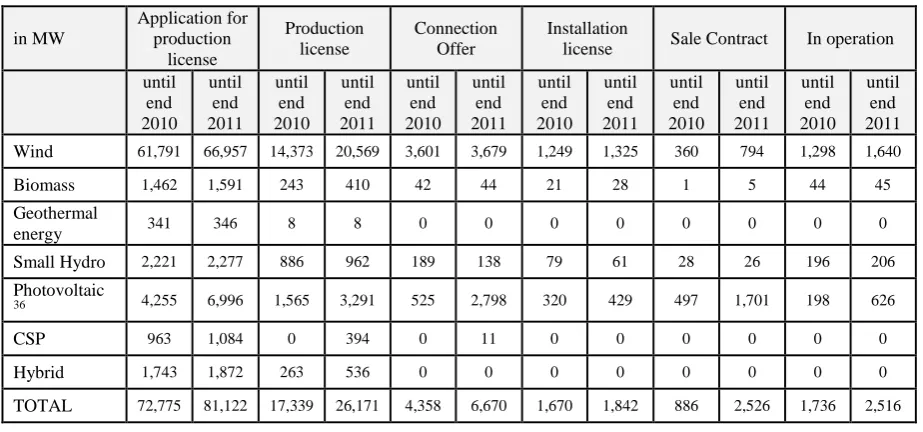
[image:14.595.59.521.487.703.2]The main goal of L.3851/2010 is to facilitate and accelerate RES penetration in Greece so that the rate of installed capacity gradually reaches 500-1000MW annually. Table 3 presents the development of the licensing procedure for RES-E installations by the end of 2010 and 2011. The progress and acceleration of the licensing process is evident. The installed RES-Δ capacity has increased by 45% by the end of 2011 reaching 2.5 GW. The capacity of the projects that are in the last licensing phase has reached the amount of 4.5 GW.
Table 3: Overview of licensing procedure by the end of 2010 and 2011
in MW Application for production license Production license Connection Offer Installation
license Sale Contract In operation
until end 2010 until end 2011 until end 2010 until end 2011 until end 2010 until end 2011 until end 2010 until end 2011 until end 2010 until end 2011 until end 2010 until end 2011
Wind 61,791 66,957 14,373 20,569 3,601 3,679 1,249 1,325 360 794 1,298 1,640
Biomass 1,462 1,591 243 410 42 44 21 28 1 5 44 45
Geothermal
energy 341 346 8 8 0 0 0 0 0 0 0 0
Small Hydro 2,221 2,277 886 962 189 138 79 61 28 26 196 206
Photovoltaic
36 4,255 6,996 1,565 3,291 525 2,798 320 429 497 1,701 198 626
CSP 963 1,084 0 394 0 11 0 0 0 0 0 0
Hybrid 1,743 1,872 263 536 0 0 0 0 0 0 0 0
TOTAL 72,775 81,122 17,339 26,171 4,358 6,670 1,670 1,842 886 2,526 1,736 2,516
36
L.3851/10 also includes important provisions for the use of renewable energy in new buildings (i.e. solar thermal systems, heat pumps, biomass, RES district heating), in accordance with the recently enacted regulation for the energy performance of buildings (OG B 407/2010), together with the Ministerial Decree OG B2654/2011 that allows the use of biomass for heating purposes in the metropolitan area of Athens and Thessaloniki. Furthermore L.3855/2010 also includes provisions improving energy performance in public sector.
Secondary legislation and/or technical reports that have been approved in the last two years also facilitate the development of RES technologies, such as geothermal (i.e. MD Γ9Β,Γ/Φ166/οικ25158/ΓΓΦΠ4398 “Definition of terms and procedures for research activities and management of the geothermal potential of low temperature geothermal areas”, OG B 2647/2011 and MD Γ9Β/Φ166/23880/ΓΓΦΠ4211 “Licensing for the distribution of thermal energy exclusively for agricultural purposes by exploiting geothermal potential of low temperature geothermal areas”, OG B 2450/2011), small hydroplants (i.e. MD οικ. 196978“Supplementation of special technical details for the spatial location criteria of small hydro plants”, OG B 518/2011) and concentrating solar power plants (“Guide for the assessment of projects for electricity generation from concentrating solar power”, RAE, November 2010).
2.2. Measures in ensuring the transmission and distribution of electricity produced from renewable energy sources and in improving the framework or rules for bearing and sharing of costs related to grid connections and grid reinforcements(Article 22(1)f of Directive 2009/28/EC).
L.3851/2010 includes special provisions for the incorporation and connection of plants producing electricity from RES to the electricity system. Under the provisions of this law, it is made possible that the owner of a RES-E plant owns a section of the plant’s connection works between the central distribution box of medium voltage of the RES-E plant and the transformer/substation of the national grid (the substation possibly included as well). In this case the plant owner becomes responsible for its management, operation and maintenance.
The owner of the connection works has to provide access to other RES-E producers, unless the network cannot absorb additional production, which is proven by the substantiated opinion of the Transmission System Operator. The new user compensates the owner for the use of the connection. A decision on the amount of the aforementioned payment and the detailed methodology of how this will be conducted is to be elaborated by the Regulatory Authority for Energy.
3. SUPPORT SCHEMES AND OTHER MEASURES CURRENTLY IN PLACE THAT ARE
APPLIED TO PROMOTE ENERGY FROM RENEWABLE SOURCES AND ANY
DEVELOPMENTS IN THE MEASURES USED WITH RESPECT TO THOSE SET OUT IN THE
GREEK NATIONAL RENEWABLE ENERGY ACTION PLAN(ARTICLE 22(1)B OF
DIRECTIVE 2009/28/EC).
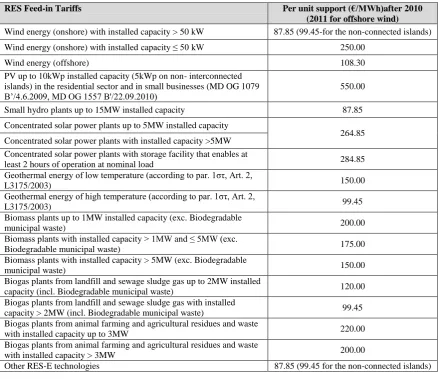
The current scheme for guaranteed feed-in tariffs for electricity that is implemented in Greece is regulated by L.3851/2010, which updated and expanded the feed-in tariff rates. The tariffs are differentiated between RES technologies, considering project characteristics (i.e. capacity), co benefits and development cost.
Thus, higher feed-in tariff are set for plants with smaller installed capacity for wind energy, photovoltaics, CSP, biomass and biogas plants, taking into account the full economic parameters of smaller plants. Higher feed-in tariffs are also foreseen in L.4030/2011 for offshore wind farms.
[image:16.595.79.518.274.653.2]The feed-in tariffs presented in the following table 4 are readjusted annually, indexed at 50% of the annual consumer index (recently imposed by L.4062/2012).
Table 4: Feed-in tariffs for electricity generated by renewable energy according to L. 3851/2010
RES Feed-in Tariffs Per unit support (€/MWh)after 2010
(2011 for offshore wind)
Wind energy (onshore) with installed capacity > 50 kW 87.85 (99.45-for the non-connected islands)
Wind energy (onshore) with installed capacity ≤ 50 kW 250.00
Wind energy (offshore) 108.30
PV up to 10kWp installed capacity (5kWp on non- interconnected islands) in the residential sector and in small businesses (MD OG 1079
Β’/4.6.2009, MD OG 1557 B'/22.09.2010) 550.00
Small hydro plants up to 15MW installed capacity 87.85
Concentrated solar power plants up to 5MW installed capacity
264.85 Concentrated solar power plants with installed capacity >5MW
Concentrated solar power plants with storage facility that enables at
least 2 hours of operation at nominal load 284.85
Geothermal energy of low temperature (according to par. 1στ, Art. 2,
L3175/2003) 150.00
Geothermal energy of high temperature (according to par. 1στ, Art. 2,
L3175/2003) 99.45
Biomass plants up to 1MW installed capacity (exc. Biodegradable
municipal waste) 200.00
Biomass plants with installed capacity > 1MW and ≤ 5MW (exc.
Biodegradable municipal waste) 175.00
Biomass plants with installed capacity > 5MW (exc. Biodegradable
municipal waste) 150.00
Biogas plants from landfill and sewage sludge gas up to 2MW installed
capacity (incl. Biodegradable municipal waste) 120.00
Biogas plants from landfill and sewage sludge gas with installed
capacity > 2MW (incl. Biodegradable municipal waste) 99.45
Biogas plants from animal farming and agricultural residues and waste
with installed capacity up to 3MW 220.00
Biogas plants from animal farming and agricultural residues and waste
with installed capacity > 3MW 200.00
Other RES-E technologies 87.85 (99.45 for the non-connected islands)
Table 5: Feed-in tariffs for electricity generated by photovoltaic systems according to L. 3851/2010
Feed-in Tariff for photovoltaic systems (€/MWh)
Interconnected system Non-interconnected islands
>100kW ≤100kW independently from installed capacity
February 2009 400.00 450.00 450.00
August 2009 400.00 450.00 450.00
February 2010 400.00 450.00 450.00
August 2010 392.04 441.05 441.05
February 2011 372.83 419.43 419.43
August 2011 351.01 394.89 394.89
February 2012 333.81 375.54 375.54
August 2012 314.27 353.55 353.55
February 2013 298.87 336.23 336.23
August 2013 281.38 316.55 316.55
February 2014 268.94 302.56 302.56
August 2014 260.97 293.59 293.59
For each year (n) from
2015 onwards 1.3*ASMP 1.4*ASMP 1.4*ASMP
Recently MEECC, after a public consultation with the relevant stakeholders and authorities, decided to accelerate this decrease rate in view of the recent high rates of cost reduction of the PV installations and the higher efficiencies that enable higher returns on investment.
It should be noted that the relevant decisions (MD Υ.Α.Π.Δ. /Φ1/οικ.2262, OG Β 97/2012 and MDΥ.Α.Π.Δ. /Φ1/οικ.2266, OG Β 97/2012) have no retroactive effect (i.e. on installations that have already signed a contract for the sale of electricity generation), to ensure the smooth operation of the energy market. The reduction amounts to 12.5% on the currently foreseen price (table 5), according to L.3851/2010 and 7% on the new price per semester henceforth. As regards the deployment of photovoltaics up to 10kW (5kW for the non-interconnected islands) on buildings (also see section 4) and especially roofs (OG B’ 1079 /4.6.2009), the feed-in tariff reduction is foreseen to be 5% per semester instead of per year as previously regulated.
In specific table 5a presents the effective FITs for PV systems as from 1stFebruary 2012, taking into account the abovementioned Ministerial Decrees.
Table 5a: Effective from February 2012, the new Feed-in tariffs for electricity generated by photovoltaic systems
Feed-in Tariff for photovoltaic systems (€/MWh)
>100kW ≤100kW& non-interconnected islands
On buildings roofs up to 10kW(5kW for non-interconnected islands)
February 2012 292.08 328.60 495
August 2012 271.64 305.60 470.25
February 2013 252.62 284.20 446.73
August 2013 234.94 264.31 424.40
February 2014 218.49 245.81 403.18
August 2014 203.20 228.60 383.02
For each year (n) from
2015 onwards 1.3*ASMP 1.4*ASMP
February 2015 363.87
August 2015 345.68
[image:17.595.72.523.560.683.2]The aforementioned feed-in tariffs for the pricing of electricity produced by RES stations, except for PV and CSP stations, are increased by 20% (15% for the case of solid biomass and biogas), if the investment is realized without any public subsidy. Moreover a possibility for setting a higher FIT for the installation of wind farms in areas with lower wind potential is foreseen.
Finally, the possibility for a partial compensation for energy production which curtailed by the Grid Transmission Operator (GTO) is foreseen in the case of wind farms owners.
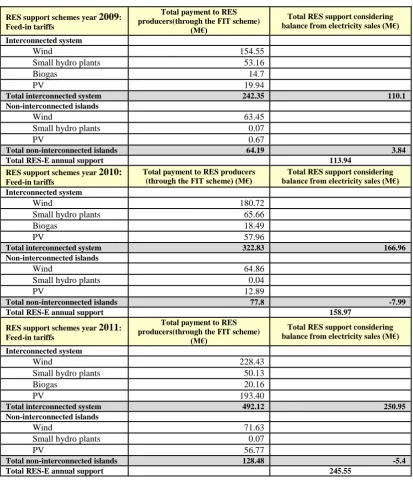
[image:18.595.60.474.276.757.2]Table 6, presents the total financial support given in 2009, 2010 and 2011 to RES plants, through the FIT scheme. It is worth mentioning that for years 2010 and 2011 in the non-interconnected islands RES power plants acted beneficially to power generation cost, since the total RES support considering balance from electricity sales was negative.
Table 6: Support schemes for renewable energy
RES support schemes year 2009: Feed-in tariffs
Total payment to RES producers(through the FIT scheme)
(M€)
Total RES support considering balance from electricity sales (M€)
Interconnected system
Wind 154.55
Small hydro plants 53.16
Biogas 14.7
PV 19.94
Total interconnected system 242.35 110.1
Non-interconnected islands
Wind 63.45
Small hydro plants 0.07
PV 0.67
Total non-interconnected islands 64.19 3.84
Total RES-E annual support 113.94
RES support schemes year 2010: Feed-in tariffs
Total payment to RES producers (through the FIT scheme) (M€)
Total RES support considering balance from electricity sales (M€)
Interconnected system
Wind 180.72
Small hydro plants 65.66
Biogas 18.49
PV 57.96
Total interconnected system 322.83 166.96
Non-interconnected islands
Wind 64.86
Small hydro plants 0.04
PV 12.89
Total non-interconnected islands 77.8 -7.99
Total RES-E annual support 158.97
RES support schemes year 2011: Feed-in tariffs
Total payment to RES producers(through the FIT scheme)
(M€)
Total RES support considering balance from electricity sales (M€)
Interconnected system
Wind 228.43
Small hydro plants 50.13
Biogas 20.16
PV 193.40
Total interconnected system 492.12 250.95
Non-interconnected islands
Wind 71.63
Small hydro plants 0.07
PV 56.77
Total non-interconnected islands 128.48 -5.4
Tax reliefs for small RES applications
For small mostly residential RES applications, L.3842/2010 foresees for tax relief on the purchase and installation of RES systems for heating, as well as decentralized RES systems for electricity generation, namely a 10% income tax reduction of the cost of interventions for the energy upgrade of a building that will arise after an energy audit under the provisions of L.3661/2008. These interventions concern, among others:
a) The purchase and installation of a renewable energy based system for space heating, space cooling and domestic hot water (solar energy systems, heat pumps, biomass boilers, etc.).
b) The purchase and installation of decentralized power generation systems based on renewable energy (photovoltaic, small wind turbines) and cogeneration of electricity,heating and cooling with natural gas or renewable sources.
The amount of the eligible expenditure for the tax relief is capped to six thousand (6,000) euros.
Also, it should be noted that the revenues from PVs installed in buildings roofs, under the respective national programme, are exempted from tax.
Subsidies on investment
The recently enacted development law (L.3908/2011) constitutes the main instrument for promoting private investment and reflects the current political directions on the content and objectives of the development process of the country.
The existing scheme for private investment support, as introduced by L.3908/2011, includes key criteria of economic efficiency, follows a coherent regional development planning and introduces specific application rules, and it concerns all types of business, from general entrepreneurship, to technological advancement and regional cohesion. The funding is in the form of a subsidy of the total investment cost and ranges from 15% to 50% depending on the region and the size of the enterprise. Especially for RES investments, the maximum subsidy is up to 40% on the initial investment, while photovoltaic plants are not eligible for subsidy under the provisions of this Law.
The NSRF also provides financial support for interventions in buildings of the private and public sector, urban and rural areas and public authorities. These interventions cover, among others, the deployment of renewable energy technologies. Specific programs currently active are:
Furthermore, it includes the installation of solar systems for hot water supply (collector, water tank, mount, pipes, etc.).
The “Exoikonomo” Program aims at supporting municipalities to introduce a sustainable development plan towards the reduction in energy consumption. It provides a 70% subsidy for energy investments at local level accounting for an overall 100M€ budget. The installation of RES applications is among the eligible actions of the program.
The “Building the Future – Large Scale Interventions” Program that will last until 2020 and is aimed to achieve 3,100,000 energy interventions in buildings (houses, apartments and commercial buildings). It foresees the installation of 5,000 solar panels and the replacement of 20,000 conventional heating systems with high efficiency ones (RES included) in residential buildings, as well as the installation of high-performance cooling/heating/ventilation systems in 5,000 commercial buildings, including the deployment of RES. The program is based on voluntary basis agreement with the suppliers, who are committed to offer a discount to the energy efficient systems and products that are listed in the programme. The systems/products are listed on the basis of their technical characteristics.
The “Green Pilot Urban Neighborhood” Program provides for the replacement of systems for heating and cooling with geothermal heat pumps and the installation of other RES applications, such as photovoltaic and solar thermal systems, in residential buildings of low income residents.
The “Bioclimatic Renewal of Urban Spaces” supports the development of certain architectural and climatic tools that can be directly used for the bioclimatic upgrading of urban spaces and which include the integration of RES technologies.
The “Green agricultural and island communities – New development model” Program comprises various actions that involve the deployment of RES applications, such as electricity generation plants, RES in buildings, desalination units that use RES, etc., in islands and remote villages.
The “Pilot bioclimatic school buildings” and “Pilot RES and EE projects on existing public school buildings” fund interventions in school buildings including the installation of RES applications.
The “Pilot RES and EE projects in public buildings” Program funds, among others, the installation of central solar thermal systems, geothermal and aerothermal heat pumps and other RES systems for heating and cooling in buildings of the public sector
Biodiesel allocation
by-products (cottonseed) and wastes (animal fats and used vegetable oils) are approved for biofuel production. According to the relevant Joint Ministerial Decrees (JMD) of the Ministry of Finance, the Ministry of Environment, Energy and Climate Change and the Ministry of Rural Development and Food (see 55 and 57 of Table 2), a specific quantity of pure biodiesel is allocated to beneficiaries in order to achieve the mandatory percentage of biodiesel blended in diesel of 4.5%, increased to 6.5% in January 2010. The JMDs also foresee the maximum premium to be offered by the beneficiaries, which is binding for the beneficiaries’ firms sales over the course and for the whole quantity of pure biodiesel for the 2011 allocation period (see also section 8).
Further support actions
The Ministry of Environment, Energy and Climate Change constantly encourages an open dialogue with the relevant stakeholders for the development of a coherent financing support mechanism for RES. In this context, the Ministry recently (end of 2011) invited stakeholders in the field of Renewable Energy to submit their opinions for ensuring the sustainability of the RES financial support mechanism. Towards this direction and after an opinion from RAE, certain measures of temporary nature were identified with an horizon up to 2013, in view of eliminating the current deficit of the special RES-E account. The measures foreseen in favour of the Special RES Account are:
Imposing an additional charge of 2 €/MWh in the lignite-fired electricity generation.
Transferring part of the income from the ΔUAs’auctions in 2011-2012.
Transferring part of the income from the reciprocal special tax (contribution) on behalf of ERT S.A. (Greek Radio and Television S.A.).
3.1. Information on how supported electricity is allocated to final customers for purposes of Article 3 (6) of Directive 2003/54/EC(Article 22(1)b of Directive 2009/28/EC).
Article 3 (6) of Directive 2003/54/EC was transposed to the Greek legislative framework through L.3426/2005 (Art. 17, Par. 2(h)), which, among others, sets the content of the Code for Electricity Supply. The Code defines the means of providing information to the final consumers by the electricity suppliers regarding the contribution of each energy source to the total electricity mix during the preceding year. It also includes reference to existing reference sources that provide information on the environmental impact, especially regarding the CO2
emissions.
Furthermore, recently enacted L.4001/2011 includes provisions towards the consumers’ protection and the suppliers’ commitments. According to Art.48, Par. 2, the Suppliers are obliged to provide the customer with information on the contribution of each energy source to the overall fuel mix of each supplier in the previous year, in an understandable and clearly comparable manner, as well as on environmental impact, regarding at least the CO2emissions
4. INFORMATION ON HOW, WHERE APPLICABLE, THE SUPPORT SCHEMES HAVE BEEN
STRUCTURED TO TAKE INTO ACCOUNT RES APPLICATIONS THAT GIVE ADDITIONAL
BENEFITS, BUT MAY ALSO HAVE HIGHER COSTS, INCLUDING BIOFUELS MADE FROM
WASTES, RESIDUES, NON-FOOD CELLULOSIC MATERIAL, AND LIGNO-CELLULOSIC
MATERIAL (ARTICLE 22 (1)C OF DIRECTIVE 2009/28/EC).
The Greek regulatory framework in order to set FITs and provide support has considered the higher cost of some RES technologies that may have additional benefits. As mentioned previously, L.3851/2010 foresees higher feed-in tariffs for the electricity generated by RES technologies with co-benefits, namely CSP plants with an embedded storage system, RES hybrid, certain types of biomass and PV on building roofs.
For PVs installed on buildings roofs a favourable FIT is set in order to tap the additional benefits both from the social aspect (increase awareness and acceptability for the photovoltaics at consumers’ level) and the energy one (production at demand side, in phase with the peaks in demand). Only residential households and very small businesses are eligible under this specific PV feed-in tariff scheme.
As far as biogas is concerned, favourable feed-in tariffs have been designated, with differentiation, according to the type of biogas used in the power plant, with the highest feed-in tariff set for plants that use biogas produced from animal farmfeed-ing and agricultural residues and waste.L.3851/2010 also provides for a higher feed-in tariff for those CSP plants that include an energy storage system that enables at least two hours of operation at nominal load.
Moreover, considering the advantages of RES hybrid plants, especially for small autonomous systems, along with the different technical and cost related parameters for their development, FIT is determined on a case-by-case basis.
L.3851/2010 also provides for a higher feed-in tariff for those CSP plants that include an energy storage system that enables at least two hours of operation at nominal load.
It is also worth mentioning that L.3851/2010 also includes high FITs for the installation of RES stations on non-interconnected islands, when the cost of connection burdens the owner, taking into account the higher production cost of conventional power stations in these areas.
5. INFORMATION ON THE FUNCTIONING OF THE SYSTEM OF GUARANTEES OF ORIGIN
FOR ELECTRICITY AND HEATING AND COOLING FROM RES, AND THE MEASURES
TAKEN TO ENSURE RELIABILITY AND PROTECTION AGAINST FRAUD OF THE SYSTEM
(ARTICLE 22(1)D OF DIRECTIVE 2009/28/EC).
According to this MD, the GoO is defined as an electronic certificate which is issued by the competent Issuing Body (IB) and certifies that 1 MWh of electricity was produced from RES or high efficiency cogeneration unit for a specific period of time. The Issuing Body (IB) is the Market Operator for the case of units that are located within the area of the interconnected system, PPC for units in the non-interconnected islands and CRES for autonomous stations.
The issuance of a GoO for electricity generated by the corresponding units can be requested for a time period of one year. The GoO certificate must be issued at the latest within 12 months from the expiry date of the production period, to which it corresponds.
For the operation of the GoO system and the quality reassurance mechanism, an electronic registry information system is kept by the respective IB that is responsible for ensuring that the registry is safe and cannot be breached. The electronic registry consists of the Units’ Registry and the GoO’s Registry. This information system is uniform for all IBs.The specifications are set by TSO and are approved by the Supervising Body (SB), which is the Greek Regulatory Authority of Energy (RAE).
RAE has access to the full electronic records of the registry and is able to proceed to a potential intervention, while the IBs have access only to their electronic records. Market Operator is also responsible for the operation, maintenance and improvement of the aforementioned system. Finally, each IB has the right to control the accuracy of the data provided with inspections, while each participant is required to facilitate this procedure through the smooth provision of the necessary data.
[image:23.595.87.514.497.570.2]The Market Operator is required to publish statistical data regarding the information that is kept in the electronic registry information system. Table 7 presents the relevant data that refer to the first year of the information system’s operation (October 2010 – September 2011, source Hellenic Electricity Market Operator S.A. - LAGIE S.A.).
Table 7: Statistical data of the GoO registry
Issued GoO (MWh)
PV Wind Small
hydro
Large
hydro Total
Q4/2010 28,000 28,000
Q1/2011 5,500 1,726,916 1,732,416
Q2/2011 8,573 290,942 10,090 309,605
Q3/2011 5,110 11,653 4,846 21,609
Total 13,683 302,595 48,436 1,726,916 2,091,630
Article 25 of recently enacted L.4062/2012 introduces in the national legislative framework specific provisions for the extension of the GoO to heating or cooling produced by RES and for the respective Issuing Bodies.
6. DEVELOPMENTS IN THE PRECEDING 2 YEARS IN THE AVAILABILITY AND USE OF
BIOMASS RESOURCES FOR ENERGY PURPOSES (ARTICLE 22(1)G OF DIRECTIVE
2009/28/EC).
Table 8: Biomass supply for energy use
Amount of domestic raw material
(tonnes)
Primary energy in domestic raw material (ktoe)
Amount of imported raw material from EU (tonnes) Primary energy in amount of imported raw material from EU (ktoe) Amount of imported raw material from non EU (tonnes) Primary energy in amount of imported raw material from non EU (ktoe)
2009 2010 2009 2010 2009 2010 2009 2010 2009 2010 2009 2010
Biomass supply for heating and electricity:
Direct supply of wood biomass from forests and other wooded land energy generation (fellings etc.) 623,855 (636,708) 37 664,232 (664,382)37
251 268 159,752 229,823 68 99 1,377 1,821 0.6 0.8
Indirect supply of wood biomass (residues and co-products from wood industry etc.)
72,656 79,831 26 33
Energy crops (grasses, etc.) and short rotation trees (please specify) Agricultura l by-products / processed residues and fishery by-products
1,006,750 1,006,03238 447 447
Biomass from waste (municipal, industrial etc. Primary Production of Biogas from landfill and sewage sludge gas) 106,000,0
00 m3 91,000,000 m3 56 49
Others (please specify) Primary Production 410,000 m3(estim.)
1,200,000 m3
0.21 0.64
37
The figure in the parenthesis concerns the total amount of raw material produced domestically without considering the exported quantity
38
of Biogas from Agricultura l industries
Biomass supply for transport:
Common arable crops for biofuels (sunflower seeds)39
Not available
Not available
Not available
Not available
Energy crops (grasses,etc .) and short rotation trees for biofuels
(please specify main types)
0 0
Others (cottonseed s)
[image:25.595.60.548.67.297.2]56,138.2 31,031.7 6.1 3.4
Table 8a. Current domestic agricultural land use for production of crops dedicated to energy production (ha)
Land use Surface (ha)
2009 2010
1. Land used for common arable crops (wheat, sugar beet etc.) and oil seeds (rapeseed, sunflower etc.), main types: sunflower seed, rape seed, soya seed
41,119 71,841
2. Land used for short rotation trees (willows, poplars). 0 0
3. Land used for other energy crops such as grasses (reed canary grass, switch grass, Miscanthus), sorghum.
0 0
7. INFORMATION ON ANY CHANGES IN COMMODITY PRICES AND LAND USE WITHIN
GREECE IN THE PRECEDING 2 YEARS ASSOCIATED WITH INCREASED USE OF
BIOMASS AND OTHER FORMS OF ENERGY FROM RENEWABLE SOURCES (ARTICLE
[image:25.595.60.522.578.667.2]22(1) H OF DIRECTIVE 2009/28/EC).
Table 9. Commodity prices (in €/t)
Type of biomass
2008 2009 2010
Mean deviation Standard Median Mean deviation Standard Median Mean deviation Standard Median
Forest residues
(Saw dust,
chipsetc.)40
29.04 8.71 29.65 38.59 51.7 26.92 28.87 9.45 28.3
Fire wood
(imports)41 57 0 57 50 0 50 45 0 45
39 The specific values are not available, however estimations on the amount of raw material and the respective energy content
of the produced biodiesel could be extrapolated by the JMDΓ1/Α/15555/04.08.2010 where specific productivity indexes are given. According to par. 5 of article 4 of the decision named above, an average theoretical productivity index of 2,650 kg/ha is considered for sunflower seed and rape seed. Moreover, it should be noted that more than 95% of the domestic energy crops refer to sunflower seeds and rape seeds.
40
Primary research based on questionnaires conducted by CRES
41