Genetic Algorithm Assisted Multiuser Detection for Asynchronous Multicarrier
CDMA
Hua Wei and Lajos Hanzo
1Dept. of ECS, University of Southampton, SO17 1BJ, UK.
Tel: +44-23-8059-3125, Fax: +44-23-8059-4508
Email:lh
1@ecs.soton.ac.uk,
http://www-mobile.ecs.soton.ac.uk
Abstract
In this contribution a novel genetic algorithm (GA) based multiuser detection (MUD) aided multicarrier code-division multiple-access (MC CDMA) scheme was investigated in the context of frequency-selective Ray-leigh fading channels. We considered four different detection strategies in our performance comparisons. Furthermore, turbo coding was invoked for the sake of performance enhancement and –surprisingly– for further complexity reduction. The simulation results showed that the GA assisted MUD was capable of sig-nificantly reducing the complexity of Verdu’s optimum MUD without significantly degrading the achievable performance.
1. INTRODUCTION
Multicarrier CDMA (MC-CDMA) [1–3] is a novel transmission technique, which combines DS-CDMA and Orthogonal Fre-quency Division Multiplexing (OFDM) [4–7]. In MC-CDMA systems, instead of applying spreading sequences in the time domain for spreading each bit, we employ spreading sequences in the frequency domain. Hence, we are capable of achiev-ing frequency diversity gain at the cost of a reduced spreadachiev-ing gain. Numerous Multiuser Detection (MUD) schemes have been proposed in the literature [8–10]. For example, the Min-imum Mean Square Error (MMSE) MUD has been described in [3, 8], while an Interference Cancellation (IC) based MUD has been proposed in [3, 9].
In [11], the Maximum Likehood (ML) MUD designed for MC-CDMA had been considered. In this specific MUD, the re-ceiver constructs all the possible combinations of the transmit-ted signal and employs the estimatransmit-ted channel transfer function for generating all the possible received signals, in order to find the one, which has the smallest Euclidean distance from the re-ceived signal. Hence, the ML detection based MUD designed for MC-CDMA is capable of achieving the optimum perfor-mance. However, it requires the calculation of 2K number of possible received signal combinations in conjunction with Bi-nary Phase Shift Keying (BPSK) modulation. In other words, the ML detection based MUD’s complexity will increase ex-ponentially with the number of users K. Hence the com-plexity imposed will become excessive, when the number of users K is high. Therefore, in this treatise we will invoke Genetic Algorithms (GA) [12, 13] for reducing the complex-ity of the ML detection based MUD employed in MC-CDMA systems. The GA-based MUD was first proposed by Juntti
The financial support of the Mobile VCE, UK; EPSRC, UK and that of the European Union is gratefully ackowledged.
et al.[14] for a synchronous DS-CDMA system communicat-ing over an Additive White Gaussian Noise (AWGN) chan-nel. Yenet al.[3] [15–17] further improved the performance of the GA-based MUD, demonstrating that the performance of the GA-based MUD approaches the single-user performance bound at a significantly lower computational complexity, than that of Verdu’s optimum MUD [18]. Again, in this treatise we will employ a GA assisted MUD scheme as a suboptimal MUD technique applicable to asynchronous MC-CDMA sys-tems communicating over broadband frequency selective fad-ing channels. We assume that each subcarrier obeys indepen-dent Rayleigh fading. More explicitly, we will investigate the performance of this specific GA-assisted MUD as a function of the affordable detection complexity.
This contribution is organized as follows. Section 2 out-lines the receiver model. Section 3 characterizes the achievable performance of the GA assisted MUD. Finally, Section 4 offers our conclusions and outlines our future work.
2. GA ASSISTED MUD AIDED ASYNCHRONOUS MC-CDMA SYSTEM
Detection Multiuser GA− z1,1
r(t)
e−jωMt e−jω1t
z1,M
zK,M
zK,1
ˆb1
ˆb2
ˆbK Assisted
Tb
0
Tb
0
Tb
0
Tb
0
c1,1(t−τ1)
cK,1(t−τK)
c1,M(t−τ1)
[image:1.595.329.517.419.601.2]cK,M(t−τK)
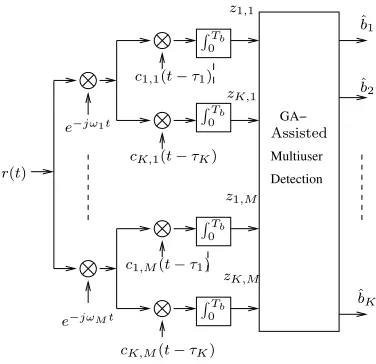
Figure 1: Schematic of the GA assisted MUD aided asyn-chronous MC-CDMA base station receiver.
When communicating over asynchronous environments, the received signal of MC-CDMA can be expressed as:
rm(t) = ∞
i=−∞
K
k=1
2Ebk
M ck,m(t−iTb−τk)γk,mb (i)
k e(jwmt+φk,m)
where τk is thekth user’s delay. Without loss of generality,
we assume that we have 0 ≤ τ1 < τ2· · · < τK < Tb, where
Ebkis thekth user’s signal energy per bit,bk(i)∈(1,−1), k=
1, . . . , Kdenotes theith transmitted bit of thekth user, while thekth user’s signature waveform isck,m(t), k= 1, . . . , K, m=
1, . . . , M on the mth subcarrier, which again has a length of N chips, and can be written as:
ck,m(t) = N−1
n=0
c(k,mn)p(t−nTc), m= 1, . . . , M, k= 1, . . . , K,
(1) where Tc is the chip duration, N is the number of chips per bit associated with each subcarrier and we have Tb/Tc =N. Again, the total processing gain isN M, whilep(t) is the rect-angular chip waveform employed, which can be expressed as:
p(t) =
1 0≤t < Tc
0 otherwise. (2)
Each user’s signal sk,m(t) transmitted on themth subcarrier is assumed to propagate over an independent non-dispersive single-path Rayleigh fading channel and the fading envelope of each path is statistically independent for all the users. Hence, the single-tap narrowband Channel Impulse Response (CIR) of the kth user on the mth subcarrier can be expressed as γk,mejφk,m, where the amplitudeγk,mis a Rayleigh distributed
random variable, while the phaseφk,mis uniformly distributed
between [0,2π).
Figure 1 shows the schematic of the GA assisted MUD aided asynchronous MC-CDMA base station receiver. As seen in Figure 1, the output of thekth user’s matched filter corre-sponding to themth subcarrier sampled at the end of theith symbol interval is given as:
z(k,mi) = −∞∞ r(t)ck,m(t−iTb−τk)dt. (3)
According to [18], the received signal vector Zm recorded
at the output of the bank of matched filters on the mth sub-carrier can be expressed as [18]:
Z(mi) = [z1,m, . . . , zK,m]
= Rm[1]WmAb(i−1)+Rm[0]WmAb(i)+ RTm[1]WmAb(i+1)+nm,
(4)
where we have
Cm = [c1,m(t), . . . , cK,m(t)]
Wm = diag[γ1,mejφ1,m, . . . , γK,mejφK,m]
A = diag[
2Eb1 M , . . . ,
2EbK M ]
b = [b1, . . . , bK]T
n = [n1, . . . , nK]T.
(5)
whereiis the time instant index and the zero-mean Gaussian noise vectornmhas the crosscorrelation matrix of:
E[n[i]nT[j]] =
σ2RT[1], if j=i+ 1; σ2R[0], if j=i; σ2R[1], if j=i−1;
0, otherwise.
(6)
The partial crosscorrelation matrix Rm[1] and the
cross-correlation matrix Rm[0] of the spreading codes, when com-municating over an asynchronous channel, are defined as [18]:
R(jkm)[0] =
1, ifj=k; ρ(jkm), ifj < k;
ρ(kjm), ifj > k,
(7)
R(jkm)[1] =
0, if j≥k; ρ(kjm), if j < k.
(8)
where the coefficientsρ(kjm)andρ(kjm)on themth subcarrier are
the pair of crosscorrelations of the spreading codes recorded in the asynchronous CDMA environment, which can be written as [18]:
ρ(jkm)=
Tb
τ cj,m
(t)ck,m(t−τ)dt (9)
ρ(kjm)=
τ
0 cj,m
(t)ck,m(t−τ+Tb)dt. (10)
According to Equation 4, the noise sample vectornmcan also be expressed as :
nm= Z(mi)−Rm[1]WmAb(i−1)
−Rm[0]WmAb(i)−RTm[1]WmAb(i+1). (11)
Hence, the objective function of the optimum ML detector on themth subcarrier can be expressed as:
Ωm(b(i)) = arg{ min
b(i−1),b(i),b(i+1)E[nm·nm T
]}. (12)
Hence, according to Equation 12, the GA’s objective metric for the mth subcarrier, which we have to maximize, can be expressed as:
Ωm(b(i)) = exp{− Zm(i)−Rm[1]WmAb(i−1)
−Rm[0]WmAb(i)−RTm[1]WmAb(i+1)2},
(13) where · denotes the Eucledian norm of a complex quantity expressed for the arbitrary variable v = a+jb as v = √
a2+b2.
Therefore, when combining the signals of theM subcarri-ers, the modified objective function becomes:
Ω(b(i)) = exp{−
M
m=1
Z(mi)−Rm[1]WmAb(i−1)
−Rm[0]WmAb(i)−RTm[1]WmAb(i+1)2}. (14) Therefore, for the sake of achieving the optimum performance, we have to maximize the metricΩof Equation 14. More ex-plicitly, the optimum decision concerning theK-dimensional Current Estimated Bit (CEB) vectorb(i) will maximize the crosscorrelation metric in Equation 14, provided that theK -dimensional Start Estimated Bit (SEB) vectorb(i−1)and the K-dimensional End Estimated Bit (EEB) vector b(i+1) are perfectly known to the receiver. However, in practice the re-ceiver is oblivious of the K-dimensional EEB vectors b(i+1) during the detection ofb(i), unless these are estimated based on pilot bits or training bits. Furthermore, theK-dimensional SEB vector b(i−1) is never perfectly known by the receiver, as a consequence of channel errors. Hence we have to in-voke appropriate strategies for finding reasonable choices of (b(i−1),b(i),b(i+1)) for the maximization of Equation 14. In the next subsection, we will describe four related strategies in detail.
2.1. Edge-bit Generation
scenario we may assume that the vector ˆb(i−1) is close to a perfect estimate. Let us now describe the four different edge-bit selection strategies in detail.
According to the first strategy (S1), the SEB vector b(i−1) will be set to the hard decision vector ˆb(i−1). Hence, in Equation 14 ˆb(i−1)will replace the vectorb(i−1)and hence we will maximize the following function:
Ω(b(i),bˆ(i+1)) = exp{−
M
m=1
Z(mi)−Rm[1]WmAbˆ(i−1) −Rm[0]WmAb(i)−
−RTm[1]WmAb(i+1)2},
(15) while the GA’s initial population is given by:
b(pi)(0) = MUTATION[ˆb(MRCi) ], (16)
bp(i+1)(0) = MUTATION[ˆbMRC(i+1)] p= 1, . . . , P; (17)
where the subscript pindicates the individuals’ index in the population of the GA, and (0) refers to the initial generation of the GA.
According to the second strategy S2, we also employ Equation 15 as the function to be maximized. However, in order to obtain a higher grade of diversity for the individuals of the GA invoked for finding the most likely K-dimensional vectorb(i), we randomly initialized theK-dimensional vector b(i) and hence the initial population associated with the 0th generation can be expressed as:
b(pi)(0) = ˆb(GAi), (18)
b(pi+1)(0) = MUTATION[ˆb(MRCi+1)]. (19)
The philosophical difference between Equations 16, 17 and Equations 18, 19 is that the MRC outputbiMRCused in
Equa-tion 16 for initializaEqua-tion has been replaced bybiGA, which is a randomly initalisedK-bit vector, subjected to no mutation.
¿From Equation 15 we can observe that it requires a GA as-sisted search for the best individual in a space of 22Kelements, which requires a larger population sizePand a higher number of generationY, than that necessitated by the search space of 2K elements required by the synchronous system which only has to consider aK-bit vector. According to thethird strat-egy S3, we will reduce the size of the search space having 22K elements to a search space of 2Kelements. This is achieved by invoking a hard decision both for the vectorb(i+1)and for the vectorb(i−1). Explicitly, according to strategy S3, the vectors b(i+1)andb(i−1)are given by:
b(i−1)= ˆb(i−1), (20)
b(i+1)= ˆb(MRCi+1). (21)
Furthermore, we randomly initialize the populationb(pi)(0) us-ing no mutation, which can be expressed as:
b(pi)(0) =b(GAi). (22)
Finally, according to ourfourth strategy S4, the vectors b(i+1) andb(i−1)are set to the same value as in the context of strategy S3 expressed in Equation 20 and 21. However, as in the context of the synchronous MC-CDMA system, we adopted biased initialization for creating the individuals of the initial population, where each bit of the MRC’s output vector
is toggled according to the mutation probability used. Hence, the initial generation for the vectorb(pi)(0) can be created
ac-cording to:
b(pi)(0) = MUTATION[b(MRCi) ]. (23)
Therefore, the objective function to be maximized for the strategies S3 and S4 can be expressed as:
Ω(b(i)) = exp{−
M
m=1
Z(mi)−Rm[1]WmAbˆ(i−1)
−Rm[0]WmAb(i)−RmT[1]WmAbˆ(MRCi+1) 2}. (24)
Create Mating Pool
Uniform Crossover
Mutation Binary
Fitness Value Evaluation
Elitism Fitness Value
Evaluation Start
Decision taken
End
Is Initialisation
S2:
S2:
S3:
S3:
S4: S4: S1:
S1, S2, S3 and S4:
S1:
y = y+ 1
y = 0
y = 1
y = Y ? ˆb(i−1)
p,SEB(0) = ˆb(i−1)
˜
b(p,EEBi+1) (0) = MUT AT ION[˜b(MRCi+1)]
˜
b(p,EEBi+1) (0) = MUT AT ION[˜b(MRCi+1)] ˜
b(pi)(0) = ˜b(GAi) ˜
b(i+1)
p,EEB(0) = ˆb(MRCi+1)
˜
b(p,EEBi+1) (0) = ˆb(MRCi+1) ˜
b(pi)(0) = ˜b(GAi) ˜
b(i)
p (0) = MUT AT ION[˜b(MRCi) ]
˜
[image:3.595.305.544.149.669.2]b(pi)(0) = MUT AT ION[˜b(MRCi) ]
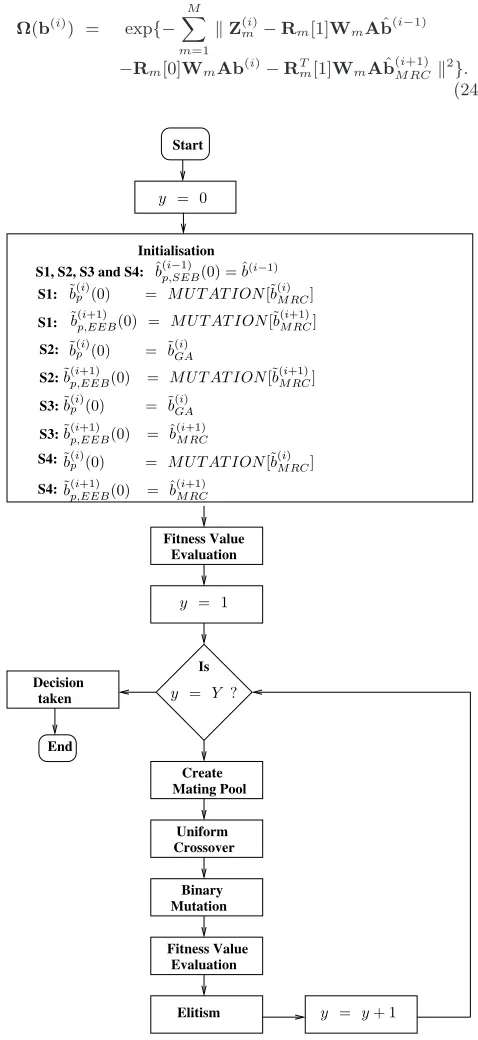
To elaborate a little further, Figure 2 shows the flowchart of the GA assisted MUD, which follows the philosophy of [3, 15, 16]. Having described the four different edge-bit generation strategies, let us now investigate their performance in the next section.
3. PERFORMANCE OF GA ASSISTED MUD AIDED ASYNCHRONOUS MC-CDMA
Parameters Value
Modulation scheme BPSK
Spreading code WALSH
Number of subcarriersM 4
subcarrier spreading gainN 8
Total spreading gainM N 32
GA’s selection method Fitness-proportionate
GA’s mutation method Standard binary mutation
GA’s crossover method Uniform crossover
GA’s mutation probabilitypm 0. 1 GA’s crossover probabilitypc 1
Mating pool sizeT 5
Elitism Yes
[image:4.595.316.545.48.228.2]Incest Prevention Yes
Table 1: The basic simulation parameters used by the GA assisted MUD aided MC-CDMA system
10-5 10-4 10-3 10-2 10-1 100
0 5 10 15 20
BER
Eb/N0 [dB] K=15
[image:4.595.47.295.151.304.2]single user S1 P=60 Y=10 S2 P=60 Y=10 S3 P=60 Y=10 S4 P=60 Y=10
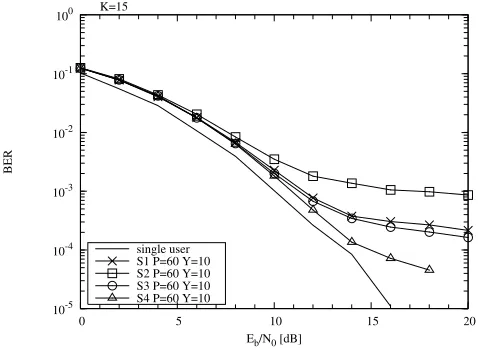
Figure 3: The GA assisted MC-CDMA MUD’s BER perfor-mance. Four different GA-aided edge-bit detection strategies were adopted for approaching the optimum MUD’s perfor-mance and the number of users supported was K = 15. The population size was P = 60 and the number of generations wasY = 10.
From Figure 3 we can observe that strategy S4 is capable of achieving a better performance than the other strategies. By studying this figure, we can infer that the biased initializa-tion strategies, namely S1 and S4 outperformed the random initialization strategies of S2 and S3.
Figure 4 shows the performance of the GA assisted MUD as a function of the number of generationsY. From this figure, we may conclude that strategy S4 converges fastest to the single-user performance.
10-4 10-3 10-2 10-1 100
1 2 3 4 5 6 7 8 9 10 11 12
BER
The Number of generations Y K=15
single user S1 P=60 S2 P=60 S3 P=60 S4 P=60
Figure 4: The GA assisted MC-CDMA MUD’s BER perfor-mance as a function of the number of generationsY. Four dif-ferent GA-aided edge-bit detection strategies were adopted for approaching the optimum MUD’s performance and the num-ber of users supported wasK= 15. The population size was P= 40.
¿From Figure 5 we can observe that the GA assisted MUD is capable of reducing the complexity imposed by a factor of 6×10¹⁰ in comparison to that of Verdu’s optimum MUD, when the number of usersK is 15, suggesting that the GA assisted MUD has the potential of significantly reducing the complexity of the optimum MUD.
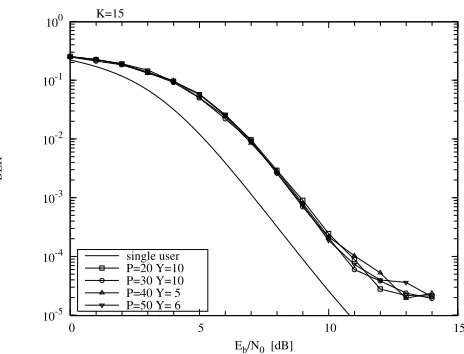
Finally, Figure 6 portrays the achievable BER performance in conjunction with R = 12 turbo codes. From this figure, we can observe that the system required a complexity on the order ofO(P·Y) =O(200) for approaching a near-single-user performance.
4. CONCLUSIONS AND FUTURE WORK
In conclusion, the GA assisted MUD is capable of significantly reducing the detection complexity in comparison to Verdu’s optimum MUD. Our future work will comparatively study the performance versus complexity trade-offs of GA versus M-Algorithm [19] based MUDs.
5. REFERENCES
[1] R. Prasad and S. Hara, “Overview of multicarrier CDMA,”IEEE Communications Magazine, pp. 126–133, December 1997.
[2] R. Prasad and S. Hara, “Overview of multi-carrier CDMA,” inProceedings of the IEEE International Sym-posium on Spread Spectrum Techniques and Applica-tions (ISSSTA), (Mainz, Germany), pp. 107–114, 22–25 September 1996.
[3] L. Hanzo, L. L. Yang, E. L. Kuan, and K. Yen,Single- and Multi-Carrier DS-CDMA. John Wiley and IEEE Press, 2003, 1060 pages.
[image:4.595.50.289.355.530.2]106 107 108 109 1010 1011
10 12 14 16 18 20
Factor of complexity reduction
[image:5.595.312.544.51.228.2]Number of users K
Figure 5: The complexity reduction factor of P23×KY was defined as the ratio of the number of objective function computations required for approaching the single-user bound at a BER of 10−3, in comparison to Verdu’s optimum MUD when commu-nicating over anasynchronousenvironment, whereP is the population size, and Y is the number of generations, whileK is the number of users supported.
[5] L. Hanzo, W. Webb, and T. Keller, Single- and Multi-carrier Quadrature Amplitude Modulation. John Wiley & Sons, Ltd, 1994.
[6] J. Bingham, “Multicarrier modulation for data transmis-sion: An idea whose time has come,”IEEE Communica-tions Magazine, pp. 5–14, May 1990.
[7] S. Weinstein and P. Ebert, “Data Transmission by frequency-division multiplexing using the discrete Fourier transform,” IEEE Transcations on Communications Technology, vol. 19, pp. 628–634, Oct 1971.
[8] S. L. Miller and B. J. Rainbolt, “MMSE Detection of Multicarrier CDMA,”IEEE Journal on Selected Areas in Communications, vol. 18, pp. 2356–2362, Nov 2000.
[9] P. Zong, K. Wang, and Y. Bar-Ness, “Partial Sampling MMSE Interference Suppression in Asynchronous Multi-Carirrer CDMA System,”IEEE Journal on Selected Ar-eas in Communications, vol. 19, pp. 1605–1613, August 2001.
[10] X. Gui and T. S. Ng, “Performance of Asynchronous Or-thogonal Multicarrier CDMA System in Freqencey Selec-tive Fading Channel,”IEEE Transactions on Communi-cations, vol. 47, pp. 1084–1091, July 1999.
[11] M. Schnell and S. Kaiser, “Diversity Considerations for MC-CDMA Systems in Mobile Communications,” in Pro-ceedings of IEEE ISSSTA 1996, pp. 131–135, 1996.
[12] D. E. Goldberg,Genetic Algorithms in Search, Optimiza-tion, and Machine Learning. ISBN 0201157675, MA USA: Addison-Wesley, August 2001.
[13] M. Mitchell, An Introduction to Genetic Algorithms. Cambrdige, Massachusetts: MIT Press, 1996.
[14] M. J. Juntti, “Genetic Algorithms for Multiuser Detection in Synchronous CDMA,”IEEE International Symposium on Information Theory, p. 492, 1997.
10-5 10-4 10-3 10-2 10-1 100
0 5 10 15
BER
Eb/N0 [dB] K=15
[image:5.595.51.290.55.228.2]single user P=20 Y=10 P=30 Y=10 P=40 Y= 5 P=50 Y= 6
Figure 6: BER performance of theS4 GA-assisted MUD de-signed for asynchronous MC-CDMA assisted byR = 12 rate, constraint lengthv= 4 turbo coding using 4 iterations, when the number of users supported wasK = 15. The number of generations wasY = 5, 6 or 10 and the population size was P= 20, 30, 40 and 50.
[15] K. Yen and L. Hanzo, “Hybrid Genetic Algorithm Based Multiuser Detection Schemes for Synchronous CDMA Systems,” in Proceedings 51st IEEE Vehicular Technol-ogy Conference, (Tokyo, Japan), pp. 1400–1404, 18 May 2000.
[16] K. Yen and L. Hanzo, “Genetic algorithm assisted joint multiuser symbol detection and fading channel estimation for synchronous CDMA systems,” IEEE Journal on Se-lected Areas in Communications, vol. 19, pp. 985 –998, June 2001.
[17] K. Yen and L. Hanzo, “Genetic Algorithm Assisted Mul-tiuser Detection in Asynchronous CDMA Communica-tions,” inProceedings of the IEEE International Confer-ence on Communications, vol. 3, pp. 826 –830, 2001. [18] S. Verd´u,Multiuser Detection. Cambridge Press, 1998.