A Space-Time Spreading Assisted Multicarrier DS-CDMA System Using OVSF Codes Employing
Adaptive Mode Switching Thresholds and Adaptive Modulation
H. Wei, L-L. Yang and L.Hanzo
1School of ECS, University of Southampton, SO17 1BJ, UK.
Tel: +44-23-8059-3125, Fax: +44-23-8059-4508
Email:lh
1@ecs.soton.ac.uk,
http://www-mobile.ecs.soton.ac.uk
Abstract
The Concept of Space-Time Spreading (STS) assisted, Adap-tive Quadrature Amplitude Modulation (AQAM) aided MC DS-CDMA is introduced. The AQAM mode-switching thres-holds are determined using an on-line real-time Bit-Error-Ratio (BER) based learning procedure. Four different sche-mes were studied, designed for maintaining a given target BER of10−2,10−3,10−4and10−5both with and without
turbo channel coding. The effect of using different number of STS antennas ranging from1to8was also characterized in terms of the achievable effective throughput, character-ising the associated system design trade-offs.
1. INTRODUCTION
Broadband mobile wireless communication systems aim for supporting a wide range of services and bit rates by employ-ing techniques capable of achievemploy-ing the highest possible spec-tral efficiency. For example, the system is expected to sup-port services, ranging from low bit rate speech communica-tions at 9.6kb/sto high bit rate video telephony at 2M b/s. Furthermore, one of the basic requirements expected to be sat-isfied by broadband mobile wireless systems is the provision of high bit rate wireless Internet services and the delivery of high-speed multimedia services. However, the system capacity and hence the achievable data rate of the wireless system is lim-ited by numerous factors, most severely by the bandwidth of the frequency-selective fading channel. In recent years, space-time coding has received much attention and as a result it has become one of the most prevalent technique of combating the time-varying characteristics of the fading channel. In order to circumvent the effects of fading, the employment of trans-mit diversity techniques, such as Space-Time Block Coding (STBC) [1] and Space-Time Trellis Coding (STTC) [1, 2] has been proposed. Both STBC and STTC incorporate channel coding, modulation, transmit diversity and optional receiver di-versity. Another transmit diversity technique using no channel coding is known as Space-Time Spreading (STS) [3,4]. Refer-ences [4,5] demonstrate that a substantial diversity gain can be
The financial support of the EPSRC, UK and the EU in the framework of the NEWCOM, NEXWAY and PHOENIX projects is gratefully acknowl-edged.
achieved by STS and this typically allows the throughout of the system to be increased. In [6] an attractive STBC based trans-mit diversity technique has been proposed for employment in W-CDMA systems.
In this contribution, we propose a novel STS assisted Multi-Carrier Direct Sequence Code Division Multiple Access (MC DS-CDMA) system for supporting a wide range of bit rates with the aid of advantageously combining Quadrature Ampli-tude Modulation (QAM) [7] and Orthogonal Variable Spread-ing Factor (OVSF) based DS spreadSpread-ing codes [8]. Since OVSF codes exhibit variableSpreading Factors(SF s), the transmit-ted bit rate can be adjustransmit-ted with the aid of differentSF s. More
specifically, when the number of activated users in a cell is low, the interference level experienced is also low, which requires a low spreading gain, and hence the users’SF scan be low.
Given a fixed bandwidth and chip rate, this enables the users to support high bit rates in comparison to the scenario of having to use highSF s.
Finally, turbo coding techniques are invoked in our system for enhancing the achievable BER versus SNR performance. As the number of turbo channel decoding iterations increases, the achievable BER versus SNR performance can be improved at the cost of an increased complexity.
Therefore, the achievable integrity and the bit rate sup-ported by this system is determined by the following factors:
• The specific value of theSF sused, which is determined
by the number of users supported within the cell consid-ered;
• The number of transmitter antennas;
• The number of bits conveyed by the QAM scheme used on each subcarrier, which is determined by the corre-sponding channel transfer factor of the channel at the specific subcarrier’s frequency and the corresponding trans-mitted power;
• The number of turbo decoding iterations, which is deter-mined by the affordable complexity.
S/P
Converter
STS
STS
STS
Data Bits
based OVSF
based OVSF
based OVSF QAM
QAM QAM
U
u=1
ηu·Lx
bk,11. . . bk,1η1Lx
bk,21. . .
bk,2η2Lx
bk,U1. . .
bk,U ηULx
Mk,11. . . Mk,1Lx
Mk,21. . .
Mk,2Lx
Mk,U1. . .
Mk,U Lx
cos(ω1t)
cos(ω1t)
cos(ω2t)
cos(ω2t)
cos(ωUt)
cos(ωUt) {Ck,1, Ck,2, . . . , Ck,Mx}
1
2
U
dk,11
dk,1Tx
dk,21
dk,2Tx
dk,U1
dk,U Tx
cos(2πfct) sk,1(t)
[image:2.595.49.288.51.190.2]sk,Tx(t)
Figure 1: Schematic of the transmitter
system. Finally, Section 5 offers our conclusions and outlines our future work.
2. SYSTEM OUTLINE
The system considered in this contribution is a STS [4] assisted MC DS-CDMA scheme [4] using U number of subcarriers,
and the space-time spreading scheme hasTxtransmitter anten-nas, but only a single receiver antenna is invoked. Furthermore, in this contribution a synchronous MC DS-CDMA scheme de-signed for the downlink channel is investigated, whereK user
signals are transmitted synchronously. The transmitter schematic of thekth user is shown in Figure 1, where the transmission of complex data symbols using QAM modulation and real-valued spreading [4] were considered. As shown in Fig.1, at
the transmitter a block of U
u=1
ηu·Lxnumber of data bits
hav-ing a bit duration of Tb is S-P converted to U parallel sub-blocks, where ηu is the number of Bits Per Symbol (BPS) transmitted by the QAM scheme on the uth subcarrier and Lx is the number of QAM symbols per space-time spread-ing sub-block. For example, if BPSK and 64QAM are in-voked on theuth subcarrier, the corresponding value ofηuwill be 1 and6, respectively. Hence, each space-time spreading sub-block hasηuLxdata bits, generatingLxmodulated sym-bols given by{Mk,u1, . . .Mk,uLx}. These modulated
sym-bols are space-time spread using the schemes of [3, 4] with the aid ofMxnumber of OVSF spreading codes, for example by
{ck,1(t), . . . , ck,Mx(t)},k = 1,2, . . . , K and mapped toTx
number of transmitter antennas. Since the bits to be transmit-ted are mapped to the multi-bit QAM symbols as well as to
Tx number of transmit antennas, the symbol duration of the STS signals is expanded toU LxTb, and the number of chips of the OVSF codes becomesU LxTb/Tc=U LxN, where we have N = Tb/Tcand Tc represents the chip-duration of the orthogonal spreading codes. The orthogonal codes assume the
form ofck,i(t) =
U LxN−1
j=0
ck,i[j]PTc(t−jTc), whereck,i[j]∈
{+1,−1}and they obey the relationship of U LxN
l=0
ci,m[l]cj,n[l] = 0, whenever we havei = jorm = n. Furthermore,PTc(t)
represents the chip waveform defined over the interval of[0, Tc). Since the maximum available number of the OVSF codes hav-ingU LxNchips isU LxNand each user requiresMxnumber of OVSF codes, the maximum number of users supported by these orthogonal codes is Kmax = U LxN/Mx. As seen in Fig.1, following STS, each STS block generatesTxnumber of parallel signals to be mapped to theTxnumber of transmitter antennas. Finally, as shown in Fig.1, the Inverse Fast Fourier Transform (IFFT) is invoked for carrying out multicarrier mod-ulation [4], and the IFFT block’s output signal is transmitted using one of the transmitter antennas.
Thekth user’s transmitted signal corresponding to theTx transmitter antennas can be expressed in a complex form as
sk(t) =
2Eb
U Tb 1
MxTx
[CkBk]Tw×cos(j2πfct), (1)
whereEb/U Tbrepresents the transmitted power per subcarrier expressed as LxEb/U LxTb = Eb/U Tb, while the factor of
MxTxrepresents STS usingMxorthogonal OVSF codes and
Tx transmitter antennas. Furthermore,Ck is a(U×U Mx) -dimensional matrix [4] constituted by the OVSF codes, while Bkis a(U Mx×Tx)-dimensional matrix [3, 4] mapping theU sub-blocks of QAM symbols to space-time spreading symbols. Assuming thatKuser signals expressed in the form of (1)
are transmitted synchronously over single-path Rayleigh fad-ing channels, the received complex-valued low-pass equivalent signal can be expressed as:
R(t) = K
k=1
Tx
g=1
2Eb
U Tb 1
MxTx
[CkBk]T
gHw+N(t), (2) whereH = diag{h1gexp(jψ1g), . . . , hU gexp(jψU g) repre-sents the channel’s complex impulse response in the context of thegth antenna and the coefficientshig, i= 1,2, . . . , U; g= 1,2, . . . , TxinHare independent identically distributed (i.i.d) random variables obeying the Rayleigh distribution.
After de-spreading, the output SNR of the receiver [4]
be-comesEb
N0
Tx
l=1 h2ul.
3. ADAPTIVE QAM AND STS ASSISTED MC DS-CDMA
3.1. Mode-Switching Threshold of AQAM
NoTx BPSK QPSK 16QAM 64QAM
10−2 −∞ 3.31dB 6.48dB 11.61dB 17.64dB
[image:3.595.319.528.48.178.2]10−4 −∞ 7.98dB 10.42dB 16.76dB 26.33dB
Table 1: Optimized AQAM mode switching levels quoted from [10], which were devised for adaptive modulation, when communicating over slowly-fading narrowband Rayleigh fad-ing channels at target BERs of10−2and10−4.
for all the symbols in a transmission burst, more specifically, that the channel’s fading envelope varied slowly across the transmission burst. Under these conditions, all the transmit-ted symbols were modulatransmit-ted using the same modulation mode, chosen according to the predicted SNR. Torranceet al. [10] optimized the modem mode switching thresholds for the tar-get BERs of10−2 and10−4, which was deemed appropriate
for a high-BER speech system and for a low-BER data system, respectively.
The resultant SNR switching thresholds optimized for ac-tivating a given modulation mode in a slowly Rayleigh fading narrowband channel are given in Table 1 for the target BERs of 10−2and10−4. Specifically, a given modulation mode is
selected, if the instantaneous channel SNR perceived by the receiver exceeds the corresponding switching levels shown in Table 1, depending on the target BER.
Furthermore, we considered a practically-motivated AQAM mode switching approach, which is based on the philosophy of learningthe switching thresholds [11] in an on-line fash-ion so that the system becomes capable of maximizing the achievable throughput expressed in terms of Bits Per Symbol (BPS). This learning scheme does not utilize the thresholds de-signed by Torrance and Hanzo [10] using Powell’s optimiza-tion, which were summarized in Table 1. The learning-based scheme also refrains from using analytically optimised switch-ing thresholds [9], or any other assumptions concernswitch-ing the op-erating environment. The only information required by Tang’s scheme [11] is the current estimated BERpe(γ)(or the Frame Error Ratio (FER)) and the target BERPthof the system. The basic philosophy is that when the current BERpe(γ)is lower than the target BERPth, this indicates that the system is ca-pable of improving the achievable BPS throughput and hence it will reduce the switching thresholds for the sake of max-imizing the throughput. By contrast, when the current BER
pe(γ) is higher than the target BERPth, then the system is overloaded by bit errors and hence the algorithm will increase the switching thresholds for the sake of reducing the system’s throughput.
In our investigations, we considered a five-mode AQAM scheme having the threshold set of s = {s1, s2, s3, s4}
de-signed for BPSK, QPSK, 16QAM, 64QAM, respectively. For the sake of simplicity, we assumed that the AQAM threshold difference(s2−s1),(s3−s1),(s4−s1)between the
differ-ent modulation schemes was the same as in Torrance’s scheme, and we denoted them by21,31,41, respectively. In other
words, once we obtained the switching thresholds1, we knew
-5 0 5 10 15 20
0 10 20 30 40
Sw
itc
hi
ng
Thres
hol
ds
[dB
]
SNR [dB]
Tx= 1 Pth= 10−2
BPSK QPSK 16QAM 64QAM
Figure 2: The learning based switching thresholds adjusted for maintaining the target BER ofPth= 10−2, when using a step-size ofµ=0.001.
all the switching thresholds. Similarly, once we adjusted the switching thresholds1, all the other switching thresholds
con-sidered were adjusted. Controlling the thresholds1is based
on the current BER performancepe(γ), where the switching thresholds can be adaptively updated as follows [11]:
s1(t) = s1(t−1) +µ·sign[pe(γ)−Pth],
s2(t) = s1(t) +21, s3(t) = s1(t) +31,
s4(t) = s1(t) +41, (3)
and where0< µ <1is the threshold control step-size. Even
though the AQAM mode-switching thresholds of Table 1 were originally derived for narrow-band time-domain Rayleigh fad-ing , they were also used for frequency-domain AQAM-aided OFDM transmissions, since the frequency domain fading is also Rayleigh distributed. Hence the algorithm is initialized using the AQAM thresholds of Table 1, and then producing the thresholds seen in Figure 2 after the completion of the ini-tial learning phase. Perfect estimation of the current BER was assumed, although in practice the accurate estimation of the short-term ’in-burst-BER’ of a transmission burst is a chal-lenging task, as it was exemplified in [9]. This issue requires further research.
4. PERFORMANCE OF AQAM AND STS ASSISTED MC DS-CDMA
Figure 2 shows the evolution of the switching thresholds versus channel SNR required for maintaining the target BER ofPth= 10−2. We can observe that the switching thresholds are close
to those proposed by Torrance and Hanzo in [10] in the SNR range of0−20dB, which were summarized in Table 1.
0.0 0.1 0.2 0.3 0.4 0.5 0.6 0.7 0.8 0.9 1.0
0 5 10 15 20 25 30 35 40
Select
Pr
ob
ab
ality
SNR
Tx= 1 Pth= 10−2
[image:4.595.308.544.52.219.2]NO TX BPSK QPSK 16QAM 64QAM
Figure 3: The mode selection probability of the learning-based switching threshold aided AQAM scheme at a target BER of
Pth= 10−2.
10-5 10-4 10-3 10-2 10-1 100
0 5 10 15 20 25 30 35 40 0 1 2 3 4 5 6
BER BPS
Eb/N0 Hollow: Fixed TH
Filled: Adaptive TH Tx=1
Tx=2 Tx=4 Tx=8 BER BPS
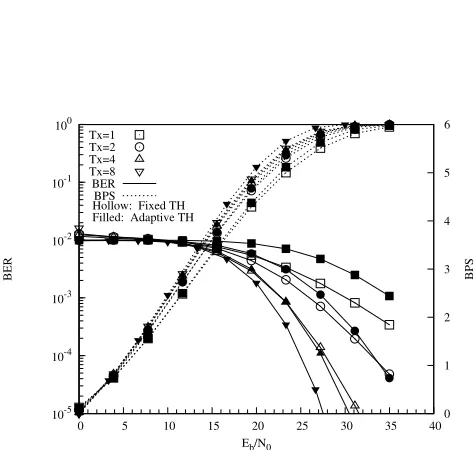
Figure 4: BER and BPS performance of AQAM aided MC DS-CDMA. The fixed switching thresholds (TH) used are shown in Table 1, while the adaptive learning-based thresholds are portrayed in Figure 2, which were adjusted for maintaining the target BER ofPth= 10−2. No channel coding was employed.
10-7 10-6 10-5
10-4 10-3 10-2
10-1 100
0 5 10 15 20 25 30 35 40 0 1 2 3 4 5 6
BER BPS
Eb/N0 Hollow: Fixed TH
Filled: Adaptive TH Tx=1
[image:4.595.65.274.96.229.2]Tx=2 Tx=4 Tx=8 BER BPS
[image:4.595.50.288.345.570.2]Figure 5: BER and BPS performance of AQAM aided MC DS-CDMA. The fixed switching thresholds (TH) used are shown in Table 1, which were adjusted for maintaining the target BER ofPth= 10−4, and no channel coding was employed.
Figure 4 shows the BER performance and BPS through-put of this system, when both the fixed switching thresholds seen in Table 1 and the adaptive thresholds of Figure 2 were employed for maintaining the target BER of Pth = 10−2. By contrast, Figure 4 shows the BER performance and BPS throughput of these systems, when maintaining the target BER ofPth = 10−4. From these two figures we can observe that in the high-SNR region the learning based threshold adjust-ment scheme exhibited a slightly better throughput than the fixed threshold based scheme of Table 1. This is because at high SNRs the switching thresholds of Figure 2 are reduced by the algorithm for the sake of increasing the achievable BPS throughput by promoting the employment of the high-throughput AQAM modes without any danger of jeopardizing the target integrity.
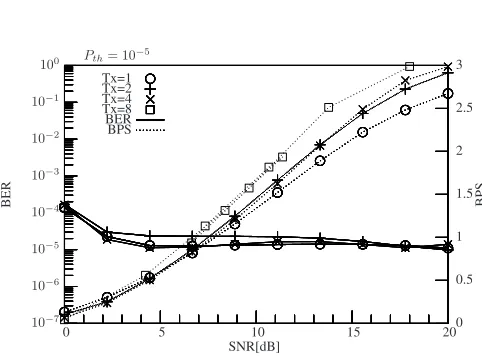
In Figure 6 and Figure 7 we will consider the performance of learning-based switching thresholds in conjunction with turbo coded AQAM MC DS-CDMA techniques, where the initial switching thresholds for BPSK, QPSK, 16QAM, 64QAM were 1.46dB, 3.46dB, 7.46dB, 11.46dB, respectively. Figure 6 il-lustrates the achievable BER and BPS performance, when the system maintains a target BER of10−3. By contrast, Figure 7
portrays the attainable BER and BPS performance, when main-taining a target BER of10−5. Observe in Figure 7 that the
sys-tem required an SNR of about9dB for achieving a throughput of 1 BPS, while the system of Figure 6 designed for maintain-ing a BER of10−3necessitated an SNR of only about6dB for
maintaining the same throughput.
5. CONCLUSION
DS-10−5
10−4
10−3
10−2
10−1
100
0 5 10 15 200
0.5 1 1.5 2 2.5 3
BE
R
BPS
SNR[dB]
Pth= 10−3
[image:5.595.50.290.98.255.2]Tx=1 Tx=2 Tx=4 Tx=8 BER BPS
Figure 6: BER and BPS performance of AQAM aided MC DS-CDMA performance in conjunction with half-rate turbo chan-nel coding, the learning based switching thresholds, which were adjusted for maintaining the target BER ofPth= 10−3,
10−7
10−6
10−5
10−4
10−3
10−2
10−1
100
0 5 10 15 200
0.5 1 1.5 2 2.5 3
BE
R
BPS
SNR[dB]
Pth= 10−5
Tx=1 Tx=2 Tx=4 Tx=8 BER BPS
Figure 7: BER and BPS performance of AQAM aided MC DS-CDMA performance in conjunction with half-rate turbo channel coding, and the learning based switching thresholds are adjusted for maintaining the target BER ofPth= 10−5.
CDMA. The system considered is capable of supporting multi-ple bit rates by employing OVSF spreading codes and adaptive threshold-learning assisted AQAM. It was demosntrated that as the channel quality improves, the achievable throughput is increased, while maintaining the target BER. Increasing the number of transmit antennas used by the STS scheme is ben-eficial in terms of reducing the channel quality fluctuations, but the associated ibncreased complexity may be more bene-ficially exploited by by using the extra antennas for creating additional spatially multiplexed channels, rather than for mit-igating the effects of fading. Analysing these aspects in more detail constitutes the subject of our further research.
6. REFERENCES
[1] L. Hanzo, T. H. Liew, and B. L. Yeap,Turbo Coding, Turbo Equalisation and Space-Time Coding for Transmission over Fading Channels. John Wiley-IEEE Press, 2002.
[2] A. F. Naguib, V. Tarokh, N. Seshadri, and A. R. Calderbank, “A space-time coding modem for high-data-rate wireless commu-nications,”IEEE Journal on Selected Areas in Communications, vol. 16, pp. 1459–1478, October 1998.
[3] B. Hochwald, T. L. Marzetta, and C. B. Papadias, “A Trans-mitter diversity scheme for wideband CDMA systems based on Space-time spreading,”IEEE Journal on Selected Areas in Com-munications, vol. 19, pp. 48–60, January 2001.
[4] L. Hanzo, L. L. Yang, E. L. Kuan, and K. Yen,Single- and Multi-Carrier DS-CDMA. John Wiley and IEEE Press, 2003,
1060 pages.
[5] S. M. Alamouti, “A simple transmit diversity technique for wire-less communications,”IEEE Journal on Selected Areas in Com-munications, vol. 16, pp. 1451–1458, October 1998.
[6] Proposed TDOC: 662/98 to ETSI SMG2 UMTS Standards,
Space-time block coded transmit antenna diversity for WCDMA,
December 1998.
[7] L. Hanzo, W. Webb, and T. Keller,Single- and Multi-carrier Quadrature Amplitude Modulation. John Wiley & Sons, Ltd, 2000.
[8] E. H. Dinan and B. Jabbari, “Spreading Codes for Direct Sequence CDMA and Wideband CDMA Cellular Networks,”
IEEE in Communications Magzine, pp. 48–54, Sept 1998.
[9] L. Hanzo, C. H. Wong, and M. S. Yee, Adaptive Wireless Transceiver. John Wiley, 2001.
[10] J. Torrance and L. Hanzo, “Optimisation of switching levels for adaptive modulation in a slow Rayleigh fading channel,” Elec-tronics Letters, vol. 32, pp. 1167–1169, 20 June 1996.
[image:5.595.49.290.406.584.2]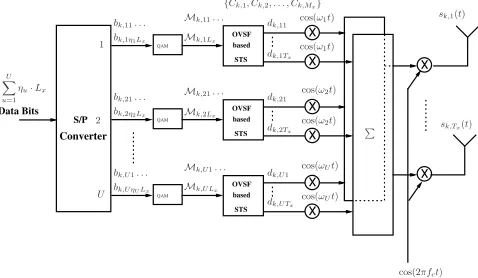
![Table 1: Optimized AQAM mode switching levels quotedfrom [10], which were devised for adaptive modulation, whencommunicating over slowly-fading narrowband Rayleigh fad-ing channels at target BERs of 10−2 and 10−4.](https://thumb-us.123doks.com/thumbv2/123dok_us/8514688.351176/3.595.319.528.48.178/optimized-switching-quotedfrom-modulation-whencommunicating-narrowband-rayleigh-channels.webp)