An Agent Construction Model for Ubiquitous
Computing Devices
Ronald Ashri and Michael Luck
Dept of Electronics and Computer Science, Southampton University, Southampton, UK
Abstract. One of the main challenges for the successful application of agent-based systems in mobile and embedded devices is enabling application develop-ers to reconcile the needs of the user to the capabilities and limitations of agents in the context of environments with changing and often limited resources. In this paper we present an attempt to move towards a solution through a frame-work for defining and reasoning about agents in a manner that is modular and reconfigurable at run-time. Departing from the theoretical basis afforded by the SMART framework, we extend it to enable the definition of fully re-configurable component-based agents. The guiding principles of this approach are an architecturally-neutral model that supports a separation between the description, behaviour and structure of an agent.
1
Introduction
The spread, and rise in influence of, embedded and mobile devices with limited compu-tational power, which have found favour in many aspects of everyday life, from mobile phones to personal digital assistants (PDAs), provides a counterpoint to the tradition of desktop computing. In line with this profile, there is also an increasing demand for integrating the various different kinds of such devices in order to provide an environ-ment where access to information and services is available in a seamless manner, while transcending physical location and computing platform.
Agent-based systems have a key role role to play in the effort to provide and support such integration, since agents embody several of the required characteristics for effec-tive and robust operation in ubiquitous environments [4, 12]. A central area of concern for supporting agents operating in such heterogeneous environments, which place dif-fering and varying demands and limitations on them, is the development of appropriate agent architectures for the device and environment within which they are operating. We identify below three specific challenges for the development of architectures in such environments.
– The heterogeneity of operating environments and devices makes it practically
representation of beliefs. Instead, we should enable developers to create solutions that are tailored to specific devices and application domains, without constraining them to specific architectural approaches.
– The necessity to have multiple types of agent architectures, while providing the
required level of flexibility, also introduces new challenges since it increases the overall complexity of the system design. A multiplicity of architectures also makes it more challenging to choose the best for a specific situation.
– Finally, the agent architecture should be able to deal with the unpredictable nature
of computing devices and the environments they operate in. For example, devices may stop operating due to power failure but it is important that agents are able to keep some information about their state when the device is restarted.
In this paper, we address just these issues by presenting a model for agent con-struction that is conceptually grounded and architecturally neutral. It is conceptually grounded by the understanding of agent systems provided through SMART [10] and it is architecturally neutral because a number of different agent architectures can be expressed through the constructs provided. Through this agent construction model we advance the current state of the art for agent-oriented software engineering in three ways. Firstly, we provide an agent construction model that addresses the specific needs of agent construction on mobile devices. Secondly, through the implementation of the model we identify some specific techniques that can be used for adapting to changes in device capabilities and operating environments. Finally, as a result of this work we identify some more generalised features that can inform the construction of agents in other settings beyond ubiquitous computing.
We begin by introducing a series of desiderata that our agent construction model should fulfil, and then outline some of the key design decisions that guide its develop-ment as well as clarify its position with the context of application developdevelop-ment. Subse-quently, the agent construction model itself is presented followed by a discussion of its implementation for devices supporting the Java 2 Micro Edition. Finally, we conclude and compare our approach to others.
2
Design Principles
2.1 Desiderata for an agent construction model
In order to address the range of concerns raised above and provide some statement of re-quirements for the agent construction model, we identify four desiderata. Although the set is not exhaustive, we consider it to be the minimum necessary set of requirements.
Abstract Agent Model An agent construction model that addresses the issues raised
Architecturally neutral The construction model should not lead to the construction
of only a limited range of agent types, but should allow the widest possible range of architectures to be defined using the same basic concepts. In order to achieve this, there are two possible avenues to explore. One option is to define a generic agent architecture and describe other architectures in terms of this generic architec-ture, something that Bryson et al. suggest [6]. Apart from the inherent difficulty in constructing any general, all inclusive model, the drawback of this approach is that there may be features of other architectures that cannot directly be translated to the generic one. The second option is to provide an architecturally-neutral model, so as to avoid this translation problem. Here, the challenge is to provide a model that is specific enough so that it actually offers something to the construction of agents, but general enough to support the development of a wide range of architec-tures. Through an appropriate architecturally-neutral model we can view a range of architectures based on a common understanding of agents and without losing expressive capability.
Modularity The model should allow for modular construction of agents. This is
nec-essary both in order to meet general software engineering concerns and to delineate clearly the different aspects of an architecture. As discussed in Section 2.3, our approach calls for a separation between describing agents in terms of their charac-teristics, their structure and their behaviour. Such a fine-grained approach can lead to a better understanding of the overall functioning of the agent as well as how it can be altered, since the different aspects of the architecture are clearly identified and the relationships between them made explicit.
Run-time reconfiguration The reality of current computing environments is that changes
are often required as the system is running. With large systems that can contain dy-namic, complex dependencies between various parts, it is crucial to be able to re-configure agents at run-time. Reconfiguration may mean providing more function-ality to an agent or changing the way it behaves in order to better meet application requirements.
2.2 SMART
The agent construction model is based onSMART[10] (Structured, Modular Agent Re-lationships and Types), which provides us with the foundational agent concepts that allow us to reason about different types of agents, and the relationships between them, through a single point of view. We choseSMARTbecause it provides us with the appro-priate agent concepts without restricting us to a specific agent architecture. Furthermore,
SMARThas already been successfully used to describe several existing agent
architec-tures and systems (e.g. [8, 9]).
represent desirable states of the environment for the agent. On top of this basic concept of an agent,SMARTadds the concept of an autonomous agent as an agent that generates its own goals through motivations, which drive the generation of goals. Motivations can be preferences, desires, etc., of an autonomous agent that cause it to produce goals and execute actions in an attempt to achieve those goals.
This approach to agent description fits well with our requirement for architecture neutrality but does not sufficiently address our requirements for modularity and run-time reconfiguration. In Section 2.3 we discuss how the descriptive capabilities of
SMARTare enhanced to cope with these requirements.
2.3 Description, Structure and Behaviour
WhileSMARTis suitable for describing agents, it lacks the necessary features for con-structing agents. For the purposes ofSMART, this was not a problem since the intended
purpose was to provide a theoretical framework that would allow the description of a number of different agent systems. However, for our purposes it is crucial to be able to provide tools that facilitate the construction of agent architectures. Nevertheless, we do not want to replace the descriptive capabilities ofSMART, since they offer some useful features as discussed above. Rather, we complement them with the additional aspects, which are identified below.
SMARTallows systems to be specified from an observer’s point of view. Agents are
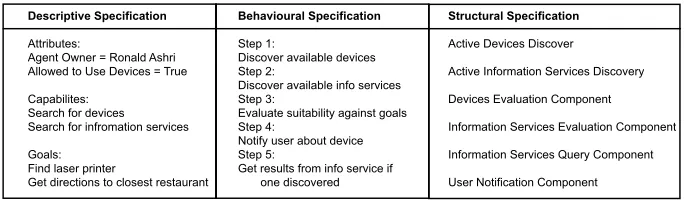
described in terms of their attributes, goals or actions, not in terms of how they are built or how they behave. In other words, the focus is on the what and not the why or how. We call this a descriptive specification, since this essentially describes a situation without analysing its causes nor the underlying structures that sustain that situation. However, these are just the issues we need to address within a construction model. Therefore, along with the descriptive specification we need to have the ability to specify systems based on their structure, i.e. the individual building blocks that make up agents, as well as their behaviour. We call these other views the structural specification and the behavioural specification, respectively.
The structural specification enables the identification of the relevant building blocks or components of an agent architecture. Different sets of building blocks and different ways of connecting them can enable the instantiation of different agent types. By con-trast, the behavioural specification of an agent addresses the process through which the agent arrives at such decisions as what actions to perform. These specifications, along with the descriptive specification, provide a more complete picture of the system from different perspectives. It is interesting to note that it is possible to begin from any one of these views and derive the remaining two, but the correspondence is not one to one. Several behavioural and structural specifications could satisfy a single descriptive spec-ification and vice-versa.
Descriptive Specification Behavioural Specification Structural Specification
Attributes: Step 1: Active Devices Discover Agent Owner = Ronald Ashri Discover available devices
Allowed to Use Devices = True Step 2: Active Information Services Discovery Discover available info services
Capabilites: Step 3: Devices Evaluation Component Search for devices Evaluate suitability against goals
Search for infromation services Step 4: Information Services Evaluation Component Notify user about device
Goals: Step 5: Information Services Query Component Find laser printer Get results from info service if
[image:5.595.137.479.115.215.2]Get directions to closest restaurant one discovered User Notification Component
Fig. 1. Distinguishing between description, structure and behaviour
agent belongs to a user, has certain right with regards to accessing devices and services in the conference room, has the goals of printing an overview of the user’s presentation and finding out where the closest restaurant is, and so forth. A behavioural specification may state that this agent begins its operation by collecting information about available devices and services, then filters for those that are best suited to the user’s goals, and de-cides whether to inform the user about them or interact directly with them to achieve the goal. A structural specification may state that the agent has different components, each able to handle specific functionalities such as searching for Bluetooth-enabled devices, communicating with information services or directory agents, and so forth. The differ-ent aspects are illustrated in Figure 1. This separation between the differdiffer-ent views allows us to change some aspects without necessarily impacting on the others. For example, the behaviour could be altered so that the agent reports on the first device that fits the required profile, rather than attempting to find the best one. The structural specification could also be based on a tightly integrated control loop rather than a component-based approach.
The agent construction model reflects these levels by allowing direct access to these different aspects of agents, based on a clear decoupling at the architectural level.
2.4 Component-Based Construction
In order to support the division of an architecture’s different aspects as described above, and satisfy the requirement for modularity and re-configurability, we take a component-based view of agent architectures.
Component-based software engineering is a relatively new trend in software en-gineering [7, 11]. Separate developments within the fields object-oriented computing, usable software code, formal methods, and modeling languages have all steered re-search towards a component-based approach [16]. Components are understood as units of composition that can be deployed independently from each other, while a third-party coordinates their interactions [18]. Interaction with a component takes place through a well-defined interface, which allows the implementation of the component to vary independently of other aspects of the system.
different functionalities and allows for their re-use in alternative contexts. Secondly, different types of components can be composed in a variety of ways to achieve the best results for the architecture at hand. Finally, by connecting the abstract agent model of
SMARTto component-based software engineering we bring it much closer to practical
development concerns within a paradigm that is not foreign to developers.
2.5 FromSMART+ to Applications
SMART actSMART Architectures
[image:6.595.250.360.234.279.2]Domain SupportApplications increasingabstraction
Fig. 2. FromSMART+ to applications
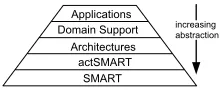
In this section we clarify the relationships between the agent construction model which, from now on, we will refer to as actSMART, the abstract agent modelSMART, and the application level. These clarifications serve to indicate how the work presented here can be used within the context of the agent development process.
The relationships are illustrated in Figure 2. At the most abstract level liesSMART. Then, actSMART represents an extension of SMART to deal with the construction of agents. Architectures for agents, which can range from application-independent archi-tectures, such as BDI, to application-specific archiarchi-tectures, can thus be designed using the framework provided by actSMART, and based on the concepts provided bySMART. We should note that generic architectures are not always required and may not always be advisable. For example, an agent dedicated to dealing with requests for quotes on fast-changing financial information, where performance optimisation is crucial, would benefit from a basic architecture tailored to that situation. Conversely, agents expected to deal with a variety of changing tasks and complex interactions with other agents, such as sophisticated negotiations, might benefit from a more generic and sophisticated de-liberative architecture. One of the benefits of our approach is that while it distinguishes between the different cases, it can still consider them within the same conceptual and practical framework.
The next level is domain-specific support, which involves choosing appropriate mid-dleware to support agent discovery and interactions between agents in the specific dis-tributed environments in which the applications will operate, as well as other com-ponents that could supplement agent capabilities. Finally, specific applications can be built, making use of all the layers below.
3
Components
as the structural representations of one or more related agent functionalities, which are considered at two different levels. At an abstract level, the functionality is described in generic terms, which we will present shortly. At the implementation level, the ab-stract functionality is instantiated through the actual mechanisms that support it. The reason for distinguishing between these different levels is so that we can use generic component types to specify an agent architecture at a high level of abstraction without making direct reference to the detailed behaviour of each component. This allows us to move between the different levels while retaining a good understanding of the overall architecture, and identifying which specific components best suit each of the generic functionalities.
ActiveDevices Discovery (Sensor)
InformationServices Discovery (Sensor)
UserGoals (InfoStore) DeviceEvaluation
(Controller)
InformationService Evaluation (Controller)
UserNotification (Actuator)
UserInput (Sensor)
ServiceQuery (Actuator)
[image:7.595.193.422.271.405.2]InfoServiceReplies (Sensor)
Fig. 3. Example Agent Architecture
Generic Component Types From here on, we set out the terms that can be used to
describe components at an abstract level. We begin by dividing components into four generic types, each one representing a class of functionality for the agent.
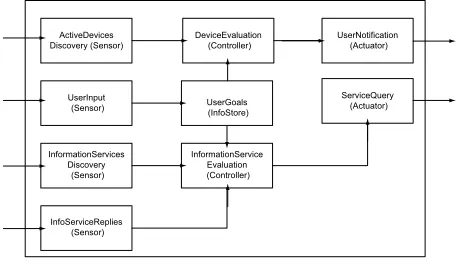
We use the example architecture illustrated in Figure 3 to explain each generic com-ponent type. The diagram presents an architecture for an agent, based on the example discussed in Section 2.3.1 The domain specific functionality of components is as
fol-lows. Information about available devices and information services is collected by the ActiveDevicesDiscovery and InformationServicesDiscovery components. The user pro-vides information through the UserInput component, which defines the goals of the user. These goals are stored in the UserGoals component. Based on these goals the De-viceEvaluation and the InformationSerDe-viceEvaluation components choose which of the devices and services are relevant to the user. Information services are queried through the ServiceQuery component and replies are received by the InfoServiceReplies com-ponent. Finally, the user is notified about relevant devices and replies from information services through the UserNotification component.
1Note that while this architecture is sufficient for illustrating the agent construction model and
The generic functionality of the components can be divided into information col-lection (sensors), information storage (infostores), decision-making (controllers) and finally those directly able to effect change in the environment (actuators). These four generic types of components, described in more detail below, can be used to describe a wide range of agent architectures and fit particular well to the context of ubiquitous devices, where there is clear distinction between the external environment to the device and the agent itself.
– Controllers are the main decision-making components in an agent. They analyse
in-formation, reach decisions as to what action an agent should perform, and delegate those actions to other components.
– Sensors are able to sense environmental attributes, such as signals from the user or
messages received from other agents. They provide the means through which the agent gains information from the environment.
– Actuators cause changes in environmental attributes by performing actions. – Infostores are components whose main task is that of storing information. Such
information could be anything from the beliefs of an agent about the world, to plans, to simply a history of the actions an agent has performed or a representation of its current relationships.
Component Statements The internal operation and structuring of components,
irre-spective of their type, is divided into a functionally-specific part and a generic part. In this subsection, we describe the generic part that is common to all components, and out-line how and what types of information components can exchange, before describing how that information is processed by a component.
Each component accepts a predefined set of inputs and produces a predefined set of outputs. A component generates an output either as a direct response to an input from another component, a signal from the environment or an internal event. For ex-ample, a a sensor component attached to a thermometer may produce an output every five minutes (based on an internal clock), or when the temperature exceeds a certain level (an external signal) or when requested from another component (response to other component).
In actSMART, inputs and outputs share a common structure; they are statements, which have a type and a body. The body carries the main information (e.g., an update from a sensor), while the type indicates how the information in the main body should be treated. We make use of three types of statements, described below.
– INFORM-type statements are used when one component simply passes information
to another component. In order for one component to inform another of something, it must be able to produce theINFORM-type statement as an output and the other must be able to accept it as an input.
– REQUEST-type statements are used when one component requires a reply from
– EXECUTE-type statements are used to instruct another component to execute a spe-cific action. Typically, controller components send such statements to actuators so that changes can be effected in the environment.
The information within a statement’s body is, in its most general form, is described through attributes, as per the definitions given in Section 2.2. Attributes can be di-vided along the lines of architecture-specific attributes and domain-specific attributes. Architecture-specific attributes are attributes that are only relevant within the internal scope of an agent architecture. For example, a BDI-based architecture could define at-tributes such as plans, beliefs, intentions and so forth.2Architecture-specific attributes can be though of as defining the internal environment of an agent. Domain-specific at-tributes define features that are relevant to the environment within which the agent is operating. So in the case of the example above it may include features such as device name, location, and so forth. Generic agent architectures, such as BDI-based will typi-cally make use of both types of attributes, including domain specific attributes within the architecture-specific attributes. So a plan may prescribe an action to contact a service, as identified by its service name. The components of an AgentSpeak(L) architecture could then manipulate plans and beliefs, and have some generic mechanisms to manipulate the domain-specific attributes. However, a developer may also choose to develop an agent that has no architecture-specific attributes, creating components that can directly manipulate domain-specific attributes.
while active and not executing do listen for statements
if statements received then store statements
if call to execute then
retrieve stored statements while stored statements not empty do if INFORM then
update relevant attributes if REQUEST then
retrieve relevant attributes create INFORM statement push statement to outbound stack if EXECUTE then
push statement to execution stack
pop statements from execution stack and perform actions
[image:9.595.217.397.404.556.2]send statements to other components
Fig. 4. Component Lifecycle
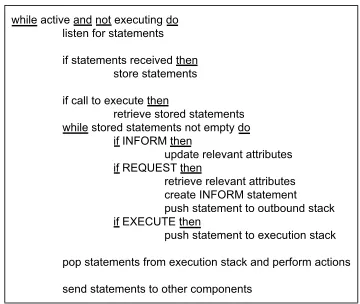
Component Operation An outline of the component operation is shown in Figure 4.
Components begin their operation in an inactive state, but once activated they perform any relevant initialisation procedures and wait for receipt of statements or for the com-mand to execute. When a statement is received, it is stored within the component until
the component enters its component execution phase. At this point, all statements re-ceived by a component are processed. The processing of statements may result in the component performing a set of actions or firing statements itself. This process stops when the component is de-activated.
The reason that components store statements instead of dealing with them imme-diately is that components can be made to react immeimme-diately after each statement is received through external control, as we discuss in the next section. In other words, the behaviour of a component within the context of the entire architecture (i.e., when it acts or sends messages) depends on an external controller.
The state of a component, in terms of the information to be manipulated, at any given time is given by the set of statements that have not been processed yet, the set of statements in the execution stack, the set of statements in the outbound stack and any attributes that the component manipulates. Depending on the specific implementation of a component it may be possible to interrogate components for their individual states. We discuss this issue further in Section 5.
With components, we are able to differentiate between the different tasks an agent architecture needs to perform, from a structural perspective. In contrast, the composition of components and the control of the flow of information between them provides the behavioural specification. In the next section we see how this is managed.
[image:10.595.223.393.418.498.2]4
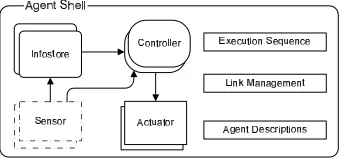
Shell
Fig. 5. Agent shell
different types of components in order to aid the illustration of agent architectures. Sen-sors are dashed rectangles, infostores are rounded corner rectangles, actuators are con-tinuous line rectangles, and controllers are accented rounded corner rectangles. Com-ponents are placed within a shell, links are created between comCom-ponents to allow the flow of statements, and an execution sequence is defined. In addition, the shell can be used to maintain descriptions of agents in terms of attributes, capabilities and goals. We consider each of these aspects in more detail below.
Links Information flows through links that the shell establishes between components.
Each link contains paths from a statement-producing component to the statement-receiving components. Each component that produces statements has a link associated to it that defines the components that should receive those statements. Links also ensure that in the case of aREQUESTstatement the reply is sent to the component that produced the request. Thus, links manage paths which are one-to-one relationships between compo-nents. They are usually unidirectional, except in the case of aREQUESTstatement for which anINFORMmay be returned in the opposite direction.
The shell then uses the information within links to coordinate the flow of state-ments between components. Ultimately, this coordination depends on the choices that a developer makes, since it requires knowledge of each component and how they can be composed.
By decoupling the handling of statements between components from the compo-nents themselves, we gain considerable flexibility. We can manage the composition of components and the flow of information without the components themselves needing to be aware of each other. It is the architecture developer’s task to ensure that the appro-priate links are in place. At the same time, we have flexibility in altering links, and it becomes easier to introduce new components. Furthermore, basic transformations can be performed on a statement from one component to the other to ensure compatibility if the output of one component does not exactly match the required input for another. For example, if a sensor component provides information from a thermometer based on the Celsius scale while a controller that uses that information makes use of the Fahren-heit scale, the link can be programmed to perform the necessary transformation. These features satisfy our requirement for facilitating the re-configuration of architectures.
Execution Sequence Apart from the management of the flow of information, we also
there is a wealth of existing research that can be accessed to address this need. For exam-ple, recent developments within the field of Semantic Web Services provide a process model language for describing the operation of a web service [1]. Through our proposed mechanisms we facilitate the necessary separation of concerns to enable the integration of such work within the scope of agent architecture development. In Section 5, where we present an implementation of actSMARTwe only implement a sequential execution sequence, which is sufficient for our current purposes.
Agent Description The description of the agent as a whole is maintained by the shell.
The shell can store a number of attributes that describe the agent owner, its location, user preferences, etc. The level of detail covered by this description is mostly an application-specific issue, and this information can either be provided directly to the shell by the developer, or collected from the various components. The shell could query a compo-nent that is able to provide information about current location for example, and add that to the profile of the whole agent. Likewise, it may keep a record of the current goal an agent is trying to satisfy or the plan it is pursuing. The capabilities collecting and providing attributes describing the agent within the shell may be particularly useful in a situation in which a developer wants to export a view of the agent for debugging purposes, or when some information needs to be advertised, such as the agent’s capa-bilities.
Agent Design With the main aspects of the agent construction model in place we now
briefly describe how the agent design process can develop. Agent design begins with an empty shell. One could envisage implementations of shells being provided by environ-ment owners, which would ensure compatibility with their environenviron-ment, while allow-ing the agent developer relative freedom as to the structure and behaviour of the agent within the confines of the shell. Subsequently, based on the purpose the agent is meant to fulfill, the necessary components for sensing, acting, decision-making (controllers) and information storage can be identified. If such components already exist the main task of the developer is to decide what is the appropriate behaviour, in terms of execu-tion sequence and flow of informaexecu-tion, and whether any of the output of components need to be transformed in order to be aligned with the input needs of other components. The components are then loaded into the shell, and links, as well as an execution sequence, can be defined. With the execution sequence in place, the operational cycle of the agent can begin. Agent operation can be suspended or stopped by stopping the execution sequence. This operational cycle can be modified by altering the execution sequence and modifying links between components.
5
Implemenation of actSMART
been programmed using solely classes supported within the Mobile Information Device Profile (MIDP) of the Java 2 Micro Edition [14]. As such, the core ideas can be used by wide range of devices, from workstations to limited capability mobile phones.
We then provide two extensions to the core, one for desktop computers and one for mobile devices, respectively. The desk part provides enhancements to the core, such as a graphical user interface for building entities and run-time loading of components, that are not possible for limited capability devices. Furthermore, in order to speed up the development process, one can define the required components, attributes, links and execution sequence within an XML file and use that to create an agent in the desktop environment. The mobile part provides functionality which is specific to mobile devices such as permanent record stores and user interfaces for mobile devices. In both cases we can manage the information flow between components at run-time as well as change the execution sequence within the limits of the types of execution sequence that we currently support.
The user interfaces provided with actSMART, for both the mobile and desktop de-vices, allow direct access to all the relevant information on the state and operation of an agent as well as the capability to manipulate each agent as a whole or individual components. As such, they can serve as the basis for effective debugging tool for agents as well as a means to manipulate and change agent configurations during run-time.
5.1 Implementing an architecture
In order to illustrate some of the benefits of this approach for mobile devices we have implemented the architecture and scenario described in Section 3 for a MIDP 2.0 com-pliant device using the J2ME Wireless Toolkit, which provides an environment that can simulate various mobile devices and the operation of MIDP applications within them.3. The discovery of available services and devices is simulated, with the mobile device using the APIs provided by MIDP 2.0 (Generic Connection Framework) for net-work communication and communicating via TCP/IP with independent processes that provide the relevant information. We avoid here a detailed descriptions of the exact statements exchanged between components, due to a lack of space, and focus on some of the specific implementation issues for mobile devices.
Adapting to changes in the environment Mobile devices are inevitably limited in
their capabilities. However, pervasive environments present a constantly changing set of devices and services to interact with as well as modes of interactions. For example, a device may be able to communicate with other devices through a variety of low-level protocols such as 802.11b wireless, Bluetooth or even SMS messages as well as higher level agent language communication protocols. By abstracting interaction using different methods to dedicated sensor components we can change the methods used at runtime based on device capabilities. For example, upon initialisation a shell could de-termine if a device supports Bluetooth communication and accordingly activate and link the Bluetooth-enabled sensor component. Similarly a device can determine that a cer-tain protocol, although supported by the device, is not supported by anything else in the
environment, and by consequence the relevant component is unlinked and deactivated by the shell, thus minimising the load the agent places on the device.
Suspending operation A particularly useful feature of actSMARTwas the easy access
it provides to the state of individual components and the agent as a whole. This allowed us to suspend the operation of the agent either through a user command or when the device was interrupted (e.g. by a phone call). The MIDP application management model allowed us to write the relevant information to the persistent record store of a device, thus allowing us to resume operation from where we left off.
Modifying the architecture
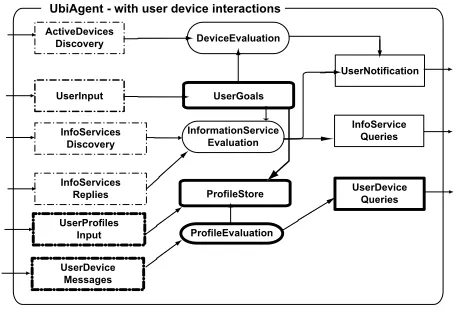
UbiAgent - with user device interactions
DeviceEvaluation ActiveDevices
Discovery
UserGoals
UserNotification
UserInput
InfoServices Discovery
InfoServices Replies
InformationService Evaluation
InfoService Queries
UserDevice Messages UserProfiles
Input ProfileEvaluation
[image:14.595.194.422.288.446.2]ProfileStore UserDeviceQueries
Fig. 6. Extended Ubiquitous Agent Design
Finally, through the mechanisms provided by Java mobile device technologies, and particularly,over-the-air provisioning of MIDP applications we can take advantage of the flexibility afforded by actSMART to replace existing architectures with modified versions that they can support more functionality. For example, in Figure 6 the basic architecture is extended to support interaction with other user devices that can provide profiles of their owners. The bold components are the additional or modified compo-nents over the existing architecture. Essentially, the user is able to input another goal, which is handled by the new components to store, evaluate and sent profiles to other devices.
5.2 Discussion
based on a simulation of the environment, the APIs used are those directly supported by the majority of high-end mobile phone devices and we also tested the application on low-end PDAs (Palm m100).
The fine-grained control over every aspect of the agent aids significantly in testing and debugging, since components can be tested individually and, more importantly, they can be tested in connection with other components without requiring an instantiation of the entire architecture. Moreover, the state of each component, and the agent as a whole, is clearly defined, and changes to individual components and to the overall architecture are easy to achieve.
6
Conclusions
A component-based approach to agent design is, of course, not unique. The majority of current agent toolkits (e.g. [19, 15, 3, 17]) support some sort of component-based approach. However, they do not explicitly support the definition of a range of archi-tectures, with the exception of JADE [3] that only provides basic support for agent architectures and as such does not constrain the developer. However, at the same time it does not aid the developer by providing a conceptually grounded construction model, such as actSMART. In fact, a future goal is to attempt to incorporate our agent construc-tion model within the wider development environment of JADE, which also provides support for mobile devices.
Methodologies for agent development have also introduced similar notions. The most relevant example is the DESIRE design method [5], where compositional design is not simply a low-level software engineering issue but a methodological approach. Components, other that at the lowest level are seen as encapsulating processes and com-position of components is, therefore, a comcom-position of processes. Our approach should not be considered as an alternative to DESIRE, but rather complimentary since it can be seen as restricting many of the concepts already supported within DESIRE. We provide a more lightweight approach to component-based approach that is far more specific route in the nature of components and the ways that they can communicate. Our ap-proach has been developed with ubiquitous computing devices in mind, so the concepts map particularly well to them, and ease of application in practical development envi-ronments so that the agent construction model is easily understood and maps directly to implementation. Using this more lightweight approach we are able to describe very simple architectures, such as just a reactive agent4, to more complex architectures5, while retaining a clear separation between an abstract specification level and practical implementation.
The approach offers several real contributions to the state-of-the-art as follows: it addresses development concerns directly by providing clear links between conceptual models and implementation; it builds on existing theoretical work while adopting the most valuable practical developments; and it tackles some of the implementation con-cerns of mobile devices and is supported by a sound foundational approach that is easily realisable in practice.
4
In our case a reactive architecture would consist of just sensors linked directly to actuators.
References
1. A. Ankolenkar, M. Burstein, J. R. Hobbs, O. Lassila, D. L. Martin, S. A. M. Drew McDer-mott, S. Narayanan, M. Paolucci, T. R. Payne, and K. Sycara. DAML-S: Web Service De-scription for the Semantic Web. In I. F. Cruz, S. Decker, J. Euzenat, and D. L. McGuinness, editors, The First Semantic Web Working Symposium, pages 411–430. Stanford University, California, 2001.
2. R. Ashri, I. Rahwan, and M. Luck. Architectures for Negotiating Agents. In V. Marik, J. Muller, and M. Pechoucek, editors, Mutli-Agent Systems and Applications III, volume 2691 of LNAI, pages 136–146. Springer, 2003.
3. F. Bellifemine, A. Poggi, and G. Rimassa. Developing Multi-agent Systems with JADE. In C. Castelfranchi and Y. Lesp´erance, editors, Intelligent Agents VII. Agent Theories
Architec-tures and Languages, volume 1986 of LNCS, pages 89–103. Springer, 2001.
4. F. Bergenti and A. Poggi. Ubiquitous Information Agents. International Journal of
Cooper-ative Information Systems, 11(3–4):231–244, 2002.
5. F. T. Brazier, C. Jonker, and J. Treur. Principles of Component-Based Design of Intelligent Agents. Data and Knowledge Engineering, 41:1–28, 2002.
6. J. Bryson and L. A. Stein. Architectures and Idioms: Making Progress in Agent Design. In C. Castelfranchi and Y. Lesp´erance, editors, Intelligent Agents VII. Agent Theories
Architec-tures and Languages, volume 1986, pages 73–88. Springer, 2001.
7. J. Cheesman and J. Daniels. UML Components: A Simple Process for Specifying COmponent-Based Software. Addison-Wesley, 2000.
8. M. d’Inverno, D. Kinny, M. Luck, and M. Wooldridge. A Formal Specification of dMARS. In M. P. Singh, A. S. Rao, and M. Wooldridge, editors, Intelligent Agenrs IV: Proceedings of
the Fourth International Workshop on Agent Theories, Architectures and Languages, volume
1365 of LNCS, pages 155–176. Springer, 1996.
9. M. d’Inverno and M. Luck. Engineering AgentSpeak(L): A Formal Computational Model.
Journal of Logic and Computation, 8(3):233–260, 1998.
10. M. d’Inverno and M. Luck. Understanding Agent Systems. Springer, 2nd edition, 2004. 11. D. D’Souza and A. Wills. Objects Components and Frameowrks with UML.
Addison-Wesley, 1998.
12. T. Finin, A. Joshi, L. kagal, O. V. Patsimor, S. Avancha, V. Korolev, H. Chen, F. Perich, and R. S. Cost. Intelligent Agents for Mobile and Embedded Devices. International Journal of
Cooperative Information Systems, 11(3–4):205–230, 2002.
13. J. Graham and K. Decker. Towards a Distributed Environment-Centered Agent Framework. In N. Jennings and Y. Lesperance, editors, Intelligent Agents VI Agent Theories,
Architec-tures, and Languages, volume 1757 of LNCS. Springer, 1999.
14. J. . E. Group. Mobile Information Device Profile for the Java 2 Micro Edition - Version 2.0. Technical report, Java Community Press, 2002.
15. H. Nwana, D. Ndumu, L. Lee, and J. Collis. ZEUS: A Tool-Kit for Building Distributed Multi-Agent Systems. Applied Artifical Intelligence, 13(1):129–186, 1999.
16. I. Srnkovic, B. Hnich, T. Jonsson, and Z. Kiziltan. Specification, Implementation and De-ployment of Components. Communications of the ACM, 45(10):35–40, 2002.
17. V. Subrahmanian, P. Bonatti, J. Dix, T. Eiter, S. Kraus, F. Ozcan, and R. Ross. Heterogeneous
Agent Systems. MIT Press, 2000.
18. C. Szyperski. Component Software: Beyond Object-Oriented Programming. Addison-Wesley, 1998.
19. T. Wagner and B. Horling. The Struggle for Reuse and Domain Independence: Research with TAEMS, TDTC and JAF. In T. Wagner and O. Rana, editors, Infrastructure for Agents,