Transcranial direct current stimulation over left inferior frontal
cortex improves speech fluency in adults who stutter
Jennifer Chesters, Riikka Möttönen and Kate E. Watkins
unchanged from baseline. We conclude that tDCS combined with behavioural fluency intervention has the capacity to improve fluency in adults who stutter. tDCS thereby offers a potentially useful adjunct to future speech therapy interventions for this population, for whom therapy outcomes are currently limited.
Keywords: Stammering, speech disorder, non-invasive brain stimulation,
Introduction
Developmental stuttering is a neurodevelopmental disorder disrupting the smooth flow of speech, resulting in characteristic speech disfluencies. Developmental stuttering represents a considerable burden to the 1% of adults living with the condition, and to society; it is associated with reduced educational and employment opportunities (Klein et al., 2004; O'Brian et al., 2011), social anxiety (Iverach et al., 2009), and compromised quality of life (Craig et al., 2009). Fluency therapies may use techniques for altering speech patterns to reduce overt stuttering (Boberg et al., 1994; O'Brian et al., 2003). However, fluency improvements do not persist without continued practice, and can be difficult to fully integrate into everyday speech. Furthermore, learning these new speech patterns can affect speech naturalness (Metz et al., 1990; O'Brian et al., 2003; Tasko et al., 2007), which can reduce the acceptability of these approaches. There is a value, therefore, in developing novel interventions to improve therapy outcomes for adults who stutter.
et al., 2009). Increasingly, tDCS is being investigated as an adjunctive treatment for acquired disorders of motor, language and cognitive functions (Allman et al., 2016; Baker et al., 2010; Khedr et al., 2013; Marangolo et al., 2011; Mortensen et al., 2016). For example, in a study treating upper limb motor function in stroke patients, tDCS was found to prolong the effects of 9-days of motor training for at least three months (Allman et al., 2016). In post-stroke aphasic patients, five days of anodal tDCS over left inferior frontal cortex enhanced naming accuracy, which remained improved for at least one week post intervention (Baker et al., 2010). Here, we aimed to evaluate whether lasting fluency improvements could be obtained in a group of adults who stutter by combining tDCS with a 5-day behavioural fluency intervention.
in people who stutter, we could facilitate the brain circuits supporting this fluent speech, promoting neuro-plastic changes and thereby produce lasting fluency improvements.
The effectiveness of the temporary fluency inducers described above is consistent with theories that dysfluency in people who stutter is caused by a problem in generating internal timing cues for motor control or sensorimotor integration or both (Alm, 2004; Max et al., 2004; Watkins et al., 2015). Brain imaging studies of adults who stutter confirm both structural and functional abnormalities in sensorimotor circuits involved in speech production. Specifically, there is consistent evidence of a white matter structural deficits underlying ventral sensorimotor cortex in the left hemisphere (Sommer et al., 2002; Watkins et al., 2008; see Neef et al., 2015, for review). Functionally, there are differences in activation patterns evoked by speech production in people who stutter that reflect both trait and state differences (see recent meta-analyses by Belyk et al., 2015, and Budde et al., 2014). Of relevance to our study, it is worth noting that the left inferior frontal cortex is functionally abnormal in people who stutter (Fox et al., 1996; Kell et al., 2009; Neumann et al., 2005; Toyomura et al., 2011; Watkins et al., 2008; Wu et al., 1995). In the current study, we placed the anodal electrode over the left inferior frontal cortex covering also the ventral sensorimotor and premotor cortex.
choral speech and metronome-timed speech during overt reading, narrative and and conversational speech tasks. We delivered 1-mA of anodal tDCS over the left inferior frontal cortex (IFC) for 20 minutes per day in five consecutive daily sessions. Fluency was assessed 1 and 6 weeks after the five-day intervention. We predicted that fluency intervention when combined with anodal tDCS would result in reduced disfluency, relative to the same fluency intervention with sham stimulation.
Methods
Study design and participants
Randomisation and masking
A researcher who was not involved in any aspect of the trial performed the randomisation of participants into the sham and tDCS study arms using blocked randomization (Roberts et al., 1998). A block size of four was chosen generating six possible sequences, which were allocated at random. Allocation concealment was achieved by assigning a unique 5-digit code per participant. The code was used to deliver tDCS or sham stimulation using the study mode on the stimulator (http://www.neurocaregroup.com/dc_stimulator_plus.html). Codes remained in sealed sequentially numbered opaque envelopes until allocation. The participants and the researcher who delivered the intervention, assessed the outcomes, and analyzed the data, were masked to group assignment.
Procedures
tDCS
parameters delivered current at an ineffective dosage. However, the initial ramping of current and the intermittent current pulse ensured effective blinding of participant and researcher.
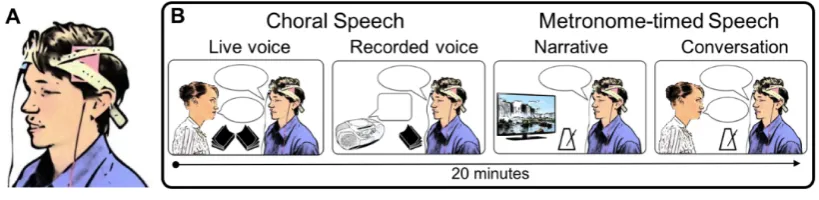
Figure 1: tDCS montage and behavioural tasks used in intervention. A shows the electrode placement montage used to apply tDCS. Anode (red) was placed over left IFC,
centred on position FC5 of the 10-10 EEG electrode placement system. Cathode (blue)
was placed over the right supra-orbital ridge. B shows the choral speech (live voice and
recorded voice) and metronome-timed speech (video narrative and conversation) tasks
used in each daily intervention session. 1-mA tDCS was applied concurrently with these
tasks for 20 mins in 15 men who stutter. Another 15 men received sham stimulation for
the same period. Both researcher and participant were blind to the stimulation
condition.
Fluency intervention
each intervention session. Choral speech involved reading passages at a normal rate in unison first with a live voice and second with an audio-book recording. Metronome-timed speech involved speaking in time with an external audio metronome to produce spontaneous narratives of silent cartoon films followed by conversation with the researcher on randomly selected topics (e.g. a recent holiday). The metronome rate increased from 140 to 190 beats per minute across the five days. Participants were instructed to indicate if the rate exceeded a comfortable speaking rate at any time. In this case, the metronome was slowed to a comfortable rate, and maintained at this rate for the remaining days. Speech disfluency during reading and conversation was measured at baseline, before and after the intervention on each day, and at 1 week and 6 weeks post-intervention.
Outcome measures
to a speech sound (i.e. core stuttering characteristics) as well as syllables in a repeated multi-syllabic word, a repeated phrase or phrase revision, a word fragment, or interjection (e.g. “um”, “err”).
We also measured how fluency was affected over the course of the intervention by including an additional assessment of the change in disfluency immediately after the intervention session on each of the 5 days of intervention.
One researcher completed all disfluency counts. Inter-rater reliability was measured by comparing all speech samples from two participants, selected at random, with counts independently completed by a second researcher. A strong intra-class correlation was found for the inter-rater measurements (ICC = .94, p < .001), indicating a high level of reliability.
Secondary outcome measures included the SSI-4, which provides a standardised and norm-referenced index of disfluency, and the Overall Assessment of the Speaker’s Experience of Stuttering (OASES: Yaruss et al., 2006), a self-assessment tool, which measures the psycho-social impact of stuttering. The latter was used at baseline and at the 6-week post-intervention time point, to avoid violating retest reliability.
related to receiving tDCS such as an itching or tingling sensation at the electrode sites.
Statistical analysis
It was not possible to perform a power calculation based on previous trials of tDCS in developmental stuttering, as no studies prior to this one were published. Previous intervention studies using tDCS in patients with aphasia reported group differences of medium effect size (e.g. using a sample size of n = 10, Baker
et al., 2010).
Data were analysed according to the intention-to-treat principle. The distribution of the measurement of speech disfluency at baseline significantly deviated from normal, as is commonly seen in people who stutter (Jones et al., 2006). To avoid the need for transformation (which is problematic for reporting confidence intervals in interpretable units, Bland et al., 1996), the trial outcomes were defined in terms of change from baseline, which was normally distributed.
a within-subjects factor of time post-intervention (1 week, 6 weeks). As the other secondary outcome measure (change from baseline in OASES) was only acquired 6 weeks post intervention, the effect of tDCS on this measure was assessed using an independent samples t-test between the two groups. For the additional analysis of the effects of tDCS during the 5-day intervention on speech fluency, we entered the change from baseline %ds measured post-intervention on each day into a mixed-model ANOVA. Group (tDCS, sham) was the between-subjects factor and task (reading, conversation) and intervention day (1 to 5) were within-subjects factors.
The means of changes from baseline in %ds, with 95% confidence intervals, were calculated for the tDCS and sham groups separately, along with the differences in these means between the two groups. Cohen’s d was calculated for the effect sizes of the group differences. The change from baseline in %ds was also calculated as a percentage of the median %ds at baseline to estimate the size of the change relative to the baseline rate of disfluency.
Results
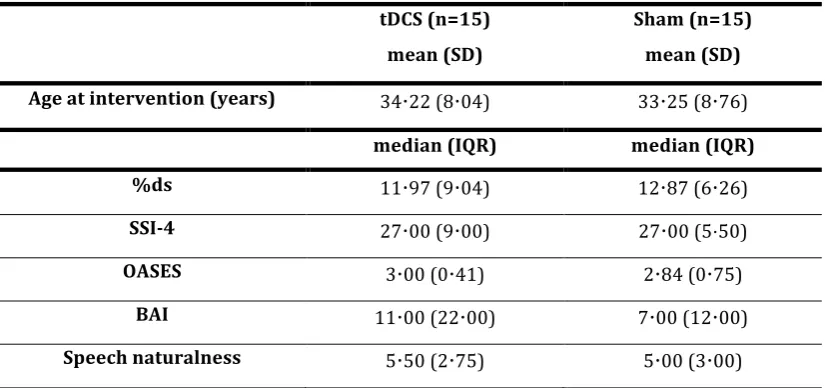
were included in all the analyses. The one-week post-intervention session was carried out on average 8 days after intervention and the six-week session at 40 days after intervention. Table 1 shows baseline characteristics, which were well-matched between the tDCS and sham groups.
[image:14.595.92.505.514.708.2]One participant in the tDCS group was an extreme statistical outlier (>3 standard deviations from the group mean) with regard to baseline stuttering, but this participant’s change from baseline scores were not outliers. Data from all participants were included in the primary analysis, according to the intention-to-treat principle. However, we also completed sensitivity analyses (Thabane et al., 2013) by re-running all analyses excluding the participant with outlying baseline scores, to evaluate the robustness of the treatment effect. The sensitivity analyses resulted in minimal change to the tDCS group mean, and did not alter the pattern of results regarding the effects of tDCS.
Table 1: Baseline characteristics. tDCS (n=15)
mean (SD)
Sham (n=15) mean (SD)
Age at intervention (years) 34⋅22 (8⋅04) 33⋅25 (8⋅76)
median (IQR) median (IQR)
%ds 11⋅97 (9⋅04) 12⋅87 (6⋅26)
SSI-4 27⋅00 (9⋅00) 27⋅00 (5⋅50)
OASES 3⋅00 (0⋅41) 2⋅84 (0⋅75)
BAI 11⋅00 (22⋅00) 7⋅00 (12⋅00)
Speech naturalness 5⋅50 (2⋅75) 5⋅00 (3⋅00)
severe anxiety. Speech naturalness ratings ranged from 1 to 9, with 1 being highly natural sounding speech. SD = standard deviation. IQR = interquartile range.
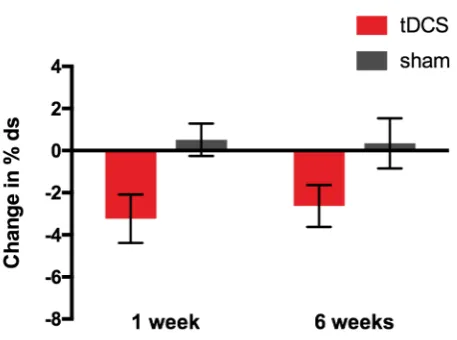
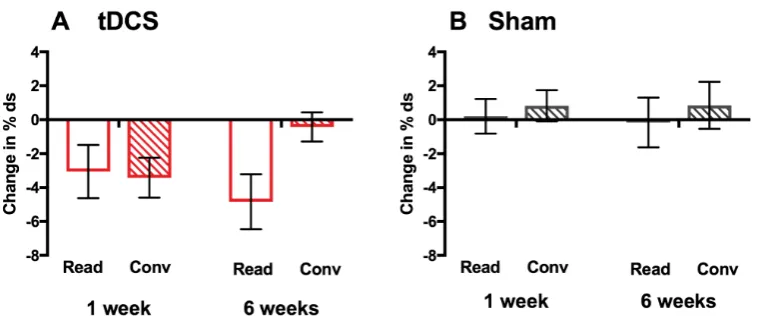
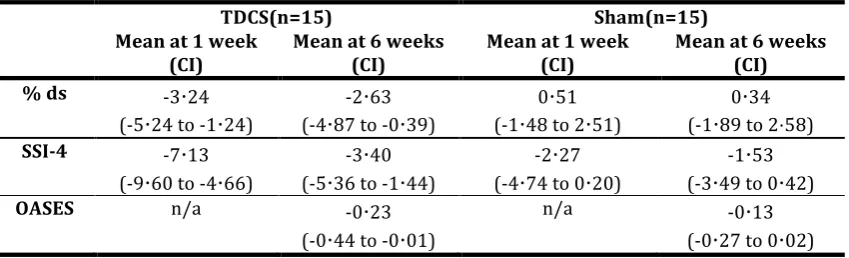
Table 2 shows mean change and confidence intervals per group for all outcomes measures. Figure 2 shows mean change in % ds, the primary outcome measure, for both groups, at both post-intervention time points. Figure 3 shows the changes from baseline disfluency for the two speaking tasks in each group separately.
Figure 2: Effect of tDCS on the primary outcome measure: change from baseline in speech disfluency. Bars indicate mean change from baseline in %ds measured at 1- and 6-weeks post intervention averaged across speech samples obtained during reading
and conversation. Red – tDCS group; grey – Sham group. Error bars indicate standard
error of the mean.
6 weeks (no significant difference between time-points) but a return to baseline disfluency levels for the conversation task (main effect of time-point, p = ⋅034).
Figure 3: Effect of tDCS on reading and conversation tasks separately. Bars indicate mean change from baseline in %ds measured at 1- and 6-weeks post
intervention for the two speaking tasks in the A. tDCS and B. sham groups. Unfilled bars
– reading task (Read), striped bars – conversation task (Conv). Error bars indicate
standard error of the mean.
Figure 4: Effects of tDCS on secondary outcomes: change from baseline in SSI and OASES scores
Bars indicate mean change from baseline in A. SSI-4 scores at 1- and 6-weeks post
intervention, and B. OASES scores at 6-weeks post intervention, for the tDCS (red) and
sham (grey) groups. Error bars indicate standard error of the mean.
Table 2: Summary of mean changes from baseline per group for the primary and secondary outcomes
TDCS(n=15) Sham(n=15)
Mean at 1 week (CI)
Mean at 6 weeks (CI)
Mean at 1 week (CI)
Mean at 6 weeks (CI)
% ds -3⋅24
(-5⋅24 to -1⋅24)
-2⋅63
(-4⋅87 to -0⋅39)
0⋅51
(-1⋅48 to 2⋅51)
0⋅34
(-1⋅89 to 2⋅58)
SSI-4 -7⋅13
(-9⋅60 to -4⋅66)
-3⋅40
(-5⋅36 to -1⋅44)
-2⋅27
(-4⋅74 to 0⋅20)
-1⋅53
(-3⋅49 to 0⋅42)
OASES n/a -0⋅23
(-0⋅44 to -0⋅01)
n/a -0⋅13
(-0⋅27 to 0⋅02)
%ds = percentage of disfluent syllables; SSI-4 = Stuttering Severity Instrument; OASES = Overall Assessment of the Speakers’ Experience of Stuttering; CI = 95% confidence interval.
Figure 5: Effects of tDCS on speech disfluency during the 5-day intervention
Bars indicate mean change in %ds from baseline in speech sample during A. reading
(unfilled bars) and B. conversation (striped bars) tasks on days 1 to 5 during the
intervention for the tDCS (red) and sham (grey) groups. Error bars indicate standard
error of the mean.
There were no serious adverse effects during the trial. tDCS adverse effects were limited to the mild symptoms commonly reported in previous studies (e.g. itching and tingling under the electrodes), and did not significantly differ in intensity or frequency of reporting between the tDCS and sham groups. Neither tDCS nor the behavioural intervention alone (the sham condition) affected speech naturalness, when tested immediately after each intervention session, or at the post-intervention time points.
Discussion
intervention. For the primary outcome measure, the percentage of disfluent syllables averaged across reading and conversation tasks at 1 and 6 weeks post intervention was significantly reduced in the tDCS group relative to the sham group. Similarly, the combination of tDCS and fluency intervention significantly reduced scores on a standardised measure of stuttering severity, SSI-4, relative to sham stimulation. This effect also persisted for 6 weeks post intervention. The magnitude and the persistence of improvements for the tDCS group in these outcomes indicate the clinical potential for tDCS as an adjunctive therapy.
No significant benefit of tDCS was found for the OASES self-assessment, our other secondary outcome measure. However, both groups showed some reduction in the negative psycho-social impact of stuttering following intervention. We included the OASES as a measure of psycho-social impact, however the assessment has a broader scope, encompassing all domains of health and disability within the World Health Organisation ICF framework (http://www.who.int/classifications/icf/en/). The sub-scores of the OASES were not separately analysed but small reductions were seen for both groups across all sub-scores (assessing general understanding of stuttering, reactions to stuttering, communication in daily situations and quality of life).
people who stutter commonly report using such avoidance strategies (Riley et al., 2004). Nevertheless, fluency during conversation might be considered a more ecologically valid outcome measure of a trial aimed at improving speech fluency. Testing combined tDCS and behavioural therapy paradigms to induce more robust increases in fluency during conversation, for example using a longer intervention period, will be important in the ongoing development of this approach for clinical application.
A side-effect of explicitly learning new speech patterns in fluency therapy, however, can be a reduction in speech naturalness (Metz et al., 1990; O'Brian et al., 2003; Tasko et al., 2007), particularly in the early stages. Reduced naturalness following therapy can result in a more negative listener response than to stuttering itself (Stuart et al., 2004), and reduce the maintenance of therapy gains (Onslow et al., 1992). The current study, aimed to induce fluent speech immediately and with minimal effort, importantly, not to negatively impact speech naturalness. The maintenance of natural-sounding speech following the combination of tDCS with temporary behavioural fluency enhancement in this paradigm is noteworthy. tDCS as an adjunctive therapy for stuttering would have particular impact if maintenance, or even improvement, of speech naturalness is shown to be a replicable outcome.
was more likely to yield positive results, as previous studies using multiple session stimulation have shown that unstable effects following the initial intervention session, can increase and stabilize following subsequent daily stimulation sessions (Baker et al.; Reis et al., 2009). However, we also made a number of changes regarding our study sample to increase sensitivity, including recruiting participants with at least moderate stuttering to avoid a floor effect, and only male, right-handed, participants to increase group homogeneity. For this first randomised controlled trial these restrictive participant criteria were justifiable in order to ascertain that tDCS has some benefit in stuttering intervention. In future work, it will be important to test effects on a more varied sample of adults who stutter. This will help to establish the clinical scope of the approach, and any systematic differences in effect may also help us to better understand the mechanisms involved in tDCS effects and in developmental stuttering.
There has been very limited research using tDCS in developmental disorders of communication, perhaps due to an understandable caution regarding interacting with neuro-plastic processes during childhood. However, tDCS has an interesting potential for augmenting the limited therapeutic outcomes for adults living with persistent developmental difficulties, the impact of which can be considerable (Clegg et al., 2005; Craig et al., 2009; Tanner, 2009). One study found that tDCS over area V5/MT combined with a five-day course of reading therapy improved reading speed and fluency in adults with developmental dyslexia, with benefits persisting one week after the intervention (Heth et al., 2015). To our knowledge, there are no other studies in adults with developmental disorders of communication, and none in developmental disorders of speech. Our study suggests that tDCS may be usefully applied to persistent developmental communication disorders, and may have particular value where behavioural therapies alone have failed to produce lasting positive outcomes.
using tDCS has very moderate costs, and the devices are simple to use, requiring minimal training. Using tDCS stimulation to improve the efficacy of a therapy could reduce the number of sessions required by an individual, offering savings and allowing more individuals to be treated. Furthermore, it could improve outcomes and prevent relapses. Further work is needed, however, to investigate the limitations of this method, its underlying mechanisms and the optimal tDCS parameters for increasing fluency.
Contributors
JC, RM and KEW designed the study. JC acquired the data. JC and KEW completed the statistical analysis. JC interpreted the data, with input from RM and KEW. JC wrote the first draft of the manuscript, which was edited by all authors. All authors gave final approval of the version to be published.
Declaration of interests.
We declare no competing interests.
Acknowledgments
References
Allman C, Amadi U, Winkler AM, Wilkins L, Filippini N, Kischka U, Stagg CJ and Johansen-Berg H. (2016) Ipsilesional anodal tDCS enhances the functional benefits of rehabilitation in patients after stroke. Sci Transl Med 8:
330re331.
Alm PA. (2004) Stuttering and the basal ganglia circuits: a critical review of possible relations. Journal of communication disorders 37: 325-369. Baker JM, Rorden C and Fridriksson J. (2010) Using Transcranial Direct-Current
Stimulation to Treat Stroke Patients With Aphasia. Stroke 41: 1229-1236. Belyk M, Kraft SJ and Brown S. (2015) Stuttering as a trait or state - an ALE meta-analysis of neuroimaging studies. The European journal of neuroscience 41: 275-284.
Bland JM and Altman DG. (1996) The use of transformation when comparing two means. BMJ 312: 1153.
Boberg E and Kully D. (1994) Long-term results of an intensive treatment program for adults and adolescents who stutter. Journal of Speech and Hearing Research 37: 1050-1059.
Budde KS, Barron DS and Fox PT. (2014) Stuttering, induced fluency, and natural fluency: A hierarchical series of activation likelihood estimation meta-analyses. Brain and Language 139: 99-107.
Chesters J, Watkins KE and Mottonen R. (2017) Investigating the feasibility of using transcranial direct current stimulation to enhance fluency in people who stutter. Brain Lang 164: 68-76.
Clegg J, Hollis C, Mawhood L and Rutter M. (2005) Developmental language disorders--a follow-up in later adult life. Cognitive, language and psychosocial outcomes. J Child Psychol Psychiatry 46: 128-149.
Craig A, Blumgart E and Tran Y. (2009) The impact of stuttering on the quality of life in adults who stutter. Journal of Fluency Disorders 34: 61-71.
Fox PT, Ingham RJ, Ingham JC, Hirsch TB, Downs JH, Martin C, Jerabek P, Glass T and Lancaster JL. (1996) A PET study of the neural systems of stuttering. Nature 382: 158-161.
Heth I and Lavidor M. (2015) Improved reading measures in adults with dyslexia following transcranial direct current stimulation treatment.
Neuropsychologia 70: 107-113.
Holland R and Crinion J. (2012) Can tDCS enhance treatment of aphasia after stroke? Aphasiology 26: 1169-1191.
Iverach L, O'Brian S, Jones M, Block S, Lincoln M, Harrison E, Hewat S, Menzies RG, Packman A and Onslow M. (2009) Prevalence of anxiety disorders among adults seeking speech therapy for stuttering. J Anxiety Disord 23: 928-934.
Jones M, Onslow M, Packman A and Gebski V. (2006) Guidelines for statistical analysis of percentage of syllables stuttered data. Journal of Speech, Language, and Hearing Research 49: 867-878.
Kell CA, Neumann K, von Kriegstein K, Posenenske C, von Gudenberg AW, Euler H and Giraud AL. (2009) How the brain repairs stuttering. Brain 132: 2747-2760.
direct current stimulation on stroke rehabilitation: a pilot randomized controlled trial. Neurorehabil Neural Repair 27: 592-601.
Kiefte M and Armson J. (2008) Dissecting choral speech: properties of the accompanist critical to stuttering reduction. Journal of communication disorders 41: 33-48.
Klein JF and Hood SB. (2004) The impact of stuttering on employment opportunities and job performance. J Fluency Disord 29: 255-273. Krause B and Cohen Kadosh R. (2014) Not all brains are created equal: the
relevance of individual differences in responsiveness to transcranial electrical stimulation. Frontiers in systems neuroscience 8: 25.
Marangolo P, Fiori V, Cipollari S, Campana S, Razzano C, Di Paola M, Koch G and Caltagirone C. (2013) Bihemispheric stimulation over left and right inferior frontal region enhances recovery from apraxia of speech in chronic aphasia. Eur J Neurosci 38: 3370-3377.
Marangolo P, Marinelli CV, Bonifazi S, Fiori V, Ceravolo MG, Provinciali L and Tomaiuolo F. (2011) Electrical stimulation over the left inferior frontal gyrus (IFG) determines long-term effects in the recovery of speech apraxia in three chronic aphasics. Behavioural Brain Research 225: 498-504.
Martin RR, Haroldson SK and Triden KA. (1984) Stuttering and speech naturalness. The Journal of speech and hearing disorders 49: 53-58. Max L, Guenther FH, Gracco VL, Ghosh SS and Wallace ME. (2004) Unstable or
Insufficiently Activated Internal Models and Feedback-Biased Motor Control as Sources of Dysfluency: A Theoretical Model of Stuttering. Contemporary Issues in Communication Science and Disorders 31: 105-122.
Metz DE, Schiavetti N and Sacco PR. (1990) Acoustic and psychophysical dimensions of the perceived speech naturalness of nonstutterers and posttreatment stutterers. The Journal of speech and hearing disorders 55: 516-525.
Monti A, Ferrucci R, Fumagalli M, Mameli F, Cogiamanian F, Ardolino G and Priori A. (2013) Transcranial direct current stimulation (tDCS) and language. J Neurol Neurosurg Psychiatry 84: 832-842.
Mortensen J, Figlewski K and Andersen H. (2016) Combined transcranial direct current stimulation and home-based occupational therapy for upper limb motor impairment following intracerebral hemorrhage: a double-blind randomized controlled trial. Disability and Rehabilitation 38: 637-643. Neef NE, Anwander A and Friederici AD. (2015) The Neurobiological Grounding
of Persistent Stuttering: from Structure to Function. Curr Neurol Neurosci Rep 15: 63.
Neumann K, Preibisch C, Euler HA, von Gudenberg AW, Lanfermann H, Gall V and Giraud AL. (2005) Cortical plasticity associated with stuttering therapy. Journal of Fluency Disorders 30: 23-39.
Nitsche MA and Paulus W. (2000) Excitability changes induced in the human motor cortex by weak transcranial direct current stimulation. J Physiol 527 Pt 3: 633-639.
direct current stimulation of the primary motor cortex in the human. J Cogn Neurosci 15: 619-626.
O'Brian S, Jones M, Packman A, Menzies R and Onslow M. (2011) Stuttering severity and educational attainment. J Fluency Disord 36: 86-92. O'Brian S, Onslow M, Cream A and Packman A. (2003) The Camperdown
Program: outcomes of a new prolonged-speech treatment model. Journal of speech, language, and hearing research : JSLHR 46: 933-946.
Onslow M, Costa L, Andrews C, Harrison E and Packman A. (1996) Speech outcomes of a prolonged-speech treatment for stuttering. J Speech Hear Res 39: 734-749.
Onslow M, Hayes B, Hutchins L and Newman D. (1992) Speech naturalness and prolonged-speech treatments for stuttering: further variables and data. J Speech Hear Res 35: 274-282.
Reis J, Schambra HM, Cohen LG, Buch ER, Fritsch B, Zarahn E, Celnik PA and Krakauer JW. (2009) Noninvasive cortical stimulation enhances motor skill acquisition over multiple days through an effect on consolidation. Proc Natl Acad Sci U S A 106: 1590-1595.
Riley G. (2009) Stuttering severity instrument for children and adults, Austin, TX: PRO-ED.
Riley J, Riley G and Maguire G. (2004) Subjective Screening of Stuttering severity, locus of control and avoidance: research edition. Journal of Fluency
Disorders 29: 51-62.
Roberts C and Torgerson D. (1998) Randomisation methods in controlled trials. BMJ 317: 1301.
Sandars M, Cloutman L and Woollams AM. (2016) Taking Sides: An Integrative Review of the Impact of Laterality and Polarity on Efficacy of Therapeutic Transcranial Direct Current Stimulation for Anomia in Chronic Poststroke Aphasia. Neural Plast 2016: 8428256.
Silverman EM and Zimmer CH. (1979) Women who stutter: personality and speech characteristics. J Speech Hear Res 22: 553-564.
Sommer M, Koch MA, Paulus W, Weiller C and Buchel C. (2002) Disconnection of speech-relevant brain areas in persistent developmental stuttering. Lancet 360: 380-383.
Stagg CJ and Nitsche MA. (2011) Physiological basis of transcranial direct current stimulation. Neuroscientist 17: 37-53.
Stuart A and Kalinowski J. (2004) The perception of speech naturalness of post-therapeutic and altered auditory feedback speech of adults with mild and severe stuttering. Folia phoniatrica et logopaedica : official organ of the International Association of Logopedics and Phoniatrics 56: 347-357. Tanner K. (2009) Adult dyslexia and the 'conundrum of failure'. Disability &
Society 24: 785-797.
Tasko SM, McClean MD and Runyan CM. (2007) Speech motor correlates of treatment-related changes in stuttering severity and speech naturalness. J Commun Disord 40: 42-65.
Teshima S, Langevin M, Hagler P and Kully D. (2010) Post-treatment speech naturalness of comprehensive stuttering program clients and differences in ratings among listener groups. J Fluency Disord 35: 44-58.
Bawor M, Lee J, Wells G and Goldsmith CH. (2013) A tutorial on sensitivity analyses in clinical trials: the what, why, when and how. BMC Med Res Methodol 13: 92.
Toyomura A, Fujii T and Kuriki S. (2011) Effect of external auditory pacing on the neural activity of stuttering speakers. NeuroImage 57: 1507-1516.
Trajkovski N, Andrews C, Onslow M, Packman A, O'Brian S and Menzies R. (2009) Using syllable-timed speech to treat preschool children who stutter: a multiple baseline experiment. J Fluency Disord 34: 1-10.
Watkins KE, Chesters J and Connally EL. (2015) The Neurobiology of
Developmental Stuttering. In: Hickok G and Small SL (eds) Neurobiology of Language. London: Elsevier, 995-1004.
Watkins KE, Smith SM, Davis S and Howell P. (2008) Structural and functional abnormalities of the motor system in developmental stuttering. Brain 131: 50-59.
Wu JC, Maguire G, Riley G, Fallon J, LaCasse L, Chin S, Klein E, Tang C, Cadwell S and Lottenberg S. (1995) A positron emission tomography
[18F]deoxyglucose study of developmental stuttering. NeuroReport 6: 501-505.