
Promotion of browning in the development of new dairy products : a thesis presented to the faculty of the Department of Food Science and Biotechnology, Massey University in partial fulfilment of the requirements for the degree of Master of Food Technology
14
0
0
Full text
(2) PROMOTI:ON OF BROWNING. m. TEE DEVELC>BU!NT. OF NEW DAIRY HWDUC!.IS. A niesi.s. Presented to the Faoulty of the Department of Food Science and Biotechnology Massey University. In Partial Ful.:f'ilment of the Requirements for the Degree Jlaster of Food Technology in Food Processing. by. Wa.rwi.ok David Ward. July 1967.
(3)
(4) "It is not enough to know; -we must turn 'tlhat we know to account.. It is not enough to mil; we. must do. 11 - Goethe.
(5) ACKNOWLEDGEKENTS. '.I.he author wishes to thank the supervising camni ttee o£ Mr. H. A. L. Morris (Convenor), Dr. E. L. Richard.a, and Dr. R. M:. Dolby.. Sincere appreciation and. grati tud.e go to Mr. H. A. L. Morris for his encouragement, and particularly for his keen interest in this study.. His practical experience, willingness to talce. part in lengthy discussions, and help in the planning and presentation of this thesis has proved to be invaluable. '.Ihanks are due to the Dairy Prod.uc ti on and Marketing Board and the Sanitarium Health Food Canpany for financial assistance. Special thanks to Miss D. Scott for the excellent photography and printing of the graphs and photographs, and also to Miss. c.. Ki tohell f'or her hand in the. photographs, studio work, and fixing of the graphs and photographs. For much frui tt'ul help and discussion, the author is indebted to the willingness o£ Mr. J. G. Clarke, Dr. W. B. Sanderson, and Kr. D. Box, of the New l.ealand Dairy Research Institute. To the l.mtiring help and patience ofhis sister, Miss :M. Ward, in the prep-. aration and typing of this thesis the author is gratefully indebted for the final presentati.cn.. 'lhe author also wishes to thank his family and close friends. for. their encouragement, and for their help in so many ways to make this work an enjoyable experience. nie assistance and interest of numerous other people "tilo have contributed in many eya is also muoh appreciated and baa made the "WOrk on this thesis that muoh more interesting..
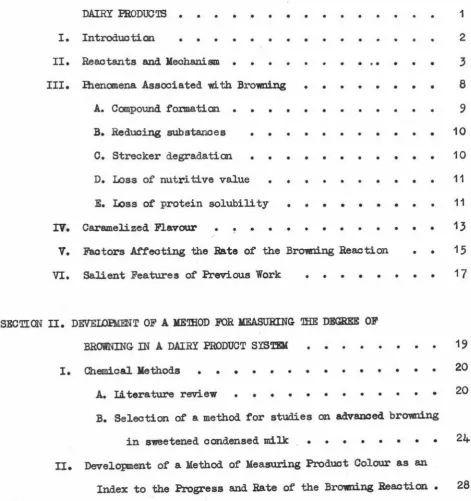
(6) TABLE OF CONTEN'IS. PART A.. BASIC SWDIES ON 'IHE BROWNING OF MIIK SOIIDS PAGE. SECTION I.. A REVIEW OF PREVIOUS RESEARCH INTO 'IHE BROWNING OF. I. II. III.. DAIRY PRODOO'IS. •. •. •. •. •. •. •. •. •. •. •. Introduoti on. •. •. •. •. •. •. •. •. •. •. •. Reao tan ts and Jleohani sm. •. •. •. •. •. •. •. •. :Ehencmena Associated with Browning A. Ccmpound fomation. VI.. • •. •. 2. ... •. •. •. •. 3. •. •. •. •. 8. •. •. •. •. 9. •. •. •. •. B. Reducing substa.noes. •. •. •. •. •. •. •. •. •. •. •. 10. o.. •. •. •. •. •. •. •. •. •. •. •. 10. •. •. •. •. •. •. •. •. •. •. 11. •. •. •. •. •. •. •. •. •. 11. •. •. •. •. •. •. •. •. •. 13. •. •. 15. •. •. •. 17. Strecker degradation. E. !Dss of protein solubility. v.. •. 1. •. •. •. D. loss of nutritive value. IV.. •. •. Caramelized Flavour. •. !. •. •. Factors Atteoting the Bate of the Browning Reao ti on Salient Features of Previous Work. •. •. •. •. •. SECTION II. DEVEIDBrnNT OF A KEMOD FOR MEASURING '1HE DEGREE OF. I.. BROWNING IN A DAIRY PRODUCT SISTml. •. •. •. •. •. •. •. •. 19. Chemical Jlethods. •. •. A. Literature review. •. •. •. •. •. •. •. •. •. •. •. •. 20. •. •. •. •. •. •. •. •. •. •. •. •. 20. B. Selection of a method for studies an adva:noed browning. •. 24. Index to the Progress and Rate of the Browning Reaction •. 28. in sweetened condensed milk. n.. •. •. •. •. •. •. •. Development of a Method. of Measuring Product Colour as an.
(7) PAGE. A. Li. terature review. •. • • • •. •. •. •. •. •. •. 28. B. Development of a method tor the measurement of browning - based an product colour. o.. •. •. • •. •. •. •. •. Summary. • • • • • • •. CONDENSED MILK. •. 32. •. •. •. •. •. •. •. •. •. •. •. •. •. •. .. . 39. •. •. m. SWEETENED. •. •. •. •. • 36. •. •. 41. •. 1+3. Studies on the Effect of Temperature on the Development of Dairy Caramel. II.. •. Correlation Between Chemical (HMF) and :Ehysical (Reflectance). SECTIOO" III. A BASIC STUDY OF FACTOBS INFUJENCDlg. BROWNING. I.. •. •. .Methods for the lleasurement of the Rate of Browning IV.. • 29. A new method of plotting reflectance results to d.etel11line the rate of' browning. III.. •. •. •. •. •. •. •. •. •. •. •. •. Study of the Effect of Moisture Concentration on the Rate of' Browning of Sweetened Condensed Milk. •. •. •. •. •. •. 49. •. •. •. 49. •. •. 51. A. Effect of moisture concentration on browning in sweetened condensed milk. • •. •. •. •. •. B. Effect of moisture content on broming in a model system oonta1 ning skim milk pawder. c.. •. •. •. •. A proposed theory to explain the effect of moisture oonoentratiai on browning in liquid systems - arising sweetene~. out of the previous study of. and glycerol-milk powder systems. condensed milk. • • •. •. • 55. •. D. Changes in moisture concentration during browning of sweetened condensed milk III.. •. • • •. •. •. 58. •. •. •. •. •. • 61. Studies an the Ef:feot of pH on Browning in Sweetened Condensed lti.lk. •. •. •. •. •. •. •. •. •. •. •.
(8) PAGE IV.. Canparisan of the E:fteot of Two Sugars on the Brcnming Reaction in Concentrated llilk. v.. A.. Effect on the rate of browning. B.. Rate of solubility decrease. •. •. •. •. •. •. •. •. 66. •. •. •. •. •. •. •. 69. •. •. •. •. •. •. • 69. •. •. •. 70. •. 74. •. 75. 76. Summary of Factors Influencing Browning in Sweetened Condensed Milk. PART B.. •. •. •. •. •. •. •. •. •. •. m. DEVEU>PlmlT OF NEf PRODUCTS BY PROMOTING BROWNING. •. •. MIIK SOLIDS. SECTICN IV. S'IDDIES ON 'lHE DEVEIDFMENT OF A SWEETENED CARAMELIZED DAIRY SffiEAD. I. II.. III.. IV.. v.. •. In trod.uo ti on. •. • • • • • •. •. •. •. •. •. •. •. •. •. •. •. •. •. •. •. •. •. •. •. •. •. •. •. •. •. •. •. •. •. •. •. •. •. •. •. • 76. •. •. •. •. •. •. •. B.. Teohnologioal applications. Texture Development. •. •. 78 83. •. •. •. •. •. •. •. •. •. •. •. •. •. •. •. •. •. •. •. •. •. •. •. 83. •. •. •. •. •. •. ' • •. 100. •. •. •. •. •. • 102. A.. '.Iheoretioal study. B.. Teohnologl.oal applioati.ons. Possible Camneroial Production Methods A.. Caramelization in the packaging container. B•. Caramelizati cm before packaging. •. •. c.. Possible oamneroial product types. •. •. •. •. •. • 102. •. •. •. •. • 107. •. •. •. •. • 111. Studies en the Changes O:Jourring During Storage ot Caramelized Sweetened Ccmdensed Mille.. VI.. •. •. '.Iheory. •. •. •. A.. •. •. •. Flavour Development. •. •. Summary.. • • • • • •. •. •. •. •. •. ~. ~. •. •. •. • 112. •. •. -·. •. •. •. • 122.
(9) PAGE STUDIES W mE DEVELOPMENT OF A POROUS WAFER FROll. SECTION V.. I. II.. III.. MIIK SOLIDS. •. •. •. •. Introduction. •. •. •. • •. ~eoretical. • •. • • • •. •. •. • 125. •. •. •. •. •. •. •. • 126. •. •. •. •. •. •. •. •. • 127. •. • •. •. •. Background Discussion. •. A. Bubble mechanics. •. •. •. •. •. •. •. •. •. •. •. •. • 127. B. Foam preparati an. •. •. •. •. •. •. •. •. •. •. •. •. • 131. lfilk Solids Solutions. •. •. •. •. •. •. •. •. •. •. • 132. A. Methods of aeration. •. •. •. •. •. •. •. •. •. •. • 132. 1. Whipping and/or injection o£ gas (air). •. •. •. • 132. 2. Cb.emical leavening. •. •. •. • 132. •. •. •. • 135. 3.. ~ennal. •. •. •. •. •. •. •. •. B. Factors a.f'fecting aeration. •. •. •. •. •. •. •. •. • 135. •. •. •. •. •. •. •. • 137. •. •. •. •. • 137. 1 • Introduction and literature review. 2. Experimental. ~tudies. 3. Conclusions •. v.. •. •. •. • •. •. • '. '. •. •. • 141. •. •. •. •. '. •. •. •. •. • 159. •. •. •. •. •. •. • 161. Method of Drying to a Solid Foam A. Oven or hot air drying. •. •. •. •. •. •. •. •. •. •. • 161. B. Vacuum foam drying. •. •. •. •. •. •. •. •. •. •. • 167. •. Possible Camneroial Aspeots of this Wafer Type A. Texture. •. •. •. B. Flavour. •. •. •. o.. •. •. •. •. •. •. •. !. •. !. •. •. •. •. •. •. •. •. •. •. •. •. •. ' 177. •. •. •. •. . 1n. •. • 178. •. • 180. Use of f'ull cream milk solids. Stumnal'y •. •. •. •. •. •. ot Product • 176. •. D. Packaging and storage. TI •. •. liberation of moisture vapour. 4. Vacuum expansion. IV.. ot. Studies an Methods of, and Factors Affecting Aeration. •. •. •. •. •. •. •. •. •. •. •. •. •. •. •. •. •. •. 1 76.
(10) PAGE SECTION VI. S1UDIES ON 'lHE DEVEWBIENT OF A CONC:ElimATED CARAMEL FLAVOUR BASE. •. •. •. Introduction. •. •. •. Liquid Concentrate. •. •. •. •. •. •. •. •. •. •. •. •. •. •. •. •. •. •. Powiered Caramel Flavour. •. •. •. •. SECTION VII. SUGGESTICNS FOR FURmER STUDY •. •. I. II. III.. •. BIBLIOGRAEHY. •. • 182. •. •. •. •. •. •. •. •. •. •. • 183. •. •. •. •. •. •. •. • 185. •. •. •. •. •. •. •. • 190. •. •. •. •. • 183. •. •. •. •. •. •. •. •. •. •. •. •. •. •. •. •. •. •. •. •. • 195. •. •. •. •. •. •. •. •. •. •. •. •. •. •. •. •. •. •. •. • 203.
(11) One readily demonstratable effect resulting fran the prolonged heat treatment of milk is browning.. A form of non-enzymic browning due to inter-. action of aldoses with free amino-groups occurs in many foods, and hence this reaction is of broad significance in the food field; e.g., dry milk products (29), processed potatoes (95), dried fruit (-l 02), dried whole eggs ( 73), dried meat (99), and.. liquid and. concentrated milk products (33,83).. fue significance of browning. in food technology has two aspects - the desirable and the undesirable. In many areas of the world today people are undernourished, malnourished, and.. even starved.. At the same time in other parts of the world, food is abundant. to the point of substantial excess.. Although many factors contribute to this. unbalance, food spoilage is an important considers.ti.en.. Sane emess food oan. be processed and. stored in a practical manner involving little or no deterioration, but sane of it faces spoilage despite man's preventive efforts. vexing problem of food spoilage is browning. 'Whi~h. One. may atteot many food. products.. 1hese include dried food such as milk, eggs, f'rui ts, fruit juices, meat, fish and vegetables ( 12) ; canned milk, fruit, and vegetables; and. other foods such as molasses.. Loss of palatability and nutri ti.ve value as well as undesirable. ohanges in physical properties frequently attend the brOWling of f'ood. to va.ry.i.ng degrees of' intensity, depending an the stage to llhich the reaction has progressed. ~s. is the undesirable aspeot of br01llling. On the other hand, the Maillard reaction can make a positive cantributicn. to food. technology by producing desirable colours, flavours and arcmas in foods auoh as. re~to-serve. and baked goods (65).. ~. oereal.s, toffees, roasted coffee, malted barley,. ibasting, bald.ng, roasting, and frying are processes.
(12) aimed at intentionally browning the f'ood... Although there is acme loss of amino. acids llhen these flavours are produced, the loss is not usually of much import8ll0e and is accepted as a price 1'0rth paying.. 'lhe Maillard. reaction can be. explai ted for particular purposes by the ad.di ti on of reduoing agents to the food.. For example, the inclusion of milk powder in a loaf of bread peDrl. ts. more even toasting at a lower temperature because of the presenoe of lactose. Another example is the production of chiaken and meat-like flavours by heating amino acids w1. th pentose sugars and. aldehydes.. 'lhe distinotive caramel and. buttersootoh flavours derived frc:m dairy produots result from the bro"WDing of milk or milk cc:mponents.. 'Illus, i t is clear that bro..Ung has two aspects, both. of "filioh canoern the acceptability of man• s food. It is the latter aspect work.. ooh is of principal interest in the present. By prc:moting browning i n milk solids to varying degrees of intensity, a. range of palatable caramel flavours may be obtained.. It is clear that dairy-. caramel flavours are appetizing by the fact that caramelized milk products are very popular, and are eaten extensively in South America, India, and Europe. Tradi ti anal products produced d.onestioally include 'Dulce de leohe' (Argentina,. Uruguay),. 1 Manyar. blanco' (Cbile), and. 1. Khoa 1 (India).. In Argentina, 2,800 tons. of 'DuJ.oe de leohe' are camnercially produced per annum;. 98%. is consumed intenial iy.. d.airy~aramel. "lilen purposely produced.. Clearly then, many people enjoy. of this produa:tian flavours. With the realization that a potential market is. already present, the purpose of this thesis is to explore the possibility of. diversifying New Zeal.and. dairy produots by the prcmoted oaramelisatian of milk solids. A review of previous research into the browning reaotiai in milk showed that muoh 'WOrk has been done and copious literature exists, but most of this neglects the beneficial effects of nai-enzymio browning in millt and oanoentrates.
(13) on the deteriorative effects.. Consequently, methods of measuring bl'O'ming. mainly involve measurements of the reactants and early intemediates as a basis. for inhibiting the early stages of browning.. As a result· of this bias in. previous research, the first task of this study was to develop a method of measuring pranoted browning ("caramelization") in milk.. '.!he method finally. chosen was the reflectance measurement of colour. A reliable method of measuring pranoted browning made possible a study of the factors affecting pranoted browning, and caramel f'lavour development, in S11eetened condensed milk.. fue study was restricted to br01ll'li.ng in "liquid". systems as the factors affecting browning in "dry" milk powder have been well documented (65,83 ).. In this context, there were t\'IO principal areas of interest. with regard to browning and associated changes in milk systems.. One is practical. and conoerns the manipulation of prooess and produot variables suoh as tempera-. ture, time, pH, and moisture content, to obtain a controlled amount of browning. '.!he other is f'und.amental and concerns me.king the knowledge of milk and its behaviour as canplete as possible. Without incorporation into palatable food structures and textures any flavour is of little value as food.. Henoe, the remainder of this thesis is an. exploration of the possibilities ot incorporating dairy caramel flavours into conventional food textures, struotures, and types ?ihich are of proven palatability.. A survey of present food tonns marketed, . and a consideration of recent. trends in food marketing suggests that the following product types are of proven consumer acceptance and worthy ot further study and development. 1.. Sweet caramelized spread for use in the same way as jams; i.e., spread, pie filling, cakes, etc.. 2.. Porous waf'er or bisoui t type of product - pe:rilapa for use as a high protein supplement in a form llh:i.ch the consumer is familiar with..
(14) 3.. Concentrated dairy caramel flavour in pawder or liquid concentrate foxm for general food flavouring.. 4.. Oanfeotions - sweets, toffees, milk caramel, hokey-pokey, etc. ( fue production of caramel confections is '91811 documented and. was not studied further.) With an aim of developing these general produot types a :f'undamental study. 118.S. undertaken to define the factors affecting flavour, colour, and texture of browned milk solids..
(15)
Figure
Related documents
The use of sodium polyacrylate in concrete as a super absorbent polymer has promising potential to increase numerous concrete properties, including concrete
The paper assessed the challenges facing the successful operations of Public Procurement Act 2007 and the result showed that the size and complexity of public procurement,
The LSA revealed that WAEE and CAEE have different effects on the life span of male and female adult flies in the long-term supplementation of extracts. WAEE has neutral
19% serve a county. Fourteen per cent of the centers provide service for adjoining states in addition to the states in which they are located; usually these adjoining states have
When tested with simulated data, the ROC curves and true positive comparison indicate that a kernel size of roughly 0.20 should show an improvement over CCA (Figure 4), but
Methods: A follow-up study 5.5 years after the explosion, 330 persons aged 18 – 67 years, compared lung function, lung function decline and airway symptoms among exposed
It was decided that with the presence of such significant red flag signs that she should undergo advanced imaging, in this case an MRI, that revealed an underlying malignancy, which
Also, both diabetic groups there were a positive immunoreactivity of the photoreceptor inner segment, and this was also seen among control ani- mals treated with a
