between paired-associate learning and reading ability
.
White Rose Research Online URL for this paper:
http://eprints.whiterose.ac.uk/129739/
Version: Published Version
Article:
Clayton, Francina Jane, Sears, Claire, Davis, Alice et al. (1 more author) (2018) Verbal
task demands are key in explaining the relationship between paired-associate learning and
reading ability. Journal of Experimental Child Psychology. pp. 46-54. ISSN 0022-0965
https://doi.org/10.1016/j.jecp.2018.01.004
[email protected]
https://eprints.whiterose.ac.uk/
Reuse
This article is distributed under the terms of the Creative Commons Attribution (CC BY) licence. This licence
allows you to distribute, remix, tweak, and build upon the work, even commercially, as long as you credit the
authors for the original work. More information and the full terms of the licence here:
https://creativecommons.org/licenses/
Takedown
If you consider content in White Rose Research Online to be in breach of UK law, please notify us by
Verbal task demands are key in explaining the
relationship between paired-associate learning
and reading ability
Francina J. Clayton
a, Claire Sears
b, Alice Davis
b, Charles Hulme
c,⇑ aDepartment of Psychology, University of York, Heslington, York YO10 5DD, UKbDivision of Psychology and Language Sciences, University College London, London WC1E 6BT, UK cDepartment of Education, University of Oxford, Oxford OX2 6PY, UK
a r t i c l e
i n f o
Article history:
Received 26 August 2017 Revised 1 December 2017 Available online 28 February 2018
Keywords:
Paired-associate learning Reading
Reading development Dyslexia
Cross-modal associations Verbal learning
a b s t r a c t
Paired-associate learning (PAL) tasks measure the ability to form a novel association between a stimulus and a response. Performance on such tasks is strongly associated with reading ability, and there is increasing evidence that verbal task demands may be critical in explaining this relationship. The current study investigated the relationships between different forms of PAL and reading ability. A total of 97 children aged 8–10 years completed a battery of read-ing assessments and six different PAL tasks (phoneme–phoneme, visual–phoneme, nonverbal–nonverbal, visual–nonverbal, non-word–nonword, and visual–nonword) involving both familiar pho-nemes and unfamiliar nonwords. A latent variable path model showed that PAL ability is captured by two correlated latent vari-ables: auditory–articulatory and visual–articulatory. The audi-tory–articulatory latent variable was the stronger predictor of reading ability, providing support for a verbal account of the PAL–reading relationship.
Ó2018 The Authors. Published by Elsevier Inc. This is an open
access article under the CC BY license (http://creativecommons.org/ licenses/by/4.0/).
Introduction
The ability to create and consolidate associations between letters and corresponding speech sounds is an essential component of learning to read (Melby-Lervåg, Lyster, & Hulme, 2012; Muter, Hulme,
https://doi.org/10.1016/j.jecp.2018.01.004
0022-0965/Ó2018 The Authors. Published by Elsevier Inc.
This is an open access article under the CC BY license (http://creativecommons.org/licenses/by/4.0/).
⇑Corresponding author.
E-mail address:[email protected](C. Hulme).
Contents lists available atScienceDirect
Journal of Experimental Child
Psychology
Snowling, & Stevenson, 2004). Individual differences in letter–sound knowledge are a powerful predic-tor of reading success (Lervåg, Bråten, & Hulme, 2009; Muter et al., 2004).
Paired-associate learning (PAL) tasks measure the ability to form novel associations between stim-uli and responses. Such associations may be unimodal (between either visual or auditory stimstim-uli) or cross-modal (between a visual stimulus and an auditory stimulus). Learning paired associates depends on learning both the individual stimuli and the association between them (Hülse, Egeth, & Deese, 1980). Many studies have shown that performance on PAL tasks predicts children’s word reading abil-ity, and evidence suggests that PAL taps a mechanism, distinct from phonological awareness, that is also important for learning to read (Lervåg et al., 2009; Warmington & Hulme, 2012; Windfuhr & Snowling, 2001). Indeed, it has been suggested that the cognitive processes underlying performance on PAL tasks reflect the very nature of learning to read—the generation of novel associations between letters (and letter strings) and phonological speech output (Ehri, 1992; Hulme & Snowling, 2013a; Snowling, 2000).
In previous studies, two different views have been taken about the nature of the relationship between PAL and reading. One view is that this relationship reflects a role for cross-modal learning as a fundamental process underlying reading development (e.g., Hulme, Goetz, Gooch, Adams, & Snowling, 2007). A second view is that the PAL–reading relationship depends specifically on verbal, or phonological, learning mechanisms (Litt, de Jong, van Bergen, & Nation, 2013).
There is some evidence that performance on tasks involving cross-modal PAL is a stronger predictor of reading as compared with other unimodal PAL tasks. A study byHulme et al. (2007)investigated the relationship between reading and three PAL conditions: two unimodal (visual–visual and verbal–ver-bal) and one cross-modal (visual–ververbal–ver-bal). Of the three conditions, visual–verbal PAL was most strongly correlated with reading ability in typically developing children, although verbal–verbal PAL was also correlated, albeit less strongly, with reading. Importantly, performance on visual–verbal PAL was a unique predictor of word reading even after controlling for performance on verbal–verbal PAL and phoneme awareness. Therefore, the authors suggested that the PAL–reading relationship was specific to learning associations between visual (orthographic) and verbal (phonological) representations. This cross-modal hypothesis is consistent with the important role of letter–sound knowledge in predicting early reading ability because acquiring letter knowledge also depends on the formation of cross-modal visual–verbal associations (Hulme & Snowling, 2013b). In addition, the finding that visual–verbal PAL is a unique predictor of reading after controlling for phoneme awareness is in line with previous research (e.g.,Windfuhr & Snowling, 2001) and suggests that PAL ability depends on skills that are, at least in part, separable from children’s phonological skills or the quality of stored phonological representations.
In addition, there is good evidence that, relative to typically developing controls, children with dys-lexia struggle to learn visual–verbal associations (Mayringer & Wimmer, 2000; Vellutino, Scanlon, & Spearing, 1995; Wimmer, Mayringer, & Landerl, 1998). For example,Messbauer and de Jong (2003)
reported that children with dyslexia perform worse on measures of visual–verbal PAL compared with a chronological-age-matched control group. Children in this study completed three PAL tasks; two cross-modal (visual–word and visual–nonword) and one unimodal (visual–visual). Children with dys-lexia performed worse on both visual–verbal PAL tasks (involving words or nonwords) but did not dif-fer from chronological-age- and reading-age-matched control groups on the visual–visual PAL task. Impaired performance on both visual–verbal PAL tasks might suggest that a cross-modal learning mechanism is important in explaining the PAL–reading relationship. However, performance on such cross-modal PAL tasks also involves verbal learning, whereas the visual–visual task involves only non-verbal stimuli and responses. In addition, Messbauer and de Jong reported that when differences in phonological awareness were taken into account, group differences on visual–verbal PAL tasks disap-peared. Therefore, these findings question the notion that cross-modal associative learning drives the PAL–reading relationship. Rather, differences in verbal or phonological processing may be key.
Verbal stimuli were consonant–vowel–consonant (CVC) nonwords, and visual stimuli were simple letter-like symbols. Correlations with word reading were found only when verbal output was required (verbal–verbal and visual–verbal conditions). Furthermore, performance in the verbal output PAL con-ditions predicted significant variance in reading accuracy above and beyond known predictors of read-ing such as phoneme awareness and rapid automatized namread-ing. The unimodal (verbal–verbal) PAL condition did not involve learning any cross-modal associations. Thus, findings from this study pro-vide strong epro-vidence that verbal learning, rather than cross-modal learning, is the most critical com-ponent of the PAL–reading relationship.
Further evidence in support of this notion comes from the finding that children with dyslexia are impaired on verbal PAL tasks but not on nonverbal PAL tasks (Litt & Nation, 2014; Mayringer & Wimmer, 2000; Vellutino, Steger, Harding, & Phillips, 1975). Across studies, poor readers consistently perform worse on verbal PAL tasks than age-matched typical readers. For example, in one study chil-dren were given two cross-modal PAL tasks; visual–verbal and visual–auditory (Vellutino et al., 1975). Children with dyslexia showed deficits only in the visual–verbal task, but not in the visual–auditory task, which involved imitating nonlinguistic sounds (e.g., high hum, cough), suggesting that reading difficulties may be specifically associated with impaired verbal (phonological) learning. Importantly, both conditions required cross-modal learning in addition to oral output. In line with this finding, more recent research indicates that children with dyslexia make more phonological errors, rather than associative errors, in visual–verbal PAL tasks, implying that their poorer performance is driven by dif-ficulties with the verbal demands of the task rather than with associative learning (Litt & Nation, 2014).
In summary, there is clear evidence to suggest that verbal learning mechanisms may be important for explaining the PAL–reading relationship. However, to our knowledge no existing studies have com-bined both cross-modal and unimodal and verbal versus nonverbal PAL tasks. In addition, studies do not consistently address response modality (and therefore response demands), which may be an important determinant of PAL performance. For example, some ‘‘nonverbal” PAL tasks have involved learning associations between pairs of visual symbols or pictures, requiring children to point to the correct response item. In other instances, a completely different response, such as drawing the PAL symbol, is required (i.e.,Messbauer & de Jong, 2003). Such inconsistencies make it difficult to draw firm conclusions about the mechanisms underlying performance on nonverbal PAL tasks.
The current study evaluated whether the PAL–reading relationship is primarily driven by verbal learning demands (e.g.,Litt & Nation, 2014; Litt et al., 2013) or cross-modal learning demands (e.g.,
Hulme et al., 2007). The study included both unimodal and cross-modal PAL conditions: phoneme– phoneme, visual–phoneme, nonverbal–nonverbal, visual–nonverbal, nonword–nonword, and visual–nonword. The use of individual phonemes as stimuli extends previous studies that have typi-cally used nonword stimuli; the visual–phoneme task can be seen as directly analogous to the process of learning letter–sound relationships. As in previous studies, nonword stimuli were three-letter CVC strings (e.g., hib), allowing us to investigate whether learning novel verbal information is a critical pre-dictive component in the PAL–reading relationship.
If the PAL–reading relationship is driven by verbal demands, performance in unimodal phoneme and nonword conditions should correlate most strongly with reading measures relative to the nonverbal PAL conditions. On the other hand, if the cross-modal conditions (including nonverbal PAL) correlate most strongly with reading, this would provide support for the cross-modal hypothesis.
Method
Participants
Measures and procedure
Reading
Children completed the sight word efficiency (SWE) and phonemic decoding efficiency (PDE) sub-tests from the Test of Word Reading Efficiency (TOWRE-2;Torgesen, Rashotte, & Wagner, 1999). In this task, children were required to read as many words (SWE) or nonwords (PDE) as possible in 45 s. Children also completed the Single Word Reading Test 6–16 (SWRT6-16;Foster, 2007), in which they needed to read aloud a list of words in increasing difficulty. Testing was discontinued after five consecutive incorrect responses. Estimates of reliability for these standardized measures of reading are .98 (Cronbach’s alpha) for the TOWRE-2 and .90 (test–retest) for the SWRT6-16.
PAL tasks
Children completed six PAL tasks (phoneme–phoneme, visual–phoneme, nonverbal–nonverbal, visual–nonverbal, nonword–nonword, and visual–nonword), each presented as a computerized game. In each task, children were presented with four pairs of items to learn. In the visual–artic-ulatory PAL tasks (visual–phoneme, visual–nonverbal, and visual–nonword), an unfamiliar symbol was presented on the computer screen and children were required to say the corresponding target sound (phoneme, nonword, or nonverbal sound) paired with that symbol. In auditory–articulatory PAL tasks (phoneme–phoneme, nonverbal–nonverbal, and nonword–nonword), the auditory target stimulus was played and children were required to produce the corresponding paired sound. The nonverbal–articulatory sounds included nonspeech sounds (e.g., lip pop, cough). Children were tested on 6 consecutive school days for approximately 15 min and completed one PAL condition on each day as well as a standardized task from the test battery. The sequence of conditions was counterbalanced using a Latin square. The program randomly generated stimulus pairs for each child across the conditions.
Each of the six PAL tasks involved children learning to produce the correct sound (a phoneme, non-word, or nonspeech sound) in response to a visual stimulus (a letter-like form) or an auditory stimulus (a phoneme, nonword, or nonspeech sound). In each condition, before teaching children any associa-tions between item pairs, children were presented with each of the auditory stimuli used in that task and asked to reproduce it (they were required to repeat, one at a time, the four auditory stimuli used in each of the visual–articulatory conditions or the eight auditory stimuli used in each of auditory–ar-ticulatory conditions). In the rare event that a child had difficulty in articulating one of the auditory stimuli, the experimenter provided a correct demonstration and asked the child to try again. After this, children moved on to the learning trials. These began with a single presentation of each of the four pairs of stimuli the children were to learn. Children then received 24 test study trials. On test study trials, children were presented with each of the four stimuli and were required to produce the corre-sponding paired response sound. After children responded (irrespective of whether their response was correct or incorrect), the correct pairing was re-presented to reinforce learning. Children’s responses were recorded for each trial (correct, incorrect, or no response).
Stimuli
Visual stimuli were 12 unfamiliar symbols (800600 pixels) adapted fromTaylor, Plunkett, and
Nation (2011). These stimuli are listed in the Appendix. All auditory stimuli were recorded by a female native English speaker in a sound-attenuated booth and included 12 phonemes, 12 nonverbal sounds, and 12 nonwords. Nonverbal sounds were adapted from Vellutino et al. (1975)and consisted of sounds that did not involve phonemes and could be easily produced. These sounds were high hum, low hum, smooch, raspberry, cough, blow, pop with lips, gasp, tut, tongue click, sigh, and sucking front teeth. Phonemes consisted of /kə/, /bə/, /pə/, /fə/, /gə/, /nə/, /rə/, /sə/, /wə/, /lə/, /jə/, and /mə/. Nonwords
were CVC nonwords taken from the ARC Nonword Database (Rastle, Harrington, & Coltheart, 2002) as used in previous PAL studies (e.g.,Litt et al., 2013): /hɪb/, /dʒɒf/, /k
æ
g/, /kæ
v/, /lɒm/, /mɪb/, /næ
l/, /pel/,Apparatus
Stimuli were presented and responses were recorded using a Visual Basic program on a Dell laptop (Latitude E5520) running Windows 7. Auditory stimuli were presented through Beyerdynamic head-phones (DT 770).
Results
We first present descriptive statistics and correlations for all measures before presenting the main analyses, which use structural equation models to investigate the relationship between reading ability and different aspects of PAL.
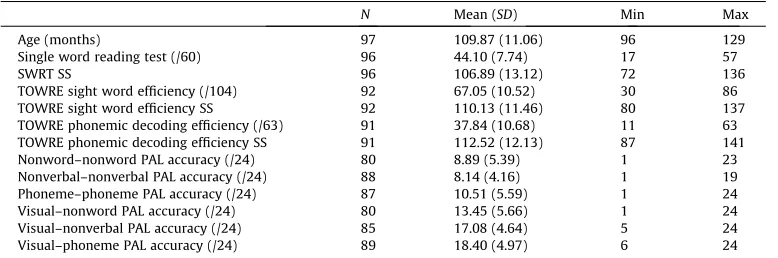
Descriptive statistics for all measures are shown in Table 1. Children performed at an age-appropriate level on measures of reading. There were small amounts of missing data due to occasional absences from school across the 6 consecutive days of testing and due to technical difficulties that resulted in the loss of PAL data for 2 children. Correlations between all measures are shown inTable 2
(simple correlations below the diagonal and partial correlations controlling for age above the diagonal).
There was a wide range in performance across the PAL conditions. Performance was higher on the visual–articulatory PAL conditions compared with the auditory–articulatory conditions, and perfor-mance varied in both sets of conditions according to the type of response (phoneme > nonverbal so und > nonword). To investigate differences in accuracy, we performed a repeated-measures analysis of variance (ANOVA) with modality (2 levels: auditory–articulatory or visual–articulatory) and response type (3 levels: nonword, nonverbal, or phoneme) as within-participant variables. There was a main effect of modality, with performance on the visual–articulatory conditions being better than performance on the auditory–articulatory conditions,F(1, 69) = 250.91,p< .001, partial
g
2 =.784. There was also a main effect of response type,F(2, 138) = 281.45,p< .001, partial
g
2= .168,indi-cating a significant difference in accuracy across the three stimulus types (with phoneme responses being by far the easiest). This main effect of response type was qualified by a significant interaction between modality and response type, F(2, 138) = 17.79,p< .001, partial
g
2= .205, which reflects [image:6.468.40.429.471.600.2]the fact in the visual–articulatory conditions the ordering of difficulty (phoneme > nonword > nonver bal) differed from that in the auditory–articulatory conditions (phoneme > nonverbal > nonword). This interaction reflects the fact that requiring children to associate two different nonverbal sounds was a particularly difficult learning task.
Table 1
Descriptive statistics for all measures.
N Mean (SD) Min Max
Age (months) 97 109.87 (11.06) 96 129
Single word reading test (/60) 96 44.10 (7.74) 17 57
SWRT SS 96 106.89 (13.12) 72 136
TOWRE sight word efficiency (/104) 92 67.05 (10.52) 30 86
TOWRE sight word efficiency SS 92 110.13 (11.46) 80 137
TOWRE phonemic decoding efficiency (/63) 91 37.84 (10.68) 11 63
TOWRE phonemic decoding efficiency SS 91 112.52 (12.13) 87 141
Nonword–nonword PAL accuracy (/24) 80 8.89 (5.39) 1 23
Nonverbal–nonverbal PAL accuracy (/24) 88 8.14 (4.16) 1 19
Phoneme–phoneme PAL accuracy (/24) 87 10.51 (5.59) 1 24
Visual–nonword PAL accuracy (/24) 80 13.45 (5.66) 1 24
Visual–nonverbal PAL accuracy (/24) 85 17.08 (4.64) 5 24
Visual–phoneme PAL accuracy (/24) 89 18.40 (4.97) 6 24
Relationships between PAL measures and reading
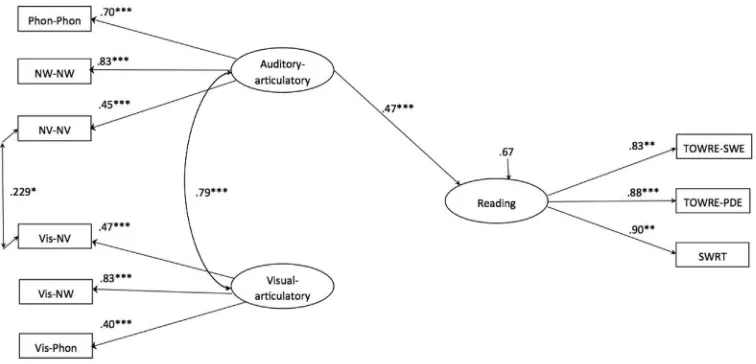
The latent variable path model shown inFig. 1was estimated with Mplus 7.4 (Muthén & Muthén, 1998–2016). Little’s MCAR test confirmed that the small number of missing values could be consid-ered missing completely at random,
v
2(98) = 115.1759,p= .11, and the small number of missing val-ues (n= 16) was handled with full information maximum likelihood estimation. [image:7.468.44.429.83.180.2]The theory we wished to test was that an auditory–articulatory PAL could be distinguished from a visual–articulatory PAL factor and that the visual–articulatory factor would show the strongest rela-tionship with reading ability. As a first step to developing the path model shown inFig. 1, a confirma-tory factor analysis model was estimated with the six PAL tasks defining two correlated latent variables: visual–articulatory PAL (visual–phoneme, visual–nonverbal, and visual–nonword) and auditory–articulatory PAL (phoneme–phoneme, nonverbal–nonverbal, and nonword–nonword). Add-ing a covariance between the two measures that involved a nonverbal response (nonverbal–nonverbal Table 2
Pairwise correlations between reading and PAL measures.
1 2 3 4 5 6 7 8 9
Word reading accuracy .74*** .79*** .41*** .29** .17 .29** .21 .12
Sight word fluency .71*** .74*** .27* .18 .12 .26* .21 .10
Nonword fluency .77*** .71*** .39*** .28* .19 .22* .21 .05
Nonword–nonword PAL .42*** .29* .40*** .36** .57*** .52*** .19 .20
Nonverbal–nonverbal PAL .33** .23* .31** .37** .26* .22* .30** .13
Phoneme–phoneme PAL .22* .18 .23* .58*** .26* .51*** .23* .34**
Visual–nonword PAL .28* .24* .21 .52*** .23* .53*** .37** .30**
Visual–nonverbal PAL .18 .18 .19 .19 .32** .25* .36** .38***
Visual–phoneme PAL .15 .14 .07 .20 .12 .33** .32** .39***
Note.Simple correlations are shown above the diagonal, and correlations controlling for age are shown below the diagonal. PAL, paired-associate learning.
* p< .05. ** p< .01. ***p< .001.
[image:7.468.49.427.414.596.2]and visual–nonverbal) resulted in a model with a good fit,
v
2(11) = 13.907,p= .24, root mean square error of approximation (RSMEA) = .053 (90% confidence interval [CI] = .000–.128), comparative fit index (CFI) = 0.97, standardized root mean residuals (SRMR) = .051. Therefore, this structure was used for the path model shown inFig. 1.In the final model shown inFig. 1, all latent variables were regressed on age (although these regres-sions are not shown in the figure); hence, the model represents relationships between the latent vari-ables that are independent of the shared variance attributable to age. An initial version of this model included paths from both PAL latent variables to reading. However, in this initial model, the path weight from auditory–articulatory PAL to reading was substantial and significant (.536,p= .043), whereas the path weight from visual–articulatory PAL to reading was negligible in size and not signif-icant ( .087,p= .754). Dropping this path resulted in a nonsignificant change in model fit,
v
2 differ-ence(1) = .103,p= .75. Therefore, we used this simplified model where the nonsignificant path had been dropped.In this model, after controlling for the effects of age, the two PAL latent variables are quite highly correlated with each other (r= .79), but auditory–articulatory PAL showed a stronger correlation with reading (r= .43) than visual–articulatory PAL (r= .36). The model accounts for 33% of the variance in reading skills and provides an excellent fit to the data,
v
2(29) = 29.014,p= .46, RSMEA = .002 (90% CI = .000–.078), CFI = 1.00, SRMR = .057.Discussion
This study explored the role of different types of PAL tasks as predictors of reading ability in chil-dren. More specifically, we examined the role of different types of associative learning (auditory–ar-ticulatory vs. visual–ar(auditory–ar-ticulatory) and the type of response required (phoneme, nonword, or nonverbal sound) as determinants of the strength of relationship between reading and PAL.
The findings from the path model are clear in showing that an auditory–articulatory PAL latent variable is a strong predictor of reading ability (accounting for 33% of the variance). However, after controlling for the effects of auditory–articulatory PAL, the visual–articulatory PAL latent variable accounted for no additional variance. This pattern contradicts earlier claims (Hulme et al., 2007) that cross-modal PAL plays an especially important role in learning to read and supports the view from later research that PAL tasks involving verbal learning are the ones most closely related to learning to read (e.g.,Kalashnikova & Burnham, 2016; Litt et al., 2013; Messbauer & de Jong, 2003).
The pattern of correlations inTable 2 shows that the PAL tasks with higher auditory–articula-tory learning demands show the strongest relationship with reading ability. Specifically, among the auditory–articulatory PAL tasks, the strongest PAL–reading correlation was observed for the non-word–nonword PAL condition, and the lowest correlation was for the phoneme–phoneme condi-tion. Arguably, the amount of phonological information that needs to be retained in memory is far higher in the nonword–nonword condition than in the phoneme–phoneme condition. Pho-nemes, in contrast to nonwords, are short and highly familiar forms and, therefore, are less demanding to learn.
It is interesting that among the auditory–articulatory PAL conditions the nonverbal–nonverbal task was a moderate correlate of reading ability (and stronger than the phoneme–phoneme PAL condition). We selected this stimulus category for being articulatory but nonverbal; however, it seems that the processing demands of learning these nonverbal stimuli share something in common with learning about verbal stimuli (phonemes or nonwords). The fact that nonverbal–nonverbal PAL correlates bet-ter with reading than the phoneme–phoneme condition suggests that something akin to the load on memory (where load reflects both stimulus familiarity and complexity) is driving the relationship between PAL and learning to read.
when items are confusable (in the same modality/phonologically similar). Therefore, these conditions involve the highest level of phonological competition and, in turn, place the greatest demands on memory. Although children demonstrated significantly higher accuracy in the visual–articulatory con-ditions, there was still a reasonable distribution of scores across these conditions (i.e., children were not performing at ceiling); therefore, it is unlikely that differences in task difficulty can account for these results. It is possible that increased memory load is driving the relationship between PAL and reading. However, an alternative theory is that both nonword and nonverbal PAL tasks involve learn-ing the associated articulatory gestures of novel sounds, which may also be implicated in learnlearn-ing to read. According to the motor theory of speech perception (Liberman, 1999), phonemes are encoded as articulatory gestures, and (in line with this) studies have demonstrated improved visual word recog-nition following training in analyzing articulatory gestures (Boyer & Ehri, 2011; Castiglioni-Spalten & Ehri, 2003).
An alternative explanation for this finding is that children were referring to familiar or preexist-ing verbal labels (e.g., the words ‘‘cough” and ‘‘tut”) when retrievpreexist-ing the nonverbal sounds in mem-ory rather than encoding and retrieving the actual nonverbal PAL stimuli. Given this possibility, it cannot be argued that this condition performs the function of being entirely nonverbal. However, that is not to say that performance in this condition depends entirely on verbal learning. For exam-ple, children may remember a verbal label and its associated meaning and, therefore, may be engag-ing additional skills rather than simply relyengag-ing on phonological memory (seeLaing & Hulme, 1999). It is clear that there are challenges in creating a nonverbal analogue of PAL while keeping response modality (i.e., articulatory production) consistent, although further research is needed to investigate nonverbal learning mechanisms and the possible role of an articulatory learning mechanism in learning to read.
In summary, the results presented here are consistent with recent accounts and provide clear sup-port for the role of verbal learning in explaining the PAL–reading relationship (Litt & Nation, 2014; Litt et al., 2013). We found that an auditory–articulatory latent variable was a stronger predictor of read-ing ability than the cross-modal visual–articulatory latent variable. However, we also found a strong correlation between reading and nonverbal–nonverbal PAL. This seemingly provides counterevidence for the verbal account and highlights the methodological advantage of the current study in comparing multiple PAL tasks. Thus, in conclusion, the current study provides support for the verbal account of the PAL–reading relationship. However, our results introduce the idea that articulatory learning might be an important demand implicated in both verbal PAL and reading; as such, further research is required to clarify the PAL–reading relationship.
Acknowledgments
This research was supported by ESRC Grant ES/L008270/1. We thank Katie Gallon for her assistance with data collection and the schools and children who took part. We would also like to thank Dr Mike Coleman (UCL) for his time in programming the paired associate learning task.
Appendix A
Visual symbols used for PAL tasks
Appendix B. Supplementary material
References
Boyer, N., & Ehri, L. C. (2011). Contribution of phonemic segmentation instruction with letters and articulation pictures to word reading and spelling in beginners.Scientific Studies of Reading, 15, 440–470.
Castiglioni-Spalten, M. L., & Ehri, L. C. (2003). Phonemic awareness instruction: Contribution of articulatory segmentation to novice beginners’ reading and spelling.Scientific Studies of Reading, 7, 25–52.
Ehri, L. C. (1992).Reconceptualizing the development of sight word reading and its relationship to recoding. Hillsdale, NJ: Lawrence Erlbaum.
Foster, H. (2007).Single word reading test 6–16. London: GL Assessment.
Hulme, C., Goetz, K., Gooch, D., Adams, J., & Snowling, M. J. (2007). Paired-associate learning, phoneme awareness, and learning to read.Journal of Experimental Child Psychology, 96, 150–166.
Hulme, C., & Snowling, M. J. (2013a).Developmental disorders of language learning and cognition. Hoboken, NJ: John Wiley.
Hulme, C., & Snowling, M. J. (2013b). Learning to read: What we know and what we need to understand better.Child Development Perspectives, 7, 1–5.
Hülse, S. H., Egeth, H., & Deese, J. (1980).The psychology of learning. New York: McGraw–Hill.
Kalashnikova, M., & Burnham, D. (2016). Novel word learning, reading difficulties, and phonological processing skills.Dyslexia, 22, 101–119.
Laing, E., & Hulme, C. (1999). Phonological and semantic processes influence beginning readers’ ability to learn to read words. Journal of Experimental Child Psychology, 73, 183–207.
Lervåg, A., Bråten, I., & Hulme, C. (2009). The cognitive and linguistic foundations of early reading development: A Norwegian latent variable longitudinal study.Developmental Psychology, 45, 764–781.
Liberman, A. M. (1999). The reading researcher and the reading teacher need the right theory of speech.Scientific Studies of Reading, 3(2), 95–111.
Litt, R. A., de Jong, P. F., van Bergen, E., & Nation, K. (2013). Dissociating cross-modal and verbal demands in paired associate learning (PAL): What drives the PAL–reading relationship?Journal of Experimental Child Psychology, 115, 137–149.
Litt, R. A., & Nation, K. (2014). The nature and specificity of paired associate learning deficits in children with dyslexia.Journal of Memory and Language, 71, 71–88.
Mayringer, H., & Wimmer, H. (2000). Pseudoname learning by German-speaking children with dyslexia: Evidence for a phonological learning deficit.Journal of Experimental Child Psychology, 75, 116–133.
Melby-Lervåg, M., Lyster, S.-A. H., & Hulme, C. (2012). Phonological skills and their role in learning to read: A meta-analytic review.Psychological Bulletin, 138, 322–352.
Messbauer, V. C., & de Jong, P. F. (2003). Word, nonword, and visual paired associate learning in Dutch dyslexic children.Journal of Experimental Child Psychology, 84, 77–96.
Muter, V., Hulme, C., Snowling, M. J., & Stevenson, J. (2004). Phonemes, rimes, vocabulary, and grammatical skills as foundations of early reading development: Evidence from a longitudinal study.Developmental Psychology, 40, 665–681.
Muthén, L. K., & Muthén, B. O. (1998–2016).Mplus user’s guide(6th ed.). Los Angeles: Muthén & Muthén.
Rastle, K., Harrington, J., & Coltheart, M. (2002). 358,534 nonwords: The ARC nonword database.Quarterly Journal of Experimental Psychology A, 55, 1339–1362.
Snowling, M. J. (2000).Dyslexia(2nd ed.). Oxford, UK: Blackwell.
Taylor, J. S. H., Plunkett, K., & Nation, K. (2011). The influence of consistency, frequency, and semantics on learning to read: An artificial orthography paradigm.Journal of Experimental Psychology: Learning, Memory, and Cognition, 37, 60–76.
Torgesen, J. K., Rashotte, C. A., & Wagner, R. K. (1999).TOWRE: Test of word reading efficiency. Austin, TX: Pro-Ed.
Vellutino, F. R., Scanlon, D. M., & Spearing, D. (1995). Semantic and phonological coding in poor and normal readers.Journal of Experimental Child Psychology, 59, 76–123.
Vellutino, F. R., Steger, J. A., Harding, C. J., & Phillips, F. (1975). Verbal vs non-verbal paired-associates learning in poor and normal readers.Neuropsychologia, 13, 75–82.
Warmington, M., & Hulme, C. (2012). Phoneme awareness, visual–verbal paired-associate learning, and rapid automatized naming as predictors of individual differences in reading ability.Scientific Studies of Reading, 16, 45–62.
Wimmer, H., Mayringer, H., & Landerl, K. (1998). Poor reading: A deficit in skill-automatization or a phonological deficit? Scientific Studies of Reading, 2, 321–340.