Electronic Theses and Dissertations Theses, Dissertations, and Major Papers
1-1-1971
The relative effectiveness of verbal and pictorial cues in children's
The relative effectiveness of verbal and pictorial cues in children's
paired-associate learning.
paired-associate learning.
Andrew H. Reid
University of Windsor
Follow this and additional works at: https://scholar.uwindsor.ca/etd
Recommended Citation Recommended Citation
Reid, Andrew H., "The relative effectiveness of verbal and pictorial cues in children's paired-associate learning." (1971). Electronic Theses and Dissertations. 6697.
https://scholar.uwindsor.ca/etd/6697
THE RELATIVE EFFECTIVENESS OF
VERBAL AND PICTORIAL CUES
IN CHILDREN'S PAIRED-ASSOCIATE LEARNING
ANDREW H. REID
B.A., FLORIDA ATLANTIC UNIVERSITY, 1968
A Thesis
Submitted to the Faculty of Graduate Studies through the Department of Psychology in Partial Fulfillment
of the Requirements for the Degree of Master of Arts at the
University of Windsor
INFORMATION TO USERS
The quality of this reproduction is dependent upon the quality of the copy
submitted. Broken or indistinct print, colored or poor quality illustrations and
photographs, print bleed-through, substandard margins, and improper
alignment can adversely affect reproduction.
In the unlikely event that the author did not send a complete manuscript
and there are missing pages, these will be noted. Also, if unauthorized
copyright material had to be removed, a note will indicate the deletion.
®
UMI
UMI Microform EC53101Copyright 2009 by ProQuest LLC.
All rights reserved. This microform edition is protected against
unauthorized copying under Title 17, United States Code.
ProQuest LLC
ACKNOWLEDGEMENTS
I wish to express my appreciation to Dr. R. Robert Orr
for the many hours of assistance and direction he provided
throughout the course of this investigation.
I also wish to express my appreciation to Drs. Akira
Kobasigawa and Gediminas Namikas for their helpful
to be facilitated by both visually (imaginally) joining
pictures of the items in an interaction, and verbally
joining side-by-side pictures of the items in an inter
action. Bruner (196^) proposed a developmental sequence
in which children move from an ikonic or imaginal mode
of mediation to a representational or verbal mode. Research
in the area of children’s paired-associate learning has,
however, produced results which are inconsistent with Bruner’s
framework. The present study was designed as a test of
the findings of Davidson and Adams (1970) that grade two
children are aided more by verbal cues than visually
«
interacting cues alone, in learning paired-associate items5
and, further, to determine which method is most effective
in promoting learning in kindergarten children.
Twenty-four grade two and 2
^
kindergarten childrenlearned a mixed list of 16 paired-associate items. Half
of the items were visually interacting pictures and half
the items were verbally interacting side-by-side pictures.
Twelve children at each grade level were assigned to either
a verbal condition in w h i c h the items were joined by a
verbal connective, or a nonverbal condition in which the
items were simply named.
stimulus-response pairs are learned better than side-by-
side pictures, but that joining pairs verbally facilitates
learning relative to simply naming the pairs. Joining
pairs visually almost consistently produced better perform
ance than if the pairs were side-by-side for both age levels,
regardless of whether a verbal connective was used or not.
The results suggest that grade two performance differs only
List of Tables ... . . . vi
List of Figures vii Introduction . . . ... 1
Method . ... ...9
R e s u l t s ... ... .. 15
D i scussion... .. ...
24-Appendix A: Review of the L i t e r a t u r e ... 30
Appendix 3; Stimuli Used ... 4-5 Appendix C: Order of Response Slides ... 4-6 Appendix D: Raw D a t a ... 4-9 Appendix Es Analysis .of Variance T a b l e ... 53
References...
LIST OF TABLES
Table Page
1 Order in Y/hich Stimulus .and Response
Pairs Were Presented in Trials 1, 2
and 12
2 Summary of Kindergarten and Grade 2 Mean
Performance in Verbal and Nonverbal Conditions with Interacting (INT) and
Side-3y-Side (S3S) Pairs' ... 16
3 Summary of Analysis of Variance of Grade,
1 Mean number of correct responses in Trials X Verbalization (VC), Non-
verbalization (NVC) Interaction... 19
2 Frequency of correct responses for
corresponding INT and S'BS pairs on Trial
3. 21
3 Mean correct responses for three trials
for verbalization condition (VC) non
verbalization condition (NVC), interacting
INTRODUCTION
Children’s paired-associate (PA) learning can be
facilitated by joining stimuli verbally or pictorially
(Davidson and Adams, 19?0; Paivio, 1969; Reese, 1970).
Davidson and Adams have shown that PA learning in grade-
two children is facilitated more by joining stimulus and
response items with a verbal phrase than by joining them
pictorially. The present study is designed to evaluate
the reliability of this finding, as well as to determine
if the facilitating effects of a verbal phrase cue are
the same for kindergarten as well as grade-two children.
In studies of PA learning using pictures as stimuli
and responses, verbal conditions usually involve present
ing the subject with side-by-side pictures and a verbal
description of an interaction between the stimulus and
response items, using a phrase or a sentence. Pictorial
conditions usually involve presenting the subject with a
picture of the stimulus and response items in an inter
action identical to that verbally described in the verbal
condition. The pictorial condition is usually referred to
as the "imaginal" condition as it is assumed that the
interacting pictures of stimulus and response items will
condition it is assumed that the stimulus and response
items are represented internally by verbal labels.
The hypotheses concerning internal representation are
inferential and the validity of these assumptions is
subject to question since the dependent and independent
variables used in PA studies concerned with imagery have
not been constructed to bring the problem to resolution.
The term "imaginal" as used in this paper will refer to
the above mentioned pictorial condition, standing
simply as traditional identifying name, rather than an
internal process elicited by the experimental manipu
lations.
Milgram (1967) has proposed that an imposed imaginal
form may elicit a covert verbal mediator and Rowher (1967)
has proposed that an imposed verbal form may elicit
mediating images. The findings of Yuille and Pritchard
(1969) that verbal cues elicited images in their subjects
adds support to Rowher*s proposal rather than Milgram*s.
According to Davidson and Adams (1970), however, suggest
ing that an imposed image may elicit a covert verbalization
or that an imposed verbal form may elicit an image does
not rule out the p o s s i b i l i t y that, altho u g h b o t h events
may occur, one process may be dominant or that one process
3
.and Adams* findings indicate that an imposed verbal cue
is the most effective mediator at the grade-two level.
Verbal cues, however, are apparently differentially
effective. Rowher (1966) found that the type of word
which joins a PA pair produces differences in facilitation.
Rowher presented grade-six subjects with verbal phrases
which joined stimulus and response items. He found that
a verb phrase combining stimulus and response items
provided the most facilitation in childrens’ PA learning,
followed by prepositional phrases, and finally conjunctive
phrases which provided relatively little facilitation
compared to the other two types of phrases. Davidson
and Adams used both prepositional and conjunctive phrases
in their study and confirmed that conjunctive phrases are «
relatively less effective in facilitating PA learning
than prepositional phrases.
An experiment by Milgram (196?) indicated that the
PA learning of younger children (approximately age 5)
was facilitated more by a verbal condition than by an
imaginal condition. The verbal condition consisted of
side-by-side line-drawings of stimulus and response items
and a sentence combining both items. The imaginal
Reese (1965) found that the PA learning of younger subjects
was facilitated by both conditions relative to a group
which did not receive visual or verbal interaction.
Both Milgram and Reese found that the PA learning of older
children (approximately age 7) was facilitated under both
conditions.
Davidson and Adams found a significant difference
between the verbal condition and the imaginal condition
in children approximately seven years of age with the
verbal condition being significantly superior. Their
findings suggest, contrary to Milgram and Reese, that the
verbal mode (verbal interaction) is a more effective
mediator than the imaginal mode (interacting pictures)
at this age level. Davidson and Adams did not, however,
use subjects of a younger age level and neither confirm
nor disconfirm the finding that the verbal mode .is the
most effective mediator for young children.
Davidson and Adams’ study differs significantly from
the Milgram and Reese studies in that they used a recogni
tion task rather than a recall task to measure learning.
5
Two- study-test trials were administered to each
subject. During the study portion of each trial Davidson
and Adams administered pictorial representations of
stimulus and response items which were either
side-by-side line drawings or interacting line drawings. Either
prepositional or conjunctive phrases were spoken by the
experimenter combining stimulus and response items (verbal
conditions). The combination of interacting (Joined) or
side-by-side (Non-Joined) line drawings with prepositional
or conjunctive phrases yielded four conditions: Joined
Preposition, Joined Conjunction, Non-Joined Preposition,
and Non-Joined Conjunction. During the test portion of
each trial the experimenter presented the stimulus member
of each pair and asked the subject to circle the correct
response on a response sheet. This procedure provided
optimal conditions under which the subject could mediate
either imaginally or verbally. Using this procedure
Davidson and Adams found that the Non-Joined Preposition
group performed significantly better than the Joined
Conjunction group.
The study found, therefore, that the prepositional
joining of side-by-side pictures with a verbal phrase
(Non-Joined Preposition) facilitated learning more than
a conjunction. Apparently the Joined Conjunction,
Joined Preposition and Non-Joined Preposition conditions
produced better performance than the Non-Joined Conjunction
condition. Thus, with a recognition procedure, verbal,
imaginal, or verbal and imaginal cues together facilitate
learning of a PA list more than' simply joining items with
a conjunction.
The present study was designed to validate the findings
of Davidson and Adams that a prepositional connective is
a more effective mediator in childrens’ PA learning than a
picture depicting the prepositional interaction. There were
several important differences between the present study and
the study of Davidson and Adams.
The first difference is that the children were tested
individually rather than in groups. This change was institu
ted to provide a better control for' attention in individual
subjects..
Another change was the use of a within subjects
design in which all subjects were exposed to both inter
acting and side-by-side pairs. This change was made to
determine if these different conditions might be differentially
facilitative for individual subjects.
Only two of the conditions from the Davidson and Adams
7
(imaginal condition) and Non-Joined Preposition (verbal
condition)# The conditions were limited to these because
the traditional comparison between imagery and verbal inodes
of mediation v/ere possible with these two conditions, Two
additional conditions were added in which interacting and
side-by-side pairs were named with both the prepositional
and conjunctive terms omitted.
Additionally, two age levels v/ere used rather than
just one age level as in the Davidson and Adams* study.
Both kindergarten and grade two subjects were employed
in the present study in order to test the reliability
of the Davidson and Adams* findings (grade two) and to
determine if these findings apply to kindergarten children.
If the findings of Davidson and Adams (1970) are valid,
it v/ould be expected that the grade tv/o subjects (seven'
years) v/ould perform better in the condition that provided
a prepositional phrase- joining side-by-side pictures in a
verbal interaction than in conditions which provided a
visual interaction and a conjunctive phrase or simply named
the PA items.
i
If the findings of Milgram (1967) are valid, it would
be expected that the kindergarten subjects (five years)
v/ould perform similar to the grade two subjects and benefit
more from the verbal cues, relative to the other conditions.
would be expected that these subjects would perform
equally well' in conditions providing verbal or imaginal
cues relative to the naming condition.
If the recognition procedure provides optimum condi
tions for the subject to respond either imaginally or
verbally, it would be expected on the basis of Bruner’s
theory that the kindergarten subjects are functioning
in the ikonic mode and v/ould perform better in the imagery
condition, relative to the other conditions.
It would also be expected, according to Rowher (1966),
that prepositional and conjunctive phrases would produce
better performance, in both kindergarten and grade two
subjects, than a simple naming condition which did not
METHOD
Subjects (S): The Ss were 48 children from a
Windsor Separate School. There' were 24 kindergarten
children (12 male and 12 female) and 24 grade two children
(12 male and 12 female).
Design: The Ss were shown line drawings which
were either side-by-side (S3S) or interacting (INT),
with each S being shown both kinds of stimuli. These items
are illustrated in Appendix A. For half of the Ss the
experimenter (E) verbally labelled the stimuli and joined
them with a conjunctive phrase if they were interacting
or a prepositional phrase if they were side-by-side
(Verbally Connected Groups or VC). For the other half of
the Ss the E labelled the same stimuli, but did not
verbally join them with a prepositional or conjunctive
phrase (Nonverbally Connected Groups or NVC).
The independent measures were age level (kinder
garten or grade two), type of presentation (S3S or INT),
type of connection (VC or NVC), and trials (one, two, and
three). Trials and type of presentation were within-Ss
factors.
Materials and Apparatus: The stimulus and response
items 'were randomly selected from the items used by
were on slides and were presented on a rear-projection
screen. The 7" x 10" - in. screen was mounted on the
front of a 12" x IV' x 32" - in. box. The rear of the
box housed a Kodak Ectographic Carousel slide projector.
A slide containing all 16 response items followed each
stimulus on the test trials. Stimulus presentations
on the study trials were controlled by a Hunter Timer
(Model 1512).
For the INT pairs (the imagery manipulation) the
Ss were presented with slides on which the stimulus and
response items were pictured in a visual interaction.
In the VC condition the E described the pairs with a
conjunctive phrase. For example, the stimulus item rope
was pictured around the- response item jar. The E named
each item and then said a conjunctive phrase combining the
items.such as "rope and jar". In the NVC condition the E
simply named the items. .
For the S3S pairs (prepositional connective) the Ss
were presented with pictures of the stimulus and response
items side-by-side. The E named them and joined them with
a prepositional phrase in the VC condition. For example,
the stimulus item key was presented beside the response item
pillow. The E named each item and then combined them in a
verbal interaction such as "key on pillow". In the NVC
11
There were eight pairs of each type, S3S and INT#
All 16 pairs were presented to each S on each of three
trials. These pairs are listed in Appendix 3. Twelve Ss
(six male and six female) from 'each grade were randomly
assigned to the VC condition and the remaining Ss to the
NVC condition. For six Ss (three male and three female) in
each condition (VC or NVC), items 1 - 8 in Appendix B were
interacting and 9 - 1 6 were side-by-side. For the remain
ing Ss, items 1 - 8 were side-by-side and 9 - 1 6 were
interacting.
t
Table 1 lists the order in which the pairs were
presented on each trial. The two types of pairs were
randomly mixed in the list with the stipulation that not
more than two pairs of .one type occur consecutively.
Pairs were reordered for each trial. The order of presenta
tion y/as the same for all Ss (i.e., the first pair on each
trial consisted of the same picture for all Ss).
The test trials consisted of 16 single stimulus
pictures with each picture presentation followed by a
picture of all 16 possible responses. The response slides
consisted of four random orders with four slides of each
order occurring on each test trial. Appendix C lists the
orders of response slides and illustrates the stimuli on
Table 1
Order in Which Stimulus and Response Pairs V/ere Presented
in Trials 1, 2 and 3«
Trial 1 Trial 2 Trial 3
Picture - Mailbox Iron - Candle Tie - Cow
Ball - Feather Bird - Dress Moon - Top Skate -- Brush Cake - Pencil Chair - Shoe Tire - Hat Pillow - Key
Ring - Lamp Chain - Dish Rope - Jar
Ship ~ Carriage Book - Lock
Tie - Cow Rope - Jar Pillow - Key Ring - Lamp Book - Lock
Picture - Mailbox Moon - Top
Bird - Dress Chain - Dish Tire - Kat Skate - Brush Iron - Candle Ship - Carriage Chair - Shoe Cake - Pencil Ball - Feather
Cake - Pencil Bird - Dress Tire - Hat Chain - Dish Ship - Carriage Moon - top
Pillow - Key Iron - Candle Tie - Cow Chair - Shoe Rope - Jar 3ook - Lock
Picture - Mailbox Ring - Lamp
13
Procedure; Each S_ was taken to a room and tested
individually. The S was seated in front of the rear-
projection screen with the E seated beside him. The E
gave the S the following instructions before the initial
study trials
I am going to show you pictures
of two things at a time. I want you
to look carefully at the pictures and try to remember which things I have
shown you. After I have shown you all
of the pictures I will show you one of them and ask you to show me what goes
with it. Remember, I want you to look
carefully at the pictures and remember
which go together. Are there any ques
tions?
During the study portion of each trial the entire
list of PA pairs was shown to each S. Each pair v/as
' presented for five seconds after which the projector
automatically advanced to the next pair.
Three study-test trials v/ere administered, v/hich took
approximately 20 minutes. The appropriate verbalization
by the E in the VC condition for the S3S and INT pairs
was only given during the initial study trial. In the
NVC condition the E simply named each item for the S during
the initial study trial. On trials two and three only
the pictures were shown with no concomitant verbalization
by the E in all conditions.
Following the initial study trial the E gave the S
what goes with it. Are there any questions?
During the test portion of each trial only the
stimulus itera of each pair was presented to the S. Each
item was timed by the E and presented for three seconds.
After the three seconds elapsed the E advanced the projector
to a response slide and the S was asked to point to the
correct response. If the S had not responded after five
seconds the E asked him to make a response. The E
recorded the response on the response sheet shown in Appendix
B. Following a response, the E immediately advanced the
projector to the next test item. This recognition procedure
did not require any verbalization by the S.
Upon completion of the experimental procedure, the
RESULTS
This study investigated children's performance
on the recognition phase of a paired-associate task as
a function of age, type of interaction between stimulus
and response, and type of verbalization by the E about
the interaction. The data are summarized in Appendix D.
Table 2 shows the performance of the kindergarten
and grade two children on the three recognition trials
for both the verbalization and nonverbalization conditions.
An analysis of variance (four factors with repeated measures
on two factors; Winer, 1962, p. 34-9 ff) was performed
1
on the mean number of correct responses per trial. This
analysis is summarized .in Table 3.
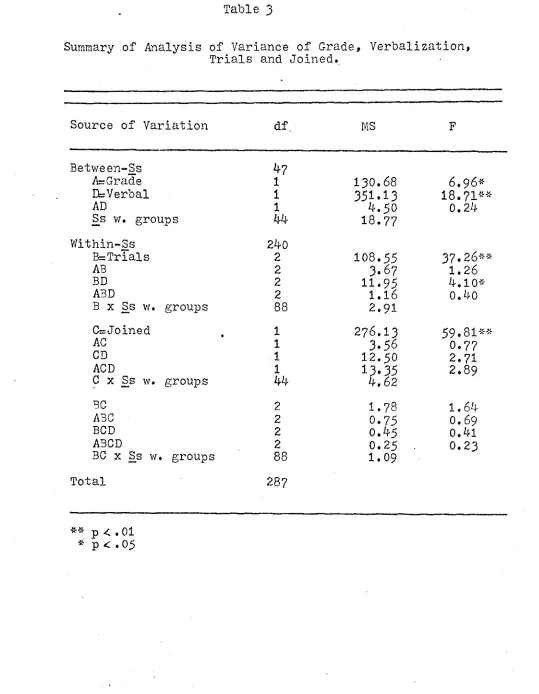
The mean correct responses for kindergarten and grade
two differed significantly (F (1,44) = 6.96, p<.05), indica
ting, as expected, that, grade two Ss performed better than
younger children. No interactions involving age were
significant.
The main effect for trials was significant (F (2,88) =
37*26, p < .01), and the main effect for verbalization was
significant (F (1,4-4-) = 18.71 * P <• 01)• The significant
1 The main effects for sex and counterbalancing were
analyzed and found nonsignificant; therefore, they v/ere
not included in additional analyses (F (1,4-4-) = 0.00,
Table 2
Summary of Kindergarten and Grade 2 Mean Performance in Verbal and Nonverbal Conditions with Interacting (INT) and
Side-By-Side _(S3S) Pairs.
Trials
Condition 1 2 3 Overall
Kinders: art en
Verbal SBS 2.50 4.17 5.17 3.95
Verbal INT 4.58 6.75 7.08 6.14
Verbal Overall •3.54 5*46 6.13 5.05
Nonverbal SBS 1.25 1.58 1.67 1.50
Nonverbal INT 2.92 4.00 4.08 3.67
Nonverbal 0verall2.09 2.79 2.87 2.59
Overall 2.82 4.13 4.50 3.82
Grade 2
Verbal SBS 4.00 5.92 7.17 5.70
Verbal INT 5.00 7.08 7.67 6.58
Verbal Overall 4.50 6.50 7.42 6.14
Nonverbal SBS 1.83 2.83 4.00 2.89
Nonverbal INT 4.42 5.75 6.2 5 5.^7
Nonverbal 0verall3.13 4.29 5.13 4.18
17
Table 3
Summary of Analysis of Variance of Grade, Verbalization, Trials and Joined.
Source of Variation df. MS F
Between-Ss 47
AnGrade 1 130.68 6.96*
D= Verbal 1 351.13 18.71**
AD 1 4-.50 0.24
Ss w. groups 44 18.77
Within-Ss 24-0
B=Trials 2 108.55 37.26**
AB 2 3.67 1.26
BD 2 11.95 4.10*
ABD 2 1.16 0.40
B x Ss w. groups 88 2.91
C=Joined 1 276.13 59.81**
AC 1 3.56 0.77
CD 1 12.50 2.71
ACD 1 13.35 2.89
C x Ss w. groups 44 4.62
BC 2 1.78 1.64
ABC 2 0.75 0.69
BCD 2 0.4-5 0.41
A3CD 2 O.25 . 0.23
BC x Ss w. groups 88 1.09
Total 287
** p < .01
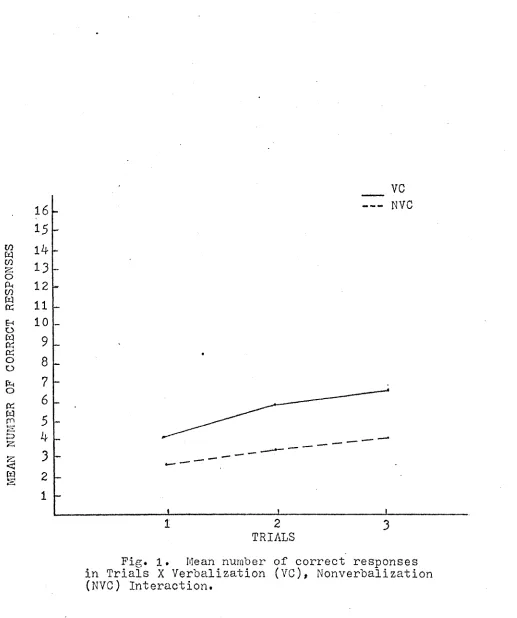
Trials X Verbalization interaction is shown in Figure 1
(F (2,88) s 4-.10, p < .05). Analyses of variance (Lindquist,
1956, p. 165 ff) performed on the trials factor at each
level of the verbalization condition (verbalization, no
verbalization) were significant (F (2,88) = 66.0^, p<f.01,
and F (2,88) - 16.68, p < . 0 1 respectively). Follow up
t-tests for pairs of trials indicated that in the VC, trials
1 and 2 were significantly different ( p < .05) as well as
trials 1 and 3 (p<'*05). In the NVC condition, only trials
1 and 3 were significantly different (p<.05). Comparing
VC and NVC at each trial, the t-tests indicated that the
VC was significantly better than the NVC on all three trials
(p < . 05 ).
Clearly, verbalizing a relationship (even if only a
conjunction) facilitates learning a stimulus-response assoc
iation, even in a situation requiring no verbalization by
the S. In this study the data indicate a clear learning
effect, with learning occurring most rapidly from the first
to second trial for the VC. The greatest difference between
the VC and NVC occurs in the third trial.
The main effect for type of presentation was significant
(F (1,^4) = 59*81, p .01), and the Type of Presentation X
Grade interaction was nonsignificant. The finding indicates
that the traditional imagery manipulation (visual interaction)
increas-M E A N N U M B E R OF C O R R E C T R E S P O N S E S 19 16 15
14
-13 12 11 10 9 8 7 6 5 k 3 2 1_
vc— NVC
1
2
3
TRIALS
Fig. l. Mean number of correct responses
ing the number of correct responses for both interacting
and side-by-side pairs in grade two by approximately the
same, amount.
Of the ^8 Ss, ^2 had more total correct responses for
the interacting than the side-by-side pairs on all three
trials. For the kindergarten Ss in the VC on Trials 1 through
3 the number of Ss making more correct responses for INT pairs
than SBS pairs was 10, 10, and 7, respectively, and in the
NVC 11, ?, and 9> respectively. For the grade two Ss in the
VC on Trials 1 through 3 the number of Ss making more correct
responses for INT pairs than SBS pairs was 6, 6, and 3> respect
ively, and in the NVC 10, 10, and 9t respectively. With the
exception of the V-grade two Ss, INT pairs consistently pro
duced more correct responses than SBS pairs. With regard to
the V-grade two subjects it should be noted that 8 of the 12
Ss on Trial 3 had an equal,high number of correct responses
for both INT and SBS-pairs. The results for V-grade two Ss
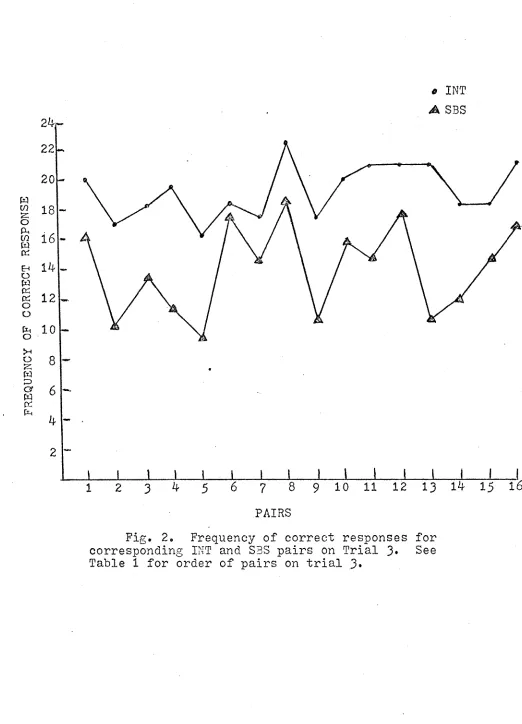
may, then, be due to a ceiling effect. Figure 2 shows the
frequency of correct responses for INT and SBS pairs in Trial
3* Collapsed over grade, the INT pairs consistently produced
more correct responses than their equivalent SBS pairs.
The Grade X Type of Presentation X Type of Verbalization
interaction collapsed over three trials is shown in Figure
3* Although the interaction was nonsignificant, the data
F
R
E
Q
U
E
N
C
Y
OF
C
O
R
R
E
C
T
R
E
S
P
O
N
S
E
21
e INT
A SBS
10
PAIRS
Fig. 2. Frequency of correct responses for
corresponding INT and SBS pairs on Trial 3* See
M E A N N U M B E R OF C O R R E C T R E S P O N S E S Kindergarten Grade Two VC NVC 8 ? 6 4 — 5 3 2 1 INT S3S
Fig. 3. Mean correct responses for three
trials for verbalization condition (VC) non- verbalization condition (NVC), interacting pairs
23
after Trial 1 in terras of performance in the different
conditions. On Trial 1 the INT pairs in both verbal and
nonverbal conditions were better than the SBS pairs in the
nonverbal conditions, but on Trials 2 and 3 "the correct
response for the INT pairs in the nonverbal condition fell
below those for the -SBS pairs in the verbal condition.
Thus, what evolves after Trial 1 is a consistent ordering
for both grades as follows, from best to worst: Verbal-INT;
Verbal-SBSj Nonverbal-INTj Nonverbal-S3S.
Possibly what is occurring is that the children do not
use, as efficiently, a verbal interaction on Trial 1 (an
imposed mediator), but are able to better mediate an inter
active phrase for joined stimuli. However, on Trial 2 they
begin to use the imposed mediator (even more efficiently than
the ones used by children in the nonverbal condition) and
the verbal condition becomes easier with respect to the
side-by-side pairs. The significant Verbalization X Trials
interacting stimulus-response pairs are learned better than
side-by-side pairs,' irrespective that joining pairs verbally
facilitates learning, relative to simply naming the pairs.
Within a given verbalization condition and age level, joining
pairs visually consistently produced better performance than
if the pairs were side-by-side, regardless of whether a
verbal connective was or was not used. The results also
indicate that grade two children’s learning in the conditions
used in this study is similar, but better than kindergarten
children's learning.
The present study failed to replicate the findings of
«
Davidson and Adams (1970) that a prepositional connective
verbally joining side-by-side pictures produced better learn
ing than visually interacting pictures joined by a conjunction,
with grade two subjects, as indicated by Table 2. The inter
acting pairs joined by a conjunction were consistently better
than the side-by-side pairs joined by a preposition with
the exception of grade two subjects in the verbal condition
who did almost equally well with both types of pairs. This
latter result, hov/ever, can be attributed to a ceiling effect
with these subjects. These data are, hov/ever, consistent with
the findings of Rowher (1966) that prepositional and conjunc
25
to simply naming the items without a verbal connective.
If Davidson and Adams' study does not reflect Type II
error, then failure to replicate may be due to method
ological differences between the two studies. In the present
study individual testing rather than group testing was used.
In an individual testing situation the experimenter has
better control over the attention of the subject. Attention
may have been a factor in the Davidson and Adams study if
the verbal phrases which were inconsistent with the pictures
the subjects saw held their attention better than visually
interacting pictures constantly accompanied by a conjunction.
Thus, if the subjects attended more to the prepositionally
connected side-by-side pictures (discrepant from what they
^perceived) they would have learned these better.
Another difference between the present study and
Davidson and Adams' study is that in the present study the
experimenter had better control over the responses. If
the subject had not responded after five seconds, he was
forced to make a response before advancing to the next
stimulus. This may not have occurred in the Davidson and
Adams study, (i.e., a disproportionate number of non
responders may have been in the Joined Conjunction condi
tion) although the authors do not discuss this possibility.
It is difficult to speculate if this difference can account
however, since little research concerning latency of
response is applicable. Possibly the latency to respond
is longer in the interacting picture condition (i.e., pre
dominant visual coding combined with verbal coding is
perhaps more cumbersome than when verbal coding is pre
dominant) and thus more subjects were forced to make a guess
or leave a blank in a timed response trial. Unfortunately,
no latency data is available in either study.
The data of the present are consistent with the
findings of Reese (1965)* Reese found, using subjects
of approximately the same age as the present study, that
both verbal and visual interactions were superior in
promoting learning to a non-interaction condition. The
present data supports this finding and also show that join
ing pairs in a visual interaction consistently produced
better learning than joining pairs in a verbal interaction.
The present data are also partially consistent with
Milgram (1967) who found that both visual and verbal inter
actions promoted learning in seven year olds more than a
non-interaction condition. Milgram found, however, contrary
to the present study that only the verbal interaction
condition promoted learning in younger subjects approximately
the same age as the kindergarten subjects of the present
study. This latter finding of Milgram differs with the
2?
may be due to the low number of younger subjects reaching
criterion in Milgram*s study because he used a trials to
criterion measure.
Both Milgram and Reese note a suggestive trend in their
data indicating that their subjects more often used the verbal
mode. The data from the present study indicate that both
kindergarten and grade two subjects use the imaginal pairs
more effectively than the verbally interacting pairs. This
inconsistency may be the result of the different procedures
used. Milgram and Reese both used an anticipation procedure
in which the subjects were forced to respond verbally. Paivio
(1969) argued that this procedure makes it difficult for the
subject to utilize imagery. The present study utilized a
'recognition procedure in which the subject did not have to
respond verbally. Although this procedure satifies Paivio*s
criticism, the results indicate that verbal cues are still
utilized by the subjects; however, the present study's find-
ing of almost consistently better performance with imaginal
or interacting pairs may be a result of a recognition
procedure.
The data of the present study are also consistent with
the findings of Rowher (I967). Rowher found, as in the
present study, that five year old children perform signifi
cantly better in an imagery condition than in a naming condi
between imagery and verbal cues found in the present study.
Rowher (1968, 19^9) hypothesized that imagery is superior in
promoting learning only if an appropriate verbal cue is stored
simultaneously with the image, and that this ability increases
with age.
The data of the present study seem to support Rowher*s
hypothesis since the ability to profit from imagery conditions
increased from kindergarten to grade two. The ability to
profit from verbal conditions also increased with age, from
kindergarten to grade two. It appears tenable, then, to accept
Rowher*s hypothesis since the subjects of the present study
apparently were capable of storing verbal cues but performed
significantly better with visually interacting pairs regard
less of the type of verbalization. It should be noted that
different recall tasks were used in the Rowher (196?) study
and in the present study. Rov/her employed an anticipation
procedure compared to the recognition procedure of the present
study. Despite these procedure differences, the results are
quite similar.
An alternative to Rowher*s hypothesis, however, is
simply an increase in memory span. It may be that kinder
garten and grade two subjects b o t h benefit equally from
verbally and visually interacting cues but that the number of
items can be remembered increases with age. Since the
29
is superior to the kindergarten subjects.
The results of the present study imply that, develop-
mentally children are characterized by an increase in the
ability to utilize imaginal cues as the primary mode of
memory storage, as indicated by Figure 3» Such an implica
tion is contrary to Bruner (1964) who hypothesized that
children are characterized by development from imaginal
mediation to verbal mediation. Developmentally, when no
overt verbalization is required, the performance of kinder
garten children is quite similar though somewhat less
effective than that of grade two children.
Because of the nature of the PA task, however, studies
such as the present one do not permit an accurate assessment
of the use of imagery in storage or mediation. Effective
control over covert verbalization of subjects in PA studies
such as the present study is difficult, if not impossible.
To accurately measure the use of imagery, in subjects, it is
necessary to use a task in which covert verbalization is not
a confounding element. Thus, the use of terms such as ‘'imagery"
and "mediation", though frequent in the literature on PA tasks
such as the present one, can only be speculative and must be
used with caution.
The data of the present study clearly indicate the
facilitative effects of one type of stiraulus-response presenta
tion and two forms of imposed verbal connectives, but the data
The concept of imagery has had two theoretical
functions in relation to learning and memory (Paivio,
I969). In the context of the "wax tablet" model of
memory, the image was the equivalent of the memory
trace. This theory states that perceptions and thoughts
are impressed on the mind as on a block of wax, and are
remembered and known as long as the image lasts (Gomulicki,
1953)* The second theoretical view was of the image
as an associative mediator. The ideas that one wanted
to remember were symbolized as images of various objects
and were visualized as such. The technique involved
a system of well-ordered memory places which were committed
to memory (Yates, 1966). Recent versions of the associat-
ional technique have involved mnemonic rhymes such as
one-bun, two-shoe, in which the objects to be remembered
are visualized in some bizarre interaction. The items can
presumably be remembered1by a cue stimulating the memory
image (Bugelski, Kidd & Segmen, 1968).
Recent interest in imagery has been stimulated by
several researchers (Paivio, 19&9; Paivio, 1970; Reese,
19703 Rowher, 1970) and the contribution of imagery to
memory tasks such as paired-associate (PA) learning have
31
sequence of infernal representation in which the child
moves from an ikonic mode of representation to a symbolic
mode. The ikonic mode is composed of imagery representa
tions and the symbolic mode of representation is composed
of verbal representations. Images have been regarded
as symbolic processes which are linked developmentally
to associative experiences involving concrete objects
and events; as conditioned sensations for which approp
riate words function as conditioned stimuli (Mowher, i960;
Sheffield, I96I; Skinner, 1957; Staats, 1961); or as
constructions that are actively generated by the individual
(Neisser, 1967; Piaget & Inhelder, 1966),
Evidence relating to imagery and properties of PA
items has been reported by Paivio. (Paivio, 196?; 1969;
1970). Several studies reported by Paivio have shown
that nouns rated high in their capacity for arousing
imagery are easier to- learn as paired-associates than
low imagery nouns. Nouns with high imagery ratings
have been shown to have more of a facilitative effect
on PA learning as stimulus members of a pair than as
response members. Concrete noun pairs have been shown
to be easier to learn than abstract noun pairs and
concrete nouns have been shown to be higher in imagery
value than abstract nouns. Thus, it appears then that
There is apparently no evidence relating to the
effects of noun imagery on children’s learning (Rowher,
1970 )j however, there is evidence about the effects of
varying a related property of paired-associate items
i.e. whether the items are presented as words or as
pictures of the objects named by the words. Rowher
suggests that this type of study may be viewed as an
extension of the contrasts between concrete and abstract
nouns. He reasons that just as concrete nouns evoke
imagery more readily than abstract nouns, so pictures
evoke imagery more readily than concrete nouns. If
this is the case, the picture items in the stimulus
position should be easier to learn than word items.
Dilley and Paivio' (1968) tested the latter prediction.
Nursery school, kindergarten, and first grade children
were given the task of learning a five pair, paired-
associate list. The materials consisted of either concrete
nouns or of line drawings depicting the object referred
to by the corresponding concrete noun. The picture-word
contrasts were manipulated independently for stimulus
and response items resulting in four different types of
pairs: picture-picture, picture-word, word-word, and
word-picture pairs. Dilley and Paivio found that picture-
than any of the other three types of pairs. The
investigators favored the interpretation that the
preferred mode of storage in children is imagery and
that pictures are more likely to evoke imagery than words.
The requirement that a response be given verbally in a
PA anticipation procedure entails a transformation of
information if it is stored visually. As a result, the
picture-word pairs were superior to all others. Paivio
(I969) also argued that young children may experience
greater difficulty than adults in transforming the concrete
memory image of a pictorial response item into an overt'
verbal response.
Rowher (1968) provided evidence that the ability
to derive benefits from pictorial modes of representation
develops later than the capacity to derive benefits from
verbal modes. Kindergarten, first grade and third grade
children were asked to learn four mixed lists with 25
paired-associates per list. All materials were presented
on a television monitor which presented both auditory and
visual materials. The three relevant types of items
were: word pairs which were presented aurally while
the television screen was blank; picture pairs in which
the television screen displayed pictures of the two
objects with no auditory signal; combined pairs where
Learning was measured by the mean number of correct responses
made per trial over the two test trials administered.
The results indicated that the picture pairs produced
significantly better performance than the word pairs and
that the superiority of the picture pairs over the word
pairs increased with grade level.
Rowher (1970) hypothesized that pictures are
superior to words in promoting learning, but that the
ability to profit from stored images is contingent upon
the subject’s ability to store an appropriate verbal
representation along with its image and that this latter
ability increases with age. He offers conformation of
this hypothesis by an analysis of the data of Rowher (1968)
which showed that the difference between the combined items
(visual and aural) and the picture items (visual)
diminished with age, Rowher (1970) argued that the data
were contrary to the idea that children are characterized
by a developmental sequence in which pictorial representa
tion emerges earlier than verbal as a preferred mode of
representation.
Ehri and Rowher (19&9)> Rowher (I966), Rowher, Lynch,
Levin and Suzuki (1967), and Rowher and Levin (1968) provide
evidence that the type of verbalization used in a PA task
three types of verbalization were compared: verb, preposi
tion and conjunction. Rowher investigated sentencial
facilitation of PA learning by dividing 224 grade six
subjects into 14 groups according to the verbal pretraining
provided. During pretraining the PA’s were presented in
the context of verbal strings which varied in three ways.
For the first factor, Meaningfulness, English word (EW)
strings were compared with nonsense word (NW) strings.
The second factor, Semantic Constraint, was defined in
terms of the part of speech of the word in each verbal
string that supplemented the two nouns and their modifiers.
This factor provided comparisons between conjunctions,
prepositions and verbs. For the third factor, Syntactic
Structure, verbal strings structured according to English
«
grammar (ST) were compared with scrambled (SC) strings.
Learning was measured in terms of the number of correct
anticipations through trial 6, and the number of trials
to a criterion of one perfect trial. The results indicated
that meaningfulness and syntactic structure in'combination
are properties of verbal strings which facilitate learning.
Neither factor is sufficient alone. Within the class of
verbal strings that were both meaningful and structured,
the results indicated that differences in learning rate
were associated with differences in the parts of speech
order.
In the Rowher, Lynch, Levin and Suzuki (1967) study
stimulus and response word-items were combined in a
sentence which described a relationship between the items
using a verb (e.g.- the shoe taps the chair), a preposition
(e.g. the shoe under the chair), or a conjunction (e.g.
the shoe and the chair). In terms of the number of correct
responses, the ranking of the three types of verbalization
from most to least was verb, preposition, conjunction.
Rowher (1970) offers an explanation for this effect in
terms of the type of visual image evoked by the different
words. He argues that conjunctive connectives evoke a
coincidental static image of the two objects side-by-side,
prepositional connectives evoke a static image of two
objects in a locational arrangement, and verb items evoke
an action image of the two objects. Rowher also argues
that action images are remembered better than the other
two types, and that locational static images are remembered
better than side by side static images.
Rowher, Lynch, Suzuki and Levin (1967) investigated
this hypothesis using pictures of the stimulus and response
objects testing the prediction that pictorial translation
of each of the connective types should produce the same
facilitation as the connectives themselves. First, third,
37
pairs of pictured objects. A factorial combination of the
verbalization factor (naming vs. conjunction vs. preposi
tion vs. verbs) and the depiction factor (coincidental vs.
locational vs. action) produced 12 independent groups at
each age level. The differential facilitation of the
corresponding aural and visual, conditions produced almost
parallel effects, confirming the prediction. The results
indicated learning for conjunction, prepositions and verbs
were quite similar, respectively to coincidental, locational
and action.
Rowher (196?) suggested that verbal symbolic processes
(sentence contexts) facilitate PA learning because
sentences may evoke mediating images. The subjects were
divided into younger and older children. The age range
for the younger children was 3 years 6 months to k years
k months, and the age range for the older subjects was
b years 5 months to 5 years 5 months. A mixed-list design
was used in which subjects were asked to learn a 20 item
PA list containing five' pairs of the type naming-
coincidental, verb-coincidental, naming-action, and verb-
action. The coincidental conditions were side-by-side
presentations of stimulus and response items while the
action conditions depicted an interaction between these
items. In the naming conditions the stimulus and
action condition (imagery) produced no facilitation over
the control (naming-coincidental) while the verb-coincidental
condition (verbal) was significantly better than the
control. For the-older subjects the action condition
was significantly better than the control and showed the
facilitating effects of imagery at this age although
the verb-coincidental condition was also significantly
better than the control. These results confirmed
Rowher*s hypothesis that the younger children do not
store an appropriate verbal label with the image evoked
i.e. verbal symbolic processes (sentence contexts)
facilitates PA learning because sentences may evoke
mediating images.
Yuille and Pritchard (1969) were unable to replicate
Rowher*s finding of a sentence effect in which recall was
greater when verbs were used as links than when conjunc
tions were used. In a PA anticipation procedure, second
and sixth grade subjects were tested in one of three
conditions: verbal, in which the stimulus and response
items were combined in a sentence by a verb? conjunctive,
in which the stimulus and response items were joined in a
sentence by a conjunction} and a no link condition in
39
Although they did not find differences in the effects
of the three sentence conditions, their results did indicate
that imaginal mediation ability increased from second to
sixth grade. They speculated then that sixth grade
subjects form more images and form them faster. These
latter conclusions were based on the introspective reports
of their subjects. Failure to replicate Rowher*s findings
of a differential sentence effect was attributed to
procedural differences between the two studies and to the
more difficult items used by Yuille and Pritchard. Thus,
although unable to replicate Rowher*s study, these investi
gators found inferential evidence that sentences may
evoke mediating images.
Experimental dembnstrations of the facilitating
effects of sentences in PA learning have also been reported
by Reese (1965) and Milgram (1967). Reese attempted to
determine whether visualization or verbalization of inter
actions between stimulus and response items provide greater
facilitation in PA learning. The design called for present
ation of the PA items with and without verbal context and,
with and without visual imagery. Sixty subjects were
randomly divided among four experimental groups. Each
group was divided into young (3-^ years), middle (^fJ-5
Group I and II the response cards were from the unit-
response set (picture of response item) and for Groups III
and IV they were from the compound-response set (pictorial
interaction between stimulus and response items). For
Groups I and III the names of the unit-response cards
were given by the experimenter and for Groups II and IV
the experimenter described the compound-response cards
using appropriate grammatical connections. The results
indicated that seeing a pictorial representation of an
interaction or hearing the interaction described facilitated
PA learning, and seeing and hearing the interaction were
equally effective. Reese had predicted that younger
children would be less lihely to employ covert verbal
descriptions and more lilcely to employ visual imagery than
older children, with the reverse true for older children.
Contrary to this prediction, both modes of representation
were equally effective regardless of age. There was a
suggestive trend that children did better when they heard
(verbal description) than when they saw (visual interaction)
but this trend did not reach significance.
Milgram (196?) attempted to replicate Reese’s findings
using 7, and 9 year old subjects. An anticipation
in the control condition v/ere instructed to trace an
imaginery circle around the stimulus and response pictures
while the experimenter named both items. Subjects in the
visual compound condition were also shown a series of
special cards in each of which the stimulus and response
items were depicted in an interaction and were asked to
trace around each item while the experimenter named both
terms. Subjects in the verbal condition were asked to
repeat sentences which corresponded to the interaction
in the equivalent visual compound pair. The results
indicated that both verbal and visual context were
significantly superior to the control condition for ?
and 9 year olds and that both facilitated PA learning
for these subjects. , A naming condition was used as a
control. It was also found that the only condition that
was significantly superior for the ^ year olds was
the verbal context condition. A post test interview of
all subjects indicated a preference for the verbal mode.
Milgram concluded that the verbal mode is both preferred
and more effective than the visual mode in facilitating
PA learning in children since a consistent trend emerged
favoring the verbal over the visual mode from the age of
■four. I.Iilgram also concluded that the results of the
interview data argue against the idea that children
He suggests that it is more probable that facilitation
in the visual compound condition probably depends upon
the covert encoding of the pictured interaction in verbal
form.
Paivio and Yuille (1969) reported that imagery was the
preferred mode of representation in their subjects.
Paivio (1969) pointed out, however, that the strategies
used by subjects were only partially controlled by the
experimental conditions? therefore, the relationship
between verbal and imagery mediators and the conditions
that effect them remains unclear. Davidson
suggested that the explanation most often advanced is
that the two modes of representation, imaginal and verbal,
interact (Davidson and Adams, 1970). An imposed image
context may elicit a covert verbalization (Milgram, 196?)
or an imposed sentence may elicit an image (Rowher, 1967)*
Davidson suggests, however, that this explanation does
not negate the possibility that developmentally one
process may grow out of the other and that developmentally
the processes may merge and augment each other.
Using grade two children as subjects, Davidson
provided additional support for the findings of Milgram
(I967) and Reese (1965) that verbalization may be the
preferred mode of representation in children (Davidson
^3
procedure in which the subject did not have to verbalize
his response. Sixty-four second grade children were
assigned randomly to one of four treatment conditions.
The stimulus and response pairs were composed of pictured
objects taken from work-books for first grade children.
The subjects, in groups of 16, were exposed to 20 pairs of
items by means of an overhead projector. Two study-test
trials were administered. The entire list was shown for
the study portion of trial one and, subsequently, only
the stimulus pictures were projected for the test portion
of the trial. The subjects were instructed to circle
the response member for each picture on an answer sheet
which pictured all possible response items. Presentation
procedure during the. study portion of trial one varied
with each of the four conditions. In the Joined Preposi
tion condition the subjects were shown a picture in
which the stimulus and response items were depicted in a
visual interaction and the experimenter uttered a preposi
tion phrase combining the stimulus and response items
in a verbal interaction equivalent to the visual interaction.
In the Joined Conjunction condition the visual presentation
was identical to the Joined Preposition condition but
the experimenter uttered a conjunctive phrase to describe
uttered a prepositional phrase to describe them. In the
final condition, Non-Joined Conjunction, side-by-side
pictures of the stimulus and response items were shown to
the subjects and the experimenter uttered a conjunctive
phrase to describe them. It was found that the prepositional
joining of side-by-side pictures (Non-Joined Preposition)
facilitated learning more than imagery without an
accompanying prepositional phrase (Joined Conjunction).
The former condition imposed only verbal context and the
latter condition imposed only visual context. Davidson
concluded that an imposed image or an imposed verbal form
facilitate learning,.but that a minimal language cue
(prepositional connective) mediates more effectively than
SIDE-BY-SIDE
APPENDIX b
INTERACTING SIDE-BY-SIDE
A5
INTERACTING
Stimulus & Stimulus &
Stimulus Response Response Stimulus Response Response
10
ft
©
1
5 '>■4,
Dish Lamp Cow Pencil Feather Candle Shoe Carriage Key Lock Brush Hat Jar Dress Mailbox Top
Lock Shoe Key Brush
Jar Mail’oox Dish Lamp
Candle Carriage Feather Hat
Dress Top Pencil Cow
Feather Shoe Dish Lamp Jar Mailbox Lock Cow • Candle Carriage Pencil Brush Dress Top Key Hat
Dish Jar Lock Key
Pencil Dress Shoe Feather
Lamp' Mailbox Hat Candle
APPENDIX c (cont*d) 4 7
TABLE 1
Illustration of one of the Four Random Orders of the Response Slides Used in the Study.
APPENDIX G (cont’d)
TABLE 2
response sheet
The Relative Effectiveness of ^ S d ? ^ and Visual Imagery in Children s Paired
Associate Learning
Gr. - K 2 Sex - M F
Condition - V NV
TRIAL I
Date
-Counterbalance - A B
1, Cake _
2, Book_
3, Moon _
4» Pillow
5. Ball _
6. Tire _
7. Chair .
8. Bird „
9. Iron _
10. Tie _
11, Picture
12, Rope __
13, Ring _
14, Skate _
15, Chain _
16, Ship _
C I
C I
c ±
C I
C I
C I
. c 1
. c 1
- c 1
_ C I
_ C 1
_ C I
_ C I
_ C I
_ C 1
C I
trial II
1. Tie
2. Book ___
3. Tire __
4, Pillow _
5, Cake __
6*. Moon _
7. Chain _
8. Bird __ 9. Picture
10. Chair _
11. Ball __
12. Iron _
13. Skate _
14. R°Pe —
15. Ship __
16. Ring _
TRIAL III
C I 1 , Moon C I
C I 2, Skate C I
C I 3, Pillow C I
C I , Chair C I
C I 5. Tire __ ___C I
C I A, Rope C I
C I 7, Book C I
C I 8, Chain C I
C I 9, Cake C I
C I 10. Picture ___ C I
C I 11. Tie C I
C I 12. Bird C I
C I 13. Ball C I
C I 14. Iron C I
C I 15. Ring C I
4 9
APPENDIX D
Raw Data
Trials
Subject
1 2 3 Mean
Verbalization Condition - Kindergarten
Male 1A INT 1 8 8
S3S 0 7 8
2A INT 5 6 8
S3S 3 4 8
3A INT 2 4 6
S3S 4 4 6
43 INT 8 8 8
S3S 6 7 8
53 INT 5 8 8
SBS 2 2 2
63 INT 6 6 8
SBS 2 • 3 6
Female7A INT 5 8 8
SBS 0 0 3
8A INT 7 8 1
SBS 1 3 0
9A INT 7 8 8
S3S 6 8 8
103 INT 2 7 8
SBS 4 4 6
113 INT 6 6 6
SBS 2 5 5
123 INT 1 4 8
SBS 0 3 2
Raw Data (cont'd)
Non-Verbalization Condition - Kindergarten
Male 13A INT 5 ? 8
SBS 4 3 5
14A INT 1 0 0
S3S 0 0 0
15A INT 4 5 6
SBS 0 0 1
163 INT 1 1 1
SBS 0 1 0
1?3 INT 4 8 7
S3S 2 • 2 3
183 INT 2 0 0
SBS 1 2 0
Femalel9A INT 2 1 1
S3S 1 2 0
20A INT 1 5 5
SBS 1 1 0
21A INT 6 7 ?
SBS 3 • 4
6
223 INT 1 0 0
SBS 0 1 0
233 INT 3 6 8
SBS 1 1 3
243 INT 5 8 6
S3S 2 2 2
6
.
6?
4.00 0.33 0.00 5.00 0.33 1.00 0.33 6.33 2.33
0
.
6?
1.00
1.33
1.00
3-6?
0
.
6?
6