Phare
European Commission:
The Phare
Programme
Annual Report
1995
What is Phare?
The Phare Programme is a European Community initiative which supports the development of a larger democratie family of nations within a prosperous and stable Europe. Its aim is to help the countries of central Europe rejoin the mainstream of European development through future membership of the European Union.
Phare does this by providing grant finance to support its partner countries through the process of economic transfor-mation and strengthening of democracy to the stage where they are ready to assume the obligations of membership of the European Union.
The main priorities for Phare funding are common to all countries, and include restructuring of state enterprises including agriculture, private sector development, reform of institutions, legislation and public administration, reform of social services, employment, education and health, development of energy, transport and telecommuni-cations infrastructure, and environment and nuclear safety. For countries that have signed Europe Agreements, Phare is the financial instrument of the European Union's pre-accession strategy which will lead them to full member-ship.
In the first six years of operation to 1995, Phare has made available ECU 5,416.9 million to eleven partner countries, making Phare the largest assistance programme of its kind. Phare works in close cooperation with its partner countries to decide how funds are to be spent, within a framework agreed by the European Community. This ensures that Phare funding is relevant to each government's own reform policies and priorities.
Contents
Commissioner's statement 2 Phare 1995 financial overview 3 Political developments in 1995 3
Phare in 1995 6 Operational management of Phare 10
Albania 13 Bulgaria 14 Czech Republic 16
Estonia 18 Hungary 19 Latvia 20 Lithuania 21 Poland 23 Romania 25 Slovakia 27 Slovenia 29
1990 - 1995 funds committed by country 30 1990 - 1995 funds committed by sector 32
Commissioner's statement
Over the last year the Phare Programme has greatlyincreased its role as a provider of grant finance and know-how to the countries of central Europe. As political relations between those countries and the European Union have progressed, Phare has embraced a new purpose. In 1995, therefore, Phare began to function as the financial instrument of the European Union's pre-accession strategy. Unveiled at the European Council in Essen, December 1994, the pre-accession strategy is the means whereby the central European countries can progress towards full membership of the European Union. It is designed to help them bridge the gap between their political and economic systems and those of the European Union.
In 1995, the European Commission published its White Paper on the preparation of the partner countries for integration into the internal market. Phare is supporting the implementation of the White Paper, which guides the partner countries in their efforts to harmonise their legislation with that of the European Community. At the same time, 1995 was a year in which Phare focused on sectors whose development is closely linked to integration, such as infrastructure investment and cross-border cooperation.
Phare's role in the pre-accession strategy is also reflected in the new programming cycle. National and cross-border programmes are now mapped out over a multi-annual period. This means that Phare operates in the framework of medium-term objectives, and can respond more flexibly to the needs of the partner countries. As shown in this Report, Phare has also made improvements in its operational procedures. This has been possible because of the dedication and commitment of the Commission staff who work on Phare.
The Dayton peace agreement reached in December required the help of the international community. In the same month, the European Commission and the World Bank organised the first meeting of donors for Bosnia-Herzegovina, with the objective of identifying reconstruction needs and mobilising donor assistance. A programme was prepared and, on the basis of a multi-lateral plan, the first phase of the Phare Essential Aid Programme (worth ECU 62.5 million) was launched in January 1996. Above all, this programme illustrates the concrete support given by the European Union to the peace process which will eventually bring Bosnia-Herzegovina into the scope of Phare funding.
As a new millennium approaches, the enlargement of the European Union is an ambitious project which requires the support of both the Union and the central European countries preparing to join. Phare is at the heart of that project. As the European Commissioner responsible for the Programme in 1995 and who will take the Programme forward in 1996,1 commend this Annual Report to you.
Hans van den Broek
Phare 1995 financial overview
1,154.7
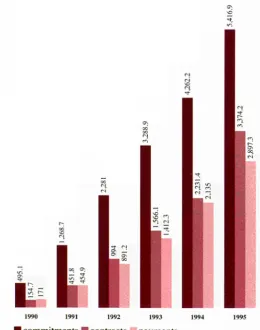
In 1995, the Phare Programme committed a total of ECU 1,154.7 million to its partner countries. This is an increase of 19 per cent on 1994 (ECU 973 million), and represents a commitment rate of 99.4 per cent. Total commitments over the life of the Programme (1990 to 1995) now equal ECU 5,416.9 million.
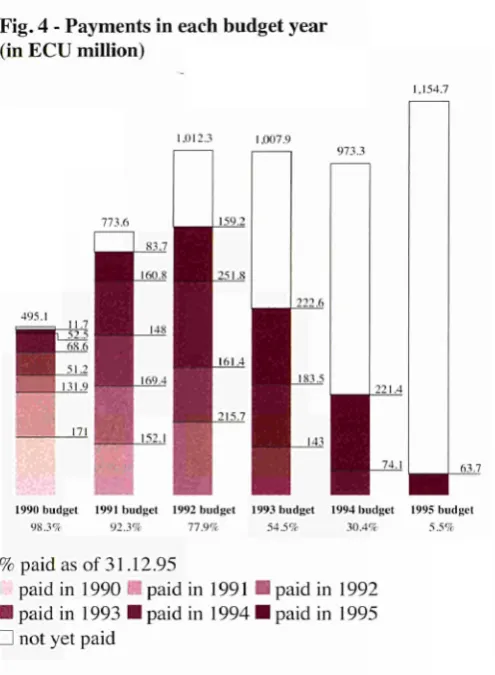
During 1995, Phare contracted funds totalling ECU 1,142.9 million. This represents an increase on 1994's total contracts (ECU 665 million) of 72 per cent and is a significant achievement for the Programme. Phare also paid ECU 762.4 million in 1995 which was an increase of 5 per cent.
In total, therefore, 62.3 per cent of all Phare funds committed have been contracted, and of the contracted funds 85.9 per cent have been paid.
The following chart shows the breakdown of Phare funds committed year on year, 1990 - 1995.
495.1
773.6
1994
It should be noted that the 1995 Phare Annual Report contains figures from all five budget lines managed within the framework of the Phare Programme. Owing to reporting software limitations, figures contained in the
1994 Phare Annual Report only included two budget lines. This therefore accounts for the small discrepancy in the historical figures between the 1994 and the 1995 Phare Annual Reports.
Political developments in 1995
Phare is at the heart of the political and economic relationsbetween the European Community and the partner countries of central Europe. Those countries are now preparing for full membership of the European Union. The pre-accession strategy, adopted at the Essen Council in December 1994, provides the framework for their preparations. Phare is the financial instrument of that strategy.
Pre-accession strategy
The pre-accession strategy is the path which leads the central European countries with Europe Agreements towards full membership of the European Union. It is designed to help the partner countries bridge the gap between their political, economic and legal systems and those of the European Community.
The strategy for accession was adopted at the Essen Council in December 1994. This represented a clear turning point in the relationship between the European Union and its partner countries.
The strategy has three main elements: the Europe Agreements, the structured dialogue, and the Phare Programme.
Europe Agreements
Country Bulgaria Czech Republic Estonia
Hungary Latvia Lithuania Poland Romania Slovakia Slovenia
Europe Agreement signed March 1993 October 1993 June 1995 December 1991 June 1995 June 1995 December 1991 February 1993 October 1993 June 1996
Europe Agreement came into force
February 1995 February 1995 .
February 1994
.
February 1994 February 1995 February 1995
-Official application for EU membership
December 1995 January 1996 November 1995 March 1994 October 1995 December 1995 April 1994 June 1995 June 1995 June 1996
The Europe Agreements acquired greater political significance following the European Council summit in Copenhagen in 1993. There, the European Council explicitly agreed that "the associated countries in central and eastern Europe that so desire shall become members of the European Union. Accession will take place as soon as an associated country is able to assume the obligations of membership by satisfying the economic and political conditions required".
Under the Agreements, the partner countries commit themselves to approximating their legislation, particularly in the areas relevant to the internal market, to that of the European Community.
One of the key elements of the Europe Agreements is the Association Councils. These are a series of bilateral meetings between the European Communities, their Member States and each of the partner countries. During
1995, these Association Councils have concentrated on the implementation of the pre-accession strategy and regional cooperation.
The Association Councils are complemented by Association Committees, which review all areas under the Europe Agreements, and the Joint Parliamentary Committees.
Structured dialogue
The second instrument of the pre-accession strategy is the 'structured dialogue'. Dialogue has always been a
cornerstone of the European Community's cooperation with the central European countries. As they emerged from decades of isolation from the rest of Europe, it played an essential part in bringing about an improved understanding of their requirements and interests.
The Copenhagen European Council in June 1993 agreed on a multilateral framework of regular meetings at ministerial level between the Union and the partner countries. This framework was endorsed at Essen, where the specific arrangements of the structured dialogue were set out.
The structured dialogue fulfils an essential role in preparing the partner countries for membership of the Union, enabling discussion of issues of common concern, in areas where solutions require action at European level. The areas of policy range from cultural cooperation to the Common Foreign and Security Policy (CFSP).
trans-European angle, such as telecommunications, transport, environment and scientific research, as well as other matters related to the European Community's internal market. In the field of justice and home affairs, cooperation has focused on the fight against organised crime.
A new focus for Phare
Developed initially as an immediate response to the challenges facing the central European countries, the Phare Programme is now also the financial instrument of the pre-accession strategy.
The pre-accession strategy, as outlined at the Essen Council, states that "integration will be supported by the European Union's Phare Programme which will develop on an indicative basis into a medium-term financial instrument with improved possibilities to promote infrastructure development and intra-regional cooperation".
In concrete terms, this means that Phare is devoting a greater share of its funds to the co-financing of infrastructure development projects and to promoting cross-border cooperation. Phare is also introducing measures to promote cooperation between the partner countries and to place a greater emphasis on investment support.
To prepare the partner countries for participation in the internal market, it was decided to support their efforts to harmonise their legislation, standards and norms with those existing within the European Community. This will involve the provision of significant support for the system of public administration to ensure that the necessary legislation can be implemented effectively.
In its progress report on the pre-accession strategy which it submitted to the European Council in December 1995, the European Commission stated that further emphasis still needed to be placed on support for investment and infrastructure. It also stated that Phare would also be supporting a number of projects in the area of justice and home affairs.
In order to increase the efficiency of the Phare Programme, the European Commission coordinates its assistance activities with the other donors supporting the central European countries, such as the European Bank for Reconstruction and Development (EBRD) or the World Bank. Emphasis is given to particular sectors in order to heighten the impact of assistance.
The Cannes European Council
The European Commission, in accordance with the conclusions of the Essen summit, presented its White Paper on the preparation of the partner countries for integration into the internal market of the European Community. The Cannes European Council concluded that "the preparation of the associated countries for integration into the internal market is, as was affirmed by the Essen European Council, the main element of the strategy of preparation for accession."
The Council also agreed to an increase in the Programme's financial envelope until 1999. The Phare budget will rise from ECU 1,154 million in 1995 to ECU
1,634 million in 1999, a total of ECU 6,693 million over the period, thereby reinforcing the commitment of the European Union to accession.
Before the publication of the White Paper, the partner countries had already begun approximating legislation and moving towards the economic freedoms on which the internal market is founded. However, with the prospect of full membership of the European Union moving closer, it was decided to produce a document which sets out the body of essential internal market legislation.
Phare funding is already being used for the implementation of the White Paper. Above all, this is a technical manual which forms a key element of the pre-accession strategy. As it guides the partner countries through the legislation, structures and broad economic conditions essential to the functioning of the internal market, the White Paper's purpose is to clarify the task of approximating national laws to those of the European Union.
For each of the twenty-three sectors of internal market legislation, the White Paper proposes a logical sequence in which to tackle the approximation exercise. While it is considered vital to lay down priorities for action, it is the countries themselves who identify those areas where the greatest impact will be achieved.
It is for this reason that the White Paper recommended that the Commission sets up and manages a Technical Assistance Information Exchange Office. This is being supported by the Phare multi-country programme and will be the focal point for the provision of advice and expertise on legislation and the necessary implementation structures. It will house an internal market database through which all interested parties will have access to information concerning the support available under Phare and other European Union programmes. It will also serve as a clearing house, matching requests for support from the partner countries with specialists and programmes available at national and European levels. In this way, the Office will direct support provided by Phare and by the various other public and private sector sources, towards the needs of the partner countries.
Madrid Council and enlargement
In December 1995, at the Madrid summit, the European Commission submitted its study on alternative strategies for the development of relations in the field of agriculture between the European Community and the partner
countries. The Commission also presented reports on the progress made in the pre-accession strategy, and on the impact of enlargement on the European Union's policies. The Madrid Council announced that the European Union's intergovernmental conference (IGC) would begin in March 1996. While the conference will have no direct impact on the Phare Programme, it will shape the European Union's institutions for the next century.
In the course of 1995, the following countries made official applications for full membership of the European Union: Bulgaria, Estonia, Latvia, Lithuania, Romania and Slovakia. Poland and Hungary applied in 1994. The Czech Republic decided to wait until the beginning of 1996, while Slovenia submitted its application in June 1996. The Madrid Council "hopes that the preliminary stage of negotiations will coincide with the start of negotiations with Cyprus and Malta". These should begin six months after the conclusion of the IGC, which is due to finish in mid-1997.
Phare in 1995
1995 was a year of both continuity and change for the Phare Programme. In many areas, the Programme continued the work started in 1994. This meant that infrastructure projects continued to be of great importance, the cross-border cooperation programme gained momentum, and Phare continued to provide know-how and grant finance to its partner countries.
In other areas, however, Phare made some fundamental changes. The new role as the financial instrument of the pre-accession strategy, and the challenge that this represented, meant that Phare had to modify its organisational structure, while continuing to improve its programming process, create a new monitoring structure and enhance its financial management.
The following sections outline both the changes which Phare made in 1995 and the areas in which it continued to concentrate its efforts.
Concentration on infrastructure investment
In 1995, Phare continued to concentrate on infrastructure projects and intensified the work begun in 1994. The Essen European Council in December 1994 recognised the increasing importance of Phare's work in this area by increasing the limit of Phare spending allowed on infrastructure to 25 per cent from a previous level of 15 per cent. This increased the Programme's ability to play a complementary role to its traditional provision of know-how by providing targeted grant funds in key areas.
The most important of these are that
■ the project must be a stated priority for the partner country. This is in line with the spirit of the pre-accession strategy which places the responsibility for determining the priorities along the road to accession with the partner countries themselves. The partner country is therefore required to contribute counterpart funds itself to the project.
. Phare's contribution must bring a clear additional benefit to the project which would not otherwise be present. This might include, amongst others, unblocking a high priority project which cannot go ahead because a country is unwilling to support a project where the costs are concentrated in its own areas but the benefits span several countries; or where Phare's money would attract additional commercial finance through the multiplier effect.
■ Phare's contribution must complement and not compete with the normal actors in this area, such as the partner country governments, private operators, commercial lenders and the International Financial Institutions.
• the project must be supported by an overall strategy which is in line with European Union standards.
Phare's infrastructure investment in 1995 has continued to concentrate on the areas of transport, the environment, energy, telecommunications and private sector development. In particular it has been focused on two broad but critical areas. The first of these are trans-European networks, recognised as a priority sector in the
1992 Maastricht Treaty and still an integral requirement of an effective internal market. This caused a number of infrastructure improvements to be identified in 1995, including roads and railways linking Berlin and Warsaw; Dresden and Prague; Nuremberg and Prague; Trieste, Ljubljana and Budapest; a telematic platform in the Baltic Sea and a Baltic ring electricity network.
The second area concerns projects which assist the countries of central Europe in the transition from a centrally-planned economy to a market economy. In the area of transport, this has included the restructuring and modernisation of both road and rail networks, the elimination of border crossing bottlenecks, and the development of traffic management systems.
Environmental projects have also been identified which tackle regional 'hot spots' in air and water pollution, especially where there is a cross-border impact. Other areas include projects of nature conservation such as coastal zone and wetlands management, environmental projects which have immediate health benefits such as the clean-up of rural water supplies or industrial and military sites, and the introduction of cleaner technologies.
In the field of energy, infrastructure projects which have received Phare investment include the environmental and safety upgrading of power plants, projects aimed at increasing energy efficiency and renewable energy, and local projects with clear environmental benefits.
Finally, Phare has helped to fund the development of rural telephony pilot projects - a significant step towards creating the communications infrastructure vital in today's global business environment.
Cross-border cooperation
The Phare cross-border programme, established in 1994 at the initiative of the European Parliament, continued to play an essential part in the pre-accession strategy.
Whereas in 1994 efforts focused on the creation or adaptation of the necessary institutional framework for the communication, programming, implementation and monitoring of the programme, 1995 saw a number of concrete steps being taken.
Although the bulk of the Phare cross-border cooperation projects have focused on the development of infrastructure, transport, telecommunications and energy, the new approach adopted for 1995-1999 will include more "soft" actions such as tourism, human resources and culture. This has been underpinned by the setting up of a Small Project Fund Facility.
In 1994, the central European countries eligible for participation were Albania, Bulgaria, the Baltic states, the Czech Republic, Poland and Slovenia. In 1995, Hungary and Slovakia were added to the list (owing to Austria's accession to the European Union) as well as new border regions in the Czech Republic and Slovenia. The eligible border regions were determined by the partner countries themselves in collaboration with the European Commission in order to ensure coherence with INTERREG.
In 1995 the Phare Management Committee gave a favourable opinion on cross-border projects for Albania, Bulgaria, the Czech Republic, Estonia, Hungary, Latvia, Lithuania, Poland, Slovakia and Slovenia. These projects mainly concerned transport, environment, agriculture, human resources and economic development and a budget of ECU 169 million was agreed.
Sectoral cooperation programmes regarding the environment and interregional cooperation were also given a favourable opinion. This type of programme involves funding from an International Financial Institution and/or a European Union Member State. Phare provides for the necessary support during the project appraisal and preparation period as well as its implementation. A wide range of measures is eligible, such as the abatement of air pollution, waste water management and minimising the environmental effects of transport projects.
As for the interregional cooperation programme, already built upon the ECOS and Ouverture instruments of the European Union, it is the first time funding has been provided for cities and regions in all Phare partner countries and those of the European Union. Over 100 interregional cooperation projects are being funded. Looking to the future, as the countries of central Europe come closer to integration, the Phare cross-border cooperation programme will shift from infrastructure project implementation and evaluation, towards increased training, administration and development of
socio-economic structures. This will allow the programme to respond better to the needs of the integration process.
Opening of Community programmes
In 1993, at the Copenhagen Summit, heads of the Member States took the political decision to offer to the associated central European countries the possiblity of participating in Community programmes.
On 4 December 1995, the Commission and the Council, in agreement with the European Parliament, concluded Additional Protocols to the Europe Agreements with Bulgaria, the Czech Republic, Hungary, Poland, and Romania in order to provide the necessary legal framework for their participation in these programmes. An Additional Protocol was also signed with Slovakia, pending the European Parliament's agreement. The additional protocols for the Baltic states are integrated into the Europe Agreements with each country.
This will allow the partner countries to participate in the Socrates, Leonardo, and Youth for Europe III programmes. It will also allow those countries whose audiovisual legislation is compatible with European Community law to participate in the Media II programme. Other programmes covering the fields of culture, environment, health, energy and the internal market will have to be adapted in order to take into account future participation by the central European countries. Corine (satellite mapping), LIFE (environment), SAVE II (energy efficiency) and Synergy (energy cooperation) are examples of programmes which have been designed for, or extended to, the central European countries.
In 1995, a budget of ECU 9.9 million was committed for the preparation of the associated countries' participation through information sessions, visits and training for national administrators, the transmission of the necessary documentation, and establishment of the appropriate national structures or information offices for the purposes of acquiring a better understanding of these programmes. Specific programmes under the Fourth Framework Programme for Research and Development have also been opened under certain conditions to the partner countries.
Coordination with other donors
assistance activities with the other donors supporting the central European countries. Since the G7 summit of heads of state and government held in Paris in July 1989, the Commission has the official task of coordinating the activities of all those donors.
In this capacity, and given the importance of Phare, the Commission works closely with the G-24 countries, as well as the International Financial Institutions such as the World Bank, the European Bank for Reconstruction and Development (EBRD), the European Investment Bank (EIB) and the Organisation for Economic Cooperation and Development (OECD).
Phare and the OECD have collaborated, for example, on the SIGMA programme (Support for Improvement in Governance and Management in central and eastern Europe). SIGMA provides support to the partner countries to develop coherent reform strategies and efficient public institutions. An example of Phare/EBRD co-financing is the environment project preparation facility, a horizontal programme launched at the end of 1995 which facilitates the implementation of critical environmental projects in the central European countries.
In March 1995, at the High Level meeting, the G-24 donors together analysed the reforms undertaken during the first five years of transition in central Europe. The general conclusion was that this transition is irreversible. The donor organisations committed themselves to continuing active support for the integration of the central European countries into the international economic community. Moreover, their assistance will be designed to fit into and enhance the pre-accession strategy.
With these objectives in mind, the European Commission's coordination work will be strengthened on the ground, in the partner countries, with emphasis being given to distinct sectors in order to heighten impact. The organisations will work together at programme and project level.
In 1995, the profile of foreign-aid coordination was raised in the public eye. The peace agreement reached by the republics of the former Yugoslavia requires the support of the international community. In December 1995, the European Commission and the World Bank organised the first meeting of donors for Bosnia-Herzegovina. The key
objectives were to identify the needs of the country in its task of reconstruction, and to mobilise the donors' assistance. Above all, this illustrates the concrete support given by the European Union to the peace process, and its role as the world community's aid coordinator for central Europe.
Phare and former Yugoslavia
1995 marked the year in which reconstruction of the former Yugoslavia began. The financing plan approved by the European Commission for support to the peace process allocated ECU 600 million, to be spent over the period 1996-99.
Likewise, in the light of the Dayton peace agreement, reached in December 1995, it was of utmost importance that the short and medium-term reconstruction of Bosnia-Herzegovina start as quickly as possible. A number of international institutions, notably the World Bank, the International Monetary Fund (IMF), the European Bank for Reconstruction and Development (EBRD), and the European Community prepared a programme for that purpose. The first phase of the Phare Essential Aid Programme was elaborated on the basis of the multilateral plan, and a first tranche of aid worth ECU 62.5 million was due to be launched immediately in January 1996.
The Court of Auditors
In November 1995, the Court of Auditors delivered its report on the financial and operational performance of the European Commission during 1994. The Court recognised that the efforts made by Phare management had led to a number of improvements in the Programme.
The Court did, however, highlight scope for further improvement, in particular better use of the PHACSY financial reporting system; greater rigour in the tendering process; and a more operational use of the results of studies conducted using Phare funds, especially to encourage real investments.
As outlined in the section below, both the financial management systems and the operational procedures for Phare were already being reviewed during the course of
Operational management of Phare
Since its inception Phare has sought to involve its partnercountries as much as possible in the strategic and operational activities of the Programme. It has, therefore, adapted its structure over time to accommodate the changing needs of its partners, to increase cooperation and coordination between the Commission and the countries, and to heighten the impact of the programmes carried out within the Phare framework.
This process of operational improvement continued in 1995. The internal structure of the Directorate and the management of the Programme were changed so as to forge closer links between work on Phare, the Europe Agreements and the pre-accession strategy.
Management processes were improved. The financial and management reporting systems were overhauled, and the number of standardised and regular independent audits increased. A stand-alone monitoring and assessment unit was created with the intention of improving the operational quality of Phare programmes and ensuring a more cost-effective use of funds. This will support the process of decentralisation which is increasing in importance as the pre-accession strategy runs its course.
Finally, the emphasis on increasing openness in the Phare Programme was maintained through a targeted communications programme to other European Union institutions, European Union Member States - notably the public services and commercial sectors - and partner countries.
Operational structure
The Directorate which manages the Phare Programme within Directorate General IA (Europe and the New Independent States, Common Foreign and Security Policy and External Missions) was reorganised in 1995.
Up until this point, the Phare service had been organised largely on a sector basis, with staff divided into sectoral units such as agriculture or infrastructure. It became clear, however, that an integrated geographical structure was needed to reflect the needs of the pre-accession strategy and the Europe Agreements, and the structured relationship and financial cooperation which were critical to its success.
Therefore, in July 1995, the Commission reorganised the Directorate responsible for Phare on a country by country basis. Three geographical units were created, with
responsibility for all aspects of relations with the central European countries. This was designed to focus on all aspects of each country's pre-accession needs at the same time as improving the performance of the Programme by enabling a faster, co-ordinated response to country issues, and operational synergy between the Delegations in the partner countries and staff in Brussels.
Many Phare programmes do, however, involve several partner countries. So as not to lose the overview necessary to manage these, separate horizontal and sectoral units were created with responsibility for policy coordination and the management of multicountry and horizontal programmes. These ensure that cooperation between countries is maintained and that opportunities for synergies are identified and implemented.
The Directorate began to work on this new geographical basis from June 1995 onwards so as not to lose the momentum created by the Essen and Cannes Councils and the launch of the pre-accession strategy.
Phare also launched an initiative to address the issue of staff, both at Headquarters in Brussels and in the Delegations. Studies are underway to identify those tasks which are core to managing the Phare Programme, which fall within the executive competence of Commission service, and which will therefore need to be carried out by Commission staff. Other tasks identified as non-core can then be contracted out, thereby using existing staff in the most efficient way.
A new programming approach
1995 saw the streamlining and improvement of the Phare programming approach. The Essen and Cannes Councils had provided a clearer definition of common objectives and the opportunity therefore to target funds more effectively. They had also provided Phare with a multi-annual financial horizon with the intention that the Programme be allied more closely with the medium term strategic ambitions of the partner countries.
and timeframes, including an indication of funds to be allocated to each sector. Multi-annual indicative programmes were produced for eleven cross-border programmes, covering all partner countries except Romania.
This new approach has benefits for both the partner countries and the Member States. For the partner countries, it brings accession into a sharper focus, provides a series of concrete objectives, and allows them to build the Phare Programme into their medium term restructuring programmes and strategies for accession. For the Member States, it gives them an opportunity to make a strategic contribution and to take a longer, more comprehensive view of each country's Phare priorities.
Whilst the multi-annual indicative programmes have given Phare a medium-term perspective, it should be remembered that the implementation of the programmes remains subject to an annual budgetary procedure. This means that the allocation of funds which appears in the multi-annual programme is purely indicative and therefore only a statement of intent. Each year, the Commission allocates the appropriate funds to each country based on a country operational programme which includes all the programme components in one document. This is based on the multi-annual indicative programme, but need not faithfully reproduce it. This allows an additional flexibility to both the country and Phare, should circumstances or priorities change.
Nevertheless, the introduction of multi-annual indicative programmes has eased the pressure caused by the annual programming round, has cut down the time lag between commitment, contracting and payment, and significantly simplified the programming process.
Changes in implementation
Implementation is the most critical area of Phare programmes. The ability to manage the individual projects on the ground determines the degree of their impact and thus the effectiveness of the use of public money.
Certain limits are set by the Council's financial regulation, attributing full responsibility for the use of funds to the Commission, thus limiting the extent to which responsibility can be delegated to the partner countries. Nevertheless, 1995 saw continued attempts to reconcile this potential conflict and to arrive at an implementation process which was both effective and stringent.
Further progress was made in 1995 towards the decentralisation of the implementation process. This was started in 1994 with the publication of the Decentralised Implementation System manuals, a response to the need for a common operating system across the whole Programme and an attempt to reconcile the management skills and habits of partner administrations with respect for the Phare Regulation.
During 1995, further work was done, in conjunction with the partner countries, on improving the Decentralised Implementation System. This concentrated on
• simplifying the programming approach, with special attempts to reduce the overall workload by establishing a closer link between the documents needed for both programming and implementation. This will reduce duplication of effort.
• transferring implementation responsibility at the two most important levels - firstly, from the Commission to the partner country, and secondly, from Phare staff in Brussels to Commission staff in the country delegations. In practice this will mean a gradual transfer from ex ante approval to ex post monitoring and assessment, without sacrificing the overall supervisory responsibility of the Commission.
• clearly defining the roles and responsibilities of the main implementation players, particularly the Brussels headquarters and the Delegations. This has involved agreeing job descriptions which again will reduce duplication of effort, allow more efficient use to be made of the resources available and increase the levels of understanding between the teams.
Work was also done in 1995 on making the Decentralised Implementation System manuals themselves more accessible and user friendly. These will be reissued, covering all the new procedures, in 1996 and be backed up by additional training for the Delegations and the Programme Management Units.
Financial management
from the Programme Management Units, and to use this as a monitoring tool. PHACSY was refined in early 1995 and reissued in a new, more user-friendly format.
Prior to this it was merged with Desirée, the main Phare information database, which was in turn fully integrated with SINCOM, the financial management system of the entire Commission. This has made the financial management process for Phare more streamlined and accurate, has reduced duplication and wasted effort, and has extended the reach of the system among PMUs. By the end of 1995. about 95% of all available management information from PMUs was contained in PHACSY and efforts will be made in 1996 to obtain the remaining information. This has been supported by the increased number of independent financial audits in 1995 which will continue into 1996.
Monitoring and assessment
Crucial to the process of ensuring greater decentralisation while maintaining the Commission's responsibilities is the creation of an effective monitoring and assessment system. When the Directorate responsible for Phare was restructured in 1995, a new unit was created with specific responsibility for monitoring and assessment.
The unit is responsible for the implementation of a monitoring and assessment system which will be independent, credible and based on the principle of common ownership and involvement of the partner countries. In doing so, it was asked to move to a standard system which could be widely applied across all Phare projects.
In 1995. the foundations were put in place for the new monitoring and assessment system. A regional structure was created, with three regional offices staffed with independent consultants from the European Union and local experts. It is planned that these offices will become fully operational in the first half of 1996 and that over four hundred projects will be both monitored and assessed each year.
The process developed is primarily an operational tool for all those involved in the Phare Programme. By providing a regular assessment of the stams and progress of Phare projects, the new unit will be able to identify and share best practice across all the partner countries, pinpoint poorly· performing projects and suggest remedial action, and provide rapid feedback to those designing future programmes. As the monitoring and assessment system
has been designed to dovetail with the regular programming process, the information will allow programmes to be adapted more closely to the needs of the partner countries.
Communications
Since 1993, Phare has actively responded to increasing interest shown by European Community institutions and advisory bodies, Member States and partner countries in the Programme.
In 1995, Phare spent ECU 3.2 million on communications. It published 67 separate titles in 18 languages and distributed over 800,000 copies in 26 countries. The Information Unit responded to over 60,000 telephone enquiries, letters and faxes, and about 5,000 personal visits. Information Unit staff also made over 100 speeches and presentations on the Phare Programme to conferences and workshops, mainly in the Member States. In 1995, the research programme was continued in partner countries to identify and find appropriate mechanisms to satisfy people's information needs. Delegation information programmes became much more focused on communicating with decision-makers and opinion-formers about pre-accession and what it may mean to join the European Union. These programmes include local-language publications, media relations, the development and implementation of contact programmes, and the creation of local communications databases. The bimonthly "European Dialogue" magazine was launched and, by the beginning of 1996, was being mailed in six central European languages to 20,000 decision-makers and opinion-formers in the region. Specific communi-cations programmes were launched in the Czech Republic, Hungary, Poland and Slovakia. Television documentaries about the European Union began appearing increasingly in the partner countries to give more information about the Union to the general public as well.
Albania
The Albanian economy has begun to recover from the collapse of an economic system whose closed and centrally-planned structure was more pronounced than that of other former communist countries. In 1995, it achieved one of the highest growth rates (11.3 per cent) of all the central European countries. Inflation fell to 6.0 per cent, a result of a disciplined monetary policy, and unemployment also dropped to 14 per cent. The privatisation process is on track, with all the remaining state enterprises being transformed into joint-stock companies in April 1995. This has made possible a mass-privatisation programme which will begin in 1996.
During 1995, progress was also made towards bringing Albanian institutions and laws closer to those of the European Union's standards. New civil, penal and labour codes were adopted resulting in a more robust judicial framework. Albania also signed the convention of the Council of Europe for the protection of minorities and was granted full membership of the Council in July 1995.
In 1995, Phare continued to provide considerable support to Albania's progress towards reform. Albania is no longer dependent on essential aid and therefore Phare's focus within the country has evolved to reflect the country's considerable economic improvement.
ECU 35 million was therefore allocated through the 1995 indicative programme for the development of
• the transport, telecommunications and energy sectors • an effective higher education system through the
Tempus programme
• local community infrastructure through the Albanian Development Fund
• the private sector, public administration and judicial systems.
Within this, Phare's priorities in 1995 shifted from the agricultural sector towards infrastructure development, particularly roads and ports, telecommunications and energy. Development in these areas is essential if Albania is to participate fully in the single market. The main infrastructure priority for 1995 was the rebuilding and upgrading of the East-West corridor. This meant that Phare financed, together with the European Investment Bank, the following projects
• upgrading of the Durres-Elbasan and Pogradec-Kapshtica sections (a total of 146 km) of the East-West corridor
• developing the Dürres ferry terminal.
Funds allocated by sector 1995 ECU 88 million
Integrated regional
Education, training and research 3.5
Infrastructure (energy, transport telecom.) 34
Financial sector 35
These projects demonstrate the important role Phare can play in unlocking funds from other international financing institutions.
In other areas, Phare also played a leading role. Work has been done on improving primary healthcare and developing hospitals, programmes have been set up to strengthen local government, and measures have been taken to channel funds directly to small-scale projects which will have a direct and beneficial impact on local communities. Phare will also continue to support the energy sector, placing emphasis on the preparation of a national strategy, policy and legislative framework and the provision of pre-investment studies in key areas.
Absorption capacity of the Phare Programme in Albania continued to be satisfactory with around 73 per cent of total committed Phare funds contracted by the end of
1995. Nevertheless, the increased emphasis on infrastructure projects which require longer periods of preparation as well as more complex tendering processes, coupled with the logistical limitations on the pace of land registration and the inability of the banking sector to provide the necessary credit lines when needed, have resulted in some slowing down in implementation and payment during 1995.
Looking forward, the stable economy will allow the Phare Programme in Albania to plan for the longer term and a multi-annual indicative programme covering the period
Bulgaria
Bulgaria's social and economie transformation has not been easy. The changes in government, combined with varying levels of parliamentary support, resulted in relatively slow decision-making in key areas of structural reform. In addition, the collapse of the Comecon markets, the Gulf crisis, and the UN sanctions against former Yugoslavia also affected economic growth. Nevertheless, the basis for a market economy has been created and the foundations have been laid for a democratic and civil society.
In 1995, the economic improvement begun in 1994 continued. Gross Domestic Product grew by 2.5 per cent, inflation and unemployment fell and privatisation progressed. This, plus a greater political stability, created a more constructive environment for the management of the Phare Programme in Bulgaria and programme management structures became more stable, and therefore more efficient.
The 1995 Phare Programme supported projects in the following areas in Bulgaria for a total of ECU 60 million
the approximation of legislation the promotion of private agriculture human resources development transport development energy and nuclear safety.
Phare provided ECU 5 million in 1995 for a number of agricultural projects. These included policy support to the Ministry of Agriculture and Food Industry, registering and restoring historic land ownership rights and other transactions, restructuring and privatising state-owned industries, and the development of production and marketing structures.
In the area of education, Phare continued to support the Tempus programme for the reform of higher education. Based on a 1993 pilot project, a programme was started for the development of post-secondary vocational training and the financial management of secondary education. The programme also supported the creation of a higher education accreditation and assessment agency.
Funds allocated by sector in 1995 ECU 83 million
Approximation of legislation
Infrastructure (energy, transpon.
telecom.) 48
Education, training and research 21
Environment and nuclear safety 7
The 1995 transport programme confinanced, with the European Bank for Reconstruction and Development and the World Bank, a major project for railway rehabilitation (approximately 400 km). It also supported the restructuring of the Sofia urban transport system.
In the energy sector, Phare supported the improvement of energy efficiency (electricity, district heating and gas), pre-investment studies and measures to promote the introduction of the 'acquis communautaire'.
In 1995, a multi-annual indicative programme for cross-border cooperation with Greece was also approved. Covering the period 1995-1999, the programme was allocated an indicative budget of ECU 115 million. Set against the background of good bilateral relations between the two countries, the programme will support the development of Bulgaria's border regions with Greece, within the overall Bulgarian policy of regional co-operation. Key areas of work are transport, environment, economic development and human resources.
As a result, part of the backlog of uncommitted funds dating from previous years was cleared and the overall contracting rate increased from 48 per cent in 1994 to 56 percent in 1995.
The 1995 programme for the approximation of laws aimed at developing a comprehensive match between Bulgarian and European Community legislation. Accordingly, Phare assisted with the drafting of new laws and provided training to target groups in the public administration as well as the judiciary. It is also intended that the programme will draw on the information and experts made available by the Technical Assistance Information Exchange Office, established in Brussels in
1996.
In February 1995, the Europe Agreement with the European Communities and their Member States came into force and the first Association Council was held in May 1995, at which the two parties discussed Bulgaria's progress within the pre-accession strategy. Phare is the main instrument to support that strategy.
Czech Republic
1995 was the year when the country's Europe Agreement with the European Union came into force, and the national economy continued the substantial progress already made. In the same year, the country was the first from central Europe to be accepted, as of 1 January 1996, into the Organisation for Economic Cooperation and Development (OECD), a move which endorsed the economic reforms carried out by the Czech government.
The continued policy mix of macroeconomic stabilisation and, on the microeconomic level, price liberalisation, deregulation and privatisation enjoyed positive results. Growth was strong and unemployment, at 3.5 per cent, was low. In 1995, the koruna, the national currency, was made fully convertible.
The entry into force of the Europe Agreement meant that the Czech Republic could take part fully in the 'structured dialogue' with the European Union. Within this framework the first Association Council took place in April 1995, and the first meeting of the Joint Parliamentary Committee in May where the White Paper on the internal market was discussed.
In 1995, the Phare Programme in the Czech Republic took a new direction in the support it provides. As with the other associated countries, this new direction is characterised by the direct linkage of Phare to the preparation of the Czech Republic for membership of the European Union, with a special focus on improving the infrastructure in the areas bordering Germany and Austria and on strengthening the institutions central to the integration process and future membership.
The Czech Republic was allocated a total of ECU 110 million, including ECU 71 million for the 1995 country operational programme, together with ECU 8 million for the Tempus programme, and ECU 25 million and ECU 6 million for cross-border cooperation with Germany and Austria respectively.
Funds allocated by sector 1995 ECU 110 million
Social development Other 3
and employment 2 Public institutions Private seclor a"d administrative reform 5
development ^^0Λ B ^ ^ ^ Education, training and enterprise ^ ^ ^ ^ and research 8
support 1
Infrastructure (energy, transport, telecom.) 91
The main focus of Phare during 1995 was the development of the Czech Republic's infrastructure. Phare has contributed to the construction of the Berlin-Decin-Prague-Breclav-Vienna rail corridor and a number of infrastructure investment initiatives under the cross-border cooperation programme. It has also, since 1995, started to support socio-economic development and tourist projects in the border region, including the renovation of historical monuments.
Since the accession of Austria to the European Union at the beginning of 1995, some 67 per cent of the Czech Republic's border is shared with member states of the European Union. This, plus the dramatic increase in road and rail traffic (particularly between the Czech Republic and Germany), has increased the focus on the border regions and the structural and environmental impact that is being made.
also improve the quality of air and water in the regions by, amongst other projects, building new gas and steam pipelines, introducing environment-friendly technology in heat and power generation, improving sewage systems and building new water treatment plants to reduce river pollution and improve drinking-water standards.
Phare has also contributed to the strengthening of Czech legislative and institutional capacity by financing expert assistance and training to Czech civil servants and by supporting the ministries and institutions central to the integration process, such as customs, statistics, industrial property, competition and standards administration. A considerable part of this effort has focused on assisting the Czechs to ensure the approximation of their laws with European Union legislation.
Looking forward, the Phare multi-annual indicative programme for 1995-99 was signed and approved, with increasing emphasis placed on investment support and the use of Phare as a medium-term financial instrument. With a total budget of between ECU 300 million and ECU 330 million, including cross-border cooperation, the indicative programme will be devoted to the following priority areas . legislative integration with the European Communities,
with the ultimate goal of adopting the 'acquis communautaire'
• infrastructure integration with the European Union, particularly in the fields of transport, energy and the environment
Estonia
Estonia has undergone a remarkable economie recovery in the past few years. In terms of trade liberalisation and the macroeconomic aspects of reform, the country is well advanced. This was reflected in GDP growth in 1995, with a six per cent increase being recorded for the second consecutive year. Importantly, foreign investment also remained at the high level achieved during the previous year. These results have been made possible by the substantial progress made in the area of structural reform. Two areas of the economy will, however, need special attention over the coming period: the relatively high level of inflation, and the trade deficit, which was running at approximately ECU 300 million at the end of the year.
Estonia submitted its formal application for membership of the European Union in November 1995, and participates in the structured dialogue of the pre-accession strategy. In November, the European Union signed an agreement with Estonia to open a Delegation of the European Commission in Tallinn.
The privatisation process was accelerated in 1995, helped by Phare's contribution to the Privatisation Agency. Though work remains to be done in the large, state-run enterprises, the privatisation of small enterprises is almost complete, with small and medium-size enterprises now accounting for over 40 per cent of employment. The privatisation of the economy was further helped by the Estonian government's efforts to create the legal framework for the national stock exchange, which is expected to open in the first half of 1996.
Phare's focus in 1995 was to help Estonia build on its economic success and prepare itself for eventual accession to the European Union. Estonia's Europe Agreement was signed in June 1995, and now awaits ratification by all the European Union Member States. Estonia remains the only central European country not to have requested a transitional period within which to liberalise its trade policy.
Phare funding for Estonia increased to ECU 24 million in 1995. This brings the total amount committed to Estonia for the period 1991-1995 to ECU 68.5 million. Continued cooperation between the Estonian government and the Phare Programme has resulted in a steady increase in the amount of funds committed.
Funds allocated by sector 1995 ECU 24 million
Social development and employment 2.9
Private sector development and enterprise support 9.1
Public institutions and administrative
form 2.8
Education, training and research 4.2
Infrastructure (energy, transport, telecom.) 5
In the agricultural sector, Phare has continued to support planning processes, the development of rural credit facilities, land registration and land privatisation. In addition, Phare will focus on institutional and human resources development in the Ministry of Agriculture. This will help to improve the efficiency of agro-industries through the provision of professional advice to farmers, the training of advisors in farm and business analysis, and the provision of support for rural credit agencies.
Phare also provided support during 1995 for the development of an energy strategy aimed at achieving greater energy efficiency; reducing the levels of pollution; investing in transport infrastructure; and reforming the social safety and health systems.
Within the framework of the multi-annual indicative programme, which has been allocated a budget of ECU 84 million for the period 1995-1999, Phare will focus on the following priority sectors
. European integration • export development • regional development
• public sector management development.
and infrastructure
Hungary
Among the first countries to benefit from Phare support, Hungary has established a system of democratic political institutions which enjoys general support from the country's main social and political forces, and has made a serious effort to develop harmonious relations with its neighbouring countries.
Its history as the most market-oriented of the former Comecon countries also enabled Hungary to attract the largest inflow of foreign investment in the region (40.5% of the region's total in the 1989-94 period). Privatisation laws, aimed at speeding up the privatisation of state companies, were rapidly introduced and all the basic structures of a market economy have been established.
Nevertheless, in 1995, the Hungarian government was faced with serious macroeconomic strains which led to the adoption of a stabilisation plan intended to reduce the budget and current account deficits and accelerate public finance reform.
Phare's support in 1995, therefore, concentrated on supporting the government in its move towards further economic orthodoxy, and in helping Hungary achieve the pre-accession strategy measures outlined in the White Paper. Hungary was the first former communist country to submit its application for full membership of the European Union (April 1994), and the government's firm commitment to the pre-accession process has meant that Phare has placed a great deal of focus on supporting the harmonisation of legislation and restructuring the public administration.
In practice this has meant providing sector and legal analyses, drafting new legislation and translating existing Community legislation into Hungarian, establishing necessary institutional structures, providing training sessions for public officials and other decision-makers, and organising public relations actions targeted at key target audiences.
Another area of great importance is the transformation and reform of the Hungarian transport and communications infrastructure. In its current state it partly discourages domestic and foreign investment and contributes to the uneven economic development of different regions within the country. Phare is actively supporting the development of appropriate standards and is cofinancing, amongst others, infrastructural improvements, road building, railway lines and combined transport terminals.
Funds allocated by sector 1995 ECU 92 million
Infrastructure (energy, transport, telecom.) 36
Environment and nuclear safety 12
In 1995 the Phare multi-annual indicative programme (1995-1999) was adopted to give support worth ECU 425 million in the following priority areas
• European integration, including approximation of laws and public administration reform
• education and training with emphasis on the establishment of a human resources development fund • economic development, focusing on agriculture,
privatisation and restructuring, small and medium-sized enterprises development, regional development, trade and investment promotion, tourism development • public finance and social sector reform
• infrastructure development with emphasis on road and rail transport, communications, transit, water management, energy and the environment
• participation in European Community programmes. For the year 1995, ECU 85 million was allocated to support these priorities.
Latvia
In 1995, Latvia once again enjoyed a substantial improvement in the economy, following the recession in the early 1990s. Economic growth was particularly strong in the service, construction and forestry sectors although, as a result of necessary restructuring, both the industrial and agricultural sectors continued to decline.
Efforts to privatise small and mediumsized enterprises proved successful in 1995, although progress has been much slower with regard to larger enterprises. The process has been supported by the creation of a single national privatisation agency. The agency will progressively tender the remaining stateowned companies over the course of the next few years, and in the meantime enterprises still in the public sector will be managed by a State Property Fund.
In the area of private sector development, Latvia still needs to complete and simplify the legal basis which is essential for attracting investment. Phare has been providing assistance both to the Latvian Privatisation Agency and the State Property Fund.
Like the other countries of central Europe, Latvia places strong emphasis on the approximation of legislation as a key step towards eventual accession to the European Union. The reform of public administration is an essential part of this effort, and a Pharefunded scheme will train as many civil servants as possible by the year 2000.
Despite its economic success, the Latvian economy suffered a number of setbacks in 1995. In June 1995 the main commercial bank. Bänkas Baltija, was declared insolvent, precipitating a general banking crisis. The European Union pledged to give ECU 2.5 million to help the financial sector.
A further economic setback was caused by a shortfall in government revenue as a result of tax evasion. This resulted in a budget crisis in the first half of 1995 and contributed to a state budget deficit for 1995 of approximately 4.8 per cent of Gross Domestic Product.
In 1995, Latvia took a number of steps towards membership of the European Union. A Europe Agreement was signed in June 1995 and Latvia submitted its formal application for membership of the European Union on 27 October 1995. The country participates fully in the structured dialogue of the preaccession strategy.
Phare's assistance to Latvia has focused on the provision of knowhow. This has concentrated in particular on public
Funds allocated by sector 1995 ECU 3 2 5 million
Social development and employment 9.2
Public institutions and administrative reform 1.3
Education, training ^ ^ ^ and research 2
Financial sector 2.5
Private sector development and enterprise support 8.3
Infrastructure (energy, transport, telecom.) 9.2
administration reform, privatisation, the development of small and mediumsized enterprises and the improvement of the banking, agriculture, telecommunications, energy, transport, health and higher education sectors. During 1995, however, Phare support was broadened to include support for economic reform, institutional and human resources development and infrastructure development
Within Phare's efforts to support Latvian infrastructure development, the energy sector received particular attention. The country has no hydrocarbon resources, and is to a great extent dependent on energy imports. However, there are domestic sources which can be developed, notably hydropower, wood and peat and Phare has financed studies to examine the feasibility of their development.
Phare funds for Latvia were ECU 32.5 million in 1995. This brings the total of funds committed to Latvia for the period 19911995 to ECU 108 million. Looking forward, the multiannual indicative programme, signed in 1995, will focus on the following priority sectors during the period 199699
. private sector development: this includes restructuring and privatisation, banking, small and mediumsized enterprise development, foreign investment and trade promotion and agricultural reform
■ institutional integration, human resources and social sector, including statistical cooperation, public administration reform, higher education, public finance and accounting, and social sector reform
Lithuania
The Lithuanian economy emerged from deep recession following the dissolution of the Soviet Union and, having declined in 1992 and 1993, Gross Domestic Product grew by 1.5 per cent in 1994 and 5 per cent in 1995.
The privatisation process has been satisfactory and, in the small companies sector, has progressed rapidly, conducted mainly through the exchange of vouchers or through local investors. By mid-1995, a new law on privatisation was passed by the parliament outlining the relative responsibil-ities of the economic ministries, state institutions, and local authorities. The law clearly marks a commitment by the government to complete the privatisation process. In addition, a privatisation agency was created in 1995 which, assisted by a resident Phare advisor, has rapidly become operational. The agency is a semi-autonomous body whose objective is to prepare and implement the remaining privatisation programme under the supervision of the Prime Minister's office. Both the new law and the operations of the agency are expected to boost the privatisation process, with an additional focus put on restructuring companies in order to provide further technical competence or financial means to those companies already privatised.
As part of the development of the private sector, in 1995 the government also started to define the legal framework for small and medium-sized enterprises and a development agency has been established as a non-profit and independent institution. Entrepreneurs, however, continue to suffer from a lack of finance for capital formation. To a certain extent this has been helped by the rapid growth in foreign investment (some ECU 254 million between 1989 and 1994) although this is significantly less than the other Baltic states. The problem of coordination among the various economic development agencies established over the past few years is being addressed by the government.
Lithuania's formal application to join the European Union was presented in December 1995 and was reinforced by a declaration adopted by the Lithuanian parliament.
The Europe Agreement was signed by Lithuania during June 1995 and the country has subsequently actively participated in all the meetings organised within the framework of the structured dialogue. Moreover, the government has been active in setting up both the institutional and legislative framework to begin the European Integration process.
Funds allocated by ECU 42 million
Social development and employment 4.4
Private sector AÊM
development ÆM
and / ' v enterprise flH support 9.6 S |
sector 1995
Public institutions and administrative reform 5.5
.¿fflk. Education, training ^ ^ und research 3.5
_nrt<9^fjí
Infrastructure (energy, transport, telecom.) 19
As part of this, Lithuania made efforts in 1995 to begin to approximate its legislation to that of the European Community's 'acquis communautaire'. Phare helped this process by supporting the development of legislation in financial services (banking law, insurance and securities), commercial law, labour law, European Community and international law, and constitutional and administrative law.
An amendment to the Lithuanian constitution, relating to the purchase of land by foreigners and made necessary by the Europe Agreement, is expected to be passed by the parliament in the first half of 1996. The Europe Agreement is also expected to be ratified during 1996. In 1995, Phare committed ECU 38 million to Lithuania, an increase of ECU 4 million on the previous year. This money was focused on the priority areas outlined in the 1994-1995 indicative programme: economic development, infrastructure development, the public investment programme, European integration and human resources development.
Phare has also been active in the agricultural sector which Phare was also active in programmes focusing on public has suffered a decline over the past few years but remains administration reform, where a policy design programme the second largest sector of the economy. The was completed in' March 1995; the health sector, privatisation of holdings has led to a break-up of the land particularly in primary healthcare; and the provision of into small parcels and this, together with the limited strategic advice in the social sector and labour market availability of capital, business skills and know-how, area,