This is a repository copy of
Order-preserving encryption using approximate integer
common divisors
.
White Rose Research Online URL for this paper:
http://eprints.whiterose.ac.uk/122946/
Version: Accepted Version
Proceedings Paper:
Dyer, J, Dyer, M and Xu, J (2017) Order-preserving encryption using approximate integer
common divisors. In: Lecture Notes in Computer Science (including subseries Lecture
Notes in Artificial Intelligence and Lecture Notes in Bioinformatics). ESORICS 2017
International Workshops, DPM 2017 and CBT 2017, 14-15 Sep 2017, Oslo, Norway.
Springer International Publishing , pp. 257-274. ISBN 978-3-319-67816-0
https://doi.org/10.1007/978-3-319-67816-0_15
© Springer International Publishing AG 2017. This is an author produced version of a
paper published in Lecture Notes in Computer Science. The final publication is available at
Springer via https://doi.org/http://doi.org/10.1007/978-3-319-67816-0_15. Uploaded in
accordance with the publisher's self-archiving policy.
[email protected] https://eprints.whiterose.ac.uk/
Reuse
Unless indicated otherwise, fulltext items are protected by copyright with all rights reserved. The copyright exception in section 29 of the Copyright, Designs and Patents Act 1988 allows the making of a single copy solely for the purpose of non-commercial research or private study within the limits of fair dealing. The publisher or other rights-holder may allow further reproduction and re-use of this version - refer to the White Rose Research Online record for this item. Where records identify the publisher as the copyright holder, users can verify any specific terms of use on the publisher’s website.
Takedown
If you consider content in White Rose Research Online to be in breach of UK law, please notify us by
Order-Preserving Encryption Using
Approximate Integer Common Divisors
James Dyer1, Martin Dyer2, and Jie Xu2
1
School of Computer Science, University of Manchester, UK. 2
School of Computing, University of Leeds, UK.
Abstract We present a new, but simple, randomisedorder-preserving encryp-tion(OPE) scheme based on thegeneral approximate common divisor problem
(GACDP). This appears to be the first OPE scheme to be based on a computational hardness primitive, rather than a security game. This scheme requires onlyO(1)
arithmetic operations for encryption and decryption. We show that the scheme has optimal information leakage under the assumption of uniformly distributed plaintexts, and we indicate that this property extends to some non-uniform dis-tributions. We report on an extensive evaluation of our algorithms. The results clearly demonstrate highly favourable execution times in comparison with existing OPE schemes.
Keywords: Order-preserving encryption; symmetric cryptography; cloud com-puting; data analytics.
1 Introduction
Outsourcing computation to the cloud has become increasingly important to business, government, and academia. However, in some circumstances, data on which those computations are performed may be sensitive. Therefore, outsourced computation proves problematic.
To address these problems, we require a means of secure computation in the cloud. One proposal, is that ofhomomorphic encryption, where data is encrypted and computation is performed on the encrypted data [32]. The data is retrieved and decrypted. Because the encryption is homomorphic over the operations performed by the outsourced computation, the decrypted result is the same as that computed on the unencrypted data.
Fully homomorphic encryptionhas been proposed as a means of achieving this. However, as currently proposed, it is not practical. Therefore, we believe thatsomewhat homomorphic encryption, which is homomorphic only for certain inputs or operations, is only of current practical interest.
ciphertextsc1andc2,3
m1 < m2 =⇒ c1 < c2
Our work presents an OPE scheme that is based on the general approximate common divisor problem(GACDP) [18], which is believed to be hard. Using this problem we have devised a system where encryption and decryption require
O(1)arithmetic operations. 1.1 Notation
x←−$ Srepresents a valuexchosen uniformly at random from the discrete setS. KeyGen : S → K denotes the key generation function operating on the security parameter spaceSand whose range is the secret key spaceK.
Enc:M × K → C denotes the symmetric encryption function operating on the plaintext spaceMand the secret key spaceK and whose range is the ciphertext spaceC.
Dec:C × K → Mdenotes the symmetric decryption function operating on the ciphertext spaceC and the secret key spaceK and whose range is the plaintext spaceM.
m, m1, m2, . . .denote plaintext values. Similarly,c, c1, c2, . . .denote cipher-text values.
[x, y]denotes the integers betweenxandyinclusive.
[x, y)denotes[x, y]\ {y}.
R[x, y)denotes the real numbers in the interval[x, y). 1.2 Scenario
Our OPE system is intended to be employed as part of a system for single-party secure computation in the cloud. In this system, a secure client encrypts data and then outsources computation on the encrypted data to the cloud. Then computation is performed homomorphically on the ciphertexts. The results of the computation are retrieved by the secure client and decrypted. We intend that our OPE scheme will support sorting and comparison of encrypted data.
1.3 Formal Model of Scenario
We have n integer inputs, m1, m2, . . . , mn, where mi ∈ M = [0, M] and n≪M.4We wish to be able to compare and sort these inputs. A secure clientA
selects an instanceEKof the OPE algorithmE using the secret parameter setK. Aencrypts theninputs by computingci =EK(mi), fori∈[1, n].Auploads c1, c2, . . . , cnto the cloud computing environment. These encryptions do not all
need to be uploaded at the same time butnis a bound on the total number of inputs. The cloud environment conducts comparisons on theci, i∈[1, n]. Since
Eis an OPE, themiwill also be correctly sorted.Acan retrieve some or all of the cifrom the cloud and decrypt each ciphertextciby computingmi =EK−1(ci).
A snooper is only able to inspectc1, c2, . . . , cn in the cloud environment.
The snooper may compute additional functions on thec1, c2, . . . , cnas part of a
cryptanalytic attack, but cannot make new encryptions.
3This relationship is typically represented asm
1≤m2 =⇒ c1≤c2. However, this seems to introduce an insecurity, by permitting an equality test for plaintexts using two comparisons. 4
1.4 Observations from Scenario
From our scenario we observe that we do not require public-key encryption as we do not intend another party to encrypt data. Symmetric encryption will suffice. Furthermore, there is no key escrow or distribution problem, as only ciphertexts are distributed to the cloud.
It is common in the literature [2, 3] to refer to an encryption or decryption oracle in formal models of security. However, our scenario has no analogue of an oracle because another party has no way of encrypting or decrypting data without breaking the system. Any cryptological attacks will have to be performed on ciphertexts only. Therefore, we seechosen plaintext attacks(CPA) andchosen ciphertext attacks(CCA) as not relevant to our scenario. Indeed, it can be argued that any notion of indistinguishability under CPA is not relevant to OPE in practice (see section 2.2). Various attempts have been made by Boldyreva and others [5, 6, 33, 36] to provide such indistinguishability notions. However, the security models impose practically unrealistic restrictions on an adversary. See, for example, our discussion of IND-OCPA below (section 2.2). It should also be pointed out that satisfying an indistinguishability criterion does not guarantee that a cryptosystem is unbreakable, and neither does failure to satisfy it guarantee that the system is breakable.
We also note that aknown plaintext attack(KPA) is considered possible only by brute force, and not through being given a sample of pairs of plaintext and corresponding ciphertext.
Our notion of security requires only that determining the plaintext values is computationally infeasible within the lifetime of the outsourced computation. However, in some cases, we can show that the information leaked about the plaintexts is not significantly greater than is leaked by the total ordering revealed by the OPE.
1.5 Related Work
Prior to Boldyreva et al. [6], OPE had been investigated by Agrawal et al. [1] and others (see [1] for earlier references). However, it wasn’t until Boldyreva et al. that it was claimed that an OPE scheme was provably secure. Boldyreva et al.’s algorithm constructs a random order-preserving function by mappingM
ciphertexts. In [6], the authors claim thatN = 2M, a claim repeated in [10], although [5] suggestsN ≥ 7M. We useN ≥M2in our implementations of Boldyreva et al.’s algorithm, since this has the advantage that the scheme can be approximated closely by a much simplified computation, as we discuss in section 3.2. The cost is only a doubling of the ciphertext size. However both [5, 6] take no account ofn, the number of values to be encrypted. As in our scheme, the scheme should haven≪M to avoid the sorting attack of [27]. Ifc=f(m)is Boldyreva et al.’s OPE, it is straightforward to show that we can estimatef−1(c) bymˆ =M c/N, with standard deviation approximatelyp2 ˆm(1−m/Mˆ ). For this reason, Boldyreva et al.’s scheme always leaks about half the plaintext bits. Yum et al. [37] extend Boldyreva et al.’s work to non-uniformly distributed plaintexts. This can improve the situation in the event that the client knows the distribution of plaintexts. This “flattening” idea already appears in [1]. In 2.3 we discuss a similar idea.
In [5], Boldyreva et al. suggest an extension to their original scheme, modular order-preserving encryption (MOPE), by simply transforming the plaintext before encryption by adding a term moduloM. The idea is to cope with some of the problems discussed above, but any additional security arises only from this term being unknown. Note also that this construction again always produces the same ciphertext value for each plaintext.
Teranishi et al.[33] devise a new OPE scheme that satisfies their own security model. However, their algorithms are less efficient, being linear in the size of the message space. Furthermore, like Boldyreva et al., a plaintext always encrypts to the same ciphertext value.
Krendelev et al. [22] devise an OPE scheme based on a coding of an integer as the real numberP
ibi2−iwherebiis theith bit of the integer. The algorithm
to encode the integer isO(n)wherenis the number of bits in the integer. Using this encoding, they construct a matrix-based OPE scheme where a plaintext is encrypted as a tuple(r, k, t). Each element of the tuple is the sum of elements from a matrix derived from the private key matricesσandA. Their algorithms are especially expensive, as they require computation of powers of the matrixA. Furthermore, each plaintext value always encrypts to the same ciphertext value. Khadem et al. [19] propose a scheme to encrypt equal plaintext values to differing values. Their scheme is similar to Boldyreva et al. where a plaintext is mapped to a pseudorandom value in a subrange. However, this scheme relies on the domain being a set of consecutive integers for decryption. Our scheme allows for non-consecutive integers. This means that our scheme can support updates without worrying about overlapping “buckets” as Khadem et al.
Liu et al. [25] addresses frequency of plaintext values by mapping the plain-text value to a value in an extended message space and splitting the message and ciphertext spaces nonlinearly. As in our scheme, decryption is a simple division. However, the ciphertext interval must first be located for a given ciphertext which isΩ(logn)whennis the total number of intervals.
In [29], Popa et al. discuss an interactive protocol for constructing a binary index of ciphertexts. Although this protocol guarantees ideal security, in that it only reveals the ordering, it is not an OPE. The ciphertexts do not preserve the ordering of the plaintexts, rather the protocol requires a secure client to decrypt the ciphertexts, compare the plaintexts, and return the ordering. It is essentially equivalent to sorting the plaintexts on the secure client and then encrypting them. Popa et al.’s protocol has a high communication cost:Ω(nlogn). This may be suitable for a database server where the comparisons may be made in a secure processing unit with fast bus communication. However, it is unsuitable for a large scale distributed system where the cost of communication will become prohibitive. Kerschbaum and Schroepfer [21] improved the communication cost of Popa et al.’s protocol toΩ(n)under the assumption that the input is random. However, this is still onerous for distributed systems. Kerschbaum [20] further extends this protocol to hide the frequency of plaintexts. Boelter et al.[4] extend Popa et al.’s idea by using “garbled circuits” to obfuscate comparisons. However, the circuits can only be used once, so their system is one-time use.
Also of note isorder-revealing encryption(ORE), a generalisation of OPE introduced by Boneh et al. [7], that only reveals the order of ciphertexts. An ORE is a scheme(C, E, D)whereC is a comparator function that takes two ciphertext inputs and outputs ‘<’ or ‘≥’, and E and D are encryption and decryption functions. This attempts to replace the secure client’s responsibility for plaintext comparisons in Popa’s scheme with an exposed function acting on the ciphertexts.
Boneh et al.’s construction uses multilinear maps. However, as stated in Chenette et al. [10], “The main drawback of the Boneh et al. ORE construction is that it relies on complicated tools and strong assumptions on these tools, and as such, is currently impractical to implement”.
Chenette et al. offer a more practical construction, with weaker claims to provable security. However, since it encrypts the plaintexts bit-wise, it requires a number of applications of a pseudorandom functionf linear in the bit size of the plaintext to encrypt an integer. The security and efficiency of this scheme depends on which pseudorandom functionf is chosen.
Lewi et al. [23] devise an ORE scheme where there are two modes of encryption: left and right. The left encryption consists of a permutation of the domain and a key generated by hashing the permuted plaintext value. The right ciphertext consists of encryptions of the comparison with every other value in the domain. It is a tuple of sized+ 1wheredis the size of the domain. Lewi et al. then extend this scheme to domains of sizedn. This results in right ciphertext
tuples of sizedn+ 1. Our experimental results compare favourably with theirs, largely because the ciphertext sizes of Lewi et al.’s scheme are much larger.
aid a guessing attack on low-entropy plaintexts, e.g. [15, 27]. A randomised OPE scheme, like ours, does not permit this. On the other hand, the information leakage of the ORE schemes so far proposed appears to be near-optimal.
1.6 Road Map
In section 2, we present our OPE scheme. In section 3, we provide the generic version of Boldyreva et al.’s algorithm and the Beta distribution approximation used in our experiments. In section 4, we discuss the results of experiments on our OPE scheme. Finally, in section 5 we conclude the paper.
2 An OPE scheme using Approximate Common Divisors
Our OPE scheme is the symmetric encryption system (KeyGen,Enc,Dec). The message space,M, is[0, M], and the ciphertext space,C, is[0, N], where
N > M. We have plaintextsmi ∈ M, i ∈ [1, n]such that0 < m1 ≤ m2 ≤
· · · ≤mn≤M.
Key Generation. Both the security parameter spaceSand the secret key space
K are the set of positive integers. Given a security parameter λ ∈ S, with
λ >8/3lgM,KeyGenrandomly chooses an integerk∈[2λ,2λ+1)as the secret key,sk. Sokis a(λ+ 1)-bit integer such thatk > M8/3
(see section 2.1). Note thatkdoes not necessarily need to be prime.
Encryption. To encryptmi ∈ M, we compute, ci =Enc(mi,sk) =mik+ri,
whereri ←−$ (k
3/4
, k−k3/4 ).
Decryption. To decryptci∈ C, we compute,
mi =Dec(ci,sk) =⌊ci/k⌋.
Order-preserving property. If m > m′, then c ≥ c′ provided mk +r > m′k+r′, ifk(m−m′) > (r′−r), which follows, since the lhs is at leastk,
and the rhs is less than(k−1). Ifm′=m, then the order of the encryptions is
random, sincePr(r′ > r)≈ 1
2−1/k≈ 12.
2.1 Security of the Scheme
Security of our scheme is given by thegeneral approximate common divisor problem(GACDP), which is believed to be hard. It can be formulated [9, 11] as:
Definition 1 (General approximate common divisor problem).Suppose we haveninteger inputs ci of the formci = kmi +ri,i ∈ [1, n], wherekis an
unknown constant integer andmiandriare unknown integers. We have a bound B such that |ri|< B for alli. Under what conditions onmi andri, and the
GACDP andpartial approximate common divisor problem (PACDP), its close relative, are used as the basis of several cryptosystems, e.g. [12, 14, 16]. Solving the GACDP is clearly equivalent to breaking our system. To make the GACDP instances hard, we needk≫M (see below). Furthermore, we need the
mito have sufficient entropy to negate a simple “guessing” attack [26]. However,
note that the model in [26] assumes that we are able to verify when a guess is correct, which does not seem to be the case here. Although our scenario does not permit it, even if we knew a plaintext, ciphertext pair(m, c), it would not allow us to break the system, sincec/m = k+r/m ∈ [k, k+k/M], which is a large interval sincek ≫ M. A numbernof such pairs would give more information, but it still does not seem straightforward to estimatekcloser than
Ω k/(M√n)
. Thus the system has some resistance to KPA, even though this form of attack is excluded by our model of single-party secure computation.
Howgrave-Graham [18] studied two attacks against GACD, to find divisors
dofa0+x0andb0+y0, given inputsa0, b0of similar size, witha0 < b0. The quantitiesx0, y0are the “offsets”. The better attack in [18],GACD L, succeeds when|x0|,|y0|< X=bβ00, and the divisord≥bα
0 0 and
β0 = 1−12α0− q
1−α0−12α20−ǫ.
whereǫ >0is a (small) constant, such that1/ǫgoverns the number of possible divisors which may be output. We will take ǫ= 0. This is the worst case for Howgrave-Graham’s algorithm, since there is no bound on the number of divisors which might be output.
Note thatβ0 < α0, since otherwise q
1−α0− 12α02 ≤1−32α0. This can only be satisfied ifα0≤ 23. But then squaring both sizes of the inequality implies
α0≥ 118 > 23, contradictingα0≤ 23.
Suppose we takeα0 = 118. Then, to foil this attack, we requireβ0 ≥ 116 . For our system we have,b0 −a0 = maxmi −minmi = M.5 To ensure that
the common divisorkwill not be found we requirebα0
0 ≥k, so we will take
k=b80/11. Sinceb0 ∼M k, this then impliesb0 =M11/3. Thus the ciphertexts will then have about 11/3 times as many bits as the plaintexts. NowGACD L could only succeed for offsets less thanbβ0
0 =b 6/11
0 =k3/4. Thus, we choose our random offsets in the range(k3/4, k−k3/4).
Cohn and Heninger [11] give an extension of Howgrave-Graham’s algorithm to find the approximate divisor ofmintegers, wherem >2. Unfortunately, their algorithm is exponential inmin the worst case, though they say that it behaves better in practice. On the other hand, [8, Appendix A] claims that Cohn and Heninger’s algorithm is worse than brute force in some cases. In our case, the calculations in [11] do not seem to imply better bounds than those derived above.
We note also that the attack of [9] is not relevant to our system, since it requires smaller offsets, of sizeO(√k), than those we use.
For a survey and evaluation of the above and other attacks on GACD, see [17].
5
2.2 Security Models
One-Wayness. The one-wayness of the functionc(m) =km+rused by the scheme clearly follows from the assumed hardness of the GACD problem, since we avoid the known polynomial-time solvable cases.
IND-OCPA. The model in [6, p.6] and [23, p.20] is as follows: given two equal-length sequences of plaintexts(m10. . . mq0) and(m11. . . mq1), where the
mjb (b ∈[0,1], j ∈[1, q]) are distinct,6 an adversary is allowed to present two plaintexts to aleft-or-right oracle[2],LR(m0,m1,b), which returns the encryption ofmb. The adversary is only allowed to make queries to the oracle which satisfy mi
0< mj0iffmi1< mj1for1≤i, j≤q. The adversary wins if it can distinguish the left and right orderings with probability significantly better than1/2.
However, Boldyreva et al. [6, p.5] note, concerning chosen plaintext attacks: “in the symmetric-key setting a real-life adversary cannot simply encrypt mes-sages itself, so such an attack is unlikely to be feasible”. Further, they prove that no OPE scheme with a polynomial size message space can satisfy IND-OCPA. Lewi et al. [23] strengthen this result under certain assumptions.
The IND-OCPA model seems inherently rather impractical, since an ad-versary with an encryption oracle could decrypt any ciphertext usinglgM com-parisons, whereM is the size of the message space. Furthermore, Xiao and Yen [35] construct an OPE for the domain [1,2] and prove that it is IND-OCPA secure. However, this system is trivially breakable using a “sorting” attack [27]. For these reasons, we do not consider security models assuming CPA to be relevant to OPE.
Window One-Wayness. We may further analyse our scheme under the same model as in [5], which was called window one-wayness. The scenario is as follows. An adversary is given the encryptionsc1 ≤c2 ≤ · · · ≤cnof a sample
ofnplaintextsm1 ≤ m2 ≤ . . . ≤ mn, chosen uniformly and independently
at random from the plaintext space [0, M). The adversary is also given the encryptioncof a challenge plaintextm, and must return an estimatemˆ ofmand a boundr, such thatm∈( ˆm−r,mˆ +r)with probability greater than1/2, say. How small canrbe so that the adversary can meet the challenge?
This model seems eminently reasonable, except for the assumption that the plaintexts are distributed uniformly. However, as we show in section 2.3, this assumption can be weakened in some cases for our scheme.
Since themi are chosen uniformly at random, a random ciphertext satisfies,
forc∈[0, kM),
Pr(c=c) = Pr(km+r=km+r) = Pr(m=m) Pr(r=r) = 1
M
1
k =
1
M k,
wherem←−$ [0, M),r←−$ [0, k). Thuscis uniform on[0, kM). Note that this is only approximately true, since we chooseruniformly from[k
3/4
, k−k3/4 ]. How-ever, the total variation distance between these distributions is2M k3/4
/M k=
2/k1/4
. The difference between probabilities calculated using the two distribu-tions is negligible, so we will assume the uniform distribution.
By assumption, the adversary cannot determinekby any polynomial time computation. So the adversary can only estimatekfrom the sample. Now, in a uniformly chosen sample c1 ≤ c2 ≤ · · · ≤ cn from [0, kM), the sample
maximumcnis a sufficient statistic for the rangekM, so all information aboutk
is captured bycn. So we may estimatekbyˆk=cn/M. This is the maximum
likelihood estimate, and is consistent but not unbiased. The minimum variance unbiased estimate is(n+ 1)ˆk/n, but using this does not improve the analysis, since the biask/(n+ 1)is of the same order as the estimation error, as we now prove. For any0≤ε≤1,
Pr ˆk∈k(1±ε)
≤Pr cn≥kM(1−ε)
= 1−(1−ε)n
≤nε <1/2 ifε <1/(2n);
≥1−e−nε≥1/2 ifε≥ln 2/n.
Now, ifc=mk+r, we can estimatembymˆ =c/ˆk≈mk/kˆ. Then
Pr m∈mˆ(1±ε)
≈Pr m∈mk/ˆk(1±ε)
= Pr ˆk∈k(1±ε)
<1/2,
if ε < 1/(2n). Thus, if r ≤ m/2n, Pr(m ∈ mˆ ±r) < 1/2. Similarly, if
r ≥ mlg 2/n,Pr(m ∈ mˆ ±r) ≥ 1/2. Thus the adversary cannot succeed if
r ≤m/2n, but can ifr≥mlg 2/n.
It follows that onlylgm−lg(m/n) +O(1) = lgn+O(1)bits ofm are leaked by the system. However, lgn bits are leaked by inserting c into the sequencec1 ≤c2 ≤ · · · ≤cn, so the leakage is close to minimal. By contrast
the scheme of [6] leaks1/2lgm+O(1)bits, independently ofn. Therefore, by this criterion, the scheme given here is superior to that of [6] for alln≪√M. Note that we have not assumed thatmis chosen uniformly from[0, M), but the leakage of the random sequencec1 ≤c2 ≤ · · · ≤cnis clearlynlgn+O(n)of
theMlgM plaintext bits. This reveals little more than thenlgnbits revealed by the known orderm1 ≤m2 ≤ · · · ≤mn.
2.3 Further Observations
This scheme can be used in conjunction with any other OPE method, i.e. any unknown increasing functionf(m)ofm. We might consider any integer-valued increasing function, e.g. a polynomial function ofm, or Boldyreva et al.’s scheme.
Iff(m) is this function, then we encryptm byc = f(m)k+r, wherer ←−$
(k3/4, k−k3/4), and decrypt bym=f−1 ⌊c/k⌋
. The disadvantage is that the ciphertext size will increase.
Iff(m)is an unknown polynomial function, we solve a polynomial equation to decrypt. The advantage over straight GACD is that, even if we can break the GACD instance, we still have to solve an unknown polynomial equation to break the system. For example, suppose we use the linear polynomialf(m) =
a1(m+a0) +s, wheres←−$ [0, a0]is random noise. But this givesc=a1k(m+
a0) + (ks+r), which is our OPE system with a deterministic linear monic
contains a single unknown parameter,a0. More generally, we need only consider monic polynomials, for the same reason.
Ifc = f(m) is Boldyreva et al.’s OPE, we can invertf only with error
O(√m). Therefore a hybrid scheme offers greater security than either alone.
Flattening. Another use of such a transformation is when the distribution func-tion F(m) of the plaintexts is known, or can be reasonably estimated. Then the distribution of the plaintexts can be “flattened” to an approximate uniform distribution on a larger set[0, N), whereN ≫M. Thus, suppose the distribu-tion funcdistribu-tion F(m)(m ∈ [0, M)) is known, and can be computed efficiently for givenm. Further, we assume that Pr(m = m) ≥ 1/N, so F is strictly increasing. This assumption is weak, since the probability thatmis chosen to be anmwith too small probability is at mostM/N, which we assume to be negligible.
We interpolate the distribution function linearly on the real intervalR[0, M), byF(x) = (1−u)F(m) +uF(m+ 1)forx= (1−u)m+u(m+ 1), where
u ∈ R[0,1). Then we will transformm ∈ [0, M) randomly by taking m˜ =
N F(x)whereuis chosen randomly from the continuous uniform distribution onR[0,1). It follows thatm˜ is uniform onR[0, N), sinceF is increasing, and
˜
m=N F(x), since
Pr( ˜m≤y) = Pr(x≤F−1(y/N)) =F(F−1(y/N)) =y/N.
Now, since we require a discrete distribution, we takem¯ =⌊m˜⌋. We invert this by takingmˆ =⌊F−1( ¯m)⌋. Now, sinceF is strictly increasing,
ˆ
m=⌊F−1( ¯m/N)⌋ ≤F−1( ˜m/N)< F−1(N F(m+ 1)/N) =m+ 1
ˆ
m=⌊F−1( ¯m/N)⌋> F−1(( ˜m−1)/N)≥F−1(N F(m−1)/N) =m−1, and somˆ =m. Thus the transformation is uniquely invertible. Of course, this does not imply thatmˆ andmwill have exactly the same distribution, but we may also calculate
Pr( ˆm≤x)≤Pr( ¯m≤N F(x))< P r( ˜m≤N F(x) + 1) =F(x) + 1/N,
Pr( ˆm≤x)≥Pr( ¯m < N F(x+ 1))≥P r( ¯m < N F(x)) =F(x).
This holds, in particular, for integersx∈[0, M). Thus the total variation distance between the distributions of mˆ andm is at most M/N. Thus the difference between the distributions ofmandmˆ will be negligible, sinceN ≫M.
This flattening allows us to satisfy the assumptions of the window one-wayness scenario above. The bit leakage inmis increased, however. It is not difficult to show that it increases by approximatelylg(mpm/F(m)), wherepm
is the frequency functionPr(m=m). Thus the leakage remains near-optimal for near-uniform distributions, whereα/M ≤pm≤β/M, for some constants α, β >0. In this caselg(mpm/F(m))≤lg(β/α) =O(1). There are also
distri-butions which are far from uniform, but the ratiompm/F(m)remains bounded.
Further, suppose we have a distribution satisfying1/mα ≤ pm ≤ 1/mβ, for
constantsα, β >0such that0< α−β <1/2. Thenlg(mpm/F(m))<1/2lgm, so the leakage is less than in the scheme of [6].
This transformation also allows us to handle relatively small plaintext spaces
Finally, note that the flattening approach here is rather different from those in [1] and [37], though not completely unrelated.
3 Algorithms of Boldyreva type
We have chosen to compare our scheme with that of Boldyreva et al. [6], since it has been used in practical contexts by the academic community [5, p.5], as well as in Popa et al.’s original version of CryptDB [30], which has been used or adopted by several commercial organisations [31]. However, scant computational experience with the scheme has been reported [30]. Therefore, we believe it is of academic interest to report our experimental results with respect to Boldyreva et al.’s scheme. We also discuss some simpler variants which have better compu-tational performance. These are compared compucompu-tationally with our scheme in section 4 below. The relative security of the schemes has been discussed above. In this section we describe generic encryption and decryption algorithms based on Boldyreva et al.’s algorithm [6], which sample from any distribution and which bisect on the domain (section 3.1). We also present an approximation of Boldyreva et al.’s algorithm which samples from the Beta distribution (section 3.2). The approximation and generic algorithms are used in our experimental evaluation presented in section 4.
3.1 Generic Algorithms
Algorithm 1 below constructs a random order-preserving functionf : M →
C, where M = [0, M], M = 2r, and C = [1, N], N ≥ 22r, so that c =
f(m)is the ciphertext form ∈ M. Algorithm 1 depends on a pseudorandom number generator,P, and a deterministic seed function,S. Likewise, Algorithm 2 constructs the inverse functionf−1:C → Mso thatm=f−1(c).
3.2 An Approximation
We have a plaintext space,[1, M], and ciphertext space,[1, N]. Boldyreva et al. use bijection between strictly increasing functions[1, M]→[1, N]and subsets of size M from [1, N], so there are MN such functions. There is a similar bijection between nondecreasing functions[1, M]→[1, N]and multisets of size
M from[1, N], and there areNM/M!such functions. If we samplenpoints
from such a functionf at random, the probability thatf(m1) =f(m2)for any
m1 6= m2 is at most n2 ×1/N < n2/2N. We will assume thatn ≪
√
N, so n2/2N is negligible. Hence we can use sampling either with or without replacement, whichever is more convenient.
Suppose we have sampled such a functionf at pointsm1 < m2 < · · ·<
mk, and we now wish to samplef atm, wheremi < m < mi+1. We know
f(mi) = ci, f(mi+1) = ci+1, and let f(m) = c, so ci ≤ c ≤ ci+1.7 Let
x=m−mi,a=mi+1−mi−1,y=c−ci,b=ci+1−ci+ 1, so1≤x≤a
and0≤y≤b. Writef˜(x) =f(x+mi)−ci. Then, if we sampleavalues from
7
Algorithm 1Generic Boldyreva-type Encryption Algorithm 1: functionRECURSIVEENCRYPT(a, b, f(a), f(b), m)
2: x←(a+b)/2
3: y←f(b)−f(a)
4: InitiatePwith seedS(a, b, f(a), f(b))
5: Determinez∈[0, y]pseudorandomly, so thatPr(z /∈[y/4,3y/4])is negligible 6: ⊲The condition implies thatycannot become smaller than
3N/4(1/4)r
= 3N/4M2
= 3M/4, with high probability. 7: f(x)←f(a) +z
8: ifx=mthen
9: returnf(x)
10: else ifx > mthen
11: returnRECURSIVEENCRYPT(a, x, f(a), f(x), m)) 12: else
13: returnRECURSIVEENCRYPT(x, b, f(x), f(b), m) 14: end if
15: end function
16: InitiatePwith a fixed seedS0.
17: Choosef(0), f(M)pseudorandomly so thatf(M)−f(0)>3N/4
18: returnRECURSIVEENCRYPT(0, M, f(0), f(M), m)
[0, b]independently and uniformly at random,c−ci will be thexth smallest.
Hence we may calculate, for0≤y≤b,
Pr ˜f(x) =y
= a!
(x−1)! (a−x)!
y
b
x−1 1
b
b−y b
a−x
(1)
This is the probability that we sample one valuey,(x−1)values in[0, y)and
(a−x)values in(y, b], in any order. Ifbis large, letz = y/b, and dz = 1/b, then (1) is approximated by a continuous distribution with, for0≤z≤1,
Pr z≤f˜(x)/b < z+dz
= z
x−1(1−z)a−x
B(x, a−x+ 1)dz (2)
which is the B(x, a−x+ 1) distribution. Thus we can determine f(m) by sampling from the Beta distribution tolgN bits of precision. In fact, we only needlgbbits. However, usingn≤M ≤√N,
Pr(∃i:mi+1−mi < N1/3) ≤
nN1/3
N ≤
M N2/3 ≤
1
N1/6
is very small, so we will almost always need at least 13lgN bits of precision. Thus the approximation given by (2) remains good even whena= 1, since it is then the uniform distribution on[0, b], whereb≥N1/3with high probability.
When themi arrive in random order, the problem is to encrypt them
con-sistently without storing and sorting them. Boldyreva et al. use binary search. If
M = 2r, we will always havea= 2sandx= 2s−1in (2), soa−x=x, and (2) simplifies to
Pr z≤f˜(x)/b < z+dz
= z
x−1(1−z)x
Algorithm 2Generic Boldyreva-type Decryption Algorithm 1: functionRECURSIVEDECRYPT(a, b, f(a), f(b), c)
2: x←(a+b)/2
3: y←f(b)−f(a)
4: InitiatePwith seedS(a, b, f(a), f(b))
5: Determinez∈[0, y]pseudorandomly 6: f(x)←f(a) +z
7: iff(x) =cthen
8: returnx
9: else iff(x)> cthen
10: returnRECURSIVEDECRYPT(a, x, f(a), f(x), c) 11: else
12: returnRECURSIVEDECRYPT(x, b, f(x), f(b), c) 13: end if
14: end function
15: InitiatePwith a fixed seedS0.
16: Choosef(0), f(M)pseudorandomly so thatf(M)−f(0)>3N/4
17: returnRECURSIVEDECRYPT(0, M, f(0), f(M), c)
for0≤z≤1, This might be closely approximated by a Normal distribution if Beta sampling is too slow.
4 Experimental Results
To evaluate our scheme in practice, we conducted a simple experiment to pseudor-andomly generate and encrypt 10,000ρ-bit integers. The ciphertexts were then sorted using a customised TeraSort MapReduce (MR) algorithm [28]. Finally, the sorted ciphertexts were decrypted and it was verified that the plaintexts were also correctly sorted.
The MR algorithm was executed on a Hadoop cluster of one master node and 16 slaves. Each node was a Linux virtual machine (VM) having 1 vCPU and 2GB RAM. The VMs were hosted in a heterogeneous OpenNebula cloud. In addition, a secure Linux VM having 2 vCPUs and 8 GB RAM was used to generate/encrypt and decrypt/verify the data.
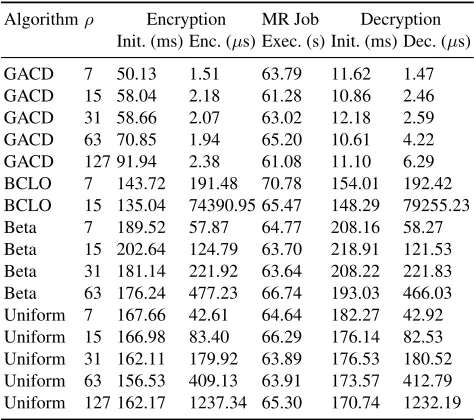
Our implementation is pure, unoptimised Java utilising the JScience library [13] arbitrary precision integer classes. It is denoted as algorithmGACDin Table 1. In addition, to provide comparison for our algorithm we have implemented Boldyreva et al.’s algorithm (referred to asBCLO) [6] along with two variants of the Boldyreva et al. algorithm. These latter variants are based on our generic version of Boldyreva et al.’s algorithm (see section 3.1). One is an approximation of Boldyreva et al.’s algorithm which samples ciphertext values from the Beta distribution (referred to asBetain Table 1). The derivation of this approxima-tion is given in secapproxima-tion 3.2. The second samples ciphertexts from the uniform distribution (referred to asUniformin Table 1). This variant appears in Popa et al.’s CryptDB [30] source code [31] asope-exp.cc. The mean timings for each experimental configuration is tabulated in Table 1. The chosen values of
Table 1.Timings for each experimental configuration (n= 10000).ρdenotes the bit length of the unencrypted inputs.Initis the initialisation time for the encryption/decryption algorithm,Enc
is the mean time to encrypt a single integer,Execis the MR job execution time,Decis the mean time to decrypt a single integer.
Algorithmρ Encryption MR Job Decryption Init. (ms) Enc. (µs) Exec. (s) Init. (ms) Dec. (µs)
GACD 7 50.13 1.51 63.79 11.62 1.47 GACD 15 58.04 2.18 61.28 10.86 2.46 GACD 31 58.66 2.07 63.02 12.18 2.59 GACD 63 70.85 1.94 65.20 10.61 4.22 GACD 127 91.94 2.38 61.08 11.10 6.29 BCLO 7 143.72 191.48 70.78 154.01 192.42 BCLO 15 135.04 74390.95 65.47 148.29 79255.23 Beta 7 189.52 57.87 64.77 208.16 58.27 Beta 15 202.64 124.79 63.70 218.91 121.53 Beta 31 181.14 221.92 63.64 208.22 221.83 Beta 63 176.24 477.23 66.74 193.03 466.03 Uniform 7 167.66 42.61 64.64 182.27 42.92 Uniform 15 166.98 83.40 66.29 176.14 82.53 Uniform 31 162.11 179.92 63.89 176.53 180.52 Uniform 63 156.53 409.13 63.91 173.57 412.79 Uniform 127 162.17 1237.34 65.30 170.74 1232.19
algorithm. The Apache Commons Math [34] implementations of the hypergeo-metric and Beta distributions we used only support Java signed integer and signed double precision floating point parameters respectively, which account for the configurations seen in Table 1. To provide fair comparison, we have used similar configurations throughout. It should be pointed out that, for theBCLO,Betaand Uniformalgorithms, whenρ= 7, this will result in only 128 possible ciphertexts, even though we have 10,000 inputs. This is because these algorithms will only encrypt each plaintext to a unique value. Such a limited ciphertext space makes these algorithms trivial to attack. Our algorithm will produce 10,000 different ciphertexts as a result of the “noise” term. Each ciphertext will have an effective entropy of at least 21 bits forρ= 7(see section 2.1). So, our algorithm is more secure thanBCLO,Beta, andUniformfor low entropy inputs.
As shown by Table 1, our work compares very favourably with the other schemes. The encryption times of our algorithm outperform the next best al-gorithm (Uniform) by factors of 28 (ρ= 7) to 520 (ρ= 127). Furthermore, the decryption times grow sublinearly in the bit length of the inputs. Compare this with the encryption and decryption times for the generic Boldyreva algorithms which, as expected, grow linearly in the bit length of the inputs. Boldyreva et al.’s version performs even worse. We believe this is down to the design of the algorithm, as stated in [6], which executesnrecursions wherenis the bit-size of the ciphertexts. We also discovered that the termination conditions of their algorithm can result in more recursions than necessary.
shows that the job timings are similar regardless of algorithm.
Of course, it is impossible to compare the security of these systems exper-imentally, since this would involve simulating unknown attacks. But we have shown above that the GACD approach gives a better theoretical guarantee of security than that of [5, 6, 33], which defines security based on a game, rather than on the conjectured hardness of a known computational problem.
5 Conclusion
Our work has produced an OPE scheme based on the general approximate common divisor problem (GACDP). This appears to be the first OPE scheme to be based on a computational hardness primitive, rather than a security game. We have described and discussed the scheme, and proved its security properties, in section 2. In section 4 we have reported on experiments to evaluate its practical efficacy, and compare this with the scheme of [6]. Our results show that our scheme is very efficient, since there areO(1)arithmetic operations for encryption and decryption. As a trade-off against the time complexity of our algorithms, our scheme produces larger ciphertexts,∼3.67 times the number of bits of the plaintext. However, as pointed out in section 4, ciphertext sizes had minimal impact on the running time of the MR job used in our experiments.
With regard to our stated purpose, our experimental results show that the efficiency of our scheme makes it suitable for practical computations in the cloud.
We have noted that, like any “true” OPE, our scheme cannot guarantee indistinguishability under CPA [6], unlike the non-OPE protocols of Popa and others [21, 29]. However, with proper choice of parameters, we believe that its security is strong enough for the purpose for which it is intended: outsourcing of computation to the cloud.
References
[1] R. Agrawal et al. ‘Order Preserving Encryption for Numeric Data’. In:Proc. SIGMOD 2004. ACM, 2004, pp. 563–574.
[2] M. Bellare et al. ‘A Concrete Security Treatment of Symmetric Encryption’. In:Proc. FOCS 1997. IEEE, 1997, pp. 394–403.
[3] M. Bellare et al. ‘Relations Among Notions of Security for Public-Key Encryption Schemes’. In:
Proc. CRYPTO 1998. Springer, 1998, pp. 26–45.
[4] T. Boelter et al.A Secure One-Roundtrip Index for Range Queries. 2016. Cryptology ePrint Archive:
2016/568.
[5] A. Boldyreva et al. ‘Order-Preserving Encryption Revisited: Improved Security Analysis and Altern-ative Solutions’. In:Proc. CRYPTO 2011. Springer, 2011, pp. 578–595.
[6] A. Boldyreva et al. ‘Order-Preserving Symmetric Encryption’. In:Proc. EUROCRYPT 2009. Springer, 2009, pp. 224–241.
[7] D. Boneh et al. ‘Semantically Secure Order-Revealing Encryption: Multi-input Functional Encryp-tion Without ObfuscaEncryp-tion’. In:Proc. EUROCRYPT 2015, Part II. Springer, 2015, pp. 563–594. [8] Y. Chen and P. Q. Nguyen.Faster Algorithms for Approximate Common Divisors: Breaking
Fully-Homomorphic-Encryption Challenges over the Integers. 2011. Cryptology ePrint Archive:2011/436. [9] Y. Chen and P. Q. Nguyen. ‘Faster Algorithms for Approximate Common Divisors: Breaking Fully
Homomorphic Encryption Challenges over the Integers’. In:Proc. EUROCRYPT 2012. Springer, 2012, pp. 502–519.
[11] H. Cohn and N. Heninger. ‘Approximate common divisors via lattices’. In:Proc. ANTS-X. Vol. 1. Mathematical Sciences Publishers, 2012, pp. 271–293.
[12] J.-S. Coron et al. ‘Fully Homomorphic Encryption over the Integers with Shorter Public Keys’. In:
Proc. CRYPTO 2011. Springer, 2011, pp. 487–504.
[13] J.-M. Dautelle.JScience. Version 4.3.1. Sept. 2014.URL:http://jscience.org.
[14] M. van Dijk et al. ‘Fully Homomorphic Encryption over the Integers’. In:Proc. EUROCRYPT 2010. Springer, 2010, pp. 24–43.
[15] F. B. Durak et al. ‘What Else is Revealed by Order-Revealing Encryption?’ In:Proc. CCS 2016. ACM, 2016, pp. 1155–1166.
[16] J. Dyer et al.Practical Homomorphic Encryption Over the Integers. Feb. 2017. arXiv:1702 . 07588 [cs.CR].
[17] S. D. Galbraith et al. ‘Algorithms for the approximate common divisor problem’. In:LMS Journal of Computation and Mathematics19.A (2016), pp. 58–72.
[18] N. Howgrave-Graham. ‘Approximate Integer Common Divisors’. In:Cryptography and Lattices. Springer, 2001, pp. 51–66.
[19] H. Kadhem et al. ‘MV-OPES: Multivalued-Order Preserving Encryption Scheme: A Novel Scheme for Encrypting Integer Value to Many Different Values’. In:IEICE Transactions on Information and Systems93.9 (2010), pp. 2520–2533.
[20] F. Kerschbaum. ‘Frequency-Hiding Order-Preserving Encryption’. In:Proc. CCS 2015. ACM, 2015, pp. 656–667.
[21] F. Kerschbaum and A. Schroepfer. ‘Optimal Average-Complexity Ideal-Security Order-Preserving Encryption’. In:Proc. CCS 2014. ACM, 2014, pp. 275–286.
[22] S. F. Krendelev et al. ‘Order-preserving encryption schemes based on arithmetic coding and matrices’. In:Proc. FedCSIS 2014. PTI, 2014, pp. 891–899.
[23] K. Lewi and D. J. Wu. ‘Order-Revealing Encryption: New Constructions, Applications, and Lower Bounds’. In:Proc. CCS 2016. ACM, 2016, pp. 1167–1178.
[24] D. Liu and S. Wang. ‘Programmable Order-Preserving Secure Index for Encrypted Database Query’. In:Proc. CLOUD 2012. IEEE, 2012, pp. 502–509.
[25] Z. Liu et al. ‘New order preserving encryption model for outsourced databases in cloud environ-ments’. In:Journal of Network and Computer Applications59 (2016), pp. 198 –207.
[26] J. L. Massey. ‘Guessing and Entropy’. In:Proc. ISIT 1994. IEEE, 1994, p. 204.
[27] M. Naveed et al. ‘Inference Attacks on Property-Preserving Encrypted Databases’. In:Proc. CCS 2015. ACM, 2015, pp. 644–655.
[28] O. O’Malley.TeraByte Sort on Apache Hadoop. Tech. rep. Yahoo, Inc., May 2008, pp. 1–3.URL:
http://sortbenchmark.org/YahooHadoop.pdf.
[29] R. A. Popa et al. ‘An Ideal-Security Protocol for Order-Preserving Encoding’. In:Proc. SP 2013. IEEE, 2013, pp. 463–477.
[30] R. A. Popa et al. ‘CryptDB: Protecting Confidentiality with Encrypted Query Processing’. In:Proc. SOSP 2011. ACM, 2011, pp. 85–100.
[31] R. A. Popa et al.CryptDB. Mar. 2014.URL:https://css.csail.mit.edu/cryptdb/. [32] R. L. Rivest et al. ‘On Data Banks and Privacy Homomorphisms’. In:Foundations of Secure
Com-putation4.11 (1978), pp. 169–180.
[33] I. Teranishi et al. ‘Order-Preserving Encryption Secure Beyond One-Wayness’. In:Proc. ASIAC-RYPT 2014. Springer, 2014, pp. 42–61.
[34] The Apache Software Foundation.Commons Math: The Apache Commons Mathematics Library. Version 3.6.1. Aug. 2016. URL:http : / / commons . apache . org / proper / commons -math/.
[35] L. Xiao and I.-L. Yen.A Note for the Ideal Order-Preserving Encryption Object and Generalized Order-Preserving Encryption. 2012. Cryptology ePrint Archive:2012/350.
[36] L. Xiao and I.-L. Yen. ‘Security analysis for order preserving encryption schemes’. In:Proc. CISS 2012. IEEE, 2012, pp. 1–6.