This is a repository copy of
The mutual information between graphs
.
White Rose Research Online URL for this paper:
http://eprints.whiterose.ac.uk/103067/
Version: Accepted Version
Article:
Escolano, Francisco, Hancock, Edwin R orcid.org/0000-0003-4496-2028, Lozano, Miguel
Angel et al. (1 more author) (2017) The mutual information between graphs. Pattern
Recognition Letters. pp. 12-19. ISSN 0167-8655
https://doi.org/10.1016/j.patrec.2016.07.012
[email protected] https://eprints.whiterose.ac.uk/
Reuse
This article is distributed under the terms of the Creative Commons Attribution-NonCommercial-NoDerivs (CC BY-NC-ND) licence. This licence only allows you to download this work and share it with others as long as you credit the authors, but you can’t change the article in any way or use it commercially. More
information and the full terms of the licence here: https://creativecommons.org/licenses/
Takedown
If you consider content in White Rose Research Online to be in breach of UK law, please notify us by
Pattern Recognition Letters
journal homepage: www.elsevier.com
The Mutual Information Between Graphs
FranciscoEscolanoa,∗∗, Edwin R.Hancockb, Miguel A.Lozanoa, ManuelCuradoa
aDepartment of Computer Science and AI, University of Alicante, 03690, Spain bDepartment of Computer Science, University of York, 03690, United Kingdom
ABSTRACT
The estimation of mutual information between graphs has been an elusive problem until the formula-tion of graph matching in terms of manifold alignment. Then, graphs are mapped to multi-dimensional sets of points through structure preserving embeddings. Point-wise alignment algorithms can be ex-ploited in this context to re-cast graph matching in terms of point matching. Methods based on bypass entropy estimation must be deployed to render the estimation of mutual information computationally tractable. In this paper the novel contribution is to show how manifold alignment can be combined with copula-based entropy estimators to efficiently estimate the mutual information between graphs.
We compare the empirical copula with an Archimedean copula (the independent one) in terms of re-trieval/recall after graph comparison. Our experiments show that mutual information built in both choices improves signiÞcantly state-of-the art divergences.
c
"2016 Elsevier Ltd. All rights reserved.
1. Introduction
1.1. Motivation
One of the key elements for building a pattern theory is the deÞnition of a set of principled dissimilarity measures between the mathematical structures underpinning the theory. For in-stance, in vectorial pattern recognition, one of the fundamental degrees of freedom of an information theoretic algorithm (for clustering, matching, classiÞcation and learning) is the choice of a divergence. There are some possibilities including mutual information, Kullback-Leibler, Bregman divergences, and so on (see Escolano et al. (2009) for a review).
The mutual informationI(X;Y) between two variablesXand
Y is very interesting since it captures high-order statistical de-pendencies between the variables. However, when these vari-ables are graphs we must address two issues. Firstly, we must express graphsXandYas random variables, beyond the sim-plistic model of Erd¬os-R«enyi model. In such model arandom graph is built by assigning a probability to the edges. How-ever this model does not fully characterize the probability that a given graph (with a variable number of vertices) is observed. Secondly, sinceI(X;Y)=H(X)+H(Y)−H(X,Y) we must es-timate the Shannon entropyH(.) of a graph. There are several
∗∗Corresponding author: Tel.:+34-965903897; fax:+34-965903902; e-mail:[email protected](Francisco Escolano)
approaches for estimating graph entropy. The most efficient
entropy estimators rely on functionals aiming to quantify the amount of information ßowing through the graph. For instance, in Bai and Hancock (2013) the state vector of the steady state random walk on the graph deÞnes a discrete probability func-tion on the nodes. The Shannon entropy of such a probability function yieldsH(.). On the other hand, quantum walks probing is used in Torsello et al. (2014) for providing mixed quantum states known as density matrices. Following Passerini and Sev-erini (2009), the von Neumann entropy (or quantum entropy) maps discrete (graph) Laplacians to quantum states: scaling the graph Laplacian by the inverse of the volume of the graph we obtain a density matrix whose entropy can be computed using the spectrum of the discrete Laplacian. More recently Han et al. (2012) have approximated the von Neumann entropy by formu-lating it in terms of node degrees.
The above methods for estimating graph entropy operate on the graph itself, i.e., they consider the graph as a coder of node/vertex dependencies and describe entropy in terms of its capability for diffusing information. However, in this paper we
not rely on estimating probability density functions but on Eu-clidean distances between vectorial patterns. This means that the Parzen approximation of the probability density function is no longer needed since entropy can be estimated directly from the samples.
On the other hand, the development of graph embeddings which map vertices to multi-dimensional spacesbypasses the rigid discrete representation of graphs. After being embedded, the associated multi-dimensional subspace must retain the rich topological information of the original representation. Many embeddings have been proposed so far: ISOMAP (Tenen-baum et al. (2000)), Heat Kernels (Xiao et al. (2010)) , Diffusion Maps (Lafon and Lee (2006)), Laplacian
Eigen-maps (Belkin and Niyogi (2003)), Commute Times (Qiu and Hancock (2007)), Centered Normalized Laplacian (Robles-Kelly and Hancock (2007)) among others. Most of the these latter structure preserving embeddings (i.e. distances in the embedding are correlated with structural properties) establish a formal link between topology (usually encoded in spectral terms) and some kind of metric or dissimilarity measure in the subspace. Understanding and exploiting the latter formal link is key to quantifying the effectiveness of the corresponding
embedding for a given task. For instance, graph comparison. In Escolano et al. (2011) there are experimental graph compar-isons showing that the Commute Time (CT) embedding out-performs the alternatives in terms of retrieval/recall for the best dissimilarity measure in a given set. In addition, the fact that the latter embedding induces a metric allows us to work in the multi-dimensional subspace of the embedding. Here, problems such as Þnding graph prototypes are more tractable. It is then possible to return to the original topological space via inverse embedding (Escolano and Hancock (2011)).
1.2. Contribution
With these ingredients at hand (bypass estimators and suit-able embeddings), the mutual information between graphs can be deÞned in terms of structural information channels (sec-tion 2). In such channel model, there will be embedding-based encoders and inverse embedding decoders. The channel will be characterized by a conditional entropy relying on a global non-rigid transformation between the input embedding and the dis-torted one. We will devote Section 3 to present how to obtain a multi-dimensional estimation of Mutual Information (MI) from the combination of copulas and R«enyi entropy estimators. In Section 4 we will compare MI for embedded graphs with other challenging dissimilarities. In order to perform a fair compari-son we will use the GatorBait database which has been proven to be a very challenging one despite its small size. This is due to the fact that it exhibits we very high intra-class variability and very low inter-class variability in only 100 samples. In Sec-tion 5 we will present our conclusions and future work.
Our main contribution in this paper is to deÞne graph simi-larity through a model of structural information channel where distortion relies on manifold and MI is estimated through dif-ferent types of copula functions.
2. Information Channels and Manifold Deformation
LetX=(VX,EX) be a random variableX:Ω→EdeÞned
over the set of unweighted and undirected graphsΩwith
node-setsVX having|VX|= nnodes. Then, its associated edge-set
EX ⊆ VX ×VX satisÞes |EX| ≤
!n
2
"
and a realization ofXis given by ann×nadjacency matrixAX∈E.
Let KX : VX×VX → Rbe a topological similarity measure KX(i,j), ideally a kernel, between two nodesi,j ∈ VX. We
assume that the probability mass p(X) relies on the probabil-ity mass of KX(., .) as follows: peaked similarity distributions
yield less probable realizations than ßat ones. This choice is convenient for two reasons. Firstly, it is consistent with re-cent deÞnitions of graph entropy (see Passerini and Severini (2009), Escolano et al. (2012) and Han et al. (2012)). Secondly, it provides a principled framework for understanding graph dis-tortion in terms of the disdis-tortions induced inKX(., .).
LetCbe an structural information channelX → C → Y where Y = (VY,EY) satisÞes VY = VX. Then, the
condi-tional probabilityp(Y|X) describes a noiseless channel with re-spect to the vertices or nodes, but a noisy channel with rere-spect to the edges. The channelCgenerates structural noise (inser-tions and/or dele(inser-tions of edges) through an unknown match-ing functiong : EX → EY#{Φ}, whereΦ is the NULL
la-bel accordingly with Myers et al. (2000). Finding the func-tion g(.) is typically posed in terms of minimizing the graph-edit distance betweenXandY (see Sanfeliu and Fu (1973)). Although many recent developments have proposed approx-imations of the graph-edit distance (see for instance Fischer et al. (2015)) they are (to some extent) rooted in marginaliz-ing p(Y|X). Marginalization tends to capture or preserve local coherence between the matched edges at the cost of loosing global coherence, especially when the input graphsXandY are unattributed.
Here, we propose a different approach which enforces global
coherence. Let fX : VX → Rd, withd ) n = |VX|, a graph
embedding function. The embedding fX(.) induces a manifold
MX, i.e. a subspace of Rd, where the structural similarities KX(i,j) between pairs of verticesi,j ∈ VX are encoded by a
geodesic. Graph embedding functions are such that the Eu-clidean norm||fX(i)− fX(j)||2is a reasonable approximation of
the geodesic insofard matches the intrinsic dimension of the manifold (see Escolano et al. (2011)).
Therefore, since a graphXis mapped to a subspace/manifold MX ⊆ Rdwe assume that the embedding function fX(.) plays
the role of an encoder associated with the channel C which transmits one manifold MX at a time. Given a manifold to
transmit, its encoding is not free of error, i.e. it is noisy: diff
er-ent vertices can be mapped to the same point ofRd. However, we assume that the messages (resulting from the encoding) re-tain the global topology of their respective graphsX. A simple model for the the conditional distribution p(Y|X) governingC is the usual factorization
p(Y|X)=
n
$
i=1
p(Θ(i) Y|Θ
(i)
X), (1)
whereΘ(i) Y andΘ
(i)
MYandMX. However, the above factorization is misleading,
since we have
p(Θ(i) Y|Θ
(i)
X)∝exp
⎧ ⎪ ⎪ ⎪ ⎨ ⎪ ⎪ ⎪ ⎩ −1 2 ) ) ) ) ) ) ) ) ) ) ) ) ) )
Θ(i) X −T(Θ
(i)
Y;W)
σ ) ) ) ) ) ) ) ) ) ) ) ) ) ) 2⎫ ⎪ ⎪ ⎪ ⎬ ⎪ ⎪ ⎪ ⎭ , (2)
whereT(.;W) is aglobalnon-rigid transformation parameter-ized byW, andσis the bandwidth (see Escolano et al. (2011) for more details). This is consistent with assuming that we can-not observe the matching function g(.) but instead its effects
in the similarity matrixKX(., .) in order to produce a new one KY(., .) which determines the embedding fY :VY →Rd
lead-ing toMY.
The framework developed in this paper encompasses our early research. A model for the information channel Cdoes not only assume that an output manifoldMY is received. It
must also specify how it is decoded. We do that through an in-verse embedding. In our previous work (see Escolano and Han-cock (2011)) we showed that for certain types of embeddings, e.g. commute-time embeddings, it is possible to approximate Ywith minimal error.
Consequently, in our model we naturally associate distortion (when the information rate exceeds the channel capacity) with excessive deformation, since the capacity of the channel, de-Þned asC=maxp(X)I(X;Y), decays signiÞcantly with the
in-crease of" = -n i=1
) ) ) ) ) )Θ
(i)
X −T(Θ
(i)
Y;W)
) ) ) ) ) ) 2
. This means that, al-thoughT(.;W) is chosen so that"is minimized, the deforma-tion is constrained by a regularizadeforma-tion constant, i.e. the channel capacity is bounded by regularization.
Bridging deformation with mutual information I(X;Y) opens up a way of analyzing structural pattern distortion in terms of rate-distortion theory. In the following section, we propose a means of estimatingI(X;Y) within this framework.
3. Mutual Information Between Graphs
3.1. Graphs as Random Variables
When headingX=(VX,EX) andY= (VY,EY) as random
variables, now with|VX|=n,|VY|=mwithm!nin general,
we assume: (i) the existence of an upper boundBof the number of vertices for any graph encoded by a structural random vari-able, i.e.n,m≤B; therefore the number of edges of any graph is bounded by!B2"; (ii) the density massp(.) is deÞned according to a similarity measureK(., .) so that peaked similarity distribu-tions yield less probable realizadistribu-tions than ßat ones. These rules are followed by the graphsX=(VX,EX) feeding the structural
information channelC.
In addition, the information channelCcan also incorporate nodal noise as well (whenm!n). The impact of this fact in the design of p(Y|X) is that we must establish a correspondence function (or matching Þeld)c : VY → VX, wherec(.) is not
necessarily a one-to-one matching. Then we can reformulate the conditional probability in terms of
p(Y|X)=
m
$
u=1
p(Θ(u) Y |Θ
c(u)
X ), (3)
where the correspondence functionc(.) comes from the mini-mization of
"′ =
n
.
i=1
m
.
u=1
) ) ) ) ) )Θ
(i)
X −T(Θ
(u)
Y ;W)
) ) ) ) ) ) 2 , (4)
for instance through regularized multi-dimensional point matching (see Myronenko and Song (2010)) and then compute the correspondence function from the optimal transformation T(.;W) minimizing"′. After applying this transformation we havec(u)=iforu∈VYandi∈VX. In this way, we ensure that
the number of matched points is alwaysn=|VX|in order to be
consistent with the information-theoretic alignment framework used for images (see Viola and III (1997) and Neemuchwala et al. (2005a)). The correspondence function plays then the role of providing a common reference system for comparing the two manifoldsMXandMYafter the optimal alignment.
Regarding the impact of nodal noise in the structure of the similarity matrix KX(., .) in order to produce another
similar-ity matrixKY(., .), we interpret this noise in terms of rewiring
the path structure of the original graph beyond a simple editing of the edges. New nodes can be added toVX or old nodes of
VX can be deleted and this may imply the appearance or the
deletion of edges. However, since p(Y|X) relies on the global transformationT(.;W) we assume that nodal noise will have a signiÞcant impact on the conditional probability p(Y|X) inso-far the structure of the obtained manifoldMYdiffers fromMX
after the optimal alignment.
Consequently we will formulate the mutual information
I(X;Y) in terms of manifold distortion after the optimal align-ment.
We summarize our approach in Algorithm 1 where there are explicit calls to compute non-rigid deformations (see de-tails in Algorithm 2 introduced here for the sake of repro-ducibility1). In this regard, the choice of non-rigid
deforma-tions instead of using rigid or affine deformations is the
ex-plicit addition of a regularization term. In Algorithm 2 this term is taking into account when computing the GreenÕs func-tion. The non-rigid transformation used in graph comparison is grounded in two principles. Firstly, the geometry of the sub-spacesMX andMY is typically non Euclidean. This means
that a rigid or affine alignment will potentially lead to low
fre-quency (poorly discriminative) results, unless a small number of samples/nodes justiÞes the use of such a strong regularizer (either rigid or affine). Secondly, given the graphsXandYwe embed their topological information (purely structural) inRd.
Then, the quadratic assignment problem associated with graph matching is linearized in the embedding space. The classical rectangle rule of Graduated Assignment (Gold and Rangara-jan (1996)) imposes the constraint that if two nodes match then their matches are also adjacent to enforce the smoothness of the matching Þeld. This is exactly the role of regularization in
Rd. Regularization in the non-rigid approach is less constrained
than in the rigid or affine cases.
1MATLAB code and data for reproducing all the experiments in this
Algorithm 1StructuralMI
Input:GraphsX,Yand embedding functionf Output: I(X;Y)
ΘX= fx(VX);ΘY= fy(VY);
[ΘY→X,c]=NonRigid(ΘX,ΘY) ;
Joint 2dvariable:ΘZ XY=[Θ
T X(c) Θ
T Y→X]
T;
Setα≈1,α!1;
ComputeIα(ΘX,ΘY→X) from Eq. 19:
ö
Iα(ΘX,ΘY→X)=−Iöα(ΘX(c))−Iöα(ΘY→X)+Iöα(ΘZXY) ;
SetI(ΘX,ΘY→X)=Iöα(ΘX,ΘY→X);
[ΘX→Y,c′]=NonRigid(ΘY,ΘX) ;
Joint 2dvariable:ΘZ Y X=[Θ
T Y(c
′) ΘT X→Y]T;
Compute öIα(ΘX→Y,ΘY):
ö
Iα(ΘX→Y,ΘY)=−Iöα(ΘX→Y)−Iöα(ΘY(c′))+Iöα(ΘZY X) ;
SetI(ΘX→Y,ΘY)=Iöα(ΘX→Y,ΘY);
return I(ΘX,ΘY→X)+I(ΘX→Y,ΘY);
In addition, given that graphsXandYare considered ran-dom variables the estimation ofI(X;Y) implies that we should carefully consider the d−dimensional representation of the structural patterns and more importantly to existing methods which are capable of capturing the statistical dependences be-tween such representations. This naturally leads to the funda-mental concept ofcopula, i.e. the amount of high-order statis-tical dependence between a collection of variables (see Nelsen (1999)) and the equivalence between the negative entropy of the copula and the mutual information between the variables. Therefore, we commence from the deÞnition of mutual infor-mation and then that of the copula itself to develop a computa-tional method for its estimation in Section 3.3.
3.2. R«enyi Mutual Information
Given the conditional probability p(Y|X) = p(Y,X)/p(X) we have that mutual information can be posed in terms of
I(X;Y)=H(X)+H(Y)−H(X,Y). This formulation is more suitable for the practical use ofbypassentropy estimators than the usual entropy formulaI(X;Y)= H(Y)−H(Y|X). This is due to the fact thatH(X) = /Rdp(X) logp(X)dXand this
re-quires the estimation of the density functionp(X). The curse of dimensionality precludes the use ofplug-inestimators, such as ParzenÕs windows, for highd. On the other hand, bypass estimators, which only rely on the samples themselves, scale reasonably well withd(see Benavent et al. (2009) for a discus-sion).
As a result, bypass estimators are useful when structural vari-ables are coded by sets ofd−dimensional vectors. This is the case, since we haveX→ΘX, through the embedding fx(.), and Y→ΘYthroughfy(.). In addition, we have applied the optimal global transformationT(.;W) and obtained a correspondence Þeldc:VY→VX.
Algorithm 2NonRigid (from Myronenko and Song (2010))
Input:Sets ofd−dimensional pointsXandY
Output:DeformedY, Correspondence functionc:Y→X
InitializeW=0,σ∝
-i,u||X(i)−Y(u)||2,β>0,λ>0
Build GreenÕs functionG, whereGab=e
− 1
2β2||Y (a)−Y(b)||2
repeat
Update transformationT =Y+GW
E-step: ComputeP
Pui=
Pui
-kPuk+h(σ,d)
wherePui=e−
1 2σ2||X
(i)−T(Y(u))||2
M-step: SolveW
(G+λσ2diag(P1)−1)W
=diag(P1)−1PX
−Y
Updateσ
untilConvergence
Obtainc:c(u)=iifPui≈1.
return Y+GW,c;
LetΘXbe the set ofn d−dimensional points encodingXand
ΘY→Xbe their correspondingnpoints fromΘYafter the global
deformation and the correspondence Þeld are applied. In Algo-rithm 1 we have used the notationΘX(c) to denote the samples
of ΘX corresponding with those ofΘY→X via the
correspon-dence mappingc(.). However we drop this notation here for the sake of clarity.
Then, we have that
I(ΘX,ΘY→X)=H(ΘX)+H(ΘY→X)−H(ΘX,ΘY→X), (5)
is a proxy we use for I(X;Y) once the global transformation T(.;W) and the correspondence Þeldc:VY→VXare found.
ObtainingI(ΘX,ΘY→X) with bypass entropy estimators for d > 1 is an open problem. The underpinning principle of most of the state of the art bypass estimators is that the Shan-non entropiesH(ΘX), H(ΘY→X) andH(ΘX,ΘY→X) can be
es-timated from the distribution of inter point distances between the points of thed−dimensional setsΘX,ΘY→X and those of
the 2d−dimensional joint (ΘX,ΘY→X) respectively. However,
there is some controversy attending to the statistical consis-tency of the estimators. For instance, although the Leonenko et al. estimator (Leonenko et al. (2008)) has been successfully used in Escolano et al. (2011) to compute the SNESV measure, some authors have recently pointed out that there exist several formal ßaws which do not ensure weak convergence. In P«al et al. (2010) it is suggested to relax the original problem and estimate instead thegeneralized Mutual Information(R«enyi or α−order, withα > 1) whose limit is the Shannon MI when α→1.
Then, given ad−dimensional random variable Θ, we have both the generalized entropyHαand the generalized MIIα de-Þned respectively as
Hα(Θ) = 1 1−αlog
0
Rd
Iα(Θ) = 1 α−1log
0
Rd
q(Θ)α
!1d
i=1qi(Θ(i))
"α−1d
Θ,
(6)
whereq:Rd →Ris the joint probability density function and qi:R→Rare the marginals.
Given a discrete sample Θ of n d−dimensional vectors Θ(1),Θ(2), . . . ,Θ(n) (coming in this case from the manifold) we
can obtain consistent estimators of bothHα(Θ) and Iα(Θ). In this regard, estimation relies on building graphs (one node per sample) whose edges rely on the Euclidean distances between the nodes (d−dimensional points). For instance,entropic span-ning graphs(Hero et al. (2002)) are Minimum Spanning Trees (MSTs) computed from thep−th powers of theL2distances
be-tween the points. There is a mathematical relation bebe-tween the sum of all the p−th powers of the Euclidean distances associ-ated to the edges in the MST and the R«enyi entropy. Nearest-neighbor (kNN) graphs are more robust to outliers than MSTs and they are used for instance in P«al et al. (2010) where a given set of nearest neighbors may be speciÞed by a set of integersS
and then used to deÞne directed edges.
The kNN graphGgeneralizes the choice of thek−th nearest neighbor of each point (when|S|=1) as follows: G=(V,E) whereV ={Θ(1),Θ(2), . . . ,Θ(n)}ande
i j ∈EifΘ(j)is the j-th
nearest neighbor ofΘ(i) and j ∈ S. It has been proved that a consistent estimator of the R«enyi entropy is
ö
Hα(Θ)= 1 1−αlog
Lp(Θ)
γn1−p/d , (7)
whereLp(Θ) = -ei j∈E||Θ
(i)−Θ(j)||p, p = d(1−α) andγis a
constant that can be estimated by generating a large sampleX
in [0,1]dand then settingγ=L
p(X)/n1−p/d.
3.3. Mutual Information and Copula Entropy
The formal link between the estimation of entropy and that of mutual information is the concept of a copula (Nelsen (1999)). Given a d−dimensional random variable we de-Þne F(Θ) = C(F1(Θ1),F2(Θ2), . . . ,Fd(Θd)) where C(.) is
a copula function, that is, a joint c.d.f. (cumulative distribution function) C : [0,1]d → [0,1] which
en-codes the dependence between c.d.f. uniform marginals. Since a random vector (F1(Θ(1)),F2(Θ(2)), . . . ,Fd(Θ(d))) has
uniform marginals, we have that the joint probability
Prob[F1(Θ(1)),F2(Θ(2)), . . . ,Fd(Θ(d)] is a copula function.
A nice property of copula functions is that
I(Θ)=−H(c(F(Θ))), (8)
i.e. the mutual information is equivalent to the negative en-tropy of the p.d.f. c(.)of the copula function (Ma and Sun (2011)). This is consistent with the rescaling property of mutual informationI(Θ)=I(h(Θ)) ifh(.) is a strictly increasing func-tion (P«al et al. (2010)). Since eachFi(.) satisÞes this property,
then we can formulate the R«enyi mutual information in terms of :
Iα(Θ)=−Hα(F1(Θ1),F2(Θ2), . . . ,Fd(Θd)). (9)
Given this formal link, we can bypass the estimation ofc(F(Θ))
by computing the so calledempirical copula. If our choice of the copula function is the multi-dimensional c.d.f., then the em-pirical copula is given by taking the union or concatenating all
ö
Fjforj=1, . . . ,d, where öFjis an estimator ofFj:
ö
Fj(Θi)=
1
n|Ri|,Ri=
2
Θ(k) j ≤Θ
(i)
j : 1≤k≤n
3
, (10)
whereΘ(i)
j is the j−th component of thei−th sample, and
simi-larly forΘ(k)
j . Then öFj(Θi) is the averagerankofΘi, the number
of samples in the j−th dimension smaller or equal thanΘi.
Con-sequently, the empirical copula is given by (W1,W2, . . . ,Wn)
whereWi = ( öF1(Θ1(i)),Fö2(Θ(2i)), . . . ,Föd(Θ(di)))T. Given the
em-pirical copula, a consistent estimator of the R«enyi mutual infor-mation between thensamples is
ö
Iα(Θ)=−Höα(W1,W2, . . . ,Wn). (11)
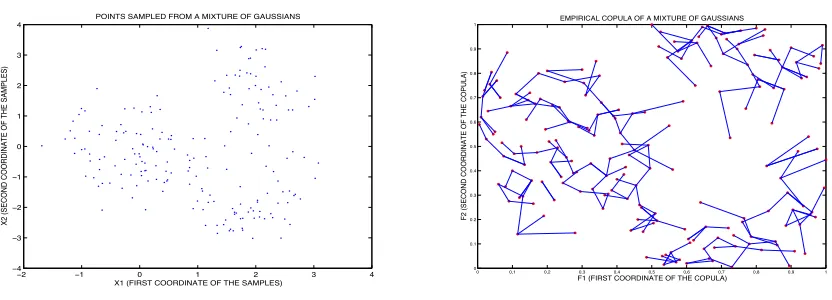
For instance, in Fig. 1 we show both a) the samples of a 2D mixture of 3 Gaussians and b) the samples corresponding to the empirical copula and their connection through the kNN graph whereS = {k}andk = 4. Although the graph has more than 3 connected components (due to the choice ofk) the empirical copula reßects the community structure of the mixture (there are no links between the large communities). We have esti-mated öIα=0.1734 withα=1−p/d=0.9894. In practice, the Shannon mutual information is estimated by choosingα≈1.
3.4. Archimedean Copulas vs Empirical Copulas
Given the öFj(Θi) ∈ [0,1] in Eq. 10 as estimators of the
marginal c.d.f. of thei−th sample along thej−th dimension, it is possible to deÞne alternatives to the empirical copula (which isn×d-dimensional) in order to perform more efficient
compu-tations for the estimation of mutual information. A particularly interesting family is that of theArchimedeancopulas (McNeil and Neslÿehov«a (2009)). These copulas are specially designed for summarizing the dependence structure in multiple dimen-sions and collapse it into a single variable since copulasC(.) are functions that satisfyC : [0,1]d → [0,1]. Archimedean
cop-ulas have been used in biometrics (Cao et al. (2012)) whereas empirical copulas have been used forICA(P«al et al. (2010)).
In the Archimedean context, instead of estimating the usual
Prob[F1(Θ(1)),F2(Θ(2)), . . . ,Fd(Θ(d)] (or bypassing it in
prac-tice) it is preferred to deÞne the copula as follows:
C(U1, . . . ,Ud)=ψ
!
ψ−1(U1)+. . .+ψ−1(Ud)
"
, (12)
whereUj=Fj(Θj) for j=1, . . . ,dandψ(.) is anArchimedean generator. An Archimedean generatorψ(.) is a non-increasing continuous functionψ: [0,∞)→[0,1] which satisÞesψ(0)= 1, limx→∞ψ(x) = 0 and is strictly decreasing in the interval
[0,inf{x :ψ(x)=0}]. The inverseψ−1(.) is deÞned as follows
ψ: (0,1]→[0,∞) and by conventionψ(∞)=0 andψ−1(0)= inf{x:ψ(x)=0}. In addition,ψ(.) only deÞnes a copula ifψ(.) isd−monotone. The functionψ(.) isd−monotone, withd≥2, in a given interval (a,b) if is differentiable up to orderd−2 and the derivativesψ(k)(.) satisfy
−2 −1 0 1 2 3 4 −4 −3 −2 −1 0 1 2 3 4
POINTS SAMPLED FROM A MIXTURE OF GAUSSIANS
X1 (FIRST COORDINATE OF THE SAMPLES)
X2 (SEC O N D C O O R D IN AT E O F T H E SAMPL ES)
0 0,1 0,2 0,3 0,4 0,5 0,6 0,7 0,8 0,9 1 0 0.1 0.2 0.3 0.4 0.5 0.6 0.7 0.8 0.9 1
F1 (FIRST COORDINATE OF THE COPULA)
F 2 (SEC O N D C O O R D IN AT E O F T H E C O PU L A)
[image:7.595.94.510.79.229.2]EMPIRICAL COPULA OF A MIXTURE OF GAUSSIANS
Fig. 1. Estimation of the empirical copula. Left:200samples generated from a 2D Mixture of3Gaussians. Right: Empirical2Dcopula and its associated
kNNgraph.
for all x ∈ (a,b) and also when (−1)d−2ψ(d−2)(.) is both non
decreasing and convex in (a,b). If the function has deriva-tives for all orders and the latter requirements are satisÞed, then it is completely monotone. The notationψd(.) denotes a d−monotone function andψ∞(.) a completely monotone one.
The latter notation is very useful for parameterizing fami-lies of Archimedean copulas. For instance, the generator of the Clayton copula family is
ψθ(x)=(1+θx)−1/θ . (14)
Forθ > 0 the Clayton generator is completely monotone and we have that
ψ0(x)=lim
θ→0(1+θx)
−1/θ=exp(−x) (15)
is the so calledindependence copulain any dimension. In this paper we will focus onψ(x) = exp(−x) (and conse-quently onψ−1(x)=−log(x)) because they are simple and
pa-rameter independent. Then, given the choice of the independent copula we have to estimate:
C(U1, . . . ,Ud) = exp4−(−log(U1)−. . .−log(Ud))5
= exp ⎛ ⎜ ⎜ ⎜ ⎜ ⎜ ⎜ ⎝ d .
j=1
log(Uj)
⎞ ⎟ ⎟ ⎟ ⎟ ⎟ ⎟ ⎠ = exp ⎛ ⎜ ⎜ ⎜ ⎜ ⎜ ⎜ ⎝ log ⎛ ⎜ ⎜ ⎜ ⎜ ⎜ ⎜ ⎝ d $
j=1
(Uj)
⎞ ⎟ ⎟ ⎟ ⎟ ⎟ ⎟ ⎠ ⎞ ⎟ ⎟ ⎟ ⎟ ⎟ ⎟ ⎠ = d $
j=1
(Uj),
(16)
where the copula is given by the factorization of the marginal c.d.f.s. This means that in a multi-dimensional setting the com-mon structural information of thensamples is encoded inde-pendently by each of these marginals. For instance, setting
ö
U(ji)=Föj(Θi) implies that rank computation along thej−th
di-mension contains the structure of the samples w.r.t. Θi along
that dimension. Therefore, letVi = C( öU1(i),Uö (i) 2 , . . . ,Uö
(i)
j ) ∈
[0,1] be new variables using now Eqs. 12 and/or 16 for deÞning
C(.). Then, we have that
ö
Iα(Θ)=−Höα(V1,V2, . . . ,Vn), (17)
that is, mutual information is estimated by a set of one-dimensional samples. R«enyi estimation can be then done in time O(nlogn). In fact, we can simplify the computa-tions by avoiding the estimation of rank information. To do so, we take the original samples and normalize them so that they belong to [0,1]d. In doing this, we are
implic-itly assuming that the value of each normalized sample com-ponent is a marginal c.d.f.. We then exploit SklarÕs the-orem: given a copula C : [0,1]d → [0,1] and c.d.f.
marginals Fj(Θj) thenC(F1(Θ1),F2(Θ2), . . . ,Fd(Θd)) deÞnes
a d−dimensional cumulative distribution function. This theo-rem allows us to use an Archimedean copulaC′ for deÞning
V′
i = C
′(N(Θ(i)
1),N(Θ
(i)
2), . . . ,N(Θ (i)
j)), where N(Θ
(i)
j) is the
normalization ofΘ(i)
j . As a result we have
ö
Iα(Θ)=−Höα(V1′,V ′ 2, . . . ,V
′
n), (18)
and we can refer to this approach as theraw estimationof the Archimedean copula and, thus, the raw estimation of mutual information.
3.5. Mutual Information between Graphs
Given the above estimators of MI in terms of copulas, e.g. ö
Iα(Θ)=−Höα(V1′,V ′ 2, . . . ,V
′
n), we have a formal means of
com-puting the proxy
I(ΘX,ΘY→X)=H(ΘX)+H(ΘY→X)−H(ΘX,ΘY→X).
Since öIα(ΘX) = −Höα(ΘX) and öIα(ΘY→X) = −Höα(ΘY→X),
we only need to compute the estimation of the joint entropy
H(ΘX,ΘY→X). In order to do this, we deÞne the variable ΘZ
XY =[Θ T
X ΘTY→X]T(the 2d-dimensional concatenation of the
two variables). The samples ofΘZ
XYare obtained from the pairs
deÞned by the correspondence Þeld. Then, we have:
ö
Iα(ΘZXY)=−Höα(ΘZXY)=−Höα(ΘX,ΘY→X).
and also
ö
AcanthurusChronixis
THE GATORBAIT GRAPH DATABASE
Class AcanthuridaeTeuthisCrestonis XesurusHopkinsi
Class Balistidae
BalistesVerres
BalistesVerres HemicaranxZelotesHemicaranxZelotes
Class Carangidae CichlidaeHeros
TetracanthusCinctus
Class Antennariidae
Class Auchenipteridae
Double triangle
(around Pectoral Fin)
Sparser triangulation
(around Pectoral Fin)
Bipartite triangulation
(no Pectoral Fin)
NasoCaeruleacauda
[image:8.595.105.500.80.378.2]NEAREST NEIGHBOURS
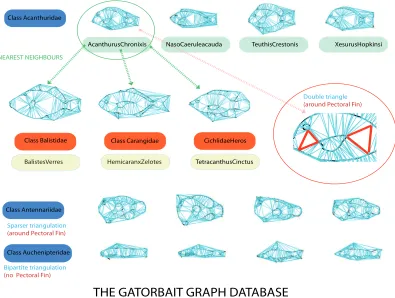
Fig. 2. Summary of the GatorBait Graph Database. The dataset has100Delaunay triangulations distributed in30classes. Classes are associated with Þsh genus and therefore we have high intra-class variability. For instance, taking as principal topological feature the distribution of triangules around the pectoral Þn, we have that this feature varies among the graphs belonging to the same class. Different triangulating topologies characterize different classes. However, there is also a high inter-class variability since thekNNof a given graph belong frequently to different classes.
so that
I(ΘX,ΘY→X))=lim α→1
ö
Iα(ΘX,ΘY→X). (20)
However, the above measure is not symmetric with respect to the non-rigid transformation applied to the data, and in gen-eral we have thatI(ΘX,ΘY→X))!I(ΘX→Y,ΘY)). Therefore, the
proxy of themutual informationbetween two graphsXandY is given by the symmetrization:
ö
Iα(ΘX;ΘY)=Iöα(ΘX,ΘY→X)+Iöα(ΘX→Y,ΘY), (21)
and
I(ΘX;ΘY)=lim α→1
ö
Iα(ΘX;ΘY). (22)
In the following section we will analyze the discriminability of mutual information in two contexts, manely a) comparison of copula functions and b) comparison with state-of-the-art diver-gences/algorithms.
4. Experiments
We use the GatorBait 100 database in our experiments. GatorBait has 100 shapes representing Þshes from 30 diff
er-ent classes (see Fig. 2 where we summarize the main features
of this graph dataset). These shapes are discretized and then their Delaunay triangulations (included in the publicly accessi-ble UA Graph Database2) are retained for testing graph
com-parison/matching algorithms. In order to compare our MI mea-sure with the one proposed in Escolano et al. (2011) (SNESV) through entropic manifold alignment as well as with the classi-cal quadratic function now computed through the PATH algo-rithm (Zaslavskiy et al. (2009)), we reproduce here the same ex-perimental conditions. For instance, embedding functions fx(.)
and fy(.) rely on the commute-time embedding withd=5, and
the settings of the CPD (Coherent Point Drift) point-matching algorithm (see Myronenko and Song (2010)) are the same. The embedding dimensiond, is typically bounded by the results ob-tained by classical estimators of the intrinsic dimensions ofMX
andMX(see Costa and Hero (2004)). Final adjustment ofdis
typically done in the proximity ofd = 5 since the bypass en-tropy estimator is relatively robust to the curse of dimensional-ity.
4.1. Comparison of Copula Functions
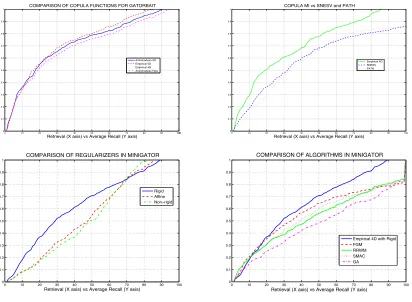
In Fig. 3-(top left) we show the average recall/retrieval curves for several copula functions, namely a) theArchimedean
0 10 20 30 40 50 60 70 80 90 100100 0
0.1 0.2 0.3 0.4 0.5 0.6 0.7 0.8 0.9 1
Retrieval (X axis) vs Average Recall (Y axis) COMPARISON OF COPULA FUNCTIONS FOR GATORBAIT
Archimedean 5D Empirical 5D Empirical 4D Archimedean Raw
0 10 20 30 40 50 60 70 80 90 100
0 0.1 0.2 0.3 0.4 0.5 0.6 0.7 0.8 0.9 1
Retrieval (X axis) vs Average Recall (Y axis) COPULA MI vs SNESV and PATH
Empirical 4D SNESV PATH
0 10 20 30 40 50 60 70 80 90 100
0 0.1 0.2 0.3 0.4 0.5 0.6 0.7 0.8 0.9 1
Retrieval (X axis) vs Average Recall (Y axis)
COMPARISON OF REGULARIZERS IN MINIGATOR
Rigid Affine Non−rigid
0 10 20 30 40 50 60 70 80 90 100 0
0.1 0.2 0.3 0.4 0.5 0.6 0.7 0.8 0.9 1
Retrieval (X axis) vs Average Recall (Y axis) COMPARISON OF ALGORITHMS IN MINIGATOR
Empirical 4D with Rigid FGM
[image:9.595.101.513.82.384.2]RRWM SMAC GA
Fig. 3. Top: Retrieval-recall experiments in GatorBait.Top-left: comparison between different copula functions. Top-right: comparison with SNESV and PATH similarities. Bottom: Experiments in MiniGator. Bottom-left: Comparison between the rigid, affine and non-rigid regularizers (always using the
4D empirical copula. Bottom-right: Comparison between the rigid regularizer+4D empirical copulas and similarities of state-of-the-art algorithms.
ula (independent) for d = 5, b) the empirical copula with
d = 5, c) theempirical copulawithd = 4, and Þnally d) the
raw Archimedean copulawithd = 5. The 5D empirical cop-ula with AUC=75.1600 outperforms all the alternatives. It is followed by the 4D empirical copula with AUC=72.05. How-ever, in this kind of recall/retrieval curve, for two similar AUCs the best curve is the one that grows faster. The 4D empirical copula intersects the alternatives (but the 5D empirical cop-ula) when nearly 45 retrievals are performed. Therefore both Archimedean copula functions (the independent and the raw in-dependent) with AUC=73.26 and AUC=70.60 outperform the 4D empirical copula. However, both Archimedean copula func-tions are outperformed by the empirical copula for the same dimensionality. This is consistent with the information fusion performed by the Archimedean functions which in fact produce faster (one-dimensional) R«enyi estimators. In practice we may use the Arquimedean independent if we have time constrains in our structural recognition systems and this is better than reduc-ing the dimensionality of the empirical copula.
4.2. Comparison with SNESV and PATH
In order to compare our approach with SNESV and the quadratic assignment function (without attributes) optimized by the PATH algorithm (both withd = 5) we will use the worst copula function, the 4Dempirical copula. As we show in Fig. 3-(top right), even the worst copula signiÞcantly outperforms both
SNESV and the quadratic assignment function optimized by PATH. This is consistent with the high-order statistical depen-dence information captured by mutual information. For exam-ple, in the case of SNESV, increasing the dimensionality leads to decrease the performance (ford>5). However, when com-puting the mutual information we estimate a R«enyi entropy for 2d =8 dimensions (the joint entropy). The joint entropy term is key for capturing the high-order dependencies and it is con-sistently estimated even for a high number of dimensions. On the other hand, SNESV (with AUC=59.60) outperforms PATH (with AUC=58.67). Actually PATH cuts SNESV at close to 55 retrievals. Entropic Alignment (SNESV) outperforms PATH and requires less intense computations than PATH.
4.3. MiniGator and Comparison with Attributed Methods
In order to study the robustness of our approach with re-spect to the number of samples (average size of the graphs) we have used a decimated version of GatorBait 100 dubbed asMiniGator. To constructMiniGator, we retain 10% of the points of each shape in GatorBait 100and then build the as-sociated Delaunay triangulation. To choose the most suitable regularizer (rigid, affine or non-rigid), our working hypothesis
three choices in MiniGator. In all casesd = 5 and the cop-ula is the empirical one. We observe a signiÞcant performance degradation with respect to GatorBait. The best choice (rigid regularizer) provides an AUC of 65.20 (vs AUC=72.05 for the 4D empirical copula). In addition, the performance degrades signiÞcantly if we relax the regularizer (the affine regularizer
does not come from a constrained optimization problem). Nei-ther the affine nor the non-rigid choices are competitive.
Given the rigid regularizer (the best choice in MiniGator) we proceed to compare it with other state-of-the-art-algorithms, most of them relying on attributes, such as the Factorized Graph Matching(FGM), (see Zhou and la Torre (2012)), which ac-tually is an attributed and optimized version of PATH. We also explore: Reweighted Random Walks Matching (RRWM), (see Cho et al. (2010)), Spectral Matching with Affine
Con-straint (SMAC), (see Cour et al. (2006)) and Graduated As-signment, (see Gold and Rangarajan (1996)). We show the performances obtained in Fig. 3-(bottom right). Our MI-based method, which is purely topological, outperforms all the alter-natives and FGM is the second best choice.
5. Conclusions and Future Work
In this paper we have introduced a novel similarity measure for graph comparison through manifold (entropic) alignment: the mutual information (MI) between graphs. Estimating MI is addressed through the combination of copula functions and R«enyi entropy estimators. We have studied both the empiri-cal and the Archimedean copula functions. Empiriempiri-cal copula functions yield the best discriminative results, although the per-formance of Archimedean functions is very close to that of the empirical ones despite their formal structure. In addition, Archimedean copulas may be computed in sub-quadratic time, whereas empirical ones have a quadratic complexity. When compared with state-of-the-art similarities/algorithms the worst copula function outperforms very signiÞcantly the alternatives. Future work includes the analysis of different families of
cop-ulas and the deÞnition of ensembles of copcop-ulas. It also includes the formulation of a uniÞed cost function for Þnding the align-ment that maximizes mutual information. Since R«enyi estima-tors rely on spanning trees or kNN graphs it is possible to ap-proximate the derivatives of such estimators (it is straightfor-ward fork =1). In addition, the inclusion of novel and more efficient copulas opens new perspectives for the formalization
of an information theory for graphs. For instance, we can study the implications of the channel coding theorem in graph theory and pattern recognition as well as having a better intuition of the meaning of entropy and coding in this context.
Acknowledgments
Funding. F. Escolano, M.A. Lozano: Project TIN2012-32839 (Spanish Gov.). M. Curado: BES-2013-064482 (Spanish Gov.). E. R. Hancock: Royal Society Wolfson Research Merit Award.
References
Bai, L., Hancock, E.R., 2013. Graph kernels from the jensen-shannon divergence. Journal of Mathematical Imaging and Vision 47, 60Ð69. URL: http://dx.doi.org/10.1007/s10851-012-0383-6, doi:10. 1007/s10851-012-0383-6.
Belkin, M., Niyogi, P., 2003. Laplacian eigenmaps for dimensionality reduction and data representation. Neural Computation 15, 1373Ð1396.
Benavent, A.P., Ruiz, F.E., S«aez, J.M., 2009. Learning gaussian mixture models with entropy-based criteria. IEEE Trans. Neural Networks 20, 1756Ð1771. URL:http://dx.doi.org/10.1109/TNN.2009.2030190, doi:10.1109/TNN.2009.2030190.
Cao, D., Chen, C., Adjeroh, D., Ross, A., 2012. Predicting gender and weight from human metrology using a copula model, in: Biometrics: Theory, Ap-plications and Systems (BTAS), 2012 IEEE Fifth International Conference on, pp. 162Ð169. doi:10.1109/BTAS.2012.6374572.
Cho, M., Lee, J., Lee, K., 2010. Reweighted random walks for graph matching, in: Proc. of ECCV.
Costa, J., Hero, A., 2004. Geodesic entropic graphs for dimension and entropy estimation in manifold learning. IEEE Transactions on Signal Processing 52, 2210Ð2221.
Cour, T., Srinivasan, P., Shi, J., 2006. Balanced graph matching, in: Proc. of NIPS.
Escolano, F., Hancock, E., 2011. From points to nodes: Inverse graph embed-ding through a lagrangian formulation, in: CAIP (1), pp. 194Ð201. Escolano, F., Hancock, E., Lozano, M., 2011. Graph matching through entropic
manifold alignment, in: CVPR, pp. 2417Ð2424.
Escolano, F., Hancock, E.R., Lozano, M.A., 2012. Heat diffusion: Thermo-dynamic depth complexity of networks. Phys. Rev. E 85, 036206. URL: http://link.aps.org/doi/10.1103/PhysRevE.85.036206, doi:10. 1103/PhysRevE.85.036206.
Escolano, F., Suau, P., Bonev, B., 2009. Information Theory in Computer Vi-sion and Pattern Recognition. Springer, Computer Imaging, ViVi-sion, Pattern Recognition and Graphics, New York.
Fischer, A., Suen, C.Y., Frinken, V., Riesen, K., Bunke, H., 2015. Approxi-mation of graph edit distance based on hausdorffmatching. Pattern Recog-nition 48, 331Ð343. URL:http://dx.doi.org/10.1016/j.patcog. 2014.07.015, doi:10.1016/j.patcog.2014.07.015.
Gold, S., Rangarajan, A., 1996. A graduated assignment algorithm for graph matching. IEEE Trans. on Pattern Analysis and Machine Intelligence 18, 377Ð388.
Han, L., Escolano, F., Hancock, E.R., Wilson, R.C., 2012. Graph characteri-zations from von neumann entropy. Pattern Recognition Letters 33, 1958Ð 1967. URL:http://dx.doi.org/10.1016/j.patrec.2012.03.016, doi:10.1016/j.patrec.2012.03.016.
Hero, A., Ma, B., Michel, O., Gorman, J., 2002. Applications of spanning entropic graphs. IEEE Signal Processing Magazine 19, 85Ð95.
Lafon, S., Lee, A., 2006. Diffusion maps and coarse-graining: A uniÞed frame-work for dimensionality reduction, graph partitioning, and data set parame-terization. IEEE Trans. Pattern Anal. Mach. Intell. 28, 1393Ð1403. Leonenko, N., Pronzato, L., Savani, V., 2008. A class of renyi information
estimators for multidimensional densities. Annals of Statistics 36, 2153Ð 2182.
Ma, J., Sun, Z., 2011. Mutual information is copula entropy. Tsinghua Science & Technology 16, 51Ð54.
McNeil, A., Neslÿehov«a, J., 2009. Multivariate archimedean copulas, d-monotone functions and 1-norm symmetric distributions. Annals of Statis-tics 37, 3059Ð3097.
Myers, R., Wilson, R.C., Hancock, E.R., 2000. Bayesian graph edit dis-tance. IEEE Trans. Pattern Anal. Mach. Intell. 22, 628Ð635. URL:http:// doi.ieeecomputersociety.org/10.1109/34.862201, doi:10.1109/ 34.862201.
Myronenko, A., Song, X.B., 2010. Point-set registration: Coherent point drift. IEEE Trans. on Pattern Analysis and Machine Intelligence 32, 2262Ð2275. Neemuchwala, H., Hero, A., Carson, P., 2005a. Image matching using
alpha-entropy measures and entropic graphs. Signal Processing 85, 277Ð296. Neemuchwala, H., Hero, A.O., Carson, P.L., 2005b. Image matching using
alpha-entropy measures and entropic graphs. Signal Processing 85, 277Ð 296.
Nelsen, R., 1999. An Introduction to Copulas. Lecture Notes in Statistics, New York.
mutual information based generalized nearest-neighbor graphs, in: Proc. of NIPS.
Passerini, F., Severini, S., 2009. Quantifying complexity in networks: The von neumann entropy. IJATS 1, 58Ð67. URL:http://dx.doi.org/10.4018/ jats.2009071005, doi:10.4018/jats.2009071005.
Qiu, H., Hancock, E., 2007. Clustering and embedding using commute times. IEEE Trans. on PAMI 29, 1873Ð1890.
Robles-Kelly, A., Hancock, E., 2007. A riemannian approach to graph embed-ding. Pattern Recognition 40, 1042Ð1056.
Sanfeliu, A., Fu, K., 1973. A distance measure between attributed relational graphs for pattern recognition. IEEE Trans. Systems Man Cybernet. 13, 353Ð363.
Tenenbaum, J.B., de Silva, V., Langford, J.C., 2000. A global geometric frame-work for nonlinear dimensionality reduction. Science 290, 2319Ð2323. Torsello, A., Gasparetto, A., Rossi, L., Bai, L., Hancock, E.R., 2014.
Tran-sitive state alignment for the quantum jensen-shannon kernel, in: Struc-tural, Syntactic, and Statistical Pattern Recognition - Joint IAPR In-ternational Workshop, S+SSPR 2014, Joensuu, Finland, August 20-22, 2014. Proceedings, pp. 22Ð31. URL:http://dx.doi.org/10.1007/ 978-3-662-44415-3_3, doi:10.1007/978-3-662-44415-3_3. Viola, P., III, W.W., 1997. Alignment by maximization of mutual information.
International Journal of Computer Vision 24, 137Ð154.
Xiao, B., Hancock, E.R., Wilson, R.C., 2010. Geometric characterization and clustering of graphs using heat kernel embeddings. Image Vision Comput. 28, 1003Ð1021.
Zaslavskiy, M., Bach, F., Vert, J.P., 2009. A path following algorithm for the graph matching problem. IEEE Trans. Pattern Anal. Mach. Intell. 31, 2227Ð 2242.