KIBTOSHI by
Linda Margaret Thompson
A thesis submitted in fulfilment of the requirements for the degree of Master of Arts (Asian Studies) in the Australian National
U n i v e r s i t y .
ACKNOWLEDGEMENTS
I should like to thank my supervisor, Dr. C. A. Gerstle, Australian National University, for the advice and encouragement he gave so freely during the p re p a r a tion of this thesis. Thanks also go to Mrs. Gibbons
1
INTRODUCTION
The literature of Japan in the Tokugawa period is
remarkable both for its quantity and its diversity. Between
1600 and 1868, about 10,000 different titles were published. After the focus of literary activity moved from the Kamigata
area of Kyoto and Osaka to Edo around 1750, there was a particularly rapid increase in the number and variety of
popular prose genres known collectively as gesaku. However,
readers in Japan and the Western world are now more familiar
with the classics of the Heian period, No, and modern novelists than with popular Edo fiction. Apart from a few connoisseurs, assessments of literary critics until quite recently tended to range from indifference to scorn, and the derogatory term ero guro nansensu has no doubt been a more powerful
disincentive to serious study than any linguistic problem of decoding colloquial references to contemporary incidents.
What is gesaku? The term has been defined variously, according to whether it is seen to denote the process or attitude behind the production of a particular work, or to
refer to a specific historical period. In its literal sense
of 'playful or frivolous writing', the word gesaku could be applied to modern works. However, since it is used most
frequently in respect to certain genres of the later Edo period, it has assumed an historical meaning. Thus, even in
more recent applications of the term gesaku, the underlying
suggestion is that the humour of the work somehow resembles that of Edo period fiction.
Hiraga Gennai (1726-1779) is generally considered
the first to have used the term gesaku. Gennai was of samurai
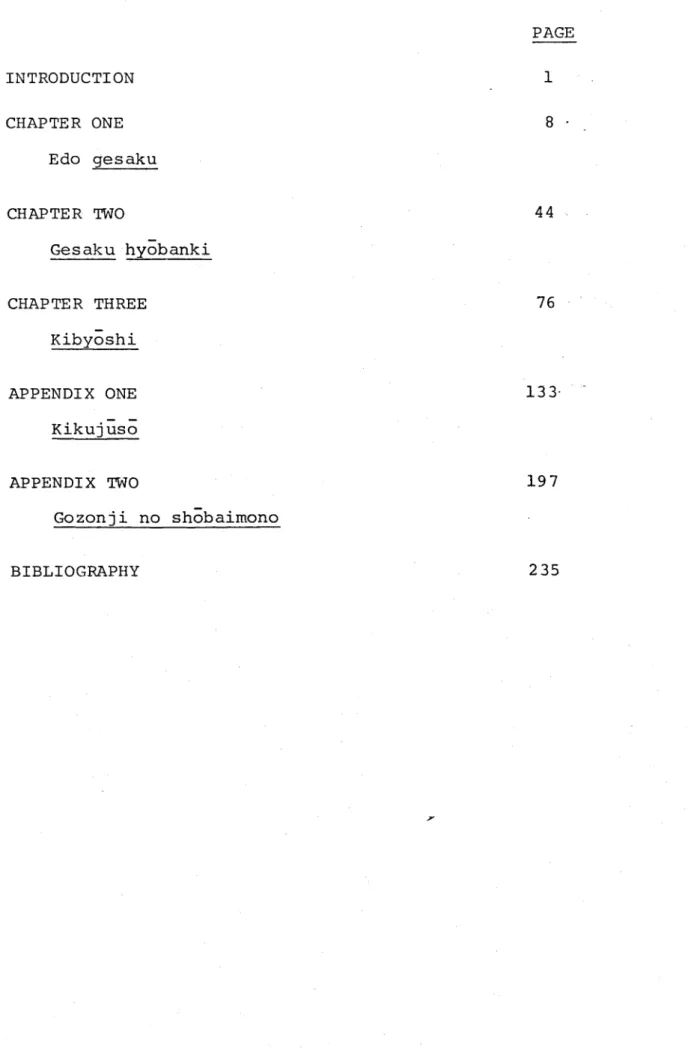
TABLE OF CONTENTS
PAGE
INTRODUCTION 1
CHAPTER ONE 8
Edo gesaku
CHAPTER TWO 44
Gesaku hyobanki
CHAPTER THREE 76
Kibyoshi
APPENDIX ONE 133
Kikuj uso
APPENDIX TWO 197
Gozonji no shobaimono
2
way as a result of the orthodox Confucian disdain of recreational fiction. This rather disarming, self-derogatory attitude is
typical of later upper-class authors of gesaku too, and suggests a certain distance between the educated aloof man of letters and so-called 'second-class literature' written ostensibly as a nagusame, a distraction or an entertainment not to be taken too seriously. However, the definition of gesaku as frivolous literature of the later Edo period is in some ways a
misrepresentation, as it falsely suggests that gesaku writers lacked a sense of artistic pride or integrity. While some may have had no more profound inspiration than a ribald joke, the range includes works of considerable
wit, satire and erudition. Thus, it would be more correct to say that intellectuals used the term in the mid-eighteenth century to refer in a rather modest way to the new style of novels they were writing, as opposed to 'first-class
literature' based on traditional classical studies. The new popular style of writing underwent many changes between 1770 and 1830, but continued to be referred to as gesaku. This classification included even such an immensely long and serious eulogy of Confucian virtues as Nanso satomi hakken-den
(Biographies of Eight Dogs), published by Takizawa Bakin (1767-1848) in one hundred and six volumes between 1814 and 1841. Thus, the term gesaku may be seen as a reflection of
the attitude of society to commercial fiction. In the Edo period, popular novels were not generally regarded as a suitable vehicle
3
In the historical sense, gesaku refers to novel like genres such as dangibon, sharebon, kobanashibon, yomihon , kibyoshi and kokkeibon. In the early nineteenth
century there were also gokan and ninjobon. The same irreverent or non-traditional spirit was evident also in forms of poetry such as kyoka, kyoshi, and
senryu. Study of all these genres reveals a predominance of contemporaneity, stereotypes, satirical humour and verbal dexterity, seen by some modern readers as a triumph of form over content. Many gesaku authors wrote in different genres under a variety of pen-names and adjusted their style to the appropriate formula. Some, like Ota Nampo (1749-182 3) , also wrote serious philosophical essays, but even they did not seek to challenge underlying assumptions on the nature or status of popular fiction. In fact, the most significant
re-assessment of the function of popular fiction came
around the time of the Meiji Restoration. After 1868, Japanese writers made dramatic progress towards the creation of their
'modern novel'. In many respects this involved a rejection of past concepts of fiction. Rather than Ihara Saikaku's
loosely constructed picaresque novels, Ejima Kiseki's sketches of stereotype characters, kibyoshi fascination with verbal puns and Bakin's unwieldy personifications of abstract virtues, the new breed of writers was attracted by Western depiction of the peculiarities of individual life and the exploration of the human consciousness.
The earliest attempt to promote the new realism was Shosetsu shinzui (Essence of the Novel), a
critical essay published in 1885 by Tsubouchi Shöyö
to Japanese literature in an effort to define the true function and status of the novel. He maintained that the ultimate goal was to portray human emotions and considered this impossible in an inflexibly didactic novel like
Nanso satomi hakken-den. He also opposed the gesaku tendency to write works only accessible to a small group of people at a specific time, and concluded that the most effective medium of self-expression was a novel embodying true and universal insights within the framework of a realistic plot. Other outstanding writers like Nagai Kafu (1879-1959), Mori Ögai (1862-1922), Natsume Soseki (1867-1916) and Shimazaki Toson (1872-1943) were all familiar with Western literature and all went abroad during a receptive phase of their
artistic development. While fully appreciative of earlier Japanese g e saku, they also inspired confidence in the novel as an acceptable art form. This change in social attitude was reflected in the replacement of the word gesaku by s o saku. The new term emphasised 's e r i o u s ' creativity rather than
'playful' satire.
As the criteria of judgements change, it is inevitable that works of the past will undergo major re-evaluations. The Japanese novelist and Edo enthusiast Nagai Kafu is reputed to have said that anyone able to decipher a senryu deserved an immediate doctorate. Research of senryu poetry has since made considerable progress and its unusual style
is now more widely appreciated. However, other genres of the period have not fared so well. For example, the fusion of illustration and amusing text in the kibyoshi suffers
4
5
Among Western critics, Donald Keene no doubt expresses a common point of view when he says that kyoshi are 'hardly more than the diversion of a pedant', that senryu 'should not be over-rated', and that the writers of kyoka had a
'fascination with trivialities... clearly the result of a disinclination to face the world seriously'.^ Marleigh Grayer Ryan observes that 'as there was virtually no
worthwhile fiction in Tokugawa Japan, neither was there much 2
that can be classified as literary criticism'. Thus,
while the worst excesses of moral rigorism of Western critics like W.G. Aston have been overcome, there is still a strong tendency to dismiss a wide range of Edo gesaku as unworthy of serious study, and, significantly, a surprising ignorance of the literary conventions of the period.
A more objective approach can be seen in the numerous critical works of Nakamura Yukihiko, one of Japan's most eminent specialists in Edo period literature. Nakamura
stresses the need to represent the social and literary norms of the time, and the dangers of reading through a twentieth- century frame of reference. Encouraged by his scholarly and insightful treatises, Japanese academics have gradually begun to re-examine gesaku literary conventions, and in the process many works have been appreciated as deliberate and carefully crafted pieces of comic satire rather than as capricious nonsense. The enthusiasm of Japanese specialists such as Mizuno Minoru, Mori Senzo and Nakano Mitsutoshi has been
supplemented by several theses and articles in English. However, there is still scope for a good deal of research
\
into many aspects of gesaku literature.
6
yellow-cover books. These short, comic, illustrated works won great popularity in Edo after the 1775 publication by
Koikawa Harumachi of Kinkin sensei eiga no yume (Mr Glitter's Dream of Glory). The genre underwent several changes due to
the effects of public demand and official censorship and had virtually disappeared by 1806. The format of the kibyoshi had been in existence for several decades before 1775 as kusazoshi, which were simple volumes of five doubled pages printed with a black-line illustration and relevant text written within the frame of the picture. However, the more
sophisticated standard of works produced in Edo after 1775 led to the recognition by contemporary readers of a new, qualitatively distinct genre, the kibyoshi, which was seen as a unique product of Edo and as a truly adult form of humour.
Several kibyoshi are now available in well-annotated 3
selections. Also, although diaries and correspondence relating to authors, works and the reading public are rare, there are a few modern editions of evaluations of popular eighteenth-century literature written by enthusiasts of the day. These are vastly different from modern Western literary criticism in both concept and execution but are an invaluable aid to understanding eighteenth-century readers' mode of
appreciation. One of these, Kikujuso (Chrysanthemum Notes) was published in 1781 and has been fully translated in the
7
Notes to Introduction
1. Keene, Donald, World Within Walls, pp. 512-532.
2. Ryan, Marleigh Grayer, The Development of Realism in
the Fiction of Tsubouchi Shoyo, p . 17.
3. All kibyoshi referred to are included in the following
annotated collections:
Hamada Giichiro et a l . (ed.), Kibyoshi senryu kyoka.
Koike Masatane et al. (ed.), Edo no gesaku ehon (4 volumes).
8.
CHAPTER ONE : EDO GESAKU
In the mid-seventeenth century, Edo was hardly
more than a military and administrative centre. Whereas Kyoto had enjoyed a long history of gradual artistic development and consolidation, the new capital selected by Tokugawa Ieyasu in 1616 was essentially a rapid-growing
village. It was a place of continual unrest as provincial lords came and went in accordance with a cumbersome system of periodic residence in the new capital. Workers came from many different areas, bringing with them a variety of accents and customs. Despite being the shogun's stronghold and centre of political power, Edo was culturally dependent on the Kamigata region of Kyoto and Osaka. However, in the early eighteenth century, the population of Edo had
reached one million, easily qualifying it as the biggest city in the world at that time. One of the more tangible signs of the new identity of the city was the special dialect spoken by the Edokko, or person born and bred in Edo. Another was the emergence of a mode of literary
expression specific to Edo. This was particularly important, as Kyoto had been the undisputed centre of publishing until the end of the seventeenth century.
In the peaceful atmosphere which followed the period of wars, Tokugawa Ieyasu and his descendents encouraged
learning and the classics as part of a policy to consolidate their rule. However, despite the spread of commercial
printing, during most of the seventeenth century reading remained the activity of a small elite section of society.
and they were not treated as a marketable commodity for distribution nation-wide. Rather, a bookshop would
have a special connection with a temple, school or lending library, or a patron within the bakufu. By 1677, there were about one hundred bookshops in Kyoto, some of which
also had special privileges in Edo. Osaka had fewer, around thirty, but the 1672 reform whereby goods were obliged to be sent via Osaka on the sea route instead of overland
across Lake Biwa was just one of several factors leading to the emergence of a flourishing commercial centre in Osaka
and a demand for new recreational reading matter. Accordingly, there was a remarkable boom in book publication at the end of the seventeenth century. During the seventeenth century there had been a steady increase in the number of kana explanations of Buddhist scriptures and reprints of Japanese classics and Chinese books. There were also kanazoshi, collections of
haikai, Joruri and sermons. A new genre called ukiyozoshi was launched with the publication by the Osaka poet Ihara Saikaku (1642-1693) of Koshoku ichidai otoko (The Life of an Amorous Man), which made a big impact on the book world in 1682. Two Osaka merchants are said to have seized upon the manuscripts and requested more 'best sellers', with prior payment of three hundred momme of silver.'*' Saikaku died before any such plan could be realised, but book-dealers took up pens themselves and in the next twenty years' about two hundred koshoku
(amorous) books appeared. While Kyoto still relied mostly on older customers and reprints of traditional works, popular
1 0.
Hachimonjiya, whose chequered career lasted from around
1650 to 1770, and which specialised in ukiyozoshi. There
were also adaptations of current Kabuki-Xyogen, Joruri
plays and yakusha hyobanki assessments of actors. Hachimonjiya Jisho made entrepreneurial attempts to promote his goods, and to monopolise popular authors to ensure a constant supply of
new manuscripts. One such successful writer, Ejima Kiseki,
attempted to set up his own company after a dispute over credits,
but was unable to compete with Hachimon,! iya ’ s marketing success
and returned as house writer to continue the genre with which he is now identified, katagimono or character sketches.
In contrast to the excitement and activity in the
Kyoto-Osaka book world, Edo had little to offer at the turn of the century in the way of originality, and relied on what
could be obtained from branches of Kyoto bookshops. Also,
printing techniques were as yet poorly developed, so Edo
2 copies of kanazoshi and saikakubon were of inferior quality. However, the book market in Edo was expanding rapidly, to
the point where after 1716 the volume of sales in Edo branches exceeded the head offices in Kyoto. By 1751, the shift of the genre of literary activity from Kamigata to Edo, known as bun'un tozen, was well on its way.
Whereas Kyoto was struggling to maintain a constant number of publications, Edo was forging ahead. The stagnation in Kyoto may have been due to an inability to provide novelty once a particular formula had succeeded. For example,
Hachimonjiya showed no inclination to break away from
character sketches and theatre-related books, and received a
major set-back with the death of Kiseki in 1736 and Jisho in 1745. Meanwhile, conditions in Edo were favourable to
1 1.
the seventeenth century there had been severe censorship
on political or moral grounds, and a 1721 edict by the shogun Yoshimune included popular literature on the list of
forbidden 'luxury goods', and directed that there should be no criticism of the government, no eroticism, no
reference to lineage, no tell-tale names or dates and no
references without permission from the shogunate administration
3
-to the Tokugawa family or -to the bakufu. The Kyoho reforms of 1723 restated these orders, and a hollyhock stamp on a work indicated a total ban. With the shogun's sanction,
publishers formed groups, and part of the guild's responsibility was to control morally dubious publications. One of the
few local genres which could emerge under these conditions was the kyokunbon, or precept book. These were related to
the oral tradition of street corner priests, who had employed comic devices to increase the appeal of their sermons. Tessai Gakusan's simple stories based on Chinese moral teachings were particularly popular and circulated widely. Such stories were written in Kyoto too, but by
1716, Edo definitely led the field.
Kyokunbon gave way to dangibon which, while still moralistic, placed more emphasis on entertainment, wit and satire. After the death of Yoshimune in 1746, more
satire. Gennai's excellent powers of description enabled him to depict familiar scenes of everyday life in Edo, and his use of the religious debate form let him a step in the direction of realistic dialogue. As the kyokun dangibon lost its thin veneer of respectability, it stood revealed as a koshoku dangibon, but while the
proselytising elements may have been reduced drastically, there was a continuing fascination with Edo matters and with the potential of colloquial language. This found its
ultimate expression in a distinct Edo genre called sharebon, which, in terms of quantity, dominated the various popular
genres for several decades.
Although the form originated in the Kyoto-Osaka area, the conventions of these comic stories of the pleasure quarters were firmly established in Edo around 1770 in Yushi hogen
(The Playboy's Dialect) by an unknown author using the pen- name Inaka Rojin Tada no Jijii (Plain Old Codger from the Backwoods). In Gesaku hyoban hanaorishi (Comments on gesaku) , a general review of gesaku which was published in 1802, this work is honoured as the archetype of all up-to-date novelettes
in the words: tosei no shosasshi mo mina kono shiuchi o minaraimashite to miemasu (It is obvious that all modern
4 _
-stories have been influenced by this one). Yushi hogen begins with an offer by a self-styled man of the world to initiate
lacking in finesse. On the contrary, it is the young man who is finally credited with refinement of manner. Short
sketches in adjoining rooms introduce a variety of
customers and situations. The physical environment depicted would have been familiar to readers, and characters are
brought alive by dialogue in the vernacular of the commoner, with natural use of ungrammatical sentences, slang,
hesitation particles and even belching. There are
descriptive passages, but generally the speaker is identified by name as in play texts. Similarly, entrances, exits and costumes are noted in parentheses, and there is a simple chronological sequence of events.
The preface of Yushi hogen is composed in classical
Chinese and solemnly invokes past authorities in a comparison of the girls of Yoshiwara to fragrant blossoms:
There are many beautiful flowers, but there are also many beautiful girls in the pleasure quarter . However lovely the plum or the peony may be, they will never speak, laugh or sing for you.
However, the flowers of Yoshiwara will talk, laugh, sing and steal away your very soul should you glance at them, and their perfume will melt your heart. The frost and dew will never wither them, nor will the wind and rain scatter them. You can take them at will, and never exhaust the supply. Unlike other flowers, they bloom at all times of the year. So let us sing the praises of these flowers of Yoshiwara.5
This lofty style is an amusing contrast to the extreme contemporaneity of the following passages, which take us
through an evening of pleasure in Yoshiwara. First, there is a description of the sophisticate, torimono:
One fine day, a man aged about thirty-five years old was standing near Willow Bridge. His hairline was plucked back in an exaggerated top-knot style. He wore a twill coat, and a narrow striped sash
broad low clogs seemed awkward to walk.in.
In his hand he carried a modish hood. Although he didn't appear to have a tissue wallet, a packet of tissues could just be seen in the front fold of his kimono. He surveyed the scene around him with proud glittering eyes, as though to say 'There's no one quite so sophisticated as m e '.6
Despite such self-esteem, the reader easily detects a certain tarnish in the image of the sophisticate. In contrast, the young man musuko is clean, neatly dressed and reserved. He is persuaded to abandon plans to
visit a sick uncle, and sends home his companion. Ostensibly the pair will view the autumn leaves at a
famous temple. In fact, they board the ferry to the pleasure quarter. The sophisticate begins his lesson with an
explanation of how one should assume the correct pose, with legs crossed, elbow propped and head leaned at a meditative angle while puffing elegantly on a pipe. Although he
pompously claims to be a popular habitue of the area, to know all the best wares and to be on intimate terms with famous entertainers, he actually misses the intended stop and is embarrassingly not known or liked by the girls.
The second section evokes the sounds and sights of evening in the pleasure quarter, with many complicated puns, short snatches of lively dialogue, and a montage of brief street images:
It's hard to choose where to go in Yoshiwara - all the five sections are good. Someone declaims, as though reading from a book of classical poetry,
'Ah, at first sight I was smitten with love for you. Let us meet again at the next moon-viewing1. Someone has stood a broom upside-down to get rid of a tiresome customer, but someone else is
counting the woven rows of the floor mat while waiting impatiently for her man. One girl reads a letter she has received, another seals a letter to be sent off. Men look in, girls peek out.
1 5.
The third section describes the beginning of festivities, and the final act has four lively scenes depicting the samurai Hira's annoyance at having to waste his time with a substitute courtesan; a girl trying to trick her blind customer into
thinking it is already morning; the unpopularity of the sophisticate and Hira’s reconciliation with his regular girl, translated below.
(Adjoining room) Hira: God 1 What a racket! It looks like that loud-mouth from last night has finally cleared off. I just heard the front door open. The regular girl, who has replaced
the substitute : Well, it'll be quieter when I move up to a better room. But, you know, all that takes a lot of money.
Hira: What's the matter with you? Didn't you listen to what I said last night?
I'll cover the expenses when you move up. You just take care of the present,
I'll look after the future.
Girl: Oh, I'm so happy, (so saying, they fool around a bit.) You know, if I just had another client like you, I'd be really well set-up.
Hira: Mmm, that's nice to know. (He cuddles up, keen to make love.) [Presumably some time elapses]
1 6.
to see you, I just felt very relaxed and slept well. But last night, when you were so bad-tempered, I was really
scared. From now on, please don't get so angry, will you?
Hira: I won't, I won't. Please forgive me. Hey, it's time I went home.
Girl: Ahh, won't you just stay a little longer?
Hira : But look, it's already morning. Just open up and have a look.
(The girl opens up the lattice window and sees it is morning. She is disappointed.)
Girl: Good heavens! The cock must have crowed a while back, but I didn't hear a thing, (aloud) Boy! Boy! Quickly, get my clothes will you! Damn! I told them at the tea-shop to bring my things over at four
o'clock, but they didn't send anyone. House boy ;: I came for you a while back.
Hira : Ah well- (As he ties his sash,
the cock crows again, Cock-a-doodle-do!) Girl:; We must meet again. I'll be waiting
at midday.
Hira:: Mm, I'm so late going home I can't promise anything. Anyway, I'll try
to come.
1 7.
Hirar.No way. Oh, I'm really running latel Girl: Be sure to come, now. (Again, the cock
crows.) Ah, who can read people's
g
feelings in the cold light of day?
These four exerpts from Yushi hogen indicate four main elements of the sharebon : comic use of Chinese characters and classical references, fine details on fashions and pleasure- quarter etiquette, familiarity with the physical environment of Edo, and a meticulous record of the exact manner of speech of all characters, presented in a dramatic format.
Although the sharebon began in Yoshiwara, it soon moved to the unlicensed okabasho. In mid-1770, the Fukagawa area provided the setting in Tatsumi no sono by Muchu Sanjin Negoto Sensei (Mr. Crazy Night Talk). Tatsumi refers to the south direction, in contrast to northern Yoshiwara, otherwise known as Hokkoku or Hokuri. There is a deliberate attempt
to individualise the customs and slang of the area, and to introduce real people. Another setting was Shinagawa, where brothels operated under the pretext of providing inns to service travellers. Late in 1770, Nanko ekiwa by Kitasa no Sanjin exposed the vanity of a self-styled Yoshiwara expert visiting Shinagawa for the first time. A third popular
okabasho was another relay station called Shinjuku, whose special features and distinctive clientele were detailed in a 1775 sharebon titled Noeki shinwa, and its sequel four years later. The author, Yamanote no Bakahito (Uptown Idiot) was probably none other than the respectable man of letters,
1 8. Quarters), who enumerated seventy Edo brothels, and even included the boat-houses or funa manju and the street
walkers known as yotaka (hawks of the night). Some sharebon
varied convention by moving the setting outside Edo. Also, in 1783, Torai Sanna's Sankyoshiki (The Three Teachings of
Love) took the liberty of introducing Confucius, Buddha,
the Shinto Sun God and Lao-tzu to a brothel in Yoshiwara. Even so, the genre was so narrowly defined that it was quite
an innovation when Kyoden situated a 1791 sharebon called Nishiki 9
no ura (The Reverse Side of the Brocade) in the daytime.
What was the reason for this extraordinary fascination
with the sharebon, which attracted some of the most
intellectual minds of upper-class society? To understand the phenomenon, it is essential to consider the nature of Edo's population. From the time of its inception, Edo had been a city of samurai, priests and small merchants,
characterised by a significant imbalance of the sexes. A combination of political and social factors led to the
establishment of a red light area officially recognised by the government, and also innumerable other illegal but sanctioned
places of prostitution. From the seventeenth century, yujo hyobanki had given the names and ranks of brothels and
courtesans, and many details on related matters. In Edo, the Yoshiwara saiken brothel guide was published every year
by Tsutaya , and its contents were of a largely informative
nature . Use of the same setting for the fictional dangibon
resulted in a unique genre which dealt exclusively in stories revealing the nuances of etiquette in the pleasure quarters,
and satirising fake sophistication. The quarters were
not only to provide sexual adventure, but were also the hub
enjoyment of the quarters was an important element in the masculine culture of the day, and even gave rise to aesthetic theories. Thus, the dominating concept of mid-eighteenth century popular Edo literature was
incontestably that of tsu (3J) .
The term tsu is related to an earlier word, sui (;ff) , used
in the Kamigata area, and could be compared to the cult of
dandyism in England and France in the eighteenth and nineteenth century. Elegant dress, deportment and behaviour appropriate to the situation were all characteristics of the Edo tsujin, but those who merely copied the outward trappings and
lacked true tsu refinement were to be relentlessly exposed as half tsu or fake tsu, and a great deal of literary energy was expended in exploring the fine distinction between
the two. An ordinary person could acquire tsu
by an interest in something very old or unusual,
but must remain essentially a dilettante. In all things he
must retain a certain cool aloofness. In particular, sentimental
love would be a disqualification. Tsu was closely related
to fashionableness, but excessive imitation or misinterpretation of fashion was also fatal. As to the finer points of discrimination, as Santo Kyoden said, only a tsujin would know.^
To a small group of men in the mid-Edo period, the term became a fashion, an aesthetic concept, a way of life and even a literary standard. In the exclusive setting of Edo tea-houses and brothels, the tsu observation or joke was a share, which
also had connotations of 'smart'. All sharebon took as point
of departure a belief in the validity of tsu, and probed the
concept through ugachi or anasagashi, which referred to
2 0. Intellectual life in mid-eighteenth century Kyoto was relatively peaceful and there was a lingering taste
for historical romances written in an elegant lofty style which reflected the writers' distant attitude or even denial of the realities of the world around them. While seeking the freedom of expression afforded by zoku
(popular) literature, Kamigata intellectuals reflected a definite continuity with ga (elegant) literature of the past, to the extent that after Yosa Buson's death in 1783, Ueda Akinari mourned him as a fine writer of kanagaki no kanshi (Chinese poetry in Japanese kana)
In Edo, there were few ties to classical culture. From the beginning of the bakufu, samurai education had grown steadily, and by the eighteenth century
this class was highly literate. However, lower-level samurai were faced with a breakdown of their traditional role as military aristocracy and a lack of real political and economic power. This may well account for the
interest in mocking, urbane escapist literature depicting the worldly pleasures of the day. In Edo there was a multiplicity of gesaku genres, which could be interpreted as the diversity of an enriched culture, or conversely as a symptom of trivialism. Most writers adapted their pens to the conventions of a variety of genres, using various different pen-names. Ota Nampo was one of the more outstanding of such educated men of samurai
2 1.
production of comic works. He wrote senryu (humorous haikai) kyoshi (comic poems in solemn-looking Chinese) and kyoka (Japanese poetry which gave a humorous twist
to the themes or lines taken from serious poetry of the past) .
Around 1770, kyoka parties became extremely
popular in Edo, and sometimes collections were published based on these convivial gatherings. There was certainly no commercial reward in either these or in sharebon. According to Kinseimono no hon Edo sakusha burui, a review of novelists published by Takizawa Bakin in 1834, there was no system of manuscript fee until 1795. Instead,
the publishers would send a lot of new titles or colour prints as a gift to writers like Höseido Kisanji, Koikawa Harumachi and Shiba Zenko. If the writers had given them a very successful story for the New Year marketing blitz, they could also be treated to an atari furumai, or
lavish entertainment in the pleasure quarter, in February or March. It was only after Kyoden and Bakin had produced works selling upwards of ten thousand copies each that
they were rewarded with an agreement on fees to be paid by
12
Tsutaya and Tsuruya, and this was not until 1795-6.
The early gesaku authors treated writing as a hobby, not as a professional occupation. There was no need to cater to the tastes of a wide commercial marked, as their works were not 'popular' in the sense that they were intended for
Reading habits have been revolutionised by mass circulation, and it is difficult to envisage a work of fiction being
written specifically for a small circle of people with similar background and t a stes, but it is precisely this sort of 'closed world' which gave rise to sharebon, kyoka and kibyoshi. The more specific the reference and the more obscure the allusion, the greater the readers' delight in unravelling the puzzle. Whereas Kyoto bookshops dealt on a national level, gesaku writers of Edo delighted in a narrow field of reference which could only be entered by a privileged or 'initiated' reader. This is what Nakamura Yukihiko terms the 'contract' between the writer and the reader. The readers were assumed to be familiar with Edo down to the finest details. The layout of the city was firmly fixed in their minds. They knew immediately that a particular area was known for cheap street-walkers, that a particular shop sold the best grilled eel in town and that a particular line was a variation on the latest hit song. Thus, gesaku literature of Edo refers constantly to contemporary expressions, songs, fashions, restaurants, shops, events, personalities and ideas. To gain a clearer
insignt into this gesaku culture, let us examine in some detail the literary devices used in k i b yoshi.
A major structural device in kibyoshi is the s h u k o , original idea or innovation, which is imposed upon the sek a i , the familiar setting or theme. In earlier haikai poetry, these terms had
already been used to describe the way an individual touch
could be achieved within the confines of a traditional pattern.
2 3.
In kibyoshi, the shuko referred primarily to the
theme of the whole work when a comic story was superimposed on a familiar place, person or episode. Thus, in Kagekiyo hyakunin isshu, a kibyoshi written by Kisanji in 1781,
the sekai is Kamakura, where Yoritomo Hideyoshi orders that a would-be assassin must be apprehended. The man they seek is Kagekiyo, a great Heike general who achieved fame at the battles of Yashima and Dan-no--ura, and who became a popular
figure in No and Joruri plays. However, the twist is that the word kagekiyo was also Edo slang for an habituö of the pleasure quarters. Thus, the search takes us through all
sorts of fantastic escapades in eighteenth-century Edo before the final comic denouement. Early gesaku writers used all their ingenuity to devise such unusual shuko, on the
assumption that their readers were equally familiar with the underlying sekai, whether it was historical or literary.
There was no need for the prolix explanations of later more'popular gesaku writers like the kokkeibon humorist Jippensha Ikku
(1765-1831), or the ninjobon specialist Tamenaga Shunsui (1790-1843).
The same principle of the shuko was applied in a more specific way in the mitate, which consisted of finding a correspondence between dissimilar things or of looking at something in a new way to give a surprise effect. The mitate was also an old device used in haikai and even
included in the shikimoku (rules) of the Teimon school. However, it became a form of humour pervasive in
Edo literature and essential in kibyoshi, which
the definition of mifate lies somewhere between the metaphor and the technical joke. For example, let us consider the contents of the first ehon mitate or books of illustrated metaphors,which are analysed in detail by Nakano Mitsutoshi
- 13
in Gesaku kenkyu. Ehon mitate hyaku kacho was published in 1755. In the preface, the author
claims to have been enjoying the cool of the evening in the Ryogoku pleasure area when he heard a song from one of the boats which contained one hundred 'tree and bird' metaphors,
so he hurried home to draw pictures of them. In the epilogue, there is a short passage full of puns on ki and tori, such as hima o tori (to take time off) and kane tsuki (to strike a bell). Thirteen of these puns appear in the main body
of the work, among a total of fifty sets of tree-bird illustrations As can be seen in the two examples below (see fig. 1),
Hyaku kacho shows everyday items drawn to look like a tree and a bird. Approximately one-third of the page is a short explanation, and together they create a visual and verbal pun such as ibiki (yawn) and sugagaki (instrumental music). In gesaku terminology, the picture is pure mitate, and the word play is kojitsuke, or sophistry.
2 5.
signed with two different pen-names, the style suggests a single author-illustrator. At the end of Zoku hvaku kacho there is an announcement for a proposed work in three volumes on thirty-six shell mitate. The bird series seems to have been finished by someone else in the same year, 1756. This
third publication Ehon ki ni tori contains twenty-four illustrations, which added to the fifty in Hyaku kacho and the twenty-three in Zoku hyaku kacho, approximates the promised one hundred items. However, three mitate are
repeated from Zoku hyaku kacho and the format has changed to show a picture and explanation on one side of the folded sheet, and a related poem on the other side, as illustrated in the pun on satori (enlightenment), where a bird
is shown flying over some scholarly texts (see fig. 2).
The twenty-four pen-names which appear at the end of these poems were probably only used in this one context, but Nakano Mitsutoshi postulates that they may represent some of the leading gesaku personalities.
26 .
Hyaku kacho was referred to several times by Kyoden, who recognised it as an important influence on gesaku writers and a list of mitate books compiled by Nakano Mitsutoshi contains thirty-five publications dating
from 1755 to 1814, and including such reknowned names as
- 14
Taketsue no Sugaru, Manzotei, Kisanji and Kyoden. The mitate device was a vital ingredient in the kibyoshi, and renders certain passages incomprehensible
to readers unfamiliar with the 'logic' of the associations. For example, in a 1776 work by Harumachi, Bakemono Öeyama, there is a scene where Watanabe Orange Peel is whisked away by Midnight Noodle to be chopped up into condiments of the season. The fearless hero hacks off the villain's
arm with his Noodle-Cutting knife, and flings it towards the roof of the gallery of the Kitano shrine, but it lands instead on top of an orange-basket. The sekai of this rather extraordinary story is a legend about the four valiant retainers of Minamoto no Yorimitsu, who went to
mountainous Tamba province in order to defeat the robber-ogre Shutendoji at Öe Mountain. This eleventh-century story
provided the theme of many No, Joruri, Kabuki and kusazoshi. The shuko was a battle between the type of noodle dish most popular in Edo at the time, and the traditional Kyoto dish. The Edoite Soba Meal's four faithful allies are
Grated Radish, Dried Bonito Flakes, Cayenne Pepper and Orange Peel. Their arch-enemy is Midnight Noodle and his
2 7.
the enclosing gallery of the shrine to an orange-basket. Although the objects are vastly different, the name Orange Peel provides a tenuous point of contact. This mitate is developed in the following scene, where Orange Peel's aunt visits to steal back the arm, kicks over the orange-basket and runs away. This is probably why, we are told, all orange-boxes now have cloth covers. In the old legend, Ibarakidoji disguised himself as Watanabe no Tsuna's aunt to retrieve his arm, then burst through the gable to
make his escape. Thus, the mitate compares the cloth covering an orange-box to protect against dust and sun with a gable-roof, and also alludes to the lack of gables
in the Watanabe residences of old. Furthermore, the aunt's place of origin is given as Kawachi (Osaka) in Heike
monogatari, but is changed to Kishu (or Kii) in the story, because the area of Wakayama is famous for its oranges. Such is the nature of the mitate, which invariably brings
15 the past story into the present.
2 8.
Fig. 3
A more extended joke is possible in the tsukushi or enumeration of related words. While such a device may
seem rather superficial to the modern reader, it has a long and respectable tradition in Japanese literature.
In Heian times, there had been lists of such things as flowers (kikuawase), but Sei Shonagon's Makura no soshi (Pillow Book)
was a vastly more imaginative approach, where it could truly be said that the total effect of the classification was more than the sum of its parts. Subsequently many more tsukushi or soroe were written, but the literary value was uneven. There were educational publications for the general public like lists of trades (shobai
oraimono) or Edo place names (Edo oraimono). More sophisticated use of the tsukushi can be seen in the celebrated m ichiyuki in the Joruri plays of Chikamatsu
Monzaemon (1653-1725). These are descriptions of the places an ill-fated couple pass through on their journey to death by suicide, and to subsequent release from the sorrows of
enumeration of post stations along the Tokaido Line. In Shinju Ten no Amijima, the word-play revolves around names of bridges in the north of Osaka. In gesaku
literature, such tsukushi are both the delight and the despair of the annotator. Sometimes the catalogue seems to achieve little beyond flattering the ego of those
familiar with all of the items. In Atama ten ten ni kuchi ari (1784) , Ota Nampo, under the pen-name Yomo Sannin, writes of a battle between different restaurants. The fifteenth
scene shows personified restaurants at a shrine, praying for guidance in the skilful use of their carving knives and in pleasing the palates of their customers. On the
same page there are written the names of dozens of rivals or 'combatants', some of them famous eateries or special
dishes, some of them now unknown. The readers' pleasure was derived from being able to identify all these places. A more complicated form of tsukushi occurs in Kyoden's
Gozonji no shobaimono (1782), where a story about books contains a short declaration of love which is also a list of dozens of terms related to paper and books. This offered more challenge as it required reading on two different
levels, with continual adjustment to the multiple syntactical functions of any one word.
3 0.
Fig. 4
This type of gesaku humour arose from a verbal mitate, and was also known as shuku, kuchiai or goroawase. In a more extended form, a familiar proverb or phrase would undergo several substitutions of similar-sounding words for a comic effect. For example, toshi no wakai no ni shirage ga mieru (although he is young, you can see some white hairs) becomes oki no kurai no ni shiraho ga m ieru (although the sea is dark, you can see some white
sails). Such humour can best be appreciated when the words are read aloud, as it depends on sound rather than
form.
A humorous device often used by gesaku authors, particularly in the preface, is the mock-serious
reflection in difficult Chinese kambun. This can be seen in the introduction to such sharebon as Yushi hogen or Tatsumi no sono, and is illustrated in an extreme form in an unusual kibyoshi by Shiba Zenko called Joro no makoto tamago no kakumoji (1790) . This kibyoshi doesn't
have a sustained story line, but is an irreverent re-writing of passages from the Confucian text Daigaku (The Great
men with any claim to education during Edo times. Zenko has taken familiar passages and altered the Chinese characters slightly to make a comment about various situations in the pleasure quarters. The kambnn are accompanied by Japanese readings (furigana) and are followed by solemn-looking commentaries on the meaning of the text. These commentaries are pure nonsense, and must have delighted those readers who had both a classical
education and worldly experience. The introduction to Daigaku reads:
My master, the philosopher Ch'ang, says: - 'The Great Learning is a Book transmitted by the Confucian School, and forms the gate by which first learners enter into virtue. That we can now perceive the order in which the ancients pursued their learning is solely owing to the preservation of this work, the Analects and Mencius coming after it. Learners must commence
their course with this, and then it may be hoped they will be kept from error*.16
Zenko's version, with a pun on koshi, which denotes both the name Confucius and 'lattice window' reads:
The master of the house says: 'The Great Patron hears all sorts of enticements as he stands at the brothel lattice, which forms the gate by which customers enter the girls' beds. We can now perceive clearly that the more one becomes a sophisticated customer, the less the girls can profit, just as they can't make much from men who don't choose to throw their money away. Patrons must commence their course with a
study of this, and then it may be hoped they will be kept from making fools of themselves'. The opening sentence of Daigaku is:
What the Great Learning teaches, is - to
32 .
Fig. 5
The way to treat a Great Patron is to get to know his nom-de-plume, to do your hair, and to show ignorance.
This is followed by three items of commentary: To get to know his nom-de-plume means to remember the name he uses when writing poetry. To do your hair means to brush it out and arrange it nicely every day. To sham ignorance means not to make out you understand everything but just to say,
'Well, gee, I don't know'.19
Finally there is an exchange of comments between the girls, who confuse kyotoku (pen-name) with rosoku
(candle) and with a temple in a Chiba province called Gyotoku. The entire kibyoshi continues in the same vein, concluding with a parody of the Daigaku epilogue.
In another kibyoshi of the same year, Hayariyasu
hiwacha S o g a , Zenko compresses the whole Soga legend into three short volumes, with a similar preface,
3 3.
Current slang was often incorporated in g e s a k u , and many such expressions are given in Harumachi's 1778 Kotoba tatakai atarashii no n e , where they are in fact personified. Daiboku no kiriguchi futoi no ne means futoi or preposterous, dorayaki-satsumaimo means umai or tasty, yomo no a k a , ippai nomikake yama and tai no misozu all refer to drinking, tonda chagama means ,'What! ' and so on.
To this brief list of elements of gesaku style one should also add muda (nonsense). The attraction of muda may have been in the irresponsible escapism it offered
from the limitations of a closed feudal society. Muda aimed less at serious satirical comment on contemporary issues than at all-inclusive mockery. This was especially pronounced in the kibyoshi, for two reasons. One was
that whereas the sharebon was an attempt to define and embody t s u , the kibyoshi derided even this concept. The second was that the kibyoshi was not limited exclusively to themes of the pleasure quarters, but could apply its special brand of irreverent wit and upside-down logic to any field whatsoever. Some of these general areas were dreams, animal tales derived from traditional children's
stories, tall tales of fantastic events, comic stories of possible future trends, strange occupations, battles
between different personified objects and parodies of contemporary issues.
Sekai-shuko, m i t a t e , s h a r e , tsukushi, jiguchi, mock-serious use of Chinese characters, slang and muda are the basic ingredients of most forms of gesaku literature. The uniqueness of the kibyoshi lies in their presentation within the format traditionally used for k u sazoshi,
about eighteen centimetres high and five centimetres wide, and each volume contained five sheets of cheap
recycled paper folded and bound with the edges to the centre, giving ten pages in all. There was a title-label and picture on the front, and each inside page consisted of a black-line illustration with a short explanation or lines of conversation written mainly in kana in any
odd space available within the picture. A complete story could consist of several volumes, in which case they were marked jo_, chu and ge, but it was customary to restrict each volume to the standard length of five doubled sheets, the back page often serving as an advertisement for other publications available from the same publisher.
Possibly soshi (Jjt-'J') was a variation of sasshi (tB"?'). In the Heian period, spellings included ,
Jjt-J- and (now simplified to ) anc^ denoted short
works written in kana . There are various theories regarding
- 20
the origin of the term kusazoshi. In an 1830 collection of essays called Kiyushoran, the addition of kusa ( M-) is
seen to distinguish between two words with identical pronunciation, ^ and • The former referred to works used for an educational purpose, whereas the latter was for recreational reading. Both are pronounced soshi, but
the word written with the character could be identified as kusazoshi in the same way that the man's name Akira is even now distinguished by saying 'the Akira spelt using the Mei character from Meiji', or 'the Akira spelt using the Sho character from Showa' ( 3^0)3^ Sg'fPCOEgCORg )•
3 5.
Heian period, as Fujioka Sakutaro suggests, then the
word kusazoshi would not seem to reflect any recognisable
difference in content, but simply a difference in orthography.
In Genkai, a reputable Japanese dictionary published
in 1886, kusazoshi are defined as books written in the
cursive or kusa style of kana. That is, the term merely
relates to the form of the script used. A third explanation
is in Takizawa Bakin’s Edo sakusha burui, where the famous
writer states that the first books were of very poor quality. Even the covers were made from recycled paper, and the
strong smell of ink caused them to be known as .
The character ^ means kusai or 'bad smelling'. Later, as the format improved, the character was changed to avoid the unpleasant nuance.
Finally, in the introduction to Edo sakusha burui it is suggested that like kusa-sumo and kusa-shibai the term has a pejorative sense of 'non-legitimate' or 'second-rate'. Even in modern Japanese, the term kusa-yakyu is a derisive term for poorly played baseball. It would seem reasonable to see this as due not only to the connotation of playing on a grassy field but also to the traditional nuance of
'second-class'. This theory seems to be most widely
accepted today. However, when discussing the etymology of kusa, critics produce a variety of spellings for soshi, so orthography may now reflect little more than a personal preference or habit.
Publishing details were not usually recorded in early
paste-3 6.
on cover slip with the title, publisher's trademark and a picture suggesting the contents. However, it soon became an unwritten rule to publish new titles at the beginning o f the New Year and to incorporate the appropriate sign
based on the Japanese sexagenary cycle. One simple reason was the popularity of the cheap colourful books as a New Year gift to children and servants. With the yearly change in design, old and new publications could be easily
recognised. As old stock was sold at a discount, this had both advantages and disadvantages. Sometimes the year's sign was alluded to in an artistic way. For example, the mouse figures in a story about the god Daikoku, so the Year of the Rat could be symbolised by a straw bag associated with this god. A jargon word for 'meat' was
'peony', so this flower could represent the Year of the Bull.similar to Western tales of a man in the moon, there
is a Japanese story of a rabbit pounding rice cakes on the moon, so the Year of the Rabbit could be indicated by a pestle and mortar. This system, especially evident from
the mid-eighteenth century, assists in dating works. Also, for the sake of unity of design, and so that the customer could identify the publisher at a glance, it became common
for a basic cover to be designed for all the titles put
out by a particular publisher in a particular year. Appropriate title, illustration and other details were added to the
basic design for each individual title. Thus, a re-edition of a title would necessitate a completely new cover
F i g . 6
Nishimura placed the title illustration in a circle, with a straw bag and two mice featured below. The publisher's trade mark was included on all the covers in the lower left-hand corner.
Fig. 7.
3 8.
Fig. 8
Chibuya used a fat purse as a picture frame, with two 21
mice and a bag of rice below.
The year of publication or re-issue is not always
so easily identifiable. Some book publishers, like Tsutaya, who was reknowned for actors' pictures by Toshusai
In the early years, authors' names were rarely recorded as they were considered far less important than the illustrators. A well-known gesaku writer Öta Nampo observed in his diary that picture books published by Urokogataya were written by someone known as Ojii (Grandpa), which hardly suggests a high
professional status. However, in a 1744 publication
the names of both the artist and the author were printed, which indicates a gradual move towards artistic
22
recognition of writers.
Another reason for our incomplete knowledge of the identities of authors and illustrators, even in the more sophisticated kibyoshi, is the widespread use of pseudonyms. Gesaku writers often used different names
at different times of their lives, or for different genres. Samurai were loathe to risk public opprobrium by signing low-class literature, especially as political surveillance became stronger at the end of the eighteenth century. Also, many of the names were of comic intent.
The kusazoshi1s development is usually defined as a
progression through akabon (red books), kurobon (black books), aobon (blue books), kibyoshi (yellow covers) and gokan
(several volumes bound together). A general change of content accompanied this change of format, but the distinction is not always easy to recognise. Akabon were largely based on folk tales or traditional children's stories such as Momotaro, Kachikachi yama (Kachikachi Mountain), Nezumi no yomeiri (The Mouse Bride), Saru-kani kassen (The Fight of the Monkey and
themes and war stories.
The participation of the Torii school of Kabuki illustrators in the field of kusazoshi from 1744 to 1751 may well have influenced the books' contents, which were now directed at an older reader, with an increase in comic or current expressions. Aobon appeared around the same time as k urobon. They were similar but contained less stories of war and more tales of love and the gay quarter. Although aobon dominated kusazoshi literature until the mid 1770s, they remained essentially a picture book with explanatory prose, ostensibly written for a reading public made up of women and children. However, as the content became more relevant to contemporary life, the literary possibilities of the kusazoshi began to be explored.
The landmark in this development was the publication of Kinkin sensei eiga no yume in 1775. The use of the term kibyoshi for this and subsequent kusazoshi is sometimes explained as a gradual move away from stern-looking black covers, and the tendency of blue covers to fade to a
yellowish shade. The most outstanding kibyoshi writer, Santo Kyoden (1761-1816) always retained the word a o b o n ,
and some modern critics also prefer to do this, with a division into an earlier and a later period. The
distinction is largely one of historical convenience, in the same way that prose written before Ihara Saikaku is known as kanazoshi and later prose is called ukiyozoshi. That is, after 1775, there was a general qualitative change in the content and style of the k usazoshi. This change was clearly recognised by Öta N a m p o , who observed that 'with
has completely changed and has become a truly adult form 2 3
of humour'.
The successful fusion of kusazoshi format and gesaku wit led to a thirty-year burst of kibyoshi publication. New titles were eagerly awaited, read and discussed. Alert readers were quick to pick up allusions and some of the liveliest minds of the time found the genre an excellent vehicle for satire. The fact that it was an extremely local
form of humour heightened appreciation. Indeed, the emergence and popularity of kibyoshi is inextricably bound to a
growing sense of Edo's cultural identity in the eighteenth century. As in other gesaku genres, the vigour of kibyoshi is in the tension between old and new, traditional Kamigata values and Edo verve, the political establishment and the
Notes on Chapter One
42 .
1. Konta Yozo, Edo no honyasan, p.52. 2. Nakano Mitsutoshi, Gesaku kenkyu, p.6. 3. Konta Yozo, Edo no honyasan, p.72-74.
4. Hasegawa Junsaburo et al. (ed.), Tokugawa bungei ruiju: hyobanki, vol. 182, p.34.
5. Mizuno Minoru et al. (ed.), Kibyoshi sharebon-shu, p.270. All translations are my own unless otherwise
indicated. 6. Ibid., p .272. 7. Ibid., p .287.
8. Ibid., pp.293-294.
9. This information on sharebon of the okabasho is based on Mizuno Minoru, Kibyoshi sharebon no sekai, p p .31-47.
10. This definition of tsu is based on Nakamura Yukihiko, Kinsei shosetsu-shi no kenkyu, pp.230-245.
11. Kubota Jun et al. (ed.), Gaisetsu nihon bungaku-shi, p.282.
12. Suwa Haruo, Shuppan shiji - Edo no hon, pp.99-100. 13. Nakano Mitsutoshi, Gesaku kenkyu, pp.296-318.
14. Ibid., p.314.
15. This analysis of the mitate is based on annotations in Koike Masatane (ed.), Edo no gesaku ehon, vol. 1, p p .35-60.
16. Translation by Legge, James, The Chinese Classics, vol. 1, p .355.
17. Hamada Giichiro et a l . (ed.), Kibyoshi senryu kyoka, p.180.
4 3.
19. Hamada Giichiro et al. (ed.), Kibyoshi senryu kyoka, p.181.
20. This survey of possible etymologies of the word kusazoshi is based on Fujioka Sakutaro, Kindai shosetsu-shi, pp.276-7,
21. More examples of these delightful cover designs can be seen in Hamada Giichiro et al. (ed.), Kibyoshi senryu kyoka, pp.564-608.
22. This publishing detail is recorded in Ota Nampo's diary Hannichi kanwa which is available in the third volume of his collected works Shokusanjin zenshu, p . 25 8.
CHAPTER TWO : GESAKU HYOBANKI
The Japanese critical assessments known as hyobanki must qualify as one of the longest-running regularly published genres in the literary history of the world. For over two hundred years, until the Meiji Restoration, they were on sale every New Year and at the beginning of spring in the three main cities, Kyoto, Osaka and Edo. The earliest ones put out in the 1620s were practical
guidebooks consulted by people who frequented the pleasure quarters. Gradually these yujo hyobanki or critical
assessments of courtesans developed from a prosaic listing of names, places, prices and service to a semi-literary
genre. As the theatre world was closely associated with the pleasure quarters, the same format was applied during
the 1660s to discussions of Kabuki actors. The famous book store Hachimonjiya also participated during the
Genroku period. In fact, a series begun by Eiima Kiseki,
Yakusha kuchi jamisen (The Actors Vocal Samisen), was
published twice a year from 1699 to 1886, which attests to the outstanding popularity of the genre. Whereas yujo
hyobanki generally contained three ranks (jo, chu and ge) ,
the yakusha '.hyobanki provided finer discrimination by creating divisions within each rank. Thus the top jo_ rank was graded into jo-no-jo, chu-no-jo, and ge-no-jo.
Jo-jo-kichi and goku-jo-jo-kichi provided two extra
superlatives, and even more nuances could be achieved by omitting certain strokes of characters, or using an outline only instead of a solid line type. These ratings were used within a system of classification based on role types of
4 5 .
was :
hero old man villain
super-villain comic character
woman role, divided into three sections: waka-onnagata - young woman
keisei - courtesan
kashagata - older woman young man
In most yakusha hyobanki a short introduction was followed by a concise table of contents. Each role type heading contained a list of ratings from best to worst. Each actor referred to would be entered under one of the ratings and there would usually be a clever pun incorporating some salient feature of
the actor or a reference to a well-known Kabuki character with whom he was somehow associated. The next section would be a more comprehensive description in the form of a collective evaluation by several connoisseurs on the performances of the actors during the previous year, and finally there would be an epilogue. The same format was applied to a myriad of apparently unrelated fields such as restaurants, cake shops or sumo wrestling. In 1780, Utei Emba (1743-1822) turned the focus of attention around from the object to the subject and published the satirical Kyakusha hyobanki (Critical Assessment of Brothel P a t rons). In 1811 this title and general method were also used in a humorous and intriguing work by Shikitei Samba (1776-1822) , Kyakusha hyobanki
tachiyaku oyajigata katakiyaku
jitsu-aku dokegata onnagata
wakashugata