Preventing Repeat Victimization:
A Systematic Review
Report prepared for
Brå – a centre of knowledge on crime and measures to combat crime The Swedish National Council for Crime Prevention (Brottsföreby-ggande rådet – Brå) works to reduce crime and improve levels of safe-ty in siciesafe-ty by producing data and disseminating knowledge on crime and crime prevention work and the justice system’s responses to crime.
Production:
Brottsförebyggande rådet/The Swedish National Council for Crime Prevention
Box 1386, SE-111 93 Stockholm, Sweden
Phone +46 (0)8–401 87 00, fax +46 (0)8–411 90 75, e-mail [email protected], www.bra.se
Authors: Louise E. Grove, Graham Farrell, David P. Farrington and Shane D. Johnson Cover Illustration: Helena Halvarsson
Printing: Edita Västerås 2012 © Brottsförebyggande rådet 2012 ISSN 1100-6676
Contents
Foreword ... 5
Executive Summary... 7
1. Background ... 9
2. Methodology ... 12
3. Findings ... 16
4. Further Analysis ... 32
5. Conclusions ... 38
References ... 39
Foreword
A large proportion of all crimes are committed against crime victims who have been victimized before, a phenomenon known as repeat victimization. There is thus a potential to achieve substantial bene-fits by focusing crime prevention measures on individuals, institu-tions or objects that have previously been exposed to crime. Success-ful strategies of this kind would prevent repeat victimization, and thus also would prevent a substantial proportion of all the crimes committed. The crime prevention measures that are implemented to this end may take several different forms. The strategy is not primar-ily about specific kinds of measures, but rather involves a way of directing crime prevention measures at relevant targets. An increas-ing number of crime prevention initiatives have been directed at repeat victimization especially to prevent repeat burglaries. But how well do they work? What does the research tell us?
There are never sufficient resources to conduct rigorous evalua-tions of all the crime prevention initiatives employed in an individual country such as Sweden. For this reason, the Swedish National Council for Crime Prevention (Brå) has commissioned distinguished researchers to conduct a series of international reviews of the re-search published across a range of fields.
This report presents a systematic review, including a statistical meta-analysis, of the effects of initiatives to prevent repeat victimiza-tion. The work has been conducted by Lecturer Louise E. Grove of Loughborough University (UK), Senior Research Fellow Graham Farrell of Simon Fraser University (Canada), Professor David P. Farrington of Cambridge University (UK), and Professor Shane D. Johnson of University College London (UK).
produce an overview of the effects associated with initiatives to pre-vent repeat victimization.
The systematic review and the statistical meta-analysis presented in this report are based on a substantial number of empirical evalua-tions. Even though important questions remain unanswered, the study provides an accessible and far-reaching overview of the effects of initiatives to prevent repeat victimization. Generally, the results are encouraging; suggesting that appropriately targeted situational prevention measures can significantly reduce repeat burglaries.
Stockholm in June 2012
Erik Wennerström
Executive Summary
In any given year, most crimes occur against targets that have al-ready been victimized. The crime prevention strategy deriving from this knowledge is that targeting repeat victimization provides a
means of allocating crime prevention resources in an efficient and informed manner. This report presents the findings of a systematic
review of 31 studies that evaluate efforts to prevent repeat victimiza-tion. Most of the evaluations focus on preventing residential burgla-ry, but commercial burglaburgla-ry, domestic violence, and sexual victimi-zation are also covered.
The main conclusion is that the evidence shows that repeat victim-ization can be prevented and crime can be reduced. Over all the evaluations, crimes decreased by one-sixth in the prevention condi-tion compared with the control condicondi-tion. The decreases were great-est (up to one-fifth) for programmes that were designed to prevent repeat burglaries (residential and commercial). There were fewer evaluations of programmes designed to prevent repeat sexual victim-ization, but these did not seem to be effective in general.
There are indications about what factors increase the success of prevention efforts. Appropriately tailored and implemented situa-tional crime prevention measures, such as target hardening and neighbourhood watch, appear to be the most effective. Advice to victims, and education of victims, are less effective. They are often not prevention measures themselves and do not necessarily lead to the adoption of such measures.
The main conclusions of this report are that:
• A systematic review of the evidence suggests that repeat vic-timization can be prevented and overall crime thereby re-duced.
• The impact on crime varies with the effectiveness of preven-tion tactics and their implementapreven-tion.
• Appropriately-tailored situational crime prevention tactics appear to be most effective.
• Advice and education for victims are often not effective.
• The effectiveness of programmes depends on the effective-ness of their implementation.
• The success to date suggests that there is an urgent need for further research into the prevention of repeat victimization for different crime types, and into how to overcome imple-mentation problems.
1. Background
This report reports a systematic review of efforts to prevent repeat victimization. The repeated criminal victimization of persons, places, and other targets, however defined, accounts for most crime, and the topic is an increasingly prominent area for criminological research. A recent annotated bibliography summarized over 140 selected stud-ies. It included studies showing that similar patterns of repeats have been found in most places where reliable data are available, includ-ing Australia, Canada, Denmark, France, Germany, Hungary, Ja-pan, the Netherlands, New Zealand, Malawi, Poland, Spain, Swe-den, the United Kingdom and the United States (Grove and Farrell 2011). Likewise, while repeats appear to be even more prevalent for personal than property crimes, they occur in all crime types ade-quately studied (except murder). These range from street crimes, including burglary, theft, assault, robbery, threats, vandalism and car crime through to obscene phone calls, sexual victimization, do-mestic violence, elder abuse, child abuse, fraud, commercial crimes, computer attacks, and terrorist attacks.
The evaluated prevention efforts reviewed herein were informed by a range of additional research. Laycock (2001) provided an excel-lent summary of the ‘story’ of repeat victimization research, detail-ing its incremental progress and the close relationship between re-search, policy, and prevention practice.
different offenders. That is, a flagged offence must occur before a
boosted offence is possible.
The evidence, including surveys of victims and interviews with offenders, suggests that the boost explanation accounts for the ma-jority of repeat victimizations for many crime types (Chenery et al. 1996; Ashton et al. 1998; Everson 2003; Tseloni and Pease 2003; Bowers and Johnson 2004). By now this is perhaps self-evident for crimes such as domestic violence, elder abuse, and child abuse, but it also holds true for other crime types. The fact that repeats tend to occur quickly, clustering rather than being randomly distributed in time, is strong indirect evidence that the same offenders return soon-er rathsoon-er than othsoon-er offendsoon-ers returning latsoon-er.
This was first demonstrated for residential break-and-enter crimes in Saskatoon, Canada (Polvi et al. 1990, 1991) and it has been repli-cated many times elsewhere for burglary and other crime types (in-cluding by Sampson and Phillips 1992; Tilley 1993a, 1993b; Lloyd et al. 1994; Johnson, Bowers and Hirschfield 1997; Robinson 1998; Kleemans 2001; Budz, Pegnall and Townsley 2001; Moitra and Konda 2004; Daigle, Fisher and Cullen 2008). It is likely that of-fenders learn the risks and likely rewards. More generally, success breeds repeats. This means that bank robbers are more likely to return to the same branch if they get away with a lot of money (Matthews, Pease and Pease 2001). However, it has also been sug-gested that, where repeat property crime is less immediate, this may be because offenders wait for goods to be replaced by insurance payment, a delayed boost account (Clarke, Perkins and Smith 2001). The likelihood that a repeat crime occurs increases with each sub-sequent victimization (Ellingworth et al. 1995, Farrell and Pease 2003). Even among targets, risk is very unevenly distributed. One classic study found that just 1% of people experienced 59% of per-sonal crimes including violence, while 2% of people experienced 41% of property crimes (Pease 1998). This suggests that around one in eight targets appears to be what has been termed a supertarget (Farrell et al. 2005), here defined as a target that experiences five or more crimes per year. This is important because it means that there are greater efficiencies if prevention is focussed on the most fre-quently victimized targets. This has been operationalized as a graded response whereby the more victimized targets receive more preven-tion resources (Chenery et al. 1997; Hanmer et al. 1999; Weisel et al. 1999). Likewise, because repeat crimes are less likely to be re-ported to the police, it has been suggested that prevention efforts will benefit if the police gather information from victims about their previous crime experiences (Rogerson 2008).
types of facilities or other places, lifestyles, vehicles or professions, are reflective of the vulnerability to criminal victimization of particu-lar groups of targets. Nurses, fire-fighters, police officers and those in other service or caring professions have a higher likelihood of becoming victims than other professional occupations, and within those professions certain individuals are much more frequently vic-timized than others (Clare, Kingsley and Morgan 2009). Lifestyle plays a role in repeat victimization (Hindelang, Gottfredson and Garafalo 1978). A person who goes out often to bars and clubs has a greater risk of experiencing theft, robbery or assault by strangers than a person who stays at home. Their unguarded home may expe-rience a burglary during their absence. Offenders also may become victims, for example when drug dealers and customers rob each other because they have money and drugs and are unlikely to call the police.
Recent developments in repeat victimization research include the identification of high risk targets which share similar characteristics to prior victims. Following a successful burglary, a neighbouring household may be targeted in anticipation of similar success (Townsley, Homel and Chaseling 2003; Bowers and Johnson 2004; Bernasco 2008; Short et al. 2009). This is known as near repeat victimization or near repeats. The concept of ‘nearness’ can apply to similar targets such as the same make and model of car or mobile phone encountered in similar circumstances. In addition, hot spots of crime, that is, spatial concentrations of crime, are often caused by repeat victimization (Levy and Tarturo 2010). The result is that the study of repeats is beginning to merge with other areas of crime concentration. The key issue is the similarity of crimes. Very similar crimes afford greater potential for prediction and therefore preven-tion than those that are dissimilar.
In short, a range of research suggests the importance of repeat victimization for crime prevention is that it provides useful infor-mation about where and when to go, and what to do, to prevent crimes. This is because crimes tend to occur against the same or similar targets, and because, if we know how the crime occurred previously, then we can also know how to go about preventing its recurrence. Hence, the essence of this theory underpinning the ef-forts reviewed herein is that targeting repeat victimization provides a
2. Methodology
This systematic review builds on those of Farrell (2005) and Farrell and Pease (2006) which focussed on repeat residential burglary, and those of Grove (2010, 2011). The crime types included here are those for which suitable evaluations were identified: residential bur-glary; domestic violence; commercial crime; and sexual victimiza-tion. Second responder efforts to prevent repeat family violence, which was covered by Davis, Weisburd and Taylor (2008), are not included here.
Evaluation studies were selected from those identified through systematic searches of databases, hand searches of bibliographies, and contact with other academics and practitioners working on repeat victimization. Efforts were made to include both published and unpublished studies. The databases and websites searched are listed in Table 1. The searches were completed in February 2010.
Table 1. List of Databases and Key Websites Searched.
• ASSIA: Applied Social Sciences Index and Abstracts (1987 – 2009);
• Criminal Justice Abstracts (1968 – 2009);
• National Criminal Justice Reference Service Abstracts (1975 – 2009);
• PsycARTICLES (1894 – 2009);
• PsycINFO (1806 – 2009);
• Social Services Abstracts (1979 – 2009);
• Sociological Abstracts (1952 – 2009);
• Worldwide Political Science Abstracts (1975 – 2009);
• UK Home Office; Australian Attorney General’s Office;
• EThOS (Electronic Theses Online Service);
• Crime Prevention Register on the Australian Institute for Criminology’s website;
Key search terms and combinations thereof were used to identify studies within each database as follows:
(repeat** victim*******) or (multi*** victim*******) or (recidi-vist victim) or (repeat** burglary) or (repeat** sexual**) or (re-peat** racial**) or (poly victim*******) or (re(re-peat** target**) or (prior target**) or (multi*** target**) or (recur**** target**) or (recur**** victim*******) or (multi*** burglary) or (multi*** sexual**) or (multi*** racial**)
In order for a study to be suitable for inclusion, all three of the fol-lowing characteristics had to be met:
1. Data had to be available for a period prior to the start of the intervention, as well as a comparable period either throughout or immediately after the duration of the inter-vention.
2. A comparison group was required, though there were no significant restrictions on how that group was defined. Pragmatic considerations meant that comparison groups comprising the rest of area were permitted, following Far-rington and Welsh (2006), who found that such compari-sons were generally valid.
3. A focus on repeat victimization on an individual level rather than a hot spot/area basis had to form a significant part of the study.
[image:15.595.112.413.605.659.2]The most common reasons for exclusion of evaluations were: no available comparison group; no pre-post data; there was a ‘hot spot’ area-based approach rather than the targeting of individually identi-fied repeat victims; or there was a paucity of information. It should be noted that all evaluations with comparison groups were included where other criteria were met, despite variation in the comparability of conditions. Perhaps this could be interpreted as a generous inter-pretation of the experimental requirements for a systematic review, but few studies could otherwise have been included. The number of studies identified at each stage of searching is shown as Table 2.
Table 2. Number of Studies Identified at Each Searching Stage
Systematic coding manuals were developed following the format suggested in Lipsey and Wilson (2001). The use of a coding manual ensured that the same comprehensive information was gathered Number of Studies Searching Stage
3001 Unique findings using keywords
955 Relevant to crime prevention (many were medical) 57 With a significant evaluative component
from each study within a crime type. Monitoring of coding reliabil-ity was achieved by recoding a sample group of studies at a later stage to check that the same coding outcome was recorded. The characteristics that were coded varied between crime types, and this was a necessary adaptation to allow for the distinct differences in approaches to the different crime types. However, consistency was maintained wherever possible.
Secondary coding was conducted following the scientific realist approach, and this phase of data extraction utilized an individual approach to each study. This involved both annotation of studies and separate note-taking. At this secondary stage, useful information was gleaned from across the full range of identified evaluations, including information on implementation difficulties and study con-texts. The aim here was to retain useful information, notably theory or valuable analyses of the subject, that might otherwise be lost. Implementation issues in particular are discussed later in this report. In order to allow evaluations to be compared, an effect size was calculated for each one. Effect sizes are a way of standardizing and directly comparing effects across studies and outcomes (Gottfredson et al. 2002). A key advantage of the effect size is that
“It allows us to move beyond the simplistic, ‘Does it work or not?’ to the far more sophisticated, ‘How well does it work in a range of contexts?’ Moreover, by placing the emphasis on the most important aspect of an intervention – the size of the effect – rather than its statistical significance (which conflates effect size and sample size), it promotes a more scientific ap-proach to the accumulation of knowledge.” (Coe, 2002: 1)
The effect size used here is the Odds Ratio (OR). This is “an effect size statistic that compares two groups in terms of the relative odds of a status or event” (Lipsey and Wilson 2001: 52). It has been used in a range of place-based crime prevention evaluations (Bowers et al. 2009) and in a systematic review of CCTV effectiveness (Welsh and Farrington 2009). To consolidate findings from the odds ratio for individual programmes, a weighted mean effect size was calculated using the random effects model which is explained further below.
The following formula is used to calculate the Odds Ratio: OR = (a*d) / (b*c)
where * indicates multiplication
Before After
Intervention a b
Comparison c d
The OR is intuitively meaningful because it indicates the relative change in crimes in the control area compared with the intervention area. For example, OR = 2 indicates that d/c (control after/control before) is twice as great as b/a (intervention after/intervention be-fore). This value could be obtained, for example, if crimes doubled in the control area and stayed constant in the intervention area, or if crimes decreased by half in the intervention area and stayed constant in the control area, or in numerous other ways.
The variance of OR is calculated from the variance of LOR (the natural logarithm of OR). The usual calculation of this is as follows:
VAR (LOR) = 1/a + 1/b + 1/c + 1/d
In this review, we use LOR, the natural logarithm of OR, and refer to VAR(LOR). This calculation of VAR(LOR) is based on the as-sumption that crimes occur at random, according to a Poisson pro-cess. This assumption is plausible because 30 years of mathematical models of criminal careers have been dominated by the assumption that crimes can be accurately modelled by a Poisson process (see e.g. Barnett, Blumstein and Farrington 1987). In a Poisson process, the variance of the number of crimes is the same as the number of crimes. However, the large number of changing extraneous factors that influence the number of crimes may cause overdispersion; that is, where the variance of the number of crimes (VAR) exceeds the number of crimes (N). The overdispersion factor (D) is expressed as:
D = VAR/N.
Where there is overdispersion, VAR(LOR) should be multiplied by the overdispersion factor, D. Farrington et al. (2007) in a CCTV meta-analysis, estimated VAR from monthly numbers of crimes and found the following equation:
D = .0008 * N + 1.2
3. Findings
A range of efforts to prevent repeat victimization have been evaluat-ed but most have focusevaluat-ed on burglary. Interventions for residential burglary and commercial burglary often included an initial security survey followed by securitization of properties. This typically in-volved improving locks on vulnerable doors and windows, but also other techniques such as reinforcing doors. Alarms were occasional-ly given or loaned to victims, including repeat victims of domestic violence. Property marking for burglary victims was often facilitated by the provision of either a microdot solution (which can be unique-ly identified) or access to a property register, usualunique-ly with decals (stickers) to promote deterrence. Neighbourhood Watch, or the smaller Cocoon Watch among nearby neighbours (Forrester, Chat-terton and Pease 1988), was established within some repeat burglary or domestic violence projects. Less common measures included of-fender-focused interventions, blocking off access to rear alleys used by burglars, and media publicity to promote deterrence.
Interventions for commercial burglary were similar to those for residential burglary, although other measures included CCTV and motion sensors. The sexual victimization prevention programmes identified within this report centred predominantly on the education of victims, with practical advice given in small group settings. The sole domestic violence prevention intervention included within this report featured a tiered response of personal safety plans, police patrols and monitored alarms, based on the Killingbeck model of Hanmer et al. (1999).1
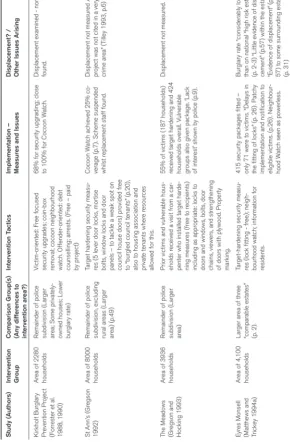
Key details of the features of the 31 included studies are given in Table 3. This provides the name by which the study is known here (often this is its location), the authors’ names and the dates of the relevant publications or reports. The size of the intervention group is also given. For residential burglary projects this is typically the number of households in the area in which the programme took place. The nature of the comparison or control group and any dif-ferences between it and the intervention group are detailed along with information on the prevention measures, their implementation, and details of any evidence relating to whether crime was displaced or whether there was a diffusion of prevention benefits beyond the intervention group. Rather than include an extended narrative re-view here, the reader wishing to obtain detailed information is invit-ed to scrutinize Table 3.
1 The Killingbeck domestic violence project (Hanmer et al. 1999) was excluded from
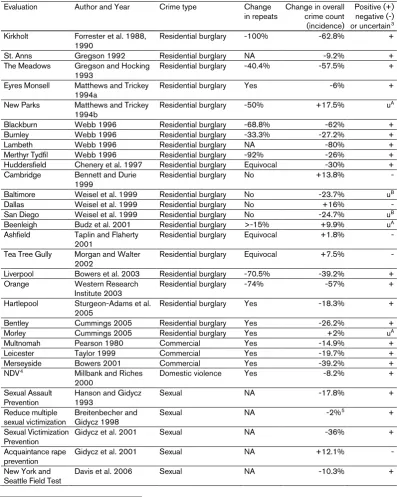
A summary of key indicators is shown in Table 4. Studies are listed chronologically by crime type. Residential burglary is first because it accounts for 22 of the 31 studies that have been evaluated, then domestic violence, commercial burglary, and sexual victimization. Study identifiers (often the location name), the date of the publica-tion of the evaluapublica-tion, and the crime type to be prevented, are shown in the first three columns. The two main outcome indicators are the change in repeats and the change in the overall level of crime. There have been evaluations conducted where preventing repeats was part of a broader crime prevention effort but these are not in-cluded if the repeat victimization component could not be distin-guished.2
Whether a reduction in repeat victimization was found among those receiving the crime prevention effort (the intervention group) is shown in the fourth column of Table 4. By this indicator, repeats fell in 17 out of 21 studies (81%). In the other 10 studies the extent of change in repeats was unknown or equivocal. On average, repeat victimization was reduced by more than half (mean = 60%, median = 69%) across the 9 studies where it was measured. However there was wide variation, from one project where repeats were eliminated to one where the best estimate was that repeats fell over 15%. Read-ers who are interested in evaluation methods should note that the change in repeat victimization was typically not measured in com-parison groups.
2 In addition, Wellsmith and Birks (2008) is the only study, to our knowledge, evaluating
Table 4. Summary of Outcomes for Repeat Victimization Prevention Studies.
Evaluation Author and Year Crime type Change
in repeats Change in overall crime count (incidence)
Positive (+) negative (-) or uncertain3
Kirkholt Forrester et al. 1988,
1990 Residential burglary -100% -62.8% +
St. Anns Gregson 1992 Residential burglary NA -9.2% + The Meadows Gregson and Hocking
1993
Residential burglary -40.4% -57.5% +
Eyres Monsell Matthews and Trickey
1994a Residential burglary Yes -6% +
New Parks Matthews and Trickey 1994b
Residential burglary -50% +17.5% uA
Blackburn Webb 1996 Residential burglary -68.8% -62% + Burnley Webb 1996 Residential burglary -33.3% -27.2% +
Lambeth Webb 1996 Residential burglary NA -80% +
Merthyr Tydfil Webb 1996 Residential burglary -92% -26% + Huddersfield Chenery et al. 1997 Residential burglary Equivocal -30% + Cambridge Bennett and Durie
1999
Residential burglary No +13.8% -
Baltimore Weisel et al. 1999 Residential burglary No -23.7% uB
Dallas Weisel et al. 1999 Residential burglary No +16% - San Diego Weisel et al. 1999 Residential burglary No -24.7% uB
Beenleigh Budz et al. 2001 Residential burglary >-15% +9.9% uA
Ashfield Taplin and Flaherty
2001 Residential burglary Equivocal +1.8% - Tea Tree Gully Morgan and Walter
2002 Residential burglary Equivocal +7.5% - Liverpool Bowers et al. 2003 Residential burglary -70.5% -39.2% + Orange Western Research
Institute 2003 Residential burglary -74% -57% + Hartlepool Sturgeon-Adams et al.
2005 Residential burglary Yes -18.3% +
Bentley Cummings 2005 Residential burglary Yes -26.2% + Morley Cummings 2005 Residential burglary Yes +2% uA
Multnomah Pearson 1980 Commercial Yes -14.9% +
Leicester Taylor 1999 Commercial Yes -19.7% +
Merseyside Bowers 2001 Commercial Yes -39.2% +
NDV4 Millbank and Riches
2000 Domestic violence Yes -8.2% +
Sexual Assault
Prevention Hanson and Gidycz 1993 Sexual NA -17.8% + Reduce multiple
sexual victimization Breitenbecher and Gidycz 1998 Sexual NA -2%
5 +
Sexual Victimization
Prevention Gidycz et al. 2001 Sexual NA -36% +
Acquaintance rape prevention
Gidycz et al. 2001 Sexual NA +12.1% -
New York and
Seattle Field Test Davis et al. 2006 Sexual NA -10.3% +
3 u = Uncertain where the superscript A denotes three sites where repeats fell but incidence increased, and superscript B
denotes two sites where repeats did not decrease but incidence did. See text for further details.
4 Outcomes measured as domestic violence calls to the police.
For each study, overall crime – not just repeats - in the intervention group was compared to a similar group. The aim of such a compari-son is to try to rule out the possibility that any change in crime was due to factors other than the intervention. This process of counter-factual inference is possible when both groups have all factors in common other than the intervention. For example, a regional fall in crime would be experienced in both an intervention and comparison area which means it could be distinguished from the effect of a suc-cessful intervention because the remainder of the fall in crime in the intervention area can be attributed to the intervention.
The fifth column of Table 4 shows the percentage change in crime in the intervention group relative to the comparison group. Crimes decreased in 23 out of 31 evaluations. In the 26 studies of crime incidence, crimes reduced on average across the studies by one fifth (mean and median = 21.7%).6 The sixth column shows whether the
project had a positive outcome of reduced crime, denoted by ‘+’, or a negative outcome of increased crime, denoted by ‘–‘. Five studies are categorized as uncertain or ‘u’ due to apparently conflicting indi-cators. With those five excluded, 21 out of 26 evaluations (81%) yielded positive outcomes.
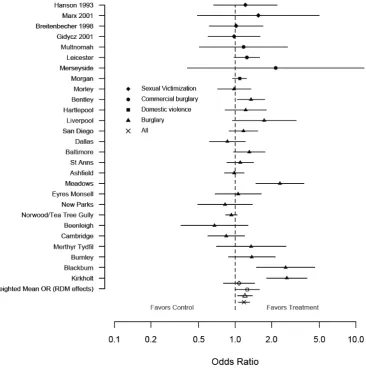
Figure 1. Outcomes of Repeat Victimization Programs Based upon Crime Incidence
[image:31.595.124.491.183.552.2]The aggregate indicator which is generated from all possible studies is the weighted mean OR of 1.18 (95% Confidence Interval: 1.07– 1.32), shown at the base of the chart along with the effect sizes for the three crime type groups which included more than one study. This value of the OR indicates that crimes in the control area in-creased by 18% relative to the intervention area, or conversely that crimes in the intervention area decreased by 15% (based on 1/1.18) relative to the control area. The weighted mean ORs for all of the evaluations and by crime type are detailed in Table 5 with their con-fidence intervals and Q statistics.7
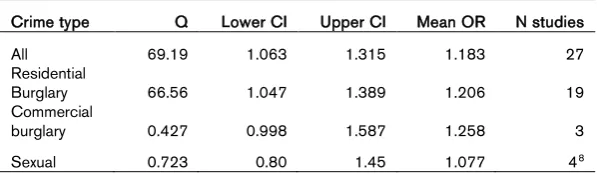
The effectiveness of programmes varied by crime type. Table 5 summarizes the weighted mean effect size for the four crime types included. This suggests that efforts designed to prevent repeat resi-dential burglary were effective. On average, crimes increased by 20.6% in the control condition compared to the intervention condi-tion, or conversely crimes decreased by 17.1% (using 1/1.206) in the intervention condition compared to the control condition. With a lower confidence interval for the OR which is very close to 1 but on the wrong side, it cannot be said that efforts designed to prevent repeat commercial burglary were statistically significant. However, the weighted mean effect size suggests that they were effective. On average, crimes increased by 25.8% in the control condition com-pared to the intervention condition, or conversely crimes decreased by 20.5% (using 1/1.258) in the intervention condition compared to the control condition. Programmes designed to prevent repeat sexual victimization have not been effective, as indicated by the fact that the lower confidence interval had a value of less than 1 and the weighted mean OR was only 1.077.
7 The Weighted Mean Effect Size (WMES) or Weighted Mean Odds Ratio (OR) gives
Table 5. Outcomes by Crime Type with Confidence Intervals
Crime type Q Lower CI Upper CI Mean OR N studies
All 69.19 1.063 1.315 1.183 27
Residential
Burglary 66.56 1.047 1.389 1.206 19 Commercial
burglary 0.427 0.998 1.587 1.258 3
Sexual 0.723 0.80 1.45 1.077 48
Note: Q = heterogeneity; CI = Confidence Interval; OR = Odds Ratio
The overall conclusion is that the evidence provides strong support for the fact that repeat victimization has been prevented, and this can be said with greatest certainty in relation to burglary, which decreased by 17%–20%. However, it is clear that there is quite some variation in impact across time and place. With respect to that issue, it has been noted that:
“If, for a particular intervention, some studies produced large effects, and some small effects, it would be of limited value simply to combine them together and say that the average ef-fect was ‘medium’. Much more useful would be to examine the original studies for any differences between those with large and small effects and to try to understand what factors might account for the difference. The best meta-analysis, therefore, involves seeking relationships between effect sizes and characteristics of the intervention, the context and study design in which they were found.” (Coe, 2002: 9)
Consequently, the next section examines why some efforts succeed more than others.
8 Two of these studies had multiple outcome measures, based on the severity of sexual
4. Further Analysis
Each of the studies examined within this report had some features unique to the particular project, crime type, and context. Overall, the three common determinants of success in efforts to prevent re-peat victimization were:
1. Successful conception and development of a functioning project,
2. Identification of context-specific and effective preventive tactics, and
3. Thorough implementation of those tactics.
The first of these features relates to the process of identifying an active ingredient and mechanism to reduce opportunities for repeat victimization. This process may involve ‘borrowing’ ideas from oth-er projects, or be more innovative in nature. This stage also involves the identification of the appropriate means for delivery, whether this makes use of police, Victim Support, volunteers, or specifically ployed project staff. Sexual victimization prevention schemes em-phasized the education of repeat victims, with the provision of gen-eral advice about how to avoid or manage risky situations. The spe-cific nature of this advice was not necessarily clear in all of the eval-uation reports. However, a key problem with education seems to be that it may change attitudes without necessarily changing behaviour or situations, or if behaviour and situations are changed this was not necessarily in a way that prevented crime. The measures typically used in relation to burglary, in contrast, tended to be of the ‘situa-tional’ crime prevention variety which more directly impacted upon behaviour by restricting choices and options.
appro-priate to the type of burglary problem or whether other tactics were also needed. For example, prevention measures that are appropriate to prevent burglary of inner-city apartments are not necessarily the same as those that are most effective for suburban burglary. There-fore, the types of measures needed varies by time and place and if they were not locally appropriate then effectiveness would be re-duced.
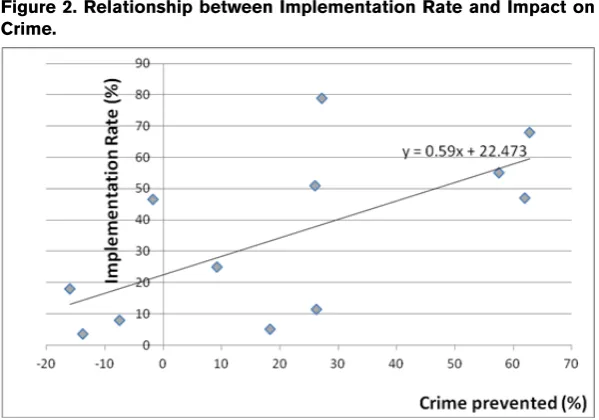
A further key issue is that it is often difficult to implement preven-tion measures for various reasons. To explore this further we sought to empirically gauge the extent of implementation. Figure 2 shows the relationship between the implementation rate and the impact on crime for the 12 studies where both measures were available. The implementation rate is defined as the percentage of eligible units (e.g. households previously burgled) who received the preventive intervention. The impact on crime is the percentage change in crime relative to the comparison group (from column 5 in Table 4). Where the intervention was provided to victims as ‘advice’, the implementa-tion rate was measured as the percentage of those eligible who fol-lowed the advice by implementing the prevention tactics.9
9 The chart excludes the five studies of sexual victimization as implementation
Figure 2. Relationship between Implementation Rate and Impact on Crime.
Figure 2 can be interpreted as preliminary empirical evidence that the crime prevention impact increases as the implementation rate increases. This would be in keeping with expectation based on theo-ry. If the data were of better quality, or implementation easier to gauge, then perhaps the relationship would be stronger. The linear best fitting line does not fit the data very well (R2=0.413). However,
it suggests that a project must implement measures at a minimum of one fifth of targets (22.5%) before any impact is achieved, that every 0.6% additional increase in the implementation rate produces a further 1% reduction in crime, and that crime is eliminated when the implementation rate exceeds 81.5%. Clearly this best fitting line cannot be interpreted so literally, as there are many uncontrolled variables and a key mediating variable would be the appropriateness of the prevention measures introduced, but it may be indicative of the general nature of the relationship between implementation and impact.
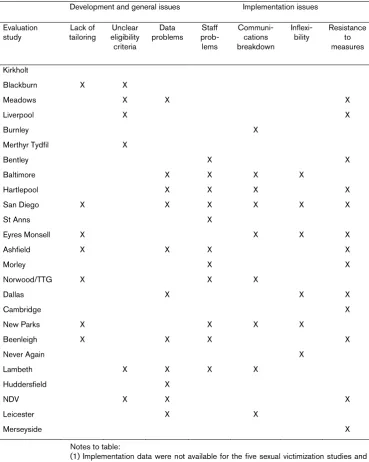
Table 6 lists the generic types of difficulties experienced that were reported in the studies included in this review.10 Two of these
prob-lems relate to the successful conception and identification of appro-priate responses. Problems with the identification of context-specific prevention measures are categorized in Table 6 as lack of tailoring. Some burglary prevention projects were required to provide security to other sections of the population who were considered by local agencies to be vulnerable, such as elderly people and single mothers. This meant that the prevention effort lacked focus and that it was
10 We recognise the need for further work and inter-rater reliability tests to confirm this
not only the prevention of repeat victimization which was being evaluated. For present purposes this is categorized as unclear
eligibil-ity criteria.
Four types of implementation problem appeared to arise and are shown in Table 6. Staff problems relate to the staff employed to implement the project. It was often difficult to recruit staff, to train staff, to retain staff, and to ensure that staff were undertaking work in the desired manner. Communications breakdowns could be det-rimental and were quite common in multi-agency projects where different agencies and parties were involved with different goals and different means of achieving them. Projects with inflexibility did not tend to learn from their mistakes and failed to accommodate chang-ing demands within the project. In some projects, there was
re-sistance to tactics that were to be implemented, either from potential
recipients who did not want them or from those who were required to implement them.
Data problems were a more general issue. Particularly with respect
Table 6. Main Types of Problems during Project Development and Implementation.
Development and general issues Implementation issues
Evaluation
study tailoring Lack of eligibility Unclear criteria
Data
problems prob- Staff lems
Communi- cations breakdown
Inflexi-bility Resistance to measures
Kirkholt
Blackburn X X
Meadows X X X
Liverpool X X
Burnley X
Merthyr Tydfil X
Bentley X X
Baltimore X X X X
Hartlepool X X X X
San Diego X X X X X X
St Anns X
Eyres Monsell X X X X
Ashfield X X X X
Morley X X
Norwood/TTG X X X
Dallas X X X
Cambridge X
New Parks X X X X
Beenleigh X X X X
Never Again X
Lambeth X X X X
Huddersfield X
NDV X X X
Leicester X X
Merseyside X
Notes to table:
(1) Implementation data were not available for the five sexual victimization studies and for one commercial burglary study (Multnomah).
(2) ‘X’ indicates that this type of problem was identified in the study’s report.
the results at face value, those officers who declined to carry out the survey thereby facilitated the revictimization of many of those they were charged to help.” (Thompson et al. 2008: 132).
5. Conclusions
Many of the evaluated efforts succeeded in preventing repeat victim-ization. Over all the evaluations, crimes increased by 18.3% in the control condition compared to the prevention condition, or con-versely crimes decreased by 15.5% in the prevention condition com-pared to the control condition. The most successful efforts used comprehensively implemented situational crime prevention measur-es. When few or no crimes were prevented, this appeared to be at-tributable to two main reasons. First, some prevention tactics were weak or inappropriate. In addition, well-meaning advice and educa-tion did not prevent crime, unless it resulted in the adopeduca-tion of a strong prevention measure. Second, a failure to implement preven-tive measures, or a low rate of implementation, not surprisingly, did not prevent crime.
While repeat victimization can be prevented, for the full potential of this crime prevention strategy to be achieved the evidence suggests that there needs to be significant additional investment in research and development, and far greater attention to implementation. Prob-lem-solving and action research approaches that develop strong prevention tactics based on careful analysis of the crime problem should be developed, and Sidebottom et al. (2012) suggest the po-tential of checklists to help pursue such goals. The evidence base will be improved greatly if such efforts include a broader range of crime types than have been addressed in work to date.
References
(* = included in the systematic review)
*Anderson, D., Chenery, S., and Pease, K. (1995). Biting Back:
Tackling Repeat Burglary and Car Crime. Crime Detection and
Prevention Series Paper 58. London: Home Office.
Ashton, J., Brown, I., Senior, B. and Pease, K. (1998). Repeat victim-isation: Offender accounts. International Journal of Risk Security
and Crime Prevention
,
3, 269–279.Barnett, A., Blumstein, A. and Farrington, D.P. (1987). Probabilistic models of youthful criminal careers. Criminology, 25, 83–107. *Bennett, T., and Durie, L. (1999). Preventing Residential Burglary
in Cambridge: From Crime Audits to Targeted Strategies. Police
Research Series Paper 108. London: Home Office.
Bernasco, W. (2008). Them again? Same-offender involvement in repeat and near repeat burglaries. European Journal of
Crimi-nology, 5, 411–431.
Blackwell, L. M., Lynn, S.J., Vanderhoff, H. and Gidycz, C. (2004). Sexual assault revictimization: Toward effective risk-reduction programs. In L.J. Koenig, L.S. Doll, A. O'Leary, and W.
Pequegnat (Eds.) From Child Sexual Abuse to Adult Sexual Risk:
Trauma, Revictimization, and Intervention. Washington,
D.C.:American Psychological Association.
*Bowers, K. (2001). Small business crime: The evaluation of a crime prevention initiative. Crime Prevention and Community Safety, 3, 23–42.
Bowers, K. J. and Johnson, S.D. (2004). Who commits near repeats? A test of the boost explanation. Western Criminology Review, 5, 12–24.
*Bowers, K., Johnson, S. and Hirschfield, A. (2003). Pushing Back
the Boundaries: New Techniques for Assessing the Impact of Burglary Schemes. London: Home Office.
Bowers, K., Sidebottom, A., and Ekblom, P. (2009). CRITIC: A prospective
planning tool for crime prevention evaluation designs. Crime Pre-vention and
Community Safety, 11, 48–70.
*Breitenbecher, K.H. and Gidycz, C. (1998). An empirical evalua-tion of a program designed to reduce the risk of multiple sexual victimization. Journal of Interpersonal Violence, 13, 472–488. *Budz, D., Pegnall, N., and Townsley, M. (2001). Lightning Strikes
Twice: Preventing Repeat Home Burglary. Brisbane, Queensland:
Casey, C., PaulRaj, B., Jacka, S. and Segessenmann, T. (2004).
Evaluation of the Target Hardening Programme. Wellington,
New Zealand: Ministry of Justice.
Chenery, S., Ellingworth, D., Tseloni, A., and Pease, K. (1996). Crimes which repeat: Undigested evidence from the British Crime Survey 1992. International Journal of Risk, Security and Crime
Prevention, 1, 207–216.
*Chenery, S., Holt, J., and Pease, K. (1997). Biting Back II:
Reduc-ing Repeat Victimization in Huddersfield. Crime Detection and
Prevention Series Paper 82. London: Home Office.
Clare, J., Kingsley, J. and Morgan, F. (2009). Assault Public Officer
Trends in Western Australia. Report to the Western Australian
Office of Crime Prevention. Perth: University of Western Austral-ia, Crime Research Centre.
Clarke, R.V., Perkins, E. and Smith, D. J. (2001). Explaining repeat residential burglaries: An analysis of property stolen. In G. Far-rell and K. Pease (Eds.), Repeat Victimization (Crime Prevention
Studies, vol. 12, pp. 119–132). Monsey, N.Y.: Criminal Justice
Press.
Coe, R. (2002). It’s the effect size, stupid: What effect size is and why it is important. Paper presented to the British Educational Research Association Annual Conference, Exeter (12–14 Sep-tember).
*Cummings, R. (2005). Operation Burglary Countdown:
Evalua-tion Study Final Report. Perth, Western Australia: Estill &
Asso-ciates.
Daigle, L. E., Fisher, B. S. and Cullen, F. T. (2008). The violent and sexual victimization of college women: Is repeat victimization a problem? Journal of Interpersonal Violence, 23, 1296–1313. Davis, R., Weisburd, D. and Taylor, B. (2008). Effects of Second
Responder Programs on Repeat Incidents of Family Abuse: A Systematic Review. Washington D.C.: Department of Justice
(Document 224991).
*Davis, R. C., Guthrie, P., Ross, T., and O'Sullivan, C. (2006).
Re-ducing Sexual Revictimization: A Field Test with an Urban Sam-ple. Washington, D.C.: National Institute of Justice.
Ellingworth, D., Farrell.G. and Pease, K. (1995). A victim is a victim is a victim? Chronic victimization in four sweeps of the British Crime Survey, British Journal of Criminology, 35, 360–365. Everson, S. (2003). Repeat victimization and prolific offending:
Chance or choice? International Journal of Police Science and
Management, 5,180–194.
Farrell, G. (2005). Progress and prospects in the prevention of repeat victimization. In N. Tilley (Ed.) Handbook of Crime Prevention
and Community Safety (pp. 145–172). Cullompton, Devon:
Farrell, G., Clark, K., Ellingworth, D. and Pease, K. (2005). Of Tar-gets and SupertarTar-gets: A Routine Activities Theory of High Crime Rates. Internet Journal of Criminology
(www.internetjournalofcriminology.com ).
Farrell. G. and Pease, K. (2003). Measuring and interpreting repeat victimization using police data: An analysis of burglary data and policy for Charlotte, North Carolina. in M. Smith and D. Cor-nish (Eds.) Theory for Practice in Situational Crime Prevention (Crime Prevention Studies, Vol. 16, pp. 265–289). Monsey, N.Y.: Criminal Justice Press.
Farrell, G. and Pease, K. (2006). Preventing repeat residential bur-glary. In B. C. Welsh and D. P. Farrington (Eds.) Preventing
Crime: What Works for Children, Offenders, Victims, and Places
(pp. 161–176). Dordrecht, Netherlands: Springer.
Farrington, D. P., Gill, M., Waples, S.J. and Argomaniz, J. (2007). The effects of Closed-Circuit Television on crime: Meta-analysis of an English national quasi-experimental multi-site evaluation.
Journal of Experimental Criminology, 3, 21–38.
*Forrester, D., Chatterton, M. and Pease, K. (1988). The Kirkholt
Burglary Prevention Project, Rochdale. Crime Prevention Unit
Paper 13. London: Home Office.
*Forrester, D., Frenz, S., O’Connell, M., and Pease, K. (1990). The
Kirkholt Burglary Prevention Project: Phase II. Crime Prevention
Unit Paper 23. London: Her Majesty's Stationery Office. *Gidycz, C., Layman, M.J., Rich, C.L., Crothers, M., Gylys, J.,
Ma-torin, A., and Jacobs, C.D. (2001). An evaluation of an acquaint-ance rape prevention program: Impact on attitudes, sexual ag-gression, and sexual victimization. Journal of Interpersonal
Vio-lence, 16, 1120–1138.
Gidycz, C., Rich, C.L., Orchowski, L., King, C. and Miller, A.K. (2006). The evaluation of a sexual assault self-defense and risk reduction program for college women: A prospective study.
Psy-chology of Women Quarterly, 30, 173–186.
Gidycz, C. A., Lynn, S.J., Rich, C.L., Marioni, N.L. Loh, C., Black-well, L.M., Stafford, J., Fite, R. and Pashdag, J. (2001). The evaluation of a sexual assault risk reduction program: A multisite investigation’, Journal of Consulting and Clinical Psychology, 69, 1073–1078.
Gottfredson, D.C., Wilson, D.B. and Najaka, S.S. (2002). School- based crime
Prevention. In L.W. Sherman, D.P. Farrington, B.C. Welsh, and D.L. Mackenzie
*Gregson, M. (1992). The St Ann's Burglary Reduction Project. Nottingham: Nottingham Trent University, Crime Reduction Re-search Unit.
*Gregson, M. and Hocking, A. (1993). The Meadows Household
Security Project. Nottingham: Nottingham Trent University,
Crime Reduction Research Unit.
Grove, L. E. (2010). Synergies of Syntheses: A Comparison of
Sys-tematic Review and Scientific Realist Evaluation Methods for Crime Prevention. Unpublished doctoral dissertation. Midlands
Centre for Criminology and Criminal Justice, Loughborough University.
Grove, L. (2011). Preventing repeat domestic burglary: A meta-evaluation of
studies from Australia, the UK, and the United States. Victims and Offenders, 6, 370–385.
Grove, L. E. and Farrell, G. (2011). Repeat victimization. Oxford Bibliographies Online (Criminology), edited by Richard Rosen-feld. (www.oxfordbibliographiesonline.com)
*Hanson, K. and Gidycz, C. (1993). An evaluation of a sexual as-sault prevention program. Journal of Consulting and Clinical
Psychology, 61, 1046–1052.
Hanmer, J., Griffiths, S. and Jerwood, D. (1999). Arresting
Evi-dence: Domestic Violence and Repeat Victimization. Police
Re-search Series, Paper 104. London: Home Office.
*Henderson, M. (2002). Preventing Repeat Residential Burglary: A
Meta-Evaluation of Two Australian Demonstration Projects.
Barton, ACT: Commonwealth Attorney-General’s Office. Hindelang, M. J., Gottfredson, M.R. and Garafalo, J. (1978).
Vic-tims of Personal Crime: An Empirical Foundation for a Theory of Personal Victimization. Cambridge, MA: Ballinger.
Johnson, S. D., Bowers, K. and Hirschfield, A. (1997). New insights into the spatial and temporal distribution of repeat victimization.
British Journal of Criminology, 37,224–241.
Kleemans, E. R. (2001). Repeat burglary victimization: Results of empirical research in the Netherlands. In G. Farrell and K. Pease (Eds.) Repeat Victimization (Crime Prevention Studies, Vol. 12, pp. 53–68). Monsey, N.Y.: Criminal Justice Press.
Laycock, G. (2001). Hypothesis-based research: The repeat victimi-zation story. Criminology and Criminal Justice, 1, 59–82. Levy, M. P. and Tartaro, C. (2010). Repeat victimization: A study of
auto theft in Atlantic City using the WALLS variables to measure environmental indicators. Criminal Justice Policy Review, 21, 296–318.
Lloyd, S., Farrell, G. and Pease, K. (1994). Preventing Repeated
Domestic Violence: A Demonstration Project on Merseyside.
Lindstrom, P. (1997). Patterns of school crime: A replication and empirical extension. British Journal of Criminology, 37, 121– 130.
Lipsey, M.W. and Wilson, D.B. (2001). Practical Meta-Analysis. London: Sage.
*Marx, B.P., Calhoun, K.S., Wilson, A.E. and Meyerson, L.A. (2001). Sexual revictimization prevention: An outcome evalua-tion. Journal of Consulting and Clinical Psychology, 69, 25–32. Matthews, R., Pease, C. and Pease, K. (2001). Repeated bank
rob-bery: Theme and variations. In G. Farrell and K. Pease (Eds.)
Re-peat Victimization (Crime Prevention Studies, Vol. 12, pp. 153–
164). Monsey, N.Y.: Criminal Justice Press.
*Matthews, R. and Trickey, J. (1994a). The Eyres Monsell Crime
Reduction Project. Leicester, U.K.: Centre for the Study of Public
Order, University of Leicester.
*Matthews, R. and Trickey, J. (1994b). The New Parks Crime
Re-duction Project. Leicester, U.K.: Centre for the Study of Public
Order, University of Leicester.
Millbank, S. and Riches, M. (2000). Reducing repeat victimisation of domestic violence: The NDV project. Paper presented at con-ference on Reducing Criminality: Partnerships and Best Practice, Perth, Western Australia (31 July–1 August).
Moitra, S. D., and Konda, S.L. (2004). An empirical investigation of network attacks on computer systems. Computers and Security, 23, 43–51.
*Morgan, F. (2004). The NDV Project Final Evaluation. Perth: Crime Research Centre, University of Western Australia.
Morgan, F. and Walter, C. (2001). The South Australian Residential
Break and Enter Pilot Project Evaluation Report. Adelaide:
South Australian Attorney-General’s Department, Crime Preven-tion Unit.
*Pearson, D. A. (1980). Evaluation of Multnomah County’s
Com-mercial Burglary Prevention Program. Salem, OR: Oregon Law
Enforcement Council, Evaluation and Research Unit.
Pease, K. (1991). The Kirkholt project: Preventing burglary on a British public housing estate. Security Journal, 2, 73–77.
Pease, K. (1998). Repeat Victimisation: Taking Stock. Crime Preven-tion and DetecPreven-tion Series Paper 90. London: Home Office. Polvi, N., Looman, T., Humphries, C., and Pease, K. (1990). Repeat
break-and-enter victimization: Time-course and crime prevention opportunity, Journal of Police Science and Administration, 7, 8– 11.
Polvi, N., Looman, T., Humphries, C., and Pease, K. (1991). The time-course of repeat burglary victimization. British Journal of
Robinson, A. L. (2006). Reducing repeat victimisation among high-risk victims of domestic violence: The benefits of a coordinated community response in Cardiff, Wales. Violence Against Women, 12, 761–788.
Robinson, M. B. (1998). Burglary revictimization: The time period of heightened risk. British Journal of Criminology, 38, 78–87. Rogerson, M. (2008). Counting crimes: The important of
under-standing crime concentration for the design and evaluation of crime reduction strategies, International Journal of Police Science
and Management, 10, 434–447.
Sampson, A. and Phillips, C. (1992). Multiple Victimisation: Racial
Attacks on an East London Estate. Crime Prevention Unit Series
Paper 36. London: Home Office.
Short, M.B., D’Orsogna, M.R., Brantingham, P.J. and Tita, G.E. (2009). Measuring and modelling repeat and near repeat burgla-ry effects, Journal of Quantitative Criminology, 25, 325–339. Sidebottom, A., Tilley, N. and Eck, J. (2012). Towards checklists to
reduce common sources of problem-solving failure. Policing: A
Journal of Policy and Practice, advanced access version
doi:10.1093/police/par054
*Sturgeon-Adams, L., Adamson, S., and Davidson, N. (2005).
Har-tlepool: A Case Study in Burglary Reduction. Hull: Centre for
Criminology and Criminal Justice, University of Hull.
*Taplin, S., and Flaherty, B. (2001). Safer Towns and Cities
House-breaking Reduction Report. Sydney, New South Wales:
Attor-ney-General’s Department.
Taylor, G. (1999). Using repeat victimisation to counter commercial burglary: The Leicester experience. Security Journal, 12, 41–52. Thompson, S., Townsley, M. and Pease, K. (2008). Repeat burglary
victimisation: Analysis of a partial failure. Irish Journal of
Psy-chology, 29, 129–137.
Tilley, N. (1993a). After Kirkholt - Theory, Method and Results of
Replication Evaluations. Crime Prevention Unit Series Paper 47.
London: Home Office.
Tilley, N. (1993b). The Prevention of Crime Against Small
Business-es: The Safer Cities Experience. Crime Prevention Unit Series
Pa-per 45. London: Home Office.
*Tilley, N. and Hopkins, M. (1998). Business as Usual: An
Evalua-tion of the Small Business and Crime Initiative. Police Research
Series Paper 95. London: Home Office.
Tilley, N., and Webb, J. (1994). Burglary Reduction: Findings from
Safer Cities Schemes. Crime Prevention Unit Series Paper 51.
London: Home Office.
Townsley, M., Homel, R., and Chaseling, J. (2003). Infectious bur-glaries: A test of the near repeat hypothesis. British Journal of
Tseloni, A. M. and Pease, K. (2003). Repeat personal victimization: "Flags" or
"boosts"? British Journal of Criminology, 43, 196–212.
*Webb, J. (1996). Direct Line Homesafe. Lincolnshire, U.K.: Janice Webb Research.
*Weisel, D. L., Clarke, R.V. and Stedman, J.R. (1999). Hot Dots in
Hot Spots: Examining Repeat Victimization for Residential Bur-glary in Three Cities. Washington D.C.: Police Executive
Re-search Forum.
Wellsmith, M. and Birks, D.J. (2008). Research on target: A collab-oration between researchers and practitioners for a target hard-ening scheme. International Review of Law, Computers and
Technology, 22, 181–189.
Welsh, B. C. and Farrington, D.P. (2009). Public area CCTV and crime prevention: An updated systematic review and meta-analysis. Justice Quarterly, 26, 716–745.
*Western Research Institute (2003). Evaluation of Operation Never
Again. Paper prepared for Orange City Council, New South
Other reports in this series
Closed-Circuit Television Surveillance and Crime Prevention
Brandon C. Welsh, David P. Farrington
A systematic review of the effects of closed circuit television sur-veillance based on 41 evaluations from five countries.
ISBN: 978-91-85664-79-5
Improved Street Lighting and Crime Prevention
David P. Farrington, Brandon C. Welsh
A systematic review of the effects on crime of improved street lighting based on 13 evaluations from the United States and United Kingdom.
ISBN: 978-91-85664-78-8
Effectiveness of Neighbourhood Watch In Reducing Crime
Trevor H. Bennett, Katy R. Holloway, David P. Farrington
A systematic review of the effects of neighbourhood watch based on 36 evaluations.
ISBN: 978-91-85664-91-7
The Influence of Mentoring on Reoffending
Darrick Jolliffe, David P. Farrington
A rapid evidence assessment of the effects of mentoring based on 18 evaluations.
ISBN: 978-91-85664-90-0
Effects of Early Family/Parent Training Programs on Antisocial Behavior and Delinquency
Alex R. Piquero, David P. Farrington, Brandon C. Welsh, Rich-ard E. Tremblay, Wesley G. Jennings
A systematic review of effects of early family/parent training based on 55 evaluations from different parts of the world. ISBN: 978-91-85664-95-5
Effectiveness of Programmes to Reduce School Bullying
Maria M. Ttofi, David P. Farrington, Anna C. Baldry
A systematic review of 59 scientific evaluations of anti-bullying programmes from different parts of the world.
Effectiveness of Treatment in Reducing Drug-Related Crime
Katy R. Holloway, Trevor H. Bennett, David P. Farrington
A systematic review of the effects of drug treatment programmes on crime based on 75 evaluations.
ISBN: 978-91-86027-10-0
Effectiveness of Programs Designed to Improve Self-Control
Alex R. Piquero, Wesley G. Jennings, David P. Farrington
A systematic review of the effects of programs designed to im-prove self-control.
ISBN: 978-91-86027-38-4
Effectiveness of Interventions with Adult Male Violent Offenders
Darrick Jolliffe, David P. Farrington
A systematic review, including statistical meta-analysis, of the effects of programmes for preventing future offending of adult male violent offenders.
ISBN: 978-91-86027-39-1
Effectiveness of Public Area Surveillance for Crime Prevention: Security Guards, Place Managers, and Defensible Space
Brandon C. Welsh, David P. Farrington, Sean J. O’Dell
A systematic review of the effects on crime of three major forms of public area surveillance: Security guards, place managers and defensible space.
ISBN: 978-91-86027-49-0
Treatment Effectiveness in Secure Corrections of Serious (Violent or Chronic) Juvenile Offenders
Luz A. Morales, Vicente Garrido, Julio Sanchez-Meca
A systematic review and meta-analysis of 31 evaluations of the effectiveness of treatment programmes in secure corrections to prevent the recidivism of serious juvenile offenders.
ISBN: 978-91-86027-56-8
School Bullying, Depression and Offending Behaviour Later in Life
David P. Farrington, Friedrich Lösel, Maria M. Ttofi, and Nikos Theodorakis
A systematic review and meta-analysis of 48 reports on offending and 75 reports on depression, to investigate the extent to which offending and depression are consequences of bullying perpetra-tion and victimizaperpetra-tion.
Preventing Repeat Victimization: A Systematic Review
This report presents a systematic review, including a statistical meta-analysis, of the effects of initiatives to prevent repeat vitimization.